Perc test results: what the numbers mean and what happens next
By the SepticMind Editorial Team
TL;DR
- A perc test measures how fast soil absorbs water, reported in minutes per inch (MPI).
- Most states accept 1 to 60 MPI for a conventional septic system.
- Below 1 MPI the soil is too fast; above 60 MPI it's too slow.
- Your result sets drain field size and may force an alternative system or, in rare cases, rule out on-site sewage entirely.
What is a perc test and what does it actually measure?
A percolation test, almost universally called a perc test, measures how fast water drains through soil at the depth where a drain field will sit. The number you get is minutes per inch (MPI): how long it takes the water level in a test hole to drop one inch. That single number drives everything downstream. Drain field size, system type, sometimes whether you can build at all.
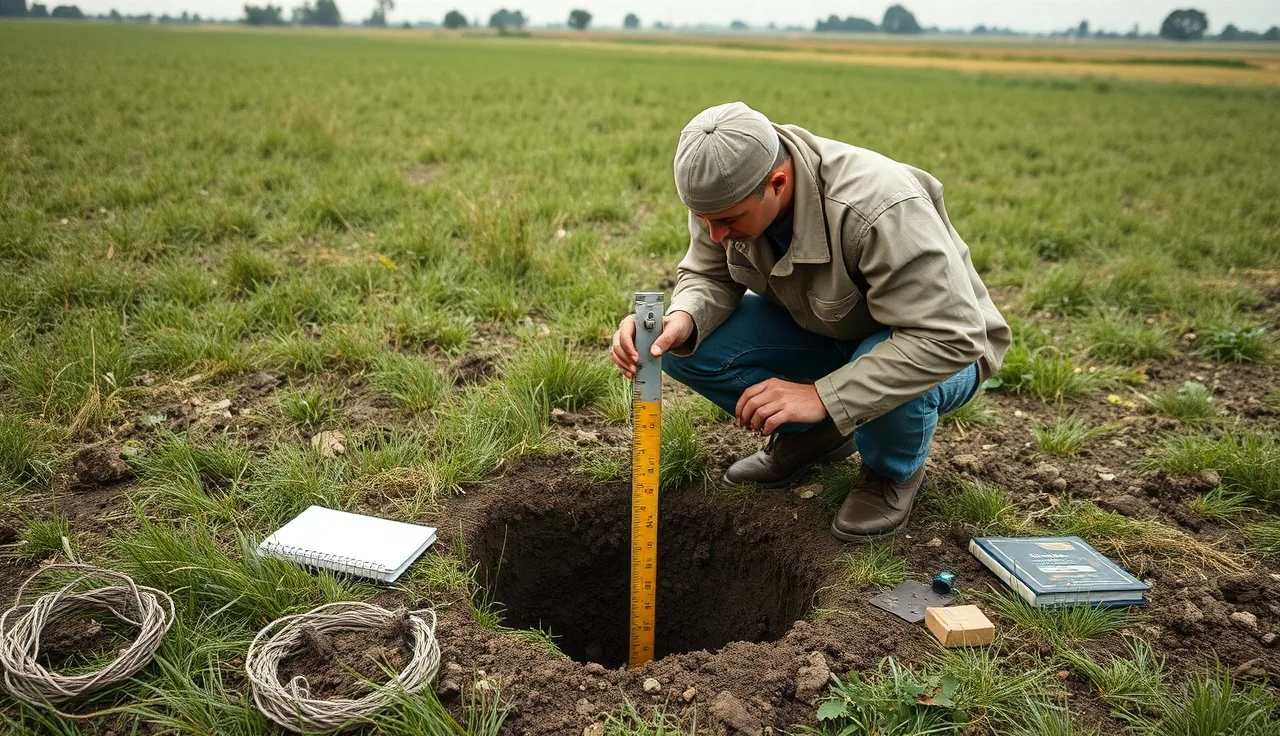
The test itself is simple. A licensed soil evaluator or engineer digs several holes (usually 6 to 12 inches in diameter, sometimes more) to the proposed drain field depth, typically 18 to 36 inches. The holes get pre-soaked for 4 to 24 hours the day before to saturate the soil, because dry soil drinks water at an unrealistic speed. On test day the evaluator fills each hole to a set depth, then measures how far the water drops over timed intervals, usually 30 minutes. The slowest reliable reading across multiple holes becomes the design MPI. [1]
That pre-soak step matters more than people think. Skip it or rush it and you get a falsely optimistic number, which produces an undersized drain field and a system that fails in five years. Good evaluators are fussy about saturation time, especially in clay soils that swell slowly.
What perc test results are considered passing or failing?
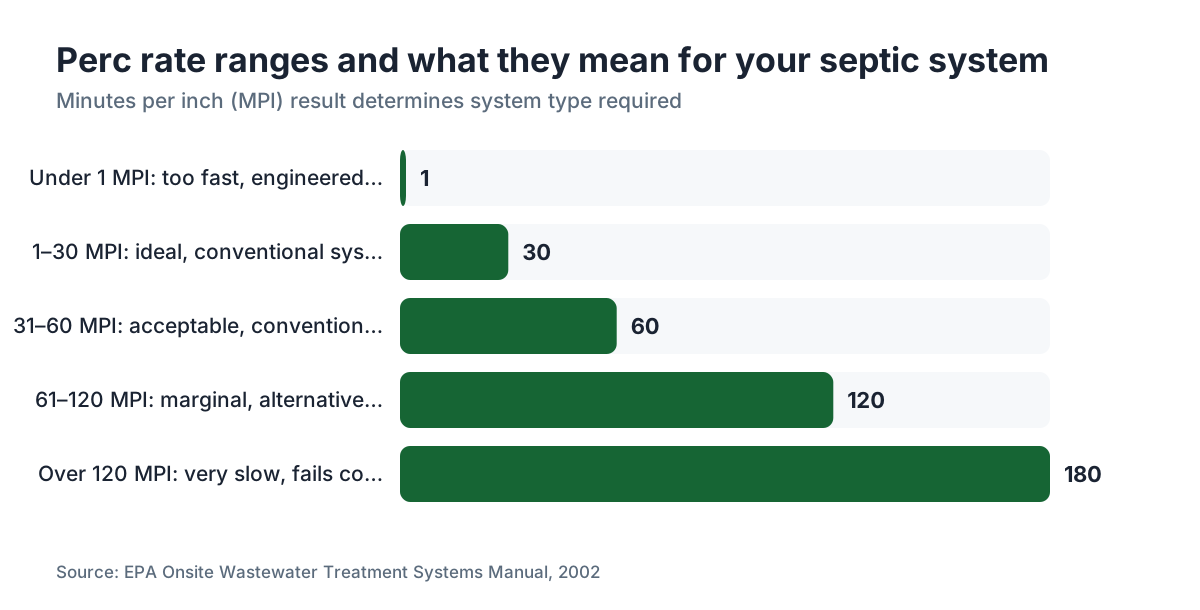
The standard acceptable range for a conventional septic drain field is 1 to 60 minutes per inch. That range comes from decades of engineering practice and is written into most state onsite wastewater codes, many of which trace back to the federal framework EPA published. [2]
Here is what each zone of results actually means:
| Result (MPI) | What it means | Typical outcome |
|---|---|---|
| Less than 1 MPI | Soil drains too fast (gravelly, coarse) | May pass with engineered fill or specific system; some states allow if bedrock/water table not an issue |
| 1 to 30 MPI | Fast to moderate absorption | Pass; drain field is sized on the smaller end |
| 31 to 60 MPI | Slow but acceptable absorption | Pass; drain field is larger |
| 61 to 120 MPI | Marginal; varies by state | Many states require alternative system (mound, drip, etc.) |
| Over 120 MPI | Very slow; often dense clay | Usually fails conventional; alternative systems may still work |
| Water does not drop | Practically impermeable | Failed; site may need engineered alternative or be declared unsuitable |
Some states draw the line at 30 MPI for conventional systems and require alternatives from 30 to 60 MPI. Others permit up to 90 MPI with design tweaks. You have to check your specific state code, because there is no single national standard. EPA sets the conceptual framework and states write the actual rules. [3]
One real-world wrinkle: the spread between holes on the same lot can be big. A front-yard hole might read 15 MPI while a back-yard hole reads 75 MPI. The evaluator averages or takes the conservative number depending on state protocol. If the spread is huge, a good evaluator flags it and may recommend more testing.
How does the MPI number determine drain field size?
Drain field sizing takes your perc rate and your household's daily wastewater flow and calculates the required square footage of infiltrative surface. The formula is called the application rate or loading rate, and it runs opposite to intuition: slower soil (higher MPI) needs more square footage, because less water moves through each square foot per day. [1]
EPA's original design manual for onsite systems gives a worked example. At 5 MPI you might apply roughly 1.2 gallons per square foot per day; at 60 MPI that drops to about 0.2 gallons per square foot per day. A 3-bedroom house generating 300 gallons per day therefore needs roughly 250 square feet of trench bottom at 5 MPI, but closer to 1,500 square feet at 60 MPI. Those numbers shift with state-specific tables, but the direction never does. [4]
That is why a slow perc result is expensive even when it technically passes. More square footage means more excavation, more gravel, more pipe, more labor, and often a bigger lot requirement. Some jurisdictions set a minimum lot size based on perc results, tying land use straight to soil performance.
For septic tank installation planning, get the perc result before you finalize a lot purchase or building footprint. The drain field area can easily double or triple depending on what the soil does.
What happens if your perc test fails?
A failed perc test does not mean you can never have a septic system. It means you cannot have a conventional gravity-fed drain field, which is the cheapest option. Several engineered alternatives exist for sites that fail a standard perc.
Mound systems sit above grade on imported fill, which lets the designer control the soil the effluent touches. They work on slowly permeable soils (often 60 to 120 MPI) and on sites with high water tables. The trade-off is cost. Mound systems typically run $10,000 to $20,000 more than a conventional system depending on your region. [5]
Drip irrigation systems push effluent through small-diameter tubing just under the surface at very low rates, spreading the load over a wide area. They need advanced treatment (usually an aerobic unit or textile filter) ahead of the drip field, which adds equipment and annual maintenance cost. They are common in Texas, parts of the Southeast, and areas with thin permeable soil over rock.
At-grade systems and low-pressure pipe systems can work on sites with moderate absorption problems. Some states allow constructed wetlands or peat biofilter units as a final treatment step.
The one outcome that truly kills a project is when the soil fails perc AND a site evaluation shows a seasonal high water table within 18 to 24 inches of the surface AND there is no room for a mound. In that case most health departments issue a letter of denial, and your only paths are hooking to a municipal sewer (if one exists) or leaving the lot undeveloped. That outcome is uncommon but real, and it is exactly why you order a perc test before you close on raw land.
If you end up with a failed system down the road rather than a failed test, the septic system repair and leach field pages cover what that path looks like.
Who conducts a perc test and who reviews the results?
In most states a perc test must be run by a licensed soil scientist, professional engineer, or certified soil evaluator. The exact credential varies. Virginia requires a licensed onsite soil evaluator (LOSE), North Carolina uses a registered soil scientist, and Texas uses a licensed professional engineer or registered sanitarian. [6] Your county health department or state environmental agency website lists who is authorized to run the test.
The evaluator submits a written report, usually on a state form, to the local health department. The department reviews it against the state onsite wastewater code, then issues a permit or a denial. In many rural counties this review happens within a few weeks. Some states under heavy development pressure have backlogs measured in months.
Homebuyers sometimes confuse a perc test with a septic tank inspection. They are completely different. A perc test evaluates raw land for the potential to support a new system. An inspection evaluates an existing system on a property that already has one. Buying an existing house with a septic system? You want an inspection, not a perc test.
How long does a perc test take and what does it cost?
The test itself usually runs one to two days: a pre-soak day followed by a measurement day. Scheduling, permit pull, and the health department review can stretch the full process to two to eight weeks depending on your county's workload.
Cost swings widely by region and evaluator. In most of the country a perc test with a soil evaluation and the required report runs $300 to $1,500. High-demand markets and technically hard sites (steep slopes, close water tables, rock) can push that past $2,500. Some evaluators bundle the perc test with a full site evaluation for septic design, which typically costs $1,000 to $3,000 and is worth it if you are serious about building. [5]
That cost sits far below the price of the system itself. A standard cost to install septic system runs $3,000 to $15,000 for a conventional setup, and alternative systems go much higher. Spending $500 on a perc test before buying a parcel is one of the clearest cases of cheap insurance in real estate.
Can you retest if your perc test fails?
Yes, usually. Most states allow a second or third test, sometimes requiring a different part of the lot or a waiting period. A few legitimate reasons a retest might improve the result:
The pre-soak was inadequate the first time. This is more common than people admit. If the evaluator rushed saturation, the soil absorbed water faster than it would in normal conditions, giving a misleadingly quick result. But more often the first test is slow because the soil is genuinely slow, and retesting the same spot gives the same answer.
Seasonal timing matters in some soils. Expansive clays swell during wet seasons and slow the perc rate, then contract and crack in dry seasons and speed it up. Some states allow testing only in certain seasonal windows for exactly this reason.
A new test location on the same lot sometimes hits a different soil profile: a layer of sand or gravel, a break in the clay. That is legitimate if the new spot sits genuinely within the proposed drain field area.
What does not work is retesting the same hole after a failed result and hoping for a better number. A reputable evaluator will not certify that result, and most state regulations require the certified number to reflect actual soil conditions, not the best of several runs.
If you believe the test was run wrong (wrong depth, inadequate pre-soak, faulty measurement), you can request a re-evaluation from a different licensed evaluator. Put your concerns in writing to the health department.
What do perc test results mean for buying or selling a property?
For undeveloped land, the perc test result is the line between a buildable lot and an expensive pile of fill. Sellers of raw land in most states are not required to disclose a previous failed perc test unless you directly ask, so ask. Request copies of any prior test reports from the seller, or pull them from the county health department, which keeps records.
For existing homes with septic systems, a perc test is generally not required at resale because the system already exists. What matters at resale is an inspection of the existing system. That said, if the system has failed and needs replacement, the county requires a new site evaluation to determine what replacement is permissible, which effectively means a new perc test for the replacement field area.
Lenders and title companies increasingly want documentation of system permits and inspection results. A property where the only workable septic option is a $40,000 engineered alternative loses value directly. If you are a buyer and the property has no prior perc results on file, make the purchase contingent on a satisfactory test.
Some real estate investors deliberately buy failed-perc lots at land prices, planning to engineer a mound or drip system and resell them as buildable. That is a real strategy, but it takes detailed knowledge of what the specific county and state will approve before you commit a dollar.
Are perc tests the only soil test for septic systems?
No. In many states the perc test has been partly or fully replaced by soil morphology evaluation, also called a soil profile or site evaluation. Here a soil scientist reads the soil layers directly: color, texture, structure, mottling (streaks of orange or gray that mark seasonal water saturation). An experienced soil scientist can judge drainage from a soil profile without running a timed water-drop test at all. [7]
The advantage is accuracy. A percolation test measures a single moment in time. Soil morphology reflects decades of drainage history, which makes it more reliable, especially for spotting seasonal high water tables that a perc test run in August might miss entirely. EPA's technical document on onsite wastewater systems states that morphological assessment "provides a more complete picture of soil hydraulic characteristics than a timed percolation test alone." [4]
Many states now require both: a soil profile evaluation for water table and restrictive-layer determination, plus a percolation test or in-situ saturated hydraulic conductivity test for the actual loading-rate calculation. North Carolina, Virginia, Florida, and most New England states use this combined approach. [9]
Some jurisdictions have moved to more precise hydraulic conductivity measurements using the Amoozegar method (also called the constant head permeameter), which gives a more technically defensible number than the traditional falling-head perc test. You are unlikely to pick the method yourself. The evaluator uses whatever your state's code requires.
How do perc results affect septic system maintenance going forward?
Once your system is installed, your perc test result still matters, just indirectly. A drain field on 45 MPI soil has far less margin for error than one on 15 MPI soil. Overload that system with heavy water use, garbage disposal waste, or non-biodegradable products, and the slow-draining soil has nowhere to put the extra effluent. Failures come faster and hit harder.
The practical takeaway: if your system was sized for slow-perc soil, water conservation is not optional. Fix leaky faucets. Spread laundry across the week instead of six loads on Saturday. Consider a septic-safe garbage disposal, or skip one entirely. EPA's SepticSmart guidance recommends spreading water use throughout the day and week to give the soil time to absorb between loading events. [8]
Pumping frequency matters more on marginal-perc sites too. A well-functioning tank on a slow-perc drain field depends on keeping solids out of the field. Skipping pumping on a slow-perc site is a fast track to a clogged field. For most 3-bedroom households, pumping every 3 to 5 years is the standard recommendation, but slow-perc systems and high-water-use homes should lean toward the shorter end. The how often to pump septic tank guide covers the factors in detail.
SepticMind's platform lets service operators track perc-rate data alongside pumping intervals across their customer base, which makes it easier to flag accounts where soil type and usage put a homeowner at higher risk of field failure before it turns into an emergency call.
For routine work like septic tank pumping and septic tank cleaning, keeping your original perc rate on file helps a technician understand why your system behaves the way it does.
What records should you keep after a perc test?
Keep everything in a home file and store digital copies. The records you want:
The original percolation test report, which should show hole locations, the pre-soak method, the measured drop intervals, and the calculated MPI result. This is a legal document that establishes what your lot can support.
The health department permit or approval letter. This is the official authorization and lists any conditions: minimum system size, required setbacks, alternative system requirements.
The soil profile description if a soil scientist ran a morphological evaluation alongside the perc test.
The as-built drawing of the system that actually went in. Most counties require the installer to file an as-built with the health department. Get a copy.
Buying an existing property and the previous owners cannot produce these documents? The county health department often has them on file. Request them in writing. Some counties have digitized records going back 20 to 30 years; others keep paper files that take a week to dig out.
All of this documentation matters if you ever repair or expand your system, refinance, sell, or answer a neighbor's complaint about system proximity to a property line. The cost to put in a septic tank climbs sharply if you have to re-permit because records were lost.
Frequently asked questions
What is a good perc test result?
A result between 1 and 30 minutes per inch is generally considered good. The soil absorbs water fast enough that a reasonably sized conventional drain field will work. Results in the 31 to 60 MPI range still pass in most states but require a larger field. Anything under 1 MPI or over 60 MPI starts to require alternative systems depending on your state's code.
How long is a perc test result valid?
Most states treat a perc test result as valid for 2 to 5 years from the date of the test, after which a new evaluation may be required before a permit is issued. Check your county health department for the exact window. If significant grading or land disturbance has happened on the lot since the original test, the department may require a fresh evaluation regardless of the date.
Can you build on land that failed a perc test?
Sometimes. A failed conventional perc test does not automatically mean no development. Engineered alternatives like mound systems, drip irrigation fields, or aerobic treatment units work on many failed sites. The key variables are depth to the water table, available lot area for an alternative system, and what your state's onsite wastewater code permits. True no-build situations require failed perc AND no viable alternative design AND no available municipal sewer.
What does a perc rate of 60 minutes per inch mean for my system?
60 MPI is at the upper edge of what most states allow for a conventional drain field. It means the soil absorbs water very slowly, roughly one inch per hour. In practical terms, your drain field needs to be significantly larger than average for your household size. Some states require an alternative system at 60 MPI. Confirm with your local health department, because the cutoff varies by jurisdiction.
Do perc tests need to be done by a licensed professional?
In virtually every state, yes. A perc test submitted for a permit must be run and certified by a licensed evaluator: a soil scientist, professional engineer, registered sanitarian, or another credential defined by your state. DIY tests have no legal standing for permitting. Hiring an unlicensed person saves money up front but produces a report the health department will reject.
Does rain or wet weather affect perc test results?
Yes, in two competing directions. Recent rain may pre-saturate the soil, producing slower results than you would see in dry conditions. Very dry conditions before the test can make soil absorb water faster than normal, producing optimistically quick results. This is why most protocols require a deliberate pre-soak period rather than relying on whatever the weather did. Some states restrict testing to certain seasons.
What is the difference between a perc test and a soil evaluation?
A perc test is a timed water-absorption test that produces a minutes-per-inch result. A soil evaluation (or soil profile assessment) is a visual and physical examination of soil layers to determine texture, structure, color, mottling, and depth to water table or restrictive layers. Many states require both. The soil evaluation catches things a perc test misses, particularly seasonal high water tables that only show up as color patterns in the soil.
How many test holes does a perc test require?
State requirements vary, but most protocols require a minimum of 3 to 6 test holes spread across the proposed drain field area. The final design rate is based on the median or conservative result across all holes, not the best single hole. More holes give a more representative picture of the site, which is why a reputable evaluator will not cut corners by testing just one or two spots.
What happens if different holes give very different perc results?
High variability across test holes is common on lots with mixed soil types, filled areas, or irregular subsurface layers. The evaluator will use a conservative average, flag the inconsistency in the report, or recommend more testing. Some states have specific rules for reconciling variable results. High variability sometimes signals that only part of the lot is suitable for the drain field, which constrains system layout.
Does a fast perc rate (under 1 MPI) mean the land is better?
Not necessarily. Soil that drains too fast, typically coarse sand or gravel, does not give enough contact time between effluent and soil particles for biological treatment. Pathogens and nutrients can pass through and reach groundwater. This is why most codes set a lower bound (often 1 MPI) as well as an upper bound. Very fast-draining sites may require engineered fill or a different system type even though the soil seems permeable.
How much does a failed perc test affect land value?
Significantly. A lot that fails conventional perc and requires a $15,000 to $40,000 engineered alternative is worth less than a comparable lot that passes easily. If no system can be permitted at all, the land drops to recreational or agricultural value, a fraction of developable land value. Always get a perc test contingency in a land purchase contract before closing.
Can a perc test be done in winter?
Some states prohibit perc testing during frozen ground conditions because frozen soil does not represent actual drainage performance. Others allow winter testing with specific protocols. If you are in a northern state and need a test between November and March, check your health department's seasonal restrictions first. Scheduling a test in early fall before the ground freezes is usually the practical move.
Will my perc rate change over time as the soil changes?
Soil hydraulic properties change, but slowly under natural conditions. What changes faster is the drain field's effective absorption capacity as biomat (a biological crust) builds on the trench walls over years of use. A properly maintained system manages this naturally. Sudden changes in apparent drainage, such as surfacing effluent, are almost never caused by the underlying soil changing; they reflect system overloading, biomat excess, or mechanical failure.
Sources
- EPA, Onsite Wastewater Treatment Systems Manual (EPA/625/R-00/008): Describes perc test procedure including pre-soaking requirements and the MPI calculation method
- EPA SepticSmart Program homepage: EPA's primary guidance hub for onsite wastewater systems including soil evaluation standards
- EPA, Septic Systems homepage: States have primary regulatory authority over onsite wastewater systems; EPA sets the conceptual framework
- EPA, Onsite Wastewater Treatment Systems Manual, Chapter 4: Soil and Site Evaluation: Provides loading rate tables by MPI and states that morphological assessment 'provides a more complete picture of soil hydraulic characteristics than a timed percolation test alone'
- HomeAdvisor / Angi, Perc Test Cost Guide: Perc test cost range $300 to $1,500 for most sites; mound systems $10,000 to $20,000 more than conventional
- Virginia Department of Health, Onsite Sewage and Water Services: Virginia requires a licensed onsite soil evaluator (LOSE) to conduct soil evaluations for septic permitting
- EPA SepticSmart, Tips for Maintaining Your Septic System: EPA SepticSmart recommends spreading water use throughout the day and week to give soil time to absorb between loading events
- North Carolina Department of Health and Human Services, On-Site Water Protection: North Carolina uses registered soil scientists for site evaluations; requires soil morphology plus hydraulic testing
- Texas Commission on Environmental Quality, On-Site Sewage Facilities Rules (30 TAC Chapter 285): Texas requires licensed professional engineer or registered sanitarian to conduct site evaluations for septic permitting
- University of Minnesota Extension: Explains seasonal variation in perc results and why pre-soak protocols are required for accurate readings
- Penn State Extension: Describes multi-hole perc test requirements and how variable results across holes are handled in system design
Last updated 2026-07-09