Perc test in South Carolina: what it costs, how it works, and what happens if you fail
By the SepticMind Editorial Team
TL;DR
- A perc test (percolation test) in South Carolina measures how fast water drains through soil to decide if a septic drain field will work on your lot.
- SC DHEC oversees the process under Regulation 61-56.
- A full site evaluation costs $250 to $900 and takes one to two site visits.
- The pass range for conventional systems is 1 to 60 minutes per inch.
What is a perc test and why does South Carolina require one?
A percolation test, almost always called a perc test, measures how fast water moves through soil. That number tells an engineer or soil scientist whether your ground can accept the effluent from a septic drain field without backing up, flooding the surface, or contaminating groundwater. [1]
South Carolina requires a site evaluation before it issues any new septic permit. The South Carolina Department of Environmental Services (SC DES) now oversees onsite wastewater systems under Regulation 61-56, "Onsite Wastewater Systems," a function that sat with SC DHEC before the 2024 agency split. [2] No passing evaluation, no permit. No permit, no septic system.
Most homeowners use "perc test" to mean the whole site evaluation. Technically the perc test is one part. The state also requires a soil morphology evaluation, where a trained professional digs down and reads the physical layers of your soil for texture, color, and structure. That morphology piece often matters more than the perc number, because certain soil conditions disqualify a site no matter how fast water drains.
Buying raw land in South Carolina or building on a lot without public sewer? This evaluation is non-negotiable. Banks and closing attorneys routinely require a passing result before they'll close on undeveloped land.
Who actually performs perc tests in South Carolina?
Here's where South Carolina splits from a lot of states. The state agency does not conduct the site evaluation itself for most residential applications. It relies on licensed professionals, usually licensed Soil Scientists and Professional Engineers certified to perform onsite wastewater site evaluations. [2]
You hire one of these evaluators privately. They do the field work, write the report, and submit it to the state for permit review. The agency then reviews the submission and issues or denies the permit.
For the perc test portion, the evaluator digs test holes, saturates them, and times how fast the water drops over a set period. Results come out in minutes per inch (MPI). Regulation 61-56 sets the acceptable range for most conventional drain fields at 1 to 60 minutes per inch. [2] Soil faster than 1 MPI (very sandy) can mean poor treatment. Soil slower than 60 MPI is too tight for a standard system.
Soils between 61 and 120 MPI may still qualify for an alternative or modified system. A failing conventional perc result isn't always the end of the road. More on that below.
How does the perc test process actually work, step by step?
The process follows a fairly consistent sequence, though individual evaluators have some flexibility in method.
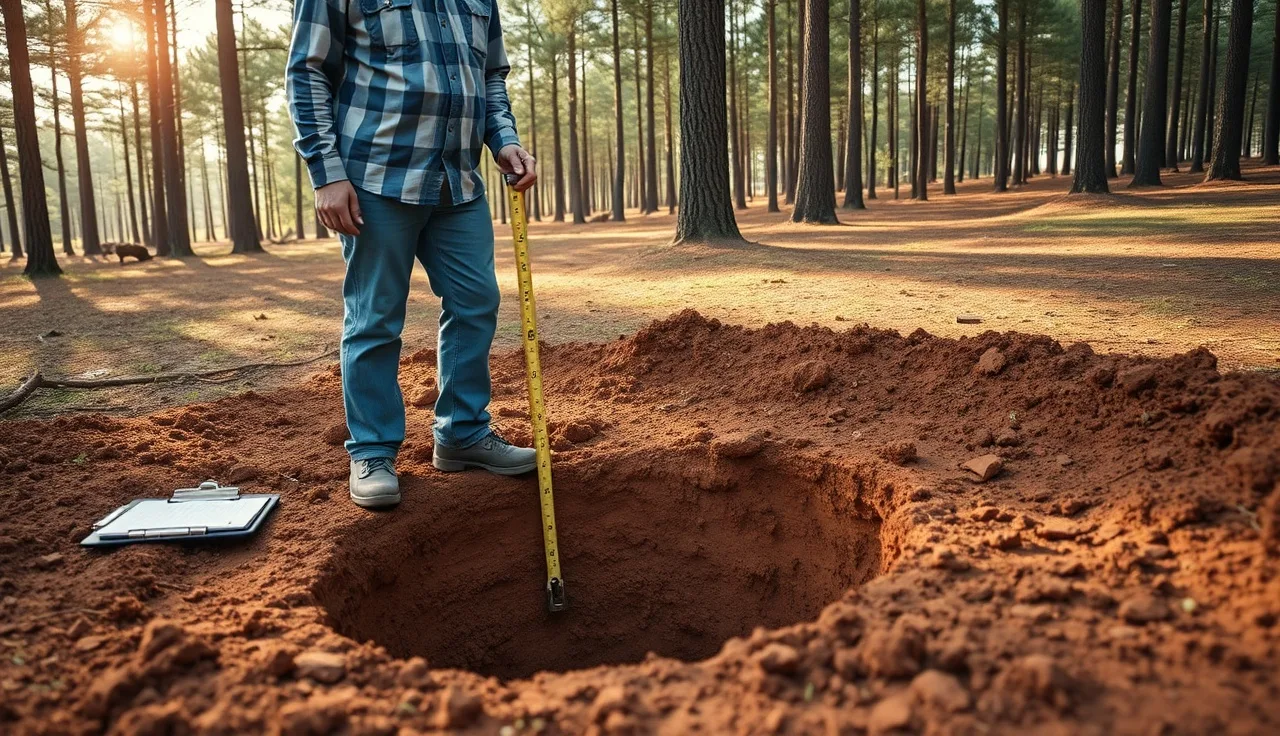
Step 1: Soil morphology first. The evaluator digs profile holes (typically 48 to 60 inches deep) with a backhoe or hand auger and describes the soil horizons. They're hunting for limiting conditions: fragipans, clay pans, mottling that flags a seasonal high water table, rock, and other features that affect drain field placement. [2] In many cases this step alone decides whether a full perc test is even worth doing.
Step 2: Pre-soaking. Test holes (usually 6 to 12 inches in diameter, 12 to 24 inches deep) are filled with water and left to pre-soak for 12 to 24 hours. This saturates the soil to mimic the wet season, the worst-case condition your drain field faces every year. [10]
Step 3: The timed test. Water goes in to a measured depth and the evaluator records how many minutes it takes the level to drop one inch. This repeats several times. The final calculation uses an average or a geometric mean of the readings, depending on the evaluator's method.
Step 4: Calculating the rate. Minutes per inch drive the system sizing. A faster rate (say, 5 MPI) means water moves quickly and the soil needs less drain field area per bedroom. A slower rate near 60 MPI needs a lot more linear footage to handle the same daily flow. [2]
Step 5: Report submission. The evaluator sends findings to the state. The agency reviews and either issues a permit authorization or asks for more information.
Most jobs run one site visit for morphology plus test hole placement, then a second visit the next day for the timed test. Some evaluators do it all in a single day when conditions allow.
How much does a perc test cost in South Carolina?
Honest answer: the range is wide. Most homeowners pay $250 to $900 for a basic residential site evaluation in South Carolina, with the median closer to $400 to $600. [3] Rural lots with rough access, steep terrain, or more than two acres push the cost higher.
Those numbers cover the evaluator's fee only. A state permit application fee, if your lot needs one, runs $50 to $150 depending on the county and system type. [4]
A few things that push the cost up:
- Backhoe rental: if the evaluator needs a machine to dig morphology holes (common on larger or harder lots), add $150 to $300.
- Re-evaluation: if the state wants additional testing after the first report, you pay for a second site visit.
- Engineered alternative systems: if the soil fails conventional testing, getting a site evaluated for an alternative system (drip irrigation, mound, and so on) means extra engineering, typically $500 to $2,000 on top of the basic evaluation.
For context on total project costs, see our guides on cost to install septic system and cost to put in a septic tank.
Nobody publishes statewide average data specifically for SC perc tests, so these ranges come from state fee schedules and published evaluator rate surveys. Prices in the Lowcountry (Charleston, Beaufort, Hilton Head) tend to run 20 to 30 percent higher than the Upstate, thanks to demand and the difficulty of coastal soils.
What perc rate is required to pass in South Carolina?
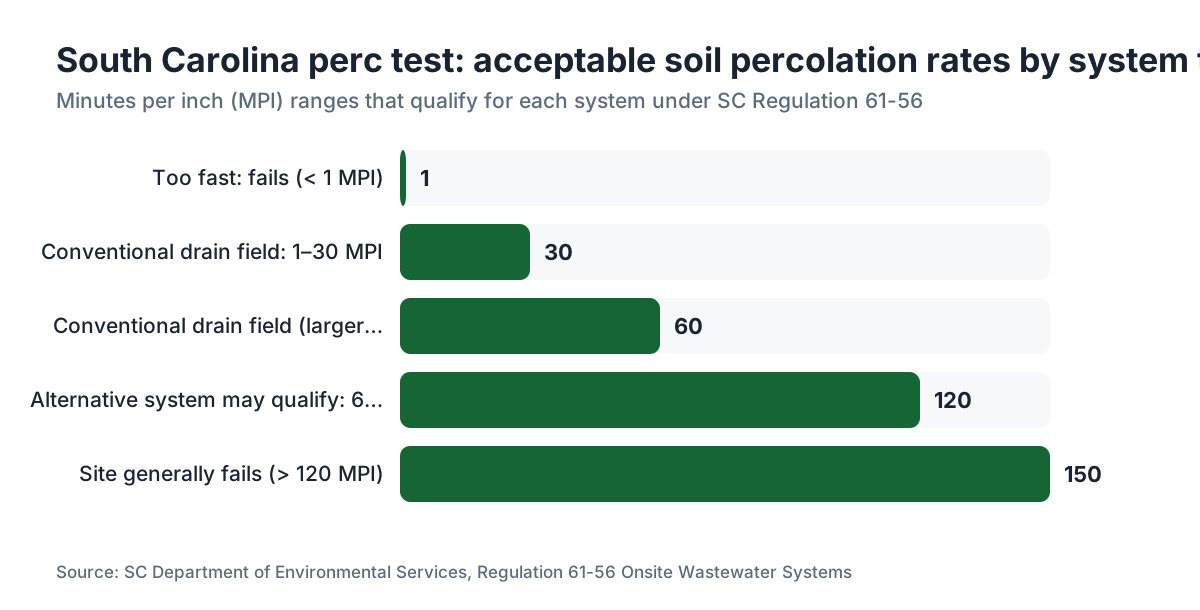
For a conventional gravity drain field under Regulation 61-56, the soil has to perc between 1 and 60 minutes per inch. [2] That is the standard pass range.
The rate also sets how much drain field area your lot needs. South Carolina uses table-based sizing where a slower rate demands more square footage of absorption area per bedroom. Soil percing at 5 MPI needs far less trench length than soil at 45 MPI for the same daily flow.
| Perc Rate (MPI) | System Type Typically Allowed | Notes |
|---|---|---|
| < 1 | Usually fails (too fast) | Very sandy soils, poor treatment |
| 1 to 30 | Conventional drain field | Standard sizing tables apply |
| 31 to 60 | Conventional drain field | Larger absorption area required |
| 61 to 120 | Alternative system may qualify | Engineer review required |
| > 120 | Site likely fails | Fill or alternative may be possible |
Passing the perc rate is necessary but not sufficient. Your soil morphology also has to allow a drain field at a usable depth without hitting limiting conditions. A lot with perfect 20 MPI results can still be denied a conventional permit if the soil profile shows a seasonal high water table at 18 inches.
Depth to limiting condition is one of the most common reasons South Carolina lots fail, especially in the coastal plain and tidal areas.
What happens if your lot fails the perc test in South Carolina?
A failed conventional perc result is not automatically a dead end. Regulation 61-56 allows several alternative system types when standard soils won't support a conventional drain field. [2]
Low-pressure pipe (LPP) systems spread effluent more evenly and can work in soils slightly tighter than the conventional range. Common in SC coastal areas.
Drip irrigation systems deliver treated effluent through small emitters and work in shallower, slower-draining soils where a conventional trench would hit groundwater.
Mound systems raise the absorption area above the native soil with engineered fill, so a drain field can work where in-ground depth falls short.
Engineered alternative systems such as aerobic treatment units (ATUs) paired with drip or spray disposal are permitted in South Carolina when conventional and modified systems won't work. They need more engineering, higher upfront money, and ongoing maintenance contracts.
If none of those work, you may have a lot that genuinely can't support onsite wastewater. Then your options are connecting to public sewer (if it's available), combining the lot with adjacent land to find a usable area, or in some counties applying for a variance. Variances are rarely granted and require proof of hardship.
Before you write off a failing site, have a licensed engineer or soil scientist look at what alternatives the state might approve. The rules have flexibility built in for a reason.
For what it costs once you do have a permitted site, the septic tank installation guide breaks down the full scope.
How long does a perc test and permit approval take in South Carolina?
The site evaluation itself takes one to two days of field work, usually scheduled one to two weeks out depending on the evaluator's calendar.
After the report goes to the state, permit processing time varies by county office and current workload. The agency has historically targeted 30 days for review, but real-world turnaround in busy coastal counties can run 45 to 90 days during peak construction season. [4]
If the state asks for more information or a site visit from its own staff, add another 30 to 60 days.
Total time from hiring an evaluator to permit in hand: plan for 6 to 12 weeks under normal conditions. In high-demand areas like the Grand Strand (Myrtle Beach) or the Charleston metro, 12 to 16 weeks is not unusual when the market is hot.
Permits have a set life and must be acted on before they expire. Under current SC regulations, residential septic construction permits are valid for five years. [2] Miss that window and you renew.
Buying land? Get the perc evaluation done during due diligence, not after closing. A failed result on a lot you already own without sewer access is an expensive problem.
Does a perc test expire in South Carolina?
Yes. The site evaluation result isn't permanent. In South Carolina the report supports a state construction permit, and that permit has a five-year validity window. [2] If the permit lapses before construction starts, you re-apply, which usually means a fresh site evaluation.
Soil conditions can also change. A lot that passed 15 years ago under an older evaluation may need a new look if you're applying for a new or expanded system today. The state accepts older evaluations in some cases, but don't count on it.
Buying land with an existing positive evaluation on file? Confirm when it was done and whether the permit is still active. A seller saying "the perc test passed" without a current valid permit authorization means less than most buyers assume.
What should you know about perc tests in South Carolina's coastal areas?
South Carolina's Lowcountry throws challenges at perc testing that the Upstate rarely sees.
Seasonal high water tables in coastal plain soils sit shallow, often 12 to 24 inches below the surface, which limits where a drain field can go. [2] Even fast-draining sandy soils get disqualified when the profile shows regular flooding at usable depth.
Tidal influence zones and jurisdictional wetlands add another layer. Lots near tidal waterways face extra setback requirements from water features, and some coastal areas fall under stricter nutrient rules meant to protect shellfish growing areas.
In Beaufort County, Colleton County, and parts of Horry County, the state has kept closer watch on onsite systems because septic failures connect directly to shellfish bed closures. The state monitors shellfish harvesting area closures linked to onsite system failures, so failing or neglected systems in these areas draw attention. [9]
Evaluating coastal property? Budget for the real chance that a conventional system won't work and an alternative will. That often adds $5,000 to $15,000 or more to the installation cost compared with a straightforward inland site.
For a look at what a complete new system costs once the site clears, the cost to install septic system article has current numbers by system type.
How do you find a licensed evaluator to perform a perc test in South Carolina?
The state keeps records of licensed onsite wastewater professionals. Licensed Soil Scientists in South Carolina hold credentials through the state's Soil Scientist licensing board, and Professional Engineers who do onsite wastewater work are licensed through the SC Board of Registration for Professional Engineers and Surveyors. [5]
The practical ways to find one:
Call your county environmental health office. They won't recommend specific companies, but they can confirm whether someone you're considering holds active credentials.
Ask your builder or real estate attorney. Anyone who regularly handles rural residential deals in SC keeps a short list of evaluators they trust.
Check professional directories. The National Society of Professional Soil Scientists and the South Carolina Association of Environmental Professionals both list members.
Get at least two quotes. Fees vary a lot between evaluators, and price doesn't reliably track thoroughness. Ask exactly what each quote includes: morphology only, full perc, report prep, and state submission.
Ask whether the evaluator works in your specific county too. Coastal counties have different soils and different local office expectations than the Upstate. An evaluator who works your area often will produce a report that clears review more cleanly than one who rarely does.
What about existing homes in South Carolina: do you need a perc test to sell or expand?
Selling an existing home with a working septic system? South Carolina does not require a new perc test as a condition of sale. What buyers often want instead is a septic tank inspection to confirm the system works.
A perc test comes back into play for an existing property in a few specific cases:
Adding bedrooms. Add a bedroom or several, and the state may want proof the existing drain field can handle the higher flow. That can mean a new site evaluation to check whether the current system is sized right or needs to grow.
Replacing a failed drain field. If your drain field is failing, you need a new site evaluation to permit the replacement area. For what drain field trouble looks like and what it costs to fix, see our leach field guide.
Switching from a cesspool or holding tank to a conventional system. Older SC properties sometimes run unpermitted or pre-regulation setups. Converting to a proper onsite system takes a full site evaluation and a state permit.
In all these cases the process matches new construction: hire a licensed evaluator, run the evaluation, submit for permit review.
Operators who manage service for clients working through these compliance situations can use platforms like SepticMind to track permit status, site evaluation dates, and renewal deadlines across a full customer base without things slipping.
How does the SC perc test process compare to neighboring states?
South Carolina's system is more privatized than some neighbors and less than others.
| State | Who performs evaluation | Pass rate range | Permit authority |
|---|---|---|---|
| South Carolina | Licensed private evaluator | 1 to 60 MPI (conventional) | SC DES |
| North Carolina | Licensed Soil Scientist (private) | 1 to 60 MPI | NC DHHS / DEQ |
| Georgia | County Environmental Health Inspector (public) | Varies by county | GA DPH / county |
| Tennessee | State-licensed evaluator or county inspector | Varies | TN TDEC |
| Virginia | Certified Onsite Soil Evaluator (private) | 1 to 60 MPI | VA DEQ / VDH |
North Carolina's process nearly mirrors South Carolina's in structure and acceptable perc range, useful context if you're comparing land across the state line. [7] Georgia is notably different: county Environmental Health departments usually do the evaluation themselves rather than hiring private contractors, though it varies by county. [8]
The EPA's SepticSmart program gives national-level guidance on onsite systems and points to proper siting, design, installation, and maintenance as the four factors that decide long-term performance. [6] State regulation fills in the specific numbers, but the underlying science holds across state lines.
What records should you keep after a South Carolina perc test?
Keep everything. File the original site evaluation report, the state permit authorization letter, the as-built drawing showing where the system went in, and every later inspection report.
These documents matter more than most homeowners expect at three moments: when you sell the house, when you need repairs or additions, and if the state ever investigates a neighbor's complaint.
The state retains records of permitted systems, but those records focus on the permit, not the full evaluation detail. The evaluator's original site report often holds soil data and design rationale that the permit file never fully reproduces. Lose that report and later need to expand or repair the system, and recreating it means paying for a new evaluation.
For system health after installation, regular pumping keeps solids out of the drain field and stretches its life. The how often to pump septic tank guide gives the real service intervals by household size. SepticMind's scheduling tools help operators track service history and remind homeowners before overdue intervals do real damage.
Good records protect you at sale, too. A buyer's attorney who can follow an unbroken chain from site evaluation to permit to as-built to pump records will have far fewer questions than one staring at a gap-filled file.
Frequently asked questions
How much does a perc test cost in South Carolina?
Most residential perc tests in South Carolina cost $250 to $900 for the licensed evaluator's fee. The low end applies to simple Upstate lots the evaluator can finish in a single day. Coastal lots, large tracts, or sites that need a backhoe for morphology holes push toward the high end. State permit application fees add another $50 to $150 on top.
Who regulates perc tests in South Carolina?
SC DES (Department of Environmental Services) oversees onsite wastewater permitting in South Carolina under Regulation 61-56, a job that sat with SC DHEC before the 2024 agency split. Licensed private professionals, usually licensed Soil Scientists or Professional Engineers certified in onsite wastewater, do the actual site evaluation. They submit findings to the state, which issues or denies the construction permit.
What perc rate do you need to pass in South Carolina?
For a conventional gravity drain field, South Carolina requires soil that percolates between 1 and 60 minutes per inch. Soils faster than 1 MPI drain too quickly for good treatment. Soils between 61 and 120 MPI may still qualify for an alternative system. Above 120 MPI, the site is generally unsuitable for conventional or modified onsite disposal.
How long does a perc test take in South Carolina?
Field work takes one to two days: one day for morphology and test hole setup, one day for the timed test after pre-soaking overnight. State permit review after submission typically takes 30 to 90 days depending on the county office and construction season. Total time from hiring an evaluator to receiving a permit usually runs 6 to 12 weeks.
Can you build a septic system if your lot fails a perc test in South Carolina?
Sometimes. Soils that fail the conventional 1 to 60 MPI standard may still support an alternative system: low-pressure pipe, drip irrigation, mound, or aerobic treatment unit. These cost more and sometimes require ongoing maintenance contracts. If no alternative works, connecting to public sewer (if available) or applying for a variance are the remaining options, and variances are rarely approved.
Does a perc test expire in South Carolina?
The perc test result supports a state construction permit, which is valid for five years under current SC regulations. If construction doesn't begin within that window, the permit lapses and a new site evaluation is typically required. When buying land with an existing evaluation, confirm the permit is still active, rather than trusting that a test was done at some point in the past.
Do I need a perc test to sell my home in South Carolina?
No. South Carolina does not require a new perc test as a condition of home sale when an existing permitted septic system is in place. Buyers may request a septic inspection, which checks the tank and system without new soil testing. A perc test becomes necessary again only when adding bedrooms, replacing a failed drain field, or permitting a new or expanded system.
Who can perform a perc test on my South Carolina property?
Only state-licensed professionals are authorized to conduct site evaluations for state permits in South Carolina. That includes licensed Soil Scientists and qualified Professional Engineers licensed through the SC Board of Registration for Professional Engineers and Surveyors. Unlicensed contractors cannot produce a report the state will accept. Your county environmental health office can confirm active credentials.
How deep are the test holes for a South Carolina perc test?
Morphology profile holes typically go 48 to 60 inches deep to fully characterize soil horizons and locate limiting conditions like seasonal high water tables or restrictive layers. The percolation test holes themselves are shallower, usually 12 to 24 inches deep, placed at the proposed drain field depth. Exact specs vary with the evaluator's method and site conditions.
What is a soil morphology evaluation and how is it different from a perc test?
A soil morphology evaluation reads the physical structure of your soil from dug profile holes: texture, color, mottling, and layer boundaries. It flags conditions like clay hardpans or high water table evidence that would disqualify a drain field regardless of percolation rate. The perc test only measures drainage speed. South Carolina requires both as part of a complete site evaluation.
Are perc tests more difficult to pass in South Carolina's coastal areas?
Generally, yes. Lowcountry coastal plain soils often have shallow seasonal high water tables (sometimes 12 to 18 inches below surface), which limits usable drain field depth even when the soil drains fine. Tidal areas add more restrictions. Many coastal SC lots that pass the percolation rate still fail on limiting conditions found in the morphology evaluation, which pushes owners toward alternative systems.
How do I find a licensed perc test evaluator in South Carolina?
Call your county environmental health office to confirm active credentials. Licensed Soil Scientists and Professional Engineers licensed through the SC Board of Registration for PE and Surveyors can do the work. Your builder, real estate attorney, or county extension office can usually refer evaluators who work your area. Get at least two quotes, ask what each includes (morphology, perc test, report, and state submission), and ask about their experience in your county.
What records should I keep after a South Carolina perc test and septic permit?
Keep the full site evaluation report, the state permit authorization letter, the as-built drawing of the installed system, and all later pump and inspection records. The state retains the permit file but not always the full evaluation detail. These documents matter when selling the home, applying for modifications, or answering a compliance inquiry. Lost records often mean paying for a new evaluation.
Sources
- US EPA, SepticSmart: Onsite Wastewater Treatment Systems: Percolation tests measure soil drainage rate to determine suitability for septic drain field effluent absorption
- SC Department of Environmental Services, Regulation 61-56: Onsite Wastewater Systems: South Carolina regulates onsite wastewater under Reg. 61-56; conventional drain fields require 1-60 MPI; permits valid five years; soil morphology evaluation required alongside percolation testing
- Clemson University Cooperative Extension, Onsite Wastewater Systems for Homeowners: Residential site evaluation costs in South Carolina typically range from $250 to $900
- SC Department of Environmental Services, Environmental Health Services Fee Schedule: State permit application fees for onsite wastewater systems range $50-$150 by county and system type; agency targets 30-day permit review
- SC Board of Registration for Professional Engineers and Surveyors (SC LLR): Professional Engineers in South Carolina must be licensed through the SC Board of Registration for PE and Surveyors to perform onsite wastewater site evaluations
- US EPA, SepticSmart: How Your Septic System Works: EPA SepticSmart states that proper siting, design, installation, and maintenance are the four factors that determine long-term septic system performance
- NC DEQ, Environmental Health / Onsite Wastewater: North Carolina onsite wastewater regulations use a 1-60 MPI acceptable range for conventional systems, comparable to South Carolina's standard
- Georgia Department of Public Health, Onsite Sewage Management Systems: Georgia onsite wastewater evaluations are typically conducted by county Environmental Health departments rather than private contractors
- SC Department of Environmental Services, Shellfish Sanitation and Recreational Water Program: South Carolina monitors shellfish harvesting area closures linked to onsite wastewater system failures in coastal counties
- US EPA, Septic System Maintenance and Site Evaluation Guidance: Pre-soaking test holes for 12-24 hours before timed percolation readings simulates wet season worst-case drainage conditions
Last updated 2026-07-10