Perc test in Tennessee: what it costs, how it works, and what happens if you fail
By the SepticMind Editorial Team

TL;DR
- A perc test in Tennessee measures how fast soil absorbs water, and the state requires it before issuing a septic permit.
- Most residential tests cost $200 to $800 depending on your county and who does the work.
- Tennessee calls this a "site evaluation" under Rule 0400-48-01, run by county health departments.
- Failing doesn't always block you.
- Alternative systems often qualify.
What is a perc test and why does Tennessee require one?
A perc test, short for percolation test, measures how fast water drains through soil. The number you get, usually expressed in minutes per inch, tells your engineer and county health department whether that soil can safely treat and absorb wastewater from a septic system.
Tennessee requires this evaluation before the county issues a permit for any onsite sewage treatment system [1]. There's no workaround. You can't break ground on a house, a cabin, or even a guest cottage served by a private septic system without first proving the land can handle the effluent load.
The state frames this under its Onsite Sewage Disposal Rules, Tennessee Department of Environment and Conservation (TDEC) Rule 0400-48-01, which governs everything from the test procedure to who can conduct it. The short version: a licensed soil scientist or a county environmental health specialist performs the evaluation, and the results decide what size and type of system you're allowed to install.
This matters beyond new construction. Property sales involving septic systems, additions that increase bedroom count (and therefore estimated wastewater flow), and certain repair projects can all trigger a new evaluation. Buying land to build on? Get the perc test done before you close, not after.
How does the perc test process work in Tennessee?
Tennessee's process is different from the simple "dig a hole, pour water in" method some older guides describe. The state relies on a combined site evaluation that looks at soil morphology (what the soil layers look like when examined in a pit or boring) alongside the percolation rate [1].
Here's the sequence:
- You apply for a site evaluation through your county health department. Some counties handle scheduling directly. Others point you to a licensed soil evaluator.
- The evaluator digs test holes or uses soil borings, typically 3 to 5 feet deep, to examine soil texture, color, and structure. Mottling (the rust and gray blotches that signal seasonal saturation) is a red flag that limits or kills conventional septic options.
- Percolation test holes, usually 6 to 12 inches wide and 12 to 24 inches deep, get pre-soaked the day before testing so the soil sits at its worst-case absorption capacity.
- The next day, the evaluator fills each hole with water and measures how far the level drops over a set interval, typically 30 minutes, repeated several times.
- The slowest rate from multiple holes drives the design. Tennessee combines that perc rate with the soil morphology findings to assign your lot a system type and size.
The field visit usually takes two to four hours. Be there, or have someone who can point out property lines and known issues. Bring your survey.
Results go into a written site evaluation report. The county health department uses that report to issue (or deny) a construction permit for the septic system [1].
What does a perc test cost in Tennessee?
The honest answer is $200 to $800 for most residential lots in Tennessee. The variation comes from who does the work, how complex the site is, and where you are in the state [2].
County health departments charge a fee just for the permit application and review. That fee is separate from what you pay the evaluator who comes to your property. In many rural counties, the county environmental health office does the field evaluation as part of the permit fee, which runs $150 to $400. In counties where you hire a licensed private soil scientist directly, expect $300 to $800 for the site evaluation alone, on top of any county application fees.
A few things push the cost higher:
- Multiple test areas on a large or irregular lot
- Sites that need a second visit because pre-soaking conditions weren't met the first day
- Rocky terrain or shallow bedrock that requires specialized equipment to get adequate borings
- Expedited scheduling
About the "DHEC perc test cost" note that shows up in some searches: DHEC is South Carolina's health agency. Tennessee's equivalent is TDEC (Tennessee Department of Environment and Conservation), working through county health departments. If you're seeing DHEC references, that information is for a different state.
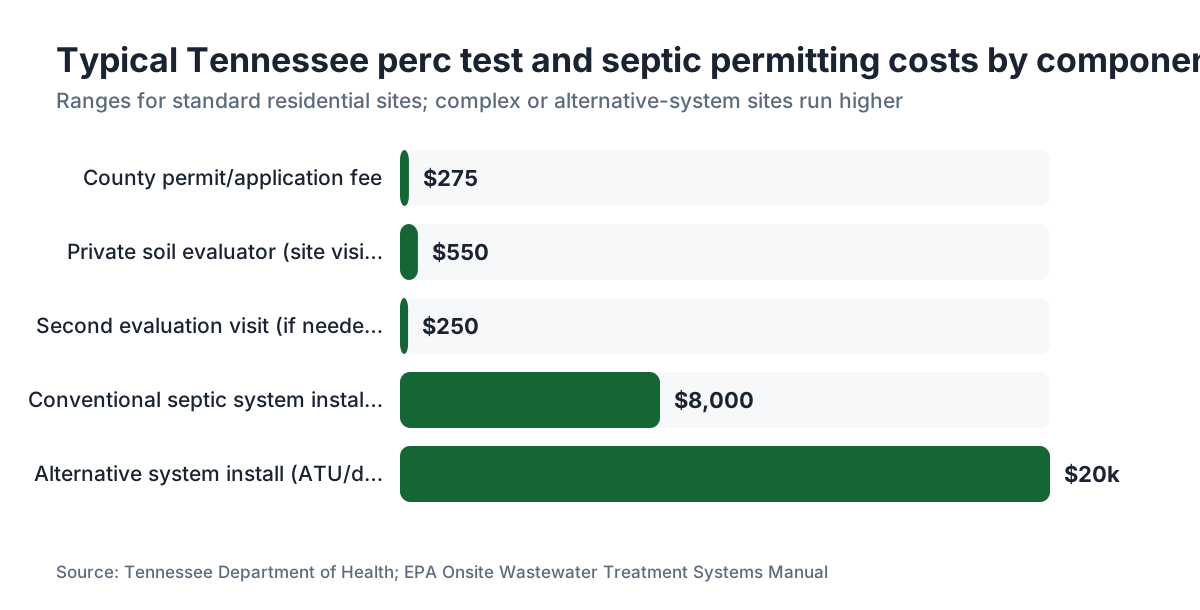
The perc test fee is a small slice of total septic costs. A conventional septic system installation in Tennessee runs roughly $4,000 to $12,000 depending on system size and site conditions. An alternative system can cost $10,000 to $25,000 or more. See our full breakdown of cost to install a septic system for the complete picture.
| Cost component | Typical range |
|---|---|
| County permit / application fee | $150, $400 |
| Private soil evaluator site visit | $300, $800 |
| Second evaluation visit (if needed) | $150, $350 |
| Total (county-performed evaluation) | $150, $400 |
| Total (private evaluator + county fee) | $450, $1,200 |
Who is allowed to perform a perc test in Tennessee?
Tennessee restricts who can conduct site evaluations under Rule 0400-48-01 [1]. Your neighbor who once took a soil science class can't do this for you.
Authorized evaluators fall into two groups. First, county environmental health specialists employed by local health departments, who are authorized under the state program. Second, licensed soil scientists who hold credentials under Tennessee's licensing program for soil scientists. If you hire a private evaluator, ask to see their license number and verify it with the Tennessee Department of Agriculture or the relevant licensing board before you pay.
Some contractors offer to "arrange" the perc test as part of a septic installation package. That's fine. Just make sure the actual evaluator meets state qualifications. The permit won't be valid otherwise, and you don't want to learn that after breaking ground.
For properties near jurisdictional boundaries or in municipalities with their own health codes, check whether the city layer adds requirements on top of the county and state rules. Nashville-Davidson County, for one, runs through Metro Public Health, which has its own scheduling process.
What perc rates pass or fail in Tennessee?
Tennessee doesn't publish a single bright-line pass/fail number the way some states do. The site evaluation weighs everything together: perc rate, soil morphology, lot size, setback distances, and the proposed system type all factor into whether you get a permit and what type of system is approved [1].
That said, percolation rates do have practical limits. Soils that absorb water faster than about 1 minute per inch are too coarse (too sandy or gravelly) to treat effluent before it reaches groundwater. Soils slower than 60 minutes per inch are generally unsuitable for conventional gravity-fed drain fields because the soil won't absorb effluent fast enough and the system backs up [3].
The sweet spot for conventional systems is roughly 1 to 30 minutes per inch. Soils in the 30 to 60 minute range often qualify with smaller drain fields and more conservative loading rates, or they may require an enhanced system.
One complication unique to Tennessee's geology: the state has limestone karst areas (particularly in Middle Tennessee), thin rocky soils in the Appalachian Mountains, heavy clay soils in West Tennessee's lowlands, and everything between. A lot that looks buildable can hide a perched water table or fractured limestone that makes conventional septic nearly impossible. The soil morphology exam catches problems a simple perc rate would miss.
EPA's SepticSmart program notes that failing septic systems can contaminate groundwater with bacteria and nitrates [4], which is exactly why states set these thresholds instead of letting individual homeowners decide their land is good enough.
What happens if your land fails the perc test in Tennessee?
Failing a perc test isn't automatically the end of the road. It depends on why you failed.
If the soil is too slow (clay-heavy or consistently saturated), an alternative system may still work. Tennessee permits several types:
- Mound systems: wastewater flows to a raised bed of engineered fill above the native soil, which buys separation from the water table
- Low-pressure pipe (LPP) systems: pressurized distribution spreads effluent more evenly across a larger area
- Aerobic treatment units (ATUs): treat wastewater to a higher standard before dispersal, allowing reduced setbacks or less permeable soils
- Drip irrigation systems: deliver treated effluent to shallow soil zones through a network of emitters
These alternatives cost more. An ATU with a drip field can run $15,000 to $30,000 installed in Tennessee, compared to $4,000 to $12,000 for a conventional gravity system. But they get people permitted on hard lots.
If the failure is shallow bedrock, seasonal flooding, or proximity to a water source that defeats even alternative systems, you may genuinely not be able to build with a private septic system on that parcel. At that point your options narrow to municipal sewer connection (if it's available and reachable) or reconsidering the land.
You can request a re-evaluation if you think the initial test was flawed, the wrong area of the lot was tested, or conditions have changed. Some buyers pass on a different corner of a large parcel after an initial failure.
Already dealing with an existing system that's failing? The septic system repair guide covers what comes next.
How long are Tennessee perc test results valid?
Tennessee site evaluation reports don't expire on a fixed calendar, but there are practical limits.
Get a site evaluation, then sit on it without pulling a construction permit, and the county health department may require a new or updated evaluation before issuing the permit. The specific window varies by county. Many departments treat evaluations older than five years as potentially stale, especially if site conditions may have changed (drainage alterations, land grading, drought followed by wet years, adjacent construction).
Buying land with an existing site evaluation report attached? Don't assume it's still good. Ask the county health department whether they'll honor it, and get that confirmation in writing before you close.
For real estate specifically, a site evaluation done to support an existing system's permit (not a new evaluation) tells you something about the original design. It says nothing about the system's current condition. A septic tank inspection by a licensed inspector is a separate step, and one you should not skip.
How do Tennessee's perc test rules compare to neighboring states?
Tennessee sits in a region with real variation in how states run their percolation testing programs.
| State | Who administers | Test type required | Typical cost |
|---|---|---|---|
| Tennessee | County health dept + TDEC | Site evaluation (perc + soil morphology) | $200, $800 |
| North Carolina | County health dept | Soil evaluation (morphology primary) | $200, $600 |
| Georgia | County health dept | Perc test + soil profile | $250, $700 |
| Kentucky | County health dept + state | Percolation test | $150, $500 |
| Virginia | Health dept (VDH) | Soil evaluation | $200, $900 |
| Alabama | County + ADEM oversight | Perc test | $150, $500 |
Tennessee's approach sits on the more rigorous end because it explicitly combines soil morphology with perc rates rather than leaning on perc rate alone. So Tennessee evaluators are less likely to approve a site that perc-tests fine but has soil horizons pointing to chronic saturation. That rigor adds cost and sometimes delays. It also means fewer system failures down the road.
One more time on DHEC: South Carolina's DHEC (Department of Health and Environmental Control) runs a different program with its own fee schedule. If you're in Tennessee, DHEC doesn't apply to you.
Do you need a perc test for an existing home with a septic system in Tennessee?
Not always, but sometimes.
Buying a home that already has a functioning permitted septic system, without adding bedrooms or changing the load? You generally don't need a new perc test. The permit is attached to the property.
You'll likely need a new evaluation if:
- You're adding a bedroom or converting space that increases the design wastewater flow
- The existing system has failed and the repair requires a new drain field in a previously unevaluated area
- You want to subdivide the property and create a new parcel that needs its own septic system
- The county determines the original permit was issued improperly or that records are missing
Real estate transactions cause the most confusion here. Lenders for FHA and USDA loans often require a septic inspection as a condition of financing [10], and some buyers and sellers mix up that inspection with a perc test. A septic inspection checks whether the existing system is working. A perc test asks whether soil can support a septic system. Different things.
Managing a portfolio of septic properties? Tools like SepticMind help operators track permit status and inspection histories across multiple sites so nothing slips through the cracks.
For the maintenance side once you're past permitting, how often to pump a septic tank is worth reading.
How to prepare your property for a perc test in Tennessee
Preparation is mostly logistics, but getting it wrong adds cost and delays.
Before the evaluator arrives:
- Have your property survey ready, showing lot lines, easements, and proximity to wells and water features. The evaluator needs setback measurements.
- Mark buried utilities, water lines, and known underground obstructions. Call 811 (Tennessee One Call) at least three business days before any digging [8].
- Clear vegetation from the test area if it's heavily overgrown. You don't need to grade or alter the land, just make it accessible.
- Confirm whether the county requires pre-soaking (most do for percolation holes). That means the evaluator visits once to set up and returns the next day to read results. Plan for two days of site access.
- If there's a well on the property, locate it. Setback requirements from wells will shape where the drain field can legally go, and the evaluator needs to know.
Don't try to game your perc test by watering the area in advance or adding sand. Evaluators know what that looks like, and submitting a manipulated test is fraud. It also puts you at legal risk if a system fails later and an investigation traces back to the original evaluation.
For properties with limited drain field space, ask your evaluator whether there's a backup area (sometimes called a repair area or reserve area) that can also be tested. Tennessee requires that a repair area be identified and protected from development for most permits [1]. Knowing this upfront saves you from finding out later you have no room for a future repair.
Finding a licensed perc test evaluator in Tennessee
Start with your county health department. Every Tennessee county has an environmental health division that handles onsite sewage permits. They can tell you whether they perform evaluations in-house, hand you a list of approved private evaluators, or both.
For private soil scientists, the Tennessee Association of Professional Soil Scientists (TAPSS) maintains a membership directory, and TDEC's licensing records are public. Don't hire anyone who can't show you their license number.
When getting quotes from private evaluators, ask:
- Does the quoted price include the full site evaluation report, or just the field visit?
- What happens if a second visit is needed?
- Do you file the results with the county, or do I?
- What's your estimated turnaround for the written report?
Turnaround from field visit to written report is typically one to three weeks for private evaluators, longer during busy building seasons (spring and early summer).
Operators who schedule perc tests and site evaluations as part of their services can track job status, client communication, and permit timelines with dedicated software. SepticMind is built for that kind of workflow.
Once you have your permit and system installed, don't lose track of septic tank pumping schedules. A system sized right for your lot can still fail early if it's never maintained.
Tennessee perc test rules and where to find the official regulations
The governing document is Tennessee Department of Environment and Conservation's Rule 0400-48-01, "Regulations Governing Subsurface Sewage Disposal Systems." This rule specifies site evaluation requirements, approved system types, setback distances, and who can perform the evaluation [1].
You can reach these rules through the Tennessee Secretary of State's official rules database [5] or through TDEC's website. The rules are updated periodically. The most recent substantive revision as of 2024 tightened requirements around alternative system maintenance contracts.
A few specific thresholds worth knowing from the rules:
- Minimum setback from a water supply well: 50 feet for a conventional system (more for some alternative systems)
- Minimum setback from property lines: 10 feet in most cases
- Minimum setback from streams and lakes: 50 to 100 feet depending on system type
- Minimum lot size for a conventional septic system: varies by perc rate and county, but often 0.5 to 1 acre for unsewered areas
EPA's SepticSmart program, which coordinates with state agencies, gives advice that matches Tennessee's approach: "Have your system inspected... and pumped as necessary by a licensed contractor" [4]. That advice extends past permitting into the life of the system. University of Tennessee Extension publishes similar homeowner guidance on siting and maintenance [6].
For anyone buying land with a leach field already in place, understanding what that field's original permit required, and how it's been maintained, is worth as much as the original perc test results.
Frequently asked questions
How much does a perc test cost in Tennessee?
Most residential perc tests in Tennessee run $200 to $800. County health departments typically charge $150 to $400 for the full evaluation when they perform it in-house. Hiring a private licensed soil scientist adds $300 to $800 on top of county application fees. Complicated sites, rocky terrain, or properties needing multiple test areas push toward the high end. The perc test fee is separate from the septic permit fee and the installation cost.
Who administers perc tests in Tennessee, DHEC or TDEC?
TDEC, the Tennessee Department of Environment and Conservation, sets the rules. County health departments run the permit process and often perform the evaluations themselves. DHEC is South Carolina's agency and has no role in Tennessee. If you're seeing DHEC references for Tennessee perc tests, that content applies to a different state.
Can I do a perc test myself in Tennessee?
No. Tennessee Rule 0400-48-01 requires site evaluations to be performed by authorized county environmental health specialists or licensed soil scientists. A self-performed test isn't valid for permitting. The county won't issue a septic permit based on results from an unlicensed evaluator.
How long does a perc test take in Tennessee?
The field work takes two days for most sites. On day one, the evaluator digs test holes and fills them with water to pre-soak the soil. On day two, they return to run the percolation measurements, which takes two to four hours. The written site evaluation report usually follows in one to three weeks, depending on the evaluator's workload and the season.
What perc rate passes in Tennessee?
Tennessee doesn't use a single pass/fail perc rate. The evaluation combines soil morphology with percolation rate. Practically, soils absorbing water in the 1 to 30 minutes-per-inch range typically support conventional systems. Rates slower than 60 minutes per inch usually require alternative systems or result in a denial. Soils faster than 1 minute per inch can also be problematic because they don't treat effluent well enough.
What happens if my land fails the perc test in Tennessee?
Failure doesn't always mean you can't build. Tennessee permits mound systems, low-pressure pipe systems, aerobic treatment units, and drip irrigation systems for sites that don't support conventional drain fields. These cost more, typically $10,000 to $30,000 installed. If the site is too restricted by shallow bedrock, flooding, or setback conflicts, you may need to look at municipal sewer access or reconsider the property.
Do I need a perc test to sell a home with a septic system in Tennessee?
Not automatically. If the home has an existing permitted septic system and you're not changing the load, no new perc test is required for the sale. Buyers using FHA or USDA financing often need a septic inspection as a loan condition, though. That's different from a perc test. A perc test applies to new system permits. A septic inspection checks whether the existing system works.
How long are Tennessee perc test results valid?
There's no fixed statewide expiration date, but county health departments generally treat evaluations older than five years as potentially outdated. If you haven't pulled a construction permit within a few years of your site evaluation, confirm with the county that they'll still honor it. Evaluations tied to properties with significant site changes since the original test may also need updating.
How many test holes are required for a Tennessee perc test?
Tennessee regulations require multiple test holes, typically three to five for a standard residential lot. The evaluator uses the slowest recorded percolation rate from the set to drive the system design. That's a conservative approach that protects against spotty results from one unusually fast or slow hole.
Can a perc test be done in the winter in Tennessee?
It depends on soil conditions. Frozen ground makes digging test holes hard or impossible, and saturated winter soils can skew results in ways that don't reflect average conditions. Many evaluators prefer spring or fall when soils are moist but not frozen or flooded. Check with the county or your evaluator about acceptable seasonal windows for your specific location in Tennessee.
Does Tennessee require a perc test for an ADU or guest house on the same property?
Yes, if the ADU or guest house will have its own separate septic system or will add significant flow to an existing system. If it connects to an existing system, the county will assess whether that system has capacity for the added load, which may or may not require a new site evaluation. Get county guidance before you design the structure.
Where can I find the Tennessee perc test regulations?
The governing rule is TDEC Rule 0400-48-01, "Regulations Governing Subsurface Sewage Disposal Systems." Access it through the Tennessee Secretary of State's official rules database at sos.tn.gov or through TDEC's website at tn.gov/environment. Your county environmental health department can also walk you through how the rules apply to your specific parcel.
What setbacks do Tennessee perc test results affect?
Your site evaluation report shapes where a drain field can go relative to wells (typically 50 feet minimum), property lines (10 feet minimum), and water bodies (50 to 100 feet). These setbacks can eliminate portions of your lot from consideration, which is why the evaluator needs your survey and why testing the right area of the property matters from the start.
How do I schedule a perc test in Tennessee?
Contact your county health department's environmental health division. They'll tell you whether they perform evaluations directly or whether you need to hire a licensed soil scientist. Either way, you'll fill out an application and pay a fee before the evaluation is scheduled. Spring and summer are the busiest seasons. Scheduling two to four weeks out is common, and rural counties may have longer waits due to limited staff.
Sources
- University of Tennessee Extension, septic system homeowner guidance: Perc test and site evaluation costs for Tennessee residential lots vary by county and by whether a county or private evaluator performs the work
- EPA, Onsite Wastewater Treatment Systems Manual (EPA/625/R-00/008): Percolation rates slower than 60 minutes per inch are generally considered unsuitable for conventional drain fields; rates faster than 1 minute per inch may not adequately treat effluent
- EPA SepticSmart Program: EPA SepticSmart advises having systems inspected and pumped as necessary by a licensed contractor and warns that failing systems can contaminate groundwater with bacteria and nitrates
- Tennessee Secretary of State, Official Compilation of Rules and Regulations: Tennessee Rule 0400-48-01 is published in the official state rules database and governs all subsurface sewage disposal system permitting
- University of Tennessee Extension, HomeASyst: Septic System Assessment: UT Extension guidance on septic system siting, soil evaluation, and maintenance requirements for Tennessee homeowners
- National Environmental Services Center (NESC) / West Virginia University, Percolation Tests: Background on percolation test methodology, typical rate thresholds, and how perc rate relates to drain field sizing
- Tennessee One Call (811), Underground utility notification requirement: Tennessee law requires calling 811 at least three business days before digging to identify buried utilities
- EPA, Septic Systems: What to Do after the Flood: EPA guidance on how saturated soil conditions affect septic system performance and evaluation timing
- USDA Rural Development, Single Family Housing Guaranteed Loan Program: USDA loan programs require septic system inspections as a condition of financing for rural properties
Last updated 2026-07-09