K-37 septic tank treatment: does it actually work?
By the SepticMind Editorial Team

TL;DR
- K-37 is a concentrated bacterial and enzyme septic additive meant to boost tank digestion and slow sludge buildup.
- The EPA and most state regulators say no additive eliminates the need for regular pumping.
- At roughly $20-40 per dose, K-37 is low risk but not a maintenance shortcut.
- Pumping every 3-5 years remains the one non-negotiable.
What is K-37 septic tank treatment?
K-37 is a commercially sold septic tank additive, typically packaged as a powder or dissolvable packet, that contains a blend of live bacteria and enzymes. You flush it down a toilet and it's meant to seed or reinforce the microbial colony already living in your tank. The bacteria in K-37 are generally facultative anaerobes, meaning they work in both oxygen-poor and oxygen-rich conditions, which makes them reasonably well suited to the anaerobic environment of a sealed septic tank.
The product has been sold under various brand names and reformulations for decades, so when people search for "K-37" they may be referring to slightly different formulations depending on where and when they bought it. The core claim across versions is the same: add bacteria, accelerate organic breakdown, reduce sludge accumulation.
Let's be direct about what K-37 is and isn't. It's a biological additive, not a chemical solvent. That matters because chemical additives (acid-based or solvent-based products) can damage tank components and harm the drain field, while biological additives like K-37 carry far less risk. But lower risk doesn't mean the product does what the marketing says. The evidence on whether any bacterial additive measurably improves a healthy tank's performance is thin.
What does the EPA say about septic additives like K-37?
The EPA's SepticSmart program is the clearest federal guidance homeowners can lean on. The EPA states that the agency "has not approved any septic system additive products" and that additives are not a substitute for regular pumping [1]. That's a direct policy position, not a vague hedge.
Several states go further. Wisconsin, Massachusetts, and Washington state have each conducted or reviewed independent studies of biological and chemical additives and found no reliable evidence that they extend pump intervals or improve effluent quality in normally functioning tanks [2]. Some states restrict or outright ban certain additive categories, particularly solvent-based products.
The logic makes sense once you think about the numbers. A healthy septic tank already holds billions of bacteria per milliliter of liquid. Dosing it with a packet of bacteria is like adding a cup of yeast to a lake and expecting the lake's chemistry to change. The microbial ecosystem in a functioning tank runs itself. Where additives might do something is in a tank that's been stressed, say after heavy antibiotic use by the household, or after a stretch of regular bleach dosing. Even then, the tank usually rebalances on its own within weeks [3].
If you want to read the EPA's actual guidance, the SepticSmart homeowner materials are on the EPA's website [1]. The phrase "has not approved" is the operative language, and it hasn't changed across program updates.
Is K-37 safe for your septic system?
Yes, with one qualification. K-37 and similar bacterial and enzyme products are safe for the tank, pipes, and drain field when used as directed. They don't dissolve the baffle, they don't harm concrete or plastic tank walls, and they don't push solids into the leach field the way some chemical additives can [2].
Here's the qualification. If a product sold as "K-37" contains surfactants, solvents, or inorganic compounds on top of bacteria, those ingredients change the safety picture. Read the full ingredient list. A legitimate all natural septic tank treatment lists bacteria strains (often Bacillus species) and enzymes (protease, lipase, amylase, cellulase) with no chemical carriers.
For households that are cautious about what goes into their system, the bacterial and enzyme category is the safest class of additive available. That still doesn't mean it works as advertised. Safe and effective are two different claims.
One scenario calls for caution. If you have a very old tank, or one already showing signs of stress (slow drains, odors, surfacing effluent), an additive won't fix the underlying problem. Get a septic tank inspection first so you know what you're actually dealing with.
Does K-37 actually reduce sludge and extend pump intervals?
This is the question that matters, and the honest answer is that the controlled evidence doesn't support the claim.
The most rigorous independent review on septic additives in the U.S. context comes from a University of Minnesota Extension study, which found that biological additives did not significantly reduce sludge accumulation compared to control tanks over a 3-year monitoring period [3]. The study's conclusion, quoted directly: "there is no documented evidence that microbial or enzyme additives improve septic system performance or reduce the frequency of required pumping." [3]
A similar review from the National Environmental Services Center found comparable results. Well-run tanks with normal household loading don't benefit measurably from bacterial supplementation. The bacteria already there do the job.
So where does the anecdotal evidence of K-37 "working" come from? A few real phenomena, probably. Some people buy the product after their tank has been stressed, the tank recovers on its own timeline, and they credit the additive. Others have tanks that were genuinely under-populated with bacteria, maybe a vacation home that sat empty, and the additive gave a real but temporary boost. Others never had their tank inspected before or after, so they have no baseline to judge by.
The honest bottom line: K-37 is unlikely to hurt your system. But budgeting it as a replacement for how often to pump your septic tank is a mistake that will eventually cost you far more than the $20-40 the packet costs.
How does K-37 compare to other natural septic tank treatments?
The market for natural treatment for septic tanks is crowded. Rid-X, Cabin Obsession, Green Gobbler, Bio-Sol, and dozens of store-brand equivalents all make similar claims with similar formulations. K-37 sits in the same category as all of them.
Here's how the main types of septic additives stack up:
| Type | Examples | Main ingredients | EPA-approved | Risk to system |
|---|---|---|---|---|
| Biological (bacterial) | K-37, Rid-X, Bio-Sol | Bacillus bacteria, enzymes | No | Low |
| Enzyme-only | Various | Lipase, protease, amylase | No | Low |
| Chemical (solvent) | Some drain cleaners | Solvents, acids | No | High |
| Yeast-based | Home remedies | Baker's yeast | N/A | Very low |
Among the biological additives, differences in CFU (colony-forming unit) counts, bacteria species, and enzyme concentrations do exist. Higher CFU counts aren't always better, because tank conditions (pH, temperature, loading) decide whether introduced bacteria survive long enough to do anything useful [4].
If someone insists on using a natural septic tank treatment, bacterial and enzyme products like K-37 are the right category. But the best natural septic tank treatment in practical terms is the one the EPA actually recommends: conserve water, avoid flushing non-biodegradable materials, and space out large laundry loads [1]. None of those cost a dime.
For operators tracking customer tank health and maintenance schedules across a fleet of accounts, tools like SepticMind can flag which customers are overdue for pumping regardless of what additive they've been using.
How do you use K-37 correctly?
The standard application is straightforward. You flush the packet or pour the powder into a toilet and flush with a full tank of water. Most directions say to do this in the evening so the treatment sits in the tank overnight without heavy water use diluting it.
Dosing schedules typically run monthly to quarterly, with an initial "shock dose" (sometimes two or three packets) for a new tank or one that's been sitting unused. Follow the specific product's directions. K-37 formulations have varied over the years, so the dose on the label you have is the one to use.
A few usage points worth knowing. Don't flush the treatment right before or after heavy bleach or antibacterial cleaner use in the house, because you'll kill the bacteria before they reach the tank. If your tank is approaching its pump interval, an additive won't buy you more time. Schedule the septic tank pump out and use the treatment afterward to help the freshly pumped tank re-establish its bacterial colony faster. That's probably the most defensible use case for any bacterial additive.
Don't use K-37 as a substitute for inspections. If you're unsure of your tank's current sludge and scum levels, the only way to know is to have someone open the lid and measure [5].
What does K-37 cost and where can you buy it?
K-37 and comparable bacterial additive products typically run $15 to $45 per package depending on the formulation, dose count, and retailer. You'll find them at home improvement stores, farm supply retailers, online through Amazon and similar platforms, and sometimes through septic service companies.
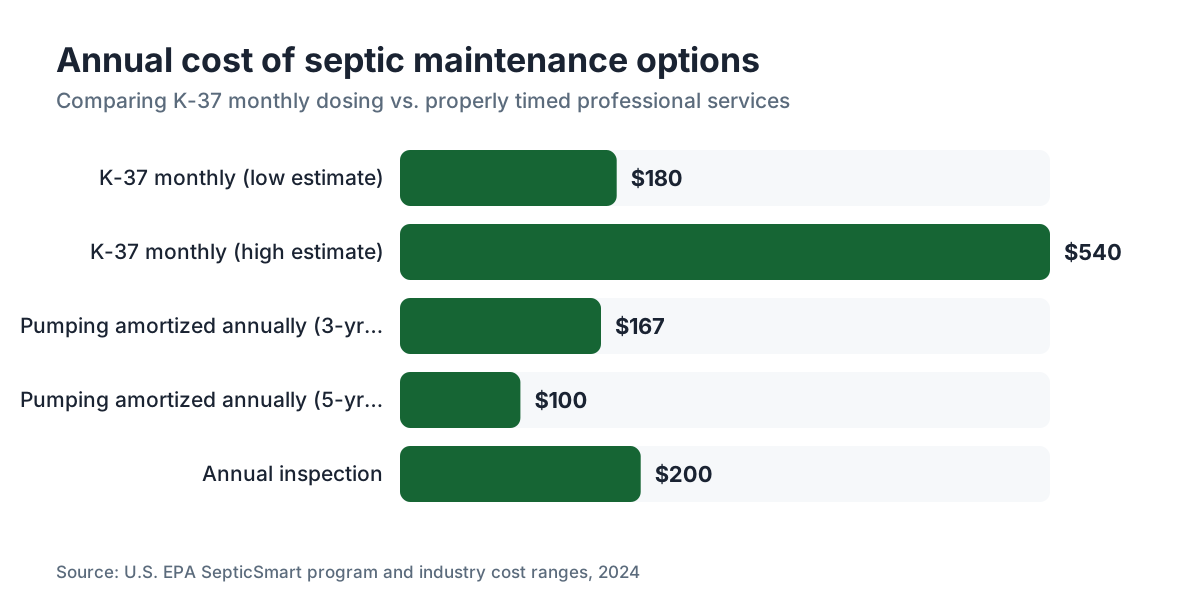
Over a year of monthly dosing, you're spending $180 to $540 on a product with no proven efficacy. A professional septic tank pumping runs $250 to $600 for a typical 1,000 to 1,500 gallon tank depending on your region [5]. The math isn't flattering for the additive.
If you're set on using a bacterial treatment, quarterly dosing after pumping is a more defensible approach than monthly maintenance doses. That drops your annual cost to $60-180, which lands in the range of low-risk optional spending rather than a real recurring expense.
One thing that genuinely moves your long-term costs: catching problems early. A failed drain field costs $5,000 to $20,000 or more to replace [6]. An additive won't prevent field failure from hydraulic overload or a broken baffle. Inspections do.
| Cost item | Typical range | How often |
|---|---|---|
| K-37 (monthly dose) | $15-45/mo | Monthly (per label) |
| Professional pumping | $250-600 | Every 3-5 years |
| Septic inspection | $100-300 | Every 1-3 years |
| Drain field repair | $1,500-10,000+ | As needed |
| Drain field replacement | $5,000-20,000+ | As needed |
Can K-37 fix a failing septic system?
No. And this point matters enough to be blunt about it.
A failing septic system has specific failure modes: a cracked or collapsed tank, a broken inlet or outlet baffle, a saturated or biologically clogged drain field, a broken distribution box, or hydraulic overload from too much water. None of these are fixable with bacteria and enzymes in a packet.
If you're seeing sewage surfacing in your yard, slow drains throughout the house, gurgling toilets, or sewage odors inside, you have a problem that needs diagnosis and likely septic system repair, not treatment. Using K-37 in that situation delays the repair and lets the damage compound.
There's one edge case where a bacterial product might play a small supporting role in recovery. After a tank has been pumped and repaired, restoring the bacterial colony can help the system return to full function faster. Some septic contractors add a starter dose after pumping for exactly this reason. But they pump first, repair second, treat third. Never the reverse.
If you're seeing any warning signs, start with a septic tank inspection before spending money on anything else.
What does state regulation say about septic additives?
State rules on septic additives vary a lot, which reflects how little federal regulation exists in this space.
Massachusetts and Washington state hold some of the strictest positions. Massachusetts Title 5 (310 CMR 15.000), the state's onsite wastewater code, does not recognize additive use as a credit toward any maintenance requirement [7]. Washington's Department of Health has published guidance stating that additives are not recommended as part of a routine maintenance program [8].
Wisconsin's Department of Natural Resources reviewed studies of septic additives and found no products demonstrated a reduction in pumping frequency or improvement in effluent quality sufficient to change state guidance [9].
Most other states sit in a middle ground. They don't ban biological additives, but they don't recognize them in lieu of pumping requirements either. A handful of states have banned or restricted solvent-based additives specifically because of groundwater contamination risk.
If you're in a state with a required maintenance program (some states require periodic inspections and pump records), using K-37 between services is fine, but it won't satisfy the inspection or pumping record requirement. Check your state environmental agency's onsite wastewater section for your specific rules.
For operators managing systems across multiple jurisdictions, keeping track of which customers sit in mandatory maintenance counties is exactly the kind of scheduling complexity SepticMind's service management tools are built around.
What should you actually do to maintain a healthy septic tank?
The EPA's SepticSmart program lays out four fundamentals, and they've held up for decades because they're grounded in how the system actually works [1].
Pump on schedule. For a typical household of four with a 1,000-gallon tank, that's every 3-5 years [5]. Smaller tanks or larger households need more frequent service. Get your tank inspected and measured to know where you actually stand. See the septic tank cleaning guide for what that process involves.
Watch what goes down the drain. Wipes (including "flushable" ones), grease, medications, and heavy antibacterial products all harm the bacterial ecosystem in your tank. This matters more than any additive you can buy.
Spread water use out. Three loads of laundry, two dishwasher cycles, and three long showers in one day can hydraulically overload even a healthy tank. Spreading laundry across the week is free and it works.
Protect the drain field. Don't plant trees near it, don't drive vehicles over it, and don't divert roof drains or surface water toward it. A healthy leach field is the most expensive component to replace and the easiest to wreck through neglect.
If you want to use a biological additive like K-37 on top of all that, the risk is low. Treat it as optional, not foundational. The four practices above are the real maintenance program.
Are there any legitimate uses for bacterial septic additives?
Yes, a few, and being fair about this matters.
After pumping. A freshly pumped tank has had most of its microbial colony hauled off with the sludge. A bacterial starter dose right after pumping can help the tank re-establish faster, though most tanks self-seed from incoming waste within a few weeks anyway. Some pumping contractors do this routinely.
Seasonal or vacation homes. A tank that sits unused for months can have a depleted or dormant bacterial population when the home reopens. A starter dose before heavy use restarts gives the bacteria a head start. This is one of the more defensible residential use cases.
After antibiotic courses. If everyone in the household has been on a broad-spectrum antibiotic, some bacterial die-off in the tank is plausible. A dose of bacterial additive during or just after the course is low cost and low risk. Whether it actually helps is hard to measure, but it's not irrational.
None of these use cases replace pumping or inspection. They're supplemental, which is fine. The problem is marketing that positions K-37 and similar products as primary maintenance tools, which the evidence doesn't support.
Frequently asked questions
Is K-37 the same as Rid-X?
K-37 and Rid-X are separate products made by different companies, but they sit in the same category: bacterial and enzyme septic additives. Both contain Bacillus bacteria strains and digestive enzymes. Neither has EPA approval for efficacy claims. Rid-X is more widely distributed in major retail chains, while K-37 has historically had a stronger presence through farm supply and specialty retailers. They work by the same mechanism and have similar evidence (or lack of it) behind them.
How often should I use K-37?
Product labeling typically recommends monthly use, with a heavier initial dose for new or recently pumped tanks. Practically, quarterly use after a pump-out is a more defensible and lower-cost approach. Daily or weekly use is unnecessary and not supported by any credible evidence. If you're using it as a post-pump starter, a single dose is enough. Always follow the current label, because formulations have changed over the years.
Can K-37 unclog a drain field?
No. Drain field clogging has two main causes: biomat buildup from fine solids that escaped the tank (usually a sign of an overfull or failing tank) and hydraulic saturation from overloading. Neither is reversible with a bacterial additive. A clogged field needs professional diagnosis and often physical remediation or replacement. See a septic professional before spending money on additives if you suspect field problems.
Does K-37 work in aerobic septic systems?
Aerobic treatment units (ATUs) have a fundamentally different microbial environment than conventional anaerobic tanks. They use oxygen injection to drive aerobic bacterial breakdown. Most bacterial additives like K-37 are formulated for anaerobic conditions. Using them in an ATU is unlikely to help, and the product label may explicitly say it's for conventional septic tanks only. Check the label and your ATU manufacturer's guidance before using any additive.
Will K-37 help if I've been using too much bleach?
Maybe, in a limited way. Heavy bleach use can suppress the bacterial population in your tank. Stopping the bleach overuse is step one, and the tank will recover over a few weeks as incoming waste re-seeds it. Adding a bacterial dose during that recovery period is low risk and might modestly speed the process. Switching to a bleach-free toilet bowl cleaner long term does more than any additive.
Is K-37 safe for a septic system with a garbage disposal?
K-37 itself won't harm a system with a garbage disposal. The bigger issue is that garbage disposals add significant solids loading to the tank, which speeds up sludge accumulation. The EPA and most state extension programs recommend against garbage disposals on septic systems, or at minimum recommend more frequent pumping if you use one. No additive compensates for the extra solids a disposal sends to the tank.
What's the difference between bacterial additives and enzyme additives for septic tanks?
Bacterial additives contain live microorganisms that digest organic waste and reproduce in the tank. Enzyme additives contain proteins (lipase, protease, amylase) that break down fats, proteins, and starches but don't reproduce. Many products, including K-37, combine both. Bacterial additives have a longer potential effect if the bacteria survive, while enzyme-only products work faster but get consumed in the process. Neither category has strong independent evidence for improving pump intervals.
Can I make my own natural septic tank treatment at home?
Some homeowners use baker's yeast flushed with warm water as a home remedy. Yeast is a fungal organism, not a bacterial one, so it targets a different part of the digestion process. There's almost no controlled evidence it helps, but it's cheap and very low risk. Active dry yeast costs pennies per dose. Rotten tomatoes, molasses, and other organic starters show up in folk literature but have essentially no supporting evidence at all.
Does K-37 reduce septic tank odors?
Sometimes, temporarily. Septic odors escaping into the house usually come from a failing water trap in a floor drain, a loose toilet wax ring, or a dry P-trap, not from the tank's biological activity. If odors come from the yard near the tank or field, that points to a venting problem, surfacing effluent, or a failing system. K-37 won't fix any of those. If the odor is mild and comes from the tank access point, a bacterial treatment is low-risk to try, but don't mistake odor reduction for system health.
How do I know if my septic tank actually needs treatment or just needs pumping?
The only reliable way to know is to have a pro open the tank and measure sludge and scum layers. As a rule of thumb, if sludge is within 12 inches of the outlet baffle or scum is within 3 inches, it's time to pump regardless of any additive use. Symptoms like slow drains, gurgling, or wet spots in the yard mean you need an inspection, not a treatment. An additive cannot substitute for that diagnosis.
What states have banned septic additives?
No state has banned all septic additives, but several have banned or restricted specific categories. Wisconsin, for example, prohibits the sale of septic additives that claim to reduce pumping frequency without documented proof. Massachusetts and Washington state guidance strongly discourages routine additive use. Some states have banned solvent-based additives specifically due to groundwater risk. Check your state environmental or health agency's onsite wastewater program for current rules in your jurisdiction.
Does the EPA recommend any septic tank additive?
No. The EPA's SepticSmart program explicitly states that no additive products have been approved by the agency, and that additives should not be seen as a replacement for regular pumping. The EPA's recommended maintenance is water conservation, avoiding flushing non-biodegradables, having the system inspected regularly, and pumping on schedule. That guidance hasn't changed across multiple SepticSmart program updates.
Can K-37 extend the time between septic tank pump-outs?
The independent evidence says no. The most-cited controlled study on biological septic additives, from the University of Minnesota Extension, found no significant reduction in sludge accumulation compared to untreated control tanks. The EPA's position lines up with that finding. A household of four with a 1,000-gallon tank should still plan to pump every 3-5 years regardless of any additive use. Skipping pumps based on additive use is one of the more common causes of preventable septic failures.
Sources
- U.S. EPA, SepticSmart Program homeowner guidance: EPA states it has not approved any septic system additive products and that additives are not a substitute for regular pumping
- Washington State Department of Health, onsite sewage system guidance: State reviews of biological and chemical additives found no reliable evidence that they extend pump intervals or improve effluent quality in normally functioning tanks
- University of Minnesota Extension, Onsite Sewage Treatment Program: Biological additives did not significantly reduce sludge accumulation compared to control tanks over a 3-year monitoring period; no documented evidence additives improve performance or reduce pumping frequency
- National Environmental Services Center, Septic System Additives fact sheet: Tank conditions including pH and temperature determine whether introduced bacteria survive long enough to have any measurable effect
- U.S. EPA, Septic System Maintenance: Typical pump interval is every 3-5 years for a household of four with a 1,000-gallon tank; pumping costs $250-600 depending on region
- U.S. EPA, How to Care for Your Septic System: Drain field replacement costs $5,000 to $20,000 or more depending on system size and site conditions
- Massachusetts Department of Environmental Protection, Title 5 Onsite Wastewater Code (310 CMR 15.000): Massachusetts Title 5 does not recognize additive use as a credit toward any maintenance requirement under state onsite wastewater rules
- Washington State Department of Health, onsite sewage system homeowner guidance: Washington guidance states that additives are not recommended as part of a routine maintenance program
- Wisconsin Department of Natural Resources, Septic System Additives review: Wisconsin DNR reviewed studies of septic additives and found no products demonstrated reduction in pumping frequency or improvement in effluent quality sufficient to change state guidance
- U.S. EPA, SepticSmart Week educational materials: EPA recommends spreading laundry loads over the week and conserving water as primary behavioral maintenance practices for septic system health
Last updated 2026-07-09