Aerobic septic system layout: how every component works together
By the SepticMind Editorial Team
TL;DR
- An aerobic septic system treats wastewater through four zones: a trash tank (pre-treatment), an aeration chamber (aerobic digestion), a clarifier (settling), and a disinfection chamber (chlorine or UV).
- Treated effluent then gets pumped to a spray or drip field.
- Installed cost runs $10,000 to $20,000, and the system needs service every 3 to 6 months.
What does an aerobic septic system actually look like?
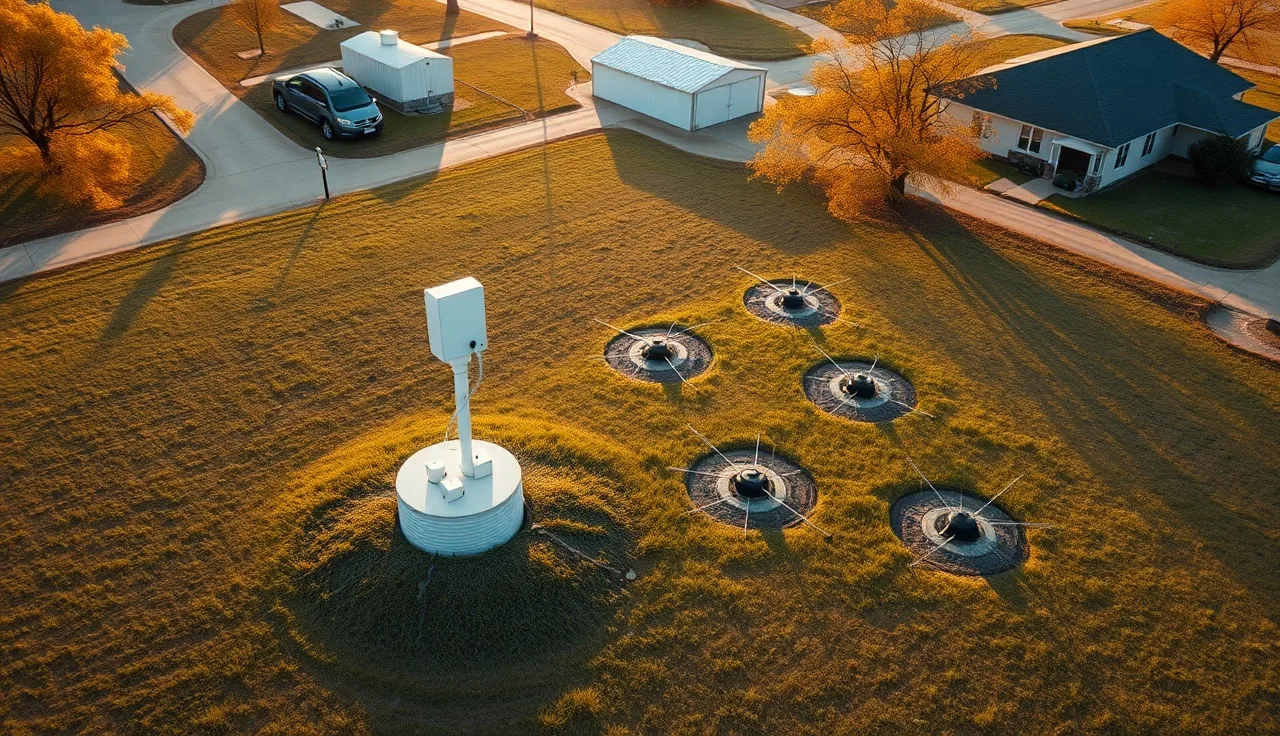
Most homeowners picture a single buried tank. An aerobic treatment unit (ATU) is closer to a small wastewater plant buried in your yard. A typical system has four treatment compartments, a control panel or alarm box mounted above ground, a network of spray heads or drip lines in a dispersal field, and a chlorinator or UV unit. Most residential systems fit inside one precast concrete or fiberglass tank divided internally, though some manufacturers ship them as two or three tanks placed end to end.
The tank sits underground, but the system is far busier than a conventional septic tank. A compressor or blower runs nonstop to push air into the aeration zone. Pumps cycle on a timer to dose the dispersal field. A float switch watches the clarifier level. Stand near the tank and you can hear the blower. Look at the yard and you can see the control panel and the spray heads. That visibility is deliberate: many states require a red-light alarm panel mounted where an occupant can see it [1].
The EPA's SepticSmart program describes aerobic systems as a fit for sites where soil conditions do not support a conventional system, noting they "provide a higher level of treatment" than anaerobic septic tanks [2]. Higher treatment is the whole point. Effluent leaving a working ATU is close to secondary-treated sewage-plant quality, which is why many states permit surface dispersal (spray irrigation) that would never fly with conventional septic effluent.
What are the four main chambers of an aerobic system?
Trash tank (pre-treatment compartment). House wastewater enters here first. Heavy solids sink to the bottom as sludge. Grease and lighter material float to the top as scum. This chamber works exactly like the first compartment of a conventional septic tank. Sizing varies by manufacturer, but a 1,000-gallon ATU serving a 3-bedroom home usually allocates 200 to 400 gallons to this zone. Skip this stage and rags and solids clog the aerator, so it is never optional.
Aeration chamber. Liquid from the trash tank flows into the aeration zone, where a submerged diffuser or aspirator injects air continuously. That oxygen feeds aerobic bacteria instead of the anaerobic bacteria in a conventional tank, and those bacteria chew through organic material much faster. Retention time here is usually 18 to 24 hours for residential units, depending on tank sizing relative to daily flow [3]. The blower or compressor that powers this zone is the most failure-prone part in the whole system and the reason for most service calls.
Clarifier (settling zone). Aerated mixed liquor passes into a quieter settling zone, where biological floc (clumps of bacteria and digested solids) sinks to the bottom. Clear liquid rises and overflows or gets pumped to the next stage. Some designs return the settled sludge to the aeration chamber, mimicking an activated sludge process. Others let it accumulate and lean on the trash tank to hold the bulk of the solids.
Disinfection chamber. The last stage kills pathogens before dispersal. Chlorine tablet chlorinators dominate in the U.S. because they are cheap and every maintenance tech knows them. The tablet feeder is a small plastic canister that effluent passes through before it reaches the pump tank. UV disinfection is showing up more often and skips the chlorine handling, though it costs more upfront and needs clear effluent to work. Oklahoma's onsite rules, for example, allow both chlorination and UV but require a chlorine residual of 0.5 to 1.0 mg/L before dispersal [4].
A fifth compartment, the pump tank or dose tank, is a separate vessel in most installs, though some manufacturers build it in. Disinfected effluent collects here until the timer-controlled pump doses it to the dispersal field.
How does the dispersal field on an aerobic system differ from a conventional drain field?
A conventional system sends partially treated effluent into a leach field (also called a drain field), where soil does the final treatment. Because ATU effluent is much cleaner, the dispersal options open up.
Spray irrigation. The most common ATU method in warm states like Oklahoma, Texas, and Florida. A timer fires a pump, and effluent sprays from rotary or fixed heads into a designated yard area set back from the house, property lines, and water features. Heads sit 10 to 15 feet apart. Many states require the spray zone to be fenced or signed so nobody walks through it during operation. Wet weather can keep spray systems from dispersing, which is why overflow provisions are required.
Drip irrigation. Pressurized tubing buried 6 to 12 inches deep delivers effluent right to the root zone. Drip works on sites with shallow soils, steep slopes, or lots where surface spray is a problem. It needs a filter (usually a disc or screen filter on the supply line) to keep the emitters from clogging. Drip runs $3,000 to $6,000 more to install than spray, but techs find it more forgiving because effluent never touches the surface.
Low-pressure pipe (LPP) or gravelless beds. Some ATU installs use a pressurized subsurface lateral field, laid out like a conventional leach field but with smaller-diameter pipe and tighter orifice spacing for even dosing. This is common where spray dispersal raises surface-contact concerns.
The dispersal field for an ATU is usually smaller than a conventional drain field for the same home, because the higher treatment level cuts the required hydraulic loading rate. Texas rules, for example, allow a 40 to 50 percent reduction in field area when an NSF 40-certified ATU is used [5].
What does a typical aerobic system layout look like on a residential lot?
Picture a bird's-eye view of a half-acre lot with the house in the middle. Running out from the house:
- A 4-inch gravity sewer line exits the foundation and drops toward the ATU at a slope of about 1/4 inch per foot.
- The ATU tank (or tank train) sits 10 to 15 feet from the house in most state codes. Setbacks from wells, property lines, and surface water vary by state but usually run 50 to 150 feet from a potable well [6].
- An electrical conduit runs from the house panel to the control panel, mounted on a post or the side of the house where it stays visible. That panel holds the blower timer, pump timer, and alarm relay.
- A pressure line runs from the pump tank to the dispersal field. For spray systems it feeds lateral pipes with heads on risers 6 to 12 inches above grade.
- The spray zone stays back from property lines (typically 10 to 50 feet by state), from the house (typically 10 to 15 feet), and from any water feature.
On a tight lot, the designer may curve the laterals or split the field into zones on separate timers so each zone dries out between doses. Site plans submitted for permitting have to show every setback dimensioned to scale.
Operators managing dozens of ATU sites across a region face a different problem: tracking each system's layout, component ages, and service intervals. That is the kind of recurring, compliance-driven schedule that software like SepticMind handles, centralizing service records and firing maintenance alerts so nothing slips.
What are the sizing rules for an aerobic system?
Sizing starts with daily flow. Most state codes set a per-bedroom design flow. The historical standard is 150 gallons per bedroom per day, though some newer guidelines use 100 to 120 gpd per bedroom [6]. At 150 gpd per bedroom, a 3-bedroom home designs for 450 gallons per day.
The manufacturer then specifies the minimum tank volume and aeration capacity for that design flow. NSF/ANSI Standard 40, the benchmark certification for residential ATUs, requires a rated unit to produce effluent meeting 30 mg/L BOD and 30 mg/L TSS on a 30-day average [3]. Certification proves the unit can hit the rated flow at the specified treatment level, but only if it is sized correctly to the house.
Common residential ATU sizes:
| Home size | Design flow | Typical ATU tank volume |
|-----------|-------------|------------------------|
| 1-2 bedrooms | 225-300 gpd | 500-750 gallons |
| 3 bedrooms | 450 gpd | 1,000 gallons |
| 4 bedrooms | 600 gpd | 1,250-1,500 gallons |
| 5 bedrooms | 750 gpd | 1,500-2,000 gallons |
Dispersal field sizing is a separate calculation. For spray systems, the hydraulic loading rate under Texas or Oklahoma-type rules often runs 1.0 to 1.5 gallons per square foot per day for ATU-quality effluent, versus 0.4 to 0.8 gpd per square foot for conventional effluent on the same soil. A 450 gpd flow at 1.0 gpd per square foot needs at least 450 square feet of spray area, and most designers add a 100 percent reserve, which puts the total spray footprint at 900 square feet or more.
Oklahoma runs its rules through the Oklahoma Department of Environmental Quality (ODEQ). The state's onsite code requires ATUs to be NSF 40 certified and sets minimum setbacks of 75 feet from a private well and 10 feet from a property line for the tank itself [4]. Spray field setbacks in Oklahoma require 50 feet from any water well, 10 feet from a property line, and no spray within 10 feet of the residence.
What electrical and mechanical components does an aerobic system need?
Here is where an ATU splits from a passive conventional system. It needs power. A 3-bedroom residential ATU typically draws 3 to 8 amps continuously for the blower, plus intermittent draw from the effluent pump. Most systems run on a dedicated 20-amp, 120-volt circuit.
Blower or compressor. The heart of the aeration chamber. Rotary vane compressors and linear diaphragm compressors are the common residential types. Linear diaphragm units (Medo, Secoh) run quieter and are simpler to service, but the diaphragm wears out in 2 to 5 years. Rotary vane compressors last longer, run louder, and cost more to replace. When a blower quits, the aeration chamber goes anaerobic within 24 to 48 hours and treatment quality drops fast.
Effluent pump. A submersible pump in the pump tank doses the dispersal field on a timer. Pump sizing depends on the volume of each dose and the head pressure needed to reach the spray heads. A typical residential spray pump is 0.5 to 1.0 horsepower.
Control panel and alarm. Mounted above ground. At minimum it carries a high-water alarm (a float switch trips a red light and audible alarm if the pump tank overfills), a blower indicator, and a pump timer. Better panels add a blower-failure alarm and event counters. State rules almost always require a working alarm visible from the residence [1].
Chlorinator. A plastic canister holding 1-inch or 3-inch trichlor or calcium hypochlorite tablets. Effluent flows past the tablets and picks up chlorine. Tablets need refilling every 1 to 3 months depending on flow. Running out of tablets is the most common maintenance failure and the one that triggers immediate permit violations.
How does an aerobic system in Oklahoma specifically differ from other states?
Oklahoma leans on ATUs more than most states because large parts of it have shallow, rocky, or tight clay soils that fail the percolation tests a conventional drain field needs. Oklahoma State University Extension estimates roughly 400,000 Oklahoma homes rely on onsite wastewater systems [8].
Oklahoma's rules (OAC 252:641) require:
- ATUs must carry NSF 40 certification or get individual ODEQ approval.
- Maintenance must run under a written contract with a licensed provider, and that provider must be registered with ODEQ.
- Inspections at least twice a year (every 6 months), with reports sent to the county health department.
- Spray dispersal setbacks of 50 feet from any water well, 10 feet from property lines, and 10 feet from any structure.
- An audible and visible alarm.
- No surface spray during rain events (systems need a rain sensor or manual bypass).
Those twice-yearly inspection rules are tighter than some neighboring states, which only ask for annual visits. They also make Oklahoma a place where maintenance contract documentation is a hard regulatory requirement rather than a nice-to-have. The CDC notes that ATU spray fields can transmit pathogens when disinfection is not working, so a documented chlorine check at each visit is a public-health control, not paperwork for its own sake [10].
One more Oklahoma note: the state's cost to install septic system tends to run a bit below the national median for ATUs because labor is cheaper, but the twice-yearly service contract adds $400 to $700 a year in operating cost that homeowners in lighter-oversight states do not always carry.
What maintenance does an aerobic system layout require?
More than most homeowners expect. A conventional system mostly needs pumping every 3 to 5 years. An ATU has ongoing mechanical maintenance baked into most state permits.
Routine visits (every 3 to 6 months). A licensed tech checks the chlorine residual in the disinfection chamber, inspects blower operation (noise, output pressure), clears clogged spray heads and confirms coverage, verifies the alarm, and eyeballs effluent clarity in the pump tank. They top off chlorine tablets if low.
Annual tasks. Test the high-water float alarm. Check the blower diaphragm or vane. Inspect the pump intake screen. Check every electrical connection at the panel for corrosion.
Pumping the trash tank. The pre-treatment compartment builds sludge just like a conventional septic tank. Frequency depends on household size and loading, but every 2 to 3 years is typical for a 3-bedroom home. Let it go and sludge overflows into the aeration chamber and wrecks the biology. Our guide on septic tank pumping covers how pumping works and what to expect.
Blower replacement. Budget for one every 3 to 7 years. Parts run $150 to $600 depending on manufacturer, and labor adds $100 to $200.
Spray head replacement. Heads crack or clog and need swapping every few years. Budget $10 to $30 per head plus a service visit.
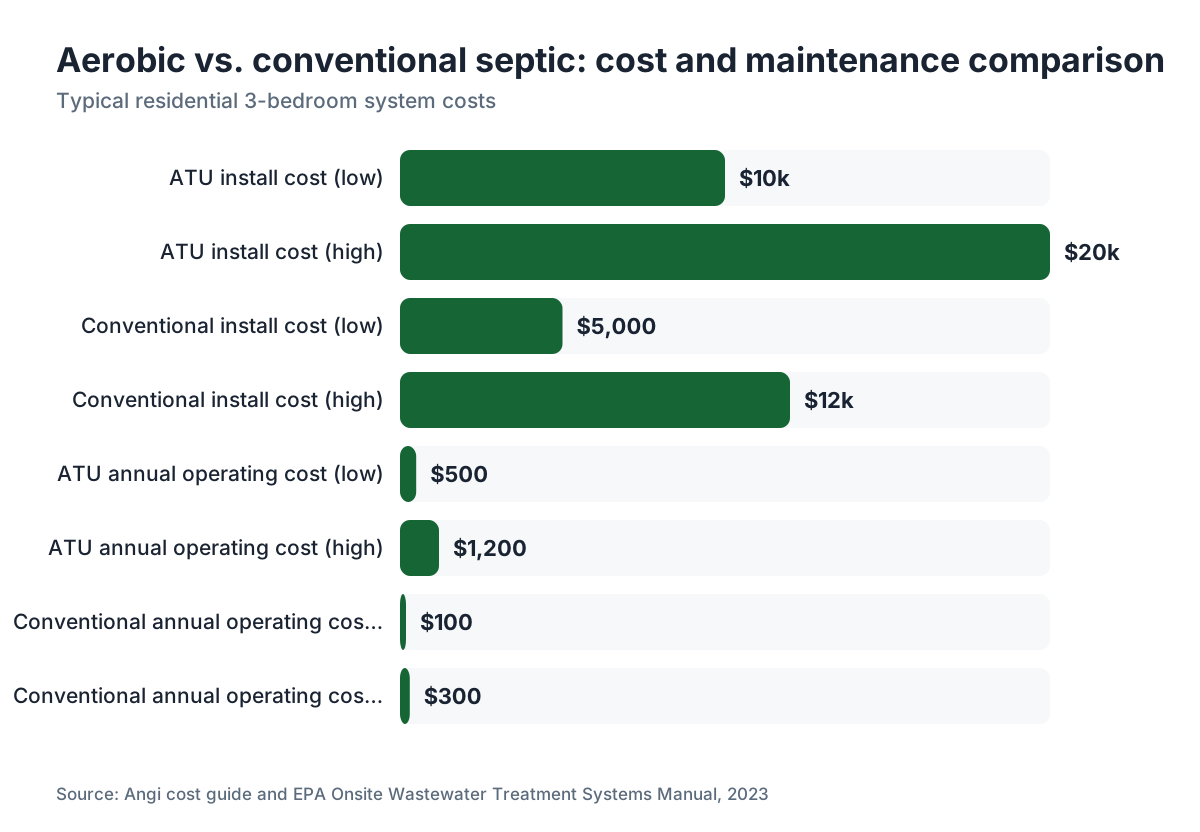
Total annual operating cost for a residential ATU, counting the service contract, chlorine tablets, and averaged repairs, runs $500 to $1,200 a year. That is 3 to 5 times the annual cost of a conventional system. Homeowners coming from a conventional setup are often blindsided by this, so I will be blunt: aerobic systems cost more to keep running. You install one because the site demands it, not because it saves money.
What can go wrong with an aerobic system layout?
Most failures trace back to a handful of causes.
Blower failure. The single most common service call. Aeration stops, the system goes anaerobic, and effluent quality drops. The alarm should warn the homeowner, but if it is broken or ignored, the system can push poorly treated effluent to the spray field for weeks. Spray field odor and dead grass near the heads are the first signs you can see.
Empty chlorinator. Homeowners sometimes drop the service contract, start doing it themselves, then forget to refill the chlorinator. In Oklahoma and similar states, a provider inspection catches it. Without an inspection, effluent can hit the spray field with no disinfection at all, which is a real public-health risk [10].
Pump failure. The effluent pump runs on a timer, and when it dies the pump tank fills. The high-water alarm should trip, but if it does not, the ATU backs up into the aeration chamber and eventually into the house. Pump replacement runs $400 to $1,000 installed. See septic system repair for how repairs get scoped.
Spray head clogging. Scale from hard water or biofilm clogs rotary heads. Clogged heads mean uneven distribution: some zones get overdosed (wet, smelly, sometimes ponding) while others get nothing.
Hydraulic overload. An ATU sized for 450 gpd will not carry a family of seven who added a laundry room and take long showers. Flows well above design push solids into the aeration chamber, swamp the clarifier, and send turbid effluent to the spray field. A flow equalization tank upstream is sometimes a workable retrofit.
Root intrusion in the lateral network. Tree roots go after the nutrient-rich drip or spray lines, and manifold unions and fittings are the weak points. A pressure test of the laterals during annual maintenance catches slow leaks before they become sinkholes.
If you are not sure whether your system is failing or just overdue for service, a septic tank inspection by a licensed ATU technician is the right place to start.
How much does an aerobic septic system cost to install?
Installed cost swings by region, site, and system size, but the national range for a residential ATU (3-bedroom home, standard spray dispersal) runs $10,000 to $20,000 [7]. That is roughly 1.5 to 2.5 times what a conventional septic system costs on the same site.
What drives the price:
- ATU tank unit: $3,000 to $7,000 for the tank and mechanical parts. Name brands (Norweco, Infiltrator, Jet, Orenco) sit at different price points.
- Dispersal field: $2,000 to $5,000 for a spray system on a straightforward site. Drip adds $3,000 to $6,000.
- Electrical: $800 to $2,000 for the conduit run and control panel.
- Permitting and engineering: $500 to $2,500, depending on whether a site evaluation and engineered plan are required.
- Site work: Excavation, backfill, and restoration. Highly variable.
In Oklahoma, installed cost for a standard residential ATU usually runs $8,000 to $15,000, below the national average, mostly because labor is cheaper. The mandatory twice-yearly maintenance contract adds real lifetime cost, though. Over 10 years, budget $5,000 to $12,000 in ongoing service on top of the install.
For a full breakdown of what drives septic pricing, see our guide on the cost to install septic system.
How does an aerobic system compare to a conventional septic system?
The two share a starting point (gravity feed from the house, pre-treatment in a tank) and split hard after that.
| Factor | Conventional septic | Aerobic (ATU) |
|--------|--------------------|--------------|
| Treatment level | Primary/secondary (anaerobic) | Secondary/tertiary (aerobic) |
| Effluent quality | 150-200 mg/L BOD | 30 mg/L BOD (NSF 40 standard) |
| Dispersal method | Subsurface drain field | Spray, drip, or pressurized subsurface |
| Power required | None (gravity) | Yes (blower + pump) |
| Install cost | $5,000-$12,000 | $10,000-$20,000 |
| Annual operating cost | $100-$300 (pumping amortized) | $500-$1,200 |
| Maintenance frequency | Every 3-5 years (pumping) | Every 3-6 months |
| Suitable for poor soils | No | Yes |
| Alarm system required | Rarely | Nearly always |
Here is the point worth remembering: an aerobic system is not a premium upgrade over a conventional one. It exists because the site demands higher treatment before dispersal. If a site passes conventional perc testing and has room for a standard leach field, a conventional system is almost always the better call for a homeowner who wants lower cost and less to break. ATUs earn their keep on hard sites.
Operators who service both types often find ATU agreements more profitable per visit (more to check, more consumables) but tougher to schedule. Running twice-yearly ATU visits across a whole territory is a genuine operations problem, and tools like SepticMind exist to manage that recurring, compliance-driven schedule.
What do homeowners need to know about living with an aerobic system?
A few practical realities that rarely make the installation paperwork:
You will hear it. The blower runs 24/7. Most residential units put out 40 to 55 decibels at the tank lid, about the noise of a refrigerator. If the tank sits near a bedroom window or patio, that matters.
The spray heads run on a timer. The dispersal pump usually fires several times a day in short cycles. Guests who do not know the spray field carries treated wastewater may walk right through it. Fencing or signage is required in some states and is smart everywhere.
Keep the area around spray heads clear. Mowers and string trimmers snap spray heads off. Show whoever mows the yard where the heads are.
Power outages stop treatment. A conventional tank keeps treating passively. An ATU without power stops aerating within hours. In an area with frequent outages, a backup generator connection for the ATU is worth thinking about.
Water conservation matters more than homeowners realize. Ten loads of laundry in one day can hydraulically shock an ATU sized for 450 gpd average flow. Spread laundry across the week. Do not dump large volumes into the system at once.
What goes down the drain matters. Antibacterial soaps, heavy bleach, and non-biodegradable wipes hurt the aerobic bacteria in the aeration chamber. That is true for conventional systems too, but the ATU is more sensitive because its treatment leans entirely on a healthy bacterial community.
Keep records. Your maintenance provider should leave a copy of each service report. Save them. When you sell, buyers and their inspectors will ask, and a gap in the records can stall the deal.
Frequently asked questions
How many chambers does an aerobic septic system have?
Most residential aerobic treatment units (ATUs) have four chambers: a trash tank (pre-treatment), an aeration zone, a clarifier (settling), and a disinfection chamber. Some designs add a separate pump or dose tank as a fifth vessel. The number of physical tanks varies by manufacturer, but the four treatment functions are almost always present whether they sit in one tank or three.
What is the minimum setback for an aerobic septic system from a house?
Setbacks vary by state and county. A common requirement is 10 feet from the foundation for the ATU tank itself, with spray heads set back at least 10 to 15 feet from any structure. In Oklahoma, OAC 252:641 requires the spray area to be at least 10 feet from any residence and 50 feet from any private water well. Always verify with your local health department before siting a system.
How often does an aerobic septic system need to be serviced?
Most state rules require service every 3 to 6 months by a licensed maintenance provider. Oklahoma requires at least two inspections per year under a written maintenance contract. At each visit, a technician checks the blower, chlorine residual, spray heads, pump operation, and alarm. The pre-treatment (trash) tank needs pumping every 2 to 3 years. Annual total operating cost typically runs $500 to $1,200.
Can I install an aerobic septic system myself?
Almost certainly not legally. Every state requires a permit for ATU installation, and most require a licensed installer or contractor to do the work. The electrical, plumbing, and engineering pieces involve multiple inspections. Oklahoma, for example, requires a registered maintenance provider under contract before the health department will issue an operating permit. DIY installation would void the manufacturer's warranty and risk permit revocation.
What size aerobic system do I need for a 3-bedroom house?
A 3-bedroom home is typically designed for 450 gallons per day (using the standard 150 gpd per bedroom design flow). That usually calls for a 1,000-gallon ATU. The spray field must cover at least 450 square feet at a 1.0 gpd per square foot hydraulic loading rate, and most designers double that for a reserve area. Actual sizing depends on your state's rules and the manufacturer's specs for the specific unit.
How long does an aerobic septic system last?
The concrete or fiberglass tank can last 30 to 50 years with no major issues. The mechanical parts are the weak link: blowers last 3 to 7 years, submersible pumps 5 to 10 years, and control panels 15 to 20 years. Spray heads and lateral piping usually need partial replacement every 10 to 15 years. A well-maintained ATU with timely part swaps can run 20 to 30 years before any major overhaul.
What happens if the blower on my aerobic system fails?
Aeration stops and the treatment chamber goes anaerobic within 24 to 48 hours. Effluent quality drops sharply. The control panel should trigger an alarm. If the alarm is ignored or missing, untreated effluent can reach the spray field, creating odor and a health hazard. Most states treat a failed blower as a permit violation. Call a licensed ATU technician within 24 hours. Do not silence the alarm and wait.
Do aerobic septic systems smell?
A working ATU produces little odor. The aerobic process makes far less hydrogen sulfide than a conventional anaerobic tank. If you smell rotten eggs or sewage near the tank or spray field, it usually means the blower has failed, the chlorinator is empty, or the system is hydraulically overloaded. Spray heads occasionally give off a faint chlorine smell during dosing, which is normal and harmless.
What is an NSF 40 certification and why does it matter for aerobic systems?
NSF/ANSI Standard 40 is the benchmark certification for residential ATUs. A certified unit must show in testing that its effluent meets 30 mg/L biological oxygen demand (BOD) and 30 mg/L total suspended solids (TSS) on a 30-day average. Most states, Oklahoma included, require NSF 40 certification before approving an ATU model for permitted installation. It is the main way regulators and homeowners confirm a unit actually treats wastewater to the claimed standard.
How does an aerobic system handle heavy rain or flooding?
Heavy rain can leak into the ATU tank through lid seals or risers, overloading the system with clean water and flushing solids into the dispersal field. Oklahoma rules require a rain sensor on spray systems so they do not spray during active rainfall. If your tank lids sit at or below grade, regrading around the tank to divert surface water is worth doing. Flooding of the whole system is a more serious problem that needs immediate service.
How does an aerobic septic system affect property value?
This is genuinely mixed. An ATU shows the property has a functioning, code-compliant onsite system where a conventional one would not pass, which can read as a positive. But the ongoing maintenance costs and mandatory service contracts are a known liability that some buyers discount. In markets where ATUs are common (rural Oklahoma, Texas Hill Country), buyers know them. Where they are rare, educating buyers on the maintenance reality is part of a clean sale.
Can I connect a garbage disposal to an aerobic septic system?
Technically yes, but most ATU manufacturers and state extension guidance advise against it. A garbage disposal raises the organic load and solids going into the trash tank by 50 percent or more, speeding sludge buildup and risking carryover into the aeration chamber [12]. If you use one, the trash tank needs pumping more often, sometimes yearly instead of every 2 to 3 years. Some states restrict garbage disposals on ATU systems outright.
What permits are required to install an aerobic septic system?
At minimum you need an onsite wastewater permit from your county or state environmental agency. Most jurisdictions also require a site evaluation (soil or percolation test), an engineered or county-approved site plan, an electrical permit for the panel and wiring, and a final inspection before the system goes into service. In Oklahoma, the county sanitarian issues the permit under ODEQ rules. Permit fees typically run $200 to $600.
Is a spray field the only dispersal option for an aerobic system?
No. The three main options are surface spray irrigation (most common in warm states), subsurface drip irrigation (better for slopes, shallow soils, or sites with proximity limits), and low-pressure pipe laterals (pressurized subsurface distribution). The right choice depends on site conditions, local rules, and lot constraints. Drip costs more to install but avoids surface contact with effluent and is often preferred for lots with children or pets in the dispersal area.
Sources
- EPA SepticSmart: aerobic treatment units and system components: Aerobic systems provide a higher level of treatment than conventional septic tanks and require alarm panels visible to occupants
- EPA SepticSmart program homepage: EPA describes aerobic treatment units as appropriate for sites where soil conditions do not support a conventional system
- NSF/ANSI Standard 40: Residential Wastewater Treatment Systems: NSF 40 requires certified ATUs to produce effluent at 30 mg/L BOD and 30 mg/L TSS on a 30-day average; typical aeration retention time is 18 to 24 hours
- Texas Commission on Environmental Quality (TCEQ): on-site sewage facilities: Texas rules allow a 40 to 50 percent reduction in dispersal field area when an NSF 40-certified ATU is used compared to a conventional system on the same soil
- EPA: Onsite Wastewater Treatment Systems Manual (EPA/625/R-00/008): Standard design flow is 150 gallons per bedroom per day; typical setback from potable wells is 50 to 150 feet depending on state code
- Angi: aerobic septic system cost guide: National range for residential ATU installation (3-bedroom home, spray dispersal) is $10,000 to $20,000 installed
- Oklahoma State University Extension: aerobic treatment units for onsite wastewater: Roughly 400,000 homes in Oklahoma rely on onsite wastewater systems; ATUs are widely used due to shallow or tight soils across the state
- CDC: onsite wastewater treatment (septic systems): ATU spray fields can transmit pathogens if disinfection is not functioning; surface spray requires adequate chlorine residual before dispersal
- Texas A&M AgriLife Extension: on-site wastewater treatment systems: Garbage disposals increase organic load and solids input to ATU trash tanks by 50 percent or more, requiring more frequent pumping
Last updated 2026-07-09