Perc testing for septic systems: what it is and what to expect
By the SepticMind Editorial Team

TL;DR
- A percolation test (perc test) measures how fast water drains through soil to decide whether land can support a septic drain field.
- A licensed engineer or soil scientist digs test holes, fills them with water, and times the drop.
- The result, reported in minutes per inch, dictates what system you can install, or whether you can build at all.
- Most counties require a passing test before issuing a septic permit.
What is a perc test?
A percolation test, almost always called a perc test, measures how fast water moves through soil. It gives you one number: the percolation rate, meaning how many minutes it takes for water in a test hole to drop one inch. That number decides how a septic drain field gets sized and whether the county approves it at all.
The physics are simple. A septic system releases treated wastewater into the ground through a leach field. Soil that drains too slowly backs the wastewater up. Soil that drains too fast lets liquid pass through before it gets filtered, and groundwater picks up pathogens. There's a middle zone, and the perc test tells you whether your dirt sits in it.
Many state codes call it a percolation test or a soil absorption test. Some places have swapped the old timed-water method for a full soil profile evaluation done by a licensed soil scientist, which reads the ground more completely. Homeowners still say "perc test" for all of it, and plenty of counties still want the timed-water-drop method either alongside a soil evaluation or instead of one [1].
You need one any time you install a new septic system, replace a failed drain field on a lot that hasn't been tested lately, or split land into parcels that will each get their own system. Sellers sometimes order one before listing rural property to prove the land is buildable.
How does a perc test work, step by step?
The procedure varies by state and county, but the bones stay the same across the country.
First, the tester digs or bores several test holes where the drain field will go. Standard depth runs 12 to 36 inches, though some states want holes at the proposed absorption trench depth, which can be deeper. Hole diameter is usually 4 to 12 inches. The number of holes ranges from one to six depending on lot size and local code.
Next comes the pre-soak. The tester fills each hole with water, lets it drain, then refills and waits. Some jurisdictions require 24 hours of pre-soaking to saturate the soil, which better mimics how the ground behaves after years of a system running on it. Skipping or shortening this step is a well-known way to get optimistic, misleading results.
Then the real test starts. The tester fills the hole to a set level, usually 6 inches above the bottom, and times how long the water takes to drop one inch. That cycle repeats three or more times, and the slowest rate of the series is typically the official result [2].
The number is reported as minutes per inch (MPI). Under 60 MPI is generally acceptable for a conventional drain field. Plenty of counties set a tighter cap, 45 or even 30 MPI, for standard systems. Below about 3 MPI, soil drains too fast, which is its own problem. The EPA's Onsite Wastewater Treatment Systems Manual states that "soil is the most important element in the treatment and disposal of wastewater" [1].
After the test, results go to the county health department or environmental agency. That office pairs the perc number with soil depth to bedrock or the seasonal high water table to decide what system type is allowed.
What are the perc rate thresholds that matter?
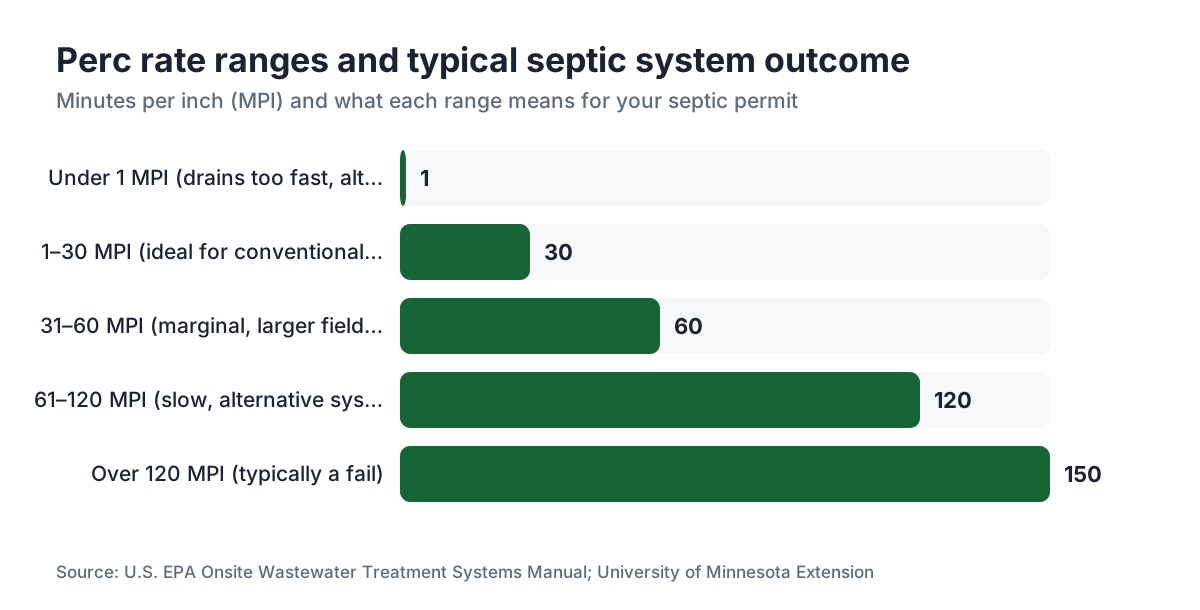
Here's how most states read perc results. Exact cutoffs vary by jurisdiction, so use this as a general guide, not a stand-in for your local code.
| Perc rate (min/inch) | What it usually means |
|---|---|
| Less than 1 | Gravelly or coarse: may drain too fast, groundwater contamination risk, alternative system often required |
| 1 to 30 | Generally ideal for conventional septic absorption fields |
| 31 to 60 | Marginal; some states allow conventional systems with larger fields, some require low-pressure dosing or other alternatives |
| 61 to 120 | Slow; most states require an alternative system (mound, drip irrigation, etc.) |
| Over 120 | Usually a fail; land may not support any in-ground septic |
These cutoffs come from one fact: conventional trench-and-gravel drain fields need soil that absorbs water at a moderate pace. Too slow, the field saturates and sewage backs up. Too fast, the soil doesn't treat the water before it reaches groundwater.
A marginal rate isn't a dead end. If you land in that slow zone, say 45 to 80 MPI, a mound system, drip-irrigation system, or aerobic treatment unit can still work. They cost more, sometimes a lot more, but they're real options. Your leach field design goes to the engineer only after the perc results come in, and those results shape everything downstream.
Who does perc testing?
Short answer: it depends on your state, and you don't always get to pick.
Most jurisdictions require the person running the test to be licensed or certified. That usually means a licensed soil scientist, a professional engineer (PE) in civil or environmental engineering, or a registered sanitarian. Some counties let licensed septic installers test. A handful of states still let homeowners dig the holes themselves if a county inspector witnesses the timed portion, though that's getting rare [3].
The workflow splits two ways. In many counties, you hire a private engineer or soil scientist to run the test, and a county official either witnesses it or reviews the report. In others, you schedule through the health department and a county employee does the whole thing. Call your local health department or environmental quality office first. Rules in one county can look nothing like the county next door.
Hire a private consultant and you're paying for their time, travel, and the report. Prices swing widely. Budget $150 to $500 for a basic perc test in most markets [4]. It climbs to $1,000 or more when the tester has to do a full soil morphology evaluation (sometimes called a perc test plus), which means digging a soil profile pit and describing the horizons, texture, mottling, and depth to restrictive layers.
Septic operators juggling multiple installs often track perc results and county schedules as part of their site evaluation work. Tools like SepticMind help operators log site data and coordinate permit submissions across projects so nothing slips.
Don't just hire the cheapest tester without checking the license. The county rejects results submitted by an unlicensed tester, and you pay to do the whole thing again.
When do you need a perc test?
New construction on a lot without municipal sewer is the most common trigger. Before the county issues a building or septic permit, it wants proof the land can handle a septic system. A passing perc test, or a full site evaluation, is that proof.
You also need one to replace a failed drain field on a property with no recent test on file. The county wants to know whether a conventional replacement fits, or whether the failure means the soil was never suited for what got installed.
Subdivision is another trigger. When a developer splits a parcel into multiple lots, each lot usually needs its own perc test before it can be sold for development.
Real estate deals pull perc tests in too. A rural property listed as buildable may need a test to back that claim, and buyers who want to confirm buildability before closing order one during due diligence. A septic tank inspection on an existing system is a different animal from a perc test, but both show up during a sale.
One case where you probably don't need a new perc test: your existing system runs fine and you just want routine service like a septic tank pump out. The perc test lives upstream of installation, not day-to-day operation.
How much does a perc test cost?
Perc test cost splits in two: what you pay the tester and what you pay the permitting authority.
The tester's fee runs $150 to $500 for a straightforward residential perc test in most U.S. markets [4]. Add $200 to $600 more if a full soil profile evaluation gets required alongside the perc test, which happens more and more. Some states have essentially replaced the standalone perc test with a soil scientist's report, and those cost more because they take longer.
County permit and inspection fees for the review typically run $50 to $250, though some counties fold that into the overall septic permit fee.
Fail and need a re-test? Plan to pay the tester's fee again, and sometimes the county fee too.
After the perc test comes the actual septic tank installation, a separate and larger expense. Total system cost hinges on what the perc test finds: a conventional system on fast-draining soil costs far less than a mound on clay. The cost to install a septic system runs roughly $3,500 to $15,000 or more depending on system type, lot conditions, and local labor.
What happens if you fail a perc test?
Failing a perc test doesn't always mean the lot is unbuildable. It means a conventional septic system won't work there.
What you can do next depends on why you failed. Slow-draining soil is the most common reason, and the answer is a system built for it: mound systems, drip irrigation, aerobic treatment units (ATUs), constructed wetlands, and other designs all exist for exactly this. They're permitted in most states and they work, but they cost more and need more upkeep than a conventional system [5].
Soil that drains too fast (under about 1 MPI) is trickier. The worry is pathogens reaching groundwater before the soil filters them. The fix might be a lined treatment cell or an ATU that treats the water to a higher standard before it discharges.
Other failure causes: the seasonal high water table sits too close to the surface, or bedrock is too shallow. A mound system that builds separation between the wastewater and that limiting layer is often the answer.
If every alternative gets ruled out, the lot may genuinely not support on-site sewage disposal. That's rare for residential lots, but it happens, usually on small lots with poor soil plus shallow bedrock or a high water table. Before you accept that verdict, get a second opinion from a different licensed engineer or soil scientist. Conditions matter: a test run in spring on saturated ground reads worse than one run in late summer.
Timing your test smart isn't cheating. Most states set a valid window, and some require wet-season testing to force a conservative result. Learn your state's rules before you schedule.
What's the difference between a perc test and a soil evaluation?
Traditional perc tests and modern soil evaluations answer the same question, can this land support a septic system, but they get there by different roads.
The traditional perc test is a pure hydraulic measurement. Dig a hole, fill it, time the drop. Simple and repeatable, but it captures one moment and one variable. It misses seasonal water table swings, soil layering, and restrictive horizons that hurt real-world performance.
A full soil evaluation, often called a site evaluation or soil morphology assessment, adds a profile analysis. A soil scientist digs a pit, often 5 to 8 feet deep, and describes every layer: texture, structure, color, mottling (the grayish or orange streaks that mark where water has stood over the years), and depth to bedrock or other restrictive layers. Mottling matters most because it reveals the seasonal high water table even when the water isn't there on test day [6].
Many states, North Carolina and Virginia among them, now require a soil profile evaluation by a licensed soil scientist rather than a timed perc test alone. EPA guidance leans the same way, toward soil morphology as the more reliable read [1].
For homeowners, the practical difference is this: a soil evaluation is more thorough, takes longer, and costs more, but it's far less likely to hand you a misleading result. And when the county requires it, the choice is made for you.
How do you prepare your property for a perc test?
The tester needs access to the proposed drain field, so clear brush, debris, and equipment off the site before they show up. Know where your property lines run, because the holes have to land in the right spot.
Don't try to game the result by conditioning the soil. Dumping sand in a test hole or testing during an unusually dry stretch to fake a faster rate might feel like a shortcut, but a witnessing inspector catches problems, and submitting fraudulent results is a legal problem in most states.
One legitimate move: schedule the test at the right time of year. If your state allows year-round testing and doesn't mandate the wet season, late summer or early fall (when soils run drier) gives faster perc rates that are more likely to pass. That's not manipulation. That's reading the rules.
Find out what the county wants before test day. Some need a site sketch showing the house footprint, well location, and property lines. Others need a completed application filed ahead of the test. Call, get the checklist, follow it exactly. A missing form can push your permit back by weeks.
How does a perc test relate to your septic permit and system design?
The perc test is step two or three in a chain that ends with an installed, permitted septic system.
The usual sequence: you apply for a septic permit, the county reviews your site, a perc test or soil evaluation gets run and submitted, the county approves or doesn't, a licensed designer uses the results to spec a system type and size, the county reviews the design, and a contractor installs it under inspection.
The perc rate drives the sizing math. Most states use loading rate tables: at a perc rate of X MPI, one bedroom's worth of daily wastewater needs Y square feet of absorption area. Slower soil demands more square footage. That's why a marginally slow result doesn't just affect the permit decision. It sets the physical size of the drain field, which drives the cost to put in a septic tank and how much of your yard the system eats.
A passing perc test guarantees nothing about long-term performance. Systems still fail from overloading, poor maintenance, and root intrusion. Regular pumping, which most tanks need every 3 to 5 years, is the main way to protect that drain field. Our guide on how often to pump a septic tank has the timing specifics.
For operators handling permit applications and site evaluations for clients, tracking where each job sits in this sequence is a real headache. SepticMind handles that workflow, letting operators manage permits, test dates, and design submissions in one place.
One last thing: perc results expire in most jurisdictions. They're commonly valid 2 to 5 years. If your project drags and the result ages out, you test again.
State and federal oversight: who makes the rules for perc testing?
The federal government sets the broad frame. The EPA's SepticSmart program and the agency's Onsite Wastewater Treatment Systems Manual lay out best practices for site evaluation and system design [1]. But EPA doesn't regulate individual perc tests or septic permits. That authority sits with the states, and states usually hand it to county health departments or environmental quality offices.
The result is a patchwork. Florida sets highly specific rules on soil texture, depth to the water table, and testing protocols under Florida Administrative Code Chapter 64E-6 [10]. North Carolina requires a licensed soil scientist for site evaluation [9]. Texas Health and Safety Code Chapter 366 governs the On-Site Sewage Facility (OSSF) program and frames testing and permitting statewide [8]. California's environmental health departments run local programs under guidance from the State Water Resources Control Board [7].
Because the rules move so much from county to county, do this first: contact your county health department or environmental services office before anything else. They'll tell you exactly what tests are required, who can run them, when, and what to file. Don't lean on what was true for your neighbor's lot or a different county.
Frequently asked questions
Can I do a perc test myself?
In a small number of counties, homeowners can dig the test holes, but a licensed inspector or soil scientist has to witness the timed test. Most jurisdictions require a licensed professional for the whole thing. Submit DIY results without proper credentials and the county rejects the application. Call your county health department first to find out who is actually qualified to test in your area.
How long does a perc test take?
The on-site portion usually runs 2 to 4 hours if pre-soaking is skipped, but many counties require a 24-hour pre-soak before the timed test starts. In that case the tester returns the next day for the measurement. Add another 1 to 4 weeks for the county to review and approve, though some offices turn results around in a few days.
What is a good perc test result?
A rate between 1 and 30 minutes per inch is generally ideal for a conventional drain field. Most counties approve a standard system up to 45 or 60 MPI. Faster than 1 MPI or slower than 60 to 120 MPI (thresholds vary by state) usually forces an alternative design. The sweet spot for easy permitting is roughly 3 to 15 MPI.
How much does a perc test cost?
Most residential perc tests cost $150 to $500 for the tester's fee. Add $50 to $250 for county permit and review fees. If a full soil profile evaluation is required alongside the perc test, the total can reach $800 to $1,500 or more. Costs swing a lot by region and by how many test holes the county requires.
What happens if my land fails a perc test?
A fail means a conventional septic drain field won't work on that site. It doesn't automatically make the lot unbuildable. Alternative systems, including mound systems, drip irrigation, and aerobic treatment units, are built for poor-draining soils and are permitted in most states. If every alternative gets ruled out by shallow bedrock or a high water table, the lot may not support on-site sewage disposal.
How long is a perc test valid?
Most counties accept perc results for 2 to 5 years. If your building or septic project slips past that window, you'll likely test again. Some counties tie validity to the septic permit itself rather than the test date. Check with your county health department when you get your results so you know your deadline.
Do I need a perc test to sell my property?
Not always, but it depends. If you're selling rural land advertised as suitable for a home with septic, buyers want proof. A valid perc test or a county-approved site evaluation is the standard way to give it. Some buyers make one a closing contingency. A property with a failed or expired perc test may sell at a discount or trigger renegotiation.
What is the difference between a perc test and a perk test?
They're the same thing. "Perc" is short for percolation, which describes water moving through soil. "Perk" is just a common misspelling, and both show up in real estate listings, permit applications, and online forums. When you see either spelling, assume it means the same timed soil drainage test used to evaluate septic suitability.
Who pays for a perc test, the buyer or seller?
It depends on who needs the information and how the deal gets negotiated. Sellers who want to market land as buildable usually pay before listing. Buyers verifying a claim before closing pay as part of due diligence. Sometimes the parties split it or the seller credits the buyer at closing. There's no universal rule; it's a negotiation point like a home inspection.
Can a perc test be done in winter?
It depends on your state's rules. Some states bar testing when soils are frozen because the results won't reflect real drainage. Others allow year-round testing. Some require wet-season testing to force a conservative, worst-case result. Check your county's requirements before scheduling. A test run under frozen or unusually dry conditions may get rejected by the permitting authority.
Is a perc test required for a mound septic system?
Yes, typically. A mound system is often the alternative prescribed after a perc test finds soil too slow for a conventional design. The county still needs a soil evaluation, which may include or replace the traditional perc test, to set the mound's requirements: how much fill, what loading rate, and how large the absorption area must be. The perc test or soil evaluation drives the mound design.
What is a perc test hole, and how deep is it dug?
A perc test hole is a small excavation, typically 4 to 12 inches across and 12 to 36 inches deep, dug in the proposed drain field area. The tester fills it with water repeatedly until saturated, then times how fast the level drops. Some codes require holes at the proposed trench depth, which can be deeper. Exact dimensions are set by state or county testing protocol.
Sources
- U.S. EPA SepticSmart Program and Onsite Wastewater Treatment Systems Manual: EPA's manual states that soil is the most important element in the treatment and disposal of wastewater, and its guidance favors soil morphology assessment over timed perc tests alone.
- U.S. EPA, Onsite Wastewater Treatment Systems Manual (EPA/625/R-00/008): Standard perc test procedure includes pre-soaking, filling the hole to a set level, and recording water drop over multiple cycles, with the slowest rate used as the result.
- National Environmental Services Center (NESC), West Virginia University: Who may conduct a perc test varies by state; some allow homeowners to dig test holes if a county inspector witnesses the test, while most require a licensed professional.
- Angi (formerly HomeAdvisor) Perc Test Cost Guide: Perc test costs typically range from $150 to $500 for a basic residential test in most U.S. markets.
- U.S. EPA, Types of Septic Systems: Alternative systems including mound systems, drip irrigation, and aerobic treatment units are approved and designed for sites where conventional systems cannot be used due to poor soil conditions.
- University of Minnesota Extension, Onsite Sewage Treatment Program: Soil mottling indicates the seasonal high water table, which a full soil evaluation captures even when water is not present on test day.
- California State Water Resources Control Board, Onsite Wastewater Treatment Systems Policy: California's county environmental health departments administer local septic permitting programs under State Water Resources Control Board guidance.
- Texas Health and Safety Code Chapter 366, On-Site Sewage Facilities: Texas Health and Safety Code Chapter 366 governs the state's On-Site Sewage Facility program, including site evaluation and testing requirements for septic permits.
- North Carolina Department of Environmental Quality, Wastewater Section: North Carolina requires a licensed soil scientist to conduct site evaluations for septic system permitting, moving beyond timed perc tests toward soil morphology assessment.
- Florida Administrative Code Chapter 64E-6, Standards for Onsite Sewage Treatment and Disposal Systems: Florida's Chapter 64E-6 specifies detailed requirements for soil texture, depth to seasonal high water table, and testing protocols for septic system site evaluation.
- University of Minnesota Extension, Percolation Tests for Septic Systems: Perc rate thresholds for conventional septic systems and guidance on alternative systems when rates fall outside acceptable ranges.
- Penn State Extension, Soil Percolation and Onsite Sewage Systems: Perc test results expressed in minutes per inch are used with loading rate tables to determine required drain field absorption area per bedroom.
Last updated 2026-07-10