Submersible pumps for septic tanks: the complete guide
By the SepticMind Editorial Team
TL;DR
- A submersible pump sits inside your septic tank or pump chamber and pushes effluent uphill to a drain field, mound system, or dosing chamber when gravity can't do the job.
- The pump alone costs $150 to $500.
- Installed, figure $300 to $900.
- Most last 5 to 15 years depending on run cycles, solids exposure, and how well you keep the tank pumped.
What does a submersible pump do in a septic system?
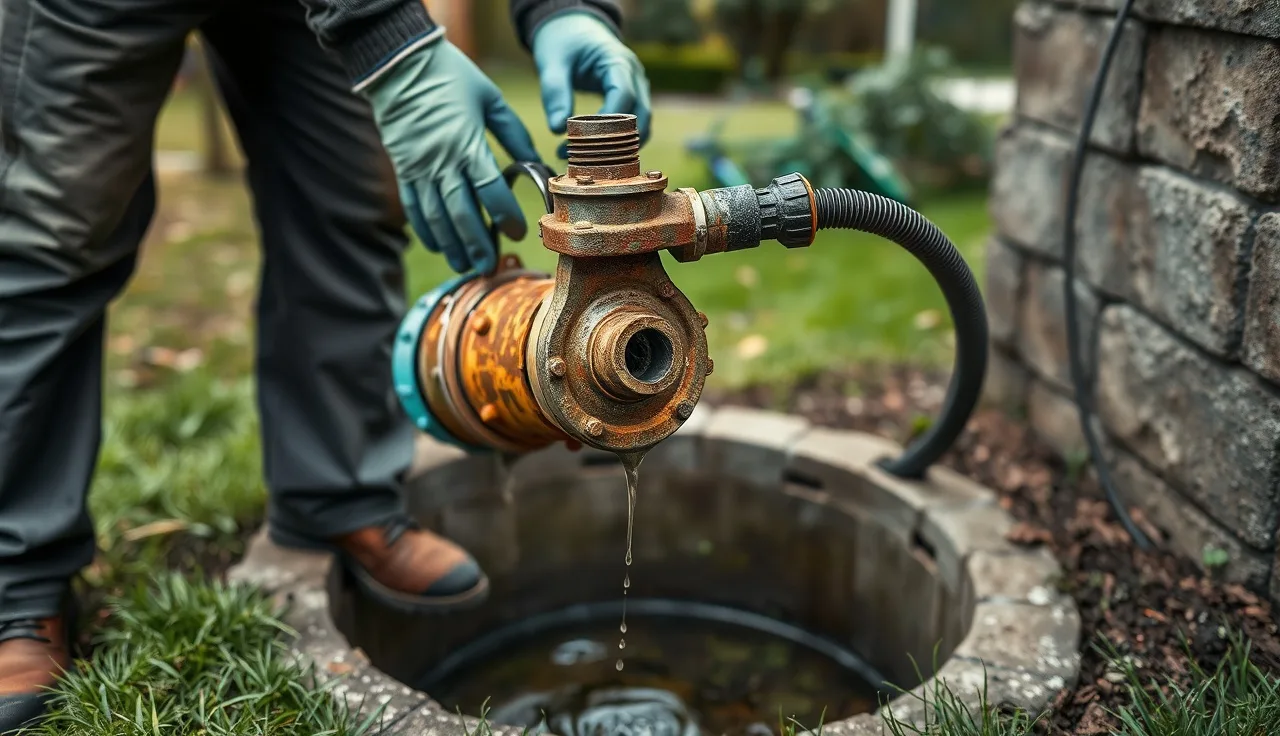
A submersible pump sits underwater inside a septic tank, a separate pump chamber, or a dosing tank. Its job is simple. Move treated effluent from one place to another when gravity can't. That happens more often than most homeowners expect.
Gravity-fed septic systems work fine when your drain field sits downhill from your tank. The moment your lot flattens out, your field is uphill, or you're running effluent several hundred feet to a remote leach field, you need a pump. People call it a septic tank lift pump, and the word "lift" says everything. The pump beats the elevation gravity can't.
The pump connects to a float switch assembly. When the liquid level rises high enough to trip the float, the pump kicks on, doses a set volume to the drain field, then shuts off. That on/off pattern is called dosing. It spreads effluent across the leach field far more evenly than a steady gravity trickle would, and even loads protect the soil and stretch out field life.
Submersible pumps are not aerator pumps (which push air into aerobic treatment units), and they're nothing like the vacuum trucks used for septic tank pumping. Different machines, different jobs. A submersible effluent pump handles liquid that has already separated in the tank. It is not built to move raw sewage full of solids.
What are the different types of submersible septic pumps?
Three pump types show up in residential septic work, and they are not interchangeable.
Effluent pumps do most pump-to-field work. They handle liquid with small suspended solids (usually up to 3/4-inch solids, though specs vary by model) and run partly submerged for years. If you have a standard septic tank with a pump chamber, or a mound system, this is almost certainly your pump. Zoeller, Liberty, and Goulds own most of this market.
Sewage pumps move raw or barely-settled sewage and pass bigger solids, often 2 inches or more. They live in grinder pump stations and holding tanks where effluent hasn't separated yet. They cost more than effluent pumps and are overkill for most residential drain-field work.
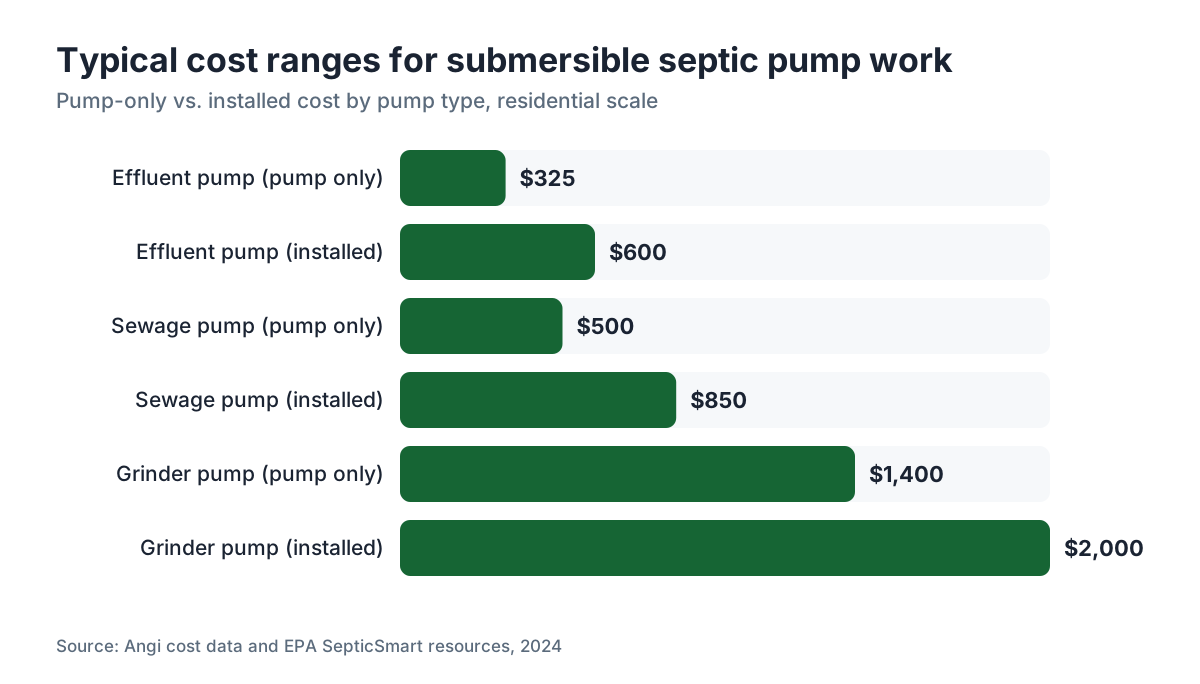
Grinder pumps are sewage pumps with a macerating impeller that shreds solids before pumping. You see them in low-pressure sewer systems and some pressure-dosed septic setups on rough lots. They run at much higher pressure than effluent pumps and cost a lot more, often $800 to $2,000 for the pump alone [1].
For most homeowners on a conventional or mound system, an effluent pump is the right pick. Don't let anyone sell you a grinder pump for a standard drain field. It's wasted money, and the higher pressure can wreck conventional leach field distribution pipes.
| Pump Type | Typical Solids Passage | Common Application | Pump-Only Cost (est.) |
|---|---|---|---|
| Effluent pump | Up to 3/4" | Mound, at-grade, pressure-dosed field | $150, $500 |
| Sewage pump | Up to 2" | Holding tanks, lift stations | $300, $700 |
| Grinder pump | Grinds solids | Low-pressure sewer, some pressure-dosed | $800, $2,000 |
Those are pump-only estimates from product listings and contractor invoices. Installation adds $150 to $500 depending on access and local labor rates [2].
How does a submersible effluent pump actually work?
The pump housing is sealed so the motor can sit underwater without shorting out. A sealed motor spins an impeller fast enough to build the pressure that shoves effluent up a discharge pipe to the distribution system.
Most residential systems use one float set at the "pump on" level and a second float set higher as the high water alarm. When effluent reaches the pump-on float, the pump runs. It drives a dose through the discharge pipe, up past a check valve (which blocks backflow when the pump stops), and into the pressure manifold or distribution box feeding the leach field. The pump shuts off when the water drops back below the float.
The check valve earns its keep. Without it, every shutoff lets the effluent in the discharge pipe drain back into the chamber. That return flow slams the impeller backward and shortens its life. A working check valve protects the pump, and it should get a look every time the pump is serviced.
The alarm float sits above the pump-on float. If the pump quits, or the system takes on more flow than the pump can clear, liquid climbs to the alarm float and sets off a light and buzzer on the panel inside the house. EPA's SepticSmart guidance tells homeowners to watch their alarm and act on it fast. That alarm is your warning before sewage backs into the house or surfaces in the yard [3].
When does a septic system actually need a pump?
Not every system needs one. If your drain field sits below the tank and the soil allows gravity distribution, you may never need a pump. But several situations make one mandatory.
Elevation is the obvious trigger. If the field is higher than the tank outlet, effluent has to be pumped up. Even a foot or two forces the issue. You can't push water uphill by wishing.
Mound systems always need a pump. A mound is a raised drain field built above native soil when the seasonal high water table or bedrock sits too close to the surface for a buried field [4]. Because the mound is above grade, a pump chamber gets built as a second compartment or separate tank, and the pump doses effluent up into the mound's distribution pipes.
Pressure-dosed systems use a pump even when the field sits at the same elevation, because timed dosing spreads effluent evenly and rests the soil between doses. Many state codes now require pressure dosing for new installs on marginal soils. Check your state's onsite wastewater rules for the threshold.
Long runs push people toward pumps too. If the house is far from the field, or the field wraps around a big lot, gravity flow through a long lateral may not hold enough velocity to keep solids from settling in the pipe. A pump fixes that.
Retrofits come up after a failed gravity field. When a septic system repair moves the field to higher ground, a pump gets added. That's often cheaper than heavy regrading.
How long do submersible septic pumps last?
Honest answer: 5 to 15 years, with wide variance. Some of it you control. Some of it you don't.
Run time matters more than age. A pump dosing 10 times a day for a busy family piles up operating hours far faster than one dosing 3 times a day for two people. More cycles mean more heat, more wear on the impeller and seals, and a motor that tires out sooner.
Solids exposure kills pumps. Effluent pumps want clarified liquid, not sludge. Skip your tank pumping and sludge builds until it carries over into the pump chamber. Sludge clogs impellers, cooks motors, and turns a $400 pump into scrap in months. EPA recommends pumping a typical household tank every 3 to 5 years [3]. For pump life, that schedule counts as much as anything. Our guide on how often to pump your septic tank covers the sizing math.
Power quality shapes motor life. Voltage swings and repeated outages cycle the pump on and off abnormally. A surge protector on the panel helps.
Zoeller, one of the most-cited manufacturers in this category, lists expected service life in its product documentation as "5 to 15 years depending on application," which matches what contractors see in the field. Nobody has good population-level data here. The closest thing is manufacturer service records, and they don't publish aggregate failure curves.
Heat is the quiet killer. A pump that runs dry, even for a few minutes, makes enough heat to destroy the seals. A float stuck in the "on" position causes exactly that. Checking float operation once a year costs nothing and can save you a pump.
What does it cost to replace a submersible septic pump?
Expect $300 to $900 for a full replacement including labor, for a standard residential effluent pump. The range is wide because access, local labor rates, and pump model all move the number.
The pump itself runs $150 to $500 for a quality effluent model. A Zoeller M267 or equivalent 1/2 HP pump usually lists around $200 to $350. A 3/4 HP pump for higher heads or longer runs is $300 to $500. Skip the cheapest imports here. A pump that dies in two years costs more in callbacks than the $80 you saved.
Labor runs $100 to $400 depending on whether the contractor has to dig up a buried access riser, how deep the chamber is, and how long it takes to reconnect fittings and test the floats. If your chamber has a riser brought to grade (it should), this is a clean service call.
The alarm panel and floats rarely need replacing at the same time as the pump. But if the floats are corroded or cracked, swap them while the contractor is already down there. Float assemblies run $20 to $80.
For context, a septic tank pump out at the same visit runs $250 to $600 for most households [5]. Doing both at once saves a truck roll. And a failing pump often means the tank hasn't been pumped recently enough, so combining the work pays off.
If you're weighing a pump replacement against a bigger system problem, our overview of septic tank repair costs puts the numbers in context.
How do you size a submersible pump for a septic system?
Sizing comes down to two numbers: flow rate (gallons per minute, GPM) and total dynamic head (TDH). Get either wrong and the pump either can't do the job or short-cycles itself to death.
Flow rate for a residential system comes from your system design, specifically the dose volume and the longest the system can sit off between doses. Your state's onsite wastewater code sets the minimum and maximum dose volumes. A typical residential system doses 50 to 150 gallons per cycle. If the design calls for a 100-gallon dose delivered in 5 minutes, you need at least 20 GPM.
Total dynamic head is the actual vertical lift (static head) plus friction losses in the pipe. Static head is easy. If the mound distribution pipe sits 8 feet above the pump, that's 8 feet of static head. Friction losses depend on pipe diameter, length, and fittings. A 1.25-inch pipe running 100 feet adds real friction loss; a 2-inch pipe over the same distance adds far less. Most residential jobs land between 10 and 30 feet TDH.
Manufacturers publish performance curves showing flow at various head pressures. Match your required GPM to the head your system imposes, then pick the model that delivers that flow at that head. Don't shop by horsepower alone. Two 1/2 HP pumps from different makers can have completely different curves.
For most residential mound or pressure-dose systems, a 1/2 HP pump rated at 20 to 30 GPM at 20 feet TDH covers the common range. Long run or big elevation? Step up to 3/4 HP. Your septic designer or installer has the original design with the target flow and head. Ask for it before you buy a replacement.
What are the signs a septic pump is failing?
Alarm lights are the obvious one. If the high-water alarm is lit or beeping, the pump has probably stopped moving effluent. Don't silence it and walk away. You have roughly 24 to 48 hours before the backup becomes a real problem, depending on household use and tank volume.
Slow drains all over the house, with no alarm, can mean the pump runs but delivers less flow than it should. A failing impeller or partial clog degrades performance without ever tripping the alarm float.
The pump hums but nothing moves. You hear the motor through the lid but the chamber level won't drop. That's usually a jammed impeller, a failed check valve recirculating water, or a discharge pipe that's cracked or blocked.
Short-cycling: the pump kicks on and off fast. That points to a mismatched dose volume, a stuck float, or a pump losing prime. Repeated short-cycling burns motors out quick.
Wet spots or unusually green grass over the mound or field, paired with slow drains, suggest the field is getting less effluent than it should, which can trace back to a pump throwing weak doses.
Seeing any of these? A septic tank inspection that includes pump chamber access is the right first move before you spend money on parts.
How do you maintain a submersible septic pump?
Annual inspection is the baseline. A qualified tech lifts the chamber lid, checks the floats for free movement, inspects the power cord for nicks, tests the alarm, and confirms the check valve holds. The whole visit runs 30 to 45 minutes if everything is healthy.
Pump your tank on schedule. EPA's SepticSmart guidance says to have your septic system serviced regularly. For pump life, this is non-negotiable. Sludge carry-over from an overfull tank is one of the top pump killers in service records, and the link between pump life and pumping frequency is direct [3]. See septic tank cleaning for what that service actually covers.
Keep out anything that shouldn't go down the drain. Wipes (even "flushable" ones), feminine products, and paper towels don't break down and can clog an effluent pump impeller even after settling partway in the main tank. EPA puts it plainly in its SepticSmart guidance: never flush wipes, even ones labeled flushable [3].
Keep a record. Write down the pump model, install date, and every service visit. When replacement time comes, that model number saves you time and gets you the right performance spec. Plenty of homeowners find their pump dead and have no idea what was in the hole.
Test the alarm panel every month. Panels have a test button. Press it. If the light and buzzer stay quiet, the panel needs service. A dead alarm stays invisible right up until sewage is backing into the house.
For operators running multiple accounts, tracking pump ages and inspection cycles across a customer base is exactly what SepticMind's operations platform is built for, flagging accounts overdue for pump inspections based on install records.
What are the electrical requirements for a septic pump?
Most residential submersible effluent pumps run on 120V single-phase power, though 240V models exist for bigger jobs. The pump belongs on a dedicated circuit protected by a GFCI breaker. That's not optional. A pump submerged in a wet environment on a shared circuit is a code violation in nearly every jurisdiction and a real electrocution hazard.
The National Electrical Code (NEC), published as NFPA 70, governs these installations, and most state codes adopt or mirror its requirements for septic pumps, including GFCI protection [10]. Your local electrical inspector can confirm what applies where you live.
Typical residential effluent pumps draw 5 to 10 amps at 120V. A 1/2 HP pump pulls roughly 6 to 8 amps running; startup (inrush) current is 3 to 5 times that for a fraction of a second. Size the breaker to swallow inrush without nuisance tripping. A 15-amp dedicated circuit is standard for 1/2 HP pumps, 20-amp for 3/4 HP.
The alarm panel usually runs on its own 120V circuit, separate from the pump. That way a tripped pump circuit doesn't kill the alarm too. Some panels add a time-delay relay so the alarm doesn't sound during brief outages, because restoring power often triggers a momentary high-water reading that clears on its own.
Run wiring in conduit from the panel to the chamber, and use the manufacturer's specified cord inside the chamber, never a field splice. Any splice underwater invites corrosion and eventually a short.
Can you install or replace a septic pump yourself?
Physically, many homeowners can pull and replace a submersible effluent pump. The basic steps: cut power at the panel, open the access riser, disconnect the discharge union and electrical connections, pull the pump by its rope or chain (there should be one; if there isn't, add one on reinstall), drop in the new pump, reconnect, test the floats, restore power. It's not hard plumbing.
The real question is whether you should. In many states, work on a septic system beyond routine maintenance requires a licensed septic contractor or a licensed electrician for the electrical side. Pulling and replacing a pump without a permit can bite you at resale when a septic tank inspection turns up unpermitted work. Check your state's onsite wastewater rules first.
Diagnosing why the pump failed matters as much as the swap. If it burned out from a bad float, a wiring fault, or chronic sludge carry-over, dropping in a new pump without fixing the cause buys you the same failure in a year. A tech who knows the system is less likely to repeat that mistake.
If you do DIY, follow the manufacturer's install instructions exactly. Don't oversize the pump. Over-pumping a mound at too high a flow rate can hydraulically load the distribution manifold past its design and damage the field. Our breakdown of the cost to install a septic system shows why protecting the field matters to your wallet.
How do state and federal rules affect septic pump installations?
The EPA doesn't regulate individual septic systems directly. That authority sits with states, which often hand it to counties. But EPA guidance through SepticSmart and the Office of Water sets the framework most state programs reference [3][6].
Most states require a permit for a septic pump install or replacement when the work goes beyond swapping a like-for-like pump on an existing permitted system. Some states go further. Florida, under Chapter 64E-6 of the Florida Administrative Code, requires a licensed septic contractor for any repair or modification to an onsite sewage treatment and disposal system [7]. California's rules vary by county but generally require permits for any component replacement that changes system function.
University extension programs publish state-specific guidance. The University of Minnesota Extension has detailed material on mound systems and pump specs for northern climates where frost affects pump chamber access [4].
For a pump that's part of a brand-new system, requirements are more uniform. The design has to be stamped by a licensed designer, the install inspected by the local health department, and the pump spec has to match the approved design. Substitute a different pump model without re-approval and you can void the permit.
The practical move: call your county health department before any pump work and ask whether a permit is required. The call takes five minutes and costs nothing. Working without a required permit creates liability at sale and, in some states, brings fines.
Frequently asked questions
How do I know if my septic system has a pump?
Look for a second access lid near your tank or a separate pump chamber tank, plus an alarm panel (a small box with a light and buzzer) mounted near your electrical panel or on an exterior wall. If you have a mound system, you definitely have a pump. Your inspection report from purchase should also note whether a pump is present.
How long does it take to replace a submersible septic pump?
A straightforward pump swap with good access takes 1 to 2 hours for a licensed technician. If the access riser is buried, fittings are corroded, or the tech has to chase a wiring issue first, add another hour or two. Most contractors block out half a day to be safe.
What happens if my septic pump fails overnight?
Your high-water alarm should sound. If it does, cut water use in the house as much as you can. Every flush and drain fills the tank faster than a dead pump can clear it. Call a contractor first thing in the morning. Most pump failures aren't instant emergencies if you slow water use, but don't ignore them past a day or two.
Can I use a sump pump as a septic effluent pump?
No. Sump pumps move clean groundwater and aren't rated for effluent with suspended solids or the corrosive chemistry of wastewater. The seals and impeller materials differ. A sump pump in a septic application fails fast, sometimes within weeks, and can void any warranty. Use a pump rated specifically for septic effluent service.
What size pump do I need for a mound septic system?
Most residential mound systems use a 1/2 HP effluent pump delivering 20 to 30 GPM at 15 to 25 feet of total dynamic head. Your original design documents spell out the required flow and head. Match the replacement pump's performance curve to those numbers. When in doubt, ask the contractor who installed or last serviced your system.
How much does a septic lift pump cost to run per month?
A 1/2 HP pump (roughly 375 watts) running 30 minutes a day uses about 0.19 kWh daily, or roughly 5.7 kWh per month. At the U.S. average residential rate of about 16 cents per kWh (EIA, 2024), that's under $1 a month in electricity. Even 3/4 HP systems add only a few dollars monthly [9].
What brand of submersible septic pump is most reliable?
Zoeller is the most consistently recommended brand among licensed septic contractors in the U.S., followed by Liberty Pumps and Goulds Water Technology. All three have long track records in residential effluent service. Brand matters less than matching the pump's performance curve to your system's actual head and flow.
Does a septic pump need to be replaced when the tank is pumped?
No, not routinely. Tank pumping and pump replacement are separate services. A technician should inspect the pump during a tank pump-out, but replacement is only needed when the pump shows signs of failure, is past its expected service life (10-plus years), or is undersized for the current household load.
Why does my septic pump run constantly?
A pump that won't shut off usually has a stuck float switch. The float is either tangled in the cord, corroded in position, or failed open. A constantly running pump burns out the motor within hours to days. Cut power at the pump breaker and call a technician right away. Also check whether a failed check valve is recirculating water and keeping the level up.
Can cold weather affect a submersible septic pump?
The pump itself sits in liquid that stays above freezing as long as the tank or chamber is buried below the frost line. The risk is the discharge pipe above the chamber. If that pipe isn't insulated or buried deep enough, it can freeze and block flow, backing up the chamber and eventually tripping the alarm.
Is a septic pump the same as an aerator pump?
No. An aerator pump injects air into an aerobic treatment unit (ATU) to feed bacterial digestion. A submersible effluent pump moves liquid from one place to another. They're completely different components. Some systems have both: an aerator in the treatment tank and a submersible pump in a separate dosing chamber.
What maintenance schedule should I follow for a septic pump?
Inspect the pump, floats, alarm, and check valve once a year. Pump the tank every 3 to 5 years for a typical household (EPA SepticSmart guidance). Test the alarm panel monthly with the test button. Keep records of install dates and service visits. Replace the pump proactively if it's over 10 years old and you're already opening the chamber for something else.
Sources
- U.S. EPA, Septic Systems (Onsite Wastewater) program: Grinder pump cost range and application context for low-pressure systems
- U.S. EPA SepticSmart Program: Pump installation cost ranges and homeowner guidance on septic system components
- U.S. EPA SepticSmart homeowner guidance: EPA recommends pumping every 3-5 years, checking alarm panels regularly, and not flushing wipes even those labeled flushable
- Angi, Septic Tank Pumping Cost Guide: Septic tank pump-out costs $250 to $600 for a typical residential tank
- U.S. EPA, How Your Septic System Works: EPA framework for onsite wastewater; states hold primary regulatory authority
- Florida Department of Health, Onsite Sewage Programs (Chapter 64E-6, FAC): Florida requires a licensed septic contractor for any repair or modification to an OSTDS
- U.S. Energy Information Administration, Electricity Data Browser: U.S. average residential electricity rate approximately 16 cents per kWh as of 2024
- National Fire Protection Association, NFPA 70 (National Electrical Code): NEC governs electrical requirements for septic pump installations including GFCI protection
- U.S. EPA, Septic Systems program: EPA guidance on what not to flush and scheduling regular septic service
Last updated 2026-07-09