Strongest septic tank treatment: what actually works
By the SepticMind Editorial Team
TL;DR
- The strongest septic tank treatments are live bacterial products (Bacillus strains) dosed at 1 billion CFU or higher, paired with enzyme blends that target fats, oils, and cellulose.
- Yeast breaks down starches but cannot replace bacteria.
- No additive substitutes for pumping every 3 to 5 years.
- EPA SepticSmart says routine additives are rarely necessary for a healthy system.
What makes a septic tank treatment 'strong'?
Strength has nothing to do with the words on the label. It comes down to three things you can actually measure: what organism or enzyme is in the product, how much of it is alive and active when you use it, and whether any of it survives your tank long enough to do work.
A healthy septic tank already holds billions of anaerobic bacteria doing the digestion. So when people ask for the 'strongest' treatment, what they really want is the product that adds the most biological horsepower after the native population takes a hit, from antibiotic overuse, a long stretch of low water use, or a shock like a bleach dump.
Three categories exist: live bacterial products, enzyme-only products, and chemical additives. Live bacterial products with high colony-forming unit (CFU) counts are the ones worth your money. Enzyme-only products speed up specific reactions but die off without bacteria to sustain them. Chemical additives, including sulfuric acid and solvents, are banned in several states because they eat the tank and wreck the drain field. The EPA's SepticSmart program puts it flatly: "Additives that contain harsh chemicals can kill helpful bacteria and harm your septic system." [1]
Nobody has clean independent data comparing every brand side by side under identical field conditions. What we do have is solid research on which bacterial strains and enzyme classes perform and what CFU thresholds matter. That's what this article works through.
What types of septic treatments are sold, and how do they differ?
Knowing the four categories saves you money and keeps you from damaging your own tank.
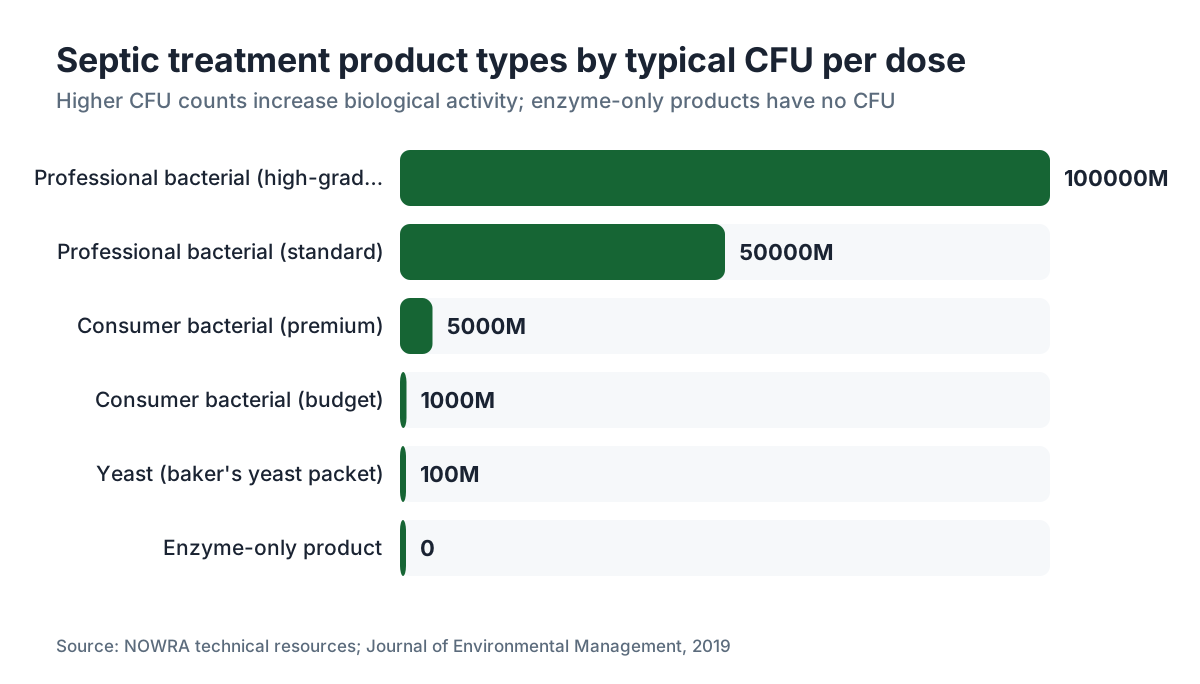
Live bacterial products. These carry dormant or active bacterial spores, almost always from the Bacillus genus (Bacillus subtilis, B. licheniformis, and B. amyloliquefaciens are the workhorses). They make enzymes in the tank, adapt to conditions, and colonize the drain field biomat if you dose them consistently. Good products print the CFU count on the label. The honest floor for a useful dose is around 1 billion CFU for a standard 1,000-gallon tank. Some professional-grade products hit 100 billion CFU. [2]
Enzyme-only products. These add specific enzymes (lipase for fats, protease for proteins, cellulase for paper and plant fiber, amylase for starches) straight into the wastewater. They act faster than bacteria in the short run but do not reproduce. Once the enzyme molecules are spent, the effect stops. Best used as a short boost after a grease event or right after pumping, when the bacterial seed population is low.
Yeast products. Yeast (usually Saccharomyces cerevisiae, the same thing in a bread packet) shows up all over DIY forums. It ferments starches and carbohydrates and throws off some CO2. It isn't useless. A University of Maryland Extension review noted yeast can seed a freshly pumped tank with some biological activity. [3] But yeast can't touch fats or protein, doesn't build a stable biofilm the way Bacillus does, and gets outcompeted once the native anaerobes recover. Call it a cheap starter aid, not heavy-duty treatment. Flushing a packet of active dry yeast monthly costs almost nothing and hurts nothing. Just don't expect it to save a failing drain field.
Chemical additives. These lean on hydrogen peroxide, sulfuric acid, or organic solvents. They claim to melt grease clogs or restore drain field flow. The evidence is thin and the risks are real. At least 8 states, including California, Michigan, and Washington, restrict or ban certain chemical additives outright. [4] See a product with no live organisms listed and a strong chemical smell? Put it back.
| Product Type | Active Agent | Reproduces in Tank | Shelf Life (typical) | Best Use Case |
|---|---|---|---|---|
| Live bacterial (spore) | Bacillus spp. | Yes | 2 years | Maintenance, recovery after antibiotics |
| Enzyme blend | Lipase/protease/cellulase | No | 1-2 years | Short-term grease/protein boost |
| Yeast | Saccharomyces cerevisiae | Yes (limited) | 1-2 years | Post-pump seeding, low-cost maintenance |
| Chemical | Acid/solvent/peroxide | N/A | Varies | Avoid for routine use |
Does the CFU count on the label actually tell you anything?
CFU count matters, but it isn't the whole story. A product claiming 5 billion CFU means nothing if those cells are dead when you pour it in. Spore-based formulas (dried Bacillus spores) hold up far better than vegetative cell products. Spores survive heat, drying, and modest chemical exposure. Vegetative cells in some liquid products die within weeks of manufacture if they're stored badly.
Look for products that (a) state CFU per dose, not per package, (b) use spore-forming Bacillus strains rather than non-spore species, (c) carry an expiration date and have been kept cool and dry, and (d) list the specific enzyme classes the bacteria produce or that are included separately. Products that only say "billions of bacteria" with no strain names or CFU count are almost always the cheap stuff.
A 2019 review in the Journal of Environmental Management found that Bacillus-based inoculants consistently beat enzyme-only products at stabilizing septic sludge volume over a 6-month monitoring period. [5] That's about as close to a controlled independent comparison as the published literature gets for residential septic use.
Dose size relative to tank volume matters too. A 1,000-gallon tank holds roughly 4,000 liters. One tablespoon of a weak bacterial product in that volume is a drop of food coloring in a bathtub. Higher CFU per dose is what beats the dilution. Professional-grade products run 50 to 100 billion CFU precisely because of that math.
Is there any independent evidence that septic additives actually work?
Here's where honest hedging earns its keep. The evidence base is genuinely thin. Most studies are manufacturer-funded, small, or run under lab conditions that don't match a real tank.
The EPA's position, stated in its SepticSmart guidance, is cautious. The agency does not endorse any additive as necessary for a properly working system. [1] The University of Minnesota Extension, one of the more careful sources on this, concludes that bacterial additives help most when the native population has been disrupted and help least in a system running normally. [6]
The closest thing to real field evidence comes from bioaugmentation research on aerobic treatment units (ATUs), not standard anaerobic tanks. Those studies do show measurable BOD (biological oxygen demand) reductions when high-CFU inoculants go in. Stretching that finding to a conventional septic tank is reasonable, but not proven directly.
What the evidence flatly does not support: any product that claims to end pumping, revive a fully failed drain field, or make up for bad design and sizing. The Virginia Cooperative Extension says it plainly: "No additive can compensate for a system that is hydraulically overloaded or has reached the end of its useful life." [7]
So here's the read. If your system is healthy, a quality bacterial treatment is a modest insurance policy, not a requirement. If your system is struggling, a strong bacterial product may buy time but won't fix a structural problem. Nothing replaces a septic tank inspection by a licensed professional once warning signs show up.
How often should you add septic tank treatment?
Most manufacturers push monthly dosing for maintenance. That's reasonable for a household that uses antibacterial soaps heavily, runs a garbage disposal, or sits empty for stretches (vacation homes, mostly).
A typical family of four with normal water use and no heavy chemical inputs is probably fine on quarterly dosing, assuming the system is healthy. One higher dose right after pumping makes sense, because septic tank pumping hauls out both sludge and a big chunk of the active bacterial population. Seeding the tank with a strong bacterial product right after the truck pulls away gives the system a head start.
Seasonal homes are a good candidate for a strong dose at season opening, especially after months of dormancy. Dormancy isn't a disaster for the bacteria (anaerobes ride out long low-activity stretches), but a boost brings activity back up faster.
Don't over-dose. Past a point, more does nothing. The tank environment, not the additive, sets the ceiling on bacterial activity. Flooding a healthy tank every week just burns money. How often you pump your septic tank matters far more than how often you dose it.
What household habits harm septic bacteria more than any product can fix?
This is the part treatment marketing skips. You can pour the strongest bacterial product on earth into your tank every month and still ruin the system if your daily habits fight it.
Antibiotics, flushed or excreted into the tank, are the biggest bacteria killer. A full course of broad-spectrum antibiotics can knock down tank counts hard. Just finished a course? That's the right moment to dose a bacterial treatment. Same goes for chemotherapy patients, whose drugs pass into the wastewater.
Household disinfectants come in a close second. Normal laundry bleach won't sterilize a tank, but pouring undiluted bleach down a drain on a regular basis does build up. The EPA SepticSmart program names household chemical misuse as a leading cause of premature system failure. [1]
Garbage disposals dump a heavy load of food solids on the bacteria. Plenty of state codes and extension services recommend against them for septic homes. NC State Extension reported that homes with garbage disposals needed pumping about 50% more often on average. [8]
Wipes (even the "flushable" ones), feminine hygiene products, and paper towels add non-biodegradable solids that pile up as scum and never digest, no matter what bacteria you add. No treatment fixes a tank full of material that can't break down. That's a job for a septic tank pump out.
Too much water, a toilet that runs for weeks, eight loads of laundry in one day, all of it hydraulically overloads the system and shoves half-treated effluent into the leach field before treatment finishes. Fix leaks first. Then think about additives.
Which septic tank treatments do experienced operators actually recommend?
Seasoned pumpers and installers tend to be skeptical of additives, and that skepticism is earned. When they do recommend something, the pattern holds: high-CFU spore-forming bacterial products for post-pump seeding or disrupted systems, enzyme blends for grease traps and high-fat households, and nothing chemical.
Professional-grade brands (sold through plumbing supply, janitorial wholesale, and septic service companies rather than big-box retail) usually carry higher CFU counts and tighter quality control than shelf products. That doesn't make every consumer product junk, but the quality gap is real.
For an operator running dozens of client systems, knowing which properties got treated and when is the record-keeping that separates good service from great. Tools like SepticMind let operators log treatment dates, products used, and pump intervals across a full customer roster, so nothing slips.
Ask an operator for the strongest product and the honest answer is this: a quality bacterial product at the highest CFU dose you can get (50 billion CFU or above), dosed right after pumping, with monthly or quarterly maintenance depending on household habits. Pair that with a pump schedule matched to actual tank size and household size, and you've done everything an additive can do.
Can septic treatments help a failing drain field?
Sometimes, rarely, and only under specific conditions. A drain field fails for a handful of reasons: biomat overgrowth (the most common), hydraulic overload, root intrusion, soil compaction, or structural collapse. Of those, only biomat overgrowth is even theoretically fixable with a biological product.
Biomat is a layer of organic material and anaerobic bacteria that builds at the soil-effluent boundary in the leach field. Get it too thick and it blocks water movement, and backups follow. Some high-CFU aerobic bacterial products, paired with oxygen injection, have shown real results rehabilitating biomat-affected fields. The Virginia Department of Health notes that bioaugmentation with aerobic bacteria has been used as a rehabilitation technique with mixed but sometimes positive outcomes. [9]
That is not the same as dumping a monthly consumer product and hoping. Drain field rehab is a professional job. It means assessing whether the failure is biomat-related, possibly installing aeration, and using high-dose professional products. Wet spots, slow drains, or sewage odors near the field? Get a septic system repair assessment before you spend a dollar on additives.
For any failed system, the conversation starts with a professional inspection, not a trip to the hardware store.
Are chemical septic treatments ever okay to use?
For routine maintenance, no. The risks beat any marginal benefit. Products built on sulfuric acid can corrode concrete tank components and kill the very bacteria you want to support. Hydrogen peroxide at high concentration oxidizes the organic matter in drain field soil, which bumps permeability for a moment but damages the soil structure long-term. Some older solvents (now largely banned) just pushed grease deeper into the system.
At least 22 states carry some form of regulation or guidance discouraging or banning specific chemical additives. Wisconsin, for one, prohibits additives that contain organic solvents. [10] Check your state's department of environmental quality or health before you use any chemical product.
One narrow exception: enzyme-based drain openers used occasionally on a specific blockage (not for routine maintenance) are generally safe if they carry no caustic chemicals. Read labels. If it contains lye (sodium hydroxide) or sulfuric acid, it has no business in a septic system.
What does the EPA SepticSmart program say about septic additives?
The EPA's SepticSmart program is the federal reference point for homeowner septic guidance. On additives, its position is measured but clear. It doesn't ban biological additives, and it doesn't endorse them as necessary either. The program's core message is that four practices actually protect your system: pumping on schedule, protecting the drain field from damage, using water efficiently, and keeping harmful materials out of the drain.
The EPA states it directly: "There is little scientific evidence that additives are necessary or beneficial for a normally functioning septic system." [1] Worth holding that sentence in mind before you commit to $30 a month for a product your system may not need.
SepticSmart also stresses that individual state programs govern septic requirements and that homeowners should follow state-specific rules. Many states are more prescriptive than the federal baseline, especially around inspection frequency, setbacks, and allowable additive types. Your state environmental or health agency website is the authoritative source for what's allowed where you live. [11]
For homeowners who want to stay ahead of their system without guesswork, SepticMind's maintenance tracker logs pump dates, additive use, and inspection history in one place, so you have documentation ready if a real problem shows up.
How do you read a septic treatment product label to spot quality?
You don't need a microbiology degree to sort the good products from the bad. Here's what the label should tell you.
First, named bacterial strains. A product that says "contains Bacillus subtilis, Bacillus licheniformis" beats one that says "billions of natural bacteria." Strain names mean the maker knows what's in the bottle and presumably tested it.
Second, the CFU count per dose, not per container. A container labeled "contains 100 billion CFU" spread across 30 monthly doses delivers about 3.3 billion CFU per dose. That's useful. The same total across 100 doses is much weaker per application.
Third, specific enzyme types: lipase, protease, cellulase, amylase. The more specific the list, the better. "Contains enzymes" tells you nothing.
Fourth, an expiration date and storage instructions. A legitimate bacterial product expires. No expiration date means the manufacturer isn't guaranteeing the CFU count holds until you use it.
Fifth, walk away from any product that claims to eliminate pumping. That claim is false no matter what else is in the bottle. Septic tank cleaning by a licensed pumper is not optional, and no biological product changes that. The EPA is unambiguous here. [1]
Packaging format matters less than people think. Pods, packets, and liquids all work if the biology behind them is sound. Powders and tablets with high spore counts often outlast liquid cultures on the shelf.
What is the real cost of septic tank treatments, and is it worth it?
Consumer bacterial products run about $10 to $60 per month depending on brand and dose size. Over a year, that's $120 to $720. Professional-grade products cost more per unit but often less per effective dose.
Compare that to a septic tank pump out, which runs $300 to $700 for most residential tanks in 2024, or a drain field replacement, which typically runs $5,000 to $25,000 depending on soil, system type, and local labor. [12]
On pure cost-benefit: if a $20/month product measurably stretches the interval between pump-outs or heads off a single $10,000 drain field repair, the math is easy. The catch is that the causal link is hard to prove for any one system. Nobody runs a controlled trial on their own tank.
My honest take. A quality bacterial product dosed quarterly runs about $80 to $120 a year. That's cheap enough that the insurance value holds even when the benefit is hard to measure. Monthly dosing is probably overkill for a healthy system. Skipping it entirely is fine if you have no disrupting factors (no antibiotic use, no heavy chemical load, regular pumping). Your money does more work getting the pump schedule right than buying premium additives to dose every week.
For how additive costs fit into the wider picture of septic ownership, see our overview of septic tank pumping costs and intervals.
Frequently asked questions
Does yeast in septic tank treatment actually work?
Yeast (Saccharomyces cerevisiae) breaks down starches and carbohydrates in a septic tank and can seed a freshly pumped tank with some biological activity. It does not digest fats or proteins well and can't replace Bacillus bacteria for sustained treatment. Flushing a packet of active dry yeast monthly is harmless and costs almost nothing, but it won't rescue a failing system or substitute for a real bacterial product.
What is the strongest over-the-counter septic tank treatment?
The strongest consumer products are spore-based bacterial formulas with clearly labeled CFU counts of 1 billion per dose or higher and named Bacillus strains (B. subtilis, B. licheniformis, B. amyloliquefaciens). Products sold through plumbing supply and janitorial wholesale channels often reach 50 to 100 billion CFU per dose, well above big-box options. Always check the expiration date; expired product may have drastically reduced live counts.
How often should I add bacterial treatment to my septic tank?
For most households, quarterly dosing is enough for maintenance. Monthly makes sense if the household uses antibacterial products heavily, runs a garbage disposal, or has had recent antibiotic use. A single higher dose right after pumping is consistently recommended, since pumping removes a large part of the active bacterial population. Avoid dosing more than monthly; it wastes money without measurable benefit.
Can septic additives eliminate the need for pumping?
No. No biological or chemical product ends the need for septic tank pumping. Solids that can't be digested (inorganic materials, non-biodegradable items, mineral sludge) build up regardless of bacterial activity. The EPA SepticSmart program and every major extension service confirm that pumping every 3 to 5 years is non-negotiable for a standard residential tank. Any product claiming otherwise is making a false advertising claim.
Are chemical septic additives safe to use?
Generally no for routine use. Additives with sulfuric acid, organic solvents, or high concentrations of hydrogen peroxide can corrode tank components, kill beneficial bacteria, and damage drain field soil. At least 22 states have regulations restricting or prohibiting certain chemical additives. Biological products, both bacterial and enzyme-based, are far safer for the system and the surrounding environment.
What bacterial strains are best for septic tank treatment?
Bacillus subtilis, Bacillus licheniformis, and Bacillus amyloliquefaciens are the most-used and best-studied strains in septic applications. These spore-forming bacteria tolerate temperature swings, store well, and produce a range of enzymes covering fats, proteins, and carbohydrates. Products listing these strains by name are more reliable than those listing only generic 'natural bacteria.'
Will septic treatment help my slow drains?
Depends on the cause. If the slow drain comes from organic buildup, a high-CFU bacterial product with lipase and protease enzymes may help over several weeks. If the cause is a clogged pipe, root intrusion, or structural blockage, no biological product fixes it. Slow drains that don't improve within two to four weeks of treatment almost always signal a mechanical problem that needs professional inspection, not more product.
How long does it take for septic tank treatment to work?
Bacterial products need time to colonize and multiply. Most users report noticeable improvement in odor or flow within two to four weeks of starting a quality bacterial treatment in a disrupted system. In a healthy system, the effect is maintenance-level and not dramatic. Enzyme-only products act faster (within days for specific reactions), but the effect ends when the enzymes are consumed, usually within a week.
Can I use septic treatment in an aerobic treatment unit (ATU) or mound system?
Yes, but check the manufacturer's guidance for your specific unit. Aerobic treatment units run under different conditions than conventional anaerobic tanks, and some ATU makers specify which additives are compatible. Mound systems use the same basic biology as conventional systems, so standard bacterial treatments apply. Never add chemical additives to an ATU; the equipment is sensitive and chemical exposure can damage components.
Does flushing dead bacteria down the toilet help my septic tank?
No. Dead bacteria and expired bacterial products provide no biological benefit. The value of a bacterial additive is in viable, live (or spore-dormant) cells that can activate and multiply in the tank. This is why expiration dates matter: a product well past its date may have minimal viable CFU left even if the label once promised billions.
What is biomat and can septic treatments fix it?
Biomat is a layer of organic material and slow-moving anaerobic bacteria that builds up at the soil-effluent interface in a drain field. Thick biomat blocks water movement and causes backups. High-CFU aerobic bacterial products combined with oxygen injection have shown some success in biomat rehabilitation, but this is a professional-level intervention, not a DIY fix. Consumer-grade monthly treatments don't deliver enough activity to reverse an established biomat problem.
Is it safe to use septic tank treatment if my household uses antibiotics?
Yes, and it's actually one of the best times to use it. A full course of broad-spectrum antibiotics can significantly cut the bacterial population in your septic tank by passing into the wastewater through excretion. Dosing a high-CFU spore-based bacterial product during or right after an antibiotic course helps replenish the native population faster. Spore-forming bacteria like Bacillus strains resist antibiotic residues better than vegetative cells.
Do septic treatments affect the drain field or leach field?
Biological treatments can reach the drain field and, with consistent dosing, may help manage biomat at the soil interface. It's a slow, gradual process. Chemical treatments can actively harm drain field soil structure and aren't appropriate. For any leach field issue beyond mild biomat management, a professional assessment is essential. See our overview of leach field maintenance for more detail.
What state regulations govern septic tank additives?
State rules vary a lot. Wisconsin prohibits additives containing organic solvents. California, Michigan, and Washington restrict certain chemical products. Many states require that additives not interfere with effluent quality standards set in their onsite wastewater codes. Check your state's department of environmental quality or department of health website for the specific rules in your jurisdiction before buying any additive.
Sources
- U.S. EPA, SepticSmart program: EPA states little scientific evidence supports additives as necessary for normally functioning systems and warns that harsh chemical additives can kill helpful bacteria
- National Onsite Wastewater Recycling Association (NOWRA), technical resources: Professional-grade bacterial septic products are commonly formulated at 50 to 100 billion CFU per dose for commercial and residential applications
- University of Maryland Extension, Home and Garden Information Center: Yeast can help seed a newly pumped septic tank with biological activity but cannot replace Bacillus bacteria for sustained treatment
- Wisconsin Department of Natural Resources, septic system regulations: Wisconsin prohibits septic additives containing organic solvents; multiple states restrict or ban specific chemical additives
- Journal of Environmental Management, Bacillus-based inoculants review (2019): Bacillus-based inoculants consistently outperformed enzyme-only products in stabilizing septic sludge volume over a 6-month monitoring period
- University of Minnesota Extension, septic system care: Bacterial additives are most beneficial when the native population has been disrupted and least useful in a system already functioning normally
- Virginia Cooperative Extension, septic system management: No additive can compensate for a system that is hydraulically overloaded or has reached the end of its useful life
- NC State Extension, septic system maintenance: Homes with garbage disposals required pumping approximately 50% more frequently on average than homes without them
- Virginia Department of Health, onsite sewage regulations: Bioaugmentation with aerobic bacteria has been used as a drain field rehabilitation technique with mixed but sometimes positive outcomes
- Wisconsin Department of Natural Resources, chapter SPS 383 onsite wastewater treatment: Wisconsin administrative code prohibits septic additives containing organic solvents
- U.S. EPA, SepticSmart state programs: Individual state programs govern septic system requirements and homeowners should follow state-specific guidance
- Angi, septic system cost data 2024: Drain field replacement typically costs $5,000 to $25,000 depending on soil conditions, system type, and local labor rates in 2024
Last updated 2026-07-09