Aerobic septic system backing up: causes, fixes, and costs
By the SepticMind Editorial Team
TL;DR
- An aerobic septic system backs up when solids overflow the trash tank, the air pump quits, the spray heads clog, or the pump chamber floods.
- Most backups trace to one fixable cause.
- Find it fast, because raw sewage in your home is a health hazard, and most state codes require you to stop using the system until it's repaired.
What actually causes an aerobic septic system to back up?
An aerobic septic system backs up when flow stops somewhere between your house drain and the disposal field. The seven usual culprits are an overfull trash tank, a dead air pump, a failed effluent pump, clogged spray heads, hydraulic overload, a control panel fault, or a saturated field. Most residential backups come down to one of these.
Aerobic treatment units (ATUs) work differently than conventional septic tanks. They push air through the sewage to grow aerobic bacteria, which treat waste faster and to a higher standard before it reaches your spray field. More treatment means more parts, and more parts means more places to fail.
The backup is always a symptom. Here's what's usually behind it:
- Solids overflowing the trash tank (pretreatment compartment). Every ATU has a first chamber that catches grease, toilet paper, and raw solids. Let it fill too far and solids carry over into the aeration chamber, then plug everything downstream. This is the single most common cause of ATU backups nationwide, and it's almost always a pumping problem. [1]
- Air pump failure. When the aerator or blower dies, dissolved oxygen in the aeration chamber drops, the aerobic bacteria die back, and the system turns into an untreated anaerobic tank. Sludge builds fast. Air pumps typically last 3 to 5 years and are a known wear item. [2]
- Effluent pump failure. The pump that moves treated water from the pump chamber to your spray heads or drip field can burn out, seize, or lose its float switch. When it stops, water has nowhere to go. It backs up into the aeration chamber, then into the house.
- Clogged spray heads or drip emitters. Even well-treated ATU effluent carries fine solids. Spray heads pick up mineral scale and biofilm over time. Block enough of them and the pump chamber fills faster than it empties.
- Hydraulic overload. More water going in than the system was built for, whether from a houseful of guests, a running toilet leaking 200 gallons a day, or a washing machine cycling all afternoon, swamps the treatment volume. [3]
- Control panel or alarm fault. Most ATUs run their air pump and effluent pump on timers driven by a control panel. A tripped breaker, a failed timer, or a bad float can shut pumping down with nothing mechanically broken at all.
- Drain field saturation. If the final disposal area (spray field, drip field, or mounded bed) is waterlogged from a high water table, soil clogging, or plain overuse, effluent has nowhere to go. The pump chamber fills, and eventually so does the aeration tank.
None of these are rare. A single service visit that pumps the trash tank, checks the air pump amp draw, and tests the effluent pump float will diagnose most residential ATU backups inside an hour.
How is an aerobic system different from a conventional septic system, and why does that matter for backups?
A conventional septic system is passive. An aerobic unit is a small mechanical treatment plant. That's the whole difference, and it changes how each one fails.
With a conventional tank, wastewater flows in, heavy solids settle, scum floats, and clarified liquid seeps out to a drain field. No moving parts except the water itself.
An aerobic treatment unit has, at minimum, an air compressor (or diffuser blower), an effluent pump, float switches, a timer or control board, and usually an ultraviolet or chlorination disinfection stage before water reaches the spray heads. Some designs add a separate pretreatment tank ahead of all that. [2]
Here's why it matters for backups: an ATU can fail silently. A conventional system warns you with slow drains or odor over weeks. An ATU looks fine until a pump burns out overnight, and you wake to sewage rising in a shower drain. The alarm built into every permitted ATU is supposed to catch this, but it only works if the float is set right, the panel has power, and someone actually responds.
State codes reflect the difference. Most states with ATU rules, including Texas (30 TAC Chapter 285), Florida (Chapter 64E-6 FAC), and others that follow NSF/ANSI 245 certification, require quarterly or twice-yearly maintenance contracts with a licensed operator. [4][5] That requirement exists because an ATU left unmonitored fails in ways a conventional system doesn't.
Just switched from a conventional tank to an ATU? Reset your mental model. This is machinery, not a tank that sits there and does its job unattended.
What are the warning signs before a full backup happens?
A backup that floods your bathroom almost always gives warning first. The alarm, slow drains, gurgling toilets, soggy ground near the spray heads, and untouched chlorine tablets are the signals to watch. Catch one early and you turn a $10,000 problem into a $500 one.
The alarm comes first, usually. Most ATUs have a red light and buzzer on the control panel, mounted near your electrical panel or outside by the tank lid. It trips when the water level in the pump chamber climbs above a set point, meaning the effluent pump can't keep up or has stopped entirely. Silence the alarm and do nothing and you're driving blind.
Slow drains in the house, especially lower-level fixtures, are another early signal. Gurgling from a toilet when you run a nearby sink means the drain lines are under partial pressure, usually from rising water in the system pushing air back up the vents.
Outside, look for wet, spongy ground around the spray heads or over the tank lids. A ring of unusually green grass around a spray head can mean it's running more than the timer calls for, which points to a stuck-open solenoid. Grass that was always green near the heads and suddenly goes brown can mean the heads stopped discharging.
Chlorine tablet consumption is a useful proxy. Most ATU chlorinators use 1-inch tablets and burn through them at a steady rate. Check the chlorinator and find the same amount you saw three weeks ago, and the effluent pump isn't running. That's a backup waiting to happen.
The EPA's SepticSmart program says it plainly: "Have your septic system inspected and pumped regularly by a licensed contractor." [6] Regular inspection is the only way to catch a rising sludge level in the trash tank before it becomes an overflow.
What should you do the moment you realize the system is backing up?
Stop adding water. Then check the breaker and the control panel, look at the pump chamber level if you can do it safely, and call a licensed ATU provider. Every gallon you add while the system is full pushes sewage further back toward your house drains.
Turn off faucets. Don't flush. No laundry, no dishwasher.
Go look at the control panel. Is there power? Is the alarm light on? Check the breaker for the ATU circuit. A tripped breaker is the easiest fix there is, and it explains a surprising share of emergency calls.
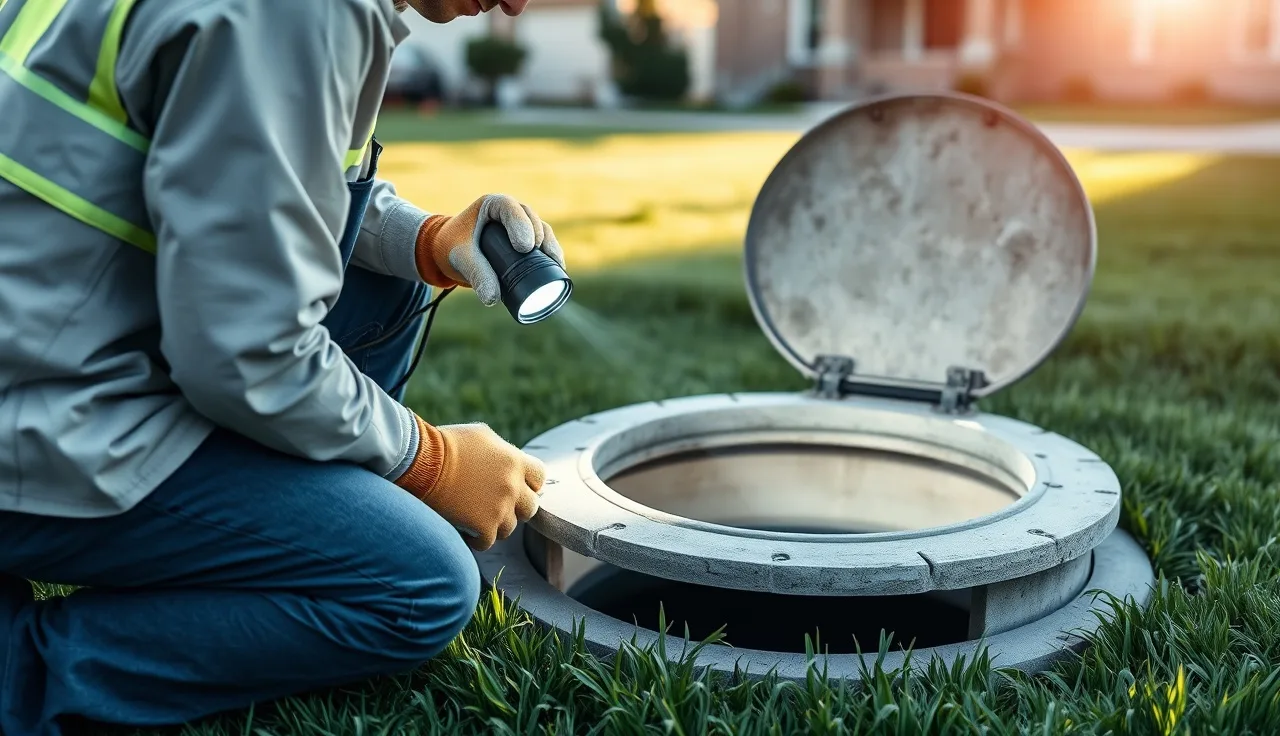
If the breaker is fine and the alarm is sounding, check the pump chamber access lid carefully, always with gloves. Is the water close to the inlet pipe? That tells you the effluent pump isn't moving water out.
Call a licensed ATU maintenance provider. In most states only a licensed technician can legally work on the system anyway, and bypassing floats or pumps yourself on a live sewage system is genuinely dangerous. Raw sewage carries pathogens including E. coli, Cryptosporidium, and hepatitis A. [6]
Sewage inside the house is a biohazard remediation job, not a plumbing call. Photograph everything for your homeowner's insurance claim before any cleanup starts. Some ATU failures are covered as sudden and accidental damage, and the documentation is what wins the claim.
While you wait, stay off the ground above the tank and spray field. Standing water there may be partially treated or completely untreated effluent.
How do you diagnose which part of the aerobic system is causing the backup?
Work through the system in order: control panel, air pump, pump chamber level, spray heads, then trash tank sludge. A methodical walkthrough takes about 30 minutes and either narrows the cause before you spend money on a service call, or lets you describe the problem accurately when you phone one in.
Start at the control panel. Check for alarm lights, read any error codes if your panel has a display, and confirm the timer settings look right. Most residential ATU panels run the aerator continuously and dose the effluent pump on a timer (often 15 minutes on, 45 off, or similar).
Check the air pump. The aerator compressor usually sits in a small housing above ground or in a dedicated compartment. You should hear and feel it running. Silent when it should be cycling? That's your problem. Running but pushing little air means the diaphragm or diffuser is failing.
Open the pump chamber lid. Gloves and eye protection. Look at the water level. At or above the high-water alarm float means the effluent pump isn't keeping up. If the level is normal, the trouble may be upstream in the aeration tank, or it's in the house drain lines and not the septic system at all.
Check the spray heads. Walk the field during a pump cycle. Are all heads discharging? Clogged ones dribble instead of spray, or don't rotate at all on rotating-style heads.
Look at the trash tank sludge level. With a clear access port and a flashlight you can sometimes see whether solids are up near the outlet baffle. A technician's scum and sludge measuring tool gives the definitive answer.
Can't pin it down from the surface? That's fine. Write down what you saw and hand it to the technician. Operators who run service management platforms (platforms like SepticMind let technicians log ATU-specific checkpoints and track alarm history across accounts) can match your alarm record against known failure patterns for your exact unit model.
What do aerobic septic system repairs actually cost?
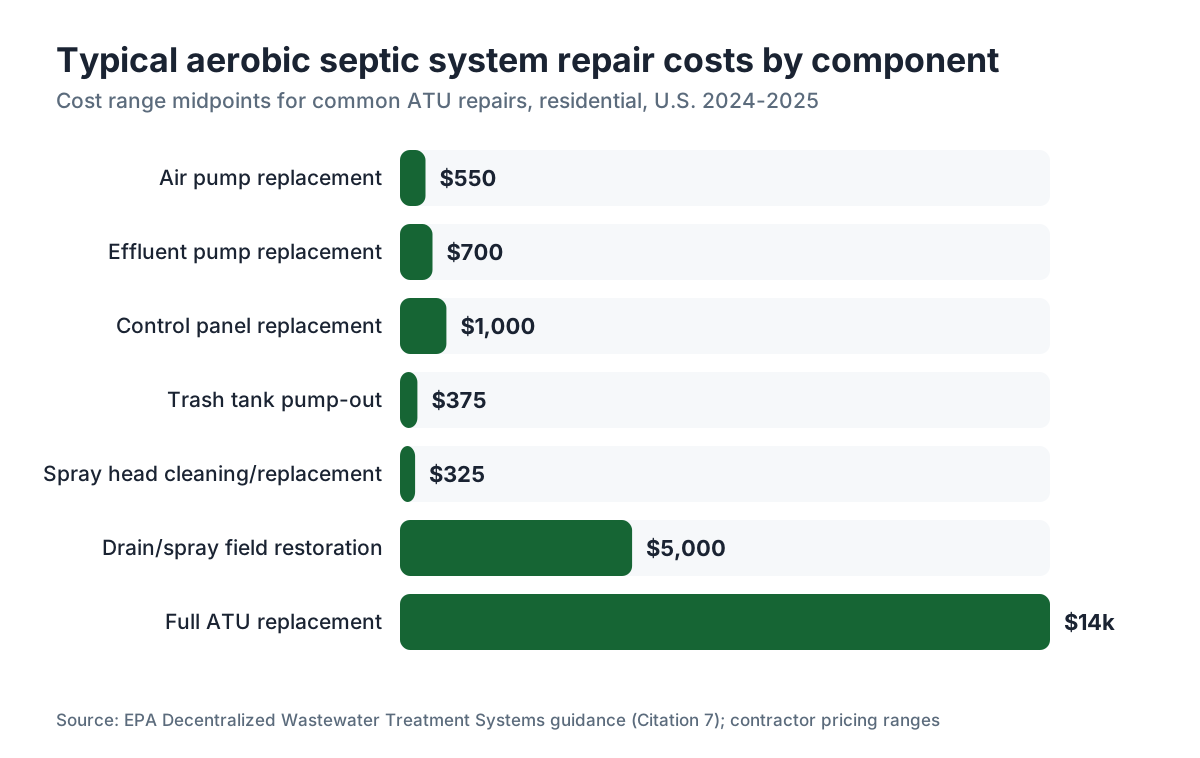
Aerobic septic repairs run from about $150 for a service call to more than $20,000 for a full system replacement. The most common first-time backup, a dead effluent pump plus an overfull trash tank, usually lands between $600 and $1,500. Regional labor rates, parts availability, and permit rules all move the final number.
Here's an honest breakdown based on typical U.S. contractor pricing for 2024 and 2025.
| Repair Type | Typical Cost Range | Notes |
|---|---|---|
| Emergency service call fee | $150 - $350 | Charged regardless of repair |
| Trash tank pump-out | $250 - $500 | More if tank is severely overloaded |
| Air pump / aerator replacement | $300 - $800 | Parts plus labor; brand-specific parts vary |
| Effluent pump replacement | $400 - $1,000 | Float switch included; higher for deep chambers |
| Control panel replacement | $500 - $1,500 | Full panel with timers and alarms |
| Spray head cleaning or replacement | $150 - $500 | Per zone; full field replacement costs more |
| Chlorinator repair/replacement | $100 - $300 | Simple UV lamp or tablet chlorinator |
| Drain/spray field restoration | $2,000 - $8,000+ | Resting, aeration, or full replacement |
| Full ATU replacement | $8,000 - $20,000+ | Includes tank, components, permits, installation [7] |
Field replacement is where costs explode. If the spray field has been taking under-treated effluent for months because the air pump was failing, biomat buildup in the soil can leave the field unusable. Some fields recover with a rest of 3 to 6 months. Others need physical replacement. Our guide to leach field repair covers that cost range in full.
For full system replacement numbers, our cost to install septic system article breaks down what new ATU installation runs by region and soil type.
Can you fix an aerobic system backup yourself, or do you need a licensed technician?
You can handle the surface stuff yourself: cleaning spray heads, replacing chlorine tablets, resetting a tripped breaker, freeing a stuck float. Anything that means opening a tank or replacing a pump or panel needs a licensed onsite wastewater professional in most states. That's both a legal line and a safety one.
Start with what's genuinely DIY. Clean a clogged spray head by removing it, soaking it in white vinegar or dilute bleach, and reinstalling. Replacing chlorine tablets needs no license. Resetting a tripped breaker is a homeowner task. If the panel shows the pump ran dry because a float stuck, a careful homeowner with clean gloves and a sense of where the float sits can free it.
Beyond that, most states require a licensed installer or maintenance provider. Texas requires an Installer II or Maintenance Provider license for ATU service under 30 TAC 285. [5] Florida requires a licensed septic contractor for any repair to a permitted system. [4] Work outside those rules and you can void your operating permit and pick up real liability if something goes wrong downstream.
Then there's the danger. ATU components sit inside tanks of actively decomposing sewage. Confined spaces kill people. Hydrogen sulfide gas kills quickly and with no warning at concentrations above 100 ppm. OSHA classifies sewage manholes as permit-required confined spaces for exactly this reason. [8] Don't send yourself or a family member into a tank. Ever.
The honest answer: run the above-ground checks yourself to diagnose and describe the problem, then call a licensed provider for anything that involves opening tanks or swapping components.
How do you prevent an aerobic septic system from backing up again?
Prevention comes down to staying ahead of three things: solids piling up, parts wearing out, and too much water going in. Pump the trash tank on schedule, replace the air pump before it dies, keep the chlorinator stocked, watch your water use, and honor your maintenance contract. Do those five and backups become rare.
Pump the trash tank on schedule. For a typical 3 to 4 bedroom home, the pretreatment chamber needs pumping every 1 to 3 years. A good technician measures scum and sludge depth every visit. When the combined scum-plus-sludge layer takes up more than a third of the tank, pump it, calendar be damned. [1] Our guide on how often to pump septic tank covers the factors that set your interval.
Replace the air pump before it fails. Most residential ATU aerators (Hiblow, Medo, Secoh, and similar) have a rated life of 2 to 5 years depending on run hours and environment. Run one to failure and by the time you notice, you've lost treatment efficiency and maybe damaged the field. Budgeting $300 to $600 every 3 to 4 years beats a field restoration every time.
Maintain the chlorinator. Add tablets consistently and replace the housing if it's cracking or scaling. Under-chlorinated effluent hitting a spray field creates health risks and, in some states, triggers an automatic shutdown by the health department.
Watch your water use. A slow toilet flapper wastes 100 to 200 gallons a day, all of it running through your ATU. Fix leaks. Spread laundry across the week instead of 10 loads on Saturday. A septic tank inspection will often catch loading problems.
Honor your maintenance contract. If your state requires quarterly ATU service, get it done. The technician's whole job is catching failing floats, low airflow, and rising sludge before they become backups. A year of skipped visits is the most reliable predictor of an emergency call in ATU service.
EPA's SepticSmart guidance notes that maintenance visits should confirm "that aerobic units have functioning air supply, that all components are operating," tying those checks straight to preventing failures. [6]
Does homeowner's insurance cover aerobic septic system backups?
Usually not without an endorsement. Standard HO-3 policies exclude septic damage and backup unless you've added "water backup and sump overflow" coverage or "service line" coverage. Water backup covers damage inside the house from sewage coming up through drains. Service line coverage can pay to repair the septic components themselves. Read your policy before you need it.
A sudden, accidental mechanical failure (a pump burning out unexpectedly) is the scenario most likely to get covered, because some insurers treat it like any other mechanical loss. A backup caused by neglected maintenance (an overfull tank, corroded pipes that should have been replaced) is almost always excluded as lack of maintenance.
Document everything before cleanup. Photos of the backed-up sewage, photos of the failed component once it's out, and a written report from the technician naming the cause of failure are what an adjuster wants. Ask your technician to state in the report whether the failure was sudden or gradual. That one line can decide the claim.
The practical move: call your insurance agent now, before anything breaks, and ask exactly what your policy covers for septic backup and component failure. A service line endorsement typically costs $40 to $80 a year and can cover $10,000 or more in ATU repair or replacement.
What do state codes and the EPA require for aerobic septic systems?
States regulate ATUs, not the federal government, though EPA guidance shows up in many state rules. Most states require an operating permit tied to a maintenance contract with a licensed provider, and most reference NSF/ANSI 245 to approve ATU models for residential use. [9] That standard sets treatment thresholds of no more than 25 mg/L CBOD5 and 30 mg/L TSS in the effluent, and some states go stricter.
Texas 30 TAC Chapter 285 is among the more detailed state rules. It requires quarterly maintenance visits for most ATU installations, a service log, and notification to the state when a system goes into alarm. [5] Florida's Chapter 64E-6 similarly requires permitted systems to be maintained by a licensed contractor, with at least annual inspection and required repairs within a set window after a failed inspection. [4]
EPA's SepticSmart program isn't a regulation, but its homeowner guidance echoes these state requirements and gets cited widely by extension services and state health departments. [6]
Operating a failing ATU can bring notices of violation, fines, and orders to connect to municipal sewer if it's available. In some places, a lapsed or unpermitted ATU can also derail a property sale: buyers' lenders increasingly require septic inspections at closing, and a system out of compliance can kill the deal. A full septic tank inspection before listing is worth the $200 to $500.
If your system needs major work, knowing the septic system repair process and the permits your county requires saves you from doing work that fails inspection.
When does a backup mean you need a full system replacement?
Most backups are fixable without replacing the whole system. Replacement is on the table when the disposal field can't recover, the tank is structurally failed, the ATU model is obsolete and unsupported, or your household has outgrown the system's rated capacity.
A failed field is the clearest sign. When years of under-treated effluent have biomat-clogged the soil around the spray or drip field, or the system sits in unsuitable soil that has now failed for good, the field has to be rebuilt. Often a new field is required even when the ATU itself is fine, and that work can cost as much as a partial system replacement. Our leach field guide has the detail.
The tank itself, usually fiberglass or polyethylene, can crack or fail structurally, especially in expansive clay soils or hard freeze-thaw cycles. A structurally failed tank gets replaced, full stop.
Age and obsolescence matter too. Some ATU models are no longer supported, so replacement parts simply don't exist. If your aerator motor housing is discontinued and your tank was custom-built around that motor, you're looking at a full unit swap.
Household growth is the last trigger. ATUs are sized in gallons per day (GPD). A 500 GPD unit built for a two-bedroom house is undersized the day you convert that house to four bedrooms, even if every part still works.
When replacement is the answer, our cost to put in a septic tank and septic tank installation articles lay out what to expect and how to compare bids. Plan on $10,000 to $25,000 for a full residential ATU installation depending on site conditions and local permitting. [7]
Operators handling multiple ATU accounts do better with systematic tracking of system age, maintenance history, and alarm frequency. SepticMind is built for that across-account service management, so an operator can spot which units in their territory are most likely to fail before the homeowner calls at 10 pm.
How long does it take to fix an aerobic septic system backup?
Simple fixes happen the same day. An effluent pump swap runs 1 to 3 hours on site. An air pump swap is under an hour. An emergency pump-out of an overloaded trash tank usually happens within 24 hours of your call in most service areas.
Bigger repairs take longer. A control panel replacement can mean ordering a panel specific to your ATU brand, so 3 to 7 days of wait. A spray field restoration by rest and aeration takes 3 to 6 months. A full system replacement, from permit application to installation, typically runs 4 to 12 weeks depending on the permit office's backlog and site conditions.
While you wait on a non-emergency repair, you need a plan for wastewater. A portable toilet rental ($100 to $200 per week) is the most practical option. Some homeowners cut water use to the absolute minimum, but that's miserable and won't last more than a day or two. In real emergencies, your county health department can sometimes authorize temporary use of a neighbor's hookup or issue a variance while repairs proceed.
For a septic tank pump out as part of the backup response, most pumping contractors arrive within 24 to 48 hours in populated areas and faster in emergencies. Rural areas take longer. Have your system's exact location, tank lids, and access points ready before the truck shows up. It saves the technician time and saves you money on the call.
Frequently asked questions
Why is my aerobic septic system alarm going off but the toilets still flush fine?
The alarm trips when water in the pump chamber rises above the high-water float, which happens before water reaches your house drain connection. Your toilets flush fine because there's still capacity in the lines. But the pump is either failing or overwhelmed. Within hours to a day, that rising level reaches the point where drains start backing up. Call your maintenance provider the same day.
Can too much rain cause an aerobic septic system to back up?
Yes. Heavy, sustained rain saturates the soil around the spray or drip field, leaving treated effluent nowhere to go, and the pump chamber fills faster than it empties. If groundwater is also rising around the tank, it can infiltrate through cracks and seals, adding water that never came from your house. After a wet stretch, give the system a few dry days and cut water use inside before assuming a mechanical failure.
How often should an aerobic septic system be pumped?
The pretreatment (trash) tank on most residential ATUs needs pumping every 1 to 3 years, depending on household size and what goes down the drains. A household of 4 to 5 people, or one that pours cooking grease down the sink or runs a garbage disposal hard, needs pumping closer to annually. The real trigger is measurement: pump when combined sludge and scum depth passes a third of tank volume. See our septic tank pumping guide.
What happens if I ignore an aerobic septic system backup?
It gets worse fast. Continued water use pushes sewage into house drains, creating a biohazard cleanup that costs far more than the original repair. Under-treated effluent reaching the spray field accelerates soil clogging and can make the field permanently unusable. Many states require you to stop water use and notify the health department when an ATU discharges untreated effluent, and noncompliance can bring fines and orders to connect to public sewer.
Is a gurgling toilet always a sign of septic backup?
Not always, but it's a meaningful warning. Gurgling happens when air is displaced by rising water in the drain system, which can come from a blocked vent stack, a clog in the house drain line, or a rising level in the septic tank. If a toilet gurgles when you run a sink and you have an ATU, check the alarm panel and pump chamber level first. A vent stack issue is possible but less urgent than a filling tank.
How do I know if my aerobic system's air pump has failed?
Listen at the air pump housing. A working aerator makes a steady hum or clicking. Silence means it's off. Vibration with no airflow means the diaphragm has failed. You can also look into the aeration chamber through the access lid during an active cycle. You should see active bubbling from the diffuser. No bubbles, air pump is suspect. An amp-clamp reading by a technician confirms whether the motor draws the right current.
Can I use bleach or antibacterial products with an aerobic septic system?
In moderate amounts, yes. ATUs tolerate household disinfectants better than conventional septic systems because the aerobic bacteria recover faster. But pouring concentrated bleach or large amounts of antibacterial product down drains kills the treatment bacteria and degrades performance. The EPA recommends septic-safe products and avoiding excess disinfectants for all onsite systems. [6] Normal household cleaning with standard products isn't a problem.
What is the lifespan of an aerobic septic system?
The tank itself, fiberglass or polyethylene, typically lasts 20 to 30 years or more if it isn't physically damaged. The mechanical parts are the limitation: air pumps 3 to 5 years, effluent pumps 5 to 10 years, control panels 10 to 20 years. A well-maintained ATU with timely part replacements can run 25 years or more before full replacement. Neglected systems commonly need replacement in 10 to 15 years, driven more by field failure than tank failure.
Does a garbage disposal hurt an aerobic septic system?
Yes, meaningfully. A garbage disposal adds raw food solids straight to the pretreatment tank, speeding up sludge accumulation. Research on conventional septic systems suggests disposal use can roughly double the rate of solids buildup. [1] ATUs handle it somewhat better thanks to active treatment, but the trash tank still fills faster and needs more frequent pumping. If your ATU already runs near capacity for your household, ditching the disposal is one of the cheapest fixes available.
Can an ATU backup contaminate my well?
It can. Untreated or under-treated effluent that reaches surface water or shallow groundwater can carry pathogens including coliform bacteria, nitrates, and viruses. If your well and septic system sit close together and you have a backup, test your well water before drinking it. Setback distances (typically 50 to 100 feet depending on state code) prevent this under normal operation, but a backup that surfaces near the wellhead is a real contamination risk. [3]
Why does my aerobic system smell like sewage near the spray heads?
A sewage smell near spray heads usually means one of two things: the system is discharging under-treated effluent because the aerobic process broke down (air pump failure, overloading), or the chlorination stage isn't working and the effluent is still biologically active. Properly treated and chlorinated ATU spray has very little odor. A persistent sulfur or sewage smell at the field warrants an immediate service call, more than a maintenance note.
How much does it cost to replace the pump in an aerobic septic system?
An effluent pump replacement in a residential ATU typically runs $400 to $1,000 including labor, the new pump, and the float switch. The range depends on pump depth, access difficulty, and pump model. Air pump (aerator) replacement usually runs $300 to $800. If you have the trash tank pumped at the same visit, add $250 to $500 for that service. See our full septic tank repair cost breakdown.
Do aerobic septic systems need more maintenance than conventional systems?
A lot more. A conventional septic system needs pumping every 3 to 5 years and basically no other routine service. An ATU needs maintenance visits every 3 to 12 months depending on state rules, plus periodic air pump and effluent pump replacement, chlorinator refills, and spray head cleaning. The tradeoff is higher treatment quality and the ability to work on lots where soil rules out a conventional drain field. [2]
Can I rent a house while my aerobic system is backed up?
No, and doing so creates serious legal and liability exposure. A failed septic system makes a property uninhabitable under health codes in nearly every jurisdiction. Most state landlord-tenant laws require functioning sanitary facilities for a habitable rental. If a tenant gets sick from sewage exposure and you knew the system was failing, you face civil and potentially criminal liability. Fix the system before placing or keeping tenants.
Sources
- EPA, Septic Systems Overview: Solids accumulation in the pretreatment tank is a leading cause of ATU performance failure; regular pumping prevents overflow into treatment components
- NSF International, Wastewater Treatment Systems (NSF/ANSI 245): ATUs have mechanical components including air pumps and effluent pumps that require periodic maintenance and replacement; NSF/ANSI 245 governs performance standards for these units
- EPA, How Your Septic System Works: Hydraulic overload from excessive water use and proximity of septic systems to wells can lead to groundwater contamination when systems fail
- Florida Department of Health, Onsite Sewage Program (Chapter 64E-6 FAC): Florida Chapter 64E-6 requires permitted ATU systems to be maintained by licensed contractors with required repairs following failed inspections
- Texas Commission on Environmental Quality, On-Site Sewage Facilities (30 TAC Chapter 285): Texas 30 TAC Chapter 285 requires quarterly maintenance visits for most ATU installations, maintenance logs, and notification to the state when systems go into alarm
- EPA SepticSmart Program: EPA SepticSmart states: 'Have your septic system inspected and pumped regularly by a licensed contractor' and specifies that aerobic units must have functioning air supply with all components checked at maintenance visits
- EPA, Decentralized Wastewater Treatment Systems: Full ATU installation costs for residential systems typically range from $8,000 to over $20,000 depending on site conditions, permitting, and system capacity
- OSHA, Confined Spaces (29 CFR 1910.146): OSHA classifies sewage manholes and septic tanks as permit-required confined spaces due to hydrogen sulfide and oxygen-deficient atmosphere hazards
- NSF International, Certified Wastewater Treatment Systems: NSF/ANSI 245 sets effluent treatment thresholds of no more than 25 mg/L CBOD5 and 30 mg/L TSS for residential ATU certification
- University of Minnesota Extension, Septic Systems: Pump the septic tank when combined scum and sludge layers exceed one-third of tank volume; garbage disposal use significantly accelerates solids accumulation
Last updated 2026-07-10