Aerobic treatment unit septic system: how it works, costs, and care
By the SepticMind Editorial Team
TL;DR
- An aerobic treatment unit (ATU) is an advanced septic system that pumps air into wastewater to speed up bacterial breakdown, producing effluent clean enough for surface or spray irrigation in many states.
- They cost $10,000 to $20,000 installed, require a service contract in most states, and need inspection every 3 to 6 months.
- They're the answer when a conventional system can't pass a perc test.
What is an aerobic treatment unit septic system?
An aerobic treatment unit, almost always called an ATU, is an onsite wastewater system that does what a conventional septic tank does, then keeps going. A regular tank relies on slow anaerobic (oxygen-free) settling. An ATU pumps air through the wastewater around the clock. That oxygen feeds a dense population of aerobic bacteria that digest organic material faster and far more completely. The treated effluent can be 10 to 100 times cleaner than what leaves a conventional tank [1].
The basic sequence has three stages. First, a trash tank or pre-treatment chamber lets solids settle and scum float, just like a conventional septic tank. Second, the aeration chamber introduces air through a compressor or blower, keeping the liquid agitated and oxygen-rich. Third, a clarifier or settling zone lets any remaining suspended solids drop before the treated water moves on. Many systems add a fourth step: a disinfection chamber using chlorine tablets or UV light before effluent leaves the unit [9].
An ATU is not a conventional septic tank with an effluent pump bolted on. It's a mechanically active system with motors, floats, timers, and either a compressor (for diffused air) or a spray rotor (for surface aeration). That complexity is what makes it effective. It's also what makes it demand real maintenance.
Why would someone need an ATU instead of a conventional system?
Most people don't choose an ATU. A soil scientist or county health department tells them they have no other legal option. The usual trigger is a lot that fails a percolation test, or one with shallow soil over bedrock, a high water table, or a footprint too small for a full drainfield. Conventional drainfields need depth and area to filter effluent through soil. When the soil isn't there, an ATU makes effluent clean enough to be dispersed on the surface or through a spray system with much less soil contact required [1].
Lots near lakes, rivers, or the coast often face nutrient limits. An ATU removes a lot more nitrogen and biochemical oxygen demand (BOD) than a conventional tank, which helps protect the water it drains toward. Some states and counties require ATUs in these sensitive zones no matter the lot size.
Replacement is the second big scenario. A homeowner whose drainfield has failed, and who can't site a new conventional field anywhere on the property, may get approval for an ATU with spray irrigation as a repair. If you're staring at a failed drainfield, the septic system repair and leach field articles walk through your repair options before you commit to a whole new system.
How does an ATU actually treat wastewater?
The science is simple. Aerobic bacteria eat organic waste far more aggressively than anaerobic bacteria because oxygen lets them pull much more energy out of the same food. A healthy ATU cuts BOD by 85 to 95 percent and total suspended solids by about the same, against a conventional tank's roughly 50 percent BOD reduction [8].
Here's the sequence in a typical residential ATU:
- Wastewater enters the trash tank. Grease, paper, and heavy solids separate out. Liquid moves on.
- The aeration zone gets a steady air supply, usually from a small surface-mounted compressor. The turbulence keeps suspended solids in contact with oxygen-hungry bacteria. Hydraulic retention time here runs about 24 hours [9].
- The clarifier is a quiet zone where the now-lighter sludge settles. Settled material returns to the aeration zone. Clear effluent moves forward.
- Disinfection. Chlorine tablets dissolve in a contact chamber, or UV light kills pathogens. EPA guidance recommends advanced treatment with disinfection in sensitive areas to reduce pathogen loads reaching groundwater and surface water [1].
After disinfection, effluent leaves through one of several dispersal options: a conventional drainfield (if soil allows), spray irrigation, a drip system, or, in some states, permitted surface discharge. The dispersal method matters as much as the ATU itself for how the system holds up over the years.
What does an ATU septic system cost to install?
Expect to spend $10,000 to $20,000 for a typical residential ATU installation, and the range is that wide for a reason. A lot with good access, easy digging, and a simple spray field might land near $10,000 to $13,000. A hard lot with rock, a high water table, or a big house needing a larger unit can push past $20,000 [3].
The ATU unit itself runs $3,000 to $8,000 depending on brand, tank material (fiberglass vs. concrete), and flow capacity. Most residential units are sized for 500 to 1,500 gallons per day [11]. The dispersal system adds another $2,000 to $6,000 depending on type and lot. Permits, engineering, and the required soil investigation add $1,000 to $3,000 on top. Labor fills in the rest.
For comparison, a standard conventional system in average conditions costs $3,500 to $10,000 fully installed [4]. You pay a real premium for an ATU, and the operating costs run higher too. Go in knowing both. Our cost to install septic system article puts the system types side by side.
One cost people keep underestimating: the mandatory service contract. Most states make ATU owners carry a contract with a certified service provider. Texas requires a maintenance contract for the first two years after installation under 30 TAC Chapter 285 [5]. Those contracts run $150 to $400 per year and cover quarterly inspections. Parts and chlorine refills are usually extra.
What does it cost to maintain an ATU every year?
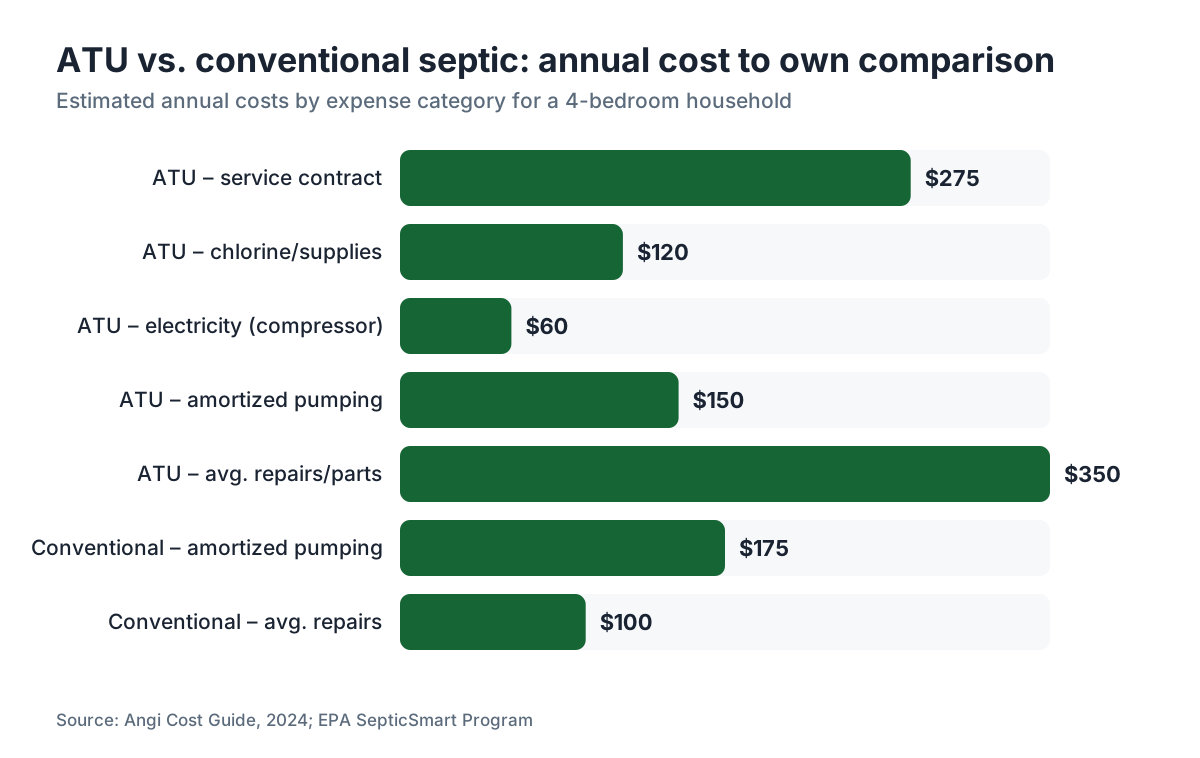
Annual operating cost for a residential ATU runs $300 to $800 when things go right [3]. That covers the service contract, chlorine tablets ($30 to $60 per refill, needed every 1 to 3 months depending on use), and electricity for the compressor ($30 to $80 per year for a small motor running nonstop).
When things go wrong, the number jumps fast. Compressor replacement is the most common failure. A quality replacement runs $200 to $600 depending on the ATU brand. Floats fail. Control panels quit. Budget $200 to $500 a year for surprise repairs if you want a realistic figure, especially past the 5-year mark.
The trash tank still builds sludge that has to be pumped, usually every 2 to 3 years for a household of four. Septic tank pumping costs $300 to $600 depending on your area. That's not optional. Skipping it is the fastest way to send raw solids into your aeration chamber, clog the system, and buy yourself a much bigger repair bill.
Realistic total to own an ATU: $500 to $1,200 a year, against roughly $150 to $300 for a conventional system (amortized pumping only). The gap exists because the ATU is doing real work and has real parts to keep alive.
How often does an ATU need to be serviced and inspected?
Most states require ATU inspections every 3 to 6 months by a licensed service provider [9]. This isn't a suggestion. Texas, Louisiana, Oklahoma, and most states with large ATU populations tie the operating permit to a maintained service contract. Let the contract lapse and you're in violation of your permit.
What does a service visit actually cover? A thorough one checks dissolved oxygen in the aeration chamber (1 to 3 mg/L for most units), inspects the compressor and diffuser for fouling, tests the float switches and control panel, refills or replaces the chlorine dispenser, pulls an effluent sample for clarity, and checks the spray heads or drip emitters for clogging.
Between visits, a homeowner can do a few things. Confirm the compressor is running (you can usually hear it). Watch for standing water or soggy ground near the spray field. Make sure the control panel shows no alarm lights. If something looks off, call your service provider instead of poking around yourself. ATU components can be live electrical equipment.
EPA's SepticSmart guidance tells homeowners to schedule regular inspections and keep maintenance records for advanced treatment systems [1]. A logbook of every service visit, chlorine refill, and alarm event makes troubleshooting faster and is often required to prove compliance when you sell.
What are the most common ATU problems and failures?
Compressor failure is the top issue by a wide margin. It runs 24 hours a day, 365 days a year. Most residential compressors last 3 to 7 years before a rebuild or replacement [11]. When the air stops, aerobic bacteria die within hours. The system slides back to anaerobic conditions, treatment quality drops, and odors often follow. Your control panel alarm should catch this, but only if the alarm itself works.
Foaming in the aeration chamber is common and looks alarming. It usually comes from detergents, antibacterial soaps, or garbage disposal waste hitting the system. Most of the time it clears on its own, but stubborn foam can mean a surfactant overload that's suppressing the bacteria. Cut the source first.
Solids carryover into the aeration chamber happens when the trash tank goes too long without pumping. Once solids reach the aeration zone, they foul the diffuser, clog the return pump, and drag down treatment. That's why the septic tank pump out schedule still matters on an advanced system.
Spray head clogging is a dispersal problem, not a treatment problem. Clogged heads make wet spots in some places and dry spots in others. The effluent has to go somewhere, and if it can't get out through the spray system, it backs up into the ATU. Regular service should catch this early.
Electrical and float switch failures show up on older units. A failed float can make the system run constantly or not at all, depending on how it dies. Test the alarm once a year, ideally before your service provider does, so you know it will actually warn you.
How does an ATU compare to a conventional septic system?
It comes down to treatment quality, maintenance load, cost, and whether your site even allows a conventional system. Here's a direct look:
| Factor | Conventional Septic | Aerobic Treatment Unit |
|---|---|---|
| Effluent quality (BOD reduction) | ~50% | 85 to 95% [8] |
| Installation cost | $3,500 to $10,000 [4] | $10,000 to $20,000+ [3] |
| Annual maintenance cost | $150 to $300 | $500 to $1,200 |
| Required inspections | Every 1 to 3 years (varies by state) | Every 3 to 6 months (most states) |
| Moving parts | Almost none | Compressor, floats, pump, possibly UV |
| Suitable for poor soil | No | Often yes |
| Allows surface/spray dispersal | No | Often yes |
| Disinfection step | No | Yes (chlorine or UV) |
| Typical service life | 20 to 40 years | 15 to 25 years for the mechanical unit |
If your lot passes a perc test and you have room for a drainfield, a conventional system is almost always the better economic call. It's simpler, cheaper to install, and cheaper to run. The ATU earns its premium when soil, lot size, or nearness to water makes a conventional system either illegal or impossible.
What are the rules and permits required for an ATU?
ATU regulation lives at the state and local level. There's no single federal ATU permit, though EPA's SepticSmart guidance sets a framework many states borrow from [1]. The specifics change a lot from state to state.
Most states require a site evaluation and soil analysis before any ATU permit is issued. The state or county health department issues a construction permit. After installation, an operating permit (sometimes called a use and maintenance permit) follows, usually conditioned on an active service contract. Texas ties this to 30 TAC Chapter 285 [5]. Oklahoma's Department of Environmental Quality runs a similar setup under OAC Title 252 [6]. Most states with real ATU numbers have frameworks that look alike.
Some states require effluent testing at set intervals. Texas, for one, has service providers collect and report effluent samples to show the unit meets permit standards. Spray systems carry extra restrictions: setbacks from property lines (often 10 to 50 feet), from structures (10 to 20 feet), from wells (50 to 100 feet), and from surface water.
Selling a home with an ATU adds friction. Many states require a system inspection and a compliance certificate before closing. Buyers and their agents often don't know what they're looking at, so clean maintenance records and a current service contract make the deal go smoother. If you're buying a home with an ATU, pay for a septic tank inspection from someone who actually works with these systems.
Operators juggling ATU service contracts across many clients lean on scheduling and compliance tools to stay ahead of reporting. SepticMind is built for that workflow, handling service route management and state reporting documentation in one place.
What can homeowners do to keep an ATU running well?
The highest-impact moves are also the easiest. Don't send anything down the drain that doesn't belong there. Cooking grease, antibacterial wipes (even the ones sold as flushable), and heavy garbage disposal use all stress the biology. The aerobic bacteria in your ATU handle normal household waste fine. They can't handle bleach poured straight down a drain, a bottle of disinfectant, or a slug of cooking oil.
Go easy on antibiotics and antimicrobial soaps. Chronic heavy use can knock back the bacterial population in the aeration chamber. Nobody has perfectly clean data on the household dose that matters, but state extension programs are consistent on the guidance: keep antibacterial drain inputs low [12].
Keep the spray field clear and reachable. Grass is fine. Trees and shrubs are not, because roots clog spray heads and emitters over time. Don't park on the dispersal area.
Know where your control panel is and check it weekly. It should read normal. If you see an alarm light or hear a buzzer, don't wait it out. Call your service provider. Problems caught early are cheap. Problems ignored until they're obvious get expensive.
Keep records. Store every service report, every chlorine refill receipt, every alarm event. The logbook you wish you'd started years ago is the one you start today. On how often to pump septic tank for the ATU trash tank, the answer is typically every 2 to 3 years for a four-person household, but your provider should measure actual sludge depth instead of following a calendar.
How long does an ATU last, and when should you replace it?
The tank chambers, concrete or fiberglass, typically last 20 to 30 years with reasonable care. The mechanical parts are another story. Compressors last 3 to 7 years [11]. Control panels 10 to 15 years. Diffusers and aeration components 5 to 10 years. You will replace parts. That's not failure. It's normal for a system with moving pieces.
Full replacement enters the conversation when the tank cracks, when the unit keeps missing effluent standards despite repairs, or when the dispersal system fails in a way you can't correct. A dead spray field that can't be fixed or expanded on the lot may force a full redesign.
Age matters less than maintenance history. A 15-year-old ATU with quarterly service records and documented repairs can outperform a 5-year-old unit that got ignored. When you're sizing up an existing ATU, whether buying a home or chasing a problem, look at the service history first.
If you're facing a big ATU repair or replacement, get quotes from several installers and ask specifically whether a drainfield modification could pair with a lower-maintenance system. Sometimes the conditions that forced an ATU in the first place have changed, especially if a neighboring well or water body that drove the setback is gone. Septic tank repair on conventional components can sometimes shrink what actually needs replacing.
If you're weighing a full replacement, the cost to put in a septic tank comparison is a good starting point before you commit to a fresh ATU versus a hybrid approach.
Are ATU systems good for the environment?
Against a failing conventional system, yes, easily. A well-run ATU sharply cuts the nitrogen, phosphorus, and pathogen load reaching groundwater and surface water. EPA identifies poorly maintained septic systems as a real source of nitrogen contamination in coastal and freshwater environments, and ATUs get recommended in sensitive areas for their stronger nutrient reduction [1].
Against a working conventional system on suitable soil, the answer gets more honest. The conventional system uses no electricity, has no mechanical emissions, and poses little ongoing risk when it's maintained and pumped. The ATU draws power continuously (typically 100 to 300 watts for the compressor), uses chlorine (with its own handling and disposal considerations), and generates a little waste from service visits.
UV disinfection comes on many newer ATUs as a chlorine alternative. UV costs more up front but drops the need to handle and store chlorine tablets, worth thinking about if you have kids at home or live under strict chemical discharge rules.
Spray irrigation, designed and maintained right, can help the yard. Treated effluent carries nitrogen and water, and a properly loaded spray field keeps grass healthy without synthetic fertilizer. Overload it, though, and you get standing water, odors, and possible pathogen exposure.
What should you ask before buying a home with an ATU?
Get the service history. All of it. Ask for every maintenance report from the current owner and, if you can, the previous one. Gaps in the record are red flags. An ATU without documented maintenance may have been running degraded for years.
Ask which state permit the system runs under and whether it's current. An expired operating permit can stall closing and may require a full inspection and remediation before it's reinstated.
Find the brand and model, then look up the manufacturer. Some ATU brands from the 1990s and early 2000s are out of business, and hunting parts for an orphaned unit gets slow and pricey. Brands with strong dealer networks (Norweco, Jet, Bio-Microbics) are easier to keep serviced.
Get an inspection from a technician who actually services that brand. A general septic inspector beats nothing, but an ATU has components a drainfield inspector may not know how to read. The inspection should include a live dissolved oxygen check, a look inside the aeration chamber, an alarm test, and a chlorine residual reading in the disinfection chamber.
Ask what the service contract costs and who holds it. In most states you'll sign your own contract before or at closing. Build the annual service cost into your ownership math. An ATU is not a set-it-and-forget-it system, and every year you treat it like one is a year you're rolling the dice on a repair bill that can reach the thousands. For operators managing many ATU service relationships, SepticMind's maintenance scheduling tools centralize service records, permit tracking, and automated customer reminders in one dashboard.
Frequently asked questions
How long does an aerobic septic system last?
The concrete or fiberglass chambers typically last 20 to 30 years. The mechanical parts (compressor, floats, control panel) replace on a rolling basis every 3 to 15 years depending on the component. A well-maintained ATU with documented service can easily run 20 or more years. A neglected one can fail critically in under 10. Maintenance history matters more than calendar age.
Can an ATU replace a failed conventional septic system?
Yes, and it's one of the most common reasons ATUs get installed. When a conventional drainfield fails and there's no room or suitable soil for a new one, a county health department will often approve an ATU with spray irrigation as a repair. You'll still need a permit, a soil evaluation, and possibly engineering drawings, but an ATU gives you options a conventional system can't on a difficult lot.
How often do you add chlorine to an aerobic septic system?
Most residential ATUs need the chlorine tablet dispenser refilled every 1 to 3 months depending on household size and water use. A four-person household typically goes through a pound of tablets every 4 to 8 weeks. Your service provider checks and refills the dispenser during quarterly visits. You can also refill it yourself between visits; the dispenser is usually accessible at ground level.
What happens if the air compressor on an ATU fails?
Without air, the aerobic bacteria die off within hours. The system reverts to anaerobic conditions and treatment quality drops sharply. Your control panel should trigger an alarm. Catch it quickly and a technician can replace or repair the compressor before treatment degrades badly. Let it run without air for days or weeks and you may see odors, discharge failures, and permit violations. Replace the compressor promptly.
Do you still need to pump an aerobic treatment unit?
Yes. The pre-treatment or trash tank in an ATU builds sludge and scum the same way a conventional septic tank does. That compartment typically needs pumping every 2 to 3 years for a four-person household. Skipping it is the fastest way to send solids into the aeration chamber, which degrades treatment and can cause expensive mechanical damage. Don't assume aeration eliminates the need to pump.
Is an aerobic septic system better than a conventional one?
It depends on your site. An ATU produces much cleaner effluent (85 to 95 percent BOD reduction vs. roughly 50 percent for a conventional tank) and works where conventional systems can't be permitted. But it costs more to install and two to four times more per year to run. On a site with good soil and room for a drainfield, a conventional system is usually the smarter economic choice. The ATU earns its premium only when you have no good alternative.
What is the spray field on an aerobic system and how does it work?
The spray field, sometimes called a spray irrigation dispersal area, is where treated and disinfected effluent leaves the ATU and gets spread across the yard through a network of sprinkler heads. Because ATU effluent is far cleaner than conventional septic effluent, it can go on the surface instead of into a buried drainfield. Spray heads usually run on a timer and fire when the ATU's pump tank hits a set level.
Can you use an aerobic septic system in cold climates?
Yes, with caveats. Most ATU manufacturers design for cold-weather operation, but freezing spray lines or spray heads is a real concern in climates with long stretches below freezing. Some systems drain the spray lines between cycles to prevent freezing. The biological treatment in the aeration chamber slows a bit in cold weather, but well-designed ATUs account for it. Your installer should know cold-climate ATU practices for your region.
What brands of aerobic treatment units are most common?
In the U.S., Norweco, Jet (Anua), Aerobic Systems Incorporated (ASI), and Bio-Microbics (FAST units) are among the most widely installed residential brands. Fuji Clean and Advantex (Orenco Systems) have strong regional followings in certain states. Brand availability varies by state and installer relationship. Pick a brand with an active local dealer network, because you'll need parts and service for the life of the system.
What is the difference between an ATU and a septic tank with a pump?
A septic tank with a pump (often called a pump-to-drainfield or pressure distribution system) still relies on anaerobic settling for treatment. The pump just doses effluent to the drainfield under pressure. An ATU actively treats the wastewater with injected air before it ever reaches dispersal, producing much cleaner effluent. The two look similar from the surface but run on different biological principles.
Do aerobic septic systems smell bad?
A properly working ATU produces very little odor. The aerobic process actually reduces odor compared to anaerobic digestion because hydrogen sulfide and other smelly compounds get oxidized. If you smell sewage near your ATU or spray field, it usually signals one of three things: the compressor has failed, the system is overloaded, or the spray field is getting more effluent than the soil can absorb. All three need attention now.
Does homeowners insurance cover ATU repairs?
Standard homeowners policies generally exclude septic components. Some insurers offer septic riders or endorsements covering mechanical breakdown of pumps and other parts. A few home warranty products cover ATU parts with limits. Read any policy carefully before assuming coverage. The more useful protection is a maintenance reserve of $300 to $500 a year set aside specifically for ATU component replacements.
How close can an ATU spray field be to a well or property line?
Setbacks vary by state. Texas requires a minimum 10-foot setback from property lines and 50 feet from a water well for spray dispersal under 30 TAC Chapter 285. Many states require 100 feet from a water supply well. Setbacks from structures, driveways, and surface water vary similarly. Always check your specific state's onsite wastewater code before assuming any minimum distance applies to your site.
What maintenance records should an ATU owner keep?
Keep every service report your licensed provider generates, typically quarterly. Record each chlorine refill date and quantity. Log any alarm events: date, nature of the alarm, and the action taken. Keep copies of your operating permit, the original installation permit, and the manufacturer's O&M manual. Many states require these records on request, and they're essential documentation when selling the property or contesting a compliance notice.
Sources
- U.S. EPA, SepticSmart Program (septic system information and homeowner guidance): ATUs reduce pathogen exposure and remove 85 to 95% of BOD; EPA recommends advanced treatment in environmentally sensitive areas and advises homeowners to keep maintenance records
- U.S. EPA Office of Water, Onsite Wastewater Treatment Systems Manual (EPA/625/R-00/008): Describes aerobic treatment unit function, components, ~24-hour aeration retention time, and effluent quality standards for residential onsite systems
- Angi, Aerobic Septic System Cost Guide: Residential ATU installation costs typically $10,000 to $20,000; annual maintenance costs $300 to $800 under normal conditions
- U.S. Census Bureau, American Housing Survey (plumbing and sewage data): Conventional septic system installation cost range of $3,500 to $10,000 in average soil conditions used as comparison baseline
- Texas Commission on Environmental Quality, 30 TAC Chapter 285, On-Site Sewage Facilities: Texas requires a two-year maintenance contract for new ATU installations and sets spray field setbacks including 10 feet from property lines and 50 feet from water wells
- The Water Research Foundation, onsite wastewater treatment research: ATU effluent quality data showing 85 to 95% BOD reduction compared to approximately 50% for conventional anaerobic tanks
- University of Florida IFAS Extension, aerobic treatment unit guidance: ATU compressor lifespan of 3 to 7 years and typical residential unit sizing of 500 to 1,500 gallons per day
- Texas A&M AgriLife Extension, On-Site Sewage Facility (OSSF) management resources: Chlorine tablet consumption rates, guidance to minimize antibacterial drain inputs, and spray field setback requirements for residential ATU installations in Texas
Last updated 2026-07-09