Aerobic septic system air compressor: what it does, when it fails, and what to do
By the SepticMind Editorial Team
TL;DR
- The air compressor (also called an aerator or air pump) in an aerobic septic system pushes oxygen into the treatment tank so aerobic bacteria can break down waste.
- It runs nonstop, usually drawing 30 to 150 watts.
- Kill the air and treatment collapses within a day or two.
- Most homeowners pay $150, $600 for a replacement unit, installed.
What does the air compressor do in an aerobic septic system?
The air compressor is the machine that keeps an aerobic septic system alive. It pumps oxygen into a treatment chamber so oxygen-hungry bacteria can colonize the wastewater and digest it far faster than the slow anaerobic process in a conventional tank. Cut the air and you're left with a very expensive septic tank that isn't meeting its permit.
An aerobic treatment unit (ATU) works on a different principle than a standard septic system. A conventional tank relies on anaerobic bacteria that work slowly and leave a lot of organic material behind. An ATU forces air into a separate aeration chamber, and the aerobic bacteria that thrive there break waste down more completely. The compressor supplies that air. It's the heart of the whole thing.
Most residential ATU compressors come in one of two designs. Linear diaphragm pumps (also called linear air pumps) are the common one. A rubber diaphragm oscillates back and forth, driven by an electromagnet, and pushes air through a diffuser at the bottom of the aeration chamber. Rotary vane compressors show up on larger or commercial units and move more air, but you'll rarely see one on a single-family home. If you own an ATU, odds are you have a diaphragm pump.
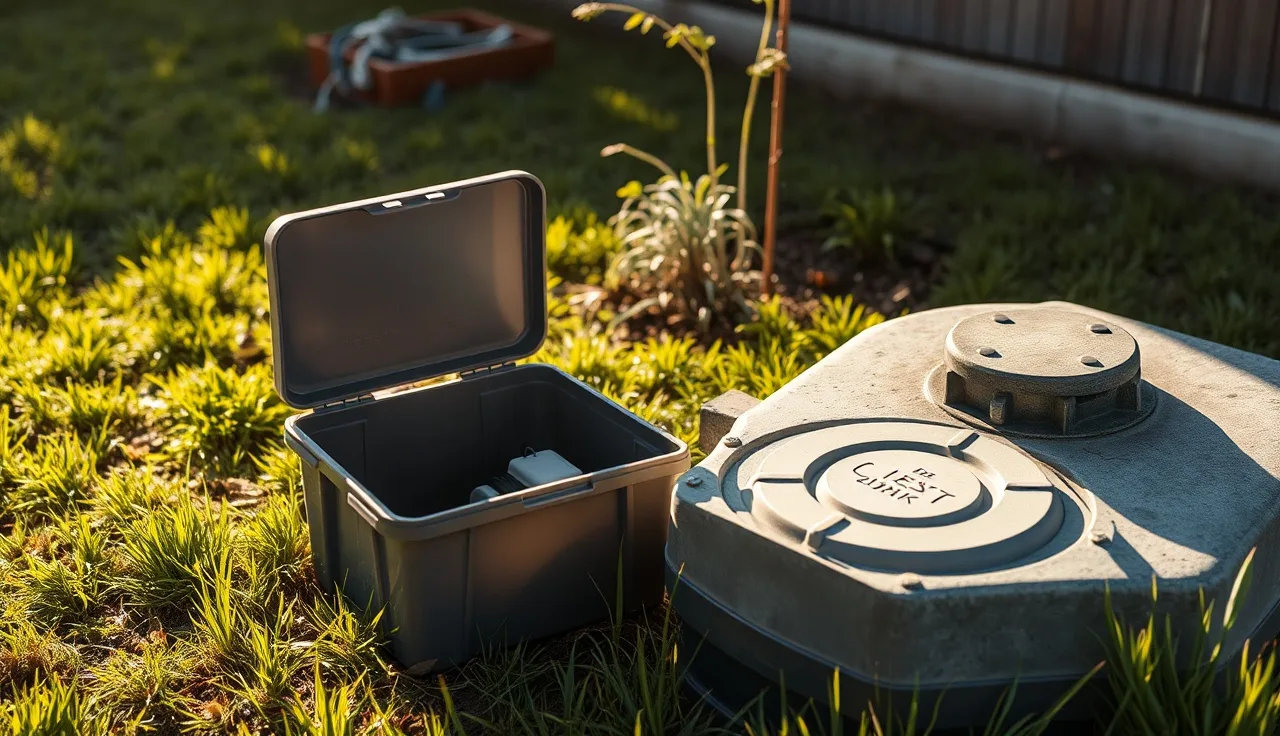
The compressor usually sits in a weatherproof housing on the ground next to the tank, sometimes in a small concrete vault. It runs 24 hours a day, every day of the year. That nonstop duty cycle is why these machines wear out on a schedule you can almost predict, and why your power bill ticks up a little when you go from a conventional to an aerobic system.
The air travels through a PVC or polyethylene line buried in the ground and reaches a diffuser, air stone, or rigid manifold at the bottom of the aeration chamber. The diffuser breaks the air into small bubbles so more oxygen dissolves into the water. A clogged or cracked diffuser is one of the most common reasons a compressor looks dead when the compressor itself is fine.
How does the compressor fit into the whole aerobic system?
The compressor feeds the aeration chamber, which sits in the middle of the treatment sequence. Knowing where it lands helps you find problems fast. A residential ATU usually has three to five chambers, depending on the manufacturer and what your state requires.
Wastewater enters a trash or pretreatment tank first, where heavy solids settle and grease floats, same as a conventional septic tank. The clarified liquid flows into the aeration chamber, which is where the compressor earns its keep. Aerobic bacteria there digest BOD (biological oxygen demand) much faster than anaerobic organisms, cutting BOD by 85 to 95% versus 30 to 50% for a conventional tank [1]. After aeration, liquid moves to a clarifier or settling chamber, then to a disinfection chamber (chlorine tablets, or sometimes UV). A pump then sends the treated effluent to a spray field, drip system, or sub-surface disposal area.
The compressor is the only moving part in that whole sequence except the effluent pump. Everything else is passive. So a dead compressor is one of the two worst failures the system can have, the other being the effluent pump. Because aerobic bacteria die or go dormant within 24 to 48 hours without oxygen, a compressor that quits Friday afternoon can mean partially treated effluent by Monday morning.
If your ATU has a control panel with an alarm, the alarm circuit is usually what catches a compressor failure first. Many panels have an audible buzzer and a red light. Some newer ones connect to a monitoring service. If yours doesn't alarm, the first thing you'll notice is odor near the aeration chamber lid, or a black or gray color to the water in that chamber instead of the brownish-tan liquid with visible bubbles you want to see.
For the bigger picture, see our overview of septic system repair and septic tank inspection.
What are the most common aerobic septic compressor problems?
Diaphragm failure is the single most common problem. The rubber diaphragm flexes millions of times a year and eventually cracks or stiffens. When it goes, airflow drops sharply or stops. You can often hear the compressor still humming while it moves little or no air. Most manufacturers sell rebuild kits for $20, $60, and a reasonably handy homeowner can swap one in about 30 minutes with basic tools.
Clogged air filters come next. Most linear diaphragm compressors have a small foam or felt intake filter. In dusty spots, or if the compressor sits along a mowing path, that filter can clog within months. A clogged filter strains the diaphragm and cuts airflow, which shortens diaphragm life. Check and clean it every three to six months. Five-minute job. North Carolina State Extension names diaphragm failure and filter clogging as the leading causes of reduced airflow in residential ATU compressors [4].
Diffuser fouling is the third one, and it fools a lot of people into buying a compressor they didn't need. The diffuser at the bottom of the aeration chamber clogs with mineral scale, biofilm, or debris over months to years. Cleaning or replacing it ($15, $80 for parts) often revives a system that looked like it had a dead compressor. Texas A&M AgriLife Extension documents this exact trap, noting that a diffuser swap frequently restores performance without touching the compressor [10]. Before you buy anything, confirm air is actually coming out of the discharge port.
Capacitor failure hits some rotary vane compressors. The run capacitor that keeps the motor spinning can fail, especially in a hot housing. The symptom is a compressor that hums but won't start, or trips the breaker over and over. Capacitors cost $10, $40 at an electrical supply house.
Overheating from blocked housing vents gets overlooked. These compressors make heat and need air around the case to shed it. Stack mulch bags against the housing or let the vent slots pack with debris and the unit runs hot, which cooks the diaphragm early. Give the housing at least 6 inches of clearance on all sides.
Water intrusion is the last killer. If the buried air line develops a low spot that collects condensation, or the diffuser connection leaks and water backs up the line, water can reach the compressor head and destroy it. Rust stains around the discharge fitting are your clue.
How long does an aerobic septic system air compressor last?
A residential diaphragm compressor lasts 3 to 8 years under normal conditions. The range is wide because so much rides on ambient temperature, humidity, filter care, and duty cycle. Units in hot humid climates fighting a clogged diffuser often die in 3 years. Units in mild climates with clean filters and good diffusers sometimes reach 10.
Nobody has large-scale published longevity data on residential ATU compressors specifically. The closest reference points come from manufacturer warranties. Most major brands (Hiblow, Gast, Thomas, Medo) warrant residential units for 1 to 3 years, which hints at the first-failure window. Hiblow, probably the most widely used brand in the U.S. residential market, warrants its HP and TB series for one year and publishes diaphragm replacement intervals of 12 to 24 months depending on duty cycle [2].
The honest take: budget for a new compressor or a diaphragm rebuild every 3 to 5 years. Put it in your home maintenance list next to the furnace filter. It's far cheaper than the alternative, which is a dead ATU that throws your discharge permit into violation and maybe triggers a notice from your local health department.
What does it cost to replace an aerobic septic system compressor?
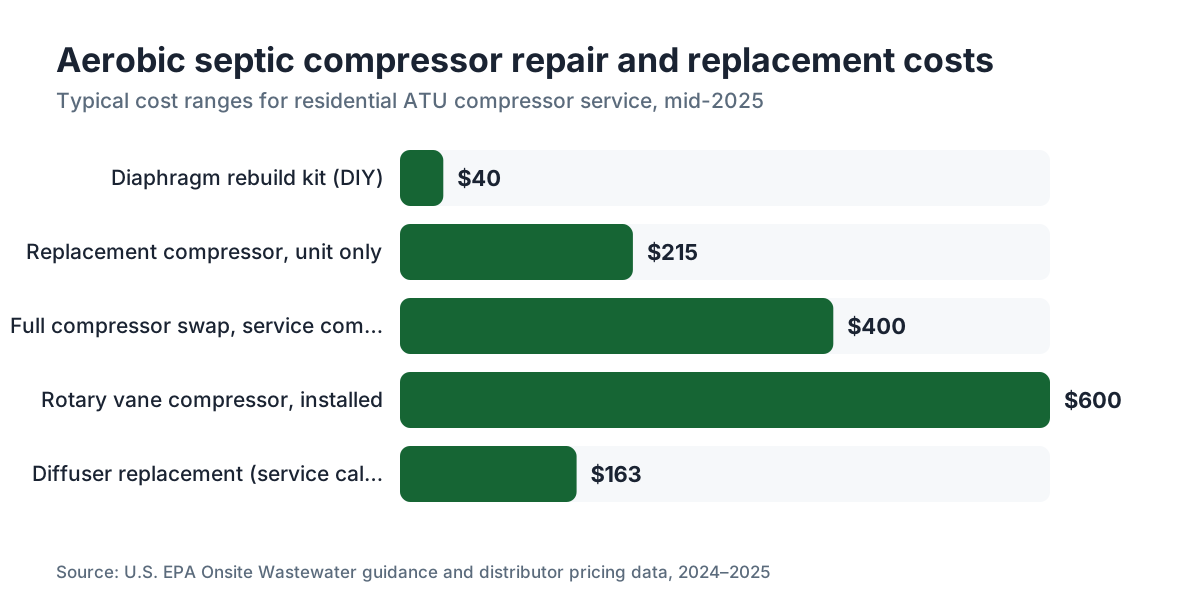
Expect $150 to $600 for a replacement unit installed on a typical residential ATU. Cost swings with unit size, brand, and whether you DIY or hire a tech. Here's a realistic breakdown at mid-2025 pricing.
| Scenario | Typical cost range |
|---|---|
| Diaphragm rebuild kit (DIY) | $20, $60 |
| Replacement diaphragm compressor, residential (unit only) | $80, $350 |
| Full compressor swap, service company (parts + labor) | $200, $600 |
| Rotary vane compressor, larger residential/small commercial | $300, $900 installed |
| Air line repair or diffuser replacement (service call) | $75, $250 |
Labor for a straight compressor swap runs 1 to 1.5 hours for an experienced tech. Service calls carry a minimum charge of $75, $150 no matter what gets done, so if your tech can confirm the diagnosis over the phone and show up with the right unit, you dodge a second trip charge.
If you're comfortable with basic mechanical work, buying a compatible diaphragm compressor from a distributor and swapping it yourself is a fine call. The main risk is buying the wrong unit. Match the required airflow (in LPM or CFM on the spec plate or in your manual) and the discharge pressure the diffuser system needs (in kPa or PSI). A compressor rated for too little pressure will under-aerate even while it runs fine.
For broader cost context on septic work, see cost to install septic system.
How do you know if the aerobic septic compressor is actually running?
Start by listening. A working linear diaphragm compressor makes a steady low-frequency hum, sometimes with a faint vibration you can feel through the housing. Dead silence usually means a tripped breaker, a failed capacitor, or a seized unit. A hum with no airflow usually means a dead diaphragm or a stuck check valve.
Next, check the aeration chamber. Open the inspection lid and look. You want vigorous bubbling across the surface of the water in the aeration compartment. No bubbles, or only weak random bubbling, tells you air isn't getting through even if the compressor is making noise.
To check airflow directly, disconnect the air line at the discharge and hold your hand near the fitting. You should feel a steady, pulsing push of air. Nothing or almost nothing means the compressor is the problem. Strong flow at the compressor but nothing at the diffuser means the line or the diffuser is blocked.
Check your control panel. Most ATU panels have an indicator for the aerator circuit. A tripped breaker is the fastest fix. If it trips again after you reset it, something is pulling too much current, like a seized motor.
If your system has a service contract (required for ATUs in most states), call your provider. Many contracts include a 24-hour emergency line for alarm conditions. Some monitoring setups, including tools built for operators like SepticMind, log alarm events and flag them remotely, so a tech may know before the homeowner calls.
How do you replace an aerobic septic air compressor yourself?
DIY replacement is realistic if you're comfortable with basic plumbing and electrical work. Here's the process in plain terms.
Shut off power at the ATU control panel or the breaker first. Don't skip this. The compressor circuit runs on 120V and the housing can be wet.
Write down the make, model, and specs of the existing unit before you pull it. The spec plate is usually on the case. You need three numbers: maximum pressure (kPa or PSI), airflow at rated pressure (LPM or CFM), and voltage (almost always 120V for residential). Photograph the air line connections before you touch anything.
Disconnect the air discharge line. It's usually a push-fit or barbed fitting with a hose clamp. Keep a rag ready since residual condensation may drip. On most units the power cord unplugs from a weatherproof outlet inside the housing, or runs to a junction box.
Set the new compressor in the same orientation. Most housings have mounting feet or slots. Reconnect the discharge line and make the connection snug. Restore power and listen for it to start. Check the aeration chamber for bubbles within a few minutes.
One caution: if you're switching brands or models, verify the new unit's maximum pressure at least matches the diffuser system's backpressure. Run a compressor past its rated pressure nonstop and the diaphragm dies early. If you're unsure, have a tech confirm compatibility before you order.
After the swap, write down the replacement date and the new unit's specs. Your state may require ATU service records on file, and some states require a service company to certify system function after major repairs. Check your local rules.
What size (airflow) compressor does your aerobic system need?
Getting the size right matters more than most homeowners think. Too little airflow means weak treatment and possible permit violations. Too much wastes electricity and can over-aerate to the point it disrupts the bacterial colony, though that's rare on residential units.
Most single-family ATUs need 2 to 6 cubic feet per minute (CFM), roughly 56 to 170 liters per minute (LPM), at the working backpressure of the diffuser system. Typical backpressures run 1 to 2 PSI (7 to 14 kPa) for shallow installs, up to 3 to 4 PSI (21 to 28 kPa) for deeper tanks. University of Florida IFAS Extension puts most single-family units at 40 to 130 LPM at 7 to 28 kPa backpressure [9].
The right answer for your system is in the owner's manual or on the original nameplate. If those are gone, call the ATU manufacturer with your system model number (usually on a plate on the tank lid) and they'll specify the compressor. Brands with wide U.S. installations include Norweco, Jet (part of Infiltrator), Clearstream, Anua, and Delta Environmental. Each has its own compressor spec.
Rough guidance if you've truly lost all documentation: a 3-bedroom home with a 500-gallon aeration chamber usually runs a 40 to 80 LPM compressor. A 5-bedroom home or a 1,000-gallon chamber may need 80 to 130 LPM. These are starting estimates, not a substitute for the real spec.
One trap to know: the nameplate airflow on a compressor is measured at zero backpressure (free air delivery). Actual airflow at your working pressure runs 15 to 40% lower. Reputable distributors publish performance curves showing airflow against pressure. Use those curves to confirm the unit meets your system's needs at real operating conditions.
What maintenance does an aerobic system compressor need?
Most states require ATUs to carry a service contract with a licensed maintenance provider, usually with quarterly or semi-annual inspections [3]. The EPA SepticSmart program tells homeowners to inspect ATUs regularly and keep service contracts current: "Have your system inspected (more frequently if needed) and pumped every three to five years" [6]. Aerobic systems get inspected more often because of the moving parts.
For the compressor specifically, here's a routine that works.
Every 3 to 6 months: pull and clean or replace the air intake filter. Most filters are foam and rinse clean. A clean filter adds real life to the diaphragm.
Annually: inspect the air line from compressor to diffuser for cracks, kinks, or loose fittings, especially where it enters the ground. UV breaks down any above-ground tubing over time.
Every 1 to 2 years (or per manufacturer spec): replace the diaphragm assembly. Most diaphragm pump makers recommend this even if the unit still runs fine. A planned swap costs $20, $60 and takes under 30 minutes. A reactive swap after a failure can mean 24 to 48 hours of zero aeration.
Every 2 to 3 years: have the diffuser inspected and cleaned or replaced. Mineral fouling builds slowly and rarely shows from the surface.
Keep the housing clear of debris, mulch, leaves, and vegetation. The unit needs airflow for cooling. In freezing climates the housing is usually insulated, but check that ice or snow isn't blocking the vents.
For pumping needs that ride along with this maintenance, see how often to pump septic tank and septic tank cleaning.
Does a failed compressor mean your whole system is in violation?
Yes, almost certainly, and fast. Every U.S. state that permits aerobic treatment units requires the system to provide aerobic treatment continuously. The Texas Commission on Environmental Quality (TCEQ), which oversees one of the largest installed bases of aerobic systems in the country, says ATUs must maintain aerobic conditions at all times and that any component failure must be repaired within a set window, typically 30 days for non-emergencies, shorter when there's a public health risk [5].
Most states follow the same pattern: the system must be under a maintenance contract, the provider must be told of any alarm within 24 hours, and repairs must happen promptly. A permit violation for an extended compressor failure can bring notices of violation, fines, and in extreme cases an order to stop using the system until it's fixed.
So if your compressor fails, move. Call your service contractor the same day. If you're between contractors or handling it yourself, order the part immediately. Aerobic bacteria can survive 24 to 48 hours without oxygen in a dormant state, but past that you're pushing effluent that doesn't meet treatment standards. The National Environmental Services Center at West Virginia University documents this same 24 to 48 hour window before treatment quality drops sharply [8].
One nuance worth knowing: if your system has a pretreatment tank (trash tank), solids keep settling in it even with the compressor down. You're not dumping raw sewage into the ground the second the compressor quits. But the aeration chamber goes anaerobic, treatment quality craters, and any spray or surface disposal is discharging substandard effluent.
Which compressor brands are most common in residential aerobic systems?
Hiblow (made by Techno Takatsuki in Japan) is probably the single most common brand in U.S. residential ATUs. Its HP and TB series linear diaphragm pumps are specified by multiple ATU manufacturers and sold through most distributors. Parts are easy to find and rebuild kits are simple. The HP-80 (80 LPM) and HP-120 (120 LPM) are the common residential sizes.
Gast Manufacturing (U.S.-based, now part of IDEX) makes rotary vane compressors used in some ATU designs, especially older Jet and Aerobic Systems Engineering (ASE) units. Gast units are heavier, louder, and pricier than diaphragm pumps, but they handle higher pressures and longer service intervals. Gast documents capacitor failure and bearing wear as common failure modes, with run capacitors cited as a frequent first-failure part in hot operating conditions [12].
Thomas (part of Gardner Denver) and Medo (another Japanese maker) also show up in residential ATUs. Medo's LA and VN series run quieter than comparable Hiblow units, which matters if the housing sits near a patio or a bedroom window.
When you buy a replacement, match the required specs instead of defaulting to the same brand. If your original unit was a Hiblow HP-80 and it lasted years, buying the same model again is a safe move. If the original failed unusually fast and you suspect a mismatch, checking specs against your ATU's documentation is worth the extra hour.
Operators running multiple ATU accounts can track compressor service intervals and part compatibility across a fleet with software built for it. SepticMind, for example, handles this kind of recurring maintenance tracking across large service territories.
For related component work, the septic tank repair guide covers broader mechanical repairs.
How does the compressor affect your aerobic system's spray field or drain field?
The effluent coming out of a working ATU is far cleaner than what a conventional septic tank produces, which is why ATUs get installed on lots where a conventional drain field would fail or be banned. The EPA notes ATUs reduce BOD and suspended solids by 85 to 95% versus 30 to 50% for conventional tanks, and that cleaner effluent can be applied at higher rates per square foot of disposal area [1].
When the compressor dies, that quality crashes. Effluent leaving a dead ATU is closer to primary-treated (conventional septic) water. If your disposal is a spray field putting effluent onto the surface, undertreated effluent is an immediate public health concern, especially for households with kids, pets, or anyone who might touch the spray. If your disposal is a sub-surface drip or leach field, the surface risk drops, but consistently poor effluent clogs the field far faster than properly treated ATU effluent.
Over time, repeated compressor failures that go unfixed degrade the disposal field. Biomat (the biological clogging layer) builds faster in soil taking poorer-quality effluent. Leach field repair or replacement runs $5,000, $20,000 depending on size and site. Keeping the compressor running is genuinely the cheapest drain field protection you have.
For more on drain field health, see leach field.
Frequently asked questions
How do I know if my aerobic septic compressor is working?
Open the aeration chamber lid and look for vigorous bubbling across the water surface. You should also hear and feel the compressor running (a steady hum) at the housing. If you hear it but see no bubbles, the air line or diffuser may be blocked. If neither is running, check the breaker on your control panel before assuming the compressor is dead.
Can I run my aerobic septic system without the air compressor?
Not legally, and not for long without consequences. Aerobic bacteria die or go dormant within 24 to 48 hours without oxygen. After that, your ATU works like a poorly sized anaerobic system and produces effluent that fails permit standards. Most states require repairs within 30 days of a component failure notification, and some require faster action when there's a public health risk.
How much does it cost to replace an aerobic septic air compressor?
A diaphragm rebuild kit runs $20, $60 for a DIY repair. A full replacement compressor (unit only) costs $80, $350 depending on size and brand. Hiring a service company for parts and labor usually totals $200, $600 for a residential system. Rotary vane compressors on larger systems can hit $600, $900 installed. Getting the airflow spec right before ordering avoids costly returns.
How long does an aerobic septic compressor last?
Most residential diaphragm compressors last 3 to 8 years. Hiblow publishes diaphragm replacement intervals of 12 to 24 months even on working units. Life depends on climate, filter care, and whether the diffuser stays clean. Budget for a diaphragm swap every 1 to 2 years and a full compressor replacement every 4 to 6 years as a planning baseline.
What size compressor does my aerobic septic system need?
Check your ATU owner's manual or the tank nameplate for the required airflow (LPM or CFM) and maximum backpressure (kPa or PSI). Most single-family systems need 40 to 130 LPM at 7 to 28 kPa. The nameplate airflow is free-air delivery; actual output at operating pressure runs 15 to 40% lower, so use the manufacturer's pressure-flow curve to confirm sizing.
Why does my aerobic septic compressor keep tripping the breaker?
A breaker that trips repeatedly usually means the motor draws more current than normal, often from a seized motor, a failed run capacitor, a stuck check valve creating backpressure, or a flooded air line forcing the pump against water. Replacing the capacitor (a $10, $40 part) fixes some cases. A seized motor means full replacement. Have a tech find the cause before resetting the breaker again and again.
Can I replace the diaphragm myself instead of buying a new compressor?
Yes, for most linear diaphragm compressors. Rebuild kits run $20, $60 from the manufacturer or a distributor, and the job takes 20 to 30 minutes. You'll need a screwdriver and maybe a wrench. Follow the instructions exactly; installing the diaphragm upside down is a common mistake. A fresh diaphragm on an otherwise sound compressor is as good as a new unit.
Does my aerobic system compressor need to run all the time?
Yes. Aerobic treatment depends on a continuous oxygen supply to keep a living colony of aerobic bacteria going. Some systems use a timer to cycle the compressor (often 30 minutes on, 30 minutes off) to save energy, but only when the system was designed for intermittent aeration. Most residential ATUs run 24/7. Never add a timer or a switch to cut power without confirming it matches your system design.
What happens to the spray field if the compressor fails?
Treatment quality drops toward anaerobic (conventional septic) levels within 24 to 48 hours. Effluent reaching the spray field or drip system is undertreated, creating a public health risk from surface contact and speeding up biomat clogging in the soil. Repeated failures without prompt repair shorten disposal field life a lot, potentially turning a $400 compressor repair into a $10,000, $20,000 drain field replacement.
Is a loud aerobic septic compressor a sign of failure?
Louder often means trouble. A diaphragm that's hardening or cracking makes a rougher, louder pulse. A worn bearing in a rotary vane unit whines. If your compressor suddenly sounds different from its normal running noise, check airflow to the aeration chamber and inspect the filter and diaphragm. Don't wait for it to quit entirely; catching it early is cheaper.
Do I need a service contract for my aerobic septic system?
In most states, yes. States that permit ATUs typically require a mandatory service contract with a licensed maintenance provider, with inspections every 3 to 6 months. Texas, for example, requires periodic inspections under Title 30 TAC 285 for most ATU installations. The contract holder responds to alarm conditions and certifies system performance. Check your state's onsite wastewater regulations for the exact requirement.
Can cold weather damage my aerobic septic compressor?
The compressor itself usually sits in an insulated or partly protected cabinet and makes its own heat while running, so the unit rarely freezes. The bigger winter risk is condensation in the air line that freezes and blocks airflow, or a diffuser that ices over in very shallow tanks. In sub-freezing climates, make sure the air line has no low spots that trap water, and check the diffuser for ice after hard freezes.
How do I find the right replacement compressor for my ATU brand?
Start with your ATU owner's manual; it usually lists the OEM compressor part number and required specs. If the manual is gone, look for a model plate on the tank lid and contact the ATU manufacturer directly. Norweco, Jet, Clearstream, and Anua all have technical support lines. Match required airflow at rated backpressure, more than the LPM free-air number on the box.
Will my homeowner's insurance cover a failed aerobic septic compressor?
Usually not as a standalone mechanical breakdown. Standard homeowner's policies cover sudden and accidental damage but typically exclude mechanical or electrical breakdown of appliances and systems. Some policies include or offer riders for service line or mechanical breakdown coverage that might apply. Check your policy declarations and ask your agent specifically about septic mechanical components. A service contract often covers wear items like compressors better.
Sources
- U.S. EPA, Onsite Wastewater Treatment Systems Manual (EPA/625/R-00/008): Aerobic treatment units reduce BOD and suspended solids by 85 to 95% compared to 30 to 50% for conventional septic tanks, enabling higher application rates to disposal fields.
- Hiblow USA, HP Series Linear Air Pump Product Documentation: Hiblow publishes diaphragm replacement intervals of 12 to 24 months for its HP and TB series residential linear air pumps depending on duty cycle.
- U.S. EPA, Voluntary National Guidelines for Management of Onsite and Clustered (Decentralized) Wastewater Treatment Systems: EPA guidelines recommend that ATUs with mechanical components including aerators be inspected at least every 6 months, and states commonly require a maintenance contract with a licensed provider.
- North Carolina State Extension, Aerobic Treatment Units for Onsite Wastewater: NC State Extension identifies diaphragm failure and filter clogging as leading causes of reduced airflow in residential ATU compressors, recommending filter inspection every 3 to 6 months.
- Texas Commission on Environmental Quality (TCEQ), On-Site Sewage Facilities, Title 30 TAC Chapter 285: TCEQ requires aerobic treatment units to maintain aerobic conditions at all times and requires component failures to be repaired within a set window, typically 30 days for non-emergencies.
- U.S. EPA, SepticSmart: Types of Septic Systems: EPA describes aerobic treatment units as requiring continuous aeration and electricity, and recommends regular inspection and pumping every three to five years.
- National Environmental Services Center (NESC) at West Virginia University, Pipeline Newsletter: NESC documents that aerobic bacteria in ATU aeration chambers go dormant or die within 24 to 48 hours of loss of aeration, causing rapid treatment quality decline.
- University of Florida IFAS Extension, Aerobic Treatment Systems for Onsite Sewage Treatment: UF IFAS documents typical residential ATU aeration chamber sizes and airflow requirements, with most single-family units needing 40 to 130 LPM at 7 to 28 kPa backpressure.
- Texas A&M AgriLife Extension, Aerobic Septic Systems: Maintenance and Operation: Texas A&M AgriLife documents the relationship between diffuser fouling and apparent compressor failure, noting that diffuser replacement often restores system performance without compressor replacement.
- Gast Manufacturing, Rotary Vane Compressor Technical Specifications: Gast documents rotary vane compressor failure modes including capacitor failure and bearing wear, with run capacitors cited as a common first-failure component in hot operating environments.
Last updated 2026-07-10