Aerobic septic systems: how they work, costs, and maintenance
By the SepticMind Editorial Team
TL;DR
- An aerobic septic system (ATU) pumps air into sewage to grow oxygen-loving bacteria that break down waste far more thoroughly than a conventional tank.
- The output is clean enough to spray on a lawn.
- Installed cost runs $10,000 to $20,000.
- These systems need electricity, a service contract in most states, and more hands-on care than a standard septic tank.
What is an aerobic septic system and how does it differ from conventional septic?
A conventional septic system is anaerobic. Waste sits in a tank, solids settle, and partially treated liquid drains passively into a soil absorption field. Simple. But the effluent leaving that tank is still loaded with pathogens and nutrients.
An aerobic treatment unit (ATU) adds oxygen. Air pumps into a treatment chamber around the clock, feeding aerobic bacteria that digest organic matter faster and more completely than anaerobic bacteria ever could. The EPA describes aerobic treatment units as producing "a higher quality effluent" than conventional septic, which is why they're approved where soil conditions or lot size rule out a standard drain field [1].
That difference matters. A working ATU cuts biochemical oxygen demand (BOD) by 85 to 95%, against the 30 to 50% you'd get from a standard septic tank [3]. Cleaner output is the whole point. It's why ATUs can legally discharge to surface water in some states, spray onto a lawn through a surface spray system, or feed a much smaller drain field than a conventional system needs.
Want to see the parts laid out? Search your state environmental agency site for an aerobic septic system diagram and you'll usually find the approved design drawings. The basic topology never changes: pretreatment trash tank, aeration chamber, clarifier, chlorine or UV disinfection, then a pump to discharge.
What are the main components of an aerobic septic system?
Most residential ATUs use a four-stage design, though the physical layout shifts by manufacturer. Norweco, Jet, Clearstream, and Bio-Microbics are common brands in the U.S.
Pretreatment (trash) tank. Raw sewage enters a first compartment that removes large solids and grease, doing roughly the same job as a conventional septic tank. This chamber still needs periodic septic tank pump out service, usually every 1 to 3 years depending on household size.
Aeration chamber. Air pumps in continuously, either through a surface aerator or a diffused-air system at the tank bottom. This is the heart of the ATU. Aerobic microbes tear through dissolved organic waste. That compressor running 24/7 is the main reason ATUs draw power, usually 150 to 300 watts, which adds roughly $15 to $30 a month to your electric bill.
Clarifier or settling zone. Treated water flows into a quieter zone where leftover suspended solids drop out before the effluent moves on. Some systems send those settled solids back to the aeration chamber to keep the bacteria population thick.
Disinfection and discharge. The last stage kills pathogens before the water leaves. Chlorine tablets in a contact chamber and UV disinfection are the two approved methods in most states. Chlorinated ATU effluent typically has to hold a residual of 0.5 to 1.0 mg/L chlorine before discharge under most state codes. After disinfection, the effluent goes to a spray field, a subsurface drip field, or in some states a small conventional absorption trench.
The diagram below shows a typical residential ATU layout. Note that the clarifier and aeration chamber often live in a single tank body to save space, which is one reason these systems fit on tighter lots.
What does an aerobic septic system cost to install?
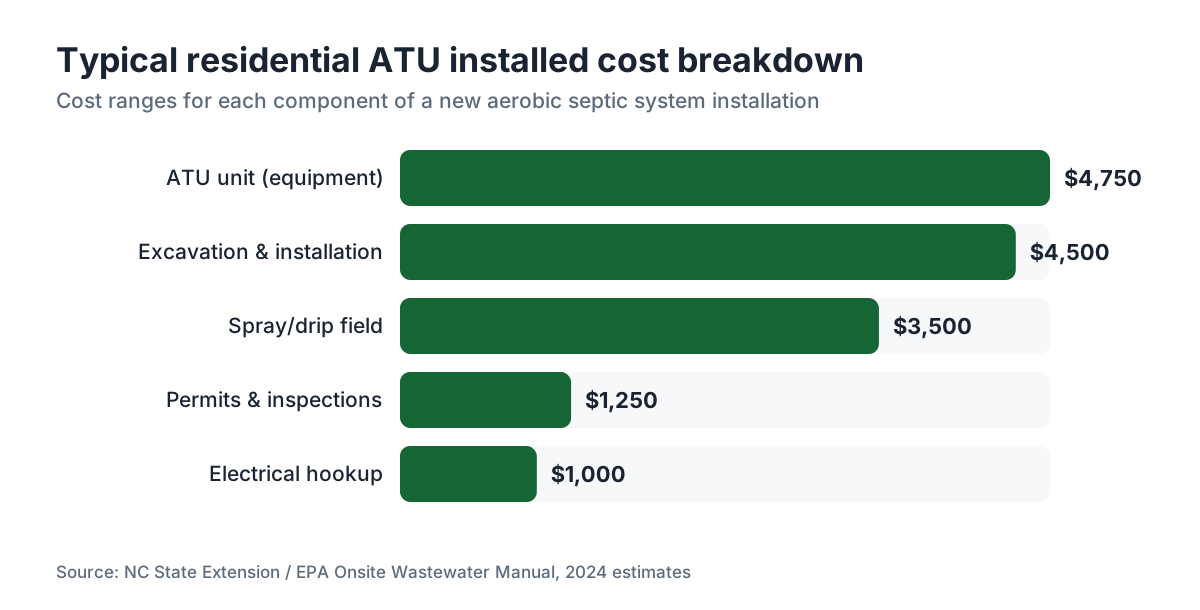
Installed cost for a residential ATU runs $10,000 to $20,000 in most U.S. markets, though you'll see quotes on either side depending on discharge method and site [9].
Here's how the money breaks down:
| Component | Typical cost range |
|---|---|
| ATU unit (equipment only) | $2,500 to $7,000 |
| Excavation and installation labor | $3,000 to $6,000 |
| Spray field or drip irrigation system | $2,000 to $5,000 |
| Permits and inspections | $500 to $2,000 |
| Electrical hookup | $500 to $1,500 |
| Total installed | $10,000 to $20,000 |
That's a lot more than conventional. A standard septic tank plus absorption field in the same market usually runs $4,000 to $12,000 depending on soil and lot conditions. The cost to install septic system guide breaks down what drives those numbers.
So why pay double? Usually because you have no choice. A failing perc test, a high water table, a small lot, or a state-designated sensitive water body can each disqualify a conventional system. When that happens, an ATU is the permit-able option, full stop [12].
Rebate and financing programs for ATUs exist in some areas. Texas, for one, has county-administered low-interest loan programs for owners upgrading failing conventional systems to ATUs in certain watersheds. Call your county environmental health department before you assume you're paying full retail.
How much does it cost to maintain an aerobic septic system annually?
Plan on $400 to $900 a year in maintenance beyond electricity, plus $100 to $500 a year in electricity depending on system size and local rates. That's a real gap from conventional septic, where a homeowner pumping every 3 years spends maybe $150 to $200 a year averaged out.
Most states make ATU owners hold an active maintenance contract with a certified service provider. Texas, one of the states with the most ATUs in the country, requires quarterly inspections of all aerobic treatment units under Title 30 of the Texas Administrative Code, Chapter 285 [4]. Florida requires operating permits and regular inspections under Chapter 64E-6 of the Florida Administrative Code. These aren't optional. Skip them and you're looking at fines or an order to decommission the system.
A typical service visit covers checking and adjusting air flow, inspecting the aerator or compressor, testing effluent chlorine residual, refilling chlorine tablets or swapping a UV bulb, checking for alarms, and logging the visit. Most contracts also cover parts that fail between visits up to a set dollar limit.
The aerator motor is the most common thing to break. Aerator replacement runs $150 to $500 for parts alone [7]. A sharp technician catches a fading motor before it dies. Miss a failure for a few weeks and the aeration chamber goes anaerobic, so you're running a very expensive conventional septic tank until it's fixed.
Chlorine tablets are a consumable. A household of four burns through roughly $30 to $60 a year in tablets, though your contract may fold that in.
Where are aerobic septic systems required or preferred?
ATUs get required or preferred in four situations, and poor soil leads the list.
When a site fails a percolation test, or the soil is too clayey, rocky, or saturated to absorb effluent reliably, a conventional drain field won't pass inspection. An ATU with drip irrigation or spray disposal can work where plain soil absorption can't [12].
Small lots are the second reason. Setback rules for a conventional absorption field eat up land. ATU effluent is clean enough to discharge through drip lines at shallower depths and tighter spacing, which cuts the required area a lot.
Sensitive receiving environments come third. Lots near lakes, streams, oyster beds, or municipal wellhead protection zones often carry special wastewater rules. A conventional system may not hit the nutrient or pathogen reduction standards required near those resources. The EPA SepticSmart program points to ATUs as appropriate technology for these settings [1].
Fourth is replacing a failing conventional system. When a drain field fails and there's no room or suitable soil for a new field on the same lot, regulators sometimes approve an ATU with spray or drip disposal as the only retrofit. If you're staring at a failed system right now, the septic system repair guide walks through your options.
How do you maintain an aerobic septic system as a homeowner?
Your service contractor handles the technical work, but plenty falls to you between quarterly visits.
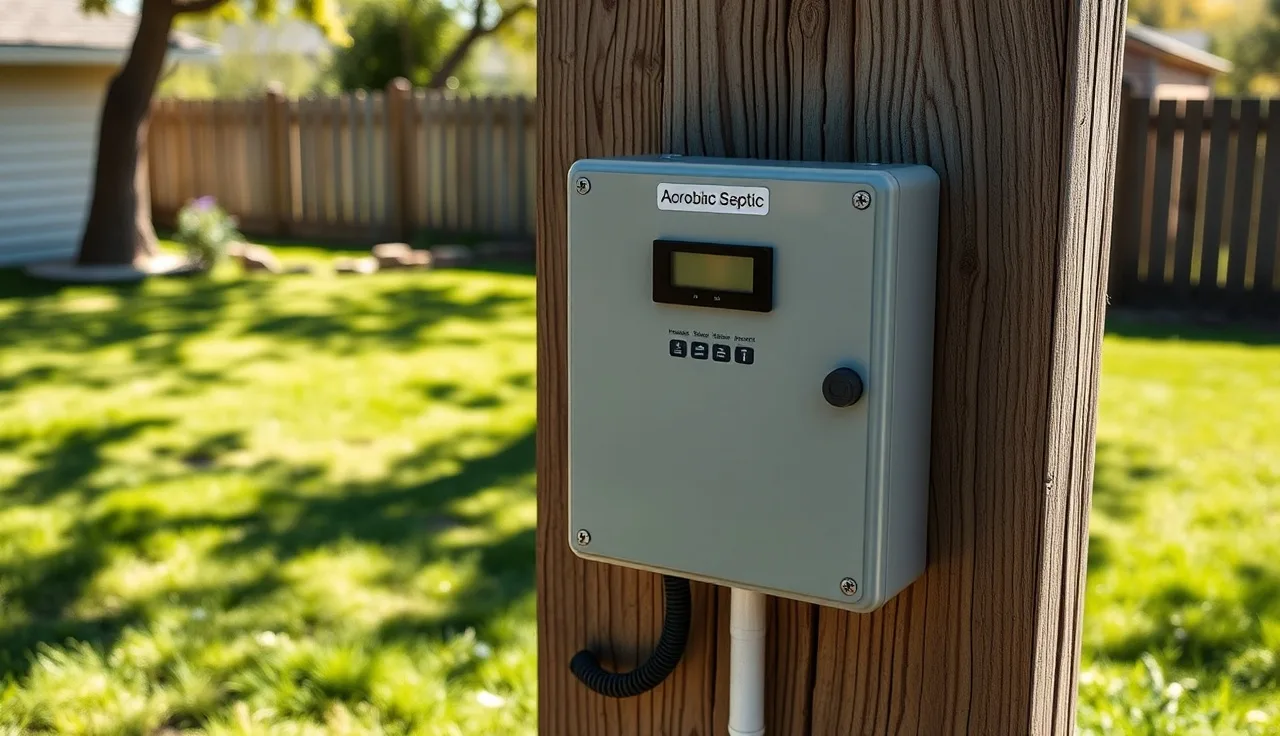
Watch your alarm panel. ATUs have a control panel with alarm lights or audible alerts for high water level, aerator failure, and chlorine depletion. An alarm means something stopped working. Call your service provider the same day, not next week.
Keep the chlorine chamber full. Some systems need fresh tablets every 4 to 8 weeks between service visits. Your manual will spell out the interval. Run dry on chlorine and untreated effluent reaches your spray field or surface discharge, which is a permit violation in most states.
Protect the spray field. If your ATU discharges through surface sprinklers, keep people and pets off the spray area during and right after a cycle. Most state codes require a 10-foot setback from the spray area to property lines and structures, and some require signage.
Watch what goes down the drain. ATUs bruise easier than conventional septic. Antibacterial soaps, bleach, and big doses of chemical drain cleaner can wipe out the aerobic bacteria you depend on. This doesn't mean you have to swear off household cleaners. It means don't dump a quart of bleach at once. The EPA's SepticSmart guidance tells homeowners to "never flush medications, wipes, or harsh chemicals" [1].
Pump the pretreatment tank on schedule. The trash tank fills with solids just like a conventional septic tank. Skip the septic tank pumping and solids carry over into the aeration chamber and foul the aerator. Most residential ATU pretreatment tanks need pumping every 1 to 3 years. The how often to pump septic tank guide gives you a sizing-based schedule.
Keep records. Service reports, alarm events, chlorine additions, and repairs all go in one file. Buyers, lenders, and regulators ask for this history when the house sells. Some states make you transfer the maintenance contract to the new owner.
What are the most common aerobic septic system problems?
A handful of failures show up over and over in ATU service records, and the aerator leads them all.
Aerator or compressor failure. The aerator runs 24/7, so it wears. Average life is 2 to 8 years depending on brand and duty cycle [7]. A dead aerator sends the system anaerobic, odors build, and effluent quality falls fast. Your alarm panel should catch this, but panels fail too, so the quarterly visit catches what the alarm misses.
Clogged diffusers. On diffused-air systems, the porous diffuser membranes at the tank bottom clog with biofilm over time, cutting oxygen transfer. Technicians clean or swap them during service visits.
Chlorinator clogging. Calcium scale builds up in the chlorine contact chamber, especially in hard-water areas. A clogged chlorinator means no residual, which means a permit violation. Cleaning or replacing it is routine service, and homeowners can handle it with the right tablet type and periodic flushing.
Spray head clogging. Surface spray systems have small nozzles that clog with mineral deposits, grass, and insect nests. Walk your spray field once in a while and watch a cycle run. If a head isn't spraying or is aiming wrong, flag it for your tech.
Hydraulic overload. ATUs are sized for a specific daily flow, typically 150 gallons per bedroom per day, which is the EPA design standard [6]. Run far more water than the design allows and the system loses the retention time it needs to treat properly. It shows up as elevated effluent BOD on test results. The fix is usually behavior change (spreading out laundry loads, fixing leaky toilets), not a new system.
To diagnose a system that's actively failing, the septic tank repair article covers the steps.
Is an aerobic septic system safe for yard spray irrigation?
Yes, with caveats. Properly treated and disinfected ATU effluent is safe enough for surface spray disposal in most states, but the rules on human contact with the spray vary.
Texas, which has more ATUs than almost any other state, allows spray disposal with specific setbacks: 75 feet from a drinking water well, 50 feet from surface water, 10 feet from property lines and structures, and 100 feet from public water supplies [4]. Most states with spray rules follow similar distances.
The qualifier that matters is "properly treated and disinfected." Spray from an ATU running without chlorine, or with a dead aerator, is partially treated sewage broadcast across your lawn. That's the public health reason states require maintenance contracts and inspections.
Keep kids and pets off the spray zone during cycles and for at least an hour after. Most residential ATU controllers spray at night or early morning to cut human contact and evaporation. Don't grow low-clearance edibles (strawberries, lettuce, root vegetables) in or right next to the spray zone. Fruit trees and turf grass are generally fine under state guidance.
Buying a home with an ATU and spray disposal? Look hard at the spray field. Bare waterlogged patches, or lush stripes next to dead zones, tell you the heads are uneven or the system is overloaded.
How long do aerobic septic systems last?
The tank body lasts the longest, typically 20 to 40 years of concrete or fiberglass with proper care. The mechanical parts are what you actually manage day to day.
Aerators run 2 to 8 years. Compressors, 5 to 10 years. UV bulbs, 1 to 2 years. Chlorine contact chambers, 10 to 20 years with cleaning. Control panels and float switches, 10 to 15 years.
A well-maintained ATU works for 20 to 30 years before the tank itself needs replacement or major structural work. Systems that get skipped on service, or that take constant chemical abuse (heavy bleach, medications, non-flushable wipes), degrade far faster and often flunk the state effluent test within 5 to 10 years.
The biggest driver of early failure isn't mechanical wear. It's a neglected maintenance contract. Systems with continuous service records live longer. Period.
If you manage properties with ATUs and need to track service history, maintenance schedules, and inspection compliance across many systems, SepticMind is built for that operator workflow, with automated contract renewal reminders and inspection logging.
For homeowners weighing repair against replacement on an aging ATU, the septic system repair guide lays out a cost-versus-replace framework.
How does a homeowner get an aerobic septic system inspected or permitted?
Permits and inspections for ATUs run through your county or state environmental health department, not a private inspector, though a private inspector may still do a pre-purchase evaluation.
New installations require a site evaluation, soil testing, a system design from a licensed engineer or sanitarian, and a permit before anyone breaks ground. Most states won't issue a building permit for a new home on a lot that hasn't been approved for an onsite sewage system first.
For existing ATUs, the routine state inspection is usually done by your licensed maintenance contractor and filed with the state electronically. Fail an inspection (effluent quality, mechanical condition, or a discharge violation) and you'll get a notice of violation with a deadline to fix it, typically 30 to 90 days depending on severity.
Home sales with ATUs almost always trigger a separate operational inspection by a licensed sanitarian or ATU technician, paid for by buyer or seller depending on local custom. That report says whether the system is operating within permit parameters as of inspection day. It doesn't predict future mechanical failures, so buyers of ATU homes should also demand the full service history, which tells you more than the inspection alone.
Adding an ATU to a lot that had a conventional system means a new permit. The old one doesn't transfer. The cost to put in a septic tank article covers what permitting adds to total installed cost.
What are the pros and cons of aerobic septic systems versus conventional septic?
Let's be direct about the trade-offs instead of pretending one system always wins.
| Factor | Aerobic (ATU) | Conventional |
|---|---|---|
| Effluent quality | High (85 to 95% BOD reduction) | Moderate (30 to 50% BOD reduction) |
| Installed cost | $10,000 to $20,000 | $4,000 to $12,000 |
| Annual maintenance | $400 to $900 + electricity | $50 to $200 averaged |
| Electricity required | Yes (150 to 300W continuous) | No |
| Mechanical parts | Multiple (aerator, pump, UV/chlorine) | Minimal |
| Drain field size | Smaller or eliminated | Full-size required |
| Suitable for poor soil | Often yes | Often no |
| State oversight | Quarterly inspections, permits | Minimal ongoing oversight |
| Lifespan (mechanical) | 2 to 10 years per component | 20 to 30 years (passive) |
For a homeowner with good soil and a standard lot, a conventional system is cheaper, quieter, and easier to live with. For a homeowner with a failing perc test, a small lot, or a location near sensitive water, an ATU may be the only path to a permitted system.
My honest take: if a conventional system is allowed on your lot, it's almost always the right financial call. The ATU costs more upfront and much more over time. But where soil or lot constraints make conventional impossible, a properly maintained ATU works well and beats the alternatives (holding tanks, expensive municipal connections).
The septic drain field article digs into why field size matters and when alternative disposal like ATU spray irrigation makes the math work.
How do aerobic septic systems affect property value and home sales?
The honest answer: an ATU is a neutral-to-slightly-negative factor at sale compared to a home with a working conventional system, all else equal. Buyers unfamiliar with ATUs see the service contract cost and worry about mechanical failure. Buyers in areas where ATUs are common (rural Texas, parts of Florida, the Ozarks) treat them as normal [11].
What kills deals isn't the ATU itself. It's an ATU with a lapsed service contract, a failed inspection, or an obviously sick spray field. Lenders, especially on FHA or VA loans, may demand proof that the system is currently permitted, under contract, and passed its last inspection before they'll close. Fannie Mae guidelines don't ban ATU-served homes, but they do require the system to be in working order at close.
Selling a home with an ATU? Get your service records in order, confirm your permit is current, and have a passing inspection in hand before listing. If the system has deferred maintenance, deal with it before buyers inspect. A $400 aerator repair looks a lot cheaper before listing than as a negotiating chip at closing.
For operators managing properties with ATUs, SepticMind's compliance tracking keeps permit status and inspection records organized across a service area, which matters when a homeowner calls asking whether they're in compliance before a sale.
Frequently asked questions
Do aerobic septic systems smell?
A properly working ATU should have almost no odor. The aerobic process makes far less hydrogen sulfide than anaerobic digestion. If you smell sewage near an ATU, the aerator has likely failed and the system has gone anaerobic, the chlorinator is empty, or solids have built up past capacity. Call your service tech. Don't shrug off ATU odors the way you might ignore an occasional whiff from a conventional system.
Can I install an aerobic septic system myself?
No, not legally in any U.S. state. ATUs require a permit, an engineered design, and licensed installation. Most states also require the installer to be a licensed sanitarian or plumbing contractor with onsite wastewater certification. DIY installation voids permits, voids the equipment warranty, and creates real liability if the system discharges improperly. Homeowners can handle minor maintenance like adding chlorine tablets, but installation and major repairs need licensed contractors.
How often does an aerobic septic system need to be pumped?
The pretreatment compartment of most residential ATUs needs pumping every 1 to 3 years, similar to a conventional septic tank. The interval depends on household size and tank capacity. Your contractor should check solids depth at each quarterly visit and recommend pumping when solids hit about one-third of tank volume. Skip pumps and solids carry over into the aeration chamber, which damages the aerator and drags down treatment quality.
What happens if the aerator on my ATU stops working?
The system flips from aerobic to anaerobic, effluent quality drops sharply, and odors build. Your alarm panel should signal the failure. Call your service provider the same day. Most state rules give you a short window (often 24 to 72 hours) to restore a failed component before you're technically violating your operating permit. Aerator replacement is a common repair, typically $150 to $500 in parts plus labor.
Can aerobic septic systems handle garbage disposals?
With caution. A garbage disposal jacks up the organic load on any septic system. For ATUs, the extra solids fill the pretreatment tank faster and can swamp the aeration chamber if the system is already near capacity. Some state codes and manufacturers advise against garbage disposals with ATUs entirely. If you insist, pump the pretreatment tank more often and have your tech check effluent quality at the next visit to confirm the system is keeping up.
What are the chlorine tablet requirements for aerobic septic systems?
Most states require a minimum effluent chlorine residual of 0.5 to 1.0 mg/L at the discharge point, which means the contact chamber must hold tablets at all times. Standard ATU tablets are calcium hypochlorite, not swimming pool tablets, which can damage system seals. Your contractor adds tablets at each visit, but you may need to top off between visits every 4 to 8 weeks depending on system volume and household flow rate.
Are there aerobic septic systems that don't use chlorine?
Yes. UV disinfection is an approved alternative to chlorine in most states and shows up more and more in new installations. A UV lamp in the effluent line kills pathogens without leaving a chemical residual. The trade-off: UV bulbs need annual replacement (roughly $80 to $200 each) and the sleeve around the bulb has to stay clean to work. UV removes chlorine handling and the chemical residual, which helps if the discharge reaches areas where chlorine could harm plants or aquatic life.
How do I find a certified ATU maintenance provider in my state?
Your state environmental agency or health department keeps a list of licensed onsite wastewater providers. In Texas, the TCEQ licenses installers and maintenance providers under its On-Site Sewage Facility program. In Florida, the Department of Health handles licensing. Searching your state name plus 'onsite sewage facility license' or 'aerobic treatment unit maintenance license' usually surfaces the right agency page. Your county environmental health office can also give referrals.
Can an ATU replace a failing conventional drain field?
Sometimes yes, and it's one of the most common reasons homeowners install ATUs. If your conventional drain field has failed and there's no suitable area for a replacement field on the lot, a permitted ATU with spray or drip disposal may be the only compliant option. The permitting process requires a new site evaluation and design. A retrofit ATU installation runs $10,000 to $20,000 plus any decommissioning work on the old system.
Do aerobic septic systems freeze in cold climates?
They can, and cold-weather performance is a real limitation. The bacteria in the aeration chamber slow down hard below 50 degrees F and can be killed by freezing. Systems in northern states often use insulated tanks and buried aeration lines to hold heat. Surface spray fields are impractical where winters are hard, so cold-climate ATUs usually discharge to subsurface drip or pressurized subsurface systems. If you're up north and considering an ATU, ask your designer specifically about winter performance specs.
What is the difference between an ATU and a septic tank with a filter?
A septic tank with an effluent filter is still a passive anaerobic system. The filter screens out suspended solids before effluent reaches the drain field, which reduces clogging. It doesn't add oxygen or meaningfully raise pathogen reduction. An ATU actively aerates to reach dramatically higher organic matter and pathogen reduction. The two aren't the same thing: a filter is a modest upgrade to conventional septic, while an ATU is a fundamentally different treatment process.
What size aerobic septic system do I need for a 3-bedroom house?
Most state codes size ATUs by bedroom count using a design flow of roughly 150 gallons per bedroom per day, which puts a 3-bedroom home at 450 gallons per day of design flow. A 500 GPD rated ATU is the standard residential unit for 3 to 4 bedrooms. Always confirm with your county sanitarian, since some states use different per-bedroom flow rates or require upsizing for certain fixtures. Undersizing is a common mistake in older installations.
Does homeowners insurance cover ATU repairs?
Standard homeowners policies treat septic systems as part of the home structure and usually don't cover mechanical breakdown of ATU components like aerators, pumps, or control panels. Some insurers offer equipment breakdown endorsements that cover exactly this. A few specialty home warranty products cover ATU mechanical parts. Read the fine print: many warranties exclude systems that weren't maintained under a service contract, which is one more reason to keep that contract active.
Sources
- U.S. EPA SepticSmart Program: EPA describes aerobic treatment units as producing a higher quality effluent than conventional septic and identifies them as appropriate for sensitive receiving environments.
- EPA Office of Water, Onsite Wastewater Treatment Systems Manual (EPA/625/R-00/008): Aerobic treatment units produce BOD reductions of 85 to 95% and are described as appropriate for challenging site conditions.
- Texas Administrative Code Title 30, Chapter 285 (On-Site Sewage Facilities): Texas requires quarterly inspections of all aerobic treatment units and specifies spray disposal setbacks including 75 feet from drinking water wells.
- EPA Onsite Wastewater Treatment Systems Manual, Hydraulic Loading Rates: EPA design standard uses approximately 150 gallons per bedroom per day for residential onsite system sizing.
- National Environmental Services Center (NESC), Aerobic Treatment Units Tech Brief: Aerator motor replacement is the most common ATU mechanical failure; aerator life averages 2 to 8 years depending on brand and duty cycle.
- North Carolina State University Cooperative Extension: Installed ATU costs range from $10,000 to $20,000 for a residential system including equipment, labor, spray field, permits, and electrical.
- Texas A&M AgriLife Extension: Texas has one of the largest concentrations of residential ATUs in the U.S., driven by state wastewater rules for rural and exurban lots.
- U.S. EPA, Types of Septic Systems: EPA identifies aerobic treatment units as suitable alternatives where conventional drain fields fail perc tests or are prohibited near sensitive water bodies.
Last updated 2026-07-09