Aerobic septic system brands: what actually separates them
By the SepticMind Editorial Team
TL;DR
- The main aerobic treatment unit (ATU) brands in the U.S.
- are Norweco, Jet Inc., Bio-Microbics, Infiltrator (AdvanTex), and Hoot Systems.
- Every reputable unit carries NSF/ANSI 40 certification, meaning the effluent meets secondary treatment standards.
- Brand matters mostly for parts availability near you, your installer's familiarity, and whether the model is on your state's approved list.
What is an aerobic septic system and how does it differ from a conventional one?
A conventional septic system is anaerobic. Bacteria break down waste in an oxygen-free tank, and the partly treated liquid flows to a leach field where soil finishes the job. An aerobic treatment unit (ATU) does something different: it forces air into the treatment chamber, feeding oxygen-hungry bacteria that digest solids far more completely. The result is effluent clean enough, in most states, to go to a smaller drip field, a surface spray area, or in some cases a surface water body.
The EPA's SepticSmart program describes ATUs as producing "a higher quality effluent than conventional septic systems" and notes they are often required on lots too small or too wet for a standard drain field [1]. That cleaner output is the whole point. It comes with a real trade-off, though: moving parts, an aerator that runs around the clock, a disinfection stage (usually chlorine tablets or UV), and a maintenance contract that most states make you sign by law.
Most aerobic systems have three or four chambers inside one or two tanks. Wastewater enters a trash or settling chamber first. It moves to the aeration chamber, where the aerator bubbles air through the liquid (that low churning you hear near the lids is the aerator, and it is normal). Then it flows to a clarifier where solids settle, and finally through disinfection before it leaves the tank. Some brands stack all four zones in one precast concrete or fiberglass tank. Others run separate tanks in series.
Which brands dominate the U.S. aerobic septic system market?
No public market-share survey exists for ATU manufacturers, so any ranking leans on installer reports, state approval lists, and trade data rather than hard sales numbers. With that caveat, five names show up on more state-approved product lists than anyone else.
Norweco (Norwalk, Ohio) has made the Singulair line since the 1960s and is probably the oldest ATU brand still running in the country. The Singulair Green is their core residential unit. Parts are stocked nationally, and the independent service network is large. Aerators are the part that gets replaced most, and Norweco's aerator is a known quantity for most pump-out contractors.
Jet Inc. (Ponce de Leon, Florida) makes fiberglass tanks in several capacities and is strong across the Southeast and Gulf Coast. Their units are common in Texas, Louisiana, and Florida, partly because fiberglass holds up better than concrete in high-water-table coastal soils.
Bio-Microbics (Shawnee, Kansas) makes the FAST (Fixed Activated Sludge Treatment) system. FAST uses a submerged fixed-film media instead of suspended growth, which some engineers prefer because it shrugs off hydraulic shock better. Bio-Microbics also builds smaller commercial-scale units and holds NSF 40 and NSF 245 (nitrogen reduction) certifications on several models [2].
Infiltrator Water Technologies / AdvanTex (the AX-20 and AX-Max) uses a textile filter media in a recirculating setup rather than a conventional aeration chamber. It is widely approved and popular in the Pacific Northwest and in states with tight nitrogen limits. Infiltrator is now part of Advanced Drainage Systems (ADS).
Hoot Systems (Oil City, Louisiana) builds fiberglass ATUs and is common across the Gulf South. Local technicians say the construction is straightforward to service.
Smaller regional brands worth knowing: Delta Environmental (polyethylene tanks, popular in parts of the South), Aerobic Systems Inc., and Clearstream (a fiberglass unit made in Texas with a following in the Hill Country). State approval lists are the authority here. Texas TCEQ, Florida DEP, and Ohio EPA each publish searchable databases of approved ATU models [3][4][5].
How does NSF/ANSI 40 certification work and why does it matter?
NSF International runs the certification program nearly every U.S. state points to when it approves ATUs for installation. NSF/ANSI Standard 40 sets performance requirements for residential wastewater treatment systems. To earn listing, a unit has to show its effluent hits a 5-day biochemical oxygen demand (BOD5) of 25 mg/L or less and total suspended solids (TSS) of 30 mg/L or less as a 30-day average, among other limits [6]. Regulators call those numbers "secondary treatment" quality.
NSF publishes a public database of listed products at nsf.org. Search it before you buy anything. If a brand or model is not on the list, that is a serious problem in any state that requires NSF 40 compliance, which is most of them.
NSF also runs Standard 245 for nitrogen reduction. That one matters in the Chesapeake Bay watershed states, Florida's spring protection zones, and other nitrogen-sensitive areas. If you are in one of those regions, your installer or county health department will tell you whether a nitrogen-reducing unit is required. Bio-Microbics FAST, AdvanTex, and a handful of other brands carry that extra listing.
Here is what NSF certification does not tell you: how the unit holds up over ten or fifteen years in the field, and how easy it is to get parts at two in the morning when the aerator quits. That is where installer experience and regional parts distribution matter as much as the certification itself.
What do aerobic septic systems cost compared to conventional systems?
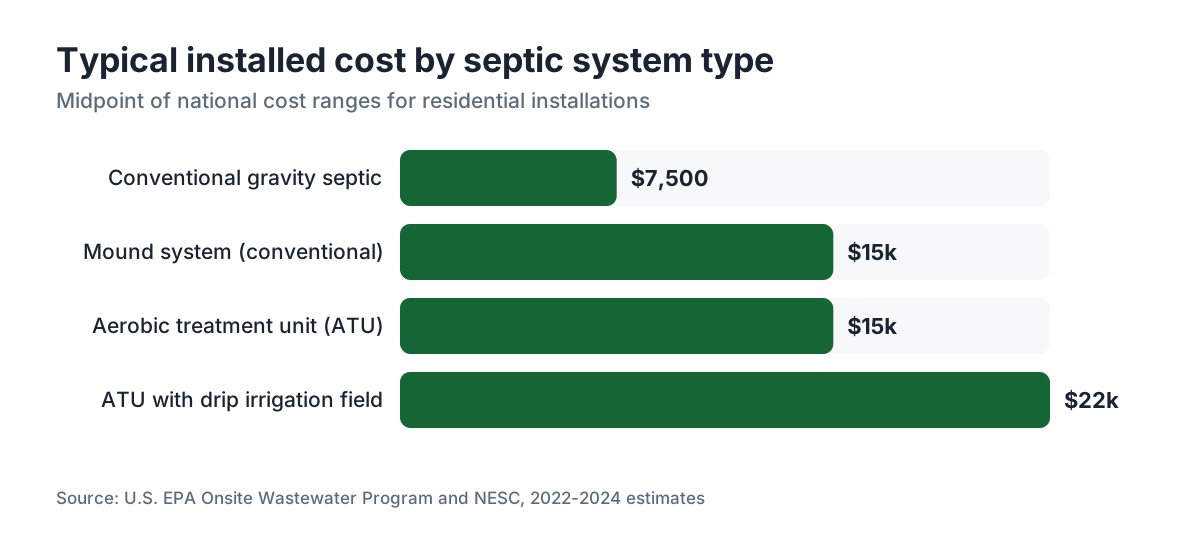
A conventional gravity septic system on a typical residential lot costs roughly $3,500 to $10,000 installed, depending on soil, tank size, and local labor [7]. An aerobic treatment unit runs higher. Installed costs usually land between $10,000 and $20,000, and systems on tough sites or in states with strict setbacks can hit $25,000 or more. The cost to install a septic system swings a lot by region.
Several things drive the gap. ATU tanks are more complex to build. Installation needs an electrician to run power to the aerator and control panel. Most states require a signed maintenance contract with a licensed service provider, which adds $150 to $500 a year on top of the install. And disinfection supplies (chlorine tablets, UV lamp replacements) are a running cost that conventional systems just do not have.
Here is a rough cost comparison across system types. These are national midpoint estimates, and local conditions move the numbers a lot.
| System type | Typical installed cost | Annual maintenance cost |
|---|---|---|
| Conventional gravity septic | $5,000 to $10,000 | $75 to $150 (pumping every 3-5 years) |
| Aerobic treatment unit (ATU) | $10,000 to $20,000 | $200 to $500 (contract + supplies) |
| ATU with drip irrigation field | $15,000 to $30,000 | $300 to $600 |
| Mound system (conventional) | $10,000 to $20,000 | $100 to $200 |
Sources: EPA onsite wastewater program estimates; National Environmental Services Center cost guides [7][8]. Ranges reflect 2022 to 2024 contractor surveys, and your local septic tank installation costs may differ.
Pumping frequency is different for ATUs too. The settling chamber builds up sludge just like a conventional tank does. Most service providers recommend pumping the ATU every one to three years instead of the three to five years typical for conventional tanks, because the chambers are smaller. Our guide on how often to pump a septic tank breaks this down further.
What should you actually look for when choosing a brand?
The brand question matters less than most people think. A well-maintained mid-tier ATU outlasts a neglected premium unit every time. Still, here is how to work through the choice.
Is it on your state's approved list? Start here. Texas TCEQ, Florida DEP, Ohio EPA, and most other states publish lists of approved ATU models. If a unit is not approved in your state, you cannot legally install it. Full stop [3][4][5].
Who services it within 30 miles? This is the most practical question you can ask. Aerators fail, control panels fault, chlorinator baffles clog. If the nearest technician who knows your brand is two hours away, that is a real problem. Ask your county health department which brands their licensed service contractors actually work on. Norweco Singulair and Jet units have broad service networks nationally. Regional brands like Clearstream (Texas) or Delta Environmental (Southeast) run denser networks in their home markets but can be orphaned if you move or the local distributor folds.
How easy are replacement parts to source? Aerators (sometimes called air compressors or diffuser assemblies) usually last five to ten years before replacement. Control floats and timer boards fail too. Norweco parts are available from multiple distributors and even some online sellers. For smaller or older brands, you may be calling a regional depot and waiting a week. Ask the installer how they source aerator replacements before you sign anything.
What is the tank material? Concrete tanks are standard in the Midwest and Northeast. Fiberglass rules the South and coastal areas with high water tables because it does not crack under hydrostatic pressure. Polyethylene tanks (Delta Environmental and others) are light and corrosion-proof but can float in saturated soils if the system sits empty and out of service. Your soil type and water table drive this choice more than brand loyalty ever should.
Single-tank or multi-tank? Some brands stack every treatment stage in one precast unit (Norweco Singulair, Jet). Others split them across tanks in series. Single-tank systems go in easier on tight lots. Multi-tank systems can be easier to service because you reach each stage on its own.
For service operators running many client systems, tracking which brands and models sit at each property is exactly where a platform like SepticMind earns its keep. Log the equipment details, schedule service reminders, and flag warranty or parts issues before a truck rolls.
How long do aerobic septic systems last?
A realistically maintained ATU should last 15 to 25 years before the tank itself needs replacement. The mechanical parts give out much sooner. Aerators usually run 5 to 10 years. Control panels and float switches go 5 to 15 years, depending on the quality of the original parts and how well the panel stays dry. Chlorinators and their baffles need a look every year and replacement every few years.
Neglect kills more ATUs than anything else. An aerator that runs nonstop without service wears out faster. Just as damaging: running an ATU dry, like a vacation home left idle for months, starves the bacterial colony and can dry and crack the aeration media in some designs. If you own a vacation property, ask your installer about a timed cycling mode or a caretaker service plan.
The settling chamber piles up sludge no matter how well the aerobic stage works. Skipping the tank pump-out because "it's aerobic and it treats everything" is a common and expensive mistake. The solids that do not get digested build up and eventually carry over into the aeration chamber, plugging media or fouling the aerator. Regular septic tank cleaning prevents most of the failures that get blamed on the brand.
During a septic tank inspection on an ATU, a good inspector checks aerator operation, dissolved oxygen in the aeration chamber (usually 1 to 2 mg/L or higher), sludge depth in the settling chamber, chlorine residual in the disinfection chamber, and the condition of the effluent screen or filter.
Why is my aerobic septic system bubbling and is it normal?
That bubbling sound near the tank lids is the aerator doing its job. Air is forced through diffusers at the bottom of the aeration chamber, and the bubbles breaking the surface make that low gurgle or churn. Normal. If the system goes quiet and the bubbling stops, the aerator has probably failed or lost power, and you should call a technician right away. A dead aerator flips the system back to anaerobic within hours and effluent quality drops fast.
Some bubbling is worth watching, though. A sudden jump in gurgling from household drains can mean a venting issue or a high sludge level in the settling chamber rather than the aerator itself. Bubbling from a riser lid that used to be sealed may mean the system is under hydraulic overload, too much water coming in too fast. Foam on the tank surface, visible through a riser inspection port, sometimes points to detergent overload or a bacterial imbalance after antibiotic use.
The EPA's SepticSmart guidelines note that "what you flush affects your system" and flag antibacterial soaps, disinfectants, and large volumes of household chemicals as threats to the bacterial population in ATUs [1]. An ATU is more sensitive to this stuff than a conventional tank because it depends on an active, living aerobic colony.
Do aerobic systems require a maintenance contract, and what does one cover?
In most states, yes. A maintenance contract is a legal condition of the operating permit for an ATU. Texas, Florida, Arizona, and most other states with big ATU populations require homeowners to keep an active service agreement with a licensed operator [3][4]. The logic is simple: ATUs have moving parts, they discharge higher-quality effluent that neighbors and water bodies count on, and regulators want someone checking them on a schedule.
A standard residential ATU contract usually covers two to four site visits a year. Each visit means an inspection of aerator operation, adjustment or replacement of chlorine tablets, a check of float switches and alarms, a look at the spray heads or drip emitters if the system has them, and a written service report filed with the county or state as required. Some contracts fold parts like chlorine tablets into the price. Others bill parts separately.
Expect to pay $150 to $300 a year for a basic contract in most markets, though high-cost areas or systems with spray irrigation fields run higher. A few states, Texas especially, have detailed rules about what the service report must contain and how fast it has to be filed after a visit. Violations can mean fines for both the homeowner and the service provider.
If you need work beyond routine maintenance, our guides on septic system repair and septic tank repair cover what to expect.
How do aerobic systems handle spray irrigation and what states allow it?
Many ATUs send their treated effluent to a spray irrigation field instead of a buried drain field. The disinfected effluent (usually chlorinated to a residual of 0.5 to 1.0 mg/L free chlorine) gets pumped to spray heads, often in a dedicated part of the yard. Because the effluent meets secondary treatment standards, the setback distances to property lines, wells, and surface water are smaller than for conventional septic discharge in most states.
Spray irrigation ATUs are everywhere in Texas, which has hundreds of thousands of permitted ATUs, more than any other state. Parts of Oklahoma, Louisiana, and other Southern states use them too, wherever shallow rocky soils or small lot sizes rule out conventional drain fields. In Texas, TCEQ Chapter 285 governs the installation and operation of on-site sewage facilities, including ATUs with spray fields [3].
Oregon, Washington, and most of the Northeast either ban surface spray discharge from ATUs or hold it to specific conditions. In those states, ATUs usually discharge to a subsurface drip field, a mound system, or in some cases, with more treatment, to a surface water body under an NPDES permit. Check your state environmental or health department's on-site wastewater rules before you assume a spray system is on the table.
One practical note: spray heads clog. They need cleaning or replacement now and then, and the technician should check each head during maintenance visits. A clogged head ponds effluent in one spot while the rest of the field goes thirsty.
What are the most common aerobic ATU failures and repair costs?
The aerator (air compressor or diffuser assembly) is the most common ATU failure. The part alone runs $200 to $600 for most residential units, plus labor. Norweco aerator assemblies, for example, run roughly $250 to $400 retail through distributors as of 2024, though prices move by region and supplier.
Control panel failures come next. A replacement control panel for a residential ATU runs $300 to $800, depending on the brand and how complex the panel is. Float switches, which trigger alarms or pump cycles, are cheap ($20 to $50 each) but need a service call to swap safely.
Chlorinators and their plastic baffles degrade in the chlorinated environment. Replacement is usually $50 to $150 for parts and one service call.
The expensive failures involve the tank itself. A cracked fiberglass tank in a high-water-table area, or a concrete tank with corroded inlet or outlet baffles, is a serious job. Tank repairs start around $500 for minor crack work and can top $5,000 for real structural repair. At that price, many homeowners choose a full septic tank replacement over repair.
When spray heads or drip emitters clog, or the distribution manifold fails, repair cost depends on how much of the field needs digging. Minor emitter swaps cost a few hundred dollars. A full drip field replacement is a major septic system repair that can approach the price of a new installation.
SepticMind's operator tools include a service history log built for tracking component replacements across an ATU fleet. It helps service companies spot which brands and models keep generating repeat calls.
Are aerobic systems better for the environment than conventional septic?
The honest answer: better effluent quality, but more energy and chemicals. ATUs consistently produce effluent with lower BOD and TSS than conventional systems, and some models cut nitrogen and pathogens too. That matters near shellfish beds, drinking water aquifers, and nitrogen-sensitive estuaries.
The EPA's Office of Water reports that advanced treatment systems can reduce nutrient loading to groundwater compared to conventional septic [9]. Several Chesapeake Bay watershed states, Maryland and Virginia among them, offer financial incentives for nitrogen-reducing ATUs to protect the Bay, specifically because the data show measurable water quality gains at the watershed scale [10].
On the other side of the ledger: ATU aerators run 24 hours a day and pull 50 to 200 watts continuously, depending on the model, adding roughly $50 to $175 a year to the electric bill. Chlorine tablets put disinfection byproducts into the soil and groundwater, though at concentrations most regulators have decided are acceptable for residential use. UV disinfection kills the chlorine byproduct worry but adds cost and needs a lamp swap every one to two years.
For most homeowners the environmental trade-off is not really a choice. If your lot needs an ATU to meet setbacks or soil conditions, that is what goes in. But if you have the option, a well-designed conventional system with a healthy drain field and good habits has a smaller energy and chemical footprint.
Frequently asked questions
What is the most reliable aerobic septic system brand?
No independent long-term reliability study exists for ATU brands. Among practitioners, Norweco Singulair gets cited most for parts availability and service network breadth nationally. Jet Inc. and Hoot Systems have strong reputations in the Gulf South. The factor that matters most is which brand your local licensed service contractor works on regularly, because maintenance quality drives reliability more than the brand name does.
How much does an aerobic septic system cost to install?
Installed costs usually run $10,000 to $20,000 for a residential ATU, versus $5,000 to $10,000 for a conventional gravity system. Systems on difficult lots or with spray irrigation fields can reach $25,000 to $30,000. Add $150 to $500 a year for the mandatory maintenance contract most states require. Local labor rates and soil conditions are the biggest variables.
How long does an aerobic septic system last?
The tank itself typically lasts 15 to 25 years with normal use. Mechanical parts fail sooner: aerators average 5 to 10 years, control panels 5 to 15 years. Regular servicing and prompt aerator replacement stretch the overall system life. Neglect, long stretches without use, or overloading the system with harsh chemicals are the main causes of early failure.
What NSF certification should an aerobic system have?
Look for NSF/ANSI Standard 40 certification, which confirms the unit hits secondary treatment quality (BOD5 under 25 mg/L, TSS under 30 mg/L). If you are in a nitrogen-sensitive area like the Chesapeake Bay watershed or Florida's spring protection zones, you may also need NSF/ANSI Standard 245 for nitrogen reduction. Verify the specific model, more than the brand, on NSF's public product database.
Is an aerobic septic system bubbling sound normal?
Yes. The gurgling or churning near the ATU lids is the aerator forcing air through diffusers in the aeration chamber. That sound means the system is working. If it stops, the aerator has probably failed and you should call a technician immediately. A sudden increase in bubbling from household drains, on the other hand, may signal high sludge levels or a venting problem.
Do aerobic septic systems need to be pumped?
Yes, more often than most people expect. The settling chamber builds up sludge even though the aerobic stage treats the liquid fraction. Most service providers recommend pumping an ATU every one to three years. Skipping pump-outs because "it's aerobic" is one of the most common ATU maintenance mistakes and leads to sludge carryover into the aeration chamber and eventual failure.
What states require aerobic treatment units?
No state requires ATUs across the board, but many require them in specific cases: lots too small for a conventional drain field, sites with high water tables, areas near sensitive water bodies, or replacement systems where a conventional drain field has failed. Texas has the largest installed base of residential ATUs in the country under TCEQ Chapter 285, thanks to soil conditions and lot sizes in suburban and rural areas.
Can I install an aerobic septic system myself?
In almost all states, no. ATU installation requires a licensed installer, a county permit, and inspections. Most states also require a licensed service provider to maintain the system under a signed contract as a condition of the operating permit. DIY installation would void the permit, likely violate state law, and leave you liable if the system causes a nuisance or a public health issue.
How does a Norweco Singulair compare to a Jet Inc. system?
Both carry NSF 40 certification and use suspended growth aeration in a single-tank design. Norweco is a concrete tank made in Ohio with a national parts and service network. Jet uses fiberglass tanks made in Florida, which perform better in high-water-table or corrosive soil. Jet has stronger market penetration in the Gulf Coast states. For most homeowners, installer familiarity and local parts availability matter more than the technical differences.
What is the AdvanTex AX-20 and how is it different from a standard ATU?
The AdvanTex (made by Infiltrator Water Technologies) uses a textile filter media in a recirculating attached-growth process rather than suspended aeration. Effluent recirculates through the textile pack, where bacteria fixed to the media do the treatment work. This design shrugs off hydraulic shock better than suspended growth systems and produces very consistent effluent. It carries NSF 40 and in some configurations NSF 245, and it is widely approved in the Pacific Northwest and nitrogen-restricted areas.
How often should an aerobic septic system be serviced?
Most state rules and manufacturer recommendations call for two to four service visits a year. Each visit usually includes checking aerator operation, replenishing chlorine tablets, inspecting floats and alarms, and verifying effluent quality. Many states require the service provider to file a written report after each visit. Annual pump-outs are sometimes bundled into contracts; otherwise they get scheduled separately every one to three years.
What happens if the aerator in an aerobic system fails?
The system reverts to anaerobic conditions within hours. Effluent quality drops, odors may develop, and partly treated wastewater can discharge to the drain field or spray area. Most control panels have a visual or audible alarm that trips when the aerator fails. Call a technician the same day the alarm goes off. Replacing the aerator fast and holding off on water use until it is fixed prevents damage to the rest of the system.
Can aerobic systems handle garbage disposal waste?
Most ATU manufacturers and state rules advise against garbage disposals on aerobic systems, or say to use them sparingly. Disposals dump large volumes of suspended food solids into the settling chamber, speeding up sludge accumulation and potentially overwhelming the aeration stage. If your system came with a disposal, check your maintenance contract or state permit conditions, because some explicitly prohibit their use.
How do I find out which aerobic brands are approved in my state?
Check your state environmental or health department website. Texas TCEQ, Florida DEP, and Ohio EPA all publish searchable databases of approved on-site sewage facility equipment. The NSF public product database at nsf.org lists all NSF 40 and NSF 245 certified units. Your county sanitarian or health department can also tell you which brands are approved locally and which service contractors hold licenses in your area.
Sources
- U.S. EPA SepticSmart Program: EPA describes ATUs as producing higher quality effluent than conventional septic systems and notes they are often required on lots too small or too wet for standard drain fields; also notes that what homeowners flush affects system performance.
- NSF International, NSF/ANSI Standard 40 and Standard 245 product certifications: Bio-Microbics FAST system holds NSF 40 and NSF 245 certifications; NSF 40 requires BOD5 no greater than 25 mg/L and TSS no greater than 30 mg/L as 30-day averages.
- Texas Commission on Environmental Quality (TCEQ), Chapter 285 On-Site Sewage Facilities Rules: Texas TCEQ Chapter 285 governs ATU installation, spray field design, and mandatory maintenance contracts for on-site sewage facilities in Texas.
- Florida Department of Environmental Protection, Onsite Sewage Program: Florida DEP maintains a list of approved ATU models and requires maintenance contracts for aerobic systems as a condition of permit.
- NSF International, NSF/ANSI 40: Residential Wastewater Treatment Systems: NSF/ANSI Standard 40 requires ATU effluent to achieve BOD5 no greater than 25 mg/L and TSS no greater than 30 mg/L as a 30-day average to earn certification.
- U.S. EPA, Types of Septic Systems: EPA cost estimates for conventional septic systems and ATUs used as baseline for installed cost ranges in this article.
- National Environmental Services Center (NESC), West Virginia University, Onsite Wastewater Treatment Cost Guidance: NESC publishes cost guidance for onsite wastewater systems including aerobic treatment units, used as basis for annual maintenance cost ranges.
- U.S. EPA, Office of Water, Decentralized Wastewater Management: EPA Office of Water notes that advanced treatment systems can reduce nutrient loading to groundwater compared to conventional septic.
- Chesapeake Bay Program: Chesapeake Bay watershed states including Maryland and Virginia offer financial incentives for nitrogen-reducing ATUs due to documented water quality improvements.
Last updated 2026-07-10