Aerobic septic systems in Tulsa: what owners need to know
By the SepticMind Editorial Team
TL;DR
- Aerobic treatment units (ATUs) in Tulsa treat wastewater with injected air, producing cleaner effluent than a conventional septic tank.
- Oklahoma law requires a licensed maintenance contract, usually $150 to $250 per quarter.
- Installation runs $10,000 to $20,000 depending on soil and lot size.
- Plan on quarterly inspections, chlorine or UV disinfection, and a surface-spray or drip dispersal field instead of a traditional leach field.
What is an aerobic septic system and how does it work?
A conventional septic tank is anaerobic. Bacteria break down solids without oxygen, and the partially treated effluent flows into a drain field where soil finishes the job. An aerobic treatment unit (ATU) flips that. It pumps air into the treatment chamber around the clock, feeding aerobic bacteria that digest organic waste far more aggressively. The effluent comes out much cleaner before it ever touches soil.
Most residential ATUs in Tulsa follow a three-compartment sequence. The first compartment is a trash tank or pre-treatment chamber that settles solids, almost like a conventional septic tank. The second is the aeration chamber, where an air pump (usually a small compressor or diffuser) bubbles air through the liquid and keeps the aerobic bacteria alive. The third is a clarifier or settling chamber that lets any leftover suspended solids drop out before the treated effluent moves to disinfection.
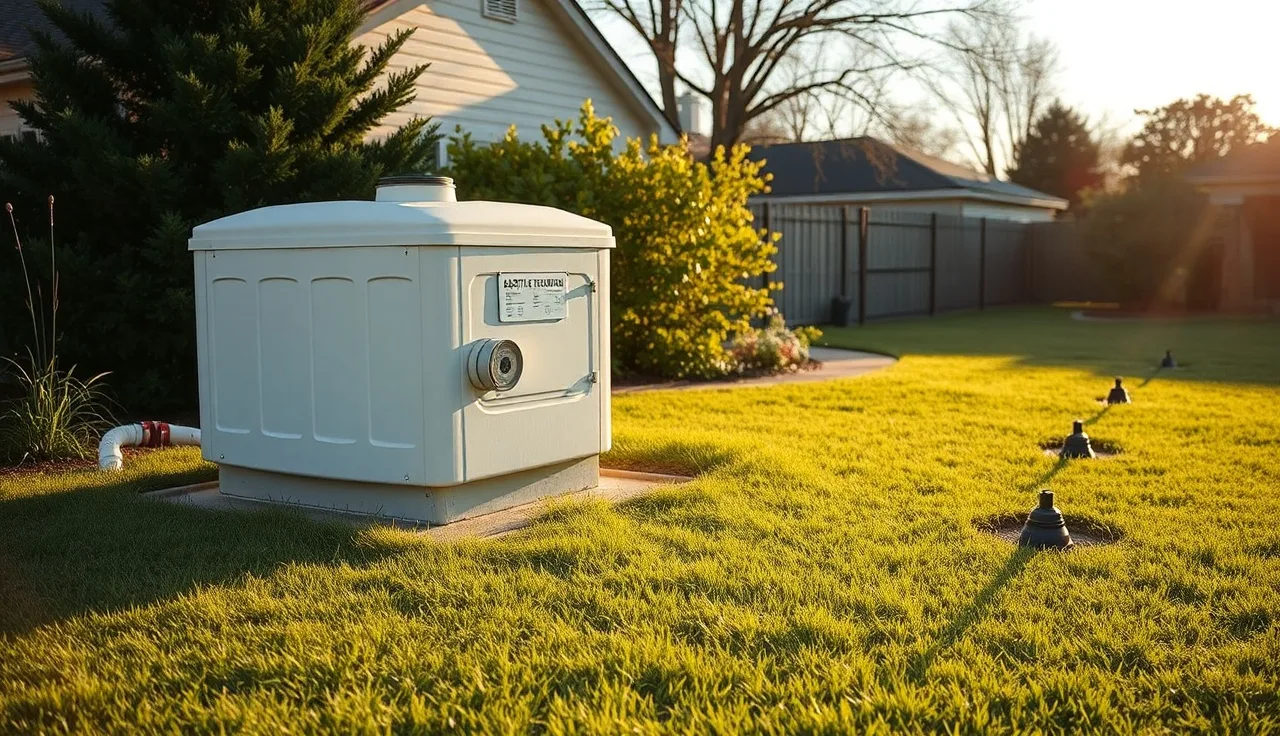
After the clarifier, effluent passes through a disinfection stage, either a chlorine tablet feeder or a UV lamp. Oklahoma rules require disinfection before surface or subsurface spray dispersal [1]. That treated, disinfected effluent then goes to the final dispersal component. On Tulsa-area lots that's often a spray head system (small pop-up sprinklers around the yard) or, on tight lots with poor soil, an aerobic drip septic system that delivers effluent through subsurface drip lines at low pressure.
The whole process takes about 24 hours from entry to dispersal. That speed is possible because aerobic bacteria work several times faster than anaerobic bacteria under good conditions [2].
Why do so many Tulsa properties use aerobic systems instead of conventional septic?
Tulsa sits in northeastern Oklahoma, where soils range from clay-heavy river bottomlands to shallow rocky ridges. A conventional septic drain field needs a permeable soil profile with enough depth and area to absorb effluent slowly over time. When a soil perc test fails, or the lot is too small for the required setback distances, a conventional system simply can't be permitted [4].
Aerobic systems produce cleaner effluent, so Oklahoma allows them to be dispersed via surface spray or drip lines across much smaller land areas than a conventional leach field. That makes ATUs the practical answer on small acreage, lots with high clay content, shallow bedrock, or sites near streams and water bodies where nitrogen loading is a worry.
Then there's the remodel scenario. Older Tulsa homes on septic sometimes need to add a bedroom or a bathroom. If the existing conventional system can't handle the extra load and the lot has no room for a bigger drain field, upgrading to an ATU can satisfy the county health department without buying more land.
Tulsa County and the counties around it (Rogers, Wagoner, Creek, Osage) all fall under the Oklahoma Department of Environmental Quality's on-site wastewater rules once you're outside a city's incorporated limits and off municipal sewer [1]. Plenty of properties in Broken Arrow, Owasso, Bixby, and Jenks look suburban but still run on private septic, and ATUs are common in those neighborhoods.
What does Oklahoma law actually require for aerobic septic systems?
Oklahoma DEQ administers on-site wastewater rules under Title 252, Chapter 641 of the Oklahoma Administrative Code [1]. For aerobic treatment units, the requirements that matter most are these.
Approved system listing. The ATU brand and model must appear on Oklahoma DEQ's list of approved on-site wastewater treatment systems [7]. Not every ATU sold nationally is approved here. Verify before buying.
Licensed installer. Only a DEQ-licensed on-site wastewater installer can do the work. The permit is pulled through the local county health department, which coordinates with DEQ [5].
Mandatory maintenance contract. This is the rule that catches most new ATU owners off guard. Oklahoma requires the homeowner to hold a current maintenance contract with a DEQ-licensed service provider for the life of the system [1]. You can't just own an ATU and maintain it yourself the way you might pump a conventional tank every three years. The licensed provider inspects the system at least four times a year, submits service reports to DEQ, and keeps the disinfection supply stocked.
Alarm and monitoring. Every Oklahoma ATU must have an audible and visual alarm that fires when the system goes into an abnormal operating condition, like a pump failure or high water level.
Disinfection. Effluent must be disinfected before dispersal. Chlorine tablet feeders are most common. UV is allowed and getting more popular because it drops the need to stock chlorine.
Setback distances. ATU spray heads must sit back from property lines, structures, and water features per DEQ tables. Surface spray is generally not permitted within a set distance of a drinking water well [1].
Violating the maintenance contract requirement is no technicality. Oklahoma DEQ can issue a compliance order, and failing to fix the problem can bring fines or a required shutdown. Buy a Tulsa home with an ATU whose previous owner let the contract lapse, and you'll need to bring the system into compliance before some transactions can close cleanly.
How much does an aerobic septic system cost in Tulsa?
Installation across the Tulsa metro generally runs $10,000 to $20,000 for a standard single-family home, and that band has widened since 2022 as material and labor costs climbed. What drives the spread?
Soil conditions matter enormously. Rocky ground in parts of Osage or Rogers County needs rock-saw excavation, which can add $2,000 to $4,000 on its own. Flat, accessible lots with decent subsoil come in cheapest. Slopes and tight lots push labor up.
The dispersal method matters too. A surface spray system usually costs less to install than an aerobic drip septic system (subsurface drip irrigation). Drip needs a more sophisticated pump vault, pressure-regulated drip lines, and a filter that needs periodic cleaning. But drip is required or preferred where surface spray would create public health problems, such as lots where spray could drift onto a neighbor's property or near surface water.
Brand and size factor in. A 500-gallon-per-day unit for a three-bedroom home costs less than a 1,000-GPD unit for a bigger house. Popular brands on the Oklahoma market include Norweco, Aerobic Systems (Aerobic Septic), and Jet Inc., among others on the DEQ approved list [7].
Ongoing costs are where ATU owners feel the difference from conventional septic. Quarterly maintenance contracts run about $150 to $250 per visit, so $600 to $1,000 a year just for the required inspections [8]. Add chlorine tablets ($30 to $80 a year for a typical household) or UV lamp replacement every one to two years ($100 to $250 for the lamp). Plan on a septic tank pump out of the trash tank every three to five years, same as a conventional system, at $300 to $600 [3].
Pumps and air compressors are the most common repair calls. A replacement air compressor runs $200 to $600 plus a service call. A submersible effluent pump replacement runs $300 to $800 installed. Neither is catastrophic, but budget $200 to $400 a year for average maintenance beyond the contract fee.
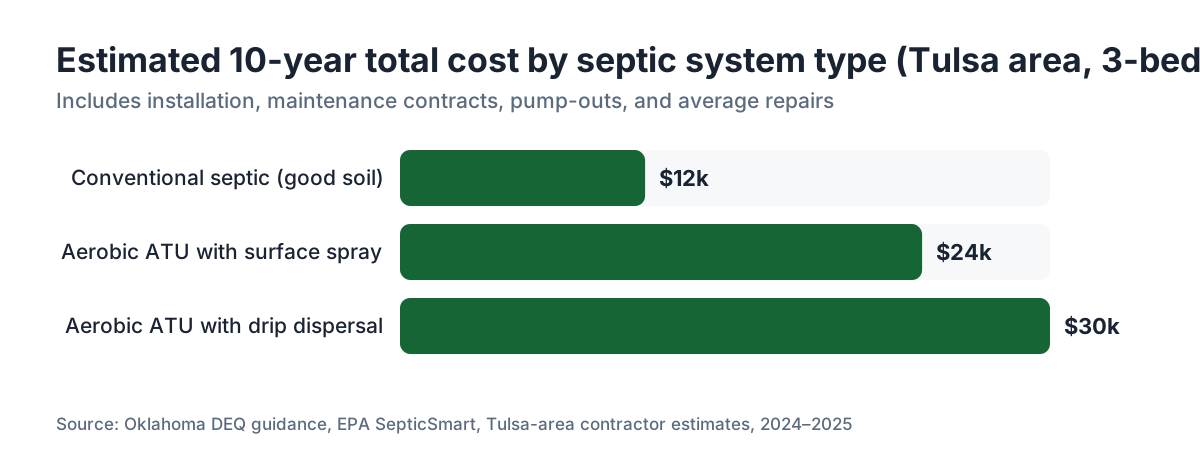
The cost comparison table below lays it out.
How does an aerobic drip septic system differ from a spray system?
Both are ways an aerobic system disperses treated effluent, but they work very differently and suit different sites.
A surface spray system uses small pop-up spray heads, usually 4 to 6 inches tall when active, that spread treated, disinfected effluent across a designated area of your yard. The heads typically run on a timed dosing pump, cycling on and off through the day. This is the most common dispersal method for Tulsa-area ATUs because it's straightforward to install and service. The downside: people and pets can come into contact with the spray zone, which is why Oklahoma requires disinfection and recommends posted signage in the spray area.
An aerobic drip septic system puts the dispersal underground. Treated effluent is pumped through thin-walled drip tubing (much like agricultural drip irrigation) buried six to eighteen inches deep. The tubing delivers effluent in small, controlled doses straight into the root zone. Because it's subsurface, there's no spray contact concern, and soil treatment carries on normally. Drip handles sloped terrain better than spray heads, and it's often required where spray drift is a real problem.
Drip systems need a filter upstream of the drip lines to keep them from clogging, and that filter wants cleaning every few months. The emitters themselves can clog over the years, especially if the ATU isn't performing well and effluent quality drops. A neglected drip system can fail quietly: the lines clog, dosing pressure builds, and the pump vault eventually alarms. Periodic pressure testing of the drip zone is part of doing maintenance right.
For most typical Tulsa-area suburban lots, surface spray is fine and cheaper. For lots near creeks (common here given the Arkansas River watershed), tight lots, or steeply sloped ground, drip is often the right call even if it costs $2,000 to $5,000 more to install.
How do aerobic system costs compare to conventional septic in Tulsa?
The honest answer: aerobic systems cost more to install and more to maintain, but they're often the only permitted option for a given site.
Here's a realistic side-by-side for a three-bedroom Tulsa-area home.
| Cost Category | Conventional Septic | Aerobic ATU (Spray) | Aerobic ATU (Drip) |
|---|---|---|---|
| Installation | $5,000, $10,000 | $10,000, $16,000 | $13,000, $20,000 |
| Annual maintenance contract | None required | $600, $1,000/yr | $700, $1,100/yr |
| Pump-out frequency | Every 3 to 5 years | Every 3 to 5 years (trash tank) | Every 3 to 5 years |
| Pump-out cost | $300, $600 | $300, $600 | $300, $600 |
| Repairs (average/year) | $100, $200 | $200, $400 | $250, $500 |
| 10-year total cost (est.) | $9,000, $14,000 | $19,000, $30,000 | $24,000, $37,000 |
Sources: Oklahoma DEQ guidance [1], EPA SepticSmart cost references [3], NESC operating cost data [8], and Tulsa-area contractor estimates from 2024 to 2025.
The ten-year gap is real. Over a decade, an aerobic system costs roughly $10,000 to $20,000 more than a conventional system on a comparable site. That's the price of land flexibility and cleaner effluent. If your soil percs fine and your lot is big enough, conventional is cheaper. If not, an ATU isn't a luxury. It's your permit path.
For new septic system installation quotes in the Tulsa metro, get at least three bids and confirm each installer is DEQ-licensed. The spread between the low and high bid on the same job can easily hit $3,000 to $5,000.
What maintenance does an aerobic septic system need in Tulsa, and how often?
Oklahoma's quarterly inspection requirement is the floor, not the ceiling. Here's what a licensed service provider actually does on those visits, and what you can do between them.
Quarterly service visit (required by law): The technician checks the air compressor output and air lines, inspects the aeration chamber for scum or sludge buildup, tests the disinfection system (chlorine residual or UV lamp function), checks alarm float operation, and inspects spray heads or drip function. Everything gets documented on a form that goes to DEQ. They'll also flag whether the trash tank is nearing the point where it needs septic tank pumping.
Chlorine: If your system uses tablet chlorine, the feeder tube usually holds a few months' supply, and on a quarterly contract the tech restocks it. In dry summer months, when the timer runs the spray system more often, you can burn through chlorine faster. Check the feeder tube yourself once a month. It takes 30 seconds.
Air compressor: This is the heart of the system. Most residential compressors are small rotary or diaphragm pumps, and they run continuously. A healthy one sounds like a quiet hum. Rattling, grinding, or silence means a service call. Typical lifespan is five to ten years. Keep the housing clear of debris and insects. Wasps love to nest in the vents.
Spray heads: Pop-up heads clog with mineral deposits or get clipped by mowers. Walk the spray zone after a dose cycle and watch every head rise and spray evenly. A clogged head is a cheap fix. A head snapped by a mower is cheap too, but the broken pattern can pool water in one spot if you don't catch it.
Trash tank pump-out: Every three to five years, the solids chamber needs pumping just like a conventional septic tank. The aerobic process doesn't stop solids from building up in that first chamber. Skip it and solids carry over into the aeration chamber, eventually clogging the air diffusers or pump. See how often to pump septic tank for more on the schedule.
Annual depth check: Measure the sludge depth in the trash tank once a year yourself, or have the quarterly tech do it. If sludge is within six inches of the outlet baffle, it's time to pump regardless of the calendar.
What are the most common aerobic septic system problems in the Tulsa area?
Air compressor failure is the number one service call. Tulsa summers top 100 degrees regularly, and outdoor compressor housings can overheat in direct sun without shade. The fix is a replacement compressor, and the diagnosis is quick. If your alarm light is on, check whether the compressor is running before you assume a bigger problem.
Chlorine depletion is the second most common compliance failure. The system runs fine mechanically, but the tablet feeder empties between quarterly visits and effluent goes out undisinfected. Oklahoma DEQ counts that as a violation. On a spray system, undisinfected effluent hitting the yard is a public health problem. Check the feeder monthly.
Spray head clogging or damage comes next. Mineral deposits from hard water (Tulsa water is moderately hard) build up in the nozzles over time. A clogged zone means uneven distribution and eventually soggy ground. Septic system repair for spray heads is cheap but needs to happen fast.
Drip line clogging hits aerobic drip septic systems specifically. When effluent quality from the ATU slips, the emitters gum up with biofilm and stop flowing. The system alarms on high water. A good operator flushes the drip zone and checks ATU performance before the clogging turns irreversible.
Solids carryover into the aeration chamber happens when the trash tank fills past capacity before anyone pumps it. Excess solids coat the air diffusers and choke aeration, and the system starts making worse effluent. It's completely preventable with routine septic tank cleaning on schedule.
Power outages get overlooked. An ATU needs electricity to run the air pump, effluent pump, and alarm. During long outages (Tulsa ice storms can kill power for days) the system goes anaerobic and falls behind. Most ATUs recover fine after a short outage, but if the home loses power for more than 24 to 48 hours and people keep using water, run a conservative water-use protocol.
How do I find a licensed aerobic septic service provider in Tulsa?
Oklahoma DEQ keeps a public list of licensed on-site wastewater maintenance providers, and the DEQ On-Site Wastewater Division is the authoritative source [1]. Tulsa County and the surrounding counties have several licensed providers. You're not locked into one company, though your ATU manufacturer may run an authorized service network.
Buying a home with an ATU, or inheriting one, do these things before closing:
- Pull the DEQ permit number from county health records and confirm the system model is on the current approved list [7].
- Ask for the last two years of quarterly service reports. Providers are required to keep them on file.
- Confirm the maintenance contract is current and transferable, or budget to start a new one at closing.
- Schedule a septic tank inspection by a licensed provider who can assess the ATU's real operating condition, more than paper compliance.
For operators managing multiple ATU accounts across Tulsa, tracking quarterly schedules, permit numbers, and service report submissions across dozens of properties is where service management tools earn their keep. SepticMind's scheduling and compliance tracking features were built for exactly this multi-account workflow.
Pricing between licensed providers varies. Get quotes from two or three. Ask specifically what the quarterly visit includes. Some contracts are bare-bones (refill chlorine, check alarm) while good ones cover compressor output testing, effluent quality assessment, and sludge depth gauging. The difference between a cheap contract and a thorough one may run $20 to $40 per visit. Pay it.
Can I add or replace an aerobic system on an existing Tulsa property?
Yes, and it's a common project. The trigger is usually a failed conventional system, a home expansion, or a sale that turns up a non-permitted or failing system during a septic tank inspection.
The process starts with a permit application to the Tulsa County (or relevant county) health department, which routes to Oklahoma DEQ for on-site wastewater [5]. You'll need a site evaluation covering soil morphology and possibly a percolation test. The engineer or soil evaluator produces a system design specifying the ATU model, tank size, and dispersal area.
Replacing a system on an existing footprint where the house is already built is usually faster to permit than new construction because many site conditions are already documented. Plan four to eight weeks from permit application to installation approval in a normal DEQ workload cycle, though backlogs can stretch that.
If you're replacing a failed drain field with an aerobic drip system, the old leach field is typically decommissioned (filled or left to dry out) and the new drip zone goes in a different area. See leach field for more on what conventional drain field failure looks like and when replacement is the call.
Cost to install a new septic system that's aerobic on a retrofit often runs higher than new construction because the excavator works around an occupied home with landscaping, utilities, and existing structures. Budget an extra $1,000 to $3,000 for the complexity of a retrofit versus a fresh install.
What should Tulsa homeowners know about aerobic system alarms?
Every Oklahoma ATU must have an audible alarm and a visual indicator, usually a red light on a small panel mounted near the electrical panel or on the ATU housing. When it triggers, something is wrong with the operating cycle, most often a pump failure, float malfunction, or high water level in one of the chambers.
Don't ignore the alarm, and don't reset it without knowing why it fired. Some homeowners hit silence and forget it, then a week later the system is in full failure. Call your maintenance provider the same day.
Common alarm triggers and how urgent they are:
- High water level alarm: the pump may have failed or the outlet is blocked. Urgent. Cut household water use right away.
- Air compressor alarm: the compressor is off or underperforming. Schedule service within 48 hours. The system goes anaerobic, but short stints are recoverable.
- Chlorine or UV alarm: disinfection has failed. Stay off the spray zone. Service needed immediately for compliance.
- Float alarm without high water: the float switch itself may be faulty. Still needs service, but it may not be a functional emergency.
If your ATU alarm goes off on a holiday or after hours, most licensed Tulsa-area providers offer emergency service. Know your provider's after-hours number before you need it. Keep a copy of your system permit, model number, and provider contact with the home paperwork.
How does EPA guidance apply to aerobic septic systems?
The EPA's SepticSmart program gives national guidance to homeowners on septic care. EPA recommends homeowners have their system inspected at least every three years by a professional and have the tank pumped every three to five years [3]. ATUs in Oklahoma get inspected quarterly by mandate, which already beats the federal baseline.
EPA also stresses that aerobic systems need more active management than conventional septic because of the mechanical parts. Its guidance notes that advanced systems with electrical float switches, pumps, and other mechanical components should be inspected more often, generally at least once a year, as a national minimum [3]. Oklahoma's quarterly rule goes well past that.
On water quality, EPA guidance on nitrogen reduction matters in the Tulsa watershed. The Arkansas River basin and its tributaries around Tulsa fall under Oklahoma DEQ water quality standards [9], and aerobic systems produce effluent with much lower biochemical oxygen demand (BOD) and suspended solids than conventional septic [2]. Whether that moves the needle on watershed health depends on system density, but it's the core reason regulators prefer ATUs near surface water.
EPA's "what not to flush" guidance applies just as much to ATU owners: no wipes (even "flushable"), no pharmaceuticals, no grease, no harsh chemical cleaners [10]. Aerobic bacteria are sensitive to antibacterial household cleaners at high concentrations. Normal household use of cleaning products is fine, but pouring a quart of bleach down the drain at once can hurt the bacterial colony in the aeration chamber and drag down system performance for days.
Frequently asked questions
How much does it cost to install an aerobic septic system in Tulsa, OK?
Expect $10,000 to $16,000 for a surface spray ATU on a standard three-bedroom Tulsa-area home, or $13,000 to $20,000 for a subsurface aerobic drip septic system. Costs rise with rocky soil, tough site access, or a larger home. Get at least three bids from DEQ-licensed installers and confirm each contractor has pulled the county permit before work starts.
What are the ongoing maintenance costs for an aerobic septic system in Oklahoma?
Budget $600 to $1,000 a year for the mandatory quarterly maintenance contract, plus $30 to $80 for chlorine tablets or $100 to $250 every one to two years for a UV lamp. Add a trash tank pump-out every three to five years at $300 to $600. Average component repairs (compressor, pumps, spray heads) run $200 to $400 a year. Total annual operating cost is roughly $800 to $1,400 for a typical household.
Do I have to have a maintenance contract on my aerobic septic system in Oklahoma?
Yes. Oklahoma Administrative Code Title 252, Chapter 641 requires all ATU owners to keep a current service contract with a DEQ-licensed provider for the life of the system. The provider must inspect quarterly and submit service reports to DEQ. There is no DIY exemption. Letting a contract lapse is a code violation and can complicate a home sale or trigger a compliance order.
How long do aerobic septic systems last in the Tulsa area?
The concrete or fiberglass ATU tank itself typically lasts 20 to 30 years with good maintenance. Mechanical parts have shorter lives: air compressors average 5 to 10 years, submersible effluent pumps 7 to 12 years, UV lamps 1 to 2 years. A well-maintained ATU with regular component replacement can serve a home for 25 or more years before major structural work is needed.
Can I install an aerobic septic system myself in Oklahoma?
No. Oklahoma requires a DEQ-licensed on-site wastewater installer for any ATU, and a permit must be pulled through the county health department before work begins. Unpermitted installations are illegal, won't pass a home sale inspection, and can force mandatory removal at the homeowner's expense. The licensing rule exists because a bad ATU install can contaminate groundwater and neighboring properties.
What's the difference between an aerobic and a conventional septic system?
A conventional system uses anaerobic (no-oxygen) bacteria in a tank and relies on soil filtration in a drain field to finish treatment. An aerobic treatment unit injects air to feed faster aerobic bacteria, producing much cleaner effluent. ATUs cost more and need more maintenance, but they work on sites where soil or lot size rules out a conventional drain field, and they're required near surface water in many Oklahoma counties.
Is surface spray from an aerobic system safe for kids and pets?
Oklahoma requires disinfection before any surface spray dispersal, which sharply reduces pathogen risk. Still, don't use the spray zone for play during active cycles, and keep children and pets off fresh spray areas. The ATU must hold adequate chlorine residual or UV disinfection to stay compliant. Undisinfected spray is a health violation. If your alarm flags a disinfection failure, keep everyone off the spray zone until it's fixed.
How do I know if my ATU is working properly?
Signs of a healthy system: no odors in the yard or near the tank, no wet or spongy ground over the dispersal zone, spray heads all rising and spraying evenly during a cycle, no active alarm lights, and clear effluent in the inspection port (not cloudy or dark). Your quarterly service reports should show passing effluent quality. Foul odors, soggy soil, or a persistent alarm all mean call your provider.
What happens to an aerobic septic system during a Tulsa power outage?
The ATU stops aerating, disinfecting, and pumping effluent the moment power drops. The system temporarily becomes an anaerobic tank. Short outages of a few hours cause little harm and the bacterial colony bounces back fast. For outages of 24 to 48 hours or longer, cut water use as much as you can. If the outage runs long, tell your maintenance provider once power returns so they can check system recovery.
Can an aerobic septic system handle a garbage disposal?
Most ATU manufacturers and Oklahoma DEQ guidance caution against garbage disposals on aerobic systems. Disposals add heavy organic solids load and can overwhelm the trash tank and aeration chamber. If you already have one and use it lightly, it's unlikely to cause immediate failure, but heavy use shortens pump-out intervals and stresses the aeration system. Composting food waste is the safer route.
What does an aerobic septic inspection involve when buying a home in Tulsa?
A proper pre-purchase ATU inspection verifies the permit and system model on DEQ's approved list, reviews two-plus years of quarterly service reports, checks compressor output and alarm function, inspects aeration chamber effluent quality visually, tests spray heads or drip operation, measures sludge depth in the trash tank, and confirms the maintenance contract is current and transferable. Budget $150 to $300 for a thorough inspection beyond a standard home inspection.
How do aerobic septic systems perform in Tulsa's clay soils?
Clay soils are one of the main reasons ATUs are common around Tulsa. Because ATU effluent is cleaner, it can disperse via spray or drip without the deep soil absorption that clay blocks. Drip dispersal in particular delivers small doses at shallow depth where even moderately clayey soil can handle the hydraulic load. The ATU solves the problem that clay creates for conventional drain fields.
Are aerobic septic systems required near Tulsa lakes or creeks?
Not universally, but Oklahoma DEQ water quality rules and local county health departments often require or strongly prefer ATUs for new construction within certain setback distances of surface water. The Arkansas River watershed covering much of the Tulsa metro carries nutrient management concerns. Check with Tulsa County Environmental Health or the applicable county health department for the rules on your parcel. Setback requirements vary by water body classification.
Sources
- Oklahoma DEQ, On-Site Wastewater Treatment Systems Rules, OAC Title 252 Chapter 641: Oklahoma requires ATU owners to hold a current maintenance contract with a DEQ-licensed provider, with quarterly inspections and disinfection before surface dispersal
- EPA, Decentralized Wastewater Treatment Systems: A Program Strategy: Aerobic treatment units produce significantly lower BOD and suspended solids than conventional septic systems; aerobic bacteria work faster than anaerobic under optimal conditions
- EPA SepticSmart Program, Homeowner's Guide to Septic Systems: EPA recommends inspection at least every three years, pumping every three to five years, and more frequent inspection for advanced systems with mechanical components; ATUs need more active management
- Oklahoma State University Extension, On-Site Wastewater Management: Soil conditions across northeastern Oklahoma including clay-heavy profiles limit conventional drain field performance and drive ATU adoption
- Tulsa Health Department, Environmental Health Division: Tulsa County Environmental Health issues on-site wastewater permits and coordinates with Oklahoma DEQ for ATU installation approvals
- EPA, Onsite Wastewater Treatment Systems Technology Fact Sheet: Aerobic Treatment Units: ATU manufacturers must have systems certified and listed as approved by state regulatory agencies; installation and maintenance must follow manufacturer specifications
- Oklahoma DEQ, Approved On-Site Wastewater Treatment Systems List: Only ATU models appearing on Oklahoma DEQ's approved list may be legally installed in the state
- National Environmental Services Center (NESC), Small Flows Quarterly, ATU Maintenance Costs: Aerobic treatment unit annual operating and maintenance costs typically exceed conventional septic by $600 to $1,000 per year due to required service contracts and mechanical component upkeep
- Oklahoma DEQ, Water Quality Standards: The Arkansas River watershed covering the Tulsa metro is subject to Oklahoma DEQ water quality standards influencing ATU requirements near surface water
- EPA SepticSmart, What Not to Put Down Your Drain: EPA advises against flushing wipes, pharmaceuticals, grease, or harsh chemical cleaners in septic systems; aerobic bacteria are sensitive to high concentrations of antibacterial products
Last updated 2026-07-09