Brunswick County perc test: what to expect and what it costs
By the SepticMind Editorial Team
TL;DR
- A perc test in Brunswick County, NC tells you whether your soil can absorb wastewater fast enough to run a septic system.
- The county's Environmental Health department oversees it under state rules.
- Expect to pay $150 to $250 for the county evaluation, schedule 2 to 8 weeks out, and allow one to three hours on-site.
- Failing soil does not always kill a lot; alternative systems can sometimes qualify.
What is a perc test and why does Brunswick County require one?
A perc test, short for percolation test, measures how fast water moves through soil. That rate tells regulators whether the ground can safely treat and disperse the effluent from a septic system without fouling groundwater or surfacing in your yard. In Brunswick County, nobody gets a permit for a conventional septic system, or most alternative systems, without this evaluation first.
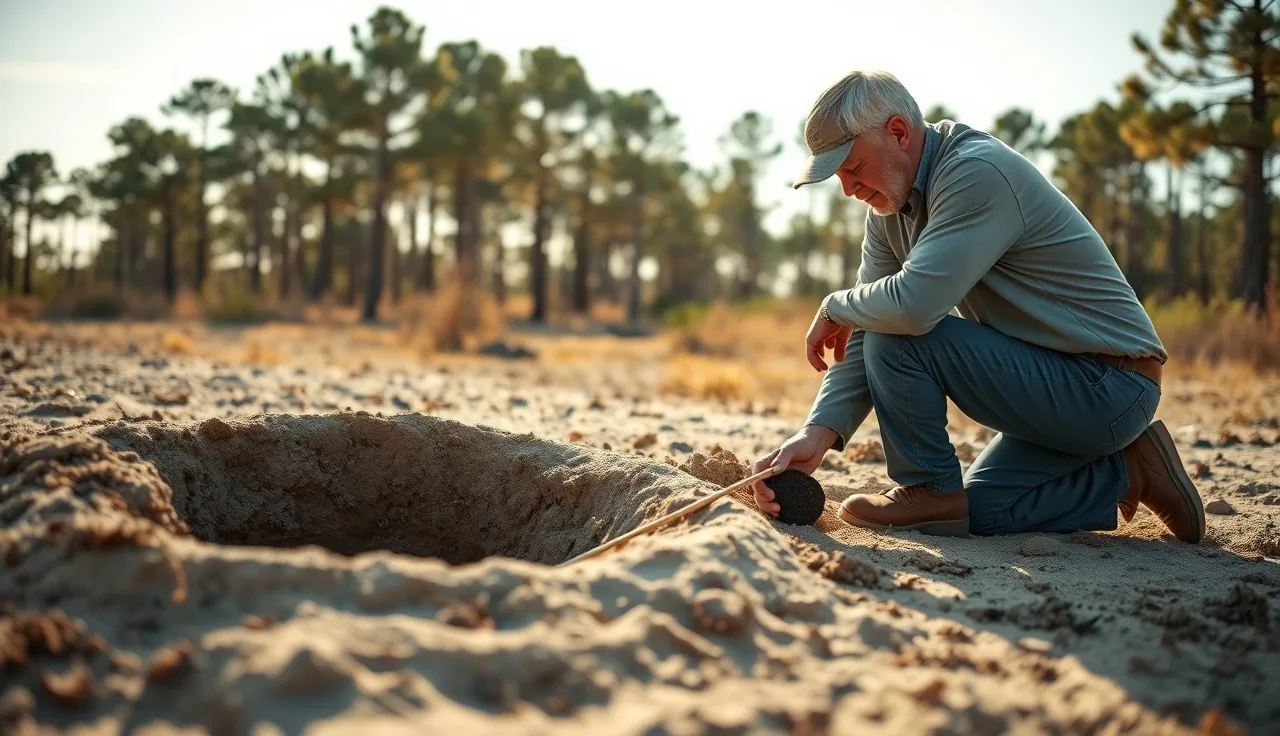
North Carolina does not use the phrase "perc test" in its code. The state calls it a "soil evaluation" or "site evaluation," and a soil morphology assessment, rather than a timed water-drainage test, drives most of the decision. A licensed soil scientist reads the texture, color, mottling, and structure of soil cores pulled from your lot. Mottling, those rusty or gray streaks in the soil, marks where the seasonal high water table has historically sat, and that water table is often the deciding factor [1].
Brunswick County's Environmental Health department issues permits under the authority of the North Carolina Department of Health and Human Services, which administers 15A NCAC 18A .1900, the state's On-Site Wastewater rules [2]. That rule set governs everything from minimum lot size to how deep a drain field trench can go. The county cannot write rules looser than the state's, and in some areas it enforces extra local restrictions tied to stormwater and coastal buffers.
Buying land and planning to build without a municipal sewer line? Order this test first. A lot that fails is often unsellable for residential development, or it needs an engineered alternative that runs two to three times the cost of a conventional system.
How does the Brunswick County perc test process actually work, step by step?
The process runs through the Environmental Health division of the county health department in Bolivia, NC. Here is the sequence from first call to permit decision.
Step 1: Submit an application. You or your agent files a Site Evaluation Application with Environmental Health. It asks for the parcel PIN, acreage, proposed number of bedrooms (which drives the required system size), and whether you want a septic permit or just a lot evaluation. You pay the application fee at submission [3].
Step 2: Wait for scheduling. A licensed soil scientist from the county gets assigned. In 2024, wait times in Brunswick County ran two to eight weeks depending on the season. Spring and fall are busiest, because those are peak building months and because soil moisture is often ideal for reading a site. Summer can move faster.
Step 3: The site visit. The soil scientist can visit without you present, though it helps to flag the area you want evaluated. The evaluator digs or augers soil borings, usually three to six holes per evaluation area, each going down at least 48 inches. They read every core for restrictive horizons (compacted layers, rock, or clay), seasonal high water table indicators, and soil texture. Sometimes they add a timed infiltration test, mostly for alternative system designs.
Step 4: Receive the report. The county issues a written Authorization to Construct (the permit) if the site passes, or a denial letter with findings if it does not. The report maps the evaluated area, names the system type that fits, and specifies setbacks from wells, property lines, and water features [1].
Step 5: Hire a contractor and pull permits. The Authorization to Construct is not a building permit. Once you have it, you hire a licensed septic contractor to install the system, and the contractor pulls the actual installation permit from Environmental Health. An inspector checks the work during and after installation before anything gets covered.
The full cycle from application to permit runs four to fourteen weeks in Brunswick County, depending on backlog and how quickly your contractor moves. Plan around your closing or construction timeline.
What does a Brunswick County perc test cost?
The county charges a fee for the site evaluation itself. As of 2024, Brunswick County Environmental Health's application and evaluation fee ran roughly $150 to $250 for a standard residential site evaluation [3]. That fee covers the soil scientist's time and the official report. It does not cover extra borings for large parcels or re-evaluations after you modify the site.
Hire a private licensed soil scientist for a preliminary evaluation, or to argue for alternative system approval, and you add cost. Private soil scientists in southeastern NC typically charge $300 to $600 for a residential lot, and more for complex sites or expert reports tied to appeals [4].
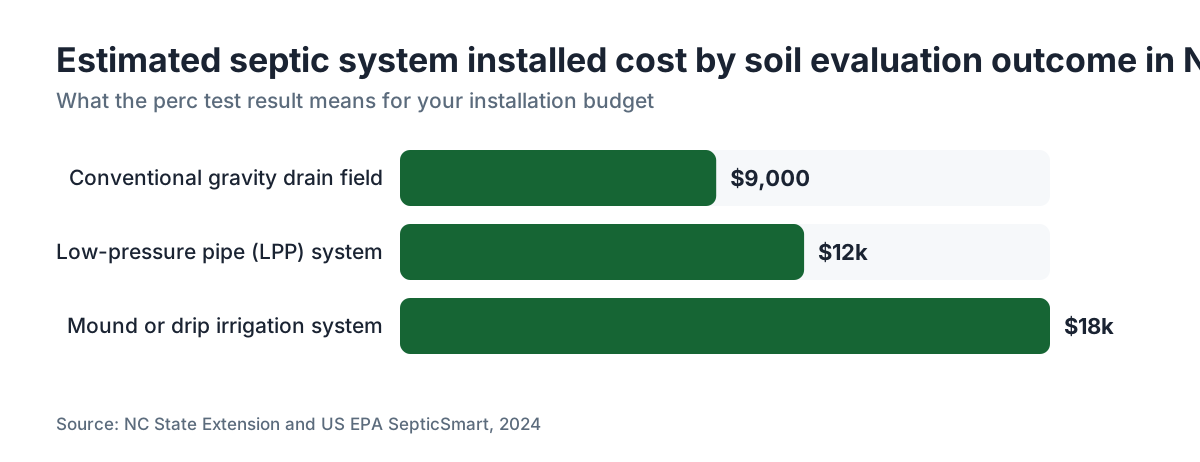
Here is where the real money sits: the perc test result decides what kind of septic system you need, and system costs swing hard.
| Soil evaluation outcome | Typical system required | Installed system cost (NC, 2024) |
|---|---|---|
| Passes conventional standards | Conventional gravity drain field | $6,000, $12,000 |
| Marginal soil, shallow water table | Low-pressure pipe (LPP) system | $8,000, $15,000 |
| Poor soil, high water table | Drip irrigation or mound system | $12,000, $25,000 |
| Fails all on-site options | No permit issued (variance or appeal required) | N/A |
Sources for cost ranges: NC Cooperative Extension and national data from EPA SepticSmart [5][6]. Individual quotes vary a lot by lot conditions, contractor, and material prices.
The test fee is a small fraction of what follows. Spending $300 on a private soil scientist before you make an offer on raw land is one of the better $300 decisions you can make. It gives you room to walk away or renegotiate before you own a lot that cannot be permitted. See our guide on the cost to install septic system for full system breakdowns.
What soil conditions are common in Brunswick County, and how do they affect results?
Brunswick County sits in the coastal plain of southeastern North Carolina. The soils here run mostly sandy at the surface but shift fast into clay-heavy or organic subsoils, and the regional water table is shallow, often within 12 to 24 inches of the surface in low-lying areas [7].
This matters enormously for permitting. North Carolina's rules require a minimum vertical separation between the bottom of a drain field trench and the seasonal high water table. For a conventional system, that separation is typically 12 inches. If the soil morphology shows mottling or a restrictive layer inside that zone, a conventional system cannot be permitted.
Big parts of Brunswick County, especially near the Cape Fear River, the Intracoastal Waterway, and the county's wetlands and pocosins, have water tables that come within inches of the surface for part of the year. Lots in those areas almost never pass for conventional systems. They may qualify for engineered alternatives, but those cost more and need an engineer or licensed designer, more than a contractor.
Higher ground in the western and central parts of the county, particularly sandy ridgelines, tends to perc well. It can drain too fast, though, which is its own problem for certain system designs, because water that races through the soil may reach groundwater before it gets treated.
Evaluating a lot near the coast or any low spot? Assume you will need at minimum a low-pressure pipe system and budget for it. If the lot holds standing water seasonally, talk to a private soil scientist before you spend county fees.
What are the NC state rules that govern the perc test and site evaluation?
North Carolina's on-site wastewater rules live in Title 15A of the NC Administrative Code, Subchapter 18A, Rules .1900 through .1982 [2]. These set the framework Brunswick County's Environmental Health department follows. There is no separate Brunswick County perc test ordinance; the county operates under state authority.
Key provisions in 15A NCAC 18A .1940 cover site suitability criteria. The rule sets minimum lot size (typically 20,000 square feet for a system serving a three-bedroom house on a private well, though this varies), setback distances from wells (50 to 100 feet depending on well type), setbacks from surface waters, and the soil morphology criteria the soil scientist applies.
The EPA's SepticSmart program describes on-site soil evaluations this way: "Soil conditions determine the type and size of the drainfield that will work on a site. Soil that is too sandy may not treat wastewater adequately; soil that is too dense may not allow water to percolate" [6]. That line captures why both ends of the drainage spectrum create permitting problems.
North Carolina also requires that anyone performing a soil evaluation for a permit hold a license as a Soil Scientist or On-Site Wastewater Evaluator. The NC Board for Licensing of Soil Scientists oversees that credential [8]. Worth knowing, because out-of-state reports or evaluations by unlicensed people are not accepted by the county.
One more rule to flag: an Authorization to Construct in North Carolina expires. Get a permit but do not start installation within five years, and you may need a fresh site evaluation. Rules and lot conditions change, and the county is not obligated to renew a permit under old criteria once real time has passed.
How long does a Brunswick County perc test take from application to decision?
The site visit itself takes one to three hours for a standard residential lot. The paperwork is the longer part.
Based on typical Environmental Health operations in Brunswick County and comparable NC coastal counties, here is a realistic schedule:
- Application submitted and fee paid: Day 1
- Scheduling confirmation from Environmental Health: 3 to 10 business days
- Site evaluation visit: 2 to 8 weeks from application (season-dependent)
- Written report issued: 5 to 15 business days after the visit
- Total elapsed time: 4 to 14 weeks
If your site needs extra borings, if there is a disagreement about the results, or if you ask for a conference with the evaluator, add another two to four weeks. Appeals to the state, handled through the NC DHHS Division of Public Health's On-Site Water Protection Branch, add months [10].
The single biggest variable is current backlog. Brunswick County has been one of the fastest-growing counties in the country, ranked among the top fastest-growing counties nationally in the 2020s based on Census Bureau data [9]. That growth keeps Environmental Health busy. If your project has a hard deadline, call the department before you apply and get a realistic current wait time. The number as of this writing is (910) 253-2250.
Contractors who do frequent business with the county will often tell you the real backlog. That relationship with local operators is one reason experienced septic contractors are worth their fee.
What happens if your lot fails the perc test in Brunswick County?
A failed site evaluation does not automatically kill the lot. It means a conventional system is not permitted. From there you have a few paths.
Alternative system permit. An engineered alternative, like a drip-irrigation system, aerobic treatment unit, or mound system, may still get permitted if soil conditions meet the lower thresholds those technologies allow. Each has its own site criteria, and each needs a licensed designer or engineer, more than a soil scientist. See our breakdown of septic system repair and septic tank installation for what these systems involve.
Modification of the site. Sometimes filling low areas or regrading brings a site into compliance. That takes county approval and a new evaluation after the work. It is not always feasible, and coastal setbacks often ban fill in certain areas.
Variance or appeal. You can appeal a denial through the county and up to the state. Variances are rare and require showing that strict compliance is impossible but that an alternative achieves equal protection. Hire a licensed soil scientist and an environmental attorney if you go this route.
Lot stays unbuilt or sells as-is. Some parcels genuinely cannot support any on-site system and sit nowhere near sewer service. These lots have limited development value. Full disclosure of a failed perc test is required in North Carolina real estate transactions.
The failure rate for initial site evaluations in NC coastal plain counties is not compiled in any single public report. Anecdotally, among Environmental Health staff and contractors, something like 20 to 40 percent of low-lying coastal lots in Brunswick County need an alternative system or modification before a permit issues. That range comes from practitioner accounts, not official state data.
Do you need a perc test when buying land in Brunswick County?
Planning to build a home without a municipal sewer connection? Yes. Full stop.
Brunswick County has sewer service in many of its incorporated towns, including Leland, Shallotte, Oak Island, and Southport. If the lot you are buying can connect to a municipal or county sewer system, you do not need a septic permit and therefore do not need a perc test. Confirm sewer availability with the utility provider before closing, not after.
If the lot sits outside a sewer service area, or if the sewer line is not yet extended to that street and you would carry the connection cost, treat the lot as a septic lot. In that case, get a site evaluation before you make a firm offer, or make the purchase contingent on a satisfactory evaluation.
Real estate agents in Brunswick County know this contingency cold. It is common in the market. A seller who refuses a perc test contingency on unimproved land in a non-sewer area is a flag worth sitting with.
If the lot already has a home with a septic system, you still want a septic tank inspection before closing. A passing perc test from ten years ago tells you nothing about whether the existing system works, is sized right, or is due for repair. Those are separate questions.
Can you do a perc test yourself in Brunswick County?
No, not for permit purposes. North Carolina requires the site evaluation be performed by a licensed soil scientist or a county-employed on-site wastewater evaluator. A DIY test has no standing with the county and will not be accepted as part of a permit application [2][8].
You can absolutely dig holes and pour water in them for a rough read on your soil before spending money on an application. Contractors and experienced buyers do this all the time as a quick screen. If water drains out of a hole in under a minute, your soil is likely fast-draining sand. If it sits for an hour, you have a drainage problem. That tells you something but proves nothing to the county.
Some private soil scientists offer informal preliminary evaluations before you commit to a county application. That can save you the county fee and the wait if the site clearly fails, and it can help you position a better system area if the site is on the margin. A private preliminary visit typically runs $300 to $500 in the Brunswick County market.
For operators and builders managing multiple sites, tracking the status of site evaluations across parcels is one of those administrative headaches that piles up. This is the kind of workflow platforms like SepticMind are built to organize, keeping evaluation dates, permit numbers, and system types tied to each address in one place.
How does the perc test affect septic system size and drain field design?
The perc test result does more than decide whether you can build. It sets how big the drain field has to be, and that size drives installation cost directly.
North Carolina's rules set the required drain field square footage from two inputs: the number of bedrooms in the house (a proxy for daily wastewater flow) and the soil's loading rate, which reflects how fast the soil accepts water [2]. Slower-percolating soils need more square footage to handle the same daily flow.
A standard three-bedroom home in NC is designed for 360 gallons per day of wastewater. In well-draining sandy soil with a loading rate of 0.5 gallons per square foot per day, you need 720 square feet of drain field. In slower loamy soil at 0.2 gallons per square foot per day, you need 1,800 square feet for the same house. That gap can be the difference between a lot that fits a system comfortably and one that cannot.
This is why bedroom count carries so much weight in permitting. A four-bedroom house on marginal soil might need a field so large it eats most of the usable lot. Adding a bedroom later without an expanded permit violates the permit terms and can create liability at resale. More on how drain field sizing works in our leach field guide.
Designing a new house on marginal soil? Talk to the soil scientist before you lock the floor plan. It can save you from wanting a bedroom count the lot cannot support.
Who do you contact for a perc test in Brunswick County?
The contact is Brunswick County Environmental Health, part of the Brunswick County Health and Human Services department.
Office location: 25 Referendum Drive, Bolivia, NC 28422
Phone: (910) 253-2250
Hours: Typically Monday through Friday, 8:00 AM to 5:00 PM, but verify with the department as hours can shift
Website: Brunswick County Health and Human Services, ncbrunswick.com [3]
Applications can often be started online or submitted in person. Environmental Health staff can tell you the current wait time when you call, and they can say whether your specific lot has any prior evaluation on record. Older lots sometimes carry evaluation records from previous owners, which may still be valid if conditions have not changed.
For a private licensed soil scientist, the NC Board for Licensing of Soil Scientists keeps a public directory of licensed practitioners [8]. Several firms in the Wilmington and southeastern NC market work Brunswick County regularly.
For general questions on how septic systems work and how to maintain one after it is permitted and installed, the EPA's SepticSmart resources are a reliable starting point [6]. For operators managing permit workflows across projects, SepticMind's operations software tracks permit status, system types, and maintenance schedules in one place, cutting down the spreadsheet chaos that comes with high-growth markets like Brunswick County.
Frequently asked questions
How much does a perc test cost in Brunswick County, NC?
The county's application and evaluation fee runs about $150 to $250 for a standard residential site as of 2024. Hire a private licensed soil scientist for a preliminary or supplemental evaluation and add $300 to $600. The test itself is small next to the septic system installation that follows, which ranges from $6,000 to $25,000 depending on soil results.
How long does it take to get perc test results in Brunswick County?
The site visit takes one to three hours. Total time from application to written permit decision typically runs four to fourteen weeks, depending on the county's current backlog and the season. Spring and fall are busiest. Call Environmental Health at (910) 253-2250 before applying to get the current realistic wait time for your project.
Who performs perc tests in Brunswick County?
The county's Environmental Health department employs licensed soil scientists or on-site wastewater evaluators who conduct official site evaluations. You can also hire a private licensed soil scientist for preliminary work or to support an appeal, but only the county-issued evaluation result counts for a permit. NC requires evaluators hold a state soil scientist license.
What happens if my land fails the perc test in Brunswick County?
A failed site evaluation means a conventional septic system cannot be permitted. You can pursue an engineered alternative system (such as drip irrigation or a mound), modify the site and request a new evaluation, or file an appeal. Some sites genuinely cannot support any on-site system. NC real estate law requires full disclosure of a failed evaluation when selling land.
Do I need a perc test if there is sewer service available in Brunswick County?
No. If your lot can connect to a municipal or county sewer system, you do not need a septic permit or a perc test. Confirm sewer availability with the relevant utility before closing on any land purchase. Incorporated areas like Leland, Southport, and Shallotte have sewer service, but many rural and unincorporated areas of Brunswick County do not.
How long is a perc test permit valid in Brunswick County?
North Carolina's Authorization to Construct is generally valid for five years from the date of issue. If you do not begin installation within that period, you may need a new site evaluation. Rules and site conditions can change, and the county is not required to renew a permit under outdated criteria. Check with Environmental Health before your permit lapses.
Can I do my own perc test in Brunswick County?
Not for permit purposes. North Carolina requires that official site evaluations be performed by a licensed soil scientist or county evaluator. A DIY drainage test has no standing with Environmental Health. You can dig test holes informally to screen a site before spending money on an application, but the county will not accept the results for any permitting decision.
What soil problems are most common in Brunswick County perc tests?
Shallow seasonal high water tables are the most common issue. Brunswick County's coastal plain soils frequently show mottling within 12 to 24 inches of the surface, marking where the water table historically rises. This restricts conventional drain field placement. Restrictive clay layers and organic soils in low-lying and wetland-adjacent areas also cause conventional system denials.
Does the number of bedrooms affect perc test requirements in Brunswick County?
Bedrooms determine the required system size, not the test process itself. North Carolina uses bedroom count as a proxy for daily wastewater flow: a standard three-bedroom house is designed for 360 gallons per day. The soil's measured loading rate then sets how much drain field square footage that flow needs. More bedrooms on marginal soil can make a system too large to fit.
What is the difference between a perc test and a soil evaluation in NC?
In North Carolina, the official process is called a soil evaluation, not a perc test. It relies mainly on soil morphology, reading texture, mottling, structure, and restrictive layers in soil borings, rather than a timed water-infiltration test. A timed percolation test may be used as a supplement for some alternative system designs, but morphology drives most permit decisions in NC.
How do I apply for a perc test in Brunswick County?
Submit a Site Evaluation Application to Brunswick County Environmental Health at 25 Referendum Drive, Bolivia, NC 28422, or check the county's website at ncbrunswick.com for online options. You will need the parcel PIN, acreage, and proposed number of bedrooms. Pay the application fee at submission. Call (910) 253-2250 to confirm current requirements and wait times before applying.
What alternative septic systems can be permitted if my lot fails a conventional perc test?
Common alternatives in Brunswick County include low-pressure pipe (LPP) systems, drip irrigation systems, aerobic treatment units, and mound systems. Each has its own soil suitability criteria. These systems need a licensed designer or engineer and cost more than conventional systems, typically $12,000 to $25,000 installed. Not every failed lot qualifies; site conditions must still meet minimum thresholds.
Should I get a perc test before making an offer on land in Brunswick County?
Yes, or make your offer contingent on a satisfactory site evaluation. A lot outside a sewer service area that cannot be permitted for a septic system has very limited development value. A perc test contingency is standard practice in Brunswick County real estate for unimproved land. Sellers in non-sewer areas who refuse a perc test contingency are worth approaching cautiously.
Sources
- NC State Extension, on-site wastewater and soil suitability resources: Soil morphology, including mottling indicating seasonal high water table, drives most permit decisions in North Carolina on-site wastewater evaluations.
- North Carolina Administrative Code, 15A NCAC 18A .1900, On-Site Wastewater rules (via NCDEQ): NC's on-site wastewater rules govern site suitability criteria, minimum lot sizes, setbacks, and soil morphology requirements for septic permits statewide including Brunswick County.
- Brunswick County, NC, Health and Human Services, Environmental Health Division: Brunswick County Environmental Health administers site evaluation applications, fees, and permit issuance for on-site wastewater systems.
- North Carolina Department of Health and Human Services, On-Site Water Protection: Private licensed soil scientists in NC charge $300 to $600 for residential lot evaluations; only NC-licensed evaluators may perform official site evaluations for permits.
- NC State Extension, septic system homeowner resources: Conventional gravity drain field installation in North Carolina costs approximately $6,000 to $12,000; alternative systems range from $8,000 to $25,000 depending on technology.
- US EPA SepticSmart Program, homeowner information: EPA SepticSmart states: "Soil conditions determine the type and size of the drainfield that will work on a site. Soil that is too sandy may not treat wastewater adequately; soil that is too dense may not allow water to percolate."
- USDA Natural Resources Conservation Service, Web Soil Survey: Brunswick County, NC soils in low-lying coastal plain areas commonly show seasonal high water tables within 12 to 24 inches of the surface.
- North Carolina Department of Health and Human Services, On-Site Water Protection (soil scientist licensing information): North Carolina requires a state soil scientist license to perform official on-site wastewater site evaluations; unlicensed evaluations are not accepted for permit applications.
- US Census Bureau, Population Estimates Program: Brunswick County, NC has ranked among the fastest-growing counties in the United States in the 2020s, driving high demand for Environmental Health services.
- NC DHHS Division of Public Health, On-Site Water Protection Branch: Appeals of site evaluation denials in North Carolina are processed through the NC DHHS Division of Public Health On-Site Water Protection Branch.
Last updated 2026-07-10