Automatic septic tank treatment: does it actually work?
By the SepticMind Editorial Team
TL;DR
- Automatic septic tank treatment drips or drops bacteria and enzymes into your tank on a timer, so you never have to remember a monthly packet.
- EPA guidance and university research agree on the limits: these products don't replace pumping and won't save a failing system.
- They can help support bacterial balance in a healthy tank, mostly after events that kill off the tank's bacteria.
What is automatic septic tank treatment and how does it work?
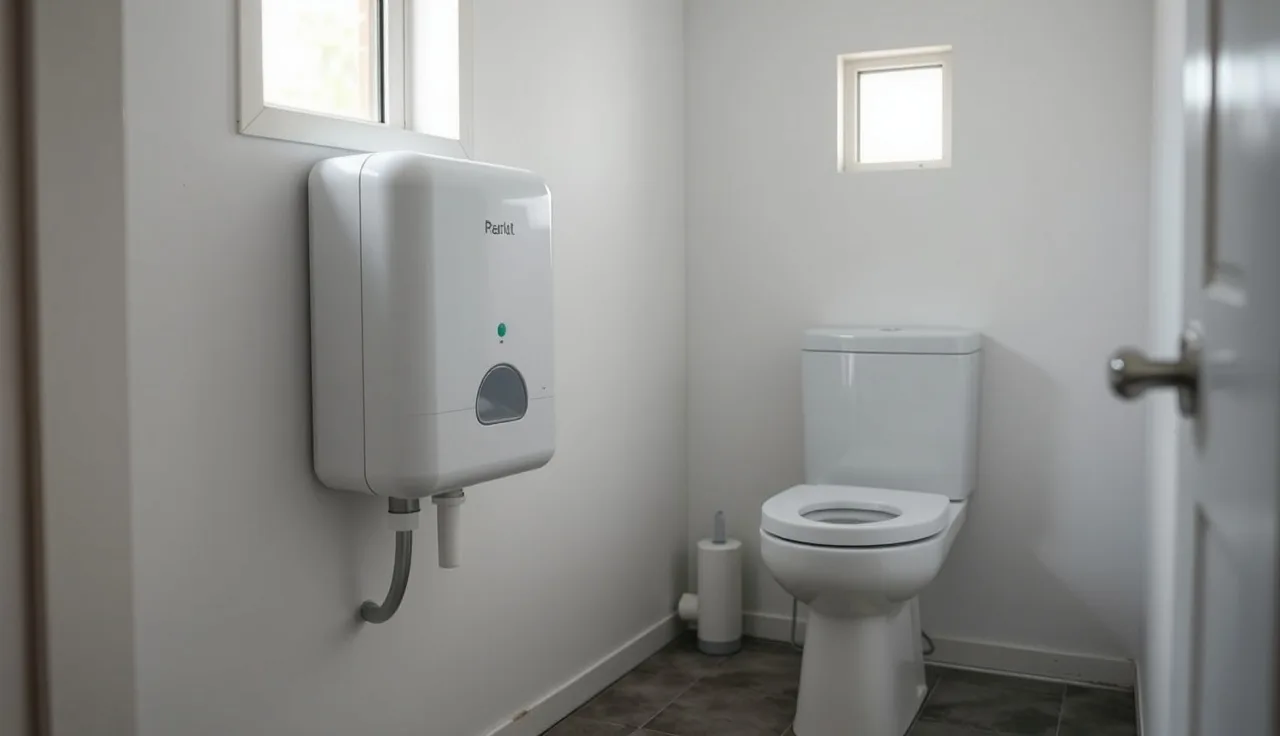
An automatic septic tank treatment system is a small device, usually mounted on the wall near your toilet or in a utility room, that releases a measured dose of bacterial cultures and enzymes into your system on a set schedule. Most run monthly or weekly. You load a cartridge or tablet supply, and it handles the timing. No more remembering to flush a packet.
The idea is simple. Your tank works because anaerobic bacteria break down solids. Those bacteria get stressed or killed by bleach, antibacterial soaps, medications, and heavy garbage disposal use. An automatic dispenser tries to keep bacterial populations steady through those hits without you having to think about it.
Two form factors dominate the market. The first is a wall-mounted timed dispenser that drops a pod or liquid dose into the toilet tank or drain at a set interval. The second is a passive in-tank cartridge or media block that dissolves slowly over 30 to 90 days. The timed wall units are the ones usually marketed as "automatic" because they have a mechanical or electronic release.
The bacteria are mostly facultative anaerobes, organisms that survive with or without oxygen during transit but do their real work in the low-oxygen tank. Common genera include Bacillus, Pseudomonas, and various enzyme-producing strains. Manufacturers rarely publish the CFU (colony-forming unit) counts they deliver per dose. That silence makes honest comparison between brands almost impossible.
Do automatic septic tank treatments actually help your system?
The honest answer: the evidence is mixed, and the marketing is way ahead of the science.
The EPA's SepticSmart program says plainly that "septic additives are generally not necessary for the proper functioning of a septic system" [1]. The agency looked at biological additives, chemical additives, and enzyme products and found that in a normal system, the resident bacterial population is self-sustaining and needs no help.
University of Minnesota Extension guidance is a bit more generous. Its review of onsite wastewater literature found biological additives showed some benefit in systems stressed by antimicrobial products or after disturbances like pumping or a resident's heavy antibiotic course [2]. The operative word is "some." No study showed dramatic gains in an already-healthy tank, and none showed additives could rescue a failing drain field.
Here's the bottom line. A healthy system probably won't be harmed by an automatic dispenser, and it might get a small lift under specific stress. A failing system will not be saved by any bacterial product. Failing systems need diagnosis, repair, or replacement. See septic system repair for what that actually involves.
Where automatic dispensers clearly beat manual treatment is consistency. People buy monthly flush packets and then forget them for six months. A timer doesn't forget. If you're going to use additives at all, automatic delivery beats sporadic manual doses every time.
How is an automatic dispenser different from manual septic treatments?
Manual treatments (the packets, powders, and liquid bottles you drop in the toilet) depend entirely on you. Buy them, remember them, use them on schedule. Most homeowners don't. That inconsistency means the bacterial load in the tank swings around based on how diligent you happen to be that month.
Automatic dispensers remove that variable. They run on a timer or mechanical schedule whether or not you remembered. Some plug into an outlet and use a small motor to drop a dose. Others use a wind-up mechanism or a passive dissolving design.
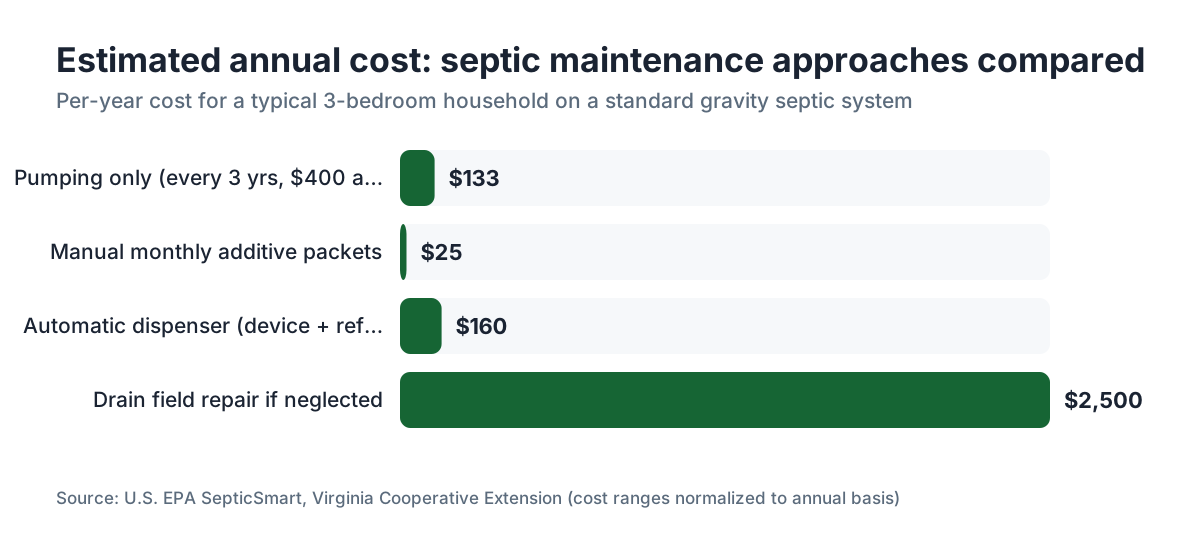
Cost is the tradeoff. A box of monthly flush packets runs roughly $15 to $30 for a year's supply. A decent automatic dispenser costs $40 to $120 for the unit, then $20 to $50 per refill cartridge every one to three months. Over five years, the automatic route might cost $200 to $400 more than manual packets, assuming you actually used the packets every month (again, most people don't).
The table below lines up the two approaches on the factors that matter:
| Feature | Manual flush packets | Automatic dispenser |
|---|---|---|
| Typical annual cost | $15 to $30 | $80 to $200 |
| Consistency of dosing | Depends on homeowner | High (timer-driven) |
| Installation required | None | Mount + outlet (some models) |
| Dose precision | Variable | Fixed per cycle |
| Replaces pumping | No | No |
| Works on failing systems | No | No |
For a rental or vacation home where the occupants won't manage maintenance, an automatic dispenser earns its keep. For an owner-occupied home with attentive owners, manual packets are cheaper and work just as well, if you actually use them right.
What types of bacteria and enzymes are in these products?
Most automatic septic treatments mix bacterial cultures with an enzyme package, though the strains and ratios vary by brand.
The bacteria are almost always spore-forming Bacillus species. Spore formers survive the trip through the toilet and into the tank even when conditions are briefly unfriendly. They activate when they hit the warm, wet, nutrient-rich tank. Labels sometimes name Bacillus subtilis, Bacillus licheniformis, or Bacillus amyloliquefaciens, though labeling rules for septic additives are inconsistent from state to state. Penn State Extension notes these spore-forming strains are the ones commonly used in biological additives [11].
Enzymes do one job: cutting complex molecules into smaller pieces the bacteria can eat more easily. The usual suspects are protease (proteins), lipase (fats and grease), amylase (starches), and cellulase (paper and plant fiber). Enzymes work fast, but they aren't alive. They don't reproduce, so their effect fades.
One thing to watch for. Some older or cheaper products contain surfactants marketed as "enzyme-based" that are really chemical dispersants. They can shrink the visible scum and sludge without doing any biological work, and some of them push solids into the drain field instead of digesting them in the tank. That's bad news for the part of your system you can't easily clean. Read the ingredient list, and skip anything that names surfactants as a primary active ingredient [7].
Can automatic septic treatment replace pumping?
No. Full stop.
This is the most dangerous myth in the septic additive market. No additive, automatic or manual, biological or chemical, dissolves the non-biodegradable solids that pile up in your tank. Synthetic fibers, hair, hardened grease, and inorganic grit just accumulate. Bacteria reduce some of the biodegradable sludge, but they can't erase the need for periodic pump-outs.
The EPA recommends septic tank pumping every three to five years for a typical household [1]. The real interval depends on tank size, household size, and what goes down the drains. A 1,000-gallon tank serving four people usually needs pumping every three to four years. A 1,500-gallon tank serving two people might stretch to five to seven [9].
Skipping pumping because you use a treatment product is a real pattern with real consequences. When the sludge and scum layers get thick enough, solids wash into the drain field and clog the soil. That's a drain field replacement at $3,000 to $15,000 or more depending on your region and soil [3]. See how often to pump septic tank for a full breakdown by tank size and household.
Treat automatic dispensers like a daily vitamin. Nice supporting habit, no substitute for the structural maintenance that keeps the system alive.
Are septic tank additives regulated or approved by any government agency?
This is where it gets messy, and the thin regulation is a big part of why the claims run so hot.
At the federal level, biological septic additives (bacteria and enzymes) don't have to prove they work before going on sale. The EPA does not pre-approve or certify septic additives. Chemical additives are a separate story. The EPA has flagged that certain chemical solvents once sold as additives, like methylene chloride or trichloroethylene, can leach into groundwater and cause serious contamination [5]. Those specific chemicals are effectively gone from the market thanks to state bans and liability pressure, but the agency never built a formal approval path for the biological alternatives [1].
Some states act on their own. Wisconsin prohibits the sale of chemical septic additives under its onsite rules [4]. Massachusetts regulates the marketing claims on septic products [10]. California and others have broader groundwater rules that shape which formulations can be sold. Before you buy, check whether your state restricts anything, especially if you're on a well drawing from the same aquifer as your septic system.
NSF International runs a testing framework, NSF/ANSI Standard 40, but it covers treatment units, not additive products [6]. So when a septic additive brand claims "NSF certified," read the fine print. They may mean their facility is certified, not that the product does what it says.
There is no federal stamp of approval for septic additives. The claims are largely unvetted. Your best protection is buying from companies that publish their bacterial strains and CFU counts and make no promises about eliminating pump-outs.
What does automatic treatment actually cost per year?
Let's run real numbers, because the marketing rarely spells out the ongoing cost.
The hardware for an automatic wall-mount dispenser runs $40 to $120, with most mid-range units landing at $60 to $90. Installation is a simple wall mount plus a battery or outlet connection. No plumber needed.
Refills are where the money goes. A monthly cartridge for a popular dispenser costs $8 to $18, or $96 to $216 a year. Some brands sell three-month cartridges for $25 to $40, which pencils out to $100 to $160 annually. Buying in bulk can drop that to $80 to $130 a year.
So the five-year total cost of ownership, device plus refills, lands around $500 to $1,200. Over that same span, you'd also spend $250 to $600 on one or two pump-outs, which happen no matter what [3].
For operators running multiple properties, the math shifts. If you're standardizing treatment across a portfolio of rentals, buying refills in bulk and logging service visits in a platform like SepticMind helps you track which properties get consistent treatment and which ones tenants are ignoring.
Set against a drain field repair or replacement (often $5,000 to $20,000 depending on system type and region [3]), annual additive cost is small. It's also no substitute for the maintenance that actually prevents those failures.
When does automatic septic treatment make the most sense to use?
A few situations line up with what little evidence exists.
After a pump-out. Pumping hauls away the established bacterial population along with the solids. Most of those bacteria recolonize on their own within a few weeks, but a dose right after pumping gives the tank a head start. This is the single use case with the most support. Penn State Extension guidance points to post-pump-out seeding as a reasonable practice [11].
After heavy antibiotic use in the house. Broad-spectrum antibiotics pass through the body into the tank, where they can knock down bacterial numbers. If someone finished a long antibiotic course, a bacterial dose can help rebuild.
In homes that lean on antibacterial cleaners. Antibacterial dish soap, regular bleach, or in-tank toilet bowl tablets take repeated bites out of the tank's bacteria. An automatic dispenser pushes back against that.
For vacation or seasonal properties. A system that sits idle for months loses its active culture. Come back to a cabin after six months and dump a heavy load on a depleted tank, and you get odor and trouble. A timed dispenser running through the off-season keeps a minimal population alive.
For rentals with unpredictable tenants. Tenants flush what they shouldn't and run heavy cleaners. A dispenser working in the background gives a baseline of bacterial support without needing anyone's cooperation.
If none of these describe you, a healthy system serving a careful household probably doesn't need regular treatment at all.
What should you look for when choosing an automatic dispenser product?
The market has hundreds of products and not much honest difference between them. Here's what actually matters.
Transparent labeling. A good product names its bacterial strains by genus and species, gives a CFU count per dose, and lists its enzymes. If the label just says "beneficial bacteria and powerful enzymes" with no specifics, walk away.
No chemical solvents. The ingredient list should not include methylene chloride, 1,4-dioxane, or any surfactant listed as an active ingredient. Pure biological only.
Honest claims. Any product promising you'll never pump again is lying. Look for brands that say straight out that their product supports proper maintenance rather than replacing it.
A dispenser that won't quit. For the device itself, read reviews about mechanical durability. The motors and release mechanisms in cheap units can die within a year, and a dispenser that stopped working six months ago without you noticing is worse than no dispenser. Look for indicator lights or low-supply alerts.
Match to your system type. Most biological products work fine with standard anaerobic tanks. If you have an aerobic treatment unit (ATU), a mound system, or a constructed wetland, check with the manufacturer first. Some aerobic units have their own bacterial requirements, and outside cultures can throw them off.
One practical note. For routine septic tank cleaning, or if you're seeing early signs of trouble, an additive is not the right first move. A licensed pumper who can run a septic tank inspection is.
Are there any risks to using automatic septic tank treatment products?
For biological products (bacteria and enzymes only), the risk is low in a properly working system. The strains are non-pathogenic and won't harm people or pets. Overdosing a biological product doesn't hurt the tank, it just wastes money.
The real risks are indirect.
False security is the biggest one. People who run an automatic dispenser sometimes decide they've handled their septic maintenance. They skip inspections and blow past pump-out intervals because they feel like they're "treating" the system. That's exactly how avoidable failures happen.
Drain field disruption from chemical additives is a real risk if you buy the wrong thing. As noted, surfactant-based products can mobilize solids into the drain field, and the leach field is the part of your system you can't easily clean once it clogs [7].
Groundwater contamination is a theoretical worry with any additive near a well. Reputable biological strains haven't shown groundwater problems in the literature the EPA reviewed [5], but it's one more reason to avoid chemical products and to check your state's rules if you're on a well.
For aerobic systems, there's a specific risk of disrupting the managed bacterial community in the aeration chamber. If you have an ATU, talk to your service provider before adding any treatment.
How does automatic treatment fit into a complete septic maintenance plan?
Picture septic maintenance as a pyramid. The base is proper use: no non-biodegradables down the toilet, no grease down the drain, no treating the garbage disposal like a trash can. That base matters more than any product you can buy.
The second layer is scheduled pumping. For most households, that's a septic tank pump out every three to five years. No exceptions. Regular pumping is the single most effective preventive step you can take, and the EPA's SepticSmart program calls it "the most important step homeowners can take" [8].
The third layer is inspection. A professional septic tank inspection every one to three years catches trouble before it turns into disaster. A cracked baffle, a failing effluent filter, early drain field saturation: all fixable when caught early, all expensive when caught late. See septic tank repair for what repair usually involves.
Automatic treatment sits at the top of that pyramid. It's a supporting tool for bacterial health between the maintenance events that actually decide whether your system lives or dies. Used with realistic expectations, it's a reasonable habit for a lot of homeowners.
Operators running multiple systems benefit from tracking all of this in one place. SepticMind's operations platform lets service companies log treatment histories, schedule pump-out reminders, and flag overdue properties, so nothing slips through across a big portfolio.
A full maintenance calendar for a typical three-bedroom home on a standard gravity system looks like this: pump every three to four years, inspect every one to two years, treat monthly or quarterly with a biological product if you want to, and call a pro right away if you see wet spots over the drain field, slow drains throughout the house, or sewage odors indoors.
Frequently asked questions
How often should I refill an automatic septic tank dispenser?
Most dispensers use cartridges rated for 30, 60, or 90 days. Follow the manufacturer's schedule rather than stretching it, because biological products lose potency once a cartridge is opened. Set a phone reminder or pick a dispenser with a low-supply indicator light so you're not guessing. Consistency matters more than which brand you choose.
Can I use an automatic septic treatment with an aerobic treatment unit (ATU)?
Use caution. Aerobic treatment units run on a specific aerobic bacterial community, different from the anaerobic cultures in most additive products. Adding outside strains can throw the ATU's balance off. Check with your ATU service provider before using anything. Some manufacturers make ATU-specific products, but standard septic additives are built for conventional anaerobic tanks.
Do automatic septic treatments work in cold climates?
Bacterial activity in a tank slows in cold weather, and dispenser cartridges can freeze in unheated spaces. Store refills indoors above freezing. The bacteria themselves are usually spore-forming strains that survive cold and reactivate when things warm up. In very cold climates, mount the dispenser in a heated part of the home rather than an unheated garage.
What's the best automatic septic tank treatment product to buy?
There's no independent head-to-head study that crowns one best product. Look for products that name bacterial strains, give CFU counts per dose, contain no chemical solvents, and don't claim to eliminate pumping. Brands featured in "best septic treatment 2020" roundups varied widely in label transparency. Prioritize disclosure and honest claims over marketing language.
Will an automatic dispenser reduce septic odors?
Sometimes, if the odor comes from bacterial imbalance or poor breakdown of organic solids. A healthy colony reduces odor-causing sulfur compounds. But odors from a failing system, a cracked vent pipe, a full tank, or a dry wax ring won't yield to additives. If odors are strong or persistent, get a professional inspection instead of assuming more treatment fixes it.
Is it safe to use an automatic septic treatment if I'm on a well?
Biological additives (bacteria and enzymes) haven't been shown to contaminate well water in the literature the EPA reviewed. The risk comes from chemical solvents once sold as septic additives, which is why several states banned them. Stick to pure biological formulas, check your state's rules for homes with wells near septic systems, and keep the standard 100-foot well-to-septic setback intact.
How soon after installation does an automatic treatment start working?
Bacteria need time to build a population in the tank. Most products show measurable changes in bacterial counts within 24 to 72 hours of dosing, but the population takes one to four weeks to stabilize. Don't expect instant odor reduction or visible sludge change. The lasting benefit comes from consistent dosing over weeks and months, not a single application.
Can automatic septic treatments save my drain field?
No. Once a drain field is clogged by solids, biomat, or hydraulic overload, bacterial additives can't reverse the damage. Some bioaugmentation products are marketed for drain field restoration, but independent evidence for them is even thinner than for tank additives. A failing drain field needs professional evaluation, resting periods, or physical repair. See the leach field article for the full picture.
Are automatic septic tank dispenser products EPA approved?
No federal pre-approval exists for biological septic additives. The EPA has not created an approval path for bacteria and enzyme products sold for septic maintenance. Its position is that additives are generally unnecessary for a properly working system and that pumping and water conservation matter more. Some states regulate chemical additives specifically; Wisconsin bans them outright.
What happens if I stop using my automatic dispenser?
If your system was healthy before you started, stopping is unlikely to cause immediate trouble. The native bacterial community in a tank is self-sustaining under normal conditions. If you stop dosing right after a stressful stretch (heavy antibiotic use, a fresh pump-out, lots of antibacterial products), the population may take a few weeks to fully restabilize on its own.
Can I use automatic treatment to extend the time between pump-outs?
You shouldn't try. Biological additives reduce some organic sludge, but they can't remove the non-biodegradable solids that require a pump truck. Pushing past your recommended pump-out interval because you're using a treatment product is a common mistake that leads to drain field damage. Pump on schedule no matter what treatment you use.
Does using a garbage disposal make automatic septic treatment more important?
Garbage disposals add a lot of solids to the tank. The EPA and most extension services recommend avoiding disposals on septic systems, or at least using one built for septic use with reduced solid output. If you run a disposal regularly, both pumping frequency and additive dosing may need to go up, but the bigger fix is putting less into the disposal, not treating harder.
Sources
- U.S. EPA, SepticSmart Program: EPA states septic additives are generally not necessary and recommends pumping every 3-5 years as the most important maintenance step
- University of Minnesota Extension, Septic System Owner's Guide: Review of biological additive literature found some benefit in stressed systems, minimal benefit in healthy systems, no evidence of drain field rescue
- U.S. EPA, Septic Systems Overview: Drain field repair and replacement costs and pump-out frequency guidance for household septic systems
- Wisconsin Department of Natural Resources: Wisconsin prohibits the sale of chemical septic additives
- U.S. EPA, Onsite Wastewater Treatment Systems Manual: Chemical additives including solvents like methylene chloride can leach into groundwater; biological additives reviewed for environmental risk
- NSF International: NSF/ANSI Standard 40 applies to onsite residential wastewater treatment systems, not to additive products specifically
- North Carolina State Extension: Cooperative extension review of surfactant-based additives and risk of mobilizing solids into drain fields
- U.S. EPA, SepticSmart: Care for Your Septic System: EPA SepticSmart describes pumping as 'the most important step homeowners can take' in septic maintenance
- Virginia Cooperative Extension: Guidance on pump-out intervals by tank size and household occupancy; garbage disposal impact on solids loading
- Massachusetts Department of Environmental Protection, Title 5: Massachusetts regulates marketing claims on septic additive products sold in the state
- Penn State Extension: Spore-forming Bacillus strains commonly used in biological septic additives; guidance on post-pump-out seeding
Last updated 2026-07-10