Smart Septic Pros septic inspection pricing: what you'll pay and why
By the SepticMind Editorial Team
TL;DR
- Septic inspections through providers like Smart Septic Pros usually cost $150 to $450 for a standard visual inspection and $300 to $650 for a full Title 5-style or real estate inspection with pumping.
- Price swings depend on tank size, access difficulty, whether pumping is bundled, and your state's rules.
- Knowing what's included before you book saves you from surprise add-ons.
What does a septic inspection cost in 2025?
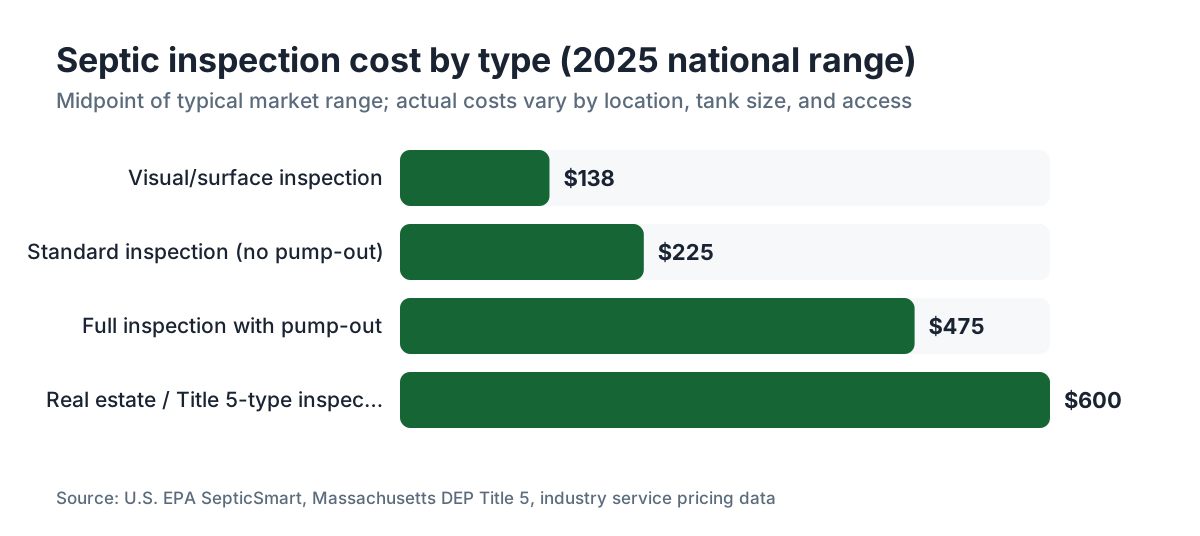
The honest answer is a range, not a number. A basic visual inspection, where a technician checks visible components, looks for surface ponding, and reviews any available records, runs $150 to $250 in most markets. A full inspection that includes locating the tank, pumping the contents, and physically inspecting all accessible components runs $300 to $650. Real estate inspections required at point of sale in states like Massachusetts (Title 5) carry their own fee schedule and often land between $400 and $800 once you add the mandatory pump-out [1].
Smart Septic Pros, like most regional septic companies, prices inspections on a few core variables: the type of inspection you need, your tank's size and age, how hard the tank is to find and access, and what local rules require. Some operators publish flat rates. Others quote after a quick phone screen. Either way, get the quote in writing before anyone digs.
Here's the math that matters. The EPA's SepticSmart program treats inspection as one of the cheapest ways to head off a failure that runs $3,000 to $7,000 for repairs or $10,000 to $30,000 for a full replacement [2]. A $400 inspection against a $25,000 replacement is not a hard call.
What types of septic inspections exist and what does each one cost?
There are four inspection types you'll run into, and they are not interchangeable.
Visual (surface) inspection: $75 to $200. A technician walks the property, checks for odors, wet spots, lush grass over the drain field, and reviews the distribution box or riser lid if accessible. No pumping. No tank opening in most cases. Fine for routine peace of mind, but most lenders and real estate attorneys won't accept it for a home sale.
Standard inspection (limited): $150 to $300. The technician locates the tank (using records, probing, or a locator), opens it, checks the inlet and outlet baffles, measures scum and sludge layers, and reads liquid levels. Pumping is usually not included unless you add it. This is the most common inspection for homeowners just checking their system's health.
Full inspection: $300 to $650. This covers everything above plus a pump-out, inspection of the distribution box and leach field (flow test or dye test in many cases), and a written report. Some providers add a camera inspection of the inlet or outlet line. This is what you want for a home purchase.
Real estate or Title 5-type inspection: $400 to $800. Required by law in some states at point of sale. Massachusetts Title 5 is the best-known example, and it sets specific pass/fail criteria, a licensed inspector, and filing with the local board of health [3]. Other states have their own point-of-sale rules under their onsite wastewater codes. If your state requires it, a cheaper option won't substitute.
| Inspection Type | Typical Cost | Pumping Included | Best For |
|---|---|---|---|
| Visual (surface) | $75, $200 | No | Routine peace of mind |
| Standard (limited) | $150, $300 | No | Annual homeowner check |
| Full | $300, $650 | Usually yes | Home purchase, known issues |
| Real estate/Title 5-type | $400, $800 | Yes (required) | Point-of-sale in regulated states |
What factors make septic inspection prices go up or down?
Tank access is the single biggest swing factor. If the tank lid sits 12 inches down and nobody has a map, the technician has to locate it, dig, and re-cover the lid. That alone adds $75 to $200 to the bill. Installing risers at the end of the inspection (which you should do) adds another $200 to $500, but it pays for itself in reduced labor on every future septic tank pump out.
Tank size matters too. A 1,000-gallon tank in a 3-bedroom home is standard. A 1,500 or 2,000-gallon tank costs more to pump, which feeds straight into the inspection price if pumping is bundled. Bigger tanks show up more on older properties and in rural areas with higher daily flow.
System complexity adds cost. A conventional gravity system is cheap to inspect. An aerobic treatment unit (ATU), mound system, or drip irrigation setup carries extra mechanical parts, often a pump, air compressor, or control panel, and each needs its own evaluation. Inspectors who work on advanced systems charge more, and they should.
Geography is real. A $250 inspection in rural Tennessee might cost $500 in coastal Connecticut, not because the inspector is gouging you, but because overhead, licensing fees, and wages differ.
And watch the quote structure. Some providers give a base fee and add line items: locating fee, pumping fee, report fee. Others quote all-in. Always ask what the number includes before you schedule.
Does a septic inspection include pumping?
Usually not automatically, but it often should. The EPA recommends pumping as part of any thorough inspection because you genuinely cannot judge baffle condition, spot cracks in the tank walls, or evaluate inlet and outlet lines with the tank full of waste [2]. A good inspector will tell you the same thing.
When comparing quotes, ask flat out: "Does this price include pumping?" If the answer is no, add $150 to $300 for a 1,000-gallon tank in most markets (more in high-cost areas) and budget for it. Our full breakdown on septic tank pumping costs walks through pricing that separately.
Some homeowners try to save by skipping the pump-out during inspection and scheduling it later. That usually costs more in total. If the inspector finds a problem that needs the tank empty to fix, you're paying for two trips. Bundle it.
How long does a septic inspection take?
Plan on 1.5 to 3 hours for a full inspection with pumping on a typical residential system. A visual inspection without tank access takes 30 to 45 minutes. Complex systems, hard-to-find tanks, and large properties run longer.
For real estate deals, the written report adds time on the back end. A Title 5-style report with pass/fail documentation can take 24 to 72 hours to land after the site visit. Some operators offer same-day digital reports. Others batch their paperwork. If you have a closing deadline, ask about turnaround the moment you book.
How do you know if a septic inspector is qualified?
Licensing requirements swing hard by state. Some states, like Massachusetts, require a specific septic inspector license issued by the state Department of Environmental Protection [3]. Others fold septic inspection into a general plumber's or contractor's license. A few have essentially no formal requirement at the inspector level beyond hauler registration.
The National Association of Wastewater Technicians (NAWT) offers a Certified Inspector (CI) credential that's widely recognized in the trade [4]. That's a reasonable baseline to ask for in states where licensing is thin. Ask for the license number and verify it with your state environmental or health agency before you hand over money.
For real estate inspections, your state may require the inspector to file results with a regulatory body. In Massachusetts, results go to the local board of health [3]. That filing requirement is a real accountability check that informal inspections don't have.
For operators running inspection-heavy shops, scheduling, license tracking, and report workflows are exactly the operational overhead a platform like SepticMind is built to manage, keeping compliance documents tied to the right customer record instead of buried in email.
What does a septic inspection report include?
A good report tells you the condition of every accessible component, what the inspector saw, the sludge and scum measurements, whether the system passed or failed any regulatory criteria, and the recommended next steps.
At minimum, expect: tank location and condition (cracks, corrosion, liquid level), inlet and outlet baffle condition, distribution box condition if accessible, drain field visual assessment (ponding, odors, surface breakout), and a summary of findings. A photo log is standard with reputable companies and very useful if you're buying a home.
If the inspector found a problem, the report should say what it is, how serious it is, and whether it needs immediate action. "Monitor annually" and "repair within 30 days" are very different calls. Make sure you know which one applies before you leave the driveway.
When do you actually need a septic inspection?
Four situations call for one.
Home purchase. Get a full inspection before you close on any property with a septic system. This is not optional. A failed system that costs $25,000 to replace will torch your closing-day goodwill fast. Your general home inspector likely lacks the training to evaluate a septic system properly. Hire a dedicated septic inspector.
Routine maintenance. The EPA recommends inspecting a conventional system every 3 years and pumping every 3 to 5 years depending on household size [2]. Most homeowners skip this until something goes wrong. Don't be most homeowners.
Visible problems. Wet spots over the leach field, sewage odors in the yard, slow drains throughout the house, or gurgling in the plumbing are all reasons to call now rather than later.
After a major event. A flood that submerges the drain field, a vehicle driven over the tank, or a tree removal near the system all warrant a check. Damage isn't always visible right away.
For how often to schedule routine pumping alongside inspections, our guide on how often to pump septic tank breaks down the EPA recommendations by household size.
What happens if the septic inspection fails?
A failed inspection means the system has a condition that needs repair or replacement before it can be certified as passing. In a real estate context, this usually kicks off negotiation: the seller pays for repairs, the price drops, or the deal falls apart.
Repair costs range widely depending on what failed. A cracked baffle is a septic tank repair job that might cost $150 to $500. A failed distribution box might run $500 to $1,500. A failing drain field is where costs get serious, often $2,000 to $10,000 for a field replacement or repair, and a full septic system repair or replacement can top $20,000 depending on soil and system type [2].
If you're a buyer and the system fails, you're in a strong position. A failed system is a known defect. Most real estate attorneys will tell you to get a repair estimate and negotiate from there. Walk away if the seller won't move on price or fix it before closing.
For cost context on a new system if the old one is beyond repair, see our guides on cost to install septic system and cost to put in a septic tank.
How do Smart Septic Pros' inspection prices compare to the industry average?
Regional septic companies like Smart Septic Pros generally price in line with local market rates. The inspection market has no single national benchmark, but data aggregated by home services platforms lands here consistently:
- Standard septic inspection (no pumping): $150 to $350 nationally
- Full inspection with pump-out: $300 to $650
- Real estate inspection with report: $400 to $800
Smart Septic Pros runs as a regional provider, so their exact prices reflect their labor market, overhead, and service scope. The way to know if their quote is competitive is simple: get two or three quotes from licensed local providers in the same service area and compare what's actually included in each.
Price alone is a bad proxy for quality here. A $200 inspection from an unlicensed contractor who doesn't pump the tank and writes a two-line report is no bargain. A $500 inspection from a licensed, certified inspector with a detailed report and photo documentation is genuinely worth it. Pay for the report quality more than the site visit.
Operators who want to see how structured inspection workflows and clear pricing presentations move their close rates and customer trust can look at what SepticMind's operations platform does on the back end.
Can you negotiate septic inspection prices, and what actually saves money?
You can ask, and some operators will move a little for slow days or a bundle. But deep discounts on inspections are rare from reputable companies, because the cost is mostly labor, fuel, and disposal, not materials.
Here's what actually saves money over time.
Install risers. If your tank lids are buried, the locating and digging fee hits every single time. Risers cost $200 to $500 installed and kill that cost for the life of the system [5].
Stay on schedule. Pumping every 3 to 5 years, as the EPA recommends, costs far less than emergency pumping after a backup, which piles on after-hours rates, possible septic tank cleaning of the distribution box, and field repair costs [2].
Bundle pumping and inspection. Most operators give a better combined rate than two separate calls.
Keep your own records. Knowing your tank size, location, last pump date, and system age cuts the inspector's research time and lowers the risk of a locating charge.
Skip additives. The EPA and most state agencies found no scientific evidence that septic additives improve system performance, and some may harm it [6]. That's money you can keep in your pocket.
Frequently asked questions
What is the average cost of a septic inspection from Smart Septic Pros?
Smart Septic Pros, like most regional septic companies, charges $150 to $300 for a standard inspection without pumping and $300 to $650 for a full inspection that includes a pump-out and written report. Real estate inspections in regulated states can reach $800 once the mandatory pump-out and filing fees are included. Always ask for an itemized quote in writing before scheduling.
Is a septic inspection required when selling a house?
It depends on your state. Massachusetts requires a Title 5 inspection at point of sale, filed with the local board of health. Several other states have similar point-of-sale requirements under their onsite wastewater codes. Even where it's not legally required, most lenders and buyers' agents will insist on one. Check your state's environmental or health agency website for the rule in your area.
How often should a septic system be inspected?
The EPA recommends inspecting a conventional septic system at least every 3 years and pumping every 3 to 5 years based on household size and tank capacity. Systems with mechanical components, like pumps, aerators, or float switches, should be inspected annually. Skipping inspections is the most common reason homeowners face expensive emergency repairs.
Does a septic inspection include pumping?
Not always. Many providers quote inspection and pumping separately. Pumping typically adds $150 to $300 for a 1,000-gallon tank. A thorough inspection really should include pumping, because you can't properly assess baffle condition or tank integrity with the tank full. Ask explicitly whether pumping is bundled before you commit to a quote.
How long does a septic inspection take?
A full inspection with pumping on a typical 3-bedroom home takes 1.5 to 3 hours on site. A surface-only visual inspection without tank access takes 30 to 45 minutes. Written report delivery, especially for real estate transactions, can take an additional 24 to 72 hours. If you have a closing deadline, ask the inspector about report turnaround when you book.
What can cause a septic inspection to fail?
Common failure causes include a cracked or deteriorating tank, broken or missing baffles, high sludge or scum levels that point to an overdue pump-out, hydraulic overload showing as liquid above the outlet, a failing distribution box, or active surface breakout over the drain field. Some states have specific criteria, like Massachusetts Title 5, that define pass and fail conditions in regulatory language.
Who pays for a septic inspection when buying a house?
In most real estate transactions, the buyer pays for the inspection as part of due diligence. In states with mandatory point-of-sale inspections, like Massachusetts, the seller is typically responsible for the Title 5 inspection cost and any required repairs before closing. Actual allocation is negotiable and should be spelled out in your purchase agreement before you go under contract.
What qualifications should I look for in a septic inspector?
Look for state licensing where it exists, which you can verify with your state environmental or health department. The NAWT Certified Inspector (CI) credential is a recognized industry standard in states with weaker licensing. For real estate inspections, confirm the inspector is authorized to file with your local regulatory body. Ask for their license number and check it before you book.
Can a general home inspector inspect the septic system?
Most general home inspectors are not trained or licensed to perform a full septic inspection. They may note visible red flags, like surface ponding or odors, but they won't open the tank, measure sludge depth, or assess baffle condition. For any real estate transaction with a septic system, hire a dedicated, licensed septic inspector separately. The general home inspection fee does not cover this.
What's the difference between a septic inspection and a septic pump-out?
A pump-out removes accumulated waste from the tank; it's maintenance. An inspection assesses the condition of the tank, baffles, distribution box, and drain field. They're related but different. A pump-out without an inspection tells you nothing about system health. An inspection without a pump-out misses problems hidden under the waste layer. For the most value, do both at the same service call.
How do I prepare my property for a septic inspection?
Know the location of your tank if possible, and dig up any buried lids beforehand to save on labor charges. Have your system records ready: installation date, tank size, last pump date, any repair history. Avoid running large water loads (laundry, dishwasher) in the 24 hours before the inspection so the tank isn't artificially overloaded during the assessment. Clear any surface obstructions over the tank and drain field.
Are septic inspection costs tax deductible?
Generally no for a primary residence. If the property is a rental or business property, inspection costs may be deductible as a maintenance or business expense. If you're buying a home and the inspection reveals a defect you repair before closing, those repair costs may affect your tax basis. Talk to a tax professional; the IRS rules on real property expenses are specific to your situation.
What happens after a failed septic inspection in a real estate deal?
A failed inspection is a known defect that must be disclosed and usually resolved before closing. Options include the seller repairing the system before closing, a price reduction to cover repair costs, the buyer assuming the repair (risky unless costs are well-defined), or the deal terminating. Get a repair estimate from a licensed contractor right after a failed inspection so you have real numbers for negotiation.
Is a dye test the same as a septic inspection?
No. A dye test flushes fluorescent dye through the system and looks for it surfacing in the drain field or nearby waterways. It's a pass/fail screening tool, not a full inspection. Many states no longer accept dye tests as sufficient for real estate transactions because they miss internal tank problems and can produce false passes. A full inspection is the more reliable standard.
Sources
- Massachusetts DEP, Title 5 Official Inspection of Onsite Sewage Disposal Systems: Massachusetts Title 5 requires a licensed inspector, mandatory pump-out, specific pass/fail criteria, and filing with the local board of health at point of sale
- U.S. EPA SepticSmart Program: EPA recommends inspecting conventional septic systems at least every 3 years and pumping every 3 to 5 years; system replacement can cost $3,000 to $7,000 for repairs or more for full replacement
- Massachusetts DEP, 310 CMR 15.000 Title 5 Regulations: Title 5 mandates specific inspector licensing, filing of inspection results with local board of health, and defined pass/fail criteria for onsite sewage systems at point of sale
- National Association of Wastewater Technicians (NAWT), Certified Inspector Program: NAWT offers a Certified Inspector (CI) credential recognized across the industry as a baseline qualification for septic inspectors
- University of Minnesota Extension: Installing risers to bring tank lids to grade eliminates repeated locating and excavation costs on future service visits
- U.S. EPA, Response to Congress on Use of Septic System Additives: EPA found no scientific evidence that biological or chemical septic additives improve system performance and noted some may be harmful
- North Carolina DEQ, Division of Water Resources: State onsite wastewater programs set inspector licensing requirements and inspection standards that vary by jurisdiction
- Washington State Department of Health: Washington State regulates onsite sewage system inspectors and requires specific approvals for systems used in real estate transactions
- Virginia DEQ, Onsite Sewage and Well Programs: Virginia requires licensed onsite soil evaluators and installers; inspection standards governed by state onsite sewage regulations
- Penn State Extension: Routine inspection and pumping on schedule is the most cost-effective way to extend septic system life and avoid costly field failures
Last updated 2026-07-09