Soil perc test: what it is, how it works, and what it costs
By the SepticMind Editorial Team
TL;DR
- A soil percolation test measures how fast water drains through your soil, which decides whether your land can support a septic drain field.
- Most counties require it before issuing a septic permit.
- Cost runs $250 to $1,000 depending on your state and how many test holes you need.
- Results stay valid for 2 to 5 years in most places.
What is a soil perc test and why does it matter?
A perc test, short for percolation test, measures how fast water soaks into the soil at a specific spot on your property. That absorption rate tells engineers, regulators, and you whether the ground can accept the effluent flowing out of a septic tank without backing up, surfacing in the yard, or reaching groundwater before it gets treated.
The math is simple. The consequences are not. A drain field spreads partially treated wastewater across a large soil area, and microbes in the soil finish the job. Move water through too fast, like through coarse gravel, and effluent hits groundwater before treatment finishes. Move it too slow, like through heavy clay, and the field saturates, sewage surfaces, and you own an expensive problem [1].
Most state and county health departments require a passing perc test before they issue a permit for a new septic system. Some jurisdictions also want one when you expand a home, subdivide a lot, or reactivate a system that sat dormant for years. No test, no legal build.
How does a perc test actually work, step by step?
The exact procedure shifts a little by state, but the sequence holds across most jurisdictions. Dig holes, soak them, then time how fast the water drops.
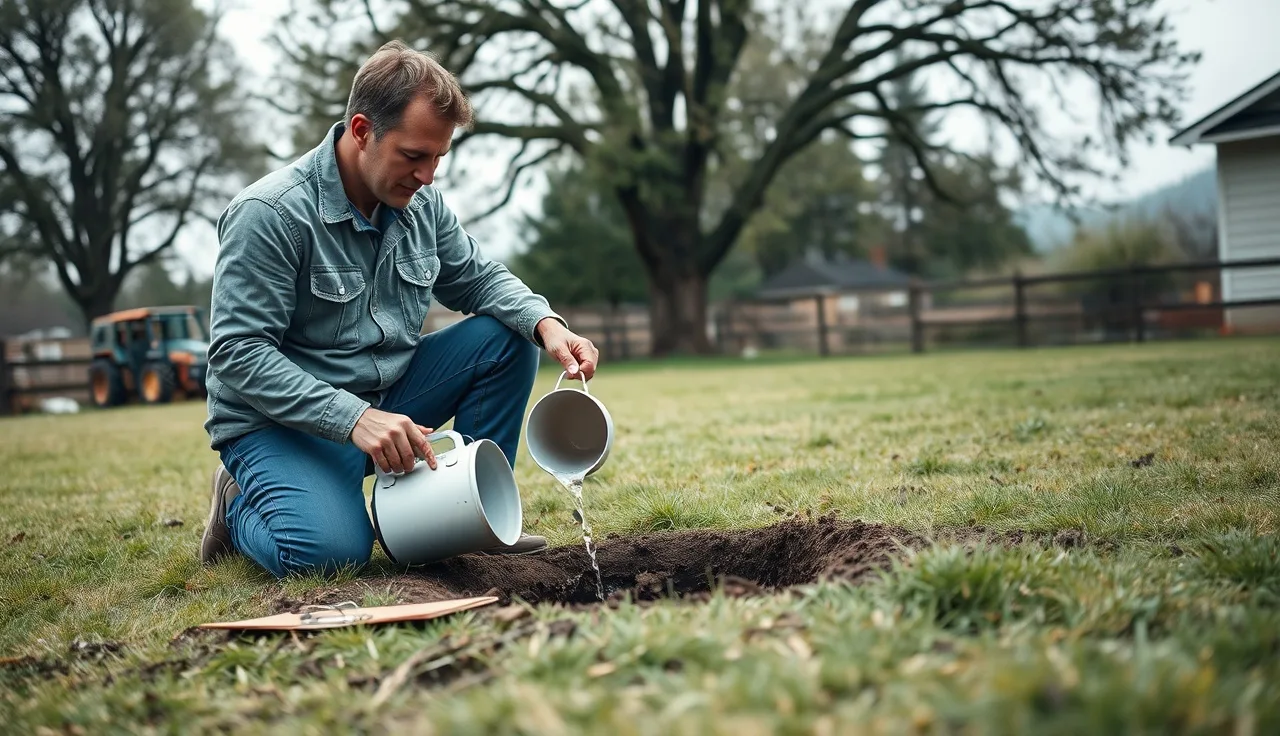
First, the tester digs or bores test holes, usually 6 to 12 inches wide and 18 to 36 inches deep, placed where the proposed drain field will actually sit. Many state codes require at least two holes. Some require six or more spread across the field footprint [2].
Next comes presaturation. The holes get filled with water and left to soak for a set period, often overnight or a minimum of 4 hours. This step matters. Soil absorbs water differently once it's already wet, and wet is closer to how a drain field really operates than bone-dry ground.
Then the actual measurement. A standard volume of water goes into the hole, and the tester records how many minutes it takes for the level to drop one inch. That number, in minutes per inch (MPI), is your percolation rate [3].
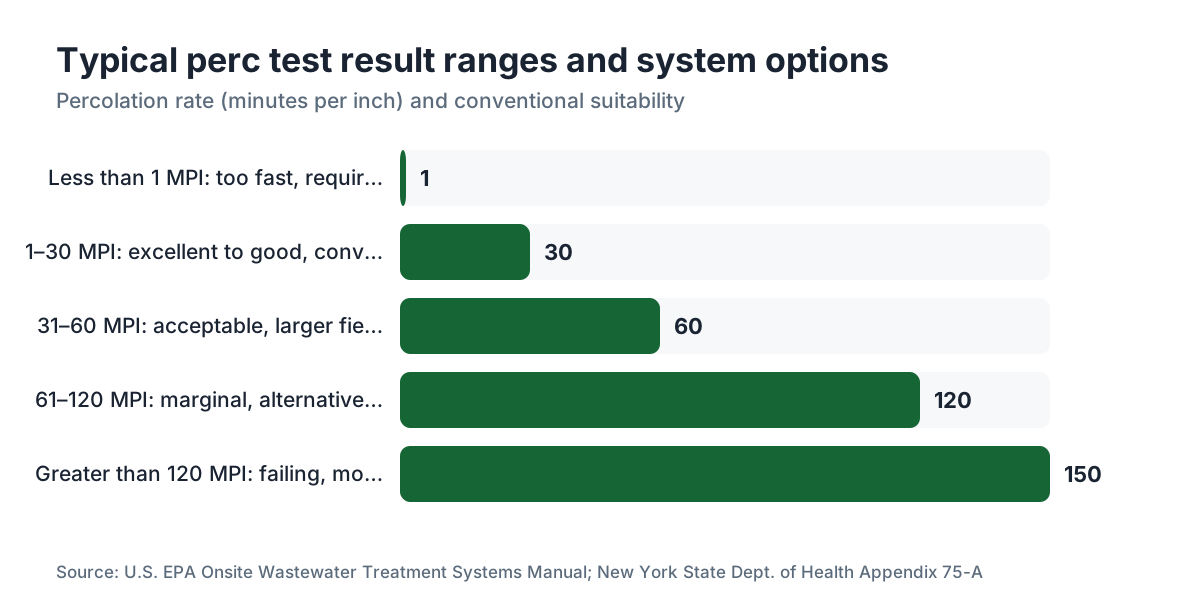
Results get averaged across all the holes. Most states set an acceptable range. A common threshold is 1 to 60 MPI. New York State, for example, allows up to 60 MPI for standard systems and has provisions down to 120 MPI for certain alternative designs [4]. Below 1 MPI (very fast draining, often sandy gravel) the soil may drain too quickly for real treatment. Above the state maximum, the soil fails.
What perc test results mean: pass, fail, and the gray zone
A passing result means your soil absorbs water inside your jurisdiction's acceptable range, and a conventional septic system may be permitted, subject to setbacks and other site conditions. A failing result does not mean you can't build.
Many states now allow alternative or "innovative" system types built for slow-draining soils. Mound systems, drip irrigation, and aerobic treatment units can often get permitted on soils that flunk a standard perc test [5]. They cost more, roughly 50% to 200% more than a conventional system, but they work.
The gray zone is real. Soil that barely passes, say 55 MPI in a state with a 60 MPI limit, needs a bigger drain field than soil at 20 MPI. Field size runs directly off the perc rate, so a marginal pass still drives your design and your budget.
One caution worth repeating. A perc test is a single snapshot in time. Testing in the dry season can hand you a better number than testing in early spring when the water table is high. Some states mandate wet-season testing for exactly this reason. If a neighbor keeps having field failures despite passing tests, ask your county health department when those tests ran.
| Perc Rate (MPI) | Typical Classification | Common System Option |
|---|---|---|
| Less than 1 | Too fast, possible failure | Requires evaluation |
| 1 to 30 | Excellent to good | Conventional drain field |
| 31 to 60 | Acceptable | Conventional, larger field area |
| 61 to 120 | Marginal to slow | Alternative system often required |
| Greater than 120 | Failing | Mound, drip, or ATU may apply |
Who does perc tests, and do you need a soil scientist?
The honest answer trips up a lot of homeowners: it depends entirely on your state.
In some states, a licensed professional engineer (PE) or a registered sanitarian runs the test. In others, a certified soil scientist evaluates the site first, and the perc test is one piece of a broader soil morphology assessment. A few states let the county health department's own inspector run the test after you file an application [2].
A soil scientist does more than watch water drain. They profile the soil horizons, spot restrictive layers like hardpan or a seasonal high water table, and note soil texture and structure at several depths. That data feeds straight into the system design. North Carolina and Virginia both require a licensed soil scientist to sign off on any site that will host a septic system, more than the difficult ones [6].
For a straightforward residential lot, especially where a county sanitarian handles the test, you may not need to hire anyone separately. Your septic designer or installer usually folds the test into their overall service. For a complex or marginal site, hiring a soil scientist independently, before you buy the land or lock in a design, can save you from an expensive mistake.
The National Society of Professional Soil Scientists keeps a directory of members by state if you need to find one on your own [7].
How much does a perc test cost?
Plan on $250 to $1,000 for a standard residential perc test. The wide range comes from a few real variables, and knowing them helps you predict where you'll land.
Who does it matters most. If the county runs the test as part of a permit application, your fee might be $150 to $300 paid to the health department. Hire a private engineer or soil scientist and you're paying their hourly rate plus mobilization, usually $400 to $800 for a simple site.
How many holes your jurisdiction requires matters next. More holes mean more labor and more time. A site with complex soil that needs six or more test holes can push past $1,000 before you add any soil morphology work.
The site itself is the third factor. Rocky ground, tight access, or the need to bring in a backhoe instead of a hand auger all add cost. Some rural counties have a single contracted tester, and if they're booked, you might wait 4 to 8 weeks.
Here's the perspective that matters. The perc test is a small slice of the total. A full septic tank installation runs $3,000 to $15,000 depending on system type and location [8]. Paying $500 for a test that shapes a $10,000 decision is money well spent.
If you want a full soil evaluation plus perc test, especially on land you're thinking about buying, budget $500 to $1,500. That cost can pay for itself when you negotiate down a price on a marginal site.
How do you get a perc test scheduled and completed?
Start with your county or township health department. Every jurisdiction that regulates onsite wastewater, which is basically all of them in the U.S., has a process. Call the environmental health or onsite wastewater section and ask four things directly: who conducts the test, what's the application fee, what site prep do you need, and what time of year is testing available.
Some counties only schedule tests during certain seasons, typically late winter through spring, to catch high water table conditions. If you're buying land and the timing is off, you may wait months. Plan for that early.
The usual steps look like this:
- Contact the county health department and get the application form.
- Submit the application with the fee and a basic site sketch showing the proposed house location, well location, and property lines.
- The county schedules the test date and tells you what prep you owe them (clearing vegetation, marking corners, sometimes pre-digging holes to depth).
- The test runs, usually with you or your agent present.
- Results come back in writing, often within 1 to 4 weeks.
If your state requires a private soil scientist or engineer, that person usually handles the county application as part of their service. Ask for a written scope of work before you hire anyone.
Does a perc test tell you everything about your site?
No, and this is where homeowners get burned. A perc test measures one thing: infiltration rate.
It does not tell you the depth to seasonal high groundwater, whether a restrictive hardpan layer sits two feet down, how close you are to a wetland, or what your soil type really is. Every one of those factors also decides whether you can install a septic system and what type you can install.
States that take onsite wastewater seriously now require a full soil evaluation, or soil morphology study, on top of (or instead of) a simple perc test. The EPA's own guidance notes that soil morphology gives a more reliable read on long-term system performance than percolation testing alone [1]. A morphology evaluation means digging a pit, profiling the soil layers, reading color changes (mottling that signals seasonal saturation), and recording texture and structure.
Florida, for one, has moved substantially toward soil morphology and away from timed percolation tests for most sites [9]. If your state still leans on a perc test, adding a soil morphology review by a qualified soil scientist is worth it, especially on any site with visible drainage problems, low-lying areas, or wetlands next door.
One more thing. A leach field design is only as good as the site data behind it. A field sized to a perc result that missed a clay layer at two feet is going to fail, and no amount of good workmanship saves it.
How long are perc test results valid?
Most jurisdictions accept results for 2 to 5 years from the test date, though the window varies by state and sometimes by county within a state. Confirm the exact period before you rely on any result.
If you tested a parcel three years ago and are only now moving on permits, check with your county that the results still count. Some health departments honor old results if the property hasn't changed and no grading or filling happened. Others require retesting no matter what.
Site changes can void results outright. Grade the lot, fill a low area, dig a pond, or alter drainage patterns, and most jurisdictions want a new test. The soil the old test measured no longer represents what's there now.
Buying land where the seller hands you perc results? Ask for the original report with the test date, the method used, and the county acceptance letter. Numbers scrawled on a napkin with no official acknowledgment are worthless when you go to pull a permit.
What happens if your land fails a perc test?
A failed perc test is not the end of the road, but it narrows your options and raises your costs. Your first move is to figure out why the soil failed.
Very slow absorption (high clay) and very fast absorption (pure gravel) call for different fixes. A soil scientist can walk you through what your specific failure means.
For slow-draining soils, the common alternatives are mound systems, which raise the drain field above grade and use imported sand as the treatment medium, or aerobic treatment units (ATUs), which treat effluent more thoroughly before it reaches the soil [5]. Both cost more upfront and demand more maintenance.
Where the perc rate is borderline, some states allow a larger conventional system. Doubling the drain field area to make up for slow soil is common practice. That eats more land, which stings on a small lot.
In a true failure, where the soil is essentially impermeable or the lot has no suitable area at all, your choices shrink to holding tanks (a sealed tank pumped regularly, no discharge), cluster systems shared with neighbors, or, sometimes, no septic at all and a required municipal sewer connection.
If you're buying and the perc test fails, that's a material fact for your negotiation. It can slash what the land is worth. Our overview of cost to install septic system fills in the full financial picture.
Perc tests for existing properties: when do you need one?
Most homeowners on a working septic system never think about perc testing. The test is a permitting requirement for new systems, not routine maintenance.
A few situations bring it back into play on existing properties, though.
Adding a bedroom or a chunk of living space often triggers a permit for system expansion. The county may want a fresh perc test to confirm the existing area can carry more load, or to size an expansion.
A major failure, where you're replacing the whole leach field instead of repairing it, can require an updated site evaluation including a perc test. Some counties let the designer reuse original test data if it's recent and the site is unchanged. Others insist on new testing.
Buying an existing home on septic? A perc test isn't usually part of a standard septic tank inspection, which focuses on the tank and accessible parts. But on a property where the original system looks undersized for the house, or where the drain field has a history of trouble, paying a soil scientist to evaluate the site gives you information a standard inspection never will.
Operators running multiple properties or a service territory can track permit histories, maintenance logs, and system types in one place. SepticMind's operator tools are built around this kind of records management, which pays off when you're trying to reconstruct what testing happened on a site a decade back.
State regulations and EPA guidance on perc testing
There is no single federal perc test standard in the United States. The EPA sets broad guidance on onsite wastewater treatment through its SepticSmart program and its Onsite Wastewater Treatment Systems Manual, but the actual rules are state and local [1].
The EPA's manual is blunt about the method's limits and recommends supplementing percolation testing with soil morphology data wherever possible [1]. Plenty of states took that to heart. The result is a patchwork.
Here's how a few states handle it:
- Texas: Requires a site evaluation by a licensed engineer or sanitarian. Perc testing is one allowed method, but soil morphology is preferred for OSSF permits [10].
- North Carolina: Requires a licensed soil scientist's evaluation for all new systems. The perc test is not the primary tool [6].
- New York: Sets detailed perc test protocols in Appendix 75-A. Results must fall within defined ranges for conventional systems [4].
- California: Delegates authority to counties. Requirements vary a lot county to county, though most require perc tests for new septic permits [11].
Before you budget or schedule anything, pull up your state's onsite wastewater code. Most state environmental or health agency websites publish it. Can't find it? Your county health department can tell you exactly what's required.
For operators working across multiple states, keeping up with different rules is genuinely hard. That's the workflow SepticMind is built to support.
Common perc test mistakes that delay your project
A handful of avoidable errors show up over and over on residential perc test projects. Each one can cost you weeks or a failed permit.
Testing at the wrong time of year. Homeowners push for an August test in a dry year, get a great number, then watch the system struggle come spring when the water table rises. Some states caught on and mandate wet-season testing. Even where it isn't required, spring testing is more conservative and closer to real conditions.
Skipping presaturation. The soak step is boring to wait through, but skip it or rush it and you get an artificially fast result. Treat any test that skips overnight presaturation with suspicion [3].
Testing only the easy part of the lot. If your proposed field area covers both a well-drained knoll and a low wet spot, testing only the high ground gives you data that doesn't represent where the field has to go. Match your hole locations to the actual field footprint.
Leaning on old results without checking validity. Results from six years ago may or may not still count. Call the county before you assume.
Not getting results in writing with the county's official acceptance. A verbal "you're fine" from an inspector is not bankable when you go to pull a permit six months later.
Frequently asked questions
What is a perc test for septic?
A perc test, or percolation test, measures how fast water absorbs into the soil at a proposed drain field site. The result, in minutes per inch (MPI), tells regulators and engineers whether the soil can handle septic effluent without saturating or contaminating groundwater. Most counties require a passing result before issuing a septic system permit.
How much does a perc test cost?
A residential perc test typically costs $250 to $1,000. County-run tests usually sit at the lower end, around $150 to $300 in fees paid to the health department. Hiring a private engineer or soil scientist runs $400 to $800 or more for a simple site. Complex sites with many required test holes or hard access can exceed $1,000.
Who performs a perc test?
It depends on your state. Some counties send their own sanitarian or inspector. Other states require a licensed professional engineer, a registered sanitarian, or a licensed soil scientist. A few states require a soil scientist for all new septic sites. Check with your county health department's environmental health division to find out who's authorized in your jurisdiction.
Do I need a soil scientist for a perc test?
In some states, yes. North Carolina and Virginia require a licensed soil scientist's evaluation for all new septic systems. In many other states, a county inspector or licensed engineer handles the test. Even where it isn't required, hiring a soil scientist independently on a marginal or complex site is often worth the cost before you commit to a land purchase or system design.
How long does a perc test take?
The active test period runs 1 to 4 hours, but the full process including presaturation takes 24 to 48 hours from start to recorded result. Most protocols require filling the holes with water the day before to presaturate the soil overnight. Add a few weeks for scheduling and report processing, and budget 3 to 6 weeks total from application to final written results.
What does a passing perc test result look like?
Most states set an acceptable range of roughly 1 to 60 minutes per inch (MPI), though the exact threshold varies. A result in that range means a conventional septic drain field may be permitted, subject to other site conditions. Results below 1 MPI drain too fast. Results above the state maximum mean conventional systems aren't allowed and alternative designs are required.
What if my land fails a perc test?
A failing result doesn't automatically end your project. Many states allow alternative systems, including mound systems, aerobic treatment units, or drip irrigation, for soils that fail a standard perc test. These cost more, often 50% to 200% more than a conventional setup. If the site truly can't support any system, options narrow to a holding tank or connecting to municipal sewer if it's available.
How long are perc test results valid?
Most jurisdictions accept results for 2 to 5 years from the test date. Some counties extend that if the site hasn't changed. Others require retesting regardless of age. Results can be voided by grading, filling, drainage changes, or other site alterations. Always confirm validity with your county health department before relying on results from a prior owner or an earlier testing cycle.
Can I do a perc test myself?
In most jurisdictions, no. The test must be conducted or witnessed by a county inspector, licensed engineer, or certified soil scientist to count for a septic permit. Even in areas with looser requirements, a self-run test has no regulatory standing. DIY procedures exist online, but they're useful only for informal site evaluation, not for permit purposes.
Does a perc test tell you if you can have a well?
Not directly. A perc test evaluates soil absorption for a drain field, not well siting. Well placement is governed by setback distances from the drain field, property lines, and other features, plus separate rules on well construction. You'd need a well driller or hydrogeologist to evaluate your site for a well, though the perc results do fix where the drain field goes, which in turn affects where the well can sit.
How many test holes are required for a perc test?
Minimum requirements vary by state and sometimes by lot size. Many states require at least two test holes. Others require four to six spread across the proposed field area. For larger fields or sites with variable soils, six or more holes may be needed. Your county health department or the engineer handling the test will know the requirement for your jurisdiction.
Does the time of year affect perc test results?
Yes, and meaningfully. Soil tested in dry summer conditions absorbs water faster than the same soil in spring when the water table is high. Some states mandate wet-season testing to capture worst-case conditions. A dry-season test can hand you an optimistic number that doesn't reflect how the field performs after heavy rain or snowmelt. Spring testing is generally more conservative.
Is a perc test required to buy land?
It isn't universally required for a sale to close, but it's strongly advisable for undeveloped land that needs a septic system. Many buyers make their offer contingent on a passing perc test. If the land fails and you've already closed, you may own an unbuildable lot. Some lenders and title companies flag this risk for rural parcels without existing sewer service.
How is a perc test different from a soil morphology evaluation?
A perc test measures infiltration rate at a single point in time. A soil morphology evaluation profiles soil layers, identifies restrictive horizons, reads seasonal water table indicators like mottling, and records texture and structure. Morphology gives a fuller picture of long-term system performance. The EPA recommends using both together, and several states now require morphology rather than relying on perc tests alone.
Sources
- U.S. EPA, Onsite Wastewater Treatment Systems Manual (EPA/625/R-00/008): EPA states that soil morphology offers a more reliable indication of long-term system performance than percolation testing alone, and recommends supplementing perc tests with soil morphology data.
- U.S. EPA SepticSmart Program, How Your Septic System Works: EPA guidance on onsite wastewater system siting and permitting, including the role of percolation testing in site evaluation.
- Penn State Extension, Soil Percolation Testing for On-lot Sewage Systems: Presaturation protocol for perc tests: holes must be presaturated, typically overnight, to mimic real operating conditions before the timed infiltration measurement.
- New York State Department of Health, Appendix 75-A Realty Subdivisions: New York State allows perc rates up to 60 MPI for standard systems and has provisions for certain alternative designs at rates up to 120 MPI.
- U.S. EPA, Types of Septic Systems: Alternative and innovative septic system types, including mound systems, drip irrigation systems, and aerobic treatment units, are options for sites that fail conventional perc test standards.
- North Carolina Department of Environmental Quality, Onsite Wastewater Section: North Carolina requires a licensed soil scientist's evaluation for all new septic system sites, with soil morphology as the primary evaluation tool.
- National Society of Professional Soil Scientists (NSPSS), Member Directory: NSPSS maintains a directory of licensed soil scientists by state for locating qualified professionals for perc testing and site evaluation.
- U.S. Census Bureau, American Housing Survey: Septic system installation costs range from approximately $3,000 to $15,000 depending on system type and region.
- Florida Department of Health, Onsite Sewage Treatment and Disposal Systems Rule 64E-6: Florida has substantially moved toward soil morphology evaluation and away from timed percolation tests for most septic system siting decisions.
- Texas Commission on Environmental Quality, On-Site Sewage Facilities Rules Chapter 285: Texas requires a site evaluation by a licensed engineer or sanitarian for OSSF permits; soil morphology is preferred over perc testing alone.
- California State Water Resources Control Board, Onsite Wastewater Treatment System Policy: California delegates onsite wastewater authority to counties; most counties require perc tests as part of new septic system permitting.
Last updated 2026-07-09