Average cost of a new septic system in rural South Carolina (2026)
By the SepticMind Editorial Team
TL;DR
- A new septic system in rural South Carolina runs $6,000 to $18,000 in 2026.
- Soil type, system type, lot size, and county permit fees set where you land.
- A conventional gravity system on sandy soil comes in around $6,000 to $10,000.
- Alternative systems on wet or clayey ground pass $15,000.
- Perc tests, permits, and installer quotes all vary by county.
What does a new septic system cost in rural South Carolina right now?
The honest answer is a range, not a number. Most rural South Carolina homeowners installing a new conventional septic system in 2026 pay somewhere between $6,000 and $12,000 for a standard gravity-fed system on cooperative soil. Put a pressure-dosed or alternative system on harder ground and that range jumps to $12,000, $18,000 or beyond. A handful of problem sites, think high water tables in the Lowcountry or Upcountry red clay, push past $20,000.
Those figures cover everything from the perc test through the final inspection: soil evaluation, permit, tank, drain field or alternative treatment unit, excavation, labor, and the county inspection fee. What they leave out is land clearing, access road work, or electrical service to a pump chamber, which can add $1,000, $4,000 depending on how remote the lot is.
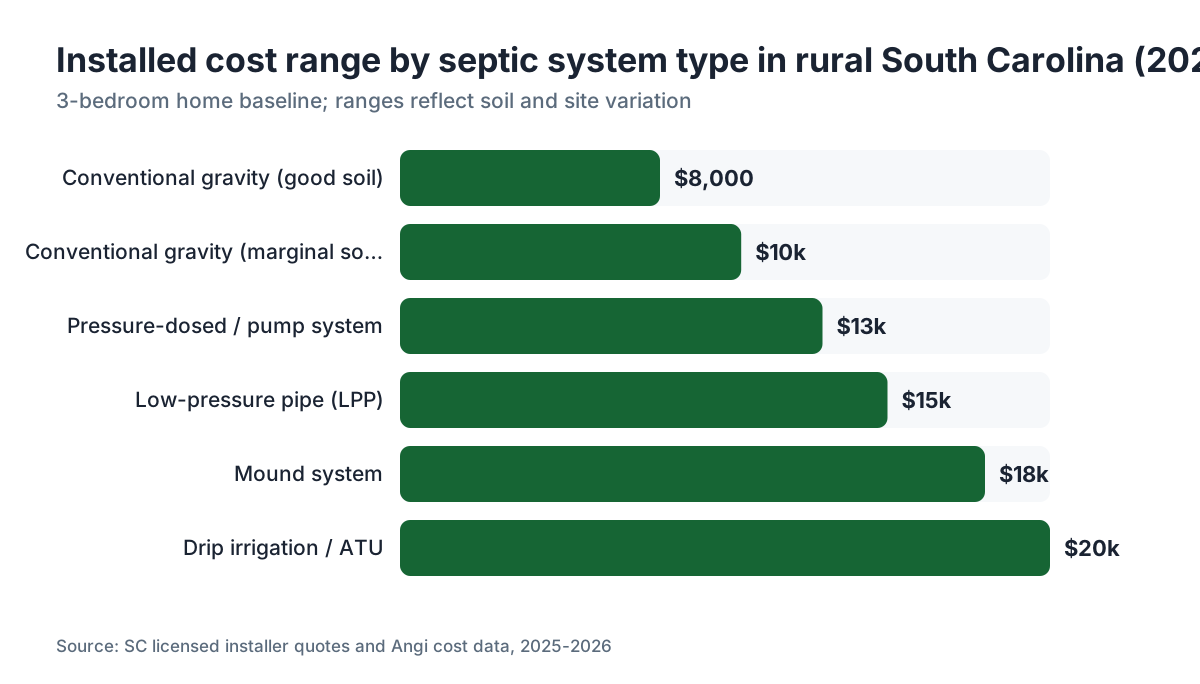
For a quick orientation before we break down each cost driver, see the table below. These are real contractor ranges gathered from South Carolina DHEC licensed installer quotes and regional industry cost data [1][2].
| System Type | Soil Condition | Installed Cost Range (2026) |
|---|---|---|
| Conventional gravity | Sandy/loamy, good perc | $6,000, $10,000 |
| Conventional gravity | Moderate clay, marginal perc | $8,000, $13,000 |
| Pressure-dosed (pump) | Shallow depth to water table | $10,000, $16,000 |
| Low-pressure pipe (LPP) | Marginal, high water table | $12,000, $18,000 |
| Drip irrigation/ATU | Failed perc, small lot | $15,000, $25,000+ |
| Mound system | Poor drainage, Lowcountry | $14,000, $22,000 |
These ranges assume a 3-bedroom house, which sets the minimum tank size at 1,000 gallons under South Carolina regulations [3].
What factors drive the price up or down the most?
Soil is the single biggest variable. South Carolina has three distinct geological zones: the Upcountry Piedmont with dense red clay, the Sandhills belt with fast-draining sandy soils, and the Coastal Plain and Lowcountry with high water tables and hydric soils. Sandy Sandhills soil is a septic installer's dream, and you may only need a modest drain field. Lowcountry clay or seasonally saturated ground forces you into an engineered alternative system, and that engineering costs real money.
System size comes next. DHEC sizing runs off bedroom count as a proxy for daily flow. A 3-bedroom home is rated at 300 gallons per day (GPD); a 4-bedroom home at 400 GPD [3]. Each extra bedroom adds roughly $800, $2,000 in field area and tank capacity.
Depth to the seasonal high water table and the required setbacks (100 feet from a well, 50 feet from a property line, 10 feet from a structure) [3] can push the drain field into a worse spot on the lot, sometimes needing a pump to move effluent uphill. A pump chamber adds $1,500, $3,000 to the job.
County matters too. Permit fees range from roughly $200 in some rural counties to $600 or more in others. Richland and Beaufort counties have historically run higher; Chester and Marlboro lower. Labor rates follow population density, so contractors near Myrtle Beach or Columbia charge more than those in Williamsburg or Allendale counties.
Tank material shifts the number as well. Concrete tanks, the default in South Carolina, hold up and run $700, $1,500 for a 1,000-gallon unit installed. Fiberglass and polyethylene tanks cost $800, $2,000 but weigh far less on difficult access lots. Some county inspectors won't accept plastic tanks, so confirm before you spec one.
What does the permit process cost and how long does it take?
In South Carolina, septic permits are issued by DHEC (the Department of Health and Environmental Control) at the county level through its Environmental Affairs offices [3]. You cannot legally install a new system without this permit, and your installer cannot legally work in the state without a DHEC contractor license.
The process usually goes like this. A licensed soil scientist or DHEC evaluator runs a site evaluation and soil morphology assessment (not always a traditional perc test, since DHEC moved toward morphological evaluation in most cases). That evaluation costs $300, $700 if you hire a private evaluator, or you can request a DHEC staff evaluation with variable wait times. DHEC's own site evaluation fees are set by the agency's fee schedule and run around $50, $150 for the state portion, with the rest being contractor or consultant fees [3].
Once the evaluation is approved, DHEC issues a construction permit. Budget 2 to 8 weeks for approval in most rural counties, though backlogged counties have run 10 to 12 weeks. If you're on a real estate closing timeline, this is the piece most likely to blow your date.
After installation, a final inspection is required before the system goes into service. That inspection fee varies by county but usually lands at $50, $200. The whole permit-to-approval process adds $500, $1,200 to total project cost once you count the evaluator, application fees, and final inspection.
One thing worth knowing: if DHEC denies a permit because the site fails evaluation, you can appeal or submit an alternative system design. A denial isn't always the end of the road, but it does mean paying an engineer to design around the site constraints, which adds $1,500, $4,000 in design fees alone.
How do conventional and alternative systems compare in cost?
A conventional gravity system is the cheapest path when the site allows it. Effluent flows by gravity from the tank to a gravel-and-pipe drain field. No pump, no specialized media, no complex controls. On a qualifying lot with good soil, this is the system you want.
When the site doesn't qualify, DHEC allows several alternative system types [3][4]. Here's how they stack up on cost and complexity:
Low-pressure pipe (LPP): Effluent is pumped through small-diameter perforated pipes across a larger field area at shallower depths than conventional. Installed cost typically runs $10,000, $16,000. The pump needs electricity and annual inspection.
Drip irrigation systems: Effluent is treated to a higher standard and then drip-irrigated into the soil through subsurface tubing. These need an aerobic treatment unit (ATU) upstream. Installed costs run $15,000, $25,000. Ongoing maintenance contracts (required by DHEC for most ATUs) add $300, $600 per year [4].
Mound systems: Used when depth to seasonal high water table is too shallow for conventional fields. A raised sand mound is engineered above native grade. Installed cost ranges $14,000, $22,000. They work, but they're visually obvious and demand careful siting.
Aerobic treatment units (ATUs): These treat wastewater to a higher effluent quality using aeration. They cost more to install and carry ongoing service contracts. DHEC requires a maintenance agreement from a licensed service provider for the life of the system [4].
For a 3-bedroom house on a Lowcountry lot with a high water table, the gap between a conventional system (if it were even possible) and a mound or ATU system can be $8,000, $15,000. That delta is worth understanding before you buy raw land.
How does soil type affect septic system cost in South Carolina?
This is where a lot of rural land buyers get surprised. South Carolina's soil variability is extreme, and the same county can hold parcels that qualify for cheap gravity systems right next to parcels that need $20,000 engineered solutions.
The Sandhills region (Kershaw, Chesterfield, Lee counties and nearby areas) mostly has fast-draining sandy soils. These perc quickly and usually support conventional systems. The tradeoff is that very fast-draining sandy soils can sometimes fail to treat effluent adequately before it reaches groundwater, which DHEC evaluators check during the site evaluation.
The Upcountry Piedmont (Spartanburg, Anderson, Cherokee counties and surrounding areas) has Cecil and Madison series red clay soils. These drain slowly. They often require larger field areas, pressure dosing, or alternative systems. Expect to pay $10,000, $18,000 on most Piedmont lots.
The Lowcountry (Beaufort, Jasper, Colleton, Hampton counties and the coast generally) is the hardest territory. Seasonal high water tables sit within 12 to 18 inches of the surface. Most lots in this zone require engineered systems, and many require mound or drip systems. Budget $15,000, $22,000 as a baseline before you've dug a hole.
The USDA Web Soil Survey [5] lets you look up any parcel's soil type for free before you commit to buying land or pulling a permit. Run it on every rural lot you're considering. It won't replace a DHEC site evaluation, but it will tell you whether you're looking at a sandy loam or a hydric clay before you spend $400 on an evaluator.
What are typical installer labor costs in rural South Carolina?
Labor usually makes up 30 to 45% of a new septic system's total installed cost. On a $9,000 job, that's $2,700, $4,000 going to the excavator and installer crew.
Rural South Carolina has a decent supply of DHEC-licensed septic contractors, especially in high-growth areas like the I-85 corridor, the Grand Strand, and the Midlands. Competition keeps rates somewhat in check. Expect to pay $75, $110 per hour for equipment and operator on the excavation side, with total labor for a conventional 3-bedroom system running $2,500, $5,000.
Getting three quotes is more than good advice. It's standard practice in a market where the same job can vary by $2,000, $4,000 between contractors. Make sure each quote covers the same system type, tank size, and field footage so you're actually comparing apples. Ask whether the quote includes the permit fee, the soil evaluation (if not already done), and the final inspection. Some contractors bundle all of it; others itemize.
For septic tank installation details beyond cost, it helps to understand what the installation process actually involves so you can hold a contractor to the scope. Remote rural lots with long equipment travel times may carry a mobilization fee of $200, $500 that suburban installers don't bother charging.
One more thing. Unlicensed contractors are a real problem in some rural counties. DHEC keeps a public lookup of licensed contractors [3]. Use it. An unpermitted installation can require full removal and reinstallation at your expense, and it kills your ability to sell the property later.
Are there financing options or cost assistance programs for rural SC homeowners?
Yes, and this is where rural homeowners have a real advantage that many don't know about.
USDA Rural Development's Single-Family Housing Repair Loans and Grants program (Section 504) can cover septic system installation or replacement for very low-income rural homeowners [6]. Grants go up to $10,000 (for homeowners 62 or older who cannot repay a loan); loans up to $40,000 at 1% interest. The program is income-limited and the property must sit in a USDA-eligible rural area, which covers a large share of South Carolina's rural counties.
South Carolina's State Housing Finance and Development Authority (SC Housing) offers home repair programs, some of which cover septic systems, through county-level Community Development Block Grant (CDBG) funds administered by counties or nonprofits [7]. Eligibility and availability vary by county. Call your county government's planning or community development office to ask what's currently funded.
EPA's SepticSmart program doesn't offer direct grants, but it publishes guidance on system selection and maintenance that can help you avoid costly mistakes [8].
For eligible homeowners, stacking a USDA 504 loan with a county CDBG grant can cut out-of-pocket cost hard. This isn't quick. USDA 504 processing takes 60 to 120 days, so plan around that if you're financing a new construction project.
Conventional financing through a home equity loan or personal loan at 7 to 10% interest is also an option if you don't qualify for assistance programs. Some septic contractors offer in-house financing, though rates vary widely and you should compare carefully.
How much does a new septic system add to rural property value in South Carolina?
A functional, permitted septic system is a baseline requirement for a rural residential property in South Carolina, not a luxury add-on. Without one, you can't get a certificate of occupancy and you can't legally occupy the home. So the real value question is: how much does a failing or absent system hurt the property?
Appraisers and real estate attorneys in South Carolina routinely note that a failed or unpermitted septic system can knock $10,000, $30,000 off property value depending on lot size and remediation cost [9]. On rural Lowcountry properties where a new system runs $18,000, $22,000, buyers discount the asking price by at least that much and sometimes more to account for the hassle and construction disruption.
A new, properly permitted system that passes DHEC requirements adds clear marketability. Buyers who have been burned by septic problems (and many have) specifically ask for septic tank inspection records and system age during due diligence. A recent DHEC permit and inspection record is a real asset at closing.
For raw land, the presence or absence of a DHEC-issued site evaluation approval is often the single biggest factor in whether the lot is buildable at all. Land that can't support any approved septic system type is effectively unbuildable for residential use unless public sewer can be extended, which in rural South Carolina rarely pencils out.
What are the ongoing costs after a new system is installed?
Installation is the big upfront number. It's not the last number. Budget for these recurring costs:
Pumping: A 1,000-gallon tank serving a 3-bedroom home should be pumped every 3 to 5 years under normal use [8]. In rural South Carolina, pump-out costs run $250, $450 depending on county and access. See our guide to septic tank pumping for a full breakdown of what that service covers. For a schedule that fits your household size, how often to pump septic tank is worth reading before you set a reminder.
Inspection: Many home insurers and mortgage servicers now require periodic septic inspections. A basic inspection runs $100, $300; a full inspection with camera runs $300, $600.
Alternative system maintenance: If you have an ATU or drip system, DHEC requires an annual maintenance contract with a licensed service provider [4]. Those contracts run $300, $600 per year and cover inspections, filter cleaning, and minor adjustments. This is not optional.
Repairs: Even a new system can need repairs. A pump failure in a pressure-dosed system costs $400, $1,200 to fix. A crushed distribution box costs $300, $700. Plan for $200, $400 per year in average maintenance spending across the life of the system, with occasional larger events. Details on common repair scenarios are in our septic system repair guide.
Over a 25 to 30 year system life, total operating costs add $8,000, $15,000 to the original installation cost. That's the real number to keep in mind when you compare system types at the design stage.
How does South Carolina regulate new septic system installation?
South Carolina DHEC is the primary regulatory authority for onsite wastewater systems under South Carolina Code of Laws Section 44-1-140 and DHEC's Regulation 61-56, which governs onsite wastewater systems [3]. Regulation 61-56 sets minimum standards for system design, setback distances, soil evaluation procedures, and inspection requirements. It's the document your designer and installer work from.
Regulation 61-56 specifies, for example, that at least 12 inches of suitable soil must exist above the limiting layer (seasonal high water table or bedrock) for a conventional system to be permitted [3]. If that depth isn't there, you're in alternative system territory. The regulation also requires that all systems be designed by or under the supervision of a licensed professional or DHEC-certified evaluator, and that all installations be performed by a DHEC-licensed contractor.
EPA's SepticSmart program notes that "properly designed, installed, and maintained septic systems are the most cost-effective wastewater treatment systems for millions of homes" [8]. That's a useful framing: the design and installation standards exist to protect both public health and your investment.
For homeowners managing multiple properties or trying to track service records, platforms like SepticMind can help organize permit documentation, inspection history, and pump-out schedules so nothing falls through the cracks between DHEC submissions.
One regulatory point that trips up rural buyers: if you're subdividing land and each parcel needs its own system, each parcel must independently qualify for a permit. A site evaluation that works for the parent parcel doesn't automatically transfer to subdivided lots. DHEC evaluates each parcel separately.
How do I get an accurate quote for my specific rural property?
Start with the soil, not the phone. Before you call a single contractor, run your parcel through the USDA Web Soil Survey [5] to see what soil series you're dealing with. If you're in a likely alternative system zone (Lowcountry, heavy Piedmont clay), know that before you start negotiating.
Next, get a DHEC site evaluation scheduled. Request one through your county DHEC office or hire a licensed private soil scientist. This evaluation tells you which system type is even permissible on your lot. Without it, any contractor quote is just an educated guess, because nobody knows whether you need an $8,000 gravity system or a $20,000 mound system until the soil is evaluated.
Once you have the evaluation results and know your approved system type, get quotes from at least three DHEC-licensed contractors. Ask each one to quote the same scope: tank size, field footage, pump chamber (if required), permit fee, and final inspection. Compare line by line.
Ask specifically: Does this quote include the permit fee? The tank delivery? Backfill and grading? What's the warranty on labor? What's the warranty on the tank?
For a useful comparison of what cost to install septic system looks like nationally versus South Carolina specifically, that context tells you if a local quote is reasonable. Rural South Carolina prices tend to run below national averages for conventional systems but approach national averages for alternative systems, because the engineering complexity is similar everywhere.
Don't let a contractor start work without a DHEC construction permit in hand. That permit protects you. No permit means no legal installation.
Frequently asked questions
What is the average cost of a new septic system in rural South Carolina in 2026?
Most rural South Carolina homeowners pay $6,000, $12,000 for a conventional gravity system and $12,000, $22,000 for an alternative system (mound, drip, ATU) in 2026. The wide range reflects soil type, system type, lot conditions, and county. A 3-bedroom house on sandy Sandhills soil sits on the low end; a Lowcountry lot with a high water table sits on the high end.
Do I need a permit to install a septic system in South Carolina?
Yes. South Carolina DHEC issues all permits for new onsite wastewater systems under Regulation 61-56. You need a site evaluation approval before a construction permit is issued, and a final inspection before the system goes into service. Installing without a permit is illegal and can require full removal at your expense. Your installer must hold a current DHEC contractor license.
How long does it take to get a septic permit in rural South Carolina?
Plan for 2 to 8 weeks from site evaluation submission to construction permit issuance in most rural counties. Some counties with heavy workloads run 10 to 12 weeks. If you're working against a real estate closing deadline, get the soil evaluation scheduled the moment you go under contract. DHEC backlogs are the number one cause of closing delays on rural land transactions.
What is the minimum septic tank size for a 3-bedroom house in South Carolina?
South Carolina DHEC requires a minimum 1,000-gallon tank for a 3-bedroom residence, based on a design flow of 300 gallons per day. A 4-bedroom home requires a minimum 1,250-gallon tank. Larger tanks are sometimes installed to add reserve capacity, particularly when site conditions are marginal or the home has high occupancy.
Can I install my own septic system in South Carolina?
No. South Carolina requires all septic system installations to be performed by a DHEC-licensed contractor. Homeowner self-installation is not permitted under Regulation 61-56. You can own the system and maintain it, but the construction must be done by a licensed professional. DHEC keeps a public list of licensed contractors.
How much does a mound septic system cost in South Carolina?
A mound system in South Carolina typically costs $14,000, $22,000 installed. Mound systems are required on lots where the seasonal high water table sits too close to the surface for a conventional drain field. They need engineered fill, a pump, and a larger surface footprint. Ongoing maintenance costs include pump inspection and occasional mound surface upkeep.
Are there grants or financial assistance for septic systems in rural South Carolina?
Yes. USDA Section 504 Home Repair loans (up to $40,000 at 1% interest) and grants (up to $10,000 for homeowners 62 or older) can cover septic systems for eligible low-income rural homeowners. County CDBG funds administered through SC Housing and county governments may also provide assistance. Eligibility is income-based and tied to USDA rural area designations.
How does soil type affect septic system cost in South Carolina?
Sandy Sandhills soils generally support the least expensive conventional systems ($6,000, $10,000). Upcountry red clay soils require larger fields or pressure dosing ($10,000, $18,000). Lowcountry hydric soils with high water tables almost always require mound, drip, or ATU systems ($15,000, $22,000+). Run a USDA Web Soil Survey on any rural lot before committing to purchase or design.
How often does a new septic system in South Carolina need to be pumped?
Most South Carolina health authorities and the EPA recommend pumping every 3 to 5 years for a standard 3-bedroom household with a 1,000-gallon tank. Heavier use or garbage disposal use shortens that interval. Pump-outs in rural South Carolina cost $250, $450. Skipping pumping is the fastest way to destroy a drain field, which costs far more than a pump-out to replace.
What setback distances apply to septic systems in South Carolina?
Under DHEC Regulation 61-56, septic systems must sit at least 100 feet from any well, 50 feet from a property line (in most cases), 10 feet from structures, and set back from wetlands and water bodies per specific site conditions. These setbacks can seriously constrain system placement on small rural lots and may force alternative designs or waivers.
Does a new septic system increase home value in rural South Carolina?
A working, permitted system is required for occupancy, so it's a baseline, not a bonus. What actually matters is that a failed or absent system can knock $10,000, $30,000 off property value as buyers price in remediation costs. A new system with a current DHEC permit and inspection record removes that discount and makes the property far more marketable.
What happens if my rural South Carolina lot fails the septic site evaluation?
A failed site evaluation means DHEC won't permit a conventional system on that lot. You can appeal, hire a private soil scientist to challenge the findings, or submit an alternative system design (mound, drip, ATU) that works within the site's limitations. Alternative system design fees add $1,500, $4,000. In some cases, lots genuinely cannot support any approved system type and are not buildable for residential use.
How do I find a licensed septic contractor in rural South Carolina?
DHEC keeps a public database of licensed onsite wastewater contractors. Search it before signing any contract. Get at least three quotes, verify each contractor's license is current, and confirm that their quote includes the permit fee, tank, field, and final inspection. Ask for references from jobs in your county and similar soil conditions. Never pay more than 10 to 20% upfront.
Sources
- South Carolina Department of Environmental Services (formerly DHEC), Onsite Wastewater Systems Program: The state agency administers permits, site evaluations, and contractor licensing for all new septic systems in South Carolina
- Angi, Septic System Cost Guide: National installed cost ranges for conventional and alternative septic systems, used as baseline comparison for South Carolina pricing
- South Carolina Regulation 61-56: Onsite Wastewater Systems (administered by the SC Department of Environmental Services): Minimum tank sizes, setback distances, soil depth requirements, and contractor licensing rules for South Carolina septic systems
- South Carolina Regulation 61-56, Alternative Onsite Wastewater Systems provisions: The state requires maintenance agreements with licensed service providers for ATU and drip irrigation septic systems
- USDA Natural Resources Conservation Service, Web Soil Survey: Free public tool for identifying soil series and drainage characteristics on specific parcels before site evaluation
- USDA Rural Development, Single Family Housing Repair Loans and Grants (Section 504): Section 504 provides loans up to $40,000 and grants up to $10,000 for eligible rural homeowners for home repairs including septic systems
- South Carolina State Housing Finance and Development Authority (SC Housing): SC Housing administers CDBG-funded home repair programs through county governments that may cover septic system installation
- US EPA, SepticSmart Program: EPA SepticSmart recommends pumping septic tanks every 3-5 years and states that properly designed and maintained systems are cost-effective wastewater treatment
- National Association of Realtors: Failed or unpermitted septic systems are commonly cited as reducing rural property values by the estimated remediation cost, typically $10,000-$30,000
- Clemson University Cooperative Extension, Septic System Care and Maintenance: Clemson Extension guidance on septic system maintenance intervals and care practices for South Carolina homeowners
Last updated 2026-07-09