Leach field vs leach pit: what's the real difference?
By the SepticMind Editorial Team
TL;DR
- A leach field (also called a drain field) spreads septic effluent through perforated pipes buried in gravel trenches across a wide soil area.
- A leach pit (seepage pit) is a single deep hole lined with open-jointed block or stone that lets effluent seep into surrounding soil.
- Fields handle more flow and are widely permitted.
- Pits are banned or restricted in most states and flagged by the EPA as a groundwater risk.
What exactly is a leach field and how does it work?
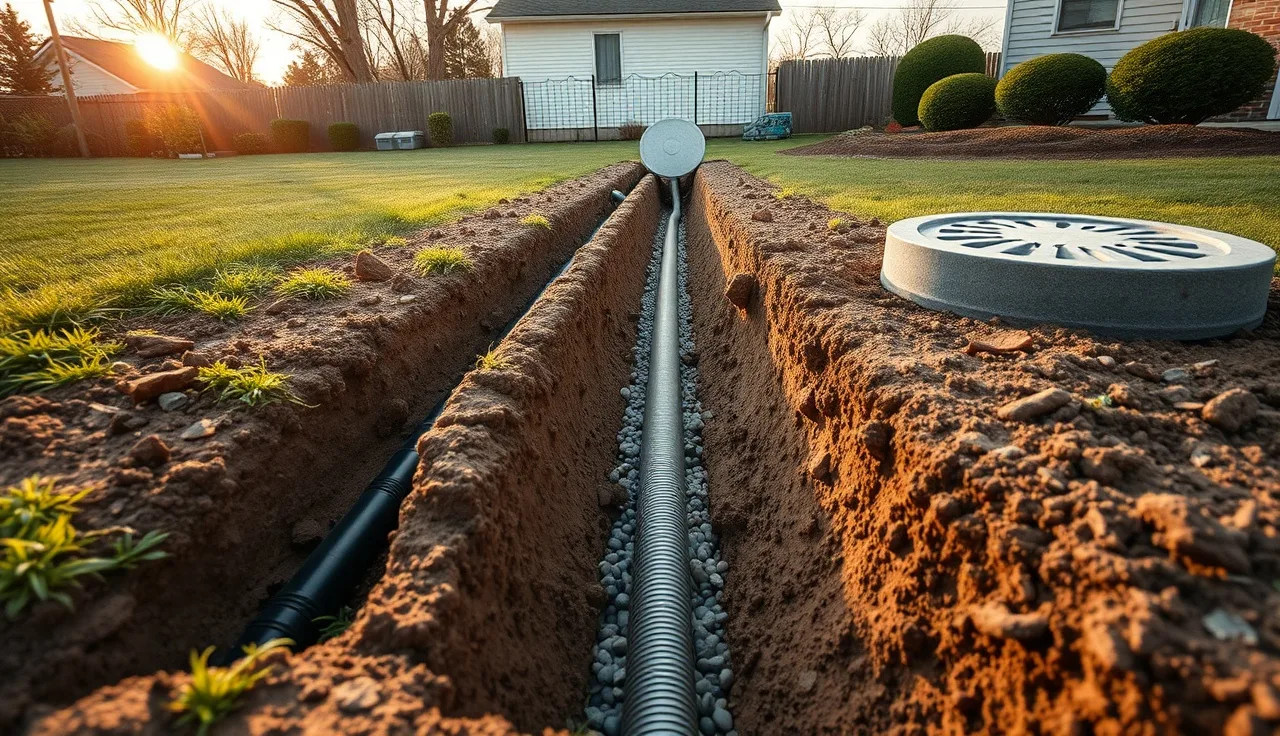
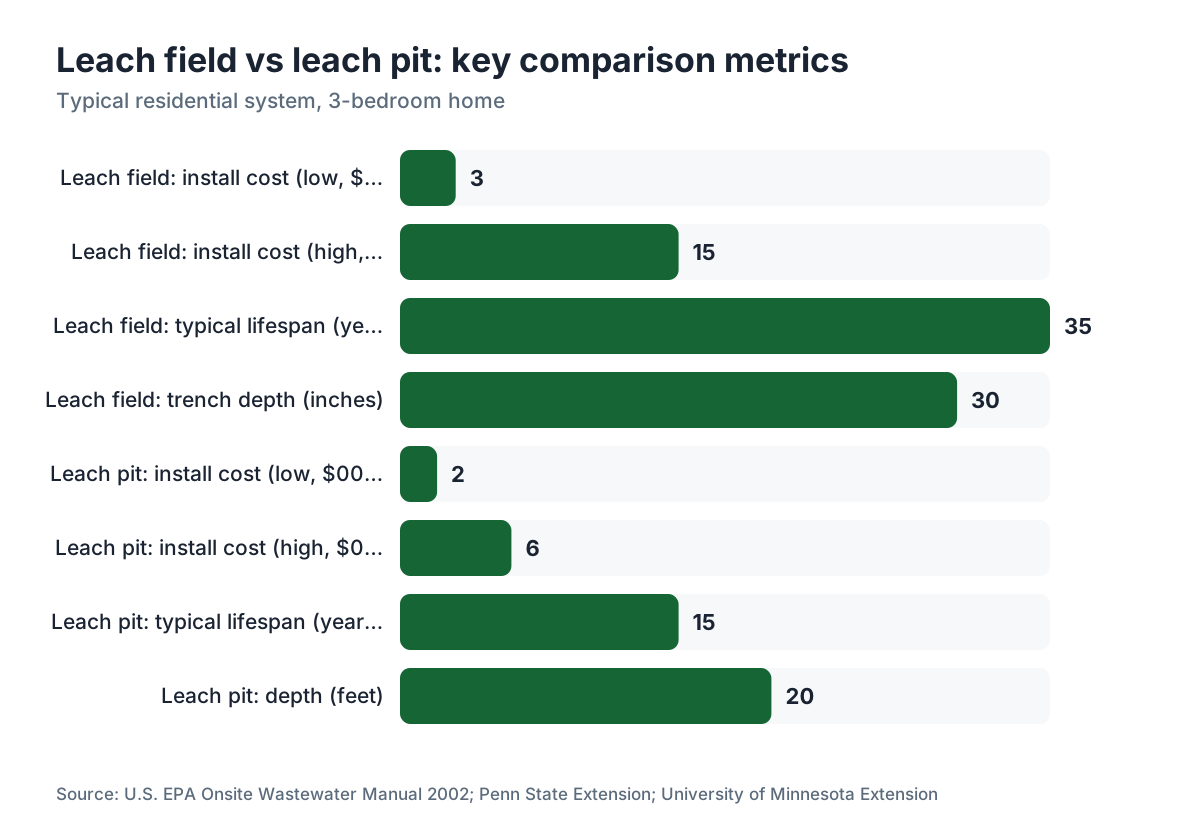
A leach field, or drain field, is the soil-treatment part of a conventional septic system. Solids settle in the septic tank. The clarified liquid effluent then flows by gravity (or pump) into a distribution box, then out through perforated pipes laid in gravel-filled trenches. Those trenches run 18 to 36 inches deep, 1 to 3 feet wide, and anywhere from 50 to several hundred feet long, depending on soil percolation rate and daily sewage flow [1].
Effluent seeps through the gravel, then through the biomat (a thin biological layer at the gravel-soil interface), and finally into native soil. The soil does the real work. Bacteria and filtration strip out pathogens and excess nutrients before the water reaches groundwater. The EPA's SepticSmart program describes the drain field as 'a shallow, covered excavation made in unsaturated soil' that 'removes or neutralizes pollutants from the liquid that emerges from the septic tank' [1].
A properly sized leach field for a three-bedroom home on decent soil can cover 3,000 to 5,000 square feet of lot area once you count the trenches and required setbacks. People rarely expect that footprint until somebody tells them they can't put a shed or a pool over it. For the full picture on what a drain field involves, see our leach field guide.
Leach fields need a minimum depth of unsaturated, permeable soil below the trench bottom before you hit a seasonal high water table or an impermeable layer. Most state codes require 2 to 4 feet of separation. That one requirement disqualifies leach fields on plenty of lots and pushes designers toward alternative systems.
What is a leach pit (seepage pit) and how is it different?
A leach pit, also called a seepage pit or cesspool-style pit, is a vertical hole in the ground. It runs 5 to 12 feet in diameter and 10 to 30 feet deep, lined with open-jointed concrete block, precast rings with holes, or loose stone [2]. Effluent from the septic tank flows in at the top, fills the pit, and seeps outward and downward through the gaps in the lining into surrounding soil.
The core difference is geometry. A field spreads effluent horizontally across a wide, shallow soil area. A pit concentrates it in a single deep point. Pits reach down to a permeable soil layer that doesn't exist near the surface, which is why builders historically used them where clay sat on top of sand or fractured rock.
That geometry has real consequences. In a leach field, the biomat forms at shallow depth where soil holds more oxygen and biological treatment runs efficiently. In a pit, effluent gets pushed deep into the earth, sometimes below the aerobic treatment zone. Pathogens and nitrates can reach groundwater with much less treatment. That's the public-health argument that got pits banned or restricted across most of the country.
A pit is also a single point of failure. When it clogs or fills with sludge, the whole system backs up. A leach field gives you multiple trenches, so you can sometimes rest one while another carries the load.
Are leach pits legal where you live?
This is the question that actually matters for most homeowners. The short answer: probably not for new construction, and increasingly not for existing systems either.
The EPA's 2002 Onsite Wastewater Treatment Systems Manual listed seepage pits among technologies with 'significant potential for groundwater contamination' and noted they 'are prohibited in many states' [2]. That guidance is more than two decades old now, and state regulators have kept moving in the same direction ever since.
California bans new seepage pits and requires permits for any modification of existing ones. Florida's Chapter 64E-6 rules prohibit seepage pits outright and require every system to use a drain field that meets setback and soil standards [6]. New York allows seepage pits in some rural upstate counties but not in coastal or Long Island groundwater-sensitive areas under its Appendix 75-A standards [7]. Texas, through TCEQ's Chapter 285, makes drain fields the standard and treats pits as a last resort that needs a special variance.
Check your county health department or state onsite wastewater program. Don't assume your neighbor's old pit is legal. Many jurisdictions grandfather existing pits but force replacement with a drain field at point of sale or when the system fails. If you're buying a home with a seepage pit, budget for a possible forced replacement.
Here's the useful shorthand: if your house went up before 1970 in a rural area, there's a real chance the 'septic system' is actually a cesspool or seepage pit with no modern tank at all.
How do the costs compare between a leach field and a leach pit?
Install costs swing so hard by region and site that any single number lies to you. But the ranges are documented.
A conventional leach field system (tank plus drain field) runs roughly $3,000 to $15,000 for a standard residential install, with most homeowners landing in the $5,000 to $9,000 range depending on soil, trench length, and local permit fees [3]. Rocky or clay soil runs up excavation cost fast. Our cost to install septic system article breaks it down by system type and region.
A seepage pit, where it's still allowed, is cheaper to install up front. A single precast concrete pit with the required septic tank ahead of it might run $2,000 to $6,000. That's the appeal that made pits popular in mid-century rural housing. Less excavation, smaller footprint, faster job.
The long-run math flips the comparison. A well-maintained leach field lasts 25 to 50 years. A seepage pit often clogs within 10 to 20 years as biomat builds up on the soil all around it (a field gives you far more surface area to absorb the load). When a pit fails, you're usually looking at a full system replacement with a drain field, which in states that mandate the upgrade runs $8,000 to $20,000 or more depending on site work.
So the honest answer: pits are cheaper on day one and more expensive over 30 years, especially if your jurisdiction forces a drain field replacement when the pit fails.
Which system requires more land, and does lot size determine your options?
Leach fields need horizontal space. A three-bedroom home producing say 300 to 450 gallons per day needs enough square footage for primary trenches plus a full-size reserve area. State codes typically require that reserve area (an undisturbed backup field) on top of the active field. Total land dedicated to the system, counting setbacks from wells, property lines, and structures, can easily hit 5,000 to 10,000 square feet or more.
Seepage pits need vertical depth instead of horizontal spread. On a small lot with barely any yard, a pit was attractive precisely because it didn't eat surface area. You dug down instead of out.
Here's the irony. The conditions that make a leach field hard to site (small lot, high water table, clay near the surface) are often the same conditions that make a seepage pit an environmental problem. Regulators noticed the pattern, which pushed the shift toward engineered alternatives: mound systems, drip irrigation systems, aerobic treatment units. Those treat effluent on smaller lots without the groundwater risk of a deep pit.
If your lot is genuinely too small or too wet for a conventional leach field, the path forward in most states is an engineered alternative, not a seepage pit. Expect higher design and install costs, but also better long-term performance and no regulatory exposure.
What are the maintenance differences between the two systems?
Both systems sit downstream of a septic tank, so regular septic tank pumping matters for both. Let solids overflow the tank and either system clogs faster. The EPA recommends pumping every 3 to 5 years for a typical household [11]. Our how often to pump septic tank guide has a size-by-household chart.
Past pumping, the maintenance stories split. A leach field in normal operation needs almost no active care. You protect it by not driving over it, not planting deep-rooted trees near it, and not drowning it in water. Most problems creep in slowly: soggy ground, slow drains, sewage odors. A septic tank inspection every two to three years can catch early field stress before it turns into failure.
A seepage pit is harder to maintain because you can't easily reach it or see inside it. When it starts to fail, the symptom looks like a failing field (sewage backup or surfacing), but your options shrink. You can sometimes rest a pit by diverting flow to a second pit, though most homes with pits only have one. Pit restoration treatments (biological additives, acidizing) have mixed real-world results at best. The honest advice for a pit owner: pump the tank religiously and accept that eventual replacement is probably in your future.
Sludge in the pit itself is one specific difference. Over the years, solids can pile up at the bottom of a seepage pit even with a working septic tank ahead of it. Some pit cleanouts need a vacuum truck to pull that material out of the pit, more than the tank. That service isn't available everywhere, and prices vary.
What are the signs that either system is failing?
Failure signs look similar for both, but the causes and fixes differ.
For a leach field: soggy or spongy ground over the trenches is the classic tell. You might see lush, dark-green grass over the trenches even in a dry spell (effluent acts like fertilizer). Slow drains inside, gurgling toilets, and sewage odors near the field all point to a stressed or failing system. If several drains crawl at once, the problem is almost certainly downstream of the tank.
For a seepage pit: the same indoor symptoms (slow drains, backup), but usually no visible wet spot above ground because the pit sits deep. Pit failures often show first as a sewage smell near the access riser or, in bad cases, a depression or sinkhole as the pit walls shift.
Both systems can fail from hydraulic overload (too much water going in), physical clogging (biomat buildup or solids overflow from an unpumped tank), tree root intrusion, or structural collapse. Drain fields are more repairable. You might rest failing trenches, add new trench capacity, or install a repair solution. Our septic system repair and septic tank repair articles cover the repair side in detail.
Failed pits generally can't be repaired the same way. Replacing the pit with a compliant drain field is usually the required outcome, and it's often the most expensive septic bill a homeowner ever sees.
Is a cesspool the same as a leach pit?
Not exactly, but everyday language tangles the two.
A true cesspool is a pit that catches raw sewage directly, with no septic tank upstream. It holds solids and liquids together and lets liquid seep out through the walls. There's no treatment step before the waste hits soil. Cesspools were common before modern plumbing codes and are now illegal for new construction in all 50 states. The EPA estimates roughly 20 million cesspools were installed historically in the U.S., and many are still in use [4].
A seepage pit (leach pit) in modern terms means a pit that takes pre-treated effluent from a septic tank. The tank handles solids separation. The pit handles soil dispersal. It's a two-component system, just like a drain field system, but with a pit instead of trenches.
Older properties often have something that fits neither definition cleanly. A home built in 1940 might have a large underground pit that started as a cesspool and later got a tank added upstream, or it might still be running as a pure cesspool with nobody the wiser. If you have an older property and don't know what's underground, a septic tank inspection by a licensed inspector is the only way to be sure.
Can you convert a leach pit to a leach field?
Yes, and many jurisdictions require exactly that when your pit fails or when you sell. The conversion is a full system retrofit. The old pit gets decommissioned (filled with pea gravel or concrete per local code), a new or existing septic tank connects to a new drain field, and the whole thing gets permitted and inspected.
A full retrofit (drain field design, permitting, excavation, pipe and gravel, inspection) typically runs $6,000 to $20,000. Sites with tough soil, high water tables, or tight space for the field push to the high end or need engineered alternatives that cost even more.
Some homeowners ask whether they can just add a drain field next to the existing pit instead of abandoning it. A few jurisdictions allow this with a properly engineered design, but most require the pit to go out of service because it creates an unregulated pathway to groundwater. Check with your local health department before you assume any hybrid approach will fly.
The permitting process for a conversion is basically the same as for a new septic tank installation. You'll need a site evaluation (perc test and soil log), a design by a licensed engineer or designer, a permit, and a final inspection. If you're replacing an aging tank at the same time, coordinate the septic tank pump out and any septic tank cleaning before decommissioning, and get quotes for the full scope together.
How do you know which system you already have?
The most reliable move is to track down the records. Septic permits get filed with the county health department or environmental agency, often going back decades. Most counties have digitized at least some of them, and a records request usually costs under $25. The permit or as-built drawing shows the system type, tank size, and field or pit location.
If records are missing or incomplete, a licensed inspector can usually identify the system type during an inspection. They'll locate the tank, check the outlet side, and figure out whether effluent flows into distribution boxes with laterals (leach field) or into a single large structure (pit or cesspool). Ground-penetrating radar and dye testing are tools some inspectors use when the outlet side is hard to reach.
Surface clues help sometimes, but they're unreliable. A single round depression or access riser away from the tank might mean a pit. A line of parallel risers or a rectangular pattern of depressions usually points to a field. Surface features shift over decades and can actively mislead you, so don't lean on them alone.
Operators tracking system types across many properties, permit records, and service histories can use tools like SepticMind, which lets service companies log system data by address and flag properties with older or non-compliant setups. That's the kind of data that pays off when a customer calls asking whether their aging pit is due for replacement.
For a homeowner who isn't sure what's in the ground, the septic tank inspection is the right first step. An inspector who sees a lot of these locally will recognize the configuration fast.
What does state and federal guidance actually say about seepage pits?
Federal guidance doesn't bind homeowners directly, but the EPA's position shapes what states allow and fund. The EPA's 2002 Onsite Wastewater Treatment Systems Manual, still the most cited federal reference for state regulators, states that seepage pits 'have significant potential for groundwater contamination' and that 'they are prohibited in many states' [2]. The agency's SepticSmart initiative treats a conventional drain field fed by a working tank as the baseline standard for onsite treatment [1].
At the state level, rules vary but the trend runs one way. A 2019 review of state onsite wastewater codes by the Water Research Foundation found seepage pits prohibited for new construction in at least 32 states, with several more limiting them to specific soil or population-density conditions [5]. States that still technically allow pits usually pile on conditions (minimum depth to groundwater, setbacks from wells and water bodies) that rule them out on most parcels anyway.
For operators and engineers, the citations that count are always the state-specific code chapters: California's seepage pit rules, Florida Chapter 64E-6, New York Appendix 75-A, Texas TCEQ Chapter 285, and so on. These define the permissible system types, soil requirements, and setback tables that govern real projects. Federal guidance is a useful benchmark. State code is what gets you a permit or a stop-work order.
Anyone dealing with a possible code issue around an existing pit should talk to a licensed designer or engineer before assuming the system is grandfathered. Grandfathering has limits, and it often evaporates at point of sale or when the system shows observable failure.
Frequently asked questions
Is a leach pit the same as a septic system?
A leach pit is one part of a septic system, not the whole thing. A complete system includes a septic tank (which separates solids from liquid) and a soil dispersal component, either a drain field or a seepage pit. A bare pit taking raw sewage with no tank upstream is technically a cesspool, not a septic system, and it's been illegal for new construction in all 50 states for decades.
Can a leach pit be used in any soil type?
No. Pits were historically built where clay sat near the surface but permeable sand, gravel, or fractured rock lay below. They don't work in uniformly tight clay because effluent has nowhere to go. They're also risky in very coarse sandy soil, where groundwater contamination risk peaks. Modern codes require soil evaluations before approving any system, and pits fail those evaluations more often than drain fields.
How long does a leach field last compared to a leach pit?
A well-designed, well-maintained leach field lasts 25 to 50 years. A seepage pit typically clogs or fails in 10 to 20 years because the surrounding soil surface area is much smaller and the biomat has less room to stabilize. Regular septic tank pumping extends both, but a pit's geometry means it reaches failure faster no matter how carefully you maintain the tank upstream of it.
What happens when a seepage pit fails?
When a seepage pit fails, sewage backs up into the house or surfaces near the pit. Unlike a drain field, you can't easily add capacity or rest sections of a failed pit. Most jurisdictions require a failed pit to be decommissioned and replaced with a code-compliant drain field or engineered alternative. That replacement typically costs $6,000 to $20,000 and needs new permits, a soil evaluation, and a licensed contractor.
Are leach pits banned in all states?
No, but they're prohibited for new construction in at least 32 states as of the most recent systematic review of state codes. States including California, Florida, and New Jersey ban them outright. Others allow them under narrow conditions (specific soil type, minimum groundwater separation, rural areas only). Even where existing pits are grandfathered, many states require replacement with a drain field when the system fails or the property sells.
How do I find out if my home has a leach field or a leach pit?
Start with a records request to your county health or environmental department. Septic permits and as-built drawings on file will identify the system type. If records are missing, hire a licensed septic inspector to locate and identify the system. They can trace the outlet piping from the tank to see whether it leads to distribution boxes with lateral pipes (field) or a single large pit. Don't rely on surface appearances alone.
Can I add a leach field to an existing seepage pit system?
In some jurisdictions, yes, but most require you to decommission the pit rather than run both at once. The concern is that an active pit left in place creates an unregulated disposal pathway even if the new field handles most of the flow. Check with your local health department before you design anything. If you can add a field alongside a pit, you'll still need full permitting, a soil evaluation, and licensed design and installation.
Does a leach field smell more or less than a leach pit?
A properly working leach field should produce no noticeable odor at the surface. If you smell sewage over the field, it usually signals hydraulic overload or a failing biomat. A seepage pit, being a deeper concentrated structure, can throw stronger odors near the access riser, especially in warm weather. Neither system should smell strongly under normal operation. Persistent odors from either one warrant a professional inspection.
Does the type of soil affect whether I need a leach field or leach pit?
Soil permeability is the main driver. Leach fields need soil that accepts effluent at a rate matching daily flow, determined by a percolation test. Sandy soil accepts water quickly; clay accepts it slowly or not at all. Seepage pits were used where surface soil was tight but deep soil was permeable. Today, when surface soil is too tight for a standard field, regulators usually require an engineered alternative rather than a deep pit.
How deep is a leach field compared to a leach pit?
Leach field trenches run 18 to 36 inches deep, with the pipe near the top of the trench and gravel below it. The key factor is 2 to 4 feet of unsaturated soil between the trench bottom and the seasonal high water table, depending on state code. Seepage pits go far deeper, commonly 10 to 30 feet, reaching a permeable layer below the surface. That depth gap is central to the groundwater contamination concern with pits.
What does a seepage pit inspection look like?
Inspecting a seepage pit is harder than inspecting a drain field because you can't easily see underground. An inspector locates the pit access, measures liquid levels, and checks for sludge buildup. They may run a probe or camera to assess the pit walls and the soil interface. Failure signs include effluent at or near the pit lid, sludge near the inlet, and collapse or shifting of the pit lining.
Is a leach pit cheaper to pump than a septic tank?
Pumping the septic tank ahead of a pit system costs the same as pumping any septic tank, roughly $250 to $600 depending on size and region. If the pit itself has built up sludge, pumping it needs a vacuum truck that can reach its depth, and that service costs more and isn't available everywhere. Factor in possible pit-pumping costs when you compare the total maintenance cost of a pit system versus a conventional drain field.
Can tree roots damage a leach field or leach pit differently?
Yes. Leach field laterals are shallow perforated pipes, and tree roots are a well-documented cause of clogging and pipe breakage. Willows, maples, and other aggressive-rooting trees should go well away from any field. Seepage pits are less exposed to root intrusion because they sit deep and the lining blocks most roots, but roots can still enter through joints and eventually displace pit walls. Keeping trees away from both system types is standard guidance.
Sources
- U.S. EPA, SepticSmart: How Your Septic System Works: The EPA describes the drain field as 'a shallow, covered excavation made in unsaturated soil' that 'removes or neutralizes pollutants from the liquid that emerges from the septic tank.'
- U.S. EPA, Onsite Wastewater Treatment Systems Manual (EPA/625/R-00/008), 2002: The EPA manual identifies seepage pits as having 'significant potential for groundwater contamination' and notes they 'are prohibited in many states.'
- University of Minnesota Extension, Onsite Sewage Treatment Program: Conventional septic system installation costs range roughly $3,000 to $15,000 for residential installs depending on soil conditions, system type, and local permit requirements.
- U.S. EPA, Cesspools: Basic Information: The EPA estimates roughly 20 million cesspools were historically installed in the United States.
- Water Research Foundation, Review of State Onsite Wastewater Treatment Regulations, 2019: A 2019 Water Research Foundation review found seepage pits prohibited for new construction in at least 32 states.
- Florida Department of Health, Chapter 64E-6: Standards for Onsite Sewage Treatment and Disposal Systems: Florida Chapter 64E-6 prohibits seepage pits and requires drain fields meeting state setback and soil standards.
- New York State Department of Health, Appendix 75-A: Wastewater Treatment Standards, Residential Onsite Systems: New York's Appendix 75-A standards restrict seepage pits in coastal and groundwater-sensitive areas while allowing them in some rural upstate locations.
- Texas Commission on Environmental Quality (TCEQ), Chapter 285: On-Site Sewage Facilities: TCEQ Chapter 285 designates drain fields as the standard soil dispersal system and treats pits as a last resort requiring special variance.
- California State Water Resources Control Board, Onsite Wastewater Treatment Systems (OWTS) Policy: California's OWTS policy and local codes ban new seepage pits and require permits for modifications to existing ones.
- Penn State Extension, Onsite Wastewater (Septic) System Resources: Conventional drain fields properly maintained can last 25 to 50 years; seepage pits typically fail within 10 to 20 years due to limited soil contact area and biomat accumulation.
- U.S. EPA SepticSmart, Caring for Your Septic System: The EPA recommends pumping a septic tank every 3 to 5 years for a typical household to prevent solids from overflowing into the drain field or pit.
Last updated 2026-07-09