Aerobic vs anaerobic septic systems: what's the real difference
By the SepticMind Editorial Team
TL;DR
- Anaerobic (conventional) septic systems use bacteria that work without oxygen to partly treat wastewater before it disperses into a drain field.
- Aerobic treatment units (ATUs) pump air into the tank, feeding faster aerobic bacteria that produce effluent clean enough to reuse for irrigation in some states.
- ATUs cost roughly twice as much to install and need monthly or quarterly maintenance contracts.
- But they work on lots that would fail a perc test for a conventional system.
What is an anaerobic septic system and how does it work?
An anaerobic septic system is what most people mean when they say "septic tank." Roughly 21 million U.S. homes use one, according to EPA data [1]. Anaerobic just means "without oxygen," and that's exactly the environment inside a conventional tank: sealed, dark, no air.
Wastewater from the house flows into the tank, usually a buried concrete or fiberglass vessel holding 1,000 to 1,500 gallons for a typical three-bedroom home. Inside, anaerobic bacteria break down solids. Heavy material sinks into a sludge layer at the bottom. Fats, oils, and lighter solids float up into a scum layer on top. The clarified liquid in the middle, called effluent, flows out through an outlet baffle toward the drain field.
Those bacteria are slow. They also don't finish the job. The effluent leaving a conventional tank still carries pathogens, nutrients (especially nitrogen), and biological oxygen demand (BOD). That's why the drain field, sometimes called a leach field, matters so much: soil microbes and filtration do the final polishing. If the soil can handle it, the system runs well for decades.
The big constraint is soil. Your lot needs permeable soil within a few feet of the surface, the water table has to stay low enough, and local setbacks from wells, property lines, and surface water have to be met. If your soil is too tight, too shallow, or too wet, a conventional anaerobic system either fails or can't be permitted in the first place [2].
What is an aerobic septic system and how does it work?
An aerobic treatment unit (ATU) does something a conventional tank never does: it pumps air into the wastewater, creating an oxygen-rich environment where aerobic bacteria thrive. Those bacteria are far more aggressive than their anaerobic cousins. They eat organic matter faster and more completely, and the effluent they leave behind is dramatically cleaner than what a conventional tank produces.
Most ATUs have three chambers. Wastewater enters a pretreatment or trash tank first, where large solids settle out. It moves into the aeration chamber, where a compressor bubbles oxygen through the liquid continuously, around the clock. After aeration, the effluent flows into a clarifier or settling zone, where remaining suspended solids drop out. Many systems add a fourth stage for disinfection: a chlorine tablet dispenser, ultraviolet light, or, in some states, spray heads that apply treated effluent to a surface drip or spray field.
The Texas Commission on Environmental Quality (TCEQ) regulates one of the largest ATU markets in the country. It requires certified ATUs to produce effluent with BOD and total suspended solids (TSS) both below 25 mg/L in standard treatment, or below 5 mg/L for systems permitted with surface irrigation [3]. Conventional septic effluent typically runs 150 to 250 mg/L BOD before soil treatment [4].
That ten-to-fifty-fold cut in contaminant load is the whole point of an ATU. The dispersal field doesn't have to work as hard, which is what lets you put a system on a smaller lot, poorer soil, or a site with a higher water table than a conventional system could ever handle.
What is the difference between aerobic and anaerobic septic systems side by side?
The table below puts the main variables in one place. Numbers come from EPA guidance, state regulatory standards, and published cost surveys.
| Feature | Anaerobic (conventional) | Aerobic (ATU) |
|---|---|---|
| Oxygen environment | No oxygen | Continuous aeration |
| Effluent BOD (before soil) | 150 to 250 mg/L | 10 to 30 mg/L (standard); <5 mg/L (advanced) |
| Typical install cost | $3,000, $7,000 [5] | $10,000, $20,000 [5] |
| Moving parts | None (gravity flow) | Air pump, timer, possibly UV or spray pump |
| Power required | No | Yes (air compressor runs continuously) |
| Annual electricity cost | $0 | $50, $150/yr (typical 1/2 HP compressor) |
| Maintenance contract | Usually not required | Required by most states |
| Pumping frequency | Every 3 to 5 years [6] | Every 1 to 3 years (smaller tanks fill faster) |
| Lot/soil requirements | Strict perc test needed | Works on sites that fail conventional perc |
| Disinfection | Soil only | Often includes chlorine or UV stage |
| Lifespan | 25 to 40+ years with pumping | 15 to 30 years (compressor, pump replacement needed) |
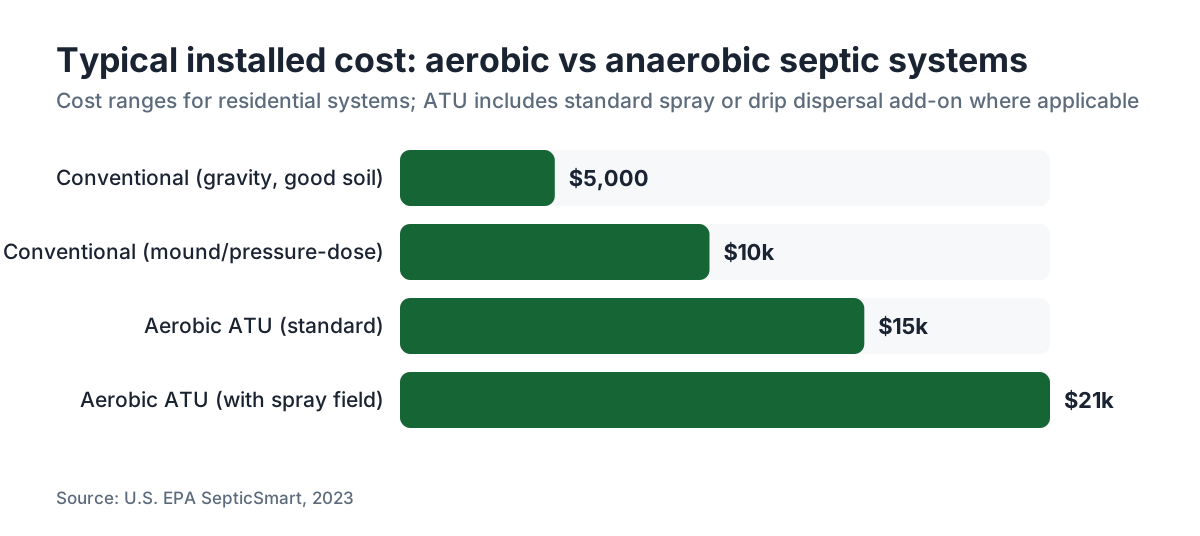
The cost difference is real and it sticks. A homeowner in rural Texas or Oklahoma who needs a system on tight clay or a small lot often spends $15,000 or more on an ATU with a spray field. A neighbor on sandy loam might put in a conventional system for $5,000. That gap doesn't shrink over time, because ATUs also carry ongoing maintenance costs that conventional systems never touch.
Which system treats wastewater better?
On pure water quality, ATUs win. The effluent from a properly running aerobic system is closer to treated municipal wastewater than to what a conventional tank puts out. Some high-end ATUs get near drinking-water clarity before the effluent ever reaches soil.
But "better treatment" doesn't automatically mean "better for your property." A conventional system, sited right and pumped on schedule, protects groundwater well because the soil does the final treatment. EPA's SepticSmart guidance notes that "properly designed, installed, and maintained" conventional systems "can provide long-term, effective treatment of household wastewater" [1]. The soil step removes pathogens and nitrogen that even a good ATU leaves behind in trace amounts.
Where ATUs clearly pull ahead: nitrogen reduction. Some designs, especially those with recirculating textile filters or separate anoxic chambers, hit biological nitrogen removal, cutting total nitrogen from the typical 40 to 60 mg/L in raw septic effluent down under 10 mg/L. That matters near sensitive water bodies, estuaries, or in states like Florida and Maryland with nitrogen-loading limits for onsite systems [7].
Here's the honest answer. A well-maintained conventional system on the right soil is not a worse choice than an ATU. It's a different tool. If your soil and lot qualify, a conventional system is more reliable over 30 years because nothing mechanical can break. ATUs need active management. When the air pump dies and nobody notices for three months, the aerobic bacteria die too, and you get untreated sewage headed for your dispersal field.
What does an aerobic septic system cost compared to a conventional one?
Install costs swing hard by region, lot conditions, and local permit requirements, so treat every number here as a range, not a quote.
Conventional anaerobic systems typically run $3,000 to $7,000 for a standard gravity-flow system on a lot that perc tests well. Complex sites with mound systems or pressure-dosed fields can push that past $12,000. The full breakdown is in our guide to the cost to install a septic system.
Aerobic treatment units start around $10,000 and commonly land between $12,000 and $20,000 installed [5]. In states that require a spray field or drip dispersal system to go with the ATU (Texas, Oklahoma, and parts of the Southeast often do), add $3,000 to $8,000 for the pump, spray heads, and controls.
Ongoing costs widen the gap further. Most state rules require ATU owners to carry a maintenance contract with a licensed service provider. In Texas, TCEQ rules require inspection at minimum every four months [3]. Those contracts typically run $150 to $400 per year. The air compressor or blower needs replacement every 5 to 10 years at $300 to $800 in parts, plus labor. Chlorine tablet dispensers need refilling every 1 to 3 months. And the system still needs septic tank pumping every 1 to 3 years, because the trash tank and clarifier keep gathering sludge.
Over 20 years, the total cost of ownership for an ATU can easily run $8,000 to $15,000 more than a conventional system on the same property. That's no reason to avoid an ATU when you genuinely need one. It's a strong reason not to choose one when a conventional system would work fine.
When does a homeowner actually need an aerobic system?
Short answer: when your lot can't support a conventional system, or when local rules demand higher-quality effluent.
You'll usually land on an ATU for one or more of these specific reasons.
Failed perc test. If your soil absorbs water too slowly (a perc rate slower than roughly 60 to 120 minutes per inch, depending on state tables), a conventional drain field won't work. ATU effluent loads the soil at much lower pollutant concentrations, which allows smaller or less-permeable fields.
High water table. USDA extension guidance and most state codes require a minimum separation between the bottom of a drain field and the seasonal high water table, often 2 to 4 feet [8]. If your site can't meet that, a conventional system is out. Some ATU designs, especially drip irrigation, work in tighter vertical spaces.
Small lot size. Setback rules eat usable area fast on small rural lots. ATU effluent quality often earns credit for reduced setback distances under state rules, which can make an otherwise impossible site work.
Environmentally sensitive areas. Near lakes, shellfish beds, or in designated nitrogen-sensitive watersheds, regulators may require treatment beyond what a conventional system provides. Florida's rules for certain springs-protection areas and the Chesapeake Bay watershed states are examples [7].
Replacing a failed conventional system on a tight lot. If your old system fails and you don't have room for a new drain field, an ATU often becomes the practical alternative. A septic system repair specialist can tell you whether your situation calls for it.
If none of those apply to your property, an ATU is almost certainly the pricier and more fragile option. I'd stick with conventional.
What maintenance does each system require?
This is where the real difference shows up, day to day.
A conventional anaerobic system, assuming it's designed and installed right, asks almost nothing of you on a regular basis. The main task is septic tank pumping every 3 to 5 years on average, though that shifts with household size and tank volume. EPA recommends most households have the tank inspected at least every three years [1]. Some systems with mechanical parts (pump chambers for pressure-dosed fields) need annual inspection of floats and pumps, but the tank itself is passive. You also protect it by watching what goes down the drain: no wipes, no grease, no garbage disposal overload, no floods of bleach or antibacterials that kill the working bacteria.
An ATU is a different animal. The air pump runs 24 hours a day, 7 days a week, and it needs periodic inspection and eventual replacement. The disinfection stage needs regular service: chlorine tablets restocked every 4 to 12 weeks depending on usage and tablet size, and UV lamps replaced after their rated service life of about 9,000 to 13,000 hours (roughly one to one-and-a-half years). Spray heads clog and need cleaning. Alarm systems (most ATUs have audible and visual alarms for pump failure or high water) need periodic testing.
Plenty of ATU owners learn the hard way that skipping the maintenance contract is a false economy. When a compressor fails silently, the aerobic bacteria in the aeration chamber die within hours to days. After that, the system reverts to something like an anaerobic process, but with no soil treatment zone built to handle that effluent quality. By the time you notice a smell or a soggy yard, you may be staring at a septic tank repair bill or worse.
Operators managing multiple ATU accounts can track maintenance schedules, inspection results, and permit deadlines in one place. Software like SepticMind was built for that recurring-service workflow, where missing a quarterly visit carries real regulatory consequences.
For a closer look at cleaning intervals, see how often to pump a septic tank and septic tank cleaning.
Are aerobic septic systems better for the environment?
Partly. The honest answer is messier than the marketing admits.
ATUs do produce cleaner effluent before it reaches the soil, and where the soil can't treat wastewater well on its own, that matters for groundwater and surface water. EPA's Office of Water notes that onsite systems are a significant source of groundwater contamination in areas where they're poorly sited or maintained [4]. An ATU on a tight-soil lot genuinely lowers that risk compared to a malfunctioning conventional system.
Nitrogen is the clearest environmental win for advanced ATUs with denitrification stages. Excess nitrogen from septic systems is a documented driver of eutrophication in coastal waters. A University of Rhode Island study on Narragansett Bay estimated that septic systems contribute roughly 25% of the nitrogen entering the bay annually (URI Cooperative Extension, Onsite Wastewater Program) [9]. Advanced nitrogen-removing ATUs can cut that contribution by 50 to 80%.
There are costs on the other side of the ledger. ATUs draw electricity nonstop, which adds to your carbon footprint. They also make waste streams a conventional system doesn't: spent chlorine tablets, UV lamps for disposal, and effluent that sometimes sprays onto the surface of a yard where kids and pets play. If you use surface spray irrigation, most states require notification and care around spray events, and some restrict irrigation during rainfall.
A well-maintained conventional system on the right soil is often the more sustainable choice, purely because it has no energy input and a longer service life with fewer parts headed to a landfill.
What do state regulations say about aerobic vs anaerobic systems?
State rules vary enormously, and this is one area where you truly need to check your local code before deciding anything. What's allowed in Texas gets rejected in Vermont, and the reverse happens too.
A few patterns hold across most states.
Conventional systems are the default. Every state with an onsite wastewater program has design standards for conventional gravity-flow septic systems. If your site meets them, a conventional system is usually the first option a regulator will approve.
ATUs require extra certification. Most states require ATU models to be certified by NSF International under NSF/ANSI Standard 40 for residential systems, or Standard 245 for nitrogen-reducing systems [10]. Your installer should be able to show you the NSF listing for any ATU they propose.
Maintenance contracts are often required by law for ATUs. TCEQ rules (30 TAC Chapter 285) mandate a two-year maintenance contract at installation, plus ongoing renewal [3]. Oklahoma, Louisiana, Florida, and many other states have similar requirements. Violating them isn't just a regulatory headache. It can void your homeowner's insurance coverage for sewage-related damage.
Surface irrigation adds another layer. If your ATU disperses through spray heads or drip lines to the surface, you'll typically need a separate permit for that component and must follow setback rules from property lines, structures, and public areas. Those are often stricter than subsurface dispersal rules.
Planning a new install? The septic tank installation process at the permit stage is where you learn which system types are even on the table for your lot. Buying a home with an existing ATU? A septic tank inspection by a licensed inspector should confirm the system is on a current maintenance contract and passing its required monitoring.
Can you convert an anaerobic septic system to an aerobic one?
Sometimes. It's rarely as simple as it sounds.
Retrofitting an air pump into an existing tank to "make it aerobic" is technically possible, and some companies sell kits that claim to do exactly this. The catch is that a real ATU isn't just a tank with air bubbled through it. It's an engineered sequence of pretreatment, aeration, clarification, and disinfection chambers, each sized to residence population and daily flow. Dropping an aerator into a conventional tank doesn't create a certified ATU. It creates an aerated cesspool that won't meet any state's effluent standards and won't be legal for permitted dispersal.
Legitimate conversions usually take one of two paths. First, you replace the existing tank entirely with a certified ATU and add a new or modified dispersal field. That's effectively a new installation, and it costs like one. Second, some installers retrofit a certified aeration chamber and clarifier as add-on components in series after the existing tank. A handful of NSF-certified products are designed for this.
Before going either way, have your existing system inspected. If the conventional system works and your lot supports it, there's usually no good reason to convert. The motivations that make sense: your drain field has failed and there's no room for a new one, you want irrigation reuse capability, or local regulations now require higher effluent quality in your area. For a cost angle on either path, the cost to put in a septic tank guide covers what typical installations run by region.
How do aerobic and anaerobic systems affect what you can and can't flush?
Both system types share the same basic prohibitions, but ATUs are more sensitive to disruption.
For any septic system, the no-flush list runs: baby wipes and "flushable" wipes (they don't break down), feminine hygiene products, medications, paint, solvents, floods of bleach, and large amounts of food waste from garbage disposals. These harm the biology in both anaerobic and aerobic tanks, damage mechanical parts in ATUs, and load the drain field too early.
ATUs carry one extra vulnerability: antibacterial products. Because an aerobic system depends on a dense, thriving population of aerobic bacteria in the aeration chamber, anything that kills bacteria hits harder than in a conventional tank. In a conventional system, anaerobic bacteria are hardy and bounce back reasonably fast from an occasional bleach load or antibacterial soap. In an ATU, a serious disruption of the aeration chamber's microbes can drag down treatment for weeks. This doesn't mean you can never clean a bathroom with bleach. It means you probably shouldn't pour a full bottle down the drain on a regular basis.
Garbage disposals are also more of a problem with ATUs. The added solids load raises how often the trash tank needs pumping, and in a small ATU it can overload the design capacity outright. Many ATU manufacturers and state guidelines recommend against using a garbage disposal at all with an aerobic system.
Paper matters too. Standard single-ply toilet paper breaks down fine in both system types. Thick, quilted paper is slower to break down in any septic environment, and the clarifier in an ATU can gather paper solids faster than a conventional tank's sludge zone does.
What's the lifespan of each system type?
Conventional anaerobic systems, maintained properly, routinely last 25 to 40 years or longer. The tank itself (concrete or fiberglass) can outlast the house. The drain field is the limiting part, and it fails when the soil goes "biomat clogged": anaerobic bacteria and organic matter seal off the soil pores and cut absorption. That takes many years under normal loading, but happens faster with hydraulic overloading, excess solids (from skipped pumping), or harsh chemicals. A conventional system pumped on schedule and kept clear of grease and wipes has a realistic lifespan north of 30 years.
ATUs have shorter expected service lives for their mechanical parts. Air pumps and blowers typically last 5 to 10 years depending on quality and run time. UV lamps need replacement roughly once a year. Spray heads and drip emitters need periodic cleaning and replacement. The tanks last as long as concrete or fiberglass would, but the overall system behaves more like a car than a well: wearing parts on a known replacement cycle.
SepticMind's service data from ATU maintenance operators shows that systems getting quarterly maintenance per their permit have far fewer emergency service calls and longer component lifespans than those serviced only once a year. Consistent, documented maintenance is the single biggest predictor of ATU longevity.
Budget for a major ATU refurbishment (new compressor, replaced spray heads, new UV lamp, pump replacement) somewhere in the 10 to 15 year range. If the original install ran around $15,000, that refurbishment might cost $1,500 to $4,000. Still cheaper than a whole new system, but not free.
Frequently asked questions
Is an aerobic septic system the same as a conventional septic system?
No. A conventional septic system is anaerobic: it uses oxygen-free bacteria to partly treat wastewater before it flows to a drain field for soil treatment. An aerobic system (ATU) pumps continuous air into the tank, feeding faster aerobic bacteria that produce much cleaner effluent. They're fundamentally different processes, with different costs, maintenance requirements, and site suitability.
How much more expensive is an aerobic septic system than a conventional one?
Conventional gravity systems typically cost $3,000 to $7,000 installed on a site that perc tests well. Aerobic treatment units generally run $10,000 to $20,000, and adding a spray or drip dispersal field can push total costs past $25,000. Over 20 years, maintenance contracts, pump replacements, and more frequent tank pumping add another $8,000 to $15,000 compared to a conventional system.
Do aerobic septic systems smell more than conventional systems?
They can smell different, not necessarily worse. A properly running ATU with an active aeration chamber sometimes gives off a faint earthy or chlorine odor near the air vent or spray heads. A failing ATU, where the compressor has died, often smells like a conventional septic tank or worse, since the aeration chamber has turned anaerobic. Strong odors from either system type mean something is wrong and needs investigating promptly.
Can an aerobic septic system be used for irrigation?
Yes, and it's one of the main reasons homeowners and installers choose ATUs. Many states allow the disinfected effluent from a certified ATU to irrigate non-edible landscaping through surface spray heads or subsurface drip lines. Texas, Oklahoma, and Florida are common examples. The effluent must meet state standards (often BOD and TSS below 5 mg/L plus a coliform limit), and the irrigation system must follow setback rules for spray near structures and property lines.
What happens if the air pump fails on an aerobic septic system?
The aeration chamber loses oxygen within hours. Aerobic bacteria die or go dormant within days. The system starts behaving like an untreated anaerobic tank, with no properly designed soil treatment zone to compensate. Most ATUs have an audible or visual alarm for this, but if the alarm gets ignored or the pump degrades slowly, untreated or partly treated effluent can reach the dispersal field. That's why maintenance contracts matter: a quarterly inspection catches pump wear before failure.
How often does an aerobic septic system need to be pumped?
The pretreatment (trash) tank and clarifier in an ATU gather solids and typically need pumping every 1 to 3 years, more often than conventional tanks because the active biological process makes more settleable material. The exact interval depends on household size, tank volumes, and whether a garbage disposal is used. Some jurisdictions require pumping at every maintenance inspection; others leave it to the service provider's judgment.
Are aerobic septic systems legal everywhere in the United States?
Most states permit certified ATUs, but rules vary widely. NSF/ANSI Standard 40 certification is the most common baseline for residential ATUs. Some states restrict where ATUs can go (allowing them only where conventional systems aren't feasible), while others actively encourage them for environmental reasons. A handful of very rural counties have thin permitting infrastructure and may lack clear rules for ATU installation. Always check with your state environmental or health agency before buying or installing one.
Does an aerobic septic system use electricity?
Yes. The air compressor or blower runs continuously, 24 hours a day. A typical residential ATU compressor draws around 150 to 500 watts depending on system size. At average U.S. electricity rates (roughly $0.12 to $0.16 per kWh as of 2024), that's about $50 to $150 per year in electricity. A spray pump, UV lamp, or alarm panel adds more. This ongoing draw is part of the true total cost of ATU ownership.
Which system is better for a small lot?
Aerobic systems generally work better on small lots. ATU effluent quality is high enough that many state codes allow reduced setback distances and smaller dispersal areas than conventional systems. If your lot lacks room for a standard drain field with required setbacks to wells, property lines, and structures, an ATU with a spray or drip field is often the only permitted option. A site evaluation by a licensed engineer or soil scientist is the definitive way to know.
What is NSF/ANSI Standard 40 and why does it matter for aerobic systems?
NSF/ANSI Standard 40 is a performance certification for residential aerobic treatment units, set by NSF International, a public health standards organization. To earn the listing, an ATU must show in a six-month performance test that its effluent averages below 30 mg/L BOD and 30 mg/L TSS. Most states require any permitted ATU to carry this certification. NSF Standard 245 covers nitrogen-reducing systems with a stricter total nitrogen limit.
Can you add a garbage disposal to a home with an aerobic septic system?
Most ATU manufacturers and state guidelines recommend against it. Garbage disposals sharply increase the solids load entering the pretreatment tank, which speeds up sludge buildup, raises pumping frequency, and can overload the aeration chamber. If you already have one and use it lightly, it's unlikely to cause immediate trouble, but heavy daily use is a genuine problem for ATU sizing. When in doubt, check the specific ATU manufacturer's installation manual for their recommendation.
How do I know if my property needs an aerobic or anaerobic system?
Start with a licensed soil scientist or engineer doing a site evaluation: soil texture analysis, a percolation test, and a high-water-table check. If your site passes, a conventional anaerobic system is almost certainly right because it's simpler and cheaper. If the soil is too tight, the lot too small, the water table too high, or local regulations require higher effluent quality, an ATU becomes the practical option. Your local health or environmental department can tell you which system types are permitted where you live.
What are the signs that an aerobic septic system is failing?
Common warning signs: an audible alarm from the control panel, sewage odors near the tank or spray area, unusually wet or soggy ground around the dispersal field, gurgling drains inside the house, and spray heads that stop working or spray unevenly. A failed air compressor is one of the most common causes. If you notice any of these, call your maintenance provider right away instead of waiting for the next scheduled visit.
Sources
- U.S. EPA, SepticSmart: Septic System Overview: Roughly 21 million U.S. homes use conventional septic systems; EPA recommends inspection at least every three years and states that properly maintained systems provide long-term effective treatment.
- U.S. EPA, Onsite Wastewater Treatment Systems Manual (EPA/625/R-00/008): Conventional drain fields require permeable soil, adequate vertical separation from the water table, and meeting setback requirements; failure to meet these means a conventional system cannot be permitted.
- Texas Commission on Environmental Quality (TCEQ), 30 TAC Chapter 285, On-Site Sewage Facilities: TCEQ requires certified ATUs to produce effluent below 25 mg/L BOD and TSS for standard treatment and below 5 mg/L for surface irrigation; maintenance inspections are required at minimum every four months and a two-year maintenance contract is required at installation.
- U.S. EPA, Office of Water, Onsite Wastewater Treatment Systems and Groundwater Quality: Conventional septic effluent typically contains 150 to 250 mg/L BOD before soil treatment; onsite systems are a significant source of groundwater contamination where poorly sited or maintained.
- U.S. EPA, SepticSmart: Costs and Benefits of Onsite Systems: Conventional septic systems typically cost $3,000 to $7,000 installed; aerobic treatment units typically cost $10,000 to $20,000 installed.
- U.S. EPA, SepticSmart: Maintain Your System: EPA recommends pumping a conventional septic tank every 3 to 5 years depending on tank size and household usage.
- Florida Department of Health, Onsite Sewage Treatment and Disposal Systems: Florida and Chesapeake Bay watershed states have nitrogen-loading restrictions for onsite systems near sensitive water bodies, requiring higher treatment levels including advanced nitrogen reduction in designated areas.
- University of Rhode Island Cooperative Extension, Onsite Wastewater Program: Septic systems are estimated to contribute roughly 25% of the nitrogen entering Narragansett Bay annually.
- NSF International, NSF/ANSI 40: Residential Wastewater Treatment Systems: NSF/ANSI Standard 40 certifies residential ATUs that achieve average effluent BOD and TSS below 30 mg/L in a six-month performance test; Standard 245 covers nitrogen-reducing systems.
Last updated 2026-07-09