Amazon septic tank treatments: what actually works and what doesn't
By the SepticMind Editorial Team
TL;DR
- Most Amazon septic tank treatments contain bacteria, enzymes, or both.
- Independent research shows biological additives have little measurable benefit in a healthy system, and chemical additives can wreck a drain field.
- No additive replaces pumping every 3 to 5 years.
- If your system is failing, a shock treatment might help for a while, but get a professional inspection first.
What are Amazon septic tank treatments and how do they work?
Amazon lists hundreds of septic tank treatments, and they sort into three buckets: biological additives (live bacteria and/or enzymes), chemical additives (surfactants, solvents, or acids), and shock treatments that pack an extra-concentrated dose of bacteria.
Biological additives work, in theory, by seeding your tank with more bacteria to break down organic waste faster. The pitch sounds reasonable. A healthy tank already holds billions of anaerobic bacteria doing exactly that, so the argument is that adding more, especially after heavy antibiotic use or a bleach spill, gives the system a boost.
Enzymes get sold alongside the bacteria. They pre-digest proteins, fats, and cellulose before the bacteria finish the job. They don't reproduce, so their effect fades. You'd have to dose regularly to hold any measurable change.
Chemical additives are a different animal. Solvents like methylene chloride or 1,1,1-trichloroethane dissolve grease fast, which sounds great, until they pass through the tank and into the soil absorption field. There they can kill soil microbes and reach groundwater. The EPA warns against chemical septic additives for exactly this reason [1].
Shock treatments, the ones marketed as "best septic tank shock treatment," are usually high-CFU (colony-forming unit) biological doses, sometimes 4 to 8 billion CFU per packet versus 1 to 2 billion in a monthly product. Whether that concentration buys you real improvement is where the science gets messy.
Does the science actually support using septic tank additives?
Honest answer: mostly no, for a system that's working normally.
The most rigorous look at this is a 1997 EPA report prepared with University of Wisconsin researchers. It found no reliable scientific evidence that biological or enzyme additives work as advertised in systems that are properly designed and maintained [2]. That finding has held up. A University of Minnesota Extension review reached the same place, noting that tanks already hold the microbial communities they need to process waste, and that adding more bacteria rarely changes effluent quality [3].
There are narrow cases where a biological additive might genuinely help. If a large dose of antibiotics or a serious bleach event wiped out your tank bacteria, a biological shock can re-establish the population faster than waiting for natural recovery. Nobody has good controlled data on how much faster. The mechanism is sound; the size of the effect is a guess.
For a system that's never failed and gets pumped on schedule, you're probably wasting money. That's the view of most licensed septic engineers, and it matches the published research.
Here's where people go wrong. They treat additives as a substitute for pumping. Solids pile up in a tank no matter what you pour in. No enzyme or bacterium dissolves the inorganic fraction of sludge. EPA's SepticSmart program puts it plainly: regular pumping, usually every 3 to 5 years, is the single most important thing a homeowner can do [1].
Which ingredients should you look for (and which should you avoid)?
If you're going to buy something, here's how to read the label.
Ingredients to look for:
- Bacillus bacteria strains (B. subtilis, B. licheniformis, B. amyloliquefaciens): aerotolerant, and they survive transit and the anaerobic tank better than many other species
- High CFU counts: at least 1 billion CFU per dose for maintenance, 4 billion or more for a shock
- Lipase, protease, amylase, cellulase: the four enzyme classes that hit fats, proteins, starches, and fibrous material
- Water-soluble pods that don't add their own undigestible material to the tank
Ingredients to avoid:
- Methylene chloride, trichloroethylene, 1,1,1-trichloroethane: solvents that kill drain field bacteria and count as regulated groundwater contaminants in most states
- Alkyl benzene sulfonate surfactants: can disperse solids into the effluent and clog soil pores in the field
- Formaldehyde: an antimicrobial, which is the last thing you want in a biologically driven system
- Inorganic acids (hydrochloric, sulfuric): they dissolve organic material and corrode concrete tanks and pipes along the way
Some states ban specific additive types outright. Washington prohibits chemical additives in onsite sewage systems under WAC 246-272A [4]. Check your state's onsite wastewater code before buying anything, because a banned product can void your system permit and leave you holding liability if the drain field fails.
| Additive Type | Typical CFU/Dose | Evidence of Benefit | EPA Stance | Drain Field Risk |
|---|---|---|---|---|
| Biological (bacteria) | 1-8 billion CFU | Weak for healthy systems; possible for recovering ones | Generally acceptable [1] | Low |
| Enzyme-only | None (enzymes, not cells) | Temporary, limited | Not addressed | Low |
| Biological shock | 4-16 billion CFU | Same caveats as biological | Generally acceptable | Low |
| Organic solvent | N/A | Some grease dissolution | Not recommended [1] | High |
| Inorganic acid/base | N/A | None documented | Not recommended | High |
| Yeast-based (DIY) | Variable | Anecdotal only | Not evaluated | Low |
What are the top-selling Amazon septic treatments and how do they compare?
A few brands own Amazon's search results. Here's an honest look, without pushing any single product.
Rid-X: The most recognized name. Contains Bacillus bacteria and four enzyme types, with a monthly dose around 1 billion CFU. The brand went through class action litigation over its advertising claims, and the settlement forced it to drop language suggesting the product eliminated the need for pumping [5]. The product doesn't harm the system. It's just unlikely to move the needle in a healthy one.
Green Gobbler Septic Saver: Bacillus bacteria at an advertised 5 billion CFU per dose, in monthly pods. The high count makes it a reasonable pick if you want a periodic shock, though the case for doing that on a schedule is thin.
Cabin Obsession Septic Treatment: A high-CFU powder popular with seasonal-property owners who want to wake up a tank after winter. That use case, low-activity tanks coming back into service, is one of the more defensible reasons to use a biological product.
Walex Bio-Active: Used by some operators as a post-pump treatment. Bacillus species plus enzymes aimed at faster recovery after pumping, which is about the most rational job any biological additive has.
Zep Septic System Treatment: Bacillus bacteria and enzymes, mid-range CFU count. Nothing unusual in the formula.
None of these harm a concrete or fiberglass tank when used as directed. None replace pumping. And none carry peer-reviewed, controlled evidence that they cut pumping frequency or improve effluent quality in a system that already works.
If you want to keep your maintenance schedule straight, including pump intervals and additive use, SepticMind lets you log service history and set reminders instead of relying on memory.
What is septic shock treatment and when does it make sense?
"Septic shock treatment" or "septic tank shock" means a high-dose, single-application biological treatment meant to rebuild bacterial populations fast in a struggling or recently disrupted system. The term is borrowed from pool chemistry, where shocking a pool means hitting it with a big dose of oxidizer. The septic mechanism is completely different, but the "shock" label stuck.
So when does it actually make sense?
After a documented bacterial kill event. A big household bleach dump (cleaning out a flooded basement, say), a course of antibiotics flushed in unusually high concentration, or a disinfectant-heavy cleanup can measurably knock down tank bacteria. A shock dose 24 to 48 hours later helps recovery.
When you're opening a long-dormant system. Vacation homes, seasonal rentals, and houses that sit empty for months sometimes have slow-starting tanks. A biological shock before you move back in gives the tank a head start.
After pumping, in some operator protocols. A few pumpers add a starter dose right after a pump-out to re-seed the tank. EPA doesn't specifically recommend this, and some engineers call it unnecessary because the residual sludge left behind after pumping already holds enough active bacteria to restart. It's not harmful either way.
What shock treatment does not fix: a tank failing because of a clogged drain field, a cracked inlet baffle, a high water table, soil saturation, or root intrusion. Those are mechanical or environmental problems. No amount of bacteria un-clogs biomat or repairs a leach field that has lost its hydraulic capacity. If you're buying shock treatments hoping to dodge a septic tank repair, get an inspection first.
How often should you use a septic tank treatment?
Product labels usually say monthly. That schedule comes from marketing departments, not independent research.
The most defensible dosing plan, based on what the evidence shows, looks like this:
- Monthly biological treatments: no proven benefit for a healthy system, low risk, your money to spend
- Quarterly shock doses: a bit more rational than monthly, since you're not topping up an already-stable bacterial population every few weeks
- Post-antibiotic or post-bleach event: one shock dose, then back to normal
- After pumping: one dose to re-seed if you like, not necessary but not harmful
- After winter dormancy: one shock dose before full household use resumes
The one point everyone agrees on: no dosing schedule replaces pumping. EPA recommends pumping every 3 to 5 years for a typical household, with the interval shifting based on tank size, household size, and garbage disposal use [1]. A 1,000-gallon tank serving a family of four builds up roughly 50 to 60 gallons of settled solids a year that bacteria simply cannot digest. Our guide to how often to pump a septic tank helps you dial in your own interval.
A good rule of thumb from the Water Environment Federation: when the scum and sludge layers together fill more than a third of the tank's liquid capacity, pump it, no matter when you last did [6].
Can you make your own septic tank treatment at home?
DIY recipes never stop circulating. Most are variations on the same idea: flush a packet of active dry yeast, or mix yeast with brown sugar and warm water and pour it in. The theory is that yeast (Saccharomyces cerevisiae) makes enzymes and helps break down organic material.
Yeast does produce amylase and some protease, and it does ferment. But Saccharomyces isn't an anaerobic decomposer built for a septic environment. It competes poorly against the established anaerobic bacteria in a working tank. Penn State Extension reviewed the yeast claim and found no evidence it improves system performance [7].
Rotten tomatoes, buttermilk, and similar kitchen additions get the same result online. The biology is loose and the evidence is anecdotal.
If you're set on a cheap approach, a single dose of a basic Bacillus product from the store or Amazon is more likely to do what you want than a science-fair experiment. But even then, watching what you flush (no wipes, no grease, no harsh chemicals) does more for your system than any additive ever will.
What do state regulations say about septic additives?
Regulation varies a lot by state. There's no federal approval process for septic additives the way there is for pesticides, so EPA keeps no registered or approved list. Through the SepticSmart program, the agency's position is that biological additives are generally considered safe but of uncertain benefit, and chemical additives are not recommended [1].
Several states go further.
Washington: WAC 246-272A bans chemical additives in onsite systems and requires that any additive not harm system components or the receiving environment [4].
New Hampshire: RSA 485-A:6 and the Env-Wq 1000 rules prohibit solvents and other harmful chemicals in septic systems [8].
Wisconsin: SPS 383 (formerly Comm 83) governs onsite systems and includes language discouraging chemical additives that could affect soil permeability [9].
California: The State Water Resources Control Board's Onsite Wastewater Treatment System Policy (adopted 2012, revised 2019) approves no additive type and requires systems to meet effluent standards regardless of what products go in [10].
What that means in practice: buy a chemical-based product on Amazon, use it in a state that prohibits chemical additives, and you're technically in violation of your onsite wastewater permit. That matters when you sell the home, or when a neighbor complains and your system gets inspected. A septic tank inspection before a sale is required in many places, and an inspector may ask what products you've used.
Check your state's environmental or health department website before you put anything in your system.
What's the real cost comparison: additives vs. professional maintenance?
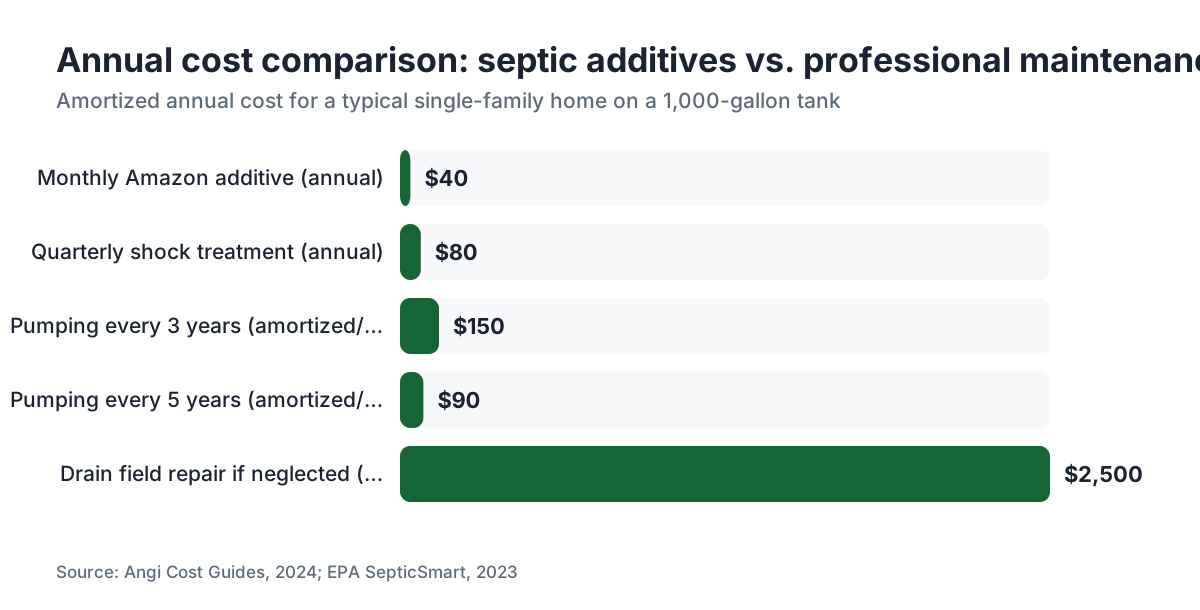
Amazon septic treatments run from about $10 for a single dose to $40 to $60 for a 12-month supply of monthly packets. A high-CFU shock product usually costs $15 to $35 per application.
Pumping costs $300 to $600 for a typical residential tank, depending on region, access, and tank size [11]. That recurs every 3 to 5 years, so call it $75 to $200 a year amortized.
Here's the math that matters. If an additive genuinely stretched your pump interval from 3 years to 4, you'd save maybe $100 to $150 in amortized pumping cost for that extra year. Against a $40-a-year additive habit, that's break-even at best, and only if the product really extends the interval. The research says it probably doesn't.
A septic tank pump out that gets put off too long is far more expensive. Sludge overflowing into the drain field can force field restoration or full replacement, which runs $5,000 to $25,000 or more depending on system type and soil conditions [12]. The cost to install a septic system from scratch can run higher still.
Spend the money on a reliable pumping schedule and annual visual checks, not on monthly additive doses. That's the consensus among professional septic engineers, and it lines up with EPA guidance.
Operators tracking customer systems, additive records, and pump schedules across a service territory will find SepticMind's operator platform handles that better than a spreadsheet.
When should you call a professional instead of buying a product?
Some signals mean no Amazon product will help. Read these, then act on them.
Sewage backing up into the house. This is a blockage or a full tank. No additive clears it. Call a pumper today. See our guide on septic tank pumping.
Slow drains throughout the house. One slow drain is probably a pipe clog. Every drain slow means the tank may be full or the inlet baffle may have failed.
Wet or soggy spots over the drain field, especially with odor. That's biomat clogging or hydraulic failure. No bacteria product reverses biomat. The field may need resting, aeration, or replacement. More on leach field trouble here.
Sewage smell outside, near the tank or field. Possible cracked tank, failed outlet baffle, or surfacing effluent. Get an inspection.
Gurgling from drains or toilets. Often a sign of a full tank or a venting problem.
You haven't pumped in more than 5 years. Skip the additive. Book a pump-out. The septic tank cleaning process gives you a baseline for your system's condition.
A septic pro can camera-inspect the baffles, probe the sludge depth, and read the drain field in 30 to 60 minutes. That information beats any bottle of bacteria. If you're at the stage of Googling "best septic tank shock treatment" because something smells wrong, the honest answer is that the problem is probably mechanical, not biological.
How to read Amazon reviews for septic products without being misled
Amazon reviews for septic products are among the least reliable in any category. Here's why.
Septic systems are invisible. A homeowner pours in a product, nothing bad happens, and credits the product. But a healthy system would have been fine anyway. That's the attribution problem behind almost all anecdotal septic reporting.
Reviews that say "my drains run faster" are almost certainly placebo or coincidence. Additives work on the tank, not the pipes. Faster drains after dosing have nothing to do with the product.
Reviews from actual operators show up occasionally and tend to be grounded. If someone cites specific CFU counts, dosing protocols, or before-and-after sludge measurements, read that one closely.
What makes a review worth trusting:
- The reviewer confirms they had a real problem (sluggish system, post-antibiotic event) rather than dosing a healthy system for insurance
- Any mention of professional verification, like a pumper who checked sludge levels
- An acknowledgment that the product was one piece of a broader maintenance routine
What to ignore:
- "My septic hasn't needed pumping in 10 years" (you can't know your sludge level without a probe measurement)
- "I can tell it's working because there's no smell" (a healthy tank shouldn't smell anyway)
- Any before-and-after claim based on drain speed or toilet flush performance
Frequently asked questions
Do Amazon septic tank treatments actually work?
Biological additives from Amazon are generally safe and may help rebuild bacteria after a disruption like heavy antibiotic use or bleach contamination. For a normally functioning, regularly pumped system, independent research including a 1997 EPA report with University of Wisconsin researchers finds no reliable evidence they improve performance. They're not harmful, but they're probably not necessary either.
What is the best septic tank shock treatment you can buy on Amazon?
Look for at least 4 billion CFU per dose, Bacillus bacteria strains as active ingredients, and lipase, protease, amylase, and cellulase enzymes. No single product has peer-reviewed evidence of superiority. High-CFU biological products are your best bet for recovering a disrupted system. Avoid anything with chemical solvents or surfactants as active ingredients.
How often should I put septic treatment in my tank?
Labels say monthly, but that's a marketing schedule, not a scientific one. A quarterly shock dose, or a single dose after a disruption event (bleach spill, antibiotics, opening after dormancy), is more defensible. Whatever you choose, pumping every 3 to 5 years matters far more than any additive schedule.
Can septic tank treatments replace pumping?
No. Biological additives can't dissolve inorganic solids, grit, or the inorganic fraction of sludge. EPA's SepticSmart program and every professional association recommend regular pumping, typically every 3 to 5 years, as the base of septic maintenance. A class action settlement forced Rid-X to remove advertising language implying the product reduced the need for pumping.
Is it safe to use Amazon septic treatments with a new septic tank?
Yes, biological products are safe for new tanks, but they're especially unnecessary. A new tank builds its own bacterial community within the first few weeks of normal use. Dosing a high-CFU shock product at installation is harmless and adds no documented benefit. Just use the system normally and follow your state's pumping recommendations.
Are septic tank additives legal in all states?
No. Chemical additives are prohibited in some states, including Washington (WAC 246-272A) and New Hampshire (RSA 485-A:6). Biological additives are more broadly accepted but still fall under state onsite wastewater rules. Check your state's environmental or public health department website before using any product. A prohibited additive can void your system permit.
What happens if I pour too much septic treatment into my tank?
With biological products, overdosing is generally harmless. Excess bacteria and enzymes just wash out with the effluent, so you're wasting money more than causing harm. With chemical additives, overdosing can kill beneficial tank bacteria, disrupt anaerobic digestion, and push harmful chemicals into your drain field, where they damage soil permeability and reach groundwater.
Can I use a septic treatment after my system backs up?
No. A backup means the tank is full, there's a blockage, or the drain field is failing. None of those are biological problems an additive fixes. Call a licensed pumper right away. Once the mechanical issue is found and resolved, a biological shock treatment may help re-seed the tank, but only after the real problem is handled.
Does flushing yeast down the toilet help a septic tank?
The yeast trick (active dry yeast, sometimes with brown sugar) is a popular DIY move. Yeast does make some enzymes and ferments organic material. Penn State Extension reviewed the practice and found no evidence it improves system performance. Yeast competes poorly with the anaerobic bacteria already in a working tank. A commercial Bacillus product, if you want to add anything, is more likely to do what you're hoping for.
What's the difference between septic tank treatment pods and powder?
Both deliver the same biological ingredients. Pods come pre-measured and water-soluble, so dosing is simple. Powders are usually cheaper per dose and often carry higher CFU counts per dollar. The main advantage of pods is convenience and no measuring error. If CFU count per dollar matters to you, compare the label data; powder often wins.
Will septic treatment help with drain field problems?
Unlikely. Most drain field problems are mechanical or environmental: biomat clogging, soil saturation, compaction, root intrusion, or a high water table. No biological additive reverses established biomat or restores lost soil permeability. Some aeration-based field restoration methods (like Terralift or aerobic injection) have limited evidence of benefit, but those are professionally administered, not something you order on Amazon.
How much do Amazon septic treatments cost compared to professional pumping?
Monthly Amazon treatments run $10 to $60 a year depending on the product. Professional pumping costs $300 to $600 every 3 to 5 years, or roughly $75 to $200 a year amortized. The additive cost is modest, but there's no reliable evidence it stretches pump intervals. If a deferred pump-out damages the drain field, repair or replacement can hit $5,000 to $25,000, which makes regular pumping the clear cost winner.
Can septic treatments harm my tank or pipes?
Biological treatments with Bacillus bacteria and standard enzymes don't damage concrete, PVC, cast iron, or fiberglass. Chemical additives, especially organic solvents and strong acids, can corrode concrete tanks and metal components over time and are far more likely to cause harm. Read the active ingredient list before buying, and avoid anything listing solvents, acids, or surfactants.
What should I do if my septic tank smells bad even after treatment?
Persistent odor after dosing signals that the problem isn't bacterial. Likely causes include a failed outlet baffle letting solids into the drain field, a cracked tank, venting problems, or a saturated field. Schedule a professional inspection. Odor from a healthy, properly functioning system should be minimal. An additive can't fix a baffle failure or a cracked tank wall.
Sources
- U.S. EPA, SepticSmart Program: EPA recommends pumping every 3-5 years as the most important maintenance step and states chemical additives are not recommended; biological additives are generally acceptable but of uncertain benefit
- U.S. EPA, Office of Research and Development, Report on Septic Tank Additives (EPA/600/R-97/120): 1997 EPA/University of Wisconsin review found no reliable scientific evidence that biological or enzyme additives work as advertised in properly maintained systems
- Washington State Department of Health, WAC 246-272A Onsite Sewage Systems: Washington State prohibits chemical additives in onsite sewage systems and requires any additive not harm system components or the receiving environment
- Federal Trade Commission and class action settlement records regarding Rid-X advertising claims: Rid-X was required by settlement to remove advertising language suggesting the product eliminated or reduced the need for pumping
- Water Environment Federation, Residential Onsite Systems: If scum and sludge layers together occupy more than one-third of the tank's liquid capacity, pumping is needed regardless of the last service date
- Penn State Extension, Septic Systems: Penn State Extension reviewed the yeast additive claim and found no evidence it improves septic system performance
- New Hampshire Department of Environmental Services, RSA 485-A:6 and Env-Wq 1000 onsite rules: New Hampshire prohibits solvents and harmful chemicals in septic systems under RSA 485-A:6
- Wisconsin Department of Safety and Professional Services, SPS 383 Private Onsite Wastewater Treatment Systems: Wisconsin SPS 383 regulates onsite systems and discourages chemical additives that may affect soil permeability
- California State Water Resources Control Board, Onsite Wastewater Treatment System Policy (2012, revised 2019): California does not specifically approve any septic additive type and requires systems to meet effluent standards regardless of products used
- Angi, Septic Tank Pumping Cost Guide: Typical residential septic tank pumping costs $300-600 depending on region, access, and tank size
- Angi, Septic System Repair Cost Guide: Drain field restoration or replacement costs $5,000-25,000 or more depending on system type and local soil conditions
Last updated 2026-07-09