Rid-X septic tank treatment: does it actually work?
By the SepticMind Editorial Team

TL;DR
- Rid-X is a powder or liquid blend of bacteria and enzymes marketed to help break down organic waste in septic tanks.
- Independent research, including EPA guidance, shows it does not reduce the need for regular pumping and may give homeowners false confidence.
- It is not harmful in normal doses, but it is not a substitute for the maintenance your system actually needs.
What is Rid-X and what does it contain?
Rid-X is a consumer septic tank treatment sold in powder, liquid, and dissolvable pouch forms. Every formula contains two active components: bacteria cultures (primarily Bacillus strains) and a set of enzymes including cellulase, lipase, protease, and amylase. The idea is that you flush or pour the product monthly, and those microbes and enzymes reinforce the bacterial population already living in your tank.
The powder form is the product most people know. One 9.8-oz box is sized for a 1,000-gallon tank. The liquid and gel packs work the same way. The difference is convenience, not chemistry.
What those enzymes actually do, at least in theory: cellulase breaks down toilet paper and plant fiber, lipase targets fats and oils, protease handles proteins, and amylase attacks starches. These are real enzymes that perform real chemical reactions. The question the science keeps bumping into is whether adding them monthly makes a meaningful difference in a tank that already holds billions of native bacteria when it's working normally [1].
How does a septic tank actually break down waste?
A healthy septic tank is a three-layer system. Solids sink and form sludge on the bottom. Fats and grease float and form scum on top. The middle layer, called effluent, is the liquid that flows out to your leach field for further treatment in the soil.
Bacteria do most of the real work. Anaerobic bacteria in the sludge layer digest organic solids continuously. They do not eliminate sludge entirely. They slow its accumulation. Over months and years, the sludge layer still grows, and that is exactly why your tank needs to be pumped out on a regular schedule.
The EPA's SepticSmart program puts it plainly: a properly sized and loaded septic tank naturally holds enough bacteria to function without additives. The bacterial community in your tank is not the limiting factor for most systems. What limits performance is usually overloading with water, flushing non-biodegradable materials, or the normal accumulation of sludge that bacteria simply cannot digest fast enough to keep up with [2].
Understanding this is the key context for judging any additive. If your tank's native bacteria are doing their job, adding more Bacillus strains is a bit like tossing a drop of yeast into an already-fermenting barrel of beer.
Does Rid-X work? What does the research say?
This is where things get uncomfortable for the product's marketing. The short answer: independent research has not found meaningful evidence that Rid-X or similar enzyme-bacteria septic additives improve system performance or reduce pumping frequency.
The most cited independent review is a University of Rhode Island Cooperative Extension analysis of biological and chemical septic additives. The review found no controlled studies showing that biological additives extend the interval between pump-outs or prevent drain field failure [3]. State extension services in Maine, North Carolina, and Virginia, among others, have said the same.
A 2006 University of Wisconsin study evaluated multiple commercial septic additives and found that none significantly changed effluent quality or sludge accumulation rates compared to control tanks that received no additives [4]. Nobody has great long-term controlled data here. The research is limited by small sample sizes and the difficulty of controlling for household-to-household variation. But the closest studies that exist keep landing on no benefit.
Rid-X's manufacturer (Reckitt) has published its own efficacy data, which is not the same as independent peer-reviewed research. Independent researchers working without financial ties to the product keep arriving at different conclusions.
Here is the practical problem with the core claim. If Rid-X meaningfully cut sludge accumulation, you would see it in measured sludge depth over time in treated versus untreated tanks. No independent study has found that. Some extension specialists warn that homeowners who use additives faithfully sometimes skip pumping inspections because they believe their tank is being maintained. That is how you end up with a failed drain field and a repair bill that can top $10,000 [5].
Can Rid-X replace pumping your septic tank?
No. This is the single most important point in the article.
Rid-X's own label does not claim the product eliminates pumping. It says to use it "in addition to" regular pump-outs. But the marketing language around "maintaining" your tank, paired with the monthly reminder format, has led a measurable share of homeowners to treat the product as a substitute for professional service.
The EPA recommends having a septic tank inspected by a professional every three years and pumped as needed, typically every three to five years for a household of four with a 1,000-gallon tank [2]. Some state codes make that schedule mandatory. Virginia's Department of Health, for example, requires inspection of septic systems every five years under the Sewage Handling and Disposal Regulations [6].
For a sense of how pumping frequency scales with household size, see the cost section below. Here is the bottom line: septic tank pumping is the one maintenance task that actually removes the inorganic solids, non-digestible material, and accumulated sludge that enzymes cannot touch. No enzyme treatment on the market can do that. The sludge has to physically leave the tank.
If your tank is overdue for a pump-out and you start using Rid-X hoping to dodge the cost, you are betting that potential drain field damage won't cost you ten times the pump-out fee.
Is Rid-X harmful to your septic system?
Probably not, in normal doses for a conventional septic tank. That is the honest, hedged answer.
The bacteria strains in Rid-X are common Bacillus species found widely in soil and in existing septic tanks. They are not pathogens and they are not exotic organisms that would destabilize a healthy tank. The enzymes are standard industrial enzymes used in food processing and agriculture. Nothing in the formula sits on a list of substances that damage septic systems.
The scenarios where you could have a problem are edge cases. If you have a very small tank relative to your household load, adding more bacteria that consume oxygen may tip the balance in a system that is already stressed. Some advanced treatment unit (ATU) makers specify in their warranties that you should not add biological additives, because the ATU is already engineered to hold a specific microbial population. If you have an aerobic treatment unit, check the manufacturer documentation before using any additive.
For a standard anaerobic septic tank, which is what most single-family homes have, using Rid-X monthly is almost certainly harmless. The risk is not toxicity. The risk is the false sense of security that leads to skipped pump-outs and delayed septic tank inspections.
What do septic service professionals think of Rid-X?
Most licensed pumpers and inspectors quoted in trade publications are skeptical, and a fair number are bluntly dismissive. The National Association of Wastewater Technicians (NAWT) has not endorsed any biological additive as a replacement for pumping, and the National Onsite Wastewater Recycling Association (NOWRA) takes a similar position [9].
The common professional view: they have pumped thousands of tanks over decades and cannot reliably tell which ones had additives and which ones did not, based on sludge levels or effluent quality. That is anecdotal, but it matches what the independent lab research shows.
Where you find more nuanced opinions is in system recovery after a disruption. If a household has run a lot of antibacterial products or bleach through the system, or someone finished a course of antibiotics, some professionals suggest a short course of a bacterial inoculant may help re-establish the population faster. That is a specific, limited use case. It is not the same as the general monthly use the product is marketed for.
For operators managing multiple systems or running a service business, tracking which properties use additives and which ones see failures is exactly the kind of data that separates good operators from guesswork. Tools that centralize maintenance history matter here. SepticMind, for example, lets operators log additive use per property so they can see over time whether it correlates with anything measurable at pump-out.
How do you use Rid-X correctly?
If you decide to use it, here is how the product is designed to be used.
For the powder: flush one 9.8-oz container down the toilet once a month. For a tank larger than 1,000 gallons, scale up proportionally. For the liquid: pour the bottle into the toilet, then flush once. The pouches are pre-measured for a 1,000-gallon tank.
The best time to add it is right before bed, so the product sits in the tank overnight without being flushed forward by morning water use. That gives the bacteria time to establish before the next load of water pushes effluent out to the drain field.
Do not pour it into a floor drain or cleanout if you can avoid it. The toilet route sends it to the tank more reliably. And do not add it right after using drain cleaner, large amounts of bleach, or heavy-duty antibacterial products, because those will kill the bacteria you just added before they do anything.
None of this changes the pumping schedule. Use Rid-X if you want, but also schedule a pump-out on the timeline your tank size and household load require.
How much does Rid-X cost compared to a pump-out?
The math is worth laying out plainly.
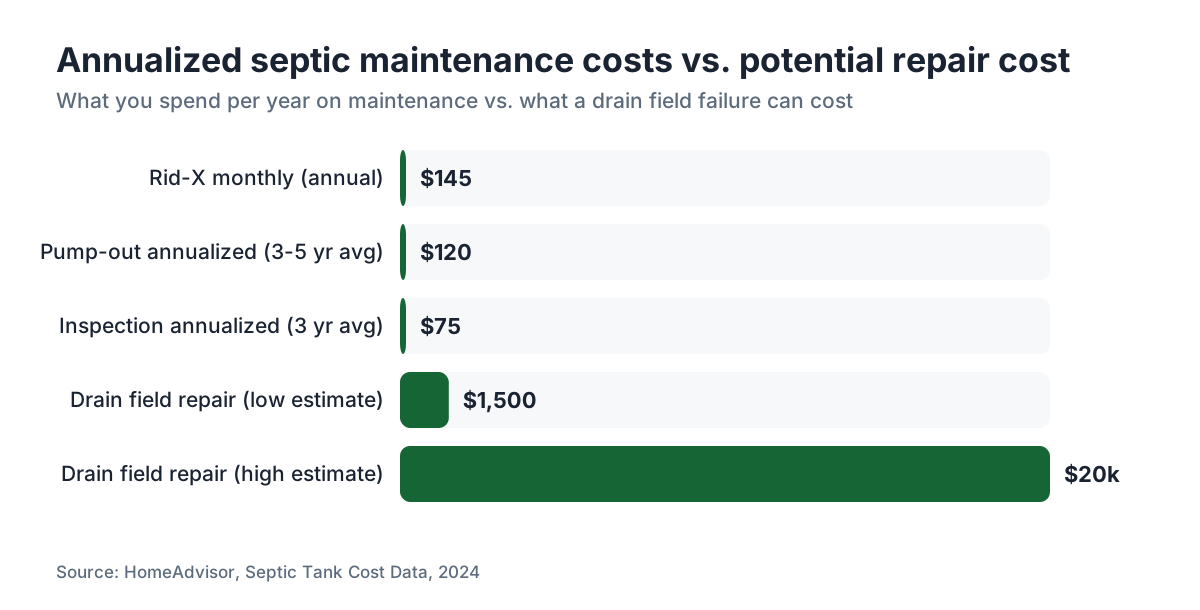
A single box of Rid-X powder (9.8 oz, a one-month supply for a 1,000-gallon tank) costs roughly $10 to $14 at major retailers as of 2025. Annual cost if used monthly: around $120 to $170.
A professional septic tank pumping costs between $250 and $600 for most residential tanks, with the national average around $400 based on HomeAdvisor survey data [5]. Pumping frequency for most households is every three to five years, so the annualized cost of pumping is roughly $80 to $200 per year.
Put another way, you spend close to the same amount per year on Rid-X as you would if you simply set that money aside toward your next pump-out, except the pump-out actually removes material from your tank.
| Item | Annual Cost Estimate | Does it remove sludge? |
|---|---|---|
| Rid-X (monthly use) | $120-$170 | No |
| Septic pump-out (every 3-5 yrs, annualized) | $80-$200 | Yes |
| Septic inspection (every 3 yrs, annualized) | $50-$100 | N/A |
| Drain field repair if system fails | $1,500-$20,000+ | N/A |
The drain field repair number is what should drive your decision. A failed leach field from neglected maintenance is not a hypothetical. It is a common and expensive outcome [5]. If monthly additive use gives you peace of mind that causes you to skip a pump-out, that peace of mind is expensive.
Are there situations where a septic enzyme treatment actually helps?
Yes, a few. These are limited and specific, not the general maintenance case.
First, a newly installed septic system. When a tank is brand new, it has no established bacterial population. Some installers and extension services suggest a one-time inoculant dose to seed the tank faster, though a tank serving a family will build its own population quickly through normal toilet use.
Second, after a long period of non-use. Vacation homes or cabins that sit empty for months may have a depleted bacterial population when the family returns for a season. A single dose of a bacterial treatment makes more sense here than as a monthly ritual.
Third, after a shock event. If someone in the household was on a long course of antibiotics, or you accidentally discharged a large amount of bleach or drain cleaner into the system, a re-inoculant dose may help restore the microbial balance faster than waiting for natural recovery.
In all three cases, the use is targeted and temporary, not the indefinite monthly program Rid-X's marketing pushes. And in all three cases, septic tank cleaning and inspection should still happen on the normal schedule.
What does the EPA say about septic additives?
The EPA's SepticSmart program is the federal reference point for homeowner guidance on septic maintenance. On additives, the EPA's position is clear: "Biological additives introduce bacteria and/or enzymes to help 'boost' or 'restore' the bacterial community in the septic tank. Commercial additives are not necessary for proper septic system function." [2]
That is a direct quote from EPA guidance, not a paraphrase. The EPA does not say additives are harmful. It says they are not necessary. That is a meaningful distinction. It means the agency is not warning you away from Rid-X the way it warns you away from, say, flushing solvents. It is simply saying the evidence does not support the product's necessity claim.
The EPA's SepticSmart program also lists what homeowners should do to protect their systems: pump regularly, conserve water, never flush non-biodegradables, and protect the drain field from heavy vehicles and deep-rooted plants [10]. Buying an additive is not on the list.
State regulations vary. A handful of states have gone further than the EPA. Massachusetts, for example, prohibits the use of any additive that is not approved by the state, and the approved list is short [8]. Utah's Division of Water Quality has issued guidance stating that biological and chemical additives have not been shown to reduce pumping frequency [7]. Check your state's onsite wastewater program before spending money on any additive, because in some states using unapproved products can affect your system's legal status.
What actually works for septic maintenance?
The evidence-based maintenance list is short and not exciting, which is maybe why people keep looking for a bottle they can buy instead.
Pump on schedule. For a household of four with a 1,000-gallon tank, that is roughly every three to five years. The exact interval depends on tank size and household habits. Use the EPA's household sizing guidance, or ask your pumper to measure sludge depth at your next service visit and use that as your calibration point. Read how often to pump your septic tank for a full breakdown by household size.
Conserve water. Every gallon you send to the tank is a gallon that pushes effluent toward the drain field. High-efficiency toilets, shorter showers, and fixing running toilets all cut hydraulic load.
Do not flush anything that is not toilet paper or human waste. Wipes (even "flushable" ones), feminine hygiene products, medications, and paper towels pile up as non-digestible solids. No enzyme will break those down.
Protect the drain field. Do not park on it, do not plant trees near it, do not direct roof runoff or sump pump discharge toward it. A healthy leach field is your system's most expensive and most vulnerable component.
Get an inspection on a regular schedule. A visual septic tank inspection by a licensed professional catches problems before they become failures. Many states require this every three to five years. Even where it is not required, it is the single best thing you can do for a system that is out of sight and easy to ignore.
Operators managing multiple systems can use software like SepticMind to track inspection dates, pump-out history, and service notes across a portfolio, which makes it much easier to catch properties falling behind schedule before a field failure turns into an emergency call.
Frequently asked questions
Does Rid-X really work or is it a waste of money?
For most homeowners with a functioning septic tank, Rid-X has not been shown to improve performance or reduce pumping frequency in independent research. It is not harmful, but it is also not doing what most buyers hope it does. Your money is better spent keeping your pump-out schedule and getting regular inspections. That said, if you want to use it after a shock event like heavy antibiotic use or a bleach spill, a single dose has some logic behind it.
How often should I use Rid-X in my septic tank?
The manufacturer recommends monthly use, one dose per 1,000 gallons of tank capacity. If you choose to use it at all, following that schedule is fine. Just do not let the monthly ritual substitute for professional pump-outs, which should happen every three to five years for a typical household. The product's own label says to use it in addition to, not instead of, regular service.
Can you use too much Rid-X?
Excess doses beyond the labeled amount are unlikely to cause harm in a standard anaerobic septic tank. The bacteria strains are benign and the enzymes are not corrosive. The main downside of overuse is cost, not system damage. If you have an aerobic treatment unit (ATU) rather than a conventional anaerobic tank, check your unit's warranty and manufacturer guidelines before adding any biological supplement.
Where do you put Rid-X in a septic tank?
Flush the powder or liquid down a toilet closest to the tank, then flush once more with water. Do not pour it down a sink or floor drain if you can avoid it, because those drain paths can dilute or slow delivery to the tank. Adding it at night, when water use is low, gives the bacteria time to establish before morning activity pushes effluent toward the drain field.
Does Rid-X prevent septic tank pumping?
No, and Rid-X's own label does not claim it does. The product may slow the rate at which some organic material builds up, but it cannot digest the inorganic solids, grit, and non-biodegradable items that make up a large share of sludge. Physical pump-out is the only way to remove that material. The EPA recommends pumping every three to five years regardless of additive use.
What is the difference between Rid-X powder and liquid?
Both contain the same active ingredients: Bacillus bacteria and a blend of enzymes including cellulase, lipase, protease, and amylase. The powder is the original format and typically the least expensive per dose. The liquid is pre-dissolved, which may make it slightly faster to disperse in the tank. The gel packs offer convenience. Choose based on preference, not chemistry, because the formulas are essentially equivalent.
Is Rid-X safe for all types of septic systems?
It is considered safe for conventional anaerobic septic tanks. For aerobic treatment units (ATUs), which use air injection to support aerobic bacteria, some manufacturers advise against biological additives because they can disrupt the engineered microbial balance. Always check your ATU's documentation. Rid-X is also generally compatible with mound systems and drip irrigation systems, since those use the same tank stage as conventional systems.
Can Rid-X help a failing septic system?
No. A failing septic system, defined by sewage backing up, wet spots over the drain field, or odors, needs professional diagnosis and likely repair or replacement. Adding a bacterial product to a failing system is not a fix. The failure modes for drain fields (biomat clogging, hydraulic overload, soil saturation) are not addressed by enzymes or bacteria. Get a professional inspection immediately. See our guide to septic system repair for what that process looks like.
What do state health departments say about septic additives?
State positions vary a lot. Massachusetts requires state approval for any additive and has a short approved list. Utah's Division of Water Quality has issued guidance saying biological additives have not been shown to reduce pumping frequency. Most states follow the EPA's neutral position: not prohibited, not endorsed, not a substitute for maintenance. A handful of states have considered or enacted restrictions. Check your state's onsite wastewater program for the current rule.
Are enzyme-based septic treatments better than chemical ones?
Yes, enzyme and bacterial treatments are considerably safer for your septic system than chemical additives. Chemical additives, particularly those containing solvents or strong acids, can kill beneficial bacteria, damage tank infrastructure, and contaminate groundwater. Enzyme and bacterial products like Rid-X are benign even if they offer limited benefit. If you are choosing between a chemical and a biological additive, the biological option is the clear choice.
How long does it take for Rid-X to work?
The bacteria in Rid-X need time to establish and begin producing enzymes at meaningful concentrations. The manufacturer suggests allowing 24 to 48 hours of minimal water use after dosing to give the bacteria time to settle and multiply. Practically speaking, any effect on sludge accumulation would take weeks to months of consistent use to show up, and independent studies have not detected that effect even over longer periods.
What happens if you never add any additives to your septic tank?
Nothing bad, assuming your system is correctly sized, loaded within normal limits, and pumped on schedule. A properly functioning septic tank develops its own strong bacterial population through normal use. The EPA's guidance is explicit that additives are not necessary for a septic tank to function correctly. Millions of systems run their entire service life without a single dose of any additive.
Is Rid-X the same as other septic tank enzyme treatments?
The formula is similar to competing products like Bio-Clean, Septic-Drene, and dozens of store-brand options. Most use the same Bacillus strains and the same four or five enzyme classes. The independent research finding no measurable benefit applies broadly to this category of products, more than to Rid-X specifically. Brand differences are primarily marketing, price, and packaging.
Sources
- EPA SepticSmart: Homeowner's Guide to Septic Systems: EPA guidance that a properly functioning septic tank naturally contains sufficient bacteria to operate without additives
- EPA SepticSmart: Homeowner's Guide to Septic Systems: Direct EPA quote: 'Biological additives introduce bacteria and/or enzymes to help boost or restore the bacterial community in the septic tank. Commercial additives are not necessary for proper septic system function.' Also recommends pumping every 3-5 years.
- University of Rhode Island Cooperative Extension: URI Cooperative Extension review of biological and chemical septic additives found no controlled studies showing additives extend pump-out intervals or prevent drain field failure
- University of Wisconsin Extension, Onsite Wastewater Treatment Program: 2006 evaluation of commercial septic additives found none significantly altered effluent quality or sludge accumulation rates compared to control tanks
- HomeAdvisor, Septic Tank Pumping Cost Guide: National average septic tank pump-out cost of approximately $400, range $250-$600; drain field repair costs $1,500-$20,000+
- Virginia Department of Health, Sewage Handling and Disposal Regulations: Virginia requires septic system inspection every five years under state onsite wastewater regulations
- Utah Division of Water Quality, Onsite Wastewater Systems: Utah guidance states biological and chemical additives have not been shown to reduce pumping frequency
- Massachusetts Title 5 Septic Regulations, 310 CMR 15.000: Massachusetts requires state approval for any septic additive and maintains a short approved list
- National Onsite Wastewater Recycling Association (NOWRA): NOWRA does not endorse biological additives as a substitute for professional pumping and inspection
- EPA SepticSmart, What Not to Flush: EPA lists proper maintenance actions for septic homeowners; buying additives is not on the list
- North Carolina State Extension, Septic System Owner's Guide: NC Extension echoes that biological additives have not been demonstrated to reduce pumping needs in independent research
Last updated 2026-07-09