Residential septic tank pumping: the complete homeowner guide
By the SepticMind Editorial Team
TL;DR
- Most households pump their septic tank every 3 to 5 years.
- A standard pump-out costs $250 to $600, depending on tank size and where you live.
- Skip it too long and solids overflow into the drain field, which costs $5,000 to $30,000 to replace.
- Pumping on schedule is the cheapest thing you can do to protect the whole system.
What actually happens during a septic tank pump-out?
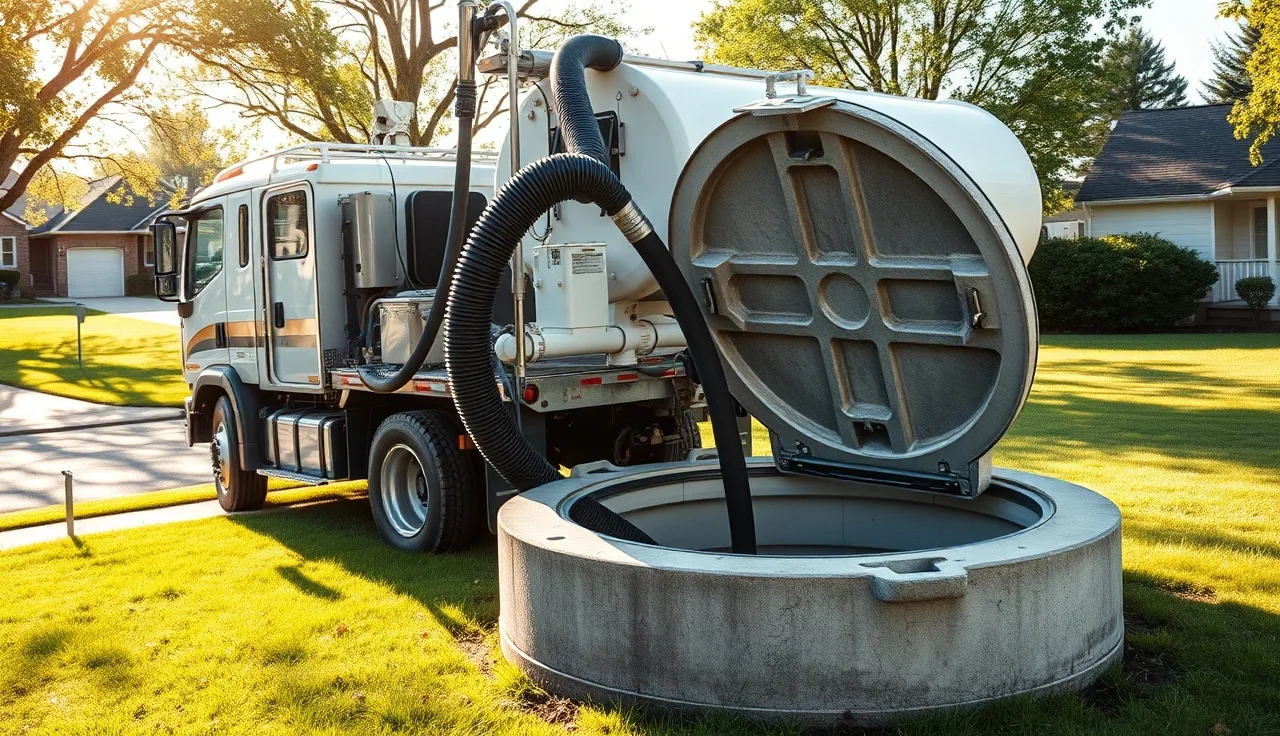
A truck pulls up, the technician finds and uncovers your tank lid, drops a vacuum hose in, and pulls out everything: liquid, floating scum, settled sludge. On a tank that's been pumped on schedule, the whole job takes 30 to 60 minutes. If nobody has touched it in a decade, plan on longer.
Once the tank is empty, a good technician grabs a flashlight and looks inside. They check the baffles (the plastic or concrete dividers that keep solids from drifting toward the outlet), the tank walls for cracks, and the inlet pipe from the house. This inspection is worth more than the pumping itself. Baffles cost $20 to $150 to replace. A failed drain field costs a lot more.
The pumped waste goes to a licensed municipal treatment plant or a permitted biosolids land-application site. Your technician should hand you a manifest or receipt showing where it went. Some states require that paperwork by law [1].
Pumping is not deep cleaning. A septic tank cleaning adds a water rinse after the pump-out to break up the sludge cake and lift sediment the vacuum alone leaves behind. Most homeowners don't need that every cycle. But if the tank has sat for years or shows heavy buildup, the extra $50 to $150 is money well spent.
How often should a residential septic tank be pumped?
The EPA's SepticSmart program recommends inspecting your system every 3 years and pumping every 3 to 5 years for a typical household [2]. Treat that as a starting point, not a law. The real interval depends on four things: tank size, how many people live in the house, the volume of solids going down the drain, and whether you run a garbage disposal.
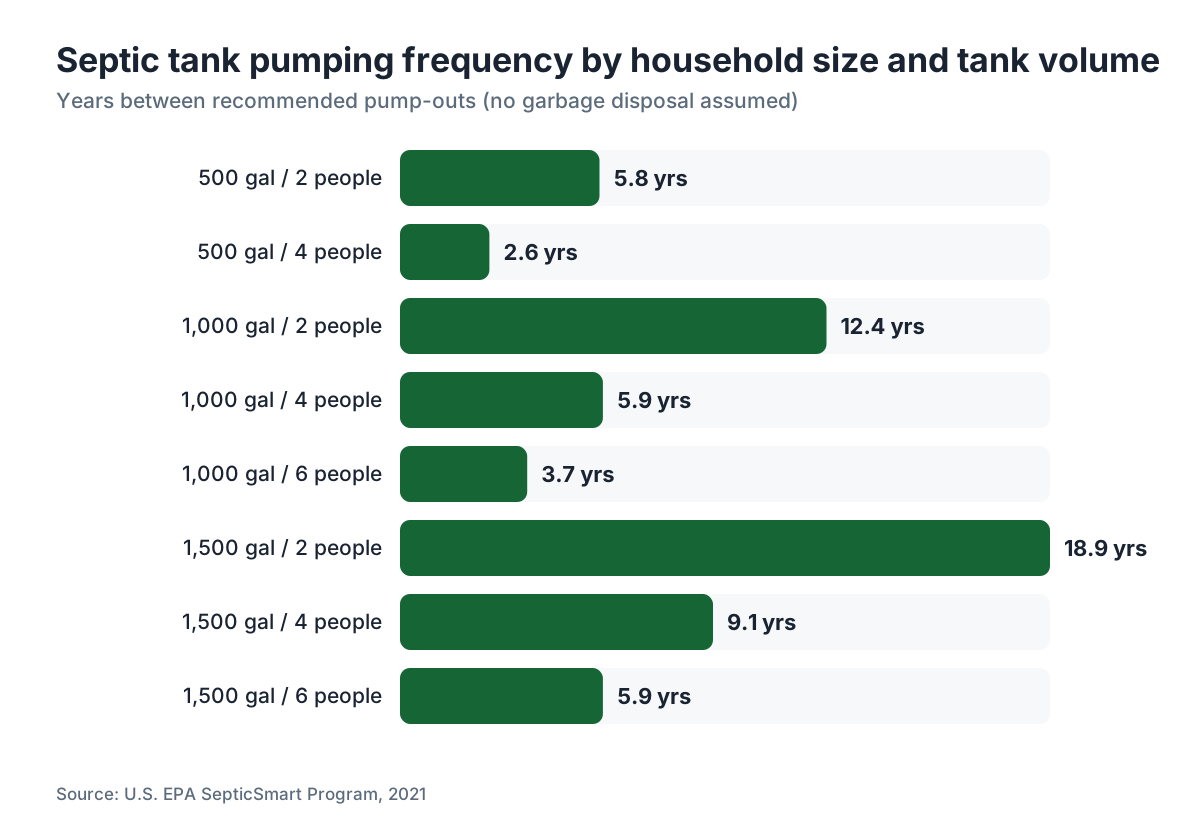
The table below shows EPA-derived pumping estimates by household size and tank volume [2]:
| Tank size (gallons) | 1-2 people | 3-4 people | 5-6 people |
|---|---|---|---|
| 500 | 5.8 years | 2.6 years | 1.5 years |
| 750 | 9.1 years | 4.2 years | 2.6 years |
| 1,000 | 12.4 years | 5.9 years | 3.7 years |
| 1,250 | 15.6 years | 7.5 years | 4.8 years |
| 1,500 | 18.9 years | 9.1 years | 5.9 years |
These numbers assume no garbage disposal. Add one and the EPA suggests pumping about 50% more often, because ground food waste dumps a lot of solids into the tank [2].
If you're not sure how often to pump your septic tank, ask the technician to measure your sludge and scum layers at the next service. When the sludge layer reaches the bottom of the outlet baffle, it's time to pump, no matter what the calendar says. That direct measurement beats every rule of thumb [11].
For a deeper look at the frequency question, see our guide on septic tank pump out schedules.
What does septic tank pumping cost?
A standard residential pump-out runs roughly $250 to $600 nationally, with most homeowners landing near $400 for a 1,000-gallon tank [3]. Prices run lower in rural Midwest markets and higher in coastal metros or anywhere disposal fees are steep.
A few things push the price up fast:
- Tank access: if the lid is buried deep or sits under a deck, add $50 to $200 for excavation.
- Riser installation: a technician who suggests a concrete or plastic riser to bring the lid to grade isn't upselling you. That riser pays for itself in saved digging by the second or third pump-out.
- Multiple compartments: two-compartment tanks take longer and may cost $75 to $150 more.
- Emergency or after-hours service: expect a 25 to 50 percent premium.
- Distance to the disposal site: in rural areas, hauling mileage gets added to the base rate. In and around Indianapolis, prices track the metro average, usually $275 to $450 for a standard 1,000-gallon tank.
Comparing quotes? Make sure each one covers the full pump-out and a baffle inspection. A $175 quote that skips the inspection is worse than a $375 quote that includes it. Damaged baffles left unchecked feed straight into drain field damage [4].
For what the big repairs cost when pumping gets skipped too long, see the septic tank repair and septic system repair guides.
What are the signs your septic tank needs pumping now?
Most of the time, a tank that's due doesn't announce itself. You pump on schedule and never see a symptom. But when a tank runs seriously overdue, or something else is wrong, here's what shows up.
Slow drains all over the house. One slow drain is a clog. Every drain slow at once points to a full tank or a blocked outlet. Gurgling toilets after a flush. Sewage odors outside near the tank or field, or inside near drains. A strip of unusually green, lush grass over the drain field lines, which means partially treated effluent is surfacing. Sewage backing up into the lowest drains, usually a basement floor drain or a ground-floor toilet.
See sewage surfacing in the yard? Stop using water and call a septic service. A surfacing system is a public health problem in every state [1]. Running more water through a saturated system makes the field damage worse and can turn a simple pumping problem into a $10,000 to $30,000 drain field replacement [4].
Odors alone don't always mean a full tank. A cracked or unsealed lid, a missing inspection port cap, or a vent that isn't working can all leak smell even when the tank level is normal. A visual inspection sorts it out.
What happens if you never pump your septic tank?
This is the question that should motivate every homeowner on a septic system. Short answer: you destroy your drain field, and drain fields are expensive.
Here's the sequence. Solids build up in the tank. When sludge and scum together fill more than about a third of the tank's liquid depth, solids start slipping past the outlet baffle toward the drain field. Once grease, undigested solids, and biomat-forming gunk reach the leach field pipes, they clog the soil pores that let the field absorb and treat effluent. The soil goes anaerobic and dead for treatment.
Once that happens, no amount of pumping fixes it. The field has to be rested (out of use for months or years), repaired, or replaced. The EPA estimates that failing septic systems put roughly 850 billion gallons of contaminated water into the environment each year in the U.S. [2]. A conventional drain field replacement runs $3,000 to $15,000. An advanced system on difficult soil can hit $30,000 or more [4].
Compare that to $400 every 3 to 5 years. The math isn't close.
There's liability too. Many states require a septic inspection when a home sells. A failed system found during a real estate septic tank inspection can kill a deal or force a repair escrow. Pumping records are one of the simplest ways to prove a system was maintained.
How do you prepare for a septic pump-out visit?
Preparation is mostly about access. The technician needs to park the truck within about 100 feet of the tank (hose length varies, but 75 to 100 feet is standard). Unlatch any gates the truck has to pass. Move vehicles, lawn furniture, anything blocking the path.
Find your tank lid before the appointment if you can. Got an as-built drawing from when the system went in? Dig it out. No drawing? Your county health department usually keeps permit records with a site plan. Some technicians will locate the tank with a probe rod, but that adds time to the job.
Don't flush or run the dishwasher and washing machine for a few hours before service. Letting suspended solids settle gives the technician a cleaner read on sludge depth. It's not required, just smart.
After the pump-out, have the technician walk you through what they found: baffle condition, any cracks in the tank, the sludge depth before pumping, and the next pump interval they recommend. Write it down. Keeping a service log is the thing most homeowners skip and later regret, either when selling the house or trying to remember when service happened last.
Running pump schedules across dozens of accounts? Tools like SepticMind track service history, fire off automated reminders, and log inspection findings in one place.
What's the difference between pumping, cleaning, and emptying a septic tank?
These three terms get swapped around, but they describe slightly different levels of service.
Pumping is the baseline. The vacuum truck removes the liquid and loosened solids. Most of the sludge cake at the bottom comes out, but a thin layer usually stays. That residual sludge holds the beneficial bacteria that restart digestion after the tank empties, so leaving a bit is fine.
Septic tank cleaning goes further. After vacuuming, the technician backflushes clean water to break up compacted sludge and rinse the walls, then vacuums again. This gets 95 to 100 percent of solids out. It costs more and isn't needed every cycle, but it's worth doing every 10 to 15 years, or whenever a tank has been badly neglected.
Septic tank emptying usually just means pumping in everyday use. Some companies use "emptying" to mean complete removal with no residual, which is the same as cleaning.
For a home sale, most buyers or their inspectors want a full clean so the tank can be inspected with a clear view. Ask the technician exactly what's included before you agree to a price.
Are septic additives worth buying?
Here's my straight opinion: for a healthy, properly pumped tank, biological additives are mostly wasted money. A working septic tank already holds billions of active bacteria. Adding a packet of dried bacteria or an enzyme product doesn't meaningfully raise microbial activity or stretch your pump interval.
The EPA is blunt about it: there's no scientific evidence that additives extend the pump interval or improve performance in a healthy system [2]. Some states go further. Florida keeps a list of approved and restricted additives under its onsite sewage rules [5].
A few narrow cases might justify a biological additive: after a heavy antibiotic course flushed into the system, or after a run of antibacterial cleaners. Even then, the tank rebuilds its bacterial population within days to weeks from normal waste. You don't need to buy anything.
Chemical additives (solvents, acids, caustic compounds) sold to "clear clogs" are a different animal, and a harmful one. They kill the bacteria, corrode tank components, and in concentrated form can reach the drain field and wreck the soil structure [2]. Keep them out of your system.
What regulations govern septic pumping, and who can legally do it?
Regulation happens at the state and county level, not the federal level. The EPA sets guidance and funds programs like SepticSmart, but licensing rules, disposal rules, and inspection mandates are all state law [1].
Most states require septic pumpers to hold a specific license, usually issued by the state environmental or health department. In Indiana, septic cleaners must be licensed under the state's environmental management statutes and work under Board of Health rules administered by the Indiana Department of Environmental Management [6]. Every state has some version of this.
When you hire a pumper, ask for the license number and verify it with your state agency if you're unsure. Hiring an unlicensed operator creates real problems. Improper disposal is illegal dumping, and if a neighbor or a local water body gets hit, the liability can circle back to the homeowner who hired the operator.
Pump-out frequency requirements show up in some state codes too. Massachusetts has mandatory pumping minimums for certain system types under Title 5 of its State Environmental Code [7]. Your county health department is the fastest place to find what applies to you.
For what happens when a system needs more than pumping, the guides on septic tank repair and leach field repair cover those regulatory angles too.
How do tank size and household size affect how often you need pumping?
Tank size matters a lot, and plenty of homeowners have no idea what size they have. The minimum for a single-family home under most modern state codes is 1,000 gallons, but older houses often have 500 or 750-gallon tanks. Homes built before 1970 can have tanks as small as 250 to 500 gallons, which fill up fast even with two people.
You can find your tank size on the original permit or as-built drawing, by asking your county health department, or by measuring during a pump-out (length times width times depth, converted to gallons). A good technician just tells you once they open it.
More people means more waste, which means sludge and scum pile up faster. Per the EPA's frequency table, a 1,000-gallon tank serving 6 people needs pumping about every 2.6 years, while the same tank for 2 people can go 9 years [2]. Both figures assume typical American water use, around 70 gallons per person per day [8].
Saving water shortens the interval a little. People who keep showers short, run high-efficiency toilets, and only run full dishwasher loads do send less volume. But solids drive the schedule more than water does. A household that cooks a lot, runs a garbage disposal, and hosts big gatherings fills a tank faster than the tables predict.
How much does it cost to replace a septic system if pumping is neglected?
If neglected pumping kills a drain field, here's the realistic range you're looking at.
A conventional gravity drain field on easy soil, tank still working: $3,000 to $7,000 for the field alone. Add $500 to $2,000 if the tank itself needs repair or replacement.
A pressurized or drip-irrigation field on tighter soils: $8,000 to $20,000.
A mound system (required when the water table is high or the site percolates poorly): $10,000 to $30,000 or more, depending on site conditions and state permit rules [9].
That's before permit fees, engineering if it's required, landscaping damage, and the days or weeks you can't use your plumbing during installation. In some jurisdictions with tangled permitting, the process takes 6 to 18 months [9].
For the full picture on new installs, the guides on cost to put in a septic tank and cost to install septic system have the detailed breakdowns. Short version: pumping costs a fraction of a percent of what replacement costs. There's no rational argument for skipping it.
Operators managing residential accounts who want a better way to flag which properties are overdue can look at how SepticMind sets service intervals and runs automated outreach to keep customers on schedule before problems reach the drain field.
How do you find and hire a good septic pumping company?
Start with your state's licensing database. Most state environmental or health department sites let you search licensed septic operators by county. Two minutes of searching filters out the unlicensed outfits.
After that, ask directly:
- Do they probe or measure sludge and scum depth before pumping and record it? That measurement tells you how fast your tank fills and sets a real pump interval [11].
- Do they inspect baffles and tank walls after pumping? If not, find someone who does.
- Where does the waste go? A licensed disposal site or municipal plant, with documentation.
- Do they install risers when needed? A company that brings up risers on its own is thinking about your long-term cost, more than today's ticket.
Price matters, but it shouldn't be the only thing. A $175 pump-out that misses a cracked baffle costs you $10,000 three years later. A $425 pump-out that catches a $75 baffle fix and documents your sludge rate is worth every dollar.
Read reviews for comments about thoroughness and communication, not speed. "Fast and cheap" is fine for a truck stop. For septic service you want thorough and honest.
Your county extension office is another good stop. Land-grant university extension programs in most states publish lists of licensed operators and sometimes offer free technical guidance on septic maintenance [10].
Frequently asked questions
How long does it take to pump a septic tank?
A 1,000-gallon tank pumped on a regular schedule takes 30 to 45 minutes. A tank that's gone years without service, or a larger 1,500-gallon tank with heavy buildup, can run 60 to 90 minutes. Add time if the lid is buried and needs excavation. The full visit, including setup and a basic inspection, is usually under two hours.
Can I pump my septic tank myself?
No, not legally in any U.S. state. Hauling and disposing of septage (the waste pumped from a tank) requires a licensed pump truck, a certified operator, and disposal at an approved facility. You can inspect your tank, add risers, and do minor maintenance, but the pump-out itself has to be done by a licensed septic service. DIY disposal is illegal dumping and carries serious fines.
What should I do right after my septic tank is pumped?
Nothing special. The tank rebuilds its bacterial population within days from normal household waste. Don't pour additives down the drain. Do write down the date, what the technician found, the sludge depth if they measured it, and when they recommend the next pump-out. File that paper with your home maintenance records or photograph it. You'll want it when you sell the house.
Does pumping a septic tank include cleaning the drain field?
No. Pumping only removes contents from the tank. The drain field is a separate component and can't be pumped out. If a field is clogged or saturated, the fix is resting it (stopping water use so the soil recovers), hydrojetting the distribution pipes, or in bad cases replacing the field. A pump-out does nothing for drain field condition.
How do I find out where my septic tank is buried?
Start with your county health or environmental department. They often keep permit records with a site diagram. Your home's as-built drawings, sometimes attached to the original permit or held by the builder, should show tank location. A septic technician can probe the yard to find it for a small fee. Some counties have online GIS portals with septic permit maps. Once you find it, install a riser so you never search again.
Is it normal for a yard to smell after pumping?
A mild odor near the tank access for a few hours after pumping is normal. The tank releases trapped gases when opened, and residual smell fades quickly. Odors that last several days, or smell coming from over the drain field rather than the tank, point to a different problem: a cracked lid, a venting issue in the house plumbing, or effluent surfacing from a stressed field. Call your tech if odors last more than 24 hours.
Do I need to be home when the septic tank is pumped?
You don't have to be there, but it's a good idea for the first service at a new property. Being present lets you see the tank location, hear the findings firsthand, and ask questions. If you can't make it, make sure the technician knows how to access the tank, has your number, and will leave a written summary. Some companies send a digital report with photos, which is even better.
What household habits make my septic tank fill up faster?
A garbage disposal is the single biggest factor; it adds food solids that don't break down quickly. Flushing wipes (even "flushable" ones), cotton swabs, or feminine hygiene products builds up fast. Heavy use of antibacterial soaps and bleach suppresses the bacteria that break down solids. Large gatherings add a sudden surge of waste. Each of these shortens the pump interval below what the standard tables predict.
What's a septic tank riser and should I get one installed?
A riser is a cylindrical extension, usually concrete or plastic, that brings your tank's access lid to ground level. Without one, every pump-out means digging to find and expose the lid. Risers cost $200 to $500 installed and pay for themselves in 2 to 3 pump-outs by cutting excavation charges. They also make it easier to inspect the tank yourself between visits. Nearly every septic professional recommends one.
How does cold weather affect septic tank pumping?
Tanks can be pumped year-round in most climates. Cold slows bacterial activity, which slightly reduces solids breakdown, but frozen ground is the bigger practical issue. In northern states, if the lid is buried and the ground is frozen solid, excavation gets much harder and pricier. That's the strongest argument for a riser: it keeps winter access simple no matter how frozen the ground is.
What do septic inspectors look for that a routine pump-out misses?
A formal septic inspection, separate from a pump-out, evaluates the whole system. The inspector checks tank structural integrity, baffle condition, the distribution box for even effluent flow, and the drain field for saturation or surfacing. They may run a dye test or a flow test. For a home sale, most buyers want a full inspection, more than a pump receipt. The two services complement each other; they aren't interchangeable.
Can a full septic tank cause toilet backups?
Yes. When a tank is full and the outlet is blocked by solids, wastewater from the house has nowhere to go. It backs up through the lowest drains first, usually a basement floor drain or a ground-floor toilet. This is a plumbing emergency. Stop all water use and call a septic service. Don't run the washing machine, dishwasher, or shower, because more water makes the backup worse and piles pressure onto the drain field.
Does homeowners insurance cover septic tank pumping or repairs?
Standard homeowners policies don't cover routine pumping; that's maintenance, not a loss. Repair coverage is inconsistent. Some policies cover sudden accidental damage (a truck driving over the tank, for example) but exclude gradual failure from neglect. Sewer backup riders, which you can add for $50 to $150 a year, sometimes cover septic-related backups inside the home. Read your policy and ask your insurer specifically about onsite septic systems.
What's the septic tank pumping cost in Indianapolis compared to the national average?
Septic tank pumping in Indianapolis and the surrounding central Indiana counties typically runs $275 to $450 for a standard 1,000-gallon residential tank, close to the national average of $250 to $600. Rural Indiana spots farther from disposal facilities can trend a little higher because of hauling distance. Getting two or three quotes from licensed Indiana operators is the best way to pin down the going rate in your township.
Sources
- U.S. EPA, Septic Systems (Managing Septage guidance): States regulate septic pumper licensing and disposal of septage; improper disposal is a regulatory violation.
- U.S. EPA SepticSmart Program: EPA recommends inspecting septic systems every 3 years and pumping every 3-5 years; publishes pumping frequency table by tank size and household size; states there is no scientific evidence additives reduce pump frequency; garbage disposals increase solids load significantly.
- Angi (HomeAdvisor), Septic Tank Pumping Cost Guide: National average cost for residential septic tank pumping is approximately $250 to $600, with most homeowners paying near $400 for a 1,000-gallon tank.
- U.S. EPA, A Homeowner's Guide to Septic Systems: Solids overflow from an un-pumped tank clogs drain field soil; drain field replacement costs $3,000 to $30,000 or more; damaged baffles accelerate field failure; EPA estimates 850 billion gallons of contaminated water annually from failing systems.
- Florida Department of Health, Onsite Sewage Treatment and Disposal System Rule (Chapter 64E-6, F.A.C.): Florida regulates approved and restricted septic additives under its onsite sewage rules.
- Indiana Department of Environmental Management, Residential Onsite Sewage Systems: Indiana requires septic cleaners and haulers to be licensed under state environmental management statutes.
- Massachusetts Department of Environmental Protection, Title 5 State Environmental Code (310 CMR 15.000): Massachusetts Title 5 includes mandatory pumping minimums for certain system types and inspection requirements at property transfer.
- U.S. Geological Survey, Estimated Use of Water in the United States: Average U.S. residential indoor water use is approximately 70 gallons per person per day, the baseline for septic sizing and pump frequency calculations.
- National Environmental Services Center (NESC) at West Virginia University: Permitting for new or replacement septic systems in some jurisdictions takes 6 to 18 months; mound and alternative systems can cost $10,000 to $30,000 or more.
- Penn State Extension, Homeowner's Guide to Septic System Maintenance: University extension programs publish lists of licensed septic operators and provide free technical guidance on septic maintenance to homeowners.
- University of Minnesota Extension, Septic System Owner's Guide: Sludge depth measurement is the most accurate method for determining pump interval; sludge should be removed before it reaches the bottom of the outlet baffle.
Last updated 2026-07-09