Eljen septic system: how it works, what it costs, and when to choose it
By the SepticMind Editorial Team
TL;DR
- An Eljen GSF (Geotextile Sand Filter) system replaces a conventional gravel leach field with modular plastic chambers wrapped in fabric and packed in sand.
- It treats wastewater to a higher standard than a standard drainfield, so it works on lots with poor soil, high water tables, or tight setbacks.
- Installed cost usually runs $8,000 to $20,000 depending on system size and site conditions.
What is an Eljen septic system and how does it work?
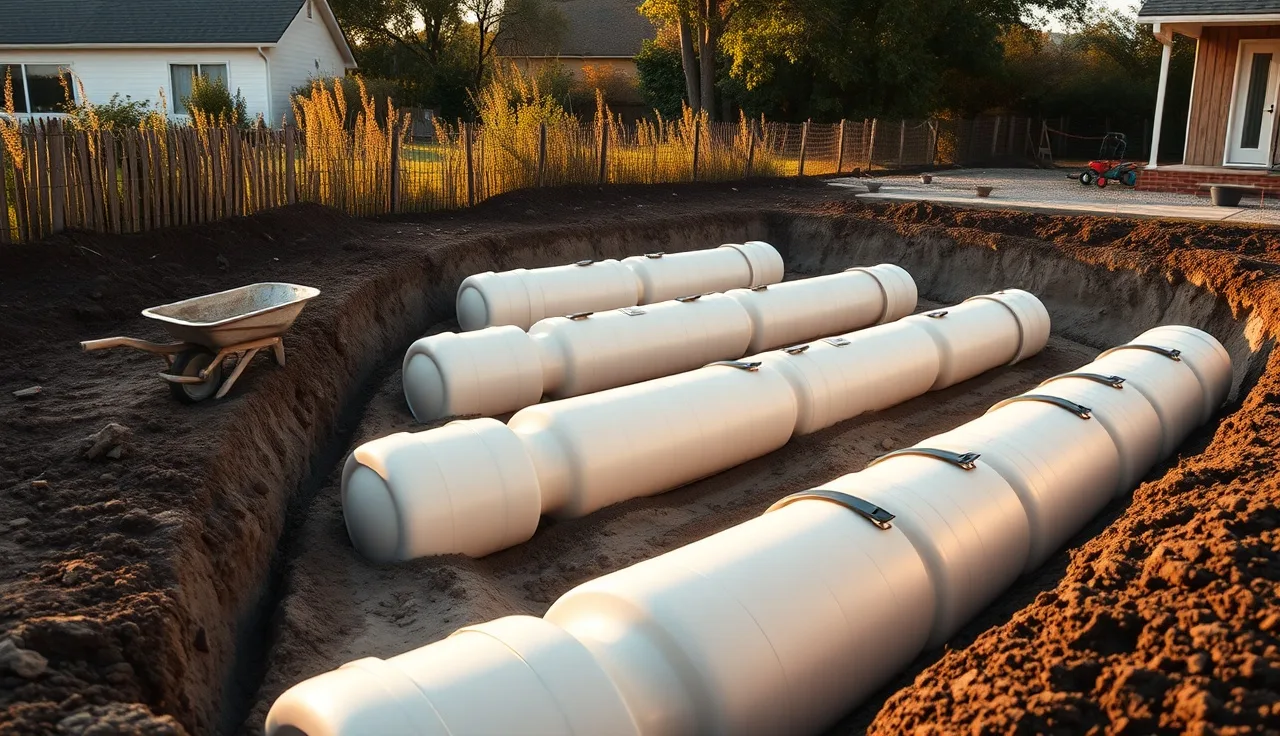
An Eljen GSF (Geotextile Sand Filter) system is a patented advanced treatment unit made by Eljen Corporation. It sits between your septic tank and the soil and does the biological treatment that a conventional gravel trench leaves entirely to soil microbes. In a conventional leach field, effluent drains from perforated pipe into gravel and then into native soil. In an Eljen system, effluent flows from the tank into modular plastic chambers called GSF units. Each chamber has a hollow corrugated core wrapped in geotextile fabric. The fabric grows a biologically active mat, called a biomat, that treats the effluent as it passes through. That treated liquid then moves through a band of concrete sand around the chambers before it reaches native soil.
Two stages do the work: biomat filtration, then sand polishing. That combination is what lets Eljen systems meet advanced secondary or even tertiary treatment standards in many states [1]. The EPA SepticSmart program describes advanced treatment units as systems that "provide additional treatment beyond conventional systems" and are often required "when standard systems are not suitable." [2]
The GSF units are long, low chambers. A typical residential unit is about 4 feet wide and 2.5 feet tall when installed, with 12 inches of sand on the sides and bottom. The low profile means the system needs only about 18 to 24 inches of total depth. A conventional trench needs 3 to 5 feet. That shallow footprint is a big reason Eljen gets specified for sites with a high water table or a restrictive soil layer close to the surface.
What makes Eljen different from a conventional septic drainfield?
The biggest practical difference is treatment capacity per square foot of soil. A standard gravel-and-pipe trench depends entirely on the native soil's percolation rate and its ability to keep absorbing effluent. Clay-heavy, compacted, or seasonally wet soil can't keep up, and you get surfacing sewage or a backed-up tank.
Eljen GSF units pre-treat the effluent before it ever touches native soil, so the soil loading rate (the gallons per day each square foot of soil must accept) drops a lot. Eljen's product documentation, and third-party studies referenced by state extension programs, show the GSF technology can cut required soil absorption area by 50 percent or more compared to a standard trench [3]. In plain terms, a lot that failed a perc test for a conventional system might still qualify for Eljen.
A few other differences matter. Eljen systems are passive. No electricity, no pumps, no chemicals under normal gravity flow (a pump gets added only if site elevation forces dosing). That keeps operating costs near zero. Conventional gravel trenches also tend to clog with biomat at the gravel-soil interface over time, which is a leading cause of drainfield failure. The Eljen design manages the biomat on the geotextile fabric, where it can be monitored and where the system is built to rest and recover [4].
The table below lays out the differences side by side.
Where is an Eljen system required or recommended?
No state mandates Eljen by brand name. Many states allow or require an "alternative" or "advanced" treatment system when a site can't support a conventional one. Eljen GSF is approved in most of the continental United States and several Canadian provinces, though approval status changes, so confirm with your local health department [5].
Sites where designers most often reach for an Eljen system include:
- Lots with a seasonal high water table less than 24 inches below the proposed trench bottom (many states require 24 inches of vertical separation between the bottom of the distribution media and the seasonal high water table)
- Soils with a percolation rate slower than 60 minutes per inch, which fail the standard test for a conventional system in most jurisdictions
- Small lots where setbacks leave little room for a full-sized conventional drainfield
- Replacement of a failed conventional system when the original footprint is too small or too wet to rebuild in kind
- Locations near wells, wetlands, or surface water where higher-quality effluent is required before it reaches the soil
The EPA's "Onsite Wastewater Treatment Systems Manual" says alternative systems like textile-based sand filters are especially useful for "sites with difficult soils, limited space, or proximity to sensitive receiving water bodies." [1]
Not sure whether your lot qualifies? A licensed site evaluator (which is a step above a contractor) should do a soil profile examination and percolation test. That test, plus a survey of setbacks, decides whether you need Eljen or whether a standard system will work. Our guide to septic tank inspection walks through what that evaluation looks like.
How much does an Eljen septic system cost?
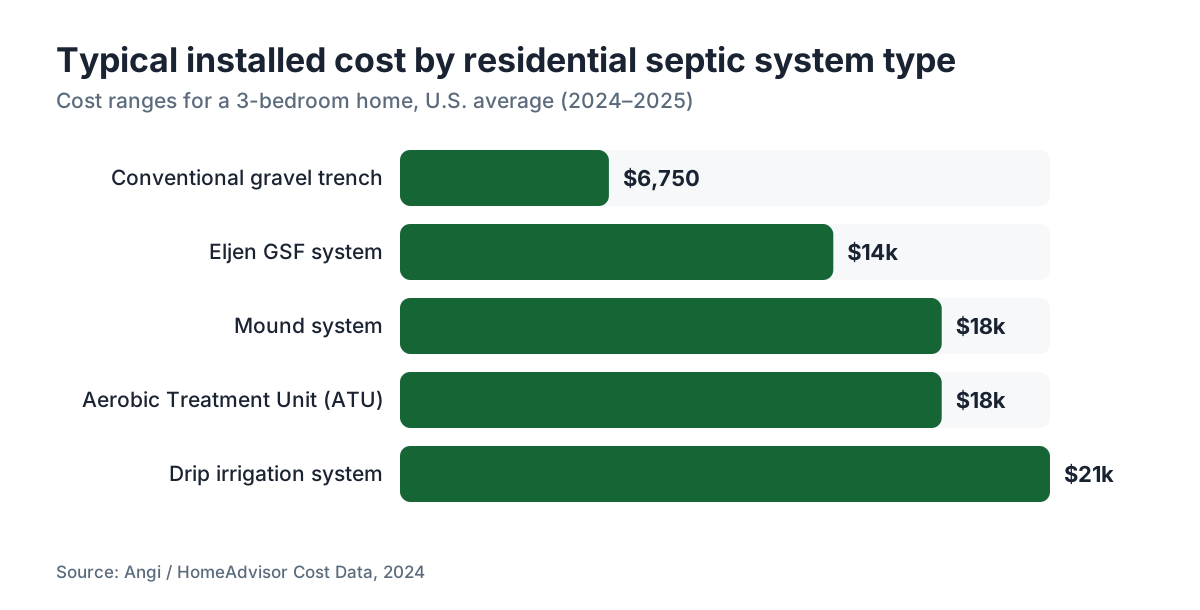
Installed cost for a residential Eljen GSF system usually runs $8,000 to $20,000 in the United States as of 2024 to 2025. The spread is real: system size (number of GSF units), excavation difficulty, sand import cost, permit fees, and labor rates all move the number. A small two-bedroom home in a rural area with easy digging might land around $8,000 to $10,000. A four-bedroom home on a tight urban lot with a high water table and imported fill can top $18,000 to $20,000 [6].
For comparison, a conventional gravity-fed septic system (tank plus gravel trench) costs $3,500 to $10,000 installed in most U.S. markets [7]. Eljen runs roughly 1.5 to 2 times that. The premium covers the GSF modules plus the concrete sand import. The sand is the line item people rarely expect: a typical residential job needs 15 to 40 tons of washed concrete sand, which in many markets costs $600 to $1,500 for material alone, before delivery and placement.
Here is a rough cost breakdown for a typical 3-bedroom installation:
| Cost Component | Typical Range |
|---|---|
| Septic tank (1,000 to 1,500 gal, concrete) | $1,200, $2,500 |
| Permits and site evaluation | $500, $2,000 |
| Excavation and site prep | $1,500, $4,000 |
| Eljen GSF modules | $1,500, $3,500 |
| Concrete sand (15 to 40 tons) | $600, $2,000 |
| Distribution piping and fittings | $300, $800 |
| Labor (installation) | $2,000, $5,000 |
| Inspection and close-out | $200, $600 |
| Total (estimated) | $7,800, $20,400 |
These are contractor-installed figures for a full system, tank and all site work included. If you already have a working tank and are only replacing a failed drainfield with Eljen units, subtract the tank cost.
Our cost to install septic system guide compares these numbers against a full conventional installation.
What factors push the cost higher or lower?
Geography is the single biggest lever. Labor rates in the Northeast and Pacific Coast run 30 to 50 percent higher than in the rural South or Midwest [6]. Sand cost is just as regional: in the Mid-Atlantic, delivered concrete sand runs $40 to $60 per ton; in parts of the South or Midwest it may be $20 to $30 per ton.
System size matters a lot. Eljen sizing is based on soil loading rate and daily flow (gallons per day). Most jurisdictions figure 75 to 100 gallons per bedroom per day for residential design. A 3-bedroom home at 75 gpd per bedroom needs a system sized for 225 gpd. Slow soil (say 45 minutes per inch) means more GSF units, and cost climbs with them.
Site access and rock are the wild cards. If the excavator hits ledge rock 18 inches down, expect rock-breaking charges of $200 to $600 per hour. A shallow rocky site can double the excavation budget on its own.
Gravity feed versus pump dosing also swings the price. Most Eljen systems run on passive gravity flow, which keeps cost down. If your topography is flat or the field sits uphill from the tank, you need a dosing pump and pump chamber, and that adds $1,200 to $2,500 to the project.
Permit fees vary by county from about $200 to over $2,000. Some states require a licensed engineer to stamp the design for an alternative system, which adds $500 to $2,000 in design fees. Ask about both upfront.
How long does an Eljen system last?
Eljen does not publish a design life in years, and honestly, nobody has 40-year field data because the product launched in the 1980s. The oldest installed systems are now in their 30s, and most are still running. The geotextile fabric and HDPE shell are rated for very long service in soil, and the EPA's onsite treatment systems manual notes that alternative systems generally last 20 to 30 or more years with proper maintenance [1].
The limiting factor is almost always the soil, not the Eljen hardware. Overload the soil beneath the system with high water use, root intrusion, or an undersized design, and you'll see failure no matter how tough the modules are. The biomat on the fabric builds up over the years, but the Eljen design lets the system rest and partially recover during low-use periods.
Regular maintenance (pumping the tank on schedule, not overloading it with water) is the most reliable way to stretch system life. The EPA SepticSmart program recommends pumping every 3 to 5 years for a typical household [2]. For a 3-bedroom home with normal use and no garbage disposal, every 3 years is a sensible default. Our guide on how often to pump septic tank has more detail.
What maintenance does an Eljen system need?
Eljen systems are among the lower-maintenance advanced systems on the market, mostly because there are no moving parts under gravity flow. Routine maintenance comes down to three things.
First, pump the septic tank on schedule. This is the same rule as any septic system. Solids that escape the tank clog the geotextile fabric far faster than normal biological activity, and clogged fabric can't be cleaned easily. A missed pump-out that sends sludge into the Eljen field is a costly mistake. The EPA recommends a pump-out every 3 to 5 years; households with garbage disposals or heavy use should lean toward 3 years [2]. Find a licensed pumper through our septic tank pumping resource.
Second, keep vehicles and compaction off the field. The GSF modules sit under only 6 to 8 inches of cover soil, and heavy vehicles can crush them. Eljen's installation guidelines call for no vehicles over 2,500 pounds over the field and no heavy equipment without bridging.
Third, manage water use in the house. Eljen systems are designed for average daily flow. Five or six loads of laundry in one day, filling and draining a large hot tub to the septic, or repeated big gatherings will hydraulically overload the field. Spread high-water activities out.
If you have a pump-dosed system, inspect the pump and float controls every 1 to 2 years. A pump failure causes tank backup rather than immediate field damage, but catching it early beats cleaning up an overflow. Our guide on septic tank repair covers pump problems.
Can an Eljen system fail, and what are the signs?
Yes, it can fail. The most common failure mode is hydraulic overloading, where the system takes in more water than it was built to handle. Watch for slow drains throughout the house, gurgling toilets, wet or spongy ground over the drainfield, and sewage odors in the yard. See any of those, stop doing laundry and call a licensed septic professional right away.
Biomat clogging of the geotextile is the other main failure mode. It usually comes from high-solids effluent escaping a tank that hasn't been pumped in years, or from grease and oils from heavy kitchen use. Once the fabric is badly clogged, recovery is possible but slow, and sometimes individual GSF units have to be replaced.
Root intrusion is less common with Eljen than with conventional trenches, because the plastic chambers resist roots better than gravel does. Still, large trees within 10 to 15 feet of the field are a risk over decades.
Eljen systems often get inspected during a home sale. Buying a home with one? Ask for a full inspection: a tank pump-out, a look at the distribution lines, and a check for surfacing effluent. Our septic tank inspection guide explains what a thorough inspection covers.
Dealing with an active failure right now? Our septic system repair guide covers your options.
How does Eljen compare to other alternative septic systems?
The main alternatives you'll run into are mound systems, drip-irrigation systems, aerobic treatment units (ATUs), and conventional sand mound filters. Here's how they stack up on what homeowners actually care about:
| System Type | Typical Installed Cost | Power Required | Maintenance Level | Best For |
|---|---|---|---|---|
| Eljen GSF | $8,000, $20,000 | None (gravity) | Low | Poor soil, shallow water table |
| Conventional gravel trench | $3,500, $10,000 | None | Low | Good perc soils |
| Mound system | $10,000, $25,000 | Pump required | Medium | High water table, shallow soil |
| Aerobic Treatment Unit | $10,000, $25,000 | Compressor | High | Very tight sites, spray disposal |
| Drip irrigation | $12,000, $30,000 | Pump + controls | High | Very limited space, poor soil |
| Textile/peat filter | $8,000, $18,000 | Sometimes | Medium | Cold climates, poor soil |
Eljen's edge over a mound system is no electricity and a lower profile. Mounds sit 2 to 4 feet above grade, which many homeowners find ugly and which some jurisdictions restrict near property lines. Its edge over an ATU is no compressor, no chlorine tablets or UV maintenance, and much lower operating cost.
The honest limit of Eljen: it still needs a minimum vertical separation to the water table and some native soil permeability. A site with a water table at or near the surface may need a mound or drip system regardless.
How do you size and design an Eljen system?
Sizing starts with two numbers: design daily flow and soil loading rate. Design daily flow for a home is usually set by bedroom count. Most state codes use 75 to 110 gallons per bedroom per day. A 3-bedroom home at 75 gpd per bedroom comes to 225 gpd design flow [8].
Soil loading rate comes from the perc test or soil morphology evaluation. Eljen's design tables spell out how many linear feet of GSF trench you need based on the soil's measured percolation rate. Because Eljen pre-treats the effluent, those tables allow a higher loading rate than a conventional system for the same soil. That's the core engineering advantage.
Take a soil with a percolation rate of 30 minutes per inch (moderately slow). A conventional system might require 150 linear feet of trench for a 3-bedroom home. An Eljen system might need only 75 to 90 linear feet for the same home, because the GSF treatment cuts required soil absorption area by roughly 50 percent [3].
State-specific design requirements vary. Some states publish their own Eljen design manuals or tweak the manufacturer's tables. Your designer needs to use the state-approved version, not the manufacturer's default. Eljen's technical support team is genuinely helpful here, and most state environmental or health agencies publish their approved ATU design standards online.
Managing installations across multiple properties? Keeping those design documents organized across projects is where a platform like SepticMind helps operators track permit history, system specs, and service schedules in one place.
What permits and approvals do you need for an Eljen installation?
In every U.S. state, you need a permit before installing any septic system, Eljen included. The permitting authority is usually the county environmental health department, or in some states a state environmental agency. Some counties hand authority to a regional wastewater district [9].
For an alternative system like Eljen, the permit process often runs through several steps: a site evaluation by a licensed site evaluator or soil scientist, a percolation test or soil morphology assessment, a design stamped by a licensed professional engineer or registered sanitarian, county review and approval of the design, installation by a licensed contractor, a mid-installation inspection by the county (often required before backfilling), and a final inspection.
Alternative system approvals take 4 to 12 weeks in most jurisdictions, and longer where staffing is short. Don't buy a property assuming you can get an Eljen permit in 2 weeks. Budget the time honestly.
Eljen Corporation keeps a list of state approvals on its website, but always verify with your local health department, because approval status and design requirements change when states update their onsite wastewater codes. The EPA's Office of Water publishes state wastewater program contacts to help you find the right agency [9].
Is an Eljen system a good investment for a property?
For a site that can't support a conventional system, an Eljen system is often the difference between a buildable lot and an unbuildable one. In that case the $8,000 to $20,000 cost isn't really a comparison against a cheaper system. It's a comparison against no system at all, and the answer is obvious.
For a site where you could technically install a conventional system but choose Eljen for its smaller footprint or better treatment, the math is fuzzier. You're paying a $2,000 to $6,000 premium over a conventional system. Whether that pays off depends on how much you value the smaller footprint, whether your state requires secondary treatment for your location, and whether you're near a well and want the extra treatment buffer.
Resale value is hard to pin down. There's no good published data on whether homes with Eljen systems sell for more or less than homes with conventional systems. A functioning, properly permitted alternative system shouldn't hurt resale. A failed or unpermitted one absolutely will.
SepticMind's service operator tools help contractors track Eljen installations across a service territory, set maintenance reminders, and generate inspection reports, which is worth knowing if you manage a portfolio of alternative systems.
Comparing costs for a full new installation from scratch? Our cost to put in a septic tank and septic tank installation guides cover the whole picture.
Frequently asked questions
What is the lifespan of an Eljen GSF septic system?
Most installed Eljen systems in the field are performing well after 20 to 30 years, and some installations from the 1980s and early 1990s are still running. The hardware (plastic modules and geotextile fabric) is very durable. The limiting factor is usually the surrounding soil. Regular tank pump-outs every 3 to 5 years are the single most important thing you can do to extend system life.
Can I install an Eljen system myself to save money?
In most states, no. Onsite septic installation requires a licensed contractor and a county permit with inspections. A few rural states let a property owner install their own system, but alternative systems like Eljen almost always require a professional designer and licensed installer because of their complexity. A DIY Eljen install without proper permitting would likely be illegal and could block a future property sale.
Does an Eljen system need electricity?
Under gravity flow, no. The standard Eljen GSF design is fully passive. If your site needs the effluent pumped uphill to the field (pump dosing), you'll need a pump and pump chamber, which does require electricity. That adds roughly $1,200 to $2,500 to the installation cost and calls for periodic pump inspection and eventual replacement.
How often does an Eljen system need to be pumped?
The septic tank feeding an Eljen system should be pumped every 3 to 5 years, the same schedule as any septic system. The EPA SepticSmart program recommends that interval for a typical household. Homes with a garbage disposal, large household, or heavy water use should pump every 2 to 3 years. The Eljen field itself needs no pumping.
What soil conditions disqualify a site from using Eljen?
Eljen still needs a minimum vertical separation between the bottom of the system and the seasonal high water table, typically 12 to 18 inches depending on state code. Sites with a water table essentially at the surface, or solid bedrock within a foot of grade, may not qualify even for Eljen. A licensed site evaluator with a soil probe and water table data gives you the definitive answer for your lot.
How much sand does an Eljen installation require?
A typical 3-bedroom residential installation needs roughly 15 to 40 tons of washed concrete sand, depending on system size. The sand surrounds the GSF modules (6 inches below and on each side) and provides the polishing layer before effluent reaches native soil. Sand cost swings by region, from about $20 to $60 per ton delivered, making it one of the larger variable cost items in the project.
Can an Eljen system be installed in cold climates or frozen ground?
Yes. Eljen systems are installed and operating across New England, the upper Midwest, and Canada. Enough cover soil (typically 6 to 12 inches minimum) plus grass or mulch cover protects the system from freezing. Installation can't happen in frozen ground, though, because the excavation is impossible and the sand can't be graded properly, so most northern contractors schedule Eljen installs from spring through fall.
What happens if an Eljen system fails, and how is it repaired?
Failure usually means hydraulic overloading or biomat clogging. In mild cases, resting the system (cutting water use for weeks or months) allows partial recovery. In severe cases, individual GSF modules may need to be dug up, cleaned or replaced, and new sand installed. If the system was undersized, a repair may require adding more GSF units. A licensed septic professional should diagnose any failure before attempting repair.
Is an Eljen system approved in my state?
Eljen GSF systems are approved in most U.S. states and several Canadian provinces, but approval status varies. Some states have full general approval; others require a site-specific variance. Check with your county environmental health or public health department for your state's current approved product list. Eljen Corporation's website also keeps a state approvals page, though the local health department has the final word.
How does the cost to build a septic system with Eljen compare to a conventional system?
A conventional gravity septic system costs roughly $3,500 to $10,000 installed. An Eljen system runs $8,000 to $20,000. You're paying a $2,000 to $6,000 premium for the GSF modules and the concrete sand import. On sites where conventional systems simply aren't permitted because of soil or site constraints, Eljen is often the least expensive compliant option available.
Can I put a garden or plants over an Eljen drainfield?
Grass is the recommended cover. Shallow-rooted groundcovers are generally fine. Don't plant vegetable gardens over the field because of pathogen risk from soil contact. Avoid deep-rooted plants, shrubs, and trees within 10 feet. The main concern is root intrusion into the modules and disturbance of the shallow cover soil. Eljen's installation guidelines call for keeping the surface undisturbed.
Will a home inspection catch an Eljen system problem when buying a house?
A standard home inspector typically won't inspect the septic system beyond a visual check. For a home with any septic system, especially an alternative system like Eljen, hire a licensed septic inspector separately. A proper inspection includes pumping the tank, inspecting the inlet and outlet baffles, checking distribution lines, and looking for surfacing effluent over the field. See our guide to septic tank inspection for details.
Are there any chemicals or additives I should avoid with an Eljen system?
The same rules apply as with any biological septic system. Avoid pouring large amounts of bleach, antibacterial cleaners, paint, solvents, or medications down the drain. These kill the beneficial bacteria in both the tank and the Eljen biomat. Septic additives sold as beneficial (enzymes, bacteria packets) have no proven benefit according to EPA guidance and are a waste of money for a properly maintained system.
Sources
- U.S. EPA, Onsite Wastewater Treatment Systems Manual (EPA/625/R-00/008): Alternative treatment systems like textile-based sand filters are particularly valuable for sites with difficult soils, limited space, or proximity to sensitive receiving water bodies; advanced systems provide treatment beyond conventional systems.
- U.S. EPA SepticSmart Program: EPA SepticSmart recommends pumping a septic tank every 3 to 5 years for a typical household, and describes advanced treatment units as systems that provide additional treatment beyond conventional systems and are often required when standard systems are not suitable.
- University of Minnesota Extension, Onsite Sewage Treatment Program: Eljen GSF and comparable geotextile sand filter technologies can achieve approximately 50 percent reduction in required soil absorption area compared to conventional gravel trench systems.
- Eljen Corporation, GSF Product Technical Documentation: The Eljen GSF design intentionally manages the biomat on the geotextile fabric, where it can be monitored and the system is designed to rest and recover; the HDPE plastic and geotextile fabric are rated for long-term soil installation.
- Eljen Corporation, State Approvals Page: Eljen GSF systems are approved in most of the continental United States and several Canadian provinces, though approval status varies by state and should be verified with local health departments.
- HomeAdvisor / Angi, Septic System Installation Cost Guide: Installed costs for alternative septic systems including Eljen GSF range from approximately $8,000 to $20,000 for residential installations, with regional labor rates in the Northeast and Pacific Coast running 30 to 50 percent higher than rural South or Midwest.
- HomeAdvisor / Angi, Septic System Cost Data: A conventional gravity-fed septic system (tank plus gravel trench) costs $3,500 to $10,000 installed in most U.S. markets.
- New Hampshire Department of Environmental Services, Onsite Wastewater Rules (Env-Wq 1000): Most state codes use 75 to 110 gallons per bedroom per day for residential septic design flow calculations.
- U.S. EPA, Office of Water, State Wastewater Programs: Permits are required before installing any septic system in every U.S. state; permitting authority is typically the county environmental health department or state environmental agency.
- North Carolina State University Extension, Onsite Wastewater: Alternative septic systems generally have a design life of 20 to 30 or more years with proper maintenance; root intrusion and hydraulic overloading are the most common causes of field failure.
- Massachusetts Title 5, Onsite Sewage Regulations (310 CMR 15.000): Massachusetts requires 12 to 24 inches of vertical separation between the bottom of the distribution medium and the seasonal high water table depending on system type, and requires licensed installers for all alternative systems.
Last updated 2026-07-09