Cost to put in a septic tank: what you'll actually pay
By the SepticMind Editorial Team
TL;DR
- A conventional septic tank and drain field costs $3,500 to $15,000 for most homes, with the national midpoint around $7,000 to $9,000.
- Alternative systems (mound, aerobic, drip) push costs to $10,000 to $20,000 or more.
- Soil conditions, tank size, local permit fees, and county labor rates drive the biggest swings.
How much does it cost to put in a septic system?
A complete septic system runs $3,500 to $15,000 for a conventional gravity-fed residential install. That covers the tank, distribution box, drain field, excavation, and permits. The range is wide because soil type, lot layout, household size, and local labor markets each move the number.
The U.S. Environmental Protection Agency estimates a new onsite system costs $3,000 to $10,000 for a typical home [1]. That figure is a few years old and doesn't fully track current labor and material prices in high-cost states. Real contractor quotes in 2024 and 2025 land closer to $6,000 to $12,000 for a standard three-bedroom home, with rural Midwest installs at the low end and suburban Northeast or West Coast installs at the high end.
Alternative systems cost a lot more. When a conventional gravity drain field can't work, you get pushed into a mound system, an aerobic treatment unit, or a drip-irrigation system. Those commonly run $10,000 to $25,000, and on a bad site you can hit $30,000.
For a full breakdown of every line item in the build, the companion guide on septic system installation covers the process step by step. This article is about the money.
What are the main cost components of a new septic install?
A septic install isn't one purchase. It's a stack of separate costs a contractor bundles into a single bid. Pull them apart and you can negotiate and spot inflated line items.
Site evaluation and soil testing (perc test): $250 to $1,500. Before anything gets dug, your county health department or a licensed soil scientist runs a percolation test (or a soil profile evaluation) to see how fast water moves through your ground. Some states require a professional soil evaluator instead of, or on top of, a traditional perc test. North Carolina's onsite wastewater rules, for example, require a soil morphology evaluation by a licensed soil scientist for most new systems [2].
Permits: $200 to $1,500. Every county or municipality sets its own permit fees. These usually include a plan review fee, a construction permit, and sometimes a separate final inspection fee. In some places the permit is a flat $300. In parts of California it tops $1,000 before any soil work starts.
Excavation and site prep: $500 to $4,000. Rocky ground, steep slopes, or bad equipment access run this up fast. A flat sandy lot in the Southeast is cheap to dig. A wooded granite hillside in New England is a different animal.
The septic tank itself: $500 to $3,000. A standard 1,000-gallon precast concrete tank runs $700 to $1,200 for the tank alone, not installed. Plastic (polyethylene) tanks run $500 to $1,000 but aren't allowed in every state. Fiberglass falls near plastic. Most state codes set tank size by the number of bedrooms in the home, not actual water use.
Distribution system: $500 to $1,500. This is the outlet pipe, the distribution box or manifold, and the connections between the tank and the field.
Drain field (leach field): $2,000 to $10,000+. Usually the largest single cost in a conventional system. A standard trench-and-gravel field for a three-bedroom home runs $3,000 to $6,000 in materials and labor. Chamber systems (infiltrator chambers instead of gravel) often cost a bit more upfront but install faster. The septic drain field guide covers field types and sizing in detail.
Backfill, cleanup, and inspection: $300 to $1,000. The final health department inspection, backfill and grading, and cleanup. Sometimes it's baked into the lump-sum bid, sometimes billed on its own.
Add those ranges and you get $4,250 to $22,500. Most residential installs land in the middle third of that span.
How much does a septic system cost by system type?
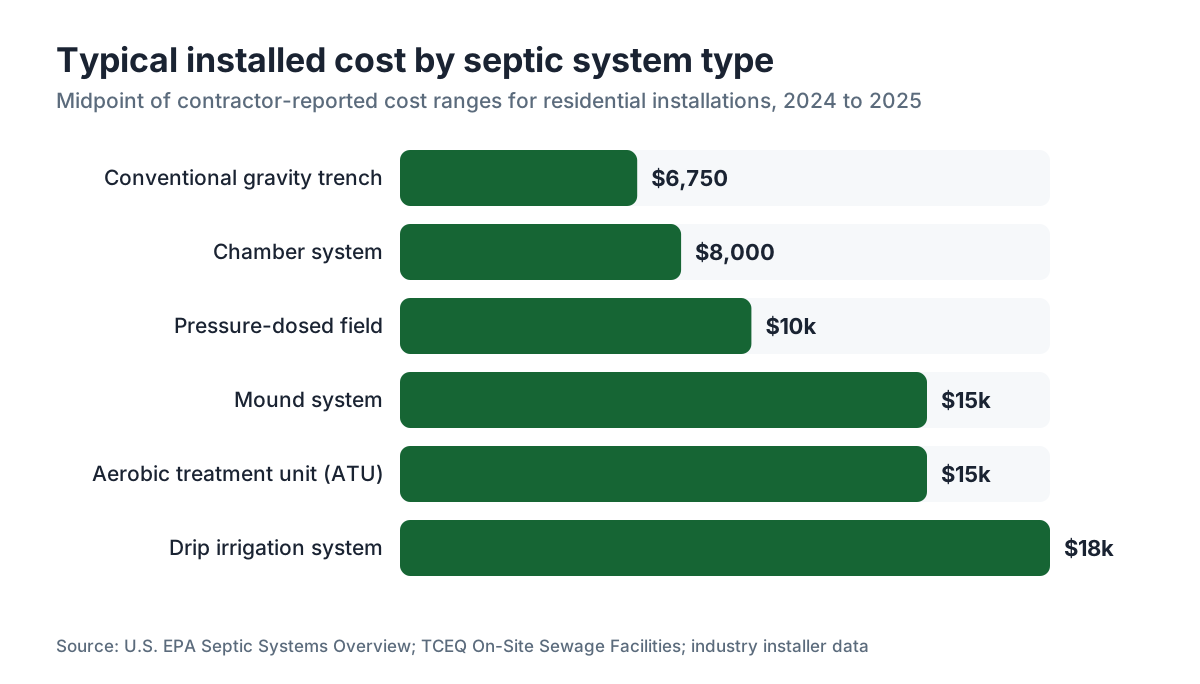
System type is the single biggest cost fork in the road. Your soil perc rate, lot size, distance to wells and water bodies, and local code decide which system you're allowed to use, and that decision can double your bill.
| System type | Typical installed cost | When it's required |
|---|---|---|
| Conventional gravity trench | $3,500 to $10,000 | Good-draining soil, adequate setbacks |
| Chamber system (Infiltrator) | $4,000 to $12,000 | Same as conventional, slightly smaller footprint |
| Mound system | $10,000 to $20,000 | High water table, shallow bedrock, slow-perc soil |
| Aerobic treatment unit (ATU) | $10,000 to $20,000 | Failing soil, small lots, near surface water |
| Drip irrigation system | $12,000 to $25,000 | Very limited drain field area, sensitive sites |
| Constructed wetland | $8,000 to $15,000 | Specialized, uncommon in residential use |
| Pressure-dosed field | $5,000 to $15,000 | Marginal soil, needs even distribution |
Aerobic treatment units are everywhere in Texas because much of the state has clay-heavy soil that fails a conventional perc test. The Texas Commission on Environmental Quality licenses ATU manufacturers and requires service contracts, which adds $150 to $300 a year in maintenance on top of the install [3].
Not sure which system your site needs? Your county sanitarian or a licensed OSSF (onsite sewage facility) designer can read your soil report and tell you. Don't let a contractor talk you into a $20,000 mound system without a written letter from the health department saying you need it.
How does household size and tank size affect the cost?
Most state codes size the tank by bedroom count, not by how many people live in the house. The logic is that bedrooms represent potential occupancy, and sizing for that protects the system when the house changes hands and a family of two becomes a family of six.
EPA design guidance recommends a minimum 1,000-gallon tank for homes with up to three bedrooms [1]. Many state codes require 1,250 gallons for four bedrooms and 1,500 gallons for five or six. Some states set higher floors.
| Home bedrooms | Minimum tank size (typical) | Tank cost (material only) |
|---|---|---|
| 1 to 2 | 750 to 1,000 gal | $600 to $900 |
| 3 | 1,000 gal | $700 to $1,200 |
| 4 | 1,250 gal | $900 to $1,500 |
| 5 to 6 | 1,500 gal | $1,100 to $2,000 |
| 6+ / large home | 2,000+ gal | $1,800 to $3,500 |
Going up one tank size adds $200 to $600 in material, which is nothing against the full project. If you're borderline on bedroom count, size up. It's the cheapest insurance in the whole build.
What drives the biggest cost differences from state to state?
Labor rates and permitting complexity swing wildly. A septic installer in rural Mississippi charges a different day rate than one in suburban Connecticut. That labor gap alone can account for $3,000 to $6,000 in total project cost.
State rules pile on cost in other ways. Some states require a licensed engineer or soil scientist on every new install. A few set specific tank construction standards (for example, California counties that bar certain plastic tanks). States near major aquifers or the Chesapeake Bay watershed have tighter setback rules that shrink the buildable drain field area and sometimes force a more expensive system type.
Florida's Department of Health regulates septic systems under Chapter 64E-6 of the Florida Administrative Code and requires a licensed contractor, a permit, and a final inspection for all new systems [4]. Florida also mandates a minimum 75-foot setback from potable water wells in most cases, which constrains lot layout.
Massachusetts Title 5 (310 CMR 15.000) is arguably the strictest residential septic code in the country [5]. It requires a licensed inspector at every property sale, mandates a reserve area for a future replacement field, and sets detailed soil evaluation requirements. A system that passes Title 5 often costs $15,000 to $25,000 because of those rules.
Want your state's real number? Start at your county health department's website or the state environmental agency's onsite wastewater page.
Are there hidden costs most quotes leave out?
Yes. Several line items ambush homeowners after the contract's already signed.
Tree and stump removal. If the planned field area has trees, they come out. Roots will wreck a drain field within a few years. Clearing one or two mature trees adds $500 to $2,000.
Pump and pump chamber. If your terrain needs a pump to move effluent from the tank to the field, you need a separate pump chamber, a pump, a float assembly, and an alarm. That's $1,000 to $3,000. Not every site needs one, but plenty do.
Effluent filter. Most new installs include an effluent filter on the tank outlet as standard. If it's not in the quote, ask. It's a $100 to $300 add-on and it extends drain field life by keeping solids out.
Riser installation. Concrete tanks buried deep with no risers are miserable to service. Adding precast concrete or plastic septic tank risers to bring access up to grade costs $200 to $600 and saves you that much every single time the tank needs pumping. Worth every dollar.
Soil import for mound systems. Mounds need clean imported fill that meets spec. Where clean sand is scarce, the fill alone runs $2,000 to $5,000 delivered.
Reinspection fees. Fail an inspection and there's usually a reinspection fee of $50 to $200. Rare with an experienced crew, but it happens.
Ask every contractor to itemize. A lump-sum number with no breakdown is hard to compare and easy to pad.
How do septic installation costs compare to connecting to public sewer?
Where public sewer is available, some homeowners can connect instead of installing a septic system. The math is closer than it looks.
A new sewer connection in a suburban area runs $1,500 to $6,000 for the lateral connection fee, plus the cost of running pipe from the house to the street. In dense urban areas with high tap fees, or where the street has to be cut open, connection costs can top $15,000.
Then there's the recurring bill. Residential sewer service runs $30 to $80 a month, or $360 to $960 a year. A well-maintained septic system costs roughly $300 to $600 every three to five years for pumping (see how often to pump your septic tank), plus the odd minor repair.
Over 20 years, a septic system usually costs less total than sewer service, assuming no big failure. The catch is the failure. A septic replacement can run $5,000 to $20,000, while sewer users hand that risk back to the municipality.
On rural land, public sewer often isn't an option at any price. The EPA estimates about 21 million U.S. homes rely on septic systems, roughly one in five households [1].
Can you get financial help with the cost of a new septic system?
Yes, and far more homeowners qualify than ever apply.
The USDA Rural Development program offers Section 504 loans and grants to very-low-income rural homeowners for repairs including septic replacement, and Section 306C Water and Waste Disposal Grants can fund community and individual septic projects in rural areas [6].
The EPA's SepticSmart program keeps a resource page pointing to state and local assistance programs [1]. Many states run their own revolving loan funds or grants aimed at failing onsite systems. Virginia's Department of Health, for one, administers a cost-share program for failing systems in certain watersheds [10].
Some counties fund programs through Clean Water Act Section 319 nonpoint source grants. These target areas with documented water quality problems from failing septic systems and can cover a chunk of replacement cost for qualifying homeowners.
A few states allow deductions or credits for septic upgrades, especially for systems that cut nitrogen loading in sensitive watersheds. Massachusetts and Maryland have both offered such incentives at various points. Check with your state revenue agency before you assume it's gone.
Financing is also available through FHA Title I home improvement loans, which don't require home equity and can cover septic work. Terms and rates vary by lender.
What's the actual process for putting in a septic system, step by step?
Knowing the sequence helps you manage the contractor, catch delays, and ask the right question at the right stage.
1. Site evaluation. A licensed soil scientist or evaluator runs a perc test or soil morphology evaluation. One to three hours on-site. The results dictate which system you can use and how big the field has to be.
2. System design. A licensed designer (engineer, OSSF designer, or in some states a certified contractor) draws the plan: tank size, field dimensions, setbacks from wells, property lines and waterways, and any special requirements.
3. Permit application. The designer or contractor submits the plan to the county health department or state agency. Review runs from a few days in rural counties to six to eight weeks where the process is complex.
4. Excavation. Once the permit issues, the crew digs for the tank and field lines. That's a one- to two-day job for a conventional system on accessible ground.
5. Tank and field installation. The tank gets set in the hole (usually by crane or hydraulic arm), outlet baffles and filters go in, and the field lines or chambers get laid out and connected.
6. Inspection. The health department inspector visits before backfill. This is the step that matters. Never let a contractor backfill before the inspector signs off.
7. Backfill and site restoration. After the inspection passes, the site gets filled and graded, then topsoil and seed over the field.
8. Final permit closeout. The contractor submits as-built drawings and the permit closes. Those as-builts show where the system is buried. Keep them somewhere you'll find them in ten years.
For the full technical walkthrough, see the septic tank installation guide. Start to finish, first perc test to final backfill, usually takes three to twelve weeks, mostly driven by permit review.
How do I get an accurate quote and avoid getting overcharged?
Get at least three itemized bids. Not three lump sums. Three line-item breakdowns. Permit fees, soil testing, tank cost, excavation, field materials, labor, and inspection fees should each show up on their own line. If a contractor won't itemize, move on.
Verify the license. Nearly every state that licenses septic installers has an online lookup tool. In Florida you check through DBPR. In Texas, through TCEQ. A licensed contractor carries insurance and answers to a licensing board if the job goes sideways.
Get the as-built drawing written into the contract. Some contractors try to charge separately for it. You legally need that document for future repairs, inspections, and the eventual sale.
Be wary of anyone who says you need a pricier system type without a health department letter or engineer's report backing it up. The permit application forces the issue eventually, but a bad-faith contractor can burn weeks of your time first.
If you're thinking past the install to running the system, SepticMind's homeowner tools include a service history tracker and maintenance reminders to keep you ahead of pumping and inspection schedules.
Last thing: the cheapest bid is sometimes the right call and sometimes a trap. If one bid comes in 40 percent under the other two, ask exactly what it leaves out.
What ongoing costs should I budget for after installation?
A new septic system isn't a set-it-and-forget-it purchase. Budgeting for maintenance from day one heads off the much bigger cost of a system repair or replacement.
Pumping is the baseline. The EPA recommends pumping every three to five years for a typical household [1]. A standard septic tank pump out costs $275 to $600 depending on tank size and local rates. Averaged over the cycle, budget roughly $100 to $150 a year.
ATUs and other advanced systems are different. Most state rules (and most manufacturer warranties) require an annual or semi-annual service contract with a licensed provider. Those contracts run $150 to $400 a year and cover inspection of the aeration components, effluent quality checks, and minor adjustments.
Clean the effluent filter at every pumping. If your installer put one in (they should have), the pumper handles it. If not, it's a cheap add-on during the visit. The septic tank cleaning guide covers what a full service visit includes.
Plan for the drain field too. A well-maintained conventional field lasts 25 to 30 years, sometimes longer. Replacement, if it ever comes, costs $5,000 to $15,000 depending on the site. Set aside even $200 to $300 a year and you won't get blindsided.
Realistic annual operating cost for a well-run conventional system: $150 to $350 in normal years, with a lump pump-out every three to five. Still far below municipal sewer in most areas.
How do I find the right installer and what questions should I ask them?
Start at your county health department. Many county sanitarian offices keep a list of licensed installers who have pulled permits locally. That list hands you vetted contractors who already know the local code and the inspectors, which matters more than you'd think.
Ask every bidder these before you hire:
- Are you licensed in this state for onsite sewage system installation? What's your license number?
- Will you pull the permit, or do I?
- Who does the soil evaluation, and is that cost in the bid?
- What tank manufacturer do you use, and what's the tank warranty?
- What happens if the inspection fails?
- Can I see two or three references from recent installs in this county?
- Is the as-built drawing included in your price?
For operators running fleets of service jobs, SepticMind's dispatch and scheduling platform tracks permits, as-built documents, and service histories across accounts, which makes ongoing compliance far easier to run.
The National Environmental Services Center at West Virginia University keeps guidance on finding qualified septic professionals and what to look for in an installer [8]. Your state environmental agency usually has similar resources.
Frequently asked questions
How much does it cost to put in a septic tank?
The tank alone, installed, costs $1,200 to $4,000 depending on size and material. But the tank is one part of a system. The full system (tank, drain field, excavation, permits) runs $3,500 to $15,000 for a conventional install. Alternative systems for difficult sites can reach $20,000 to $30,000. Labor and local permit requirements drive most of the variation.
How much is it to put in a septic tank for a 3-bedroom home?
A three-bedroom home typically needs a 1,000-gallon tank and a drain field sized for about 300 to 450 gallons per day. Installed cost in most of the country runs $6,000 to $12,000 for a conventional gravity system. The range reflects soil conditions, site access, and local labor rates. Strict-code states like Massachusetts and California sit at the high end; the rural Midwest and South sit low.
What is the cheapest type of septic system you can install?
A conventional gravity-fed trench-and-gravel system is the least expensive option when soil allows it. Installed cost can be as low as $3,500 to $6,000 in favorable conditions. The key is passing a perc test with a fast enough rate. If the soil fails, you're pushed into a mound or ATU system, which costs a lot more.
How long does a new septic system last?
A properly installed, maintained concrete tank lasts 40 years or more. The drain field is the weak link: conventional gravel fields typically last 25 to 30 years with good care. ATU components like the aerator motor may need replacement every 10 to 15 years. Neglected systems, especially those never pumped, fail much sooner, sometimes inside 10 years.
Does a new septic system add value to a home?
Yes, in the sense that a functioning, code-compliant system is required for sale in most states, and a failing system is a liability that drags down the price. Appraisers don't usually assign a premium for a new system, but replacing a failed one before listing removes a large negotiation discount. In Massachusetts, a Title 5 inspection is required at sale, so a passing system has direct transaction value.
Can I install a septic system myself to save money?
In most states, no. Septic installation requires a licensed contractor, and unpermitted work is illegal and creates serious liability at resale. A handful of rural jurisdictions allow owner-builders to install their own systems with a permit, but even then a licensed inspector must approve the work. An unpermitted install risks a stop-work order, fines, and mandatory removal. The rules exist because failed systems contaminate groundwater.
How much does a perc test cost before installing a septic system?
A standard percolation test runs $150 to $700 in most areas, depending on whether a licensed soil scientist is required and how many test holes the site needs. Some states have replaced the traditional perc test with a soil profile evaluation, which is pricier, often $400 to $1,200, because it requires a licensed soil scientist. Permit fees for the test itself usually add $50 to $200 on top of the professional's fee.
How much extra does a mound septic system cost compared to conventional?
A mound system typically costs $10,000 to $20,000 installed, against $4,000 to $10,000 for a conventional system on the same site. The premium comes from imported fill sand, the larger footprint, the required pump chamber, and the extra labor to build the mound to grade. On sites with high water tables or slow-perc soil, a mound is often the only permitted option.
Are there grants or loans to help pay for a new septic system?
Yes. The USDA Rural Development Section 504 program offers loans and grants to qualifying low-income rural homeowners for septic work. The EPA SepticSmart program links to state and local assistance programs. Many states run their own revolving loan funds for failing systems, especially in watershed protection areas. Some counties have grant programs funded through Clean Water Act Section 319 money. Check with your county health department for local options.
What permits are required to put in a septic system?
At minimum, a construction permit from your county health department or local permitting authority is required in every state. Many counties also require a separate soil evaluation permit before any digging. Some states require plan review by a licensed engineer. After installation, a final health department inspection is required before backfill. Permit fees total $200 to $1,500 depending on jurisdiction. Your licensed installer usually handles the applications.
How much does it cost to pump a new septic tank after installation?
Routine pumping costs $275 to $600 for a standard 1,000-gallon tank, varying with tank size, access, and local market. The EPA recommends pumping every three to five years. Adding risers at installation keeps access easy and saves the digging cost at pump time. See the full guide on septic tank pumping for what the service includes.
Does homeowner's insurance cover the cost of putting in a new septic system?
Standard homeowner's policies typically do not cover a new septic system or drain field replacement due to age or normal failure. Some policies cover sudden, accidental damage, like a tank collapse caused by a vehicle. Specific septic riders are available from some specialty insurers. If you're buying a home with a septic system, verify its age and condition before closing, because this cost lands entirely on the owner.
How long does the septic system installation process take?
The physical install, excavation through backfill, takes two to five days on a typical residential site with no complications. Permit review is the real timeline driver: rural counties with simple codes may issue permits in two to three days, while complex jurisdictions can take six to ten weeks. Total project time from first soil evaluation to system in service is typically three to twelve weeks.
What size septic tank do I need for my home?
Most state codes size tanks by bedroom count, not actual water use. The EPA recommends a minimum 1,000-gallon tank for a three-bedroom home. Four bedrooms typically requires 1,250 gallons, and five to six bedrooms require 1,500 gallons. Sizing up is cheap insurance. If you have a garbage disposal, some codes require a larger tank or more frequent pumping to handle the extra solids load.
Sources
- U.S. EPA, Septic Systems Overview: EPA estimates about 21 million U.S. homes rely on septic systems; typical new system cost estimate of $3,000 to $10,000; recommendation to pump every 3 to 5 years; 1,000-gallon minimum tank for up to 3-bedroom home; SepticSmart resource page links to assistance programs.
- North Carolina Department of Health and Human Services, On-Site Water Protection: North Carolina onsite wastewater rules require a soil morphology evaluation by a licensed soil scientist for most new systems.
- Texas Commission on Environmental Quality (TCEQ), On-Site Sewage Facilities: TCEQ licenses aerobic treatment unit manufacturers and requires ongoing maintenance service contracts for all ATUs in Texas.
- Florida Department of Health, Onsite Sewage Programs: Florida Chapter 64E-6 requires a licensed septic contractor, permit, and final inspection for all new septic system installations; 75-foot setback from potable water wells applies in most cases.
- Massachusetts Department of Environmental Protection, Title 5 Septic System Regulations (310 CMR 15.000): Massachusetts Title 5 requires a licensed inspector at every property sale, mandates reserve area for a future replacement field, and sets detailed soil evaluation requirements.
- USDA Rural Development, Water and Waste Disposal Programs: USDA Section 504 offers loans and grants to very-low-income rural homeowners for septic repairs; Section 306C Water and Waste Disposal Grants can fund individual and community septic projects.
- National Environmental Services Center, West Virginia University: NESC at WVU provides guidance on finding qualified septic professionals and what to look for in a licensed installer.
- U.S. EPA, How Your Septic System Works: EPA guidance on conventional septic system components including the tank, distribution system, and drain field, and their typical functions.
- Virginia Department of Health, Onsite Sewage and Water Services: Virginia administers cost-share programs for failing septic systems in certain watersheds and regulates alternative system types.
Last updated 2026-07-09