Residential septic tank inspections: what they cost, cover, and when you need one
By the SepticMind Editorial Team
TL;DR
- A residential septic inspection checks tank condition, inlet and outlet baffles, sludge and scum levels, and the drain field.
- Routine visual checks run $100 to $250.
- Full Title 5-style engineered inspections reach $300 to $900.
- Most states require an inspection at home sale.
- Inspect every 1 to 3 years, pump every 3 to 5 years, and you avoid the $5,000-plus failures.
What does a residential septic tank inspection actually include?
A residential septic inspection checks tank condition, baffle integrity, sludge and scum depth, and drain field function. There's no single national checklist. What gets covered depends on who ordered it, why, and which state you're in. Most thorough inspections still hit the same core items.
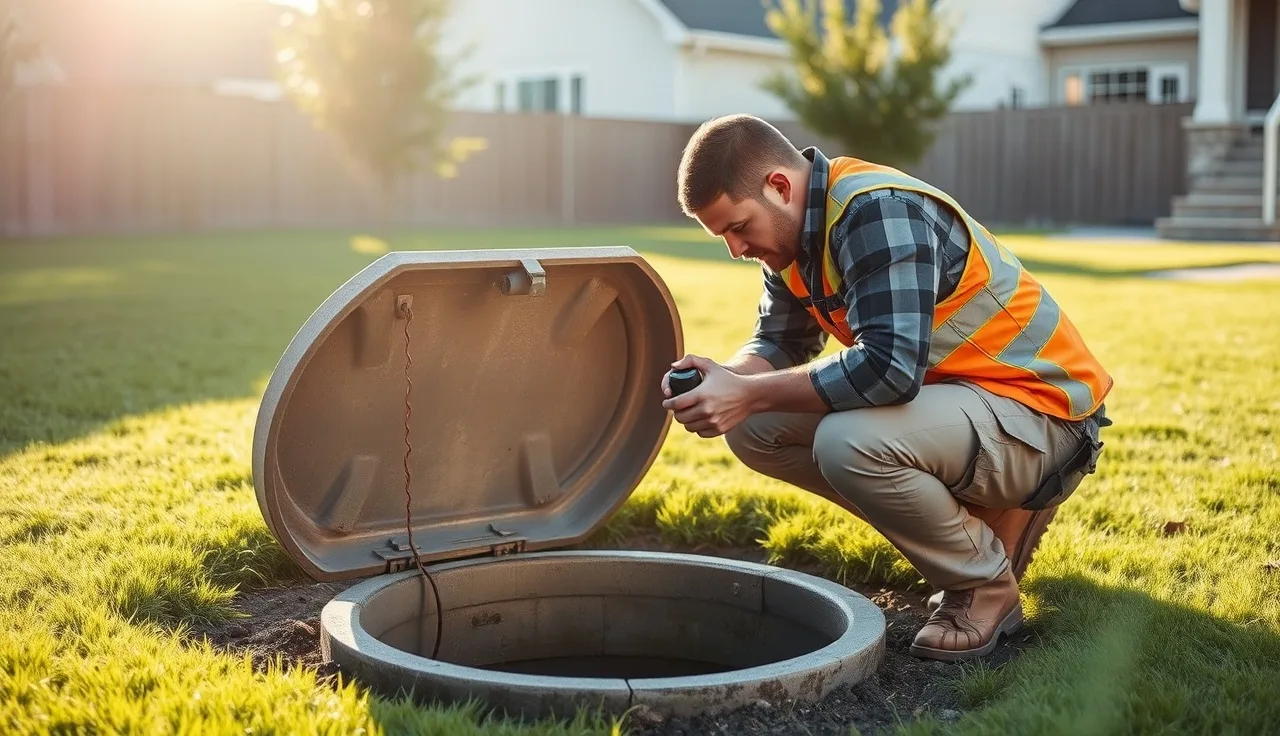
The inspector finds and uncovers the tank access lids (sometimes that means digging), measures the sludge at the bottom and the scum floating on top, and checks whether the inlet and outlet baffles are intact. Baffles are the plastic or concrete tees that keep solids from washing into the drain field. A cracked or missing outlet baffle is one of the most common failures inspectors write up.
Next the inspector looks for cracks in the tank walls, signs of groundwater getting in when it shouldn't (infiltration) or sewage leaking out when it shouldn't (exfiltration), and whether the lid is structurally sound. Many inspectors run water through the house to confirm flow reaches the tank and leaves it normally.
The drain field, or leach field, gets a visual read: soft or wet ground over the lines, bright green stripes during dry weather, and surface ponding all point to trouble. A basic inspection won't send a camera down the field laterals. A full engineered inspection (the kind required at sale in states like Massachusetts) goes much further and may include dye testing or a hydraulic loading test [1].
What a standard inspection leaves out: a camera run of the sewer line from house to tank, pump testing on pressure-dosed systems, and soil testing. Want those? Ask for them by name and expect to pay more.
How much does a septic inspection cost?
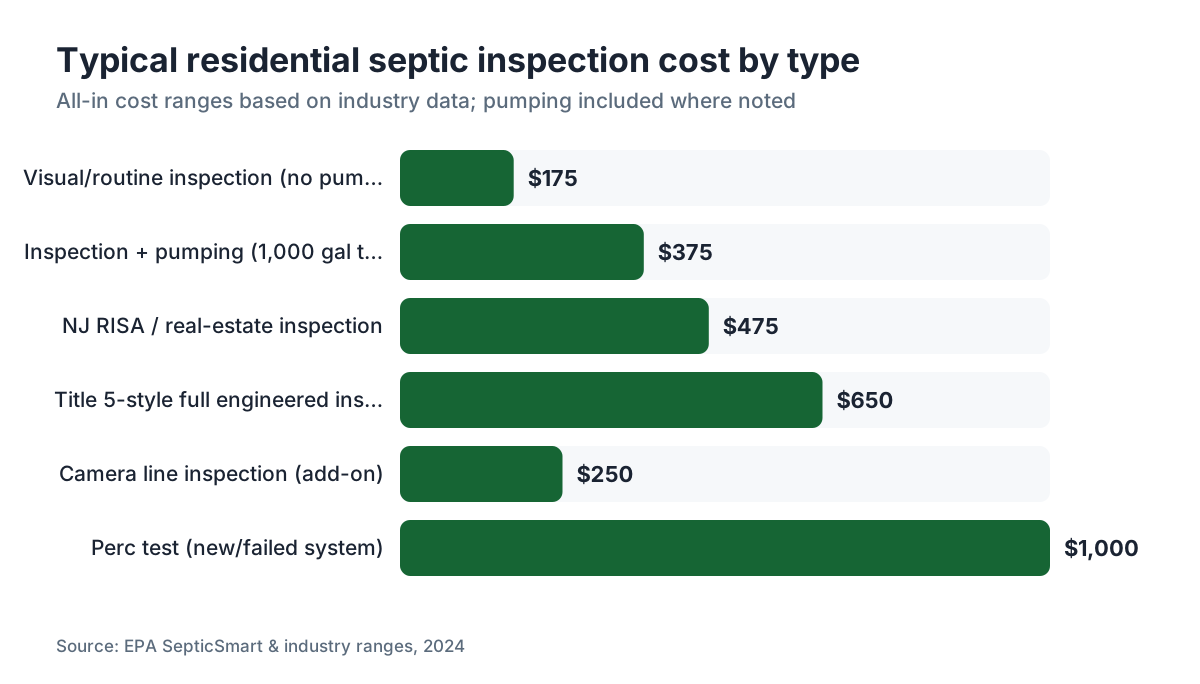
A basic visual septic inspection runs $100 to $250. Add pumping and you're at $250 to $450. A full engineered real-estate inspection reaches $300 to $900. Prices swing hard by region, inspector credentials, and how deep and buried your tank is.
| Inspection type | Typical cost range | What drives the high end |
|---|---|---|
| Visual/routine inspection | $100, $250 | Tank is deep, hard to access |
| Pumping-included inspection | $250, $450 | Tank size, hauling distance |
| Real-estate/Title 5-style full inspection | $300, $900 | Engineered report, hydraulic test |
| Camera inspection of lines | $150, $350 add-on | Pipe length, access difficulty |
| Perc test (new or failed system) | $500, $1,500 | Soil scientist, permits |
New Jersey makes a useful reference point. A residential inspection there ahead of a home sale commonly runs $300 to $600, because the state requires a licensed inspector and a report that meets NJ Department of Environmental Protection standards [2]. Not cheap. Far cheaper than a drain field replacement, which typically runs $5,000 to $25,000 depending on soil and system size [3].
If the inspector recommends pumping before or during the visit (good practice regardless), budget for that separately. Septic tank pumping runs $300 to $600 for a typical 1,000 to 1,500 gallon tank. Many inspectors won't give you a real condition assessment without emptying the tank first. You cannot see the baffles or the tank floor through 18 inches of sludge.
Here's the honest part: nobody publishes great national inspection cost data. The EPA SepticSmart program says regular inspection and maintenance is "much less expensive than repairing or replacing a malfunctioning system," but it gives no national inspection price [4]. Your best local benchmarks come from state DEP offices and regional extension services.
How often should a residential septic tank be inspected?
Inspect every 1 to 3 years. Pump every 3 to 5 years for a standard gravity system. Those are the EPA's numbers, and they aren't guesses [4]. They track how fast sludge and scum build up under normal household use.
Several things push you toward the short end. Garbage disposals add a lot of solid loading. EPA guidance notes that disposal use can raise the solids reaching the tank substantially, which fills it faster [5]. Big families, young kids, and heavy water use all shorten the interval. Steel tanks corrode faster than concrete or fiberglass. If your system has a pump (pressure-dosed or mound designs), check that pump and its floats every year, because a dead pump can back sewage into your house within days.
Newer alternative systems with mechanical or electrical parts often require annual inspection by a licensed pro as a permit condition. Read your permit or call your county health department.
Never had the system inspected and don't know when it was last pumped? Get it done now, no matter how long you've lived there. The EPA reports that "more than one in five U.S. households" relies on a septic system [4], and plenty of those go a decade without a single inspection. That's how a $350 maintenance visit turns into a $30,000 drain field.
For scheduling specifics, see our guide on how often to pump a septic tank.
When is a septic inspection legally required?
The most common trigger is a home sale. Most states either require a septic inspection before ownership transfers or give the buyer the right to one as a sale condition. The rules differ a lot state to state.
Massachusetts has the strictest law in the country. Title 5 of the state Environmental Code (310 CMR 15.000) requires a full inspection within two years of most property transfers [6]. A state-certified inspector does the work, and the report goes to both parties and the local board of health. A failed system has to be repaired or upgraded before or shortly after sale.
New Jersey requires an inspection at sale under the Realty Improvement Sewerage and Facilities Act, and a licensed inspector has to perform it [2]. The seller usually pays, though that's negotiable. NJ inspections assess the tank, distribution box, and absorption area.
Other common triggers:
- Refinancing (some lenders require it, especially FHA and USDA loans)
- Adding bedrooms or expanding the home (this raises design flow and may need proof the system can handle it)
- Permit applications for renovation
- Complaints or code violations filed with the health department
- Enrollment in a county or municipal periodic inspection program (several counties in VA, MD, and PA run these)
Buying a home? Do not waive the septic inspection to win a bid. Inheriting a failed system costs anywhere from a few thousand dollars for a septic tank repair to tens of thousands for full replacement. That's not a gamble worth a week of due diligence.
What happens during a septic inspection in New Jersey specifically?
In New Jersey, a licensed inspector must evaluate the on-site system before a home with septic can close. The inspector locates the tank and distribution box, usually pumps the tank, measures sludge and scum, checks baffles and tank integrity, and inspects the absorption area, then files a written report. NJ runs one of the more regulated programs in the country, so this comes up often.
Under the Realty Improvement Sewerage and Facilities Act (N.J.S.A. 58:11-23 et seq.), the seller has to have the system inspected by a licensed inspector before closing [2]. The NJ DEP licenses those inspectors and sets minimum standards.
The distribution box gets close attention in NJ. A cracked or unlevel D-box sends uneven flow to the drain field laterals, overloading some lines and starving others. It's a common failure in older NJ systems and cheap to fix if caught early.
Counties administer their own programs under state oversight, so the details vary. Bergen, Burlington, and Ocean counties each publish their own protocols. If you're buying or selling in NJ, confirm requirements with the specific county health department rather than the state DEP homepage.
Cost for a NJ residential inspection typically runs $350 to $600 all-in with pumping. If the report shows a failure or defect, remediation becomes a negotiating point. For bigger fixes, see our guide to septic system repair.
What are inspectors actually looking for and what causes a failure?
Most homeowners picture a pass/fail box. It's more of a spectrum, from clean and functional to actively failing, with a lot of gray in between. Here are the findings inspectors document most.
Missing or deteriorated baffles. The outlet baffle matters most. Without it, solids run into the drain field and clog the soil. Concrete baffles in old tanks crack and crumble; plastic tee replacements cost $50 to $200 in materials and are cheap to fix early.
High sludge or scum levels. When sludge plus scum takes up about a third of the tank's liquid depth, the common rule of thumb from EPA guidance, the tank needs pumping now [4]. At that point treatment capacity drops and the tank starts passing solids downstream.
Tank cracks or structural failure. Concrete tanks crack from soil movement or root intrusion. Minor cracks sometimes seal; real structural failure means septic tank repair or replacement.
Groundwater intrusion. If the liquid level sits above the outlet pipe and it hasn't rained hard, water is getting in somewhere. That dilutes treatment and can swamp the drain field.
Drain field saturation. Wet, spongy ground over the field, effluent pooling at the surface, or sewage odors near the lines mean the soil has stopped absorbing. This is the expensive one. A failed leach field may need full replacement.
Distribution box problems. A tipped or cracked D-box sends flow unevenly. Often visible during the inspection and fixable for a few hundred dollars.
A finding doesn't automatically kill the sale or condemn the system. Most issues are repairable. The real question is who pays and by when.
How do you find a qualified septic inspector?
Licensing rules for septic inspectors vary by state, which is genuinely confusing. Some states let only licensed professional engineers or sanitarians sign a report. Others accept a certified pumper with inspection training. A few have almost no formal licensing at all.
Start with your state's department of environmental quality, department of health, or the equivalent agency. They usually keep a list of licensed inspectors or can point you to the right board. The National Environmental Health Association and the National Association of Wastewater Technicians both run training and certification programs many inspectors hold, though those are voluntary credentials, not state licenses [7][12].
Buying a home? Your agent probably has a short list of inspectors they've used. Fine as a start. Ask the inspector directly: how many residential systems do you inspect a year, are you licensed in this state, and do you carry errors and omissions insurance? An inspector with no E&O coverage is a risk if they miss something big.
Be skeptical of anyone who charges next to nothing and finishes in 20 minutes without pumping the tank. A real inspection takes 1 to 3 hours depending on how complex the system is. Cutting corners here is exactly how people inherit broken systems.
Operators juggling scheduling and inspection records across many clients can use platforms like SepticMind to track inspection histories, upcoming due dates, and report documentation in one place. That cuts the manual work of staying compliant across a customer base.
Can you inspect your own septic system, or do you need a professional?
You can do a basic visual check yourself, and doing it regularly is smart. It won't replace a professional inspection, but it catches obvious problems early.
What you can do: note any odor near the tank or field, look for wet or unusually green grass over the field, check that the tank lid is intact and not sinking (a sinking lid is a serious safety hazard), and watch for slow drains or gurgling inside the house.
What you cannot safely or usefully do: measure sludge and scum without proper gear (a sludge judge or equivalent), judge baffle condition without opening the tank, or assess soil absorption without specific testing. Opening a septic tank exposes you to toxic gases, including hydrogen sulfide, which can knock a person out fast. That's not a scare tactic. OSHA rules on permit-required confined spaces exist because these entries kill workers every year [8].
For regulatory purposes, a self-inspection satisfies nothing. Any inspection tied to a sale, permit, or lender has to come from a qualified professional.
The practical middle ground: walk the system every six months, keep records of when it was last pumped (see septic tank pump out for what that involves), and book a professional inspection every 1 to 3 years. That combination catches most problems before they turn into disasters.
What should you do to prepare for a septic inspection?
A few simple steps make the inspector's job faster and your results more accurate.
Locate your tank lids before the inspector arrives if you can. Most charge extra to find and dig up buried lids. Dig out your system as-built drawing too (sometimes called a record drawing or septic card). County health departments often keep these on file if you don't have a copy.
Don't pump the tank right before the inspection to hide high sludge. Some sellers try it, and experienced inspectors know how to spot a freshly pumped tank with no normal scum layer. It's a disclosure problem and it defeats the point of the inspection.
Hold off on heavy water use the morning of the visit. Running the dishwasher, five loads of laundry, and long showers beforehand loads the system and can make a marginal drain field look worse than it runs on a normal day.
Have your maintenance records ready. When was the tank last pumped? Any repairs done? That context helps the inspector read what they find. Never had it serviced? Say so. That's useful too.
After the inspection, get the written report and keep it. If you're selling, it's a disclosure document. If you're staying, it's your baseline for tracking condition over time. A good report tells you not only what's wrong but what to watch for next round.
What happens if your septic system fails inspection?
A failed inspection is not a disaster, but it does force action. What comes next depends on how bad the failure is, what triggered the inspection, and what your state requires.
For a home sale, a failed inspection usually leads to one of three outcomes: the seller fixes it before closing, the parties negotiate a price cut so the buyer handles it, or the deal falls apart. In Massachusetts under Title 5, a failed system has to be repaired or upgraded on a set timeline, generally within two years of the inspection, with limited exceptions [6]. In NJ, the DEP and county health departments have enforcement authority over failing systems.
For a routine inspection not tied to a sale, a failure still creates an obligation to repair, but the timeline is usually more flexible, unless there's an imminent health threat like sewage surfacing in the yard or backing up indoors. Health departments can order repairs within 30 to 90 days in those cases.
Remediation cost depends entirely on what failed. A baffle replacement is a few hundred dollars. A cracked distribution box runs a few hundred to a couple thousand. A full drain field replacement runs $5,000 to $25,000 or more depending on lot conditions and permitting [3]. A complete system replacement with a new tank runs higher; see our guide on the cost to install a septic system.
If the drain field failed, ask about rehabilitation options like aerobic treatment units or alternative soil treatment before assuming you need a full replacement. Some fields can be restored; others cannot. An engineer's assessment (separate from the inspector's) is worth the money before you commit to major work.
SepticMind's inspection tracking tools help operators and homeowners document failure findings, track remediation timelines, and keep the paper trail regulators want.
How does a septic inspection differ from a whole-home inspection?
Buyers often assume the general home inspection covered the septic system. It almost never did, at least not in any way that matters.
General home inspectors observe conditions visible without special equipment. They'll note that a tank is present, maybe walk the drain field for obvious wetness, and eyeball interior plumbing. They are not trained or equipped to open tanks, measure sludge, evaluate baffles, or test soil absorption. The American Society of Home Inspectors standards of practice specifically exclude septic systems from a standard home inspection unless separately contracted [9].
A dedicated septic inspection is a separate job with a separate cost. Your real estate contract should name it as a distinct contingency. If your purchase agreement just says "inspection contingency" without calling out the septic system, you may have signed away your right to a septic inspection without realizing it. Have that conversation with your real estate attorney before you sign.
The takeaway: always contract a septic inspection separately when buying a home on septic. Treat it like title insurance or a radon test, just another line in due diligence. Our septic tank inspection page covers what's involved across the different inspection types.
Are there federal programs or incentives that help cover inspection costs?
Not directly at the federal level, but a few avenues are worth knowing.
The EPA's SepticSmart initiative provides education and pushes regular inspection and maintenance, but it runs no direct homeowner subsidy [4]. USDA Rural Development does offer grants and loans under the Section 504 Home Repair program and Section 306C Water and Waste Disposal programs that can cover failing septic system costs for eligible rural, low-income households [10]. These are need-based and geographically targeted.
State programs vary widely. Massachusetts, Virginia, and Maryland run funded loan or grant programs to help homeowners upgrade failing systems near sensitive waters. Maryland's Bay Restoration Fund has provided grants for septic upgrades on properties near the Chesapeake Bay [11]. Check your state environmental agency's site for current programs.
For new systems after a failed inspection, some counties offer low-interest loans through their own programs. Call your county health department or extension office before you assume the full cost lands on you.
If you itemize deductions, some septic repairs tied to the structural integrity of the home may factor into home improvement loan interest deductions. That's a tax question for a tax professional to answer for your situation. Don't rely on general advice here.
Frequently asked questions
How long does a residential septic inspection take?
A thorough inspection takes 1 to 3 hours for a standard gravity system. Complex systems with pumps, multiple tanks, or hard-to-find components take longer. An inspector who finishes in 20 minutes without pumping the tank is almost certainly skipping steps. Plan for a half-day window if the tank also needs pumping and the lids are buried.
Do you need to pump the septic tank before an inspection?
Pumping before or during the inspection is generally recommended, and many states require it for a complete evaluation. You cannot properly assess baffle condition, tank walls, or the tank floor through several feet of sludge. Some inspectors pump as part of their service; others coordinate with a pumping company. Clarify this before booking so you know the all-in cost.
What does a septic inspection cost in New Jersey?
A residential septic inspection in NJ typically costs $350 to $600 including pumping, which is usually required to meet NJ DEP and county health department standards. The inspector must be state-licensed. Costs vary by county, tank size, and whether the lids sit at grade. If excavation is needed to expose buried lids, expect $100 to $300 more.
Can a septic inspection be waived in a real estate transaction?
It depends on the state. In Massachusetts (Title 5) and New Jersey (RISA), the inspection is required by law and cannot be waived. In states without mandatory inspection laws, buyers can contractually waive it, but that's a real financial risk. Inheriting a failing system can cost tens of thousands of dollars. Waiving this to speed up a sale is rarely a good trade.
How do I find out when my septic tank was last inspected?
Start with your county health department or sanitarian's office. Many counties keep permit files and inspection records for on-site systems. If you have a real estate disclosure from when you bought the home, check it for service history. Your local pumping company may have records too if they've serviced the property. If you find nothing, treat the system as uninspected and schedule service now.
What is the difference between a septic inspection and a perc test?
A septic inspection evaluates an existing system's condition. A perc test (percolation test) measures how fast water absorbs into the soil, done to design or permit a new system or check whether a failed drain field can be replaced in the same spot. They're separate processes, done by different specialists (usually a licensed soil scientist or engineer for perc tests), at different costs and timelines.
Does homeowner's insurance cover a failed septic system?
Standard homeowner's policies typically exclude septic failures, treating them as maintenance rather than sudden accidental losses. Some policies cover sewage backup damage inside the home as an add-on rider, but not the cost of repairing or replacing the system itself. Check your specific policy language. A few specialty insurers offer septic service contracts or riders, but these are not widely available.
How far in advance should I schedule a septic inspection before selling my home?
Schedule at least 4 to 6 weeks before your planned listing date in states with mandatory inspection requirements. If the inspection turns up problems needing repair, you'll want time to get contractor bids, pull permits, and complete work without delaying closing. Some repairs, especially drain field work, need engineering plans and permits that take weeks on their own. Waiting until you have an offer creates needless time pressure.
What are signs that a septic system is failing between inspections?
Watch for slow drains across the house (more than one fixture), gurgling from toilets or drains, sewage odors inside or out, unusually lush green grass over the drain field, or soft wet areas near the tank or field. Any surface pooling of effluent is a health hazard and needs immediate professional attention. These signs mean the system needs evaluation now, not at the next scheduled inspection.
Do new septic systems still need to be inspected?
Yes, though the schedule can be more relaxed in the early years if the system was installed and permitted correctly. Most states run an installation inspection before the system goes into service. After that, EPA guidance still recommends a professional inspection every 1 to 3 years. New systems with mechanical or electrical parts (effluent pumps or aerobic treatment units) typically require annual inspection under the operating permit.
What credentials should a septic inspector have?
Requirements vary by state. At minimum, look for a state license or certification from your DEP, department of health, or equivalent agency. Voluntary credentials from the National Association of Wastewater Technicians (NAWT) or the National Environmental Health Association (NEHA) point to extra training. Always confirm the inspector carries liability and errors and omissions insurance. For real estate deals, confirm they can produce the specific report format your state or lender requires.
Can I get a septic inspection if my tank lids are buried?
Yes, but it adds cost and time. The inspector or a crew they coordinate will probe the yard to find the tank, then excavate to expose the lids. Expect $100 to $300 or more for excavation, depending on depth and soil. After inspection, consider having risers installed to bring the lids to grade. Risers cost $200 to $600 and pay for themselves in reduced excavation for every future inspection and pump-out.
Sources
- Massachusetts DEP, Title 5 Inspection Program: Massachusetts requires a full engineered septic inspection within two years of property transfer, including hydraulic loading tests in some cases
- New Jersey Department of Environmental Protection, Onsite Wastewater Management: New Jersey requires a licensed inspector to evaluate an on-site septic system at property sale under the Realty Improvement Sewerage and Facilities Act
- EPA, SepticSmart Program: Drain field replacement typically costs thousands to tens of thousands of dollars depending on site conditions and system size
- EPA SepticSmart, Homeowner's Guide to Septic Systems: EPA recommends inspecting septic systems every 1 to 3 years and pumping every 3 to 5 years; more than one in five U.S. households depends on a septic system
- EPA, Onsite Wastewater Treatment Systems Manual (EPA/625/R-00/008): Garbage disposal use increases the solids loading reaching the septic tank
- Massachusetts DEP, 310 CMR 15.000 Title 5 Environmental Code: Title 5 requires inspection within two years of property transfer; a failed system must be repaired or upgraded within a specified timeline after inspection
- National Association of Wastewater Technicians (NAWT): NAWT offers voluntary training and certification programs for septic system inspectors and pumpers
- OSHA, Permit-Required Confined Spaces: OSHA regulates permit-required confined space entry because hydrogen sulfide and other toxic gas exposure in spaces such as septic tanks and sewer structures causes fatalities
- American Society of Home Inspectors (ASHI), Standards of Practice: ASHI standards of practice exclude septic systems from the scope of a standard general home inspection unless separately contracted
- USDA Rural Development, Water and Environmental Programs: USDA Rural Development Section 504 and Section 306C programs can provide grants and loans for septic system repairs for eligible rural low-income households
- Maryland Department of the Environment, Bay Restoration Fund: Maryland's Bay Restoration Fund has provided grants to homeowners for upgrading failing septic systems near the Chesapeake Bay
- National Environmental Health Association (NEHA): NEHA offers credentialing programs for environmental health professionals including those conducting onsite wastewater system inspections
Last updated 2026-07-09