Failed perc test: what it means and what to do next
By the SepticMind Editorial Team
TL;DR
- A failed perc test means soil on your lot absorbs water too slowly (or too fast) to support a conventional septic drain field.
- It doesn't automatically mean you can't build.
- Alternative systems, mound systems, and aerobic treatment units can often satisfy regulators.
- Expect extra engineering costs of $5,000 to $20,000 or more on top of standard installation.
What does a failed perc test actually mean?
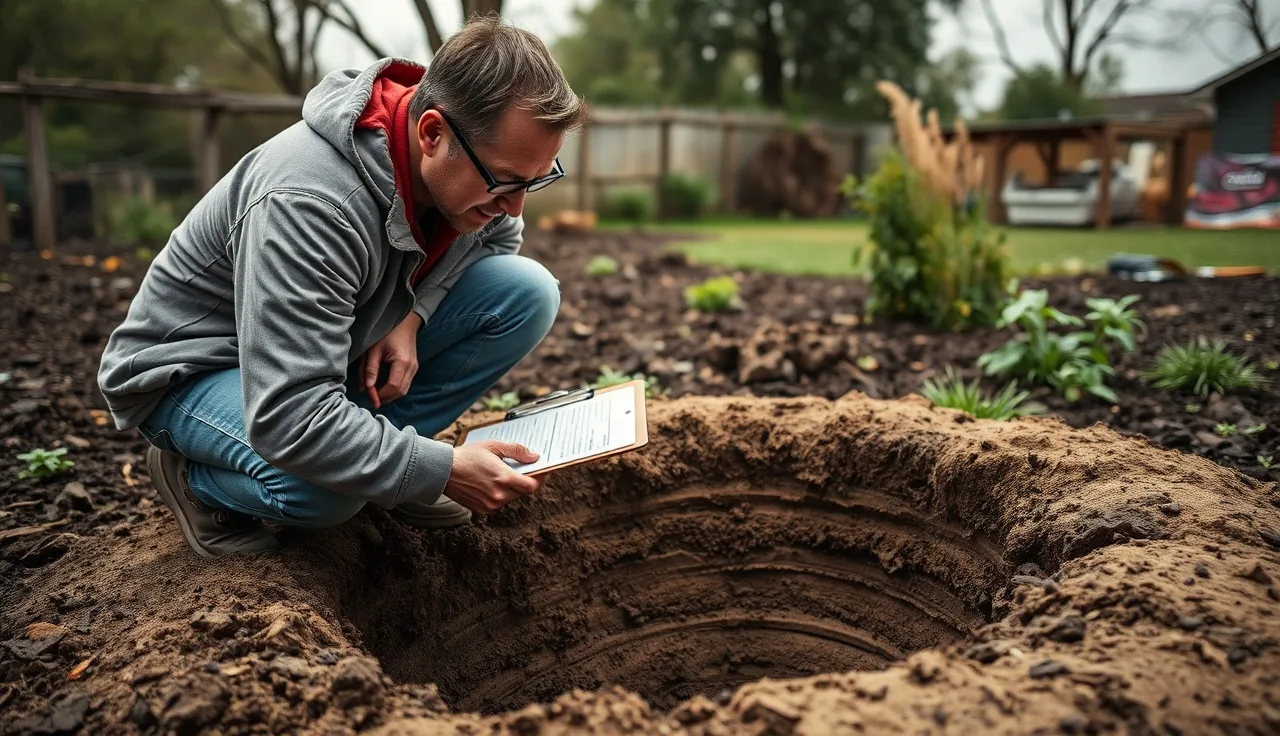
A percolation test, or perc test, measures how quickly water drains through the soil at a specific depth on your property. A technician digs test holes, saturates them, and then times how fast the water level drops. The result is expressed in minutes per inch (MPI). Most state codes approve conventional septic drain fields only when soil drains between roughly 1 and 60 MPI, though the exact range varies by state [1].
Fail below 1 MPI and your soil drains so fast that effluent races through before the ground can filter out pathogens. Fail above 60 MPI and your soil is so tight, usually clay-heavy, that water essentially sits there. Either way, a standard leach field can't function safely.
A failed result is a regulatory finding, not a final verdict on whether you can build. It means a conventional system is off the table. It does not mean every system is off the table. The distinction matters because a lot of people hear "failed" and assume the land is worthless for building. That's rarely true.
One other thing worth knowing: perc tests can fail for reasons that have nothing to do with the deep soil profile. Seasonal groundwater, a test done right after heavy rain, or improperly prepped holes can all produce a misleading failure [2]. If you're shocked by a result, ask whether the test conditions were ideal before you spend money on alternatives.
Why do perc tests fail? The main causes
Clay soil is the most common culprit. Clay particles are tiny and pack tightly, leaving almost no pore space for water to move through. A site dominated by clay will almost always read above 60 MPI, sometimes north of 120 MPI.
High water tables are the second major cause. If the seasonally high groundwater sits within two to four feet of the surface (the minimum separation distance varies by state), regulators won't approve a conventional system regardless of how the soil itself percolates [1]. The concern is that a shallow water table puts treated and partially treated effluent too close to drinking water sources.
Rocky or shallow soils cause failures too. Ledge rock close to the surface means there's simply no room for a soil absorption system.
Fast-draining sandy or gravelly soils can fail on the other end, reading under 1 MPI. This is less common but it happens, particularly in parts of Florida, coastal New England, and the Southwest.
Poor test conditions produce false failures more often than people admit. The EPA's SepticSmart guidance notes that soil conditions at test time, including recent rainfall and soil saturation levels, can significantly affect results [2]. Some states now require testing during the wettest season specifically to avoid optimistic readings, but a test done in an unusually wet week can cut the other way and give you a number that doesn't represent normal conditions.
What are the alternatives when a perc test fails?
This is where the conversation should go the moment you get a failure notice. The range of failed perc test alternatives has grown a lot over the past 30 years, and most states now have code provisions for at least several of them [3].
Mound systems. The most common alternative. Engineered fill soil is brought in to create a raised bed above the natural ground surface, giving effluent the vertical distance it needs to filter before reaching groundwater or rock. Mound systems work well on slow-draining soils. They need more land area and cost more to install, typically $10,000 to $20,000 more than a conventional system [4]. They're also more visible, which some homeowners dislike.
Aerobic treatment units (ATUs). These systems use forced air to speed up bacterial breakdown of waste, producing a much cleaner effluent that can be dispersed in smaller areas or even spray-irrigated in some states. ATUs suit tight-soil sites where there isn't enough land for a mound. Ongoing maintenance costs run higher because the system has mechanical parts and usually requires a service contract [3].
Drip irrigation systems. Treated effluent drips slowly through subsurface tubing at a controlled rate that even clay soils can accept over time. It needs a treatment unit upstream and it's relatively expensive, but it can work on sites that fail everything else.
Constructed wetlands and other advanced treatment systems. A small number of states allow these, usually only for sites with unusual constraints. They're engineered, permitted individually, and expensive.
Holding tanks. Not really a solution for most people. A holding tank collects all wastewater and must be pumped out regularly, which costs several hundred dollars every few weeks for a typical household. It's approved for seasonal camps in some states, but regulators won't approve it for a full-time residence in most jurisdictions.
Connecting to municipal sewer. If a public sewer line runs near your property, connecting may be allowed or even required. The cost to extend a service line varies enormously by distance, but $5,000 to $30,000 for a short extension is common in suburban areas.
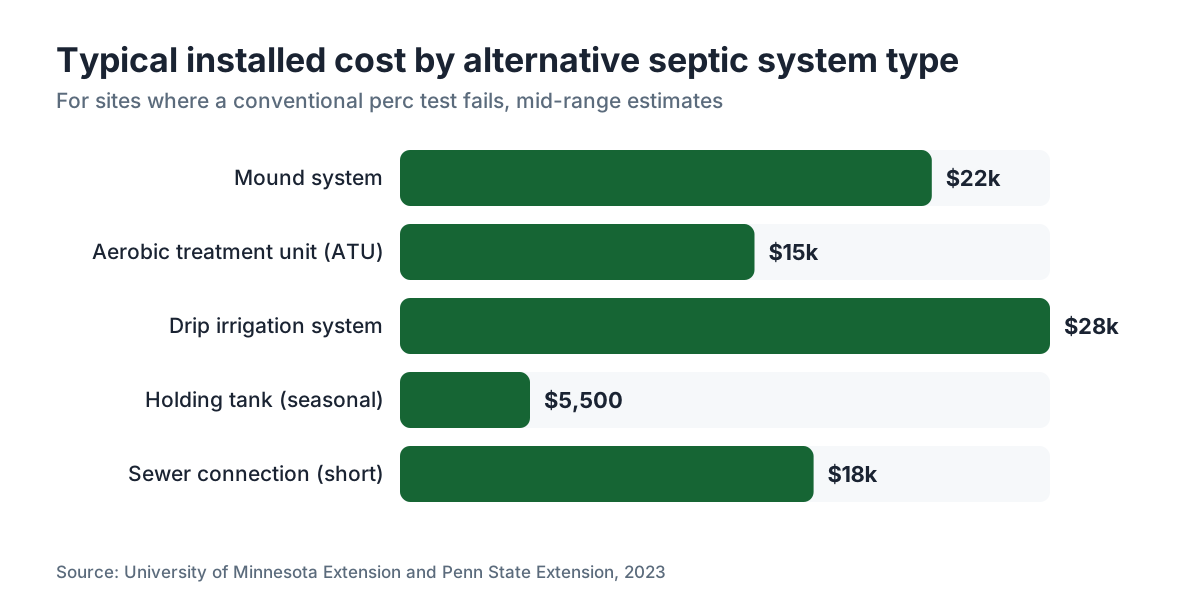
See the comparison table below for a quick cost and suitability overview.
How much does it cost to fix or work around a failed perc test?
There's no honest single number here, because cost hinges on which alternative system your soil and local code will accept. Here's a real range for each path.
| Alternative | Typical installed cost | Ongoing annual cost |
|---|---|---|
| Mound system | $15,000, $30,000 | $100, $400 (pumping) |
| Aerobic treatment unit (ATU) | $10,000, $20,000 | $400, $1,200 (service contract + electric) |
| Drip irrigation system | $15,000, $40,000 | $300, $800 |
| Holding tank (seasonal use) | $3,000, $8,000 | $2,000, $6,000 (frequent pumping) |
| Sewer connection | $5,000, $50,000+ | Sewer utility bill |
These figures come from published state extension and EPA cost guidance and reflect 2023-2024 contractor survey ranges [4][5]. Your region, soil conditions, and local permit fees will move the number. Get at least three written quotes.
Add the cost of a soil scientist or licensed engineer to design the alternative system. That's typically $1,500 to $5,000 depending on complexity, and it's not optional. Most states require a stamped design for any alternative system permit [1].
If you're buying land and the perc test fails, this is a real renegotiation point. The added engineering and system cost is a genuine reduction in what the land is worth for residential building.
Can you appeal or retest after a failed perc test?
Yes, and in the right circumstances it's worth doing.
Most state health departments or environmental agencies have a formal variance or appeal process. The grounds that tend to succeed: the test was conducted under demonstrably abnormal conditions (an unusually wet or dry period), the test holes were improperly prepared or not pre-soaked per code, or new soil science evidence supports a different reading of the site.
A soil scientist, specifically someone with credentials in soil morphology and onsite wastewater, can sometimes re-evaluate the site and submit a soil profile study in place of or alongside a perc test. Many modern state codes actually prefer soil morphology evaluations over perc tests for exactly this reason. The EPA's Onsite Wastewater Treatment Systems Manual notes that "soil morphology can provide information about a soil's long-term hydraulic capacity that a short-duration perc test cannot" [3].
Before you spend money on a formal appeal, talk to your county sanitarian directly. They often know whether a variance is realistically achievable on your parcel before you file paperwork. That conversation is usually free and can save you weeks.
Retesting in the same spots the following season is another option in states that allow it. If the original test was in an unusually wet spring, a late-summer retest may produce a different result. Check whether your state's code specifies an approved testing window, because retesting outside that window may not be accepted.
Does a failed perc test mean the land is worthless?
Almost never, but it does mean it's worth less for certain uses.
Raw land without a septic approval has limited residential development value, and a buyer financing the purchase through a conventional mortgage will typically require proof that a septic system can be permitted before closing. That's a real constraint.
The land still has value for uses that don't require sewage disposal: agriculture, recreation, hunting land, or as an addition to an adjoining parcel that already has septic approval. In some cases, a seller will accept a lower price to reflect the cost of the alternative system, and a buyer who's comfortable with that cost can still make the deal work.
The honest calculation: if an alternative system costs $25,000 more than a conventional install would have, and a conventional system was already priced into the land, the buyer should be looking for roughly that amount in price concession. It's subtraction, not a death sentence for the deal.
For homeowners already on a lot with an existing house, a failed perc test on a replacement system evaluation is a different situation. You likely have time and options. Your state's regulations often allow repairs or upgrades to existing systems under a different approval pathway than a new system on a vacant lot. Talk to your county sanitarian before assuming you're in crisis.
How does the perc test process work, step by step?
Understanding the process helps you know where failures can be contested and where they can't.
Site evaluation. Before any holes are dug, a county official or licensed site evaluator walks the property and notes topography, distance to wells and water features, available area, and any obvious constraints. Sites that can't meet minimum setbacks at this stage may be rejected before a perc test is even scheduled.
Soil profile inspection. The evaluator typically digs several test pits with a backhoe to examine the soil horizons. They're looking at texture, structure, and mottling. Mottling, those rust and gray streaks in the soil, indicates seasonal saturation and effectively locates the seasonal high water table without waiting for rain.
Perc test holes. Multiple holes are dug at the proposed absorption area depth, usually 18 to 36 inches. The number of holes required varies by state but is often 5 to 10.
Pre-soaking. Holes are filled with water and allowed to drain 12 to 24 hours in advance. This step is required by most state codes to bring soil to field capacity before timing begins. Skipping or shortcutting pre-soak is a common source of inaccurate results.
Timing. Water is added to a set level and the rate of drop is measured over 30 to 60 minutes. The official MPI reading is typically the average of the final two or three measurements.
Results and report. The evaluator submits findings to the county health department or equivalent agency. A pass typically comes with a conditional approval for a specific system size. A failure triggers the alternative system conversation.
The whole process from scheduling to written results usually takes two to six weeks depending on county backlog.
What perc test results are acceptable for a septic system?
State codes differ, but the widely accepted range for a conventional soil absorption system runs from 1 to 60 minutes per inch [1][3]. Some states tighten that to 3 to 45 MPI for certain system types.
Here's how to read the numbers:
- Under 1 MPI: too fast, soil won't filter pathogens. Common in coarse sand and gravel.
- 1 to 30 MPI: generally acceptable, works well with standard trench or bed systems.
- 30 to 60 MPI: slower, may require a larger system footprint or adjusted design, but still approvable in most states.
- Over 60 MPI: conventional system not approvable. Alternative system required.
A handful of states, including some Northeastern states with older codes, use slightly different thresholds or have moved entirely to soil morphology evaluations [3]. If your evaluator quotes you a number that seems inconsistent with what you're reading, ask them to show you the specific code section they're applying. That's a reasonable request and any licensed evaluator should be able to answer it without hesitation.
Who conducts perc tests and who approves them?
In most states, a perc test must be conducted or directly witnessed by a licensed professional: a soil scientist, a licensed septic system designer, a professional engineer with onsite wastewater experience, or a county sanitarian [1]. Private testing done by a homeowner without that oversight is not accepted for permitting purposes.
Approval authority sits with the county or local health department in most states, though some states centralize it at the state environmental agency. Either way, the permit for a new system comes from that agency, not from the tester.
If you're buying land, confirm that any existing perc test result is in the county's official file and was conducted within the code's time validity window. Most states give perc test approvals a shelf life of two to five years. An old approval may have expired, which means the test has to be redone before a building permit will issue.
For operators managing multiple jobs at once, tracking test expiration dates across parcels is exactly the kind of administrative task that purpose-built software handles well. SepticMind is built for that kind of operational record-keeping.
For the homeowner side: ask the county directly whether the test on record is still valid. That question takes five minutes and could save you a costly surprise at closing.
What should you do right now if your perc test just failed?
A clear sequence helps.
First, get a copy of the test report and the applicable code section. Read the exact failure criteria. Confirm the failure isn't procedural or conditional on a specific test date.
Second, call your county sanitarian. Not your real estate agent, not your contractor. The sanitarian can tell you whether alternative systems are commonly approved on similar sites in your county, what they've seen work, and whether a variance process exists.
Third, hire a licensed soil scientist if the county sanitarian suggests there's any hope in a more detailed site evaluation. A soil morphology study costs $500 to $2,000 but can change the regulatory picture entirely on marginal sites.
Fourth, get quotes for alternative systems before you make any land or construction decisions. You need actual numbers to make a rational call, not general estimates. A septic tank installation contractor with alternative system experience can give you a preliminary budget number fairly quickly.
Fifth, revisit your finances and timeline with realistic numbers in hand. Understand what the cost to install a septic system actually looks like for an alternative system on your specific lot, not a generic national average.
Don't let urgency push you into a bad decision. A perc test failure is frustrating, but it's a problem with known engineering solutions in most cases. The goal is to figure out which solution fits your site and what it will cost.
How do state regulations vary for failed perc tests?
State variation is significant enough that advice from someone in a different state can genuinely mislead you.
Texas, for example, has detailed rules through the Texas Commission on Environmental Quality (TCEQ) that allow ATUs and drip systems on sites where conventional systems aren't feasible, and the state maintains a public database of approved system types [6]. North Carolina's rules under 15A NCAC 18A .1900 are among the more detailed in the Southeast and specify exactly which alternative systems can substitute for a failed conventional perc [7]. California's Title 22 governs recycled water and advanced treatment options, but local counties retain primary permitting authority, which makes California one of the most variable states in practice.
New England states, particularly Massachusetts and Vermont, run strong soil morphology programs that can effectively replace perc testing, giving more flexibility on some marginal sites [8].
Always verify what your specific state allows. The EPA maintains a state-by-state resource list for onsite wastewater regulations that's a reasonable starting point [2][3]. Your county health department's website should also list approved alternative system types for your jurisdiction.
Don't assume that a system that worked in a neighboring state, or even a neighboring county, is automatically approvable where you are. Licensing requirements for installers also vary, which affects who can legally build the alternative system you need. The septic system repair and septic tank repair pages cover related regulatory questions for existing systems.
Does EPA guidance affect what happens after a failed perc test?
The EPA doesn't issue individual permits for septic systems. That's a state and local function. But EPA guidance shapes how states write their codes, and EPA funding through programs like the Clean Water State Revolving Fund can influence what alternatives states invest in and approve.
The EPA's Onsite Wastewater Treatment Systems Manual, last substantially updated in 2002, is still the most detailed federal reference on this topic and is directly cited by many state codes [3]. It covers soil evaluation methods, alternative system types, and management requirements in considerable technical depth.
The EPA's SepticSmart program is the consumer-facing version of federal guidance. It focuses more on maintenance than on permitting, but it does include guidance on what to do when conventional systems aren't feasible and points to state contacts [2].
Here's the practical truth: if you're in a dispute with a local health department over a failed perc test, citing EPA guidance directly rarely moves the needle. Local code is what the sanitarian applies. EPA guidance is more useful as background for understanding the technical reasoning behind the rules, and occasionally as support for a variance argument when a local code seems to contradict established soil science.
Frequently asked questions
Can you build a house on land that failed a perc test?
Often yes, but not with a conventional septic system. Many states allow mound systems, aerobic treatment units, or drip irrigation systems on sites that fail a standard perc test. The key is whether there's enough suitable land area and whether an approved alternative system can meet local setback requirements. Expect $10,000 to $30,000 in additional system costs compared to a conventional install.
How long does a perc test approval last before it expires?
Most states set a validity window of two to five years for perc test approvals. After that, the test must be repeated before a building permit will issue. If you're buying land with an existing approval, confirm the test date and check your state's expiration rule with the county health department. An expired approval doesn't transfer value at closing.
What is the difference between a perc test and a soil evaluation?
A perc test times how fast water drains through a prepared hole and gives a result in minutes per inch. A soil morphology evaluation has a trained soil scientist read the physical and chemical characteristics of soil layers, including mottling that indicates historic saturation. Many modern state codes prefer soil morphology because it reflects long-term drainage capacity better than a single timed test.
Can a perc test fail because of the weather?
Yes. Testing during or immediately after heavy rain can saturate the soil and produce a slower drainage rate than the site would show under normal conditions. Some states require testing during the seasonally wet period intentionally to capture worst-case conditions. If you believe weather skewed your result, ask the county sanitarian whether a retest at a different time of year is permissible under state code.
Who pays for a perc test, the buyer or the seller?
This is a negotiated term in real estate transactions. On vacant land sales, sellers typically pay for the initial perc test or allow buyers to conduct one during a due diligence period at the buyer's cost. If the test fails and a retest or soil evaluation is needed, who pays for that is again negotiable. Get the arrangement in writing in the purchase agreement before you spend money.
How much does a perc test cost?
A basic perc test runs $300 to $1,000 in most parts of the country, depending on the number of test holes required by state code and local contractor rates. If a soil scientist is required to be present or to conduct a formal soil morphology evaluation alongside the perc test, total site evaluation costs can reach $1,500 to $3,500. County permit fees for the evaluation are usually $100 to $500 on top of that.
What is a mound septic system and when is it required?
A mound system uses imported fill material built up above grade to create the vertical separation and soil depth that the native ground can't provide. It's the most common alternative when a perc test fails due to slow soil or a high seasonal water table. Installation typically costs $15,000 to $30,000. It needs more land area than a conventional system and the mound itself is visible on the property.
Can an aerobic treatment unit work on any lot that fails a perc test?
Not automatically. An ATU produces higher-quality effluent that can be dispersed through smaller areas or spray-irrigated, which helps on tight soils with limited land. But the lot still needs enough open area to meet setback requirements from wells, property lines, and water features. ATUs also require ongoing maintenance contracts, typically $300 to $600 per year, because they have mechanical and electrical components.
Does a failed perc test affect property value?
Yes, for residential purposes. A lot without a valid septic approval or a path to one has limited value for a buyer who needs a mortgage, since lenders typically require proof that sanitary waste disposal can be permitted. The practical impact on value is roughly equal to the cost of the alternative system needed to make the lot buildable, often $10,000 to $30,000 below what a similar lot with a passing test would sell for.
Is there a way to improve soil before a perc test to avoid failing?
No legitimate way, and altering soil specifically to pass a perc test is likely to violate the conditions of the test permit. The soil profile evaluation examines characteristics that developed over decades and aren't changed by surface modifications. If your soil is genuinely marginal, a soil scientist evaluating the full profile may find acceptable horizons at different depths, which is a legitimate path. Gaming the test itself isn't.
What happens if you install a septic system on land that failed a perc test without a permit?
Significant legal and financial risk. Unpermitted systems can be ordered removed at the owner's expense, which often costs more than doing it right originally. The property may be flagged in county records, complicating any future sale. You can also face civil fines, which vary by state but can run $1,000 to $10,000 per day in some jurisdictions. Lenders and title companies routinely check for septic permit compliance.
Can I use a holding tank permanently instead of fixing a failed perc test?
In most states, no. Holding tanks are approved only for seasonal or temporary use because they don't treat or dispose of waste, they just collect it. A typical household generates 50 to 100 gallons of wastewater per day, which means pumping costs of $2,000 to $6,000 annually or more. Most county health departments won't issue a certificate of occupancy for a full-time residence relying solely on a holding tank.
How is an alternative septic system maintained differently from a conventional one?
Aerobic treatment units and drip systems have mechanical or electrical components that require periodic inspection, usually quarterly or semi-annually under a maintenance contract. Mound systems need the same routine pumping as any septic tank, typically every three to five years per EPA guidance, but the pump chamber in a mound system also needs periodic inspection. All alternative systems benefit from conservative water use habits to avoid hydraulic overloading.
Sources
- EPA, Onsite Wastewater Treatment Systems Manual (EPA/625/R-00/008): Most state codes approve conventional septic drain fields only when soil percolation rates fall between approximately 1 and 60 minutes per inch; minimum vertical separation distances from seasonal high groundwater are required.
- EPA SepticSmart Program: EPA SepticSmart guidance notes that soil conditions at test time, including recent rainfall and soil saturation, can significantly affect perc test results.
- EPA, Onsite Wastewater Treatment Systems Manual, Chapter 4: Site and Soil Evaluation: The EPA manual states that soil morphology can provide information about a soil's long-term hydraulic capacity that a short-duration perc test cannot, and documents approved alternative system types including mound systems, ATUs, and drip irrigation.
- Penn State Extension, Mound Septic Systems: Mound systems typically cost $10,000 to $20,000 more than conventional systems and require periodic pumping of the pump chamber.
- University of Minnesota Extension, Septic System Costs and Alternatives: ATU installed costs range from $10,000 to $20,000 with annual service contract costs of $400 to $1,200; drip irrigation systems range from $15,000 to $40,000 installed.
- Texas Commission on Environmental Quality (TCEQ), On-Site Sewage Facilities: Texas rules allow ATUs and drip systems on sites where conventional systems aren't feasible, and the state maintains a public database of approved system types.
- North Carolina Administrative Code, 15A NCAC 18A .1900, NC DHHS: North Carolina rules under 15A NCAC 18A .1900 specify which alternative systems can substitute for a failed conventional perc test.
- Massachusetts Title 5 Regulations (310 CMR 15.00), Massachusetts DEP: Massachusetts requires soil morphology evaluations as part of site assessment for onsite septic systems, reflecting the state's move away from reliance on perc tests alone.
Last updated 2026-07-09