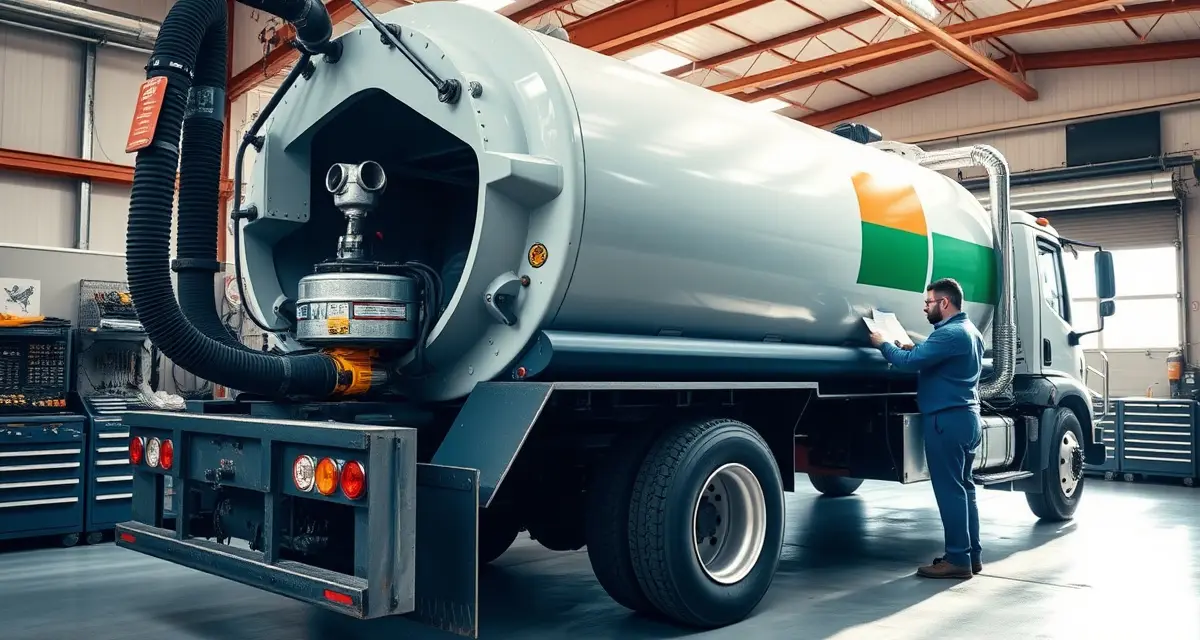
Equipment Management for Septic Trucks: Maintenance, Tracking, and Scheduling
By the SepticMind Editorial Team
A single breakdown that sidelines a pump truck costs an average of $1,800 in lost revenue. That's one day. If the truck needs a part that takes three days to source, you're looking at $5,400 in missed jobs before you've paid the mechanic.
TL;DR
- A vacuum truck's usable lifespan is 10-15 years with proper maintenance; pump failures, hose degradation, and tank corrosion are the most common causes of early retirement.
- Preventive maintenance programs that track scheduled service by hours of pump operation rather than calendar time reduce unexpected breakdowns.
- Equipment downtime costs include not just repair expense but lost revenue from missed service calls, which often exceeds the repair cost.
- Vacuum pump oil changes are the single most important septic pump truck maintenance item; running degraded oil is the leading cause of pump failure.
- Pre-trip inspection checklists completed by drivers before each day catch developing problems before they become mid-route breakdowns.
- Fleet management software tracking service history by truck VIN allows comparison of maintenance costs across the fleet to identify underperforming equipment.
Companies without truck maintenance tracking experience 40% more unplanned breakdowns than those with structured programs. The difference between a breakdown you planned for and one you didn't isn't just the repair cost. It's whether your crew is sitting idle and your customers are being rescheduled.
This guide covers what equipment management for septic trucks actually requires, and how to build a system that prevents surprises.
What Makes Septic Truck Maintenance Different
Pump trucks are not ordinary service vehicles. A standard work truck has a basic maintenance schedule: oil changes, tire rotations, brakes, and filters. A septic pump truck has all of that plus:
- A vacuum pump with its own lubrication and maintenance schedule
- A tank and plumbing system that handles corrosive waste
- Valves, hoses, and fittings that degrade from chemical exposure
- DOT compliance requirements for commercial vehicle operation
- Waste transport licensing requirements that vary by state
- Tank integrity requirements and inspection schedules
Missing any of these creates problems. Miss the vacuum pump oil change and you're looking at a pump rebuild. Miss a DOT inspection and you can't legally put the truck on the road. Miss a tank inspection certification and you're out of compliance with your waste hauler permit.
Routine Maintenance: What Every Pump Truck Needs
Weekly Checks
These are the basics that should happen before every week of operation:
- Tire pressure and tread condition on all tires (under-inflated tires on a loaded pump truck wear out fast)
- Fluid levels: engine oil, coolant, brake fluid, hydraulic fluid if applicable
- Lights and signals: brake lights, turn signals, running lights
- Hose condition: visual inspection for cracks, abrasions, or compromised fittings
- Valve function: open and close every valve to confirm it operates freely
- Tank exterior: visual check for corrosion or damage around welds and fittings
These checks take 15-20 minutes per truck. Most companies build them into the start of the driver's day.
Monthly Maintenance
- Vacuum pump lubrication per manufacturer spec (this is the most commonly skipped critical maintenance task)
- Air filter inspection and replacement if clogged
- Belt inspection: vacuum pump belt, alternator belt, fan belt
- PTO (power take-off) inspection for wear and proper engagement
- Hose reel function and rotation
- Tank vent inspection
Quarterly Service
- Oil and filter change (engine and vacuum pump)
- Fuel filter replacement
- Battery load test
- Coolant concentration check
- Brake inspection at all four wheels
- Chassis lubrication
Annual Service
- Complete brake job as needed
- DOT annual inspection (if required for your weight class)
- Tank inspection and certification per state waste hauler permit
- Transmission service
- Full hose and fitting replacement on high-wear components
- Emission inspection where required
DOT Compliance for Pump Trucks
How do I track DOT inspection deadlines across a multi-truck fleet? This is where many growing septic companies develop a compliance gap.
Any commercial motor vehicle over 10,001 pounds GVWR is subject to DOT regulations. Most full-size pump trucks exceed this threshold loaded. That means:
- Annual DOT inspections
- Driver qualification files
- Hours of service rules for drivers who travel beyond 150 air miles
- Vehicle inspection reports
- Maintenance records that must be retained for defined periods
SepticMind's technician tracking software stores DOT compliance records by vehicle and by driver. Upcoming inspection deadlines appear in the compliance dashboard before they're due. For multi-truck operations, this replaces the manual calendar system that almost always has a gap.
If you run five trucks and one of them misses its annual DOT inspection, you could face fines of $16,000 per violation per day the vehicle is operated out of compliance. That's not a hypothetical. It happens to legitimate companies that just didn't have a reliable tracking system.
DOT Inspection Checklist by Truck
For each vehicle in your fleet, you should be tracking:
| Document | Frequency | Who's Responsible |
|---|---|---|
| Annual DOT inspection | Annual | Fleet manager |
| Driver qualification file update | Annual or at hire | Office |
| Vehicle condition report | Daily | Driver |
| Preventive maintenance | Per schedule | Fleet manager |
| State registration | Annual | Office |
| Waste hauler permit | Per state requirement | Office |
Tracking Maintenance Across a Multi-Truck Fleet
When you have two trucks, you can track maintenance mentally or on a simple calendar. When you have six, eight, or twelve trucks, each on a different maintenance schedule, mental tracking fails.
Can SepticMind link equipment maintenance records to specific job records? Yes. When a technician completes a job in SepticMind, the job record captures which truck was used. That links the truck's service history to the jobs it ran. If a vacuum pump fails, you can trace back through the maintenance records and job history to understand contributing factors.
The equipment module in SepticMind tracks maintenance schedules by vehicle, with alerts when service is due. You can record completed service with date, mileage, technician, and notes. Upcoming service appears in the dashboard so maintenance can be scheduled during downtime rather than disrupting a peak week.
For dispatch purposes, this matters because the dispatch system can flag a truck as unavailable during scheduled maintenance. You don't accidentally book six jobs for a truck that's going to be in the shop on Thursday.
What Routine Maintenance Does a Septic Pump Truck Require?
Vacuum Pump Care
The vacuum pump is the heart of the truck and it's usually the most neglected component. Most vacuum pumps require:
- Oil change every 250-500 operating hours (not calendar months)
- Oil level check weekly
- Inlet filter cleaning or replacement per manufacturer spec
- Belt tension adjustment every 6 months
- Carbon vane inspection annually and replacement when worn below minimum thickness
Ignoring vacuum pump oil changes is the single most common cause of pump failure in septic fleets. A rebuilt or replaced vacuum pump runs $2,000-8,000 depending on the model. A scheduled oil change costs $50 and 30 minutes.
Tank and Plumbing
- Tank cleaning and deodorizing: at minimum annually, more often for heavy-use trucks
- Baffle inspection inside the tank
- Valve packing replacement when valves begin to seep
- Hose pressure testing annually
- Tank vent cleaning
Safety Equipment
- Emergency spill kit restocked quarterly
- Fire extinguisher inspected annually
- First aid kit restocked as used
Preventing the Most Common Breakdowns
Based on what fleet managers report as the most common unplanned breakdowns in septic truck fleets:
Vacuum pump failure (most common): Caused by running low on oil and deferred maintenance. Prevented by weekly oil checks and scheduled changes based on operating hours, not calendar dates.
Hose failure: Caused by abrasion damage and chemical degradation. Prevented by visual inspection before every job and annual replacement of hoses that show wear.
PTO problems: Caused by improper engagement technique and deferred lubrication. Prevented by driver training and regular inspection.
Radiator overheating: More common in summer when trucks are worked hard. Prevented by checking coolant concentration and cleaning radiator fins seasonally.
Brake problems: Caused by deferred brake inspections on heavy vehicles that see constant stop-and-go in urban routes. Prevented by quarterly brake inspections.
Building a Maintenance Schedule for Your Fleet
A maintenance schedule only works if it's written down, assigned to someone, and actually followed. Here's how to build one that doesn't fall apart.
Step 1: List every vehicle in your fleet with current mileage, engine hours, and the date of each last service item.
Step 2: Calculate when each vehicle is due for each service item based on your intervals.
Step 3: Load these into a tracking system that will alert you before service is due. SepticMind's equipment module handles this automatically once the vehicle profiles are entered.
Step 4: Assign responsibility. Who is accountable for ensuring weekly checks happen? Who schedules and oversees quarterly service? Who monitors the dashboard for upcoming DOT deadlines? Named accountability prevents the "I thought someone else was handling it" failure mode.
Step 5: Record everything. When service is performed, document it. Maintenance records are legal compliance documents for DOT purposes. They're also your evidence in a warranty claim or insurance dispute if a breakdown results in an accident or property damage.
The Cost of Reactive vs. Preventive Maintenance
Most septic company owners who move from reactive to preventive maintenance are surprised by how quickly the savings materialize.
If your five-truck fleet has one unplanned breakdown per month, and each breakdown costs an average of $1,800 in lost revenue plus repair costs averaging $800, that's $2,600 per month in breakdown-related costs. $31,200 per year.
A disciplined preventive maintenance program for five trucks costs roughly $8,000-12,000 per year in parts and shop time. The math is straightforward.
SepticMind's dispatch management also shows you real-time truck availability, so when a truck goes into planned maintenance, you can redistribute jobs in advance rather than scrambling on the day of a breakdown.
Get Started with SepticMind
Running a profitable septic business means managing compliance, customer relationships, and field operations without letting any of them slip. SepticMind handles the operational and compliance infrastructure so you can focus on growing the business. See what the platform can do for your operation.
FAQ
What routine maintenance does a septic pump truck require?
Routine maintenance covers both the commercial vehicle components (engine oil, coolant, brakes, tires) and the pump-specific systems (vacuum pump oil and filters, hoses, valves, tank cleaning). Weekly checks take 15-20 minutes per truck. Monthly, quarterly, and annual service intervals cover progressively deeper maintenance items. Vacuum pump oil changes based on operating hours, not calendar months, are the most critical and commonly skipped item.
How do I track DOT inspection deadlines across a multi-truck fleet?
The most reliable method is a centralized equipment tracking system that stores the last inspection date for each vehicle and alerts you 30-60 days before the annual renewal is due. SepticMind's equipment module tracks DOT inspection dates, waste hauler permit renewals, and state registration by vehicle. Without a centralized system, multi-truck fleets routinely miss deadlines when the responsibility is spread across multiple people and tracked on separate calendars.
Can SepticMind link equipment maintenance records to specific job records?
Yes. SepticMind captures which truck was used for each job. This creates a service history that connects vehicle maintenance records to job data. You can pull a vehicle's full maintenance history alongside the jobs it ran, which is useful for identifying patterns when specific trucks have higher breakdown rates than others.
How often should septic truck vacuum pumps be serviced?
Vacuum pump oil should be changed every 250-500 hours of operation depending on the manufacturer's specification, not on a calendar schedule. Pumps running multiple shifts accumulate hours faster than calendar intervals suggest. Check oil color and viscosity monthly regardless of hours; dark or milky oil indicates contamination requiring immediate change. Vanes should be inspected for wear at each oil change. Full pump rebuilds are typically recommended at 3,000-5,000 hours. Keep a pump hours log by truck to track service needs accurately.
What should a pre-trip inspection checklist cover for a septic vacuum truck?
A thorough pre-trip checklist covers tire condition and pressure, brake function, all lights, vacuum pump oil level and condition, hose condition and fittings, tank valve operation, pressure gauge accuracy, tank integrity, spill containment equipment, and required regulatory placards. Drivers should also verify that the disposal facility is open and accepting waste on the planned route day. A five-minute pre-trip catches most issues that would otherwise become mid-route breakdowns or regulatory violations.
Try These Free Tools
Sources
- National Onsite Wastewater Recycling Association (NOWRA)
- US EPA Office of Wastewater Management
- National Environmental Services Center (NESC)
- Water Environment Federation
- Occupational Safety and Health Administration (OSHA)