Anaerobic septic system: how it works, costs, and when to upgrade
By the SepticMind Editorial Team
TL;DR
- An anaerobic septic system breaks down wastewater with bacteria that live without oxygen.
- It's the standard conventional setup: a tank, a drain field, no electricity.
- Most homes on septic use one.
- They cost $3,000 to $7,000 installed, need pumping every 3 to 5 years, and work well on good soil.
- Aerobic systems treat effluent about 10 times cleaner but cost 2 to 3 times more.
What is an anaerobic septic system?
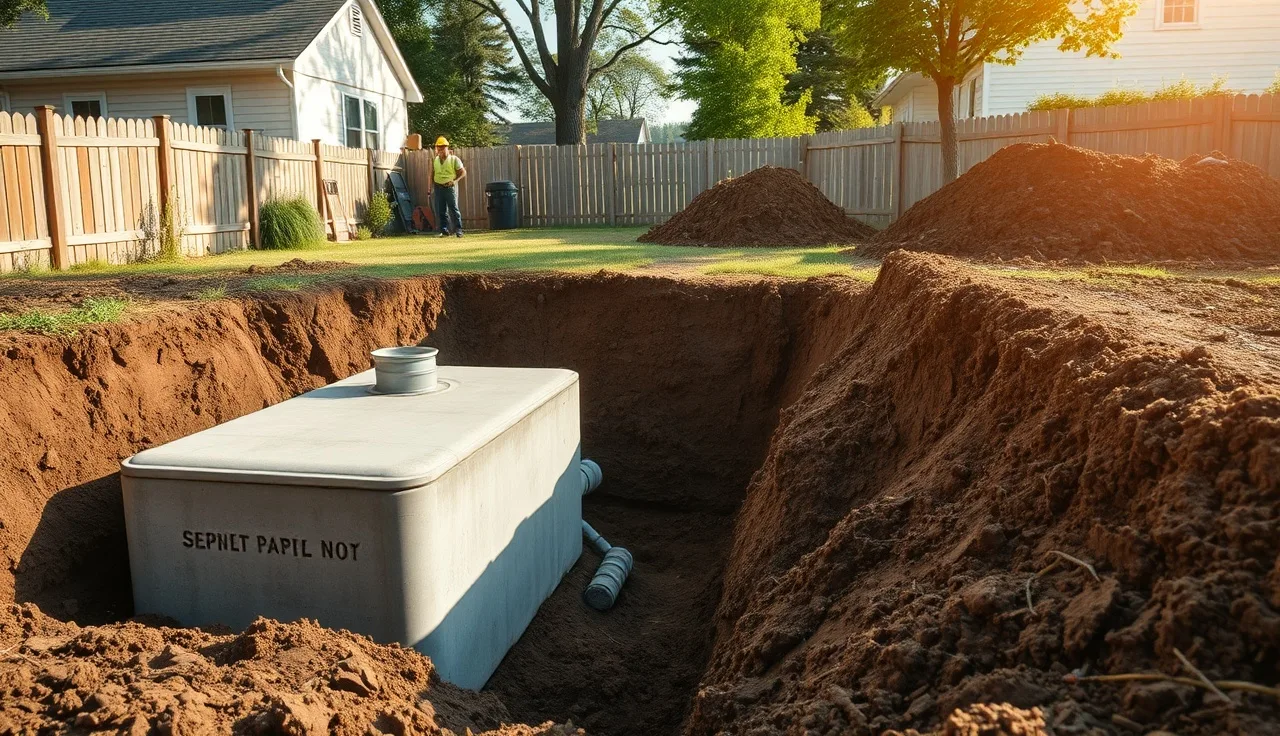
An anaerobic septic system treats household wastewater with bacteria that live without oxygen. Wastewater flows into a sealed tank. Heavy solids sink and form sludge, grease and lighter stuff floats up as scum, and the clarified liquid in the middle (effluent) leaves through an outlet baffle into a drain field. The anaerobic bacteria in the tank chew through the organic material in that sludge layer over time, with no mechanical help at all.
This is the conventional septic system. If you have a tank buried in your yard and no electrical control panel bolted to the side of your house, you almost certainly have one. The U.S. Environmental Protection Agency estimates that about 20 percent of U.S. households use onsite wastewater treatment, and most of those are conventional anaerobic systems [1].
"Anaerobic" just means without air. The bacteria doing the heavy lifting, including methanogens and sulfate-reducing bacteria, die or go dormant when they hit oxygen. That single fact is the difference between this system and an aerobic one, and it drives every practical gap in cost, performance, and upkeep.
How does an anaerobic septic system treat wastewater?
Treatment happens in two stages: the tank and the soil. The tank does a partial job. The soil finishes it.
In the tank, settling removes most of the suspended solids. Anaerobic microbes then attack the settled material and convert organic compounds into gases (mostly methane and carbon dioxide), water, and stable solids. This shrinks the sludge over time, but it never clears it out completely. That's the whole reason you need periodic septic tank pumping: the sludge that doesn't break down keeps stacking up until it starts pushing solids into the drain field.
From the tank, effluent flows by gravity into the drain field (also called a leach field). It percolates through gravel or a chamber system, drops into native soil, and the soil takes over. Soil particles filter out remaining solids, organisms in the soil digest leftover organic matter, and the soil matrix traps pathogens. When the soil is right (permeable enough to take the effluent, but not so open that sewage races down to groundwater), this second stage does most of the real cleaning.
The EPA SepticSmart program puts it plainly: "the soil is the most important part of your septic system" because it provides the final treatment before effluent reaches groundwater [1]. The anaerobic tank gets effluent clean enough for the soil to handle. It was never meant to produce clean water on its own.
Where the process struggles: tight clay that won't take effluent, lots that are too small or sit over a high water table, and households dumping grease, harsh cleaners, or antibiotics that knock back the bacteria.
Aerobic vs anaerobic septic system: what's actually different?
The core difference is oxygen. An anaerobic system seals oxygen out. An aerobic treatment unit (ATU) pumps air into the tank around the clock, feeding aerobic bacteria that digest waste faster and more completely.
Aerobic bacteria are the better digesters. An ATU typically produces effluent with biochemical oxygen demand (BOD) and total suspended solids (TSS) of 10 to 20 mg/L, against 100 to 200 mg/L for a conventional anaerobic tank [2]. That's roughly 10 times cleaner effluent leaving the tank. Cleaner effluent can often disperse through a smaller drain field, or work on a site where a conventional system can't get a permit at all.
Here's the two systems side by side:
| Feature | Anaerobic (conventional) | Aerobic (ATU) |
|---|---|---|
| Electricity required | No | Yes (air pump runs 24/7) |
| Install cost | $3,000 to $7,000 | $10,000 to $20,000+ |
| Annual maintenance cost | ~$200 to $400 (pumping amortized) | $500 to $1,200 (service contract) |
| Effluent quality (BOD) | 100 to 200 mg/L | 10 to 20 mg/L |
| Drain field size needed | Standard | Often 50% smaller |
| Suitable for poor soils | Sometimes (with mound/drip) | More often |
| Chlorination required | No | Often yes (state-dependent) |
| Mechanical failure risk | Low | Higher (pump, compressor, timer) |
| Permit complexity | Lower | Higher |
Neither system wins everywhere. On a standard lot with good soil, anaerobic is cheaper, simpler, and just as protective of public health when it's maintained. Aerobic earns its price premium when a site can't fit a full-size drain field, when state rules demand advanced treatment near surface water, or when an existing field has failed with no room for a replacement [see /articles/leach-field].
Shopping for an aerobic septic system for sale? ATUs come as packaged units from makers like Norweco, Jet, and BioMicrobics, and the unit alone usually runs $3,000 to $7,000 before installation. The full installed cost from a licensed installer runs $10,000 to $20,000 in most markets, higher in states with strict permitting [3].
What does an anaerobic septic system cost?
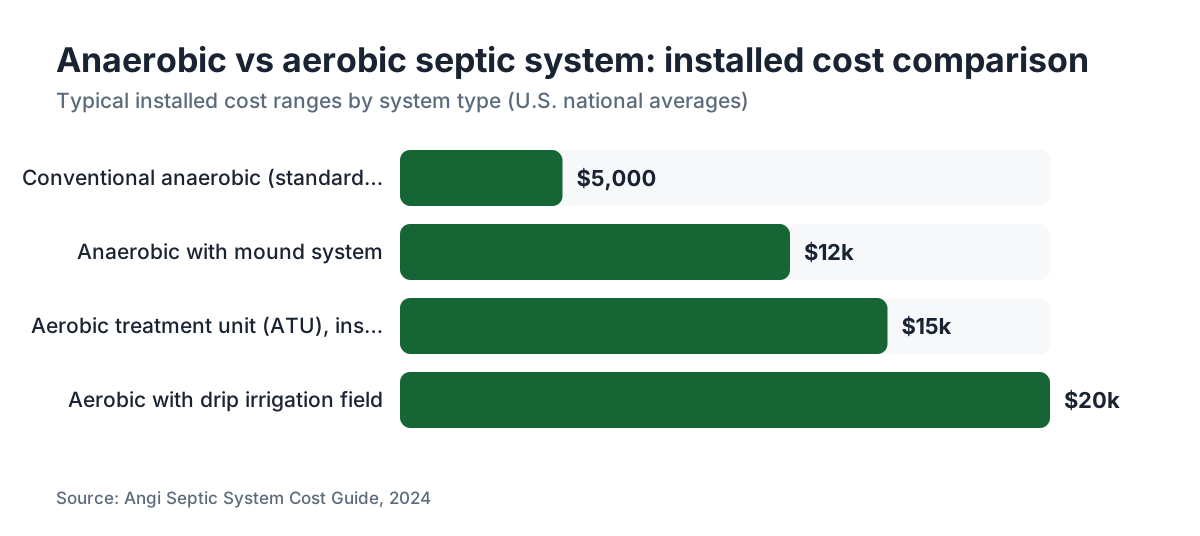
A new conventional anaerobic system, tank plus drain field, runs $3,000 to $7,000 in most of the country, with the national average around $5,000 [3]. That range hides a lot.
Soil drives cost more than anything else. Sandy or loamy soils that perc well make installation fast and cheap. Rocky ground, shallow bedrock, high water tables, or tight clay all push the price up because they force a modified system: a mound, a drip irrigation field, or pressure dosing with a pump chamber. A mound system can hit $10,000 to $15,000 even though it still uses anaerobic treatment in the tank.
Tank size matters too. A 1,000-gallon tank is the minimum in most states and works for homes up to about 3 bedrooms [4]. Add a bedroom and you usually need a 1,250- or 1,500-gallon tank. Concrete tanks cost $700 to $2,000 depending on size. Plastic and fiberglass tanks run a bit more but drop into tight spots more easily.
Ongoing costs are modest. Pumping every 3 to 5 years runs $300 to $600 per visit, so call it $75 to $150 a year amortized. A septic tank inspection at pump time adds $100 to $250. Total annual cost of ownership lands around $200 to $400 for a well-kept system. That's the number people forget to budget for.
For cost detail broken down by region and system type, the cost to install a septic system guide covers it.
When does an anaerobic system fail, and what are the warning signs?
Anaerobic systems fail in predictable ways. The most common cause is skipped pumping: once sludge climbs past about 30 percent of tank volume, solids start pushing into the drain field and clog the soil pores [5]. Clogged soil has nowhere to send the effluent, so it backs up. You get slow drains, sewage smell in the yard, or wet soggy patches over the field.
Other failure causes:
- Hydraulic overload. Too much water too fast (think 10 loads of laundry in a day) shoves effluent through the tank before solids can settle.
- Chemical damage. Bleach, disinfectants, and antibiotics knock back the anaerobic bacteria. The system doesn't fail overnight, but long-term die-off drags down treatment.
- Root intrusion into distribution pipes or tank baffles.
- Soil saturation from heavy rain or a high seasonal water table, which temporarily stops the soil from taking effluent.
The soggy-yard sign is the one most homeowners spot last, after the problem is already serious. A septic system repair at that stage runs $1,500 to $20,000 depending on whether you're swapping a baffle or the whole drain field.
Catch it early. Inspect the tank at every pump-out and note how fast sludge builds. That habit gives you years of warning before a catastrophic failure.
Operators juggling multiple accounts can track inspection records and pump intervals in one place. SepticMind's scheduling and inspection logging tools are built for this workflow, so nothing slips through between service visits.
How do you maintain an anaerobic septic system?
Maintenance for a conventional anaerobic system is genuinely simple next to aerobic units. No air pumps to service. No chlorine tablets. No electrical components to check. The job list is short.
Pump the tank on schedule. The EPA SepticSmart program recommends inspecting and pumping every 3 to 5 years [1]. Your right interval depends on tank size, number of people, and how hard you run a garbage disposal. A licensed inspector can measure the sludge and scum layers and tell you exactly where you stand.
Protect the drain field. Don't drive over it. Don't plant trees or deep-rooted shrubs near it. Route roof drains and sump pumps away from the field so you're not drowning the soil.
Watch what goes down the drains. Wipes (even "flushable" ones), medications, grease, and big doses of harsh cleaner all mess with anaerobic digestion or clog things mechanically. The EPA's guidance is blunt: "Only flush toilet paper. Never flush wipes, feminine hygiene products, or medications" [1].
Keep records. Log your pump dates, inspection findings, and repairs. When you sell the house, that log is worth money.
For regular septic tank cleaning and septic tank pump out scheduling, most counties list licensed pumpers with the local health department. Some states make the pumper file a waste manifest, so your records may already sit in a state database.
One thing that's a straight waste of money: septic additives. The research on bacterial additives, enzyme packets, and "rejuvenators" keeps landing in the same place, no measurable benefit to a properly working anaerobic system [6]. Keep the $30 a month.
Who can use an anaerobic system, and who can't?
Most rural and suburban properties built before the 1990s have one. If your lot has enough suitable soil, passes a percolation test, and isn't too close to surface water or a drinking well, an anaerobic system is the default answer from any permitting authority.
Sites that usually can't use a conventional anaerobic system:
- High water table (less than 18 to 24 inches of separation between the drain field bottom and seasonal high groundwater, though minimums vary by state [4]).
- Slow percolation. If the perc test shows soil that takes longer than 60 to 90 minutes per inch to absorb water, many states won't approve a conventional system. The threshold moves state to state.
- Lots too small to fit both a primary drain field and a reserve area.
- Properties near shellfish waters, wellhead protection areas, or other sensitive zones where states require nitrogen or pathogen reduction beyond what anaerobic treatment gives you.
In those cases you're looking at an aerobic treatment unit, a mound system, a drip irrigation system, or some mix. The leach field guide walks through what happens when native soil isn't an option.
State rules control here. Texas has some of the most detailed onsite sewage facility rules in the country under Title 30 TAC Chapter 285 [7]. California's requirements under the State Water Board's onsite wastewater treatment system policy push toward advanced treatment near impaired water bodies [8]. Always check your county health department and state environmental agency before you assume a conventional system is on the table.
Aerobic vs anaerobic: which system should you actually choose?
Building new and your site qualifies for a conventional system? Choose anaerobic. Lower cost, simpler maintenance, no electricity to depend on, no service contract. The anaerobic system's record across tens of millions of installs is solid when it's sited right and pumped on time.
Choose aerobic when you have no choice. Sites with failing conventional systems and no room for a new drain field are the most common reason people switch. High-density lakefront communities, lots with brutal soils, and new builds in states with nutrient-reduction mandates all get steered toward ATUs. The cleaner effluent from an aerobic unit sometimes fits a smaller footprint where a conventional field won't.
Shopping aerobic septic systems for sale as a replacement for a failed conventional system? Get at least two bids from licensed installers. The unit cost is only part of the picture. Installation, electrical hookup, permit fees, and the ongoing service contract all pile on. Some states require a licensed provider to inspect the ATU quarterly or annually and report to the state. That's a real recurring bill, not optional.
A note on the aerobic-versus-anaerobic fight in online forums: much of the advocacy for aerobic systems comes from Texas, Florida, and the Gulf Coast, where shallow soils made conventional systems impractical to begin with. In those markets aerobic is genuinely the norm and installers know them cold. Across most of the rest of the country, conventional anaerobic systems dominate, and finding an ATU technician can be harder than finding a standard pumper.
What regulations cover anaerobic septic systems?
Septic systems are regulated at the state level, not the federal level. The EPA sets guidance and funds research through programs like SepticSmart, but it has no direct permitting authority over individual systems [1]. Your state environmental or health agency writes the rules. Your county health department enforces them.
Every state sets its own minimum tank size, setbacks, drain field design standard, and inspection frequency. A few themes hold across most codes:
- Setbacks of 50 to 100 feet from drinking water wells.
- Setbacks of 10 to 25 feet from property lines and structures.
- Soil separation above seasonal high groundwater, often 18 to 36 inches.
- Permits for new installation and major repair.
- Design by a licensed engineer or soil scientist for anything non-standard.
The USDA's Natural Resources Conservation Service publishes soil survey data that many states use to map suitable and unsuitable septic areas. The EPA's National Pollutant Discharge Elimination System (NPDES) program can apply to onsite systems that discharge to surface water, though most conventional anaerobic systems don't surface-discharge.
For septic guidance, the EPA's Office of Water maintains documents used as reference across state programs [1]. The National Environmental Services Center at West Virginia University publishes technical guidance that many state agencies adopt [9].
Buying a home? Title transfer in many states triggers a required septic tank inspection. Don't skip it. A failed system found before closing is a negotiating tool. The same failure found after closing is your problem.
How long does an anaerobic septic system last?
A concrete tank installed right lasts 40 years minimum, often 50 or more [10]. Fiberglass and plastic tanks have shorter track records but generally hold up 30 to 40 years. The tank itself rarely fails all at once. More often baffles corrode or crack, lids settle, or risers start leaking. Those are all repairable without pulling the tank.
The drain field is the weak link. A well-sited, well-maintained field can last 25 to 50 years. A field getting hit with excess solids from an overfull tank, or one that stays saturated, can fail in 5 to 10 years. That's why pumping is the highest-leverage maintenance task you have: you're protecting the field more than the tank.
Some older systems use cesspools or seepage pits instead of a true drain field. Those are banned for new construction in most states and fail more readily. If your system predates the 1970s, get a professional to tell you what you actually have.
For a septic tank repair that doesn't touch the drain field, costs stay manageable: $150 to $500 for a baffle, $200 to $800 for a new lid or riser. Full drain field replacement is where the numbers jump, and that's where the comparison to aerobic installation gets interesting.
SepticMind's service record tracking lets operators and homeowners log system age, last pump date, and component condition, so the full picture is visible when it matters.
Can you convert an anaerobic system to aerobic, and how does that work?
Yes, and it happens more than people expect. When a conventional anaerobic drain field fails and there's no room for a replacement field, converting the tank to an aerobic treatment unit is one legitimate path.
The conversion usually means retrofitting an air diffuser or aerator into the existing tank, or replacing the tank outright with a purpose-built ATU. Because the existing septic tank installation work is already done (excavation, piping, electrical), the added cost of an ATU retrofit can beat a full aerobic system from scratch. That said, many ATU makers require their unit to go in as designed, and your existing tank dimensions may not match.
Some states actively steer failing systems toward aerobic treatment. Florida's Department of Health has pushed advanced treatment near springs and sensitive water bodies [12]. Texas TCEQ keeps a list of approved ATU units that can be permitted for replacement installations [7].
Before you commit to a conversion, get a soil evaluation and talk to your county sanitarian. Sometimes the field can be rehabilitated (rested, treated with Terralift aeration, or expanded laterally) and the anaerobic system saved. Sometimes it can't, and aerobic with a small drip irrigation footprint is genuinely the right call. There's no universal rule.
Frequently asked questions
What is the difference between an aerobic and anaerobic septic system?
An anaerobic system uses bacteria that live without oxygen to break down waste in a sealed tank, then disperses partially treated effluent through a drain field. An aerobic system pumps air into the tank, feeding oxygen-loving bacteria that produce much cleaner effluent (roughly 10 times lower BOD). Anaerobic systems cost $3,000 to $7,000 installed with no electrical parts. Aerobic systems cost $10,000 to $20,000 and need electricity plus a service contract.
How often does an anaerobic septic system need to be pumped?
The EPA recommends inspecting and pumping every 3 to 5 years. Your actual interval depends on tank and household size: a 1,000-gallon tank serving 4 people typically needs pumping every 3 to 4 years, while the same tank serving 2 people might go 5 to 6 years. A licensed pumper measures sludge depth at each visit and tells you when you're near the threshold where solids risk moving into the drain field.
Can an anaerobic septic system be installed on any property?
No. The site needs enough suitable soil to pass a percolation test, adequate separation from groundwater (usually at least 18 to 36 inches depending on state), and proper setbacks from wells, structures, and property lines. High water tables, poor-draining soils, small lots, and proximity to sensitive water bodies can make a conventional anaerobic system impossible to permit. In those cases, aerobic, mound, or drip irrigation systems are required.
Is an anaerobic septic system safe for the environment?
A properly maintained and sited anaerobic system is safe. The soil provides the final treatment, filtering pathogens and trapping nutrients before effluent reaches groundwater. Problems arise when systems are overloaded, poorly maintained, or sited too close to groundwater or surface water. Anaerobic systems leave higher nutrient levels in their effluent than aerobic systems do, which is why some states near sensitive water bodies require aerobic or advanced treatment.
What can kill the bacteria in an anaerobic septic system?
Heavy use of bleach, antibacterial soaps, disinfectants, and prescription antibiotics can cut down your anaerobic bacteria. Garbage disposal use adds fats and proteins that can overwhelm the system. Septic-safe cleaners in normal household amounts generally won't do lasting harm because the colony recovers, but repeated high-dose chemical exposure does real damage. You don't need bacterial additives; the EPA's research finds they provide no measurable benefit.
How long does an anaerobic septic system last?
Concrete tanks typically last 40 to 50 years or more. Drain fields last 25 to 50 years when properly maintained. The drain field fails first in most cases, usually because of solids pushed from an overfull tank or chronic hydraulic overloading. Regular pumping every 3 to 5 years is the single most effective thing you can do to extend system life. Baffles, lids, and risers wear out sooner but are cheap to replace.
What does it cost to install a new anaerobic septic system?
Most new conventional anaerobic systems run $3,000 to $7,000 installed, with a national average near $5,000. Rocky ground, high water tables, or clay soils push that higher, sometimes to $10,000 to $15,000 for a mound system variant. Tank size (1,000 to 1,500 gallons for most homes), local permit fees, and soil prep all affect the final number. Get at least two bids from licensed installers and confirm what the permit and inspection fees include.
Can an anaerobic system handle a garbage disposal?
It can, but it shortens pump intervals. Garbage disposals add significant food solids and grease to the tank, speeding up sludge buildup. The general rule is to size up your tank by 250 to 500 gallons if you use a disposal regularly, and plan to pump 25 to 50 percent more often. Some county health codes, in states like North Carolina, restrict disposals on septic or require a bigger tank.
Do aerobic septic systems require a service contract?
In most states, yes. States that permit ATUs typically require the homeowner to keep a service contract with a licensed ATU provider who inspects the unit quarterly or annually and reports performance to the state. These contracts run $150 to $500 per year depending on the state and provider. This ongoing cost is the biggest practical difference between aerobic and anaerobic systems once they're in the ground.
What happens when an anaerobic septic system fails?
Failure usually shows up as sewage backing up into the house, slow drains, odors near the drain field, or soggy ground over the leach field. The most common cause is solids from an overfull tank clogging the drain field soil pores. Repair options range from replacing a baffle ($150 to $500) to full drain field replacement ($5,000 to $20,000). Call a licensed inspector before assuming the worst; some apparent failures are temporary and caused by saturated soil after heavy rain.
Are aerobic septic systems better than anaerobic in all cases?
No. Aerobic systems produce cleaner effluent, but they cost 2 to 3 times more to install, need electricity, require annual or quarterly servicing, and have more components that can fail. For most homeowners with suitable soil and lot size, a conventional anaerobic system is cheaper, simpler, and equally protective of public health when maintained. Aerobic systems earn their premium on difficult sites or where state rules demand advanced treatment.
Where can I buy an aerobic septic system?
Aerobic treatment units are sold by manufacturers like Norweco, Jet Inc., and BioMicrobics, typically through licensed distributors and installers rather than retail stores. The unit alone costs $3,000 to $7,000; full installation with permitting runs $10,000 to $20,000 in most markets. Search for a licensed ATU installer in your state rather than buying a unit independently, because most states require manufacturer-certified installation for permit approval.
How does soil type affect anaerobic septic system performance?
Soil is the final treatment stage. Sandy loam and loamy soils with percolation rates of 1 to 60 minutes per inch are ideal. Clay soils drain too slowly and can cause the field to back up. Coarse gravel or fractured rock drains too fast, giving effluent too little contact time for treatment before it reaches groundwater. A percolation test and soil evaluation by a licensed engineer or soil scientist determine whether your specific site can support a conventional anaerobic system.
Does an anaerobic septic system need electricity?
No. That's one of its main advantages over aerobic systems. A gravity-fed conventional anaerobic system has no pumps, compressors, timers, or electrical parts unless the terrain requires a pump to move effluent uphill to the drain field. If you live somewhere with frequent power outages, a conventional anaerobic system keeps working through them. An aerobic system stops treating waste effectively when the power fails.
Sources
- U.S. EPA, SepticSmart Program: About 20 percent of U.S. households rely on onsite wastewater treatment; EPA recommends inspecting and pumping every 3 to 5 years; soil is the most important part of the septic system; flush only toilet paper.
- U.S. EPA, Onsite Wastewater Treatment Systems Manual (EPA/625/R-00/008): Aerobic treatment units typically produce effluent with BOD and TSS of 10 to 20 mg/L versus 100 to 200 mg/L for conventional anaerobic tanks.
- Angi, Septic System Installation Cost Guide: Conventional septic system installation averages $3,000, $7,000; aerobic systems run $10,000, $20,000 installed.
- U.S. EPA, How Your Septic System Works: A 1,000-gallon tank is typical for homes up to 3 bedrooms; minimum setbacks and soil separation requirements are state-regulated.
- U.S. EPA, Septic Systems Overview: Solids accumulating past roughly 30 percent of tank volume can push into and clog the drain field.
- University of Minnesota Extension, Septic System Additives: Research consistently shows that bacterial and enzyme septic additives provide no measurable benefit to a properly functioning anaerobic system.
- Texas Commission on Environmental Quality, On-Site Sewage Facilities (30 TAC Chapter 285): Texas regulates onsite sewage facilities under 30 TAC Chapter 285 and maintains a list of approved ATU units for permitting.
- California State Water Resources Control Board, Onsite Wastewater Treatment System Policy: California's OWTS policy requires advanced treatment near impaired water bodies.
- National Environmental Services Center (West Virginia University): NESC publishes technical guidance on onsite wastewater treatment used as reference by state agencies.
- U.S. EPA, Septic Systems: Frequent Questions: Properly installed and maintained septic tanks can last decades, with concrete tanks commonly lasting 40 years or more.
- Florida Department of Health, Onsite Sewage Treatment and Disposal Systems: Florida has pushed for advanced aerobic treatment near springs and sensitive water bodies, requiring aerobic systems in certain zones.
Last updated 2026-07-09