Are perc tests public record? How to find yours
By the SepticMind Editorial Team

TL;DR
- In most U.S.
- counties, percolation test results are public record.
- They sit in the septic permit file at the local health department or environmental office.
- Most jurisdictions keep them at least 5 to 25 years, and some forever.
- You can usually request them online, by phone, or in person.
- A few states let applicants keep pre-application soil borings confidential, so access rules vary.
What is a perc test and why does its record matter?
A percolation test (perc test) measures how fast water moves through soil. A technician digs or bores test holes to a set depth, soaks them, then tracks how far the water level drops over timed intervals. The result is a perc rate, written in minutes per inch. That single number decides whether a lot can support a conventional septic drain field, and if it can, how big the field has to be.
The record matters for a few concrete reasons. Buyers use it to confirm a lot can legally support a septic system before closing. Homeowners pull it when they add bedrooms or square footage that raises wastewater load. Contractors need it when they design a replacement drain field. Lenders sometimes ask for it before financing a property on an onsite system.
Without the original result on file, you may have to run the test again. That costs $250 to $1,000 depending on the state and the soil [1]. Finding the original record, if it still exists, is almost always worth the phone call first.
Are perc test results public records under U.S. law?
Yes, in most places, though no single federal law says so. Access runs through state public records statutes and local health department policy. The practical answer across the country is that a perc test tied to an issued permit is public.
Here is why. A perc test is almost never a standalone document. It rides inside a septic permit application, and septic permits are treated as public records in all 50 states. The EPA's SepticSmart program describes local health departments as the bodies that "issue permits and maintain records" for onsite wastewater systems [2]. Once a permit is issued or denied, that file falls under the same open-records rules as any other government decision.
There is one narrow exception. A handful of states let applicants ask that pre-application soil borings, submitted speculatively before any permit is filed, stay confidential as professional work product. File the permit application, though, and those soil data almost always join the public file.
So the rule of thumb is simple. If a permit was issued, the perc test behind it is public. If the application was denied and no permit followed, the file may still be public, but the custodian might make you file a formal records request to get it.
Which agency holds the perc test record?
The custodian is almost always the county or local health department, sometimes called environmental health or the on-site wastewater program. In rural areas it might be a regional sanitation district or a state agency field office. Start there.
Here is a rough breakdown by institutional type:
| Custodian type | Where common | How to identify yours |
|---|---|---|
| County health department | Most of the U.S. | Search "[county name] environmental health septic permits" |
| State health or environment dept. (field office) | New England, some Plains states | Check your state's onsite wastewater program page |
| Regional sanitation district | Parts of CA, FL, TX | Look at your property tax bill for the water/sewer authority |
| City/township building department | Dense suburban areas | Call the building department directly |
If you don't know who issued the original permit, start with the county assessor or GIS portal. Most counties now map permitted septic systems, and the map entry usually names the issuing agency. Your environmental health permit number (sometimes printed on the deed or a title insurance document) is the fastest lookup key you have.
Inspectors often pull this record themselves before they show up. So if you're arranging a septic tank inspection, your inspector may already have it in hand.
How long do agencies keep perc test records?
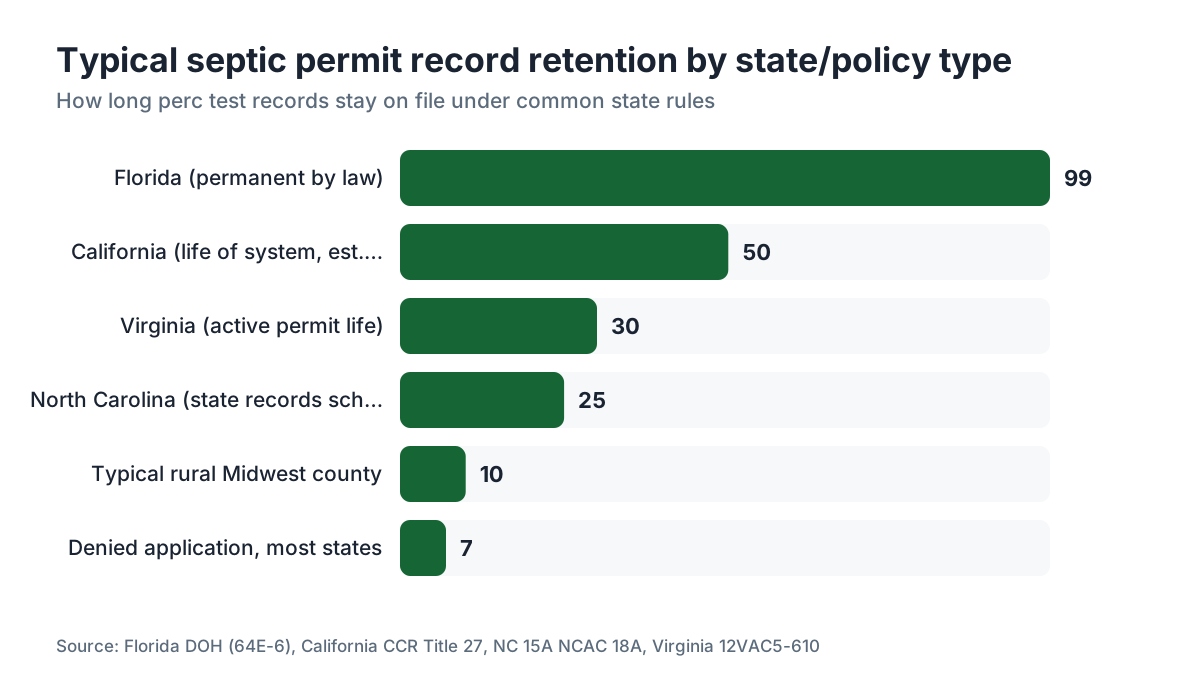
It depends, and this is honestly the messiest part of the whole question. Retention schedules run from 5 years to forever.
Many county health departments follow state retention schedules for environmental permit files. Common windows by category:
| Record type | Typical retention | Notes |
|---|---|---|
| Issued septic permit file (including perc test) | 10 to 50 years | Many counties keep them permanently |
| Denied permit application | 5 to 10 years | Less uniformly kept |
| Pre-application soil borings | 5 years or until superseded | Most variable category |
| Septic system as-built drawing | Often permanent | Filed with the deed in some states |
Florida keeps septic permit files permanently under Florida Administrative Code Chapter 64E-6 [3]. California counties keep permit records for the life of the system under Title 27 of the California Code of Regulations [4]. On the short end, some rural Midwestern counties run a 10-year cycle, which means a perc test from the 1970s or early 1980s may simply be gone.
If the local record is missing, two backups sometimes hold copies. The licensed soil scientist or engineer who ran the test may keep their own file. Title insurance underwriters occasionally scan permit documents during the title search. Neither is guaranteed. Both are worth a call.
How do you request a perc test record?
The process is simple in most counties. Here is the path that works nearly everywhere:
- Find the property's parcel number (APN or parcel ID) from the county assessor's website.
- Contact the county environmental health department. Many have an online permit lookup portal. Search "environmental health permit records" or "onsite wastewater permit search" plus your county name.
- Request the septic permit file for the address or parcel. Ask specifically for the percolation test data sheet, the soil evaluation report, and the original permit.
- Pay any copy fee. Most counties charge $5 to $30 for a printout or a scanned PDF [1]. Some hand over digital records free.
- If the records aren't online, file a written public records request under your state's open-records law (the Freedom of Information Act equivalent in your state). Most states require a response within 5 to 10 business days.
Buyers in a real estate deal have a shortcut. The title company or your real estate attorney can often pull the permit record faster than you can, because they already work with county recorders. Ask them to fold it into the title search.
Contractors and inspectors who pull these records constantly sometimes get a professional portal with bulk access. Software built for service operators, like SepticMind, tracks which permits your team has already pulled and flags properties where records are incomplete. That matters when you're scheduling several septic tank inspections in the same county in one week.
What does the perc test record actually contain?
A perc test file usually holds several parts. Knowing what to look for saves you from getting a stack of paper and not knowing which page matters.
The perc test data sheet itself typically shows the date of the test, the name and license number of the soil scientist or evaluator, the location and depth of each test hole, soil descriptions by horizon (texture, structure, color in Munsell notation), the pre-soak record, and the timed percolation readings in minutes per inch (mpi). The final perc rate is the stabilized rate from the slowest qualifying test hole.
Alongside that you'll usually find the site plan showing where the test holes sat relative to the proposed drain field, the setback calculations from wells and property lines, and the permit itself with the approved system design.
A perc rate under 60 mpi is generally fine for a conventional gravel-and-pipe drain field, though the exact cutoff varies by state. North Carolina, for example, uses 120 mpi as the upper limit for certain alternative systems [5]. The EPA's "Onsite Wastewater Treatment Systems Manual" (EPA/625/R-00/008) is the technical backbone most state codes are built on, and it flags soils slower than 60 mpi as candidates for alternative treatment [6].
Planning a new leach field? The perc rate from the original test tells you what the original design assumed. If conditions have shifted (compaction, a rising seasonal water table, root intrusion), that old rate may no longer match what the ground does today.
Can a perc test record be used for a real estate transaction?
Yes, and that's one of the most common reasons people go looking for one. There's a catch, though. Many health departments will accept a prior perc result for a new permit application only if the test happened within a set window, usually 2 to 5 years, and only if site conditions haven't changed in a meaningful way.
For a buyer doing due diligence, the old record still has value even when it can't feed a new permit. It tells you the lot was tested, the soil passed or failed, and what the system was designed around. That matters when you're weighing whether a property can carry an expanded home.
If the test is too old to use, some counties let a licensed soil scientist do a desk review of the original data and issue a perc test certification confirming the results still hold. That's faster and cheaper than a full retest. Ask the local health department whether the option exists before you schedule a new test.
Buying septic tank installation on a vacant lot? Check whether the county already has perc data on file before you pay for a fresh test. Subdivision-era lots from the 1960s and 1970s were sometimes tested lot by lot when the subdivision was platted, and those records may survive.
Our guide on cost to install a septic system breaks down what new testing and permitting adds to total installation costs.
What if the perc test shows the property failed?
A failed perc test on record isn't automatically a dealbreaker, but it's serious information. A failure means the soil either absorbed water too slowly (past the state cutoff, often 60 to 120 mpi) or too fast (under 1 mpi in many jurisdictions, which means the soil won't filter effluent well enough).
Find out when the test ran. Soil conditions change, especially where the water table swings with the seasons. A wet-season result from 30 years ago may say nothing useful about current dry-season conditions. A licensed soil scientist can tell you whether a retest is justified.
Alternative system options have expanded a lot since the 1970s and 1980s. A lot that failed for a conventional system back then may qualify today for a mound system, an aerobic treatment unit, a drip irrigation system, or a constructed wetland. The EPA's onsite wastewater manual lists systems built for difficult soils [6]. Your state's onsite wastewater program keeps its own approved alternatives list.
Buying a property with a failed test on record and no permitted system? Price that uncertainty into your offer. Get a licensed soil scientist out for a preliminary evaluation before closing, not after. The cost to put in a septic tank plus field can run $15,000 to $50,000 or more for alternative designs on hard lots [7].
Do perc tests differ from soil evaluations, and are those records public too?
Fair question, because the terminology is a mess across states. People use "perc test" and "soil evaluation" as if they mean the same thing. Technically they measure different things.
A percolation test measures how fast water absorbs in a prepared hole. It was the standard method from the 1940s through roughly the 1990s. A soil evaluation (also called a soil morphology evaluation or soil profile analysis) reads the physical character of the soil: texture, structure, color, redoximorphic features, depth to seasonal high water table, and more, using a trained soil scientist's judgment instead of a timed water drop. Most states have shifted to soil morphology as the primary design tool, with percolation testing as a supplement or backup.
Both kinds of records usually sit in the same permit file and follow the same public records rules. When you request the "perc test record," ask for the full soil evaluation report too. It carries far more information and tells you more about long-term system suitability.
Some states wrote the transition into their rules. Virginia's regulations (12VAC5-610) require a soil evaluation by a licensed professional and treat perc test data as secondary confirmation [8]. North Carolina's rules (15A NCAC 18A .1942) likewise put soil morphology ahead of raw perc rates [5].
Whichever method the file used, the resulting data becomes public record once a permit application is filed.
What if you can't find the perc test record at all?
It happens. Old records get lost, counties have had fires and floods, and some rural jurisdictions barely filed anything before the 1990s. Here is where to look when the primary source comes up empty.
Start with the state-level environmental or health agency. Many states keep a central database of onsite wastewater permits that includes scanned historic records. Florida's Department of Health runs an online septic tank permit search at the state level [9]. In Texas, OSSF records flow through the Texas Commission on Environmental Quality for some counties [10].
Next, call the original system installer. Septic contractors in many states must file as-built drawings with the health department, and the good ones keep their own copies for years.
Then try the title company that handled the most recent sale. Title searches sometimes surface permit records that never made it into the county's digital system.
If none of that works, a licensed soil scientist or professional engineer can run a fresh soil evaluation and perc test. In most states that's the only route to a new permit for a modification or new install anyway. It costs real money, but it hands you current, reliable data instead of decades-old paper.
For operators managing many properties, a running log of permit status (which parcels have on-file perc data, which don't) prevents duplicate requests and flags the properties that need a fresh evaluation before any work starts. That's the exact workflow SepticMind tracks for teams doing county-level permit research at scale.
State-by-state access: how consistent is it?
Consistent in principle, uneven in practice. Every state treats completed permit files as public records. The gap is in how hard it is to actually get your hands on them.
States with organized online databases make it painless. Florida, Texas (for many counties), and Minnesota run searchable portals. You can find a permit by address or parcel number in minutes.
States that lean on paper records at the county level are a slog. If the county digitized records only back to a certain year, anything older takes a physical visit or a mail request. Some rural counties run on one environmental health officer who handles permits, inspections, and records requests all at once. Expect 1 to 4 weeks for a response there.
A few notes drawn from state codes:
- Florida: Permits and test data retained permanently, online search available through DOH [9].
- California: Records kept for the life of the system under state code; access through county environmental health [4].
- North Carolina: Soil evaluation reports are part of the permit file, retained per the state records schedule [5].
- Virginia: Permit files public under state FOIA (Va. Code Title 2.2, Chapter 37); soil evaluations included [8].
- Texas: County-level OSSF programs hold the records; state TCEQ keeps oversight data [10].
Need records from a state not on this list? Search "[state] onsite wastewater program" plus "public records" to find the right agency contact.
Frequently asked questions
How do I find out if a perc test was ever done on my property?
Contact your county environmental health or sanitarian's office and ask for the septic permit file for your parcel number or address. If a perc test ran as part of a permit application, that record is almost certainly on file. Many counties have online permit portals you can search by address. If the property was built before 1980, you may need to request a manual search of paper records.
Can a neighbor access the perc test results for my property?
Yes. Completed septic permit files, including perc test data, are public records in nearly every U.S. jurisdiction. Any member of the public can request them from the local health department. There's no privacy protection for perc results once a permit application is filed. The data describes soil characteristics and water absorption rates, not personal information, so it sits squarely inside standard open-records access.
Is a perc test required before selling a home with a septic system?
Not universally. Most states don't require a new perc test at sale, though they may require a septic system inspection. Some lenders, especially for FHA or USDA rural loans, want evidence that the lot has a valid septic permit on file, which includes historical perc data. Check your state's real estate disclosure laws and your lender's requirements before assuming the existing permit record is enough.
How much does it cost to get a copy of a perc test record?
Most counties charge $5 to $30 for a printout or scanned PDF of a permit file. Some provide digital records free through their online portals. If you need a certified copy for a legal proceeding or loan application, expect more, usually $10 to $50. Filing a formal public records request is usually free; the fee applies to copying and staff retrieval time.
How long is a perc test result valid for a new septic permit?
Validity windows vary by state and county, but 2 to 5 years is the most common range. After that, the health department usually wants a new test or a licensed professional's certification that site conditions haven't changed. If you're planning to build or install a new system, check with your local health department before relying on an older result. Some jurisdictions accept old results indefinitely if the site hasn't been disturbed.
What does a perc rate of 60 minutes per inch mean for my septic system?
A perc rate of 60 mpi means the water drops one inch in the test hole every 60 minutes. That's at the slower end of what most states allow for a conventional gravel-and-pipe drain field. States typically set a maximum between 60 and 120 mpi for standard systems. Soils at 60 mpi may need a larger drain field to make up for slower absorption. Your soil evaluator's report specifies what system size the rate supports.
Can a perc test record be used to design a replacement drain field?
Sometimes, depending on how old the record is and whether conditions have changed. A health department may accept it if the test ran within 2 to 5 years and the area hasn't been disturbed. For older records, most counties require a new evaluation before issuing a permit for a replacement. The old record still helps as background: it tells you what the original design assumed and points out any historic problem areas.
Who performs a perc test, and are their records separate from the county file?
Perc tests must be performed by a licensed soil scientist, sanitarian, or professional engineer in most states. That professional files the results with the local health department as part of the permit application. They usually keep their own copy too. So if the county record is missing, contacting the original evaluator (whose license number appears on the test report) is a reasonable backup route.
Do perc test records show up in a standard title search?
Not always, but sometimes. Title searches focus on ownership, liens, and easements rather than permit records. A thorough search may turn up the septic permit number, and some title companies scan permit documents as part of their process. If you specifically need the perc data, ask your title company to pull the environmental health permit file. It isn't automatic, but most companies will do it on request.
What happens if my perc test record was never filed or has been lost?
If a system went in before modern record-keeping rules (roughly pre-1975 in many counties), there may simply be no record. In that case you'll need a new soil evaluation and perc test to support any permit application for modifications. For real estate purposes, the absence of a record means you can't confirm permit compliance, which some lenders treat as a red flag. A licensed soil scientist's current evaluation can substitute for the missing historic data.
Are perc test results different from a septic inspection report?
Yes, they measure completely different things. A perc test evaluates soil absorption capacity before a system goes in, during the site suitability phase. A septic inspection assesses the condition of an installed system, checking the tank, baffles, and drain field for signs of failure or needed maintenance. You want both records for a thorough property assessment. See our guide on septic tank inspections for what an inspection covers.
Can I get perc test records for a vacant lot I'm thinking about buying?
Yes. Public records requests are open to anyone, not only property owners. You don't need to own the parcel to request its permit history from the county health department. Provide the parcel number or address and ask for any onsite wastewater permit applications, soil evaluations, and perc test data on file. This is smart due diligence before you make an offer on raw land.
Sources
- HomeAdvisor / Angi, Perc Test Cost Guide: Perc tests typically cost $250 to $1,000 depending on state and local soil conditions; county record copy fees are typically $5 to $30.
- U.S. EPA, SepticSmart Program: Local health departments issue permits and maintain records for onsite wastewater systems as part of their regulatory function.
- Florida Department of Health, Florida Administrative Code Chapter 64E-6: Florida requires septic system permit files to be retained permanently.
- California Code of Regulations, Title 27, Environmental Protection: California counties must keep septic permit records for the life of the system.
- North Carolina Administrative Code, 15A NCAC 18A .1942, Wastewater Systems: North Carolina uses 120 mpi as the upper limit for certain alternative systems and prioritizes soil morphology over raw perc rates.
- U.S. EPA, Onsite Wastewater Treatment Systems Manual (EPA/625/R-00/008): Soils with percolation rates slower than 60 mpi typically need alternative treatment methods; the manual provides the technical framework most state codes are built on.
- National Environmental Services Center (NESC), West Virginia University: Alternative septic system designs for difficult lots can cost $15,000 to $50,000 or more.
- Virginia Administrative Code, 12VAC5-610, Sewage Handling and Disposal Regulations: Virginia requires a soil evaluation by a licensed professional and treats perc test data as secondary confirmation; permit files are public under Va. Code Title 2.2, Chapter 37.
- Florida Department of Health, Environmental Health / Onsite Sewage Program: Florida DOH maintains a state-level online searchable database of septic tank permits including test records.
- Texas Commission on Environmental Quality (TCEQ), On-Site Sewage Facilities Program: Texas OSSF records flow through county-level programs with state TCEQ oversight; permit data is public record.
- U.S. EPA, SepticSmart for Homeowners: EPA SepticSmart guidance recommends homeowners know their system's permit and design history for proper maintenance planning.
Last updated 2026-07-10