4 inch leach field pipe: what it is, how it works, and when to replace it
By the SepticMind Editorial Team
TL;DR
- Four-inch perforated pipe is the standard distribution pipe in conventional leach field trenches.
- It sits in a gravel bed 18 to 36 inches below grade and lets clarified effluent seep into the soil.
- Two materials dominate: SDR 35 PVC and corrugated HDPE.
- Trench depth, pipe slope (about 1/8 inch per foot), and inspection ports are all set by state onsite wastewater codes, not the EPA.
What exactly is 4 inch leach field pipe?
Four-inch leach field pipe is the perforated distribution pipe that carries septic effluent from the tank, through a distribution box, and out into the drain field trenches where it seeps into the soil. The 4-inch diameter is the near-universal residential standard, required or specified in the onsite wastewater codes of nearly every state.
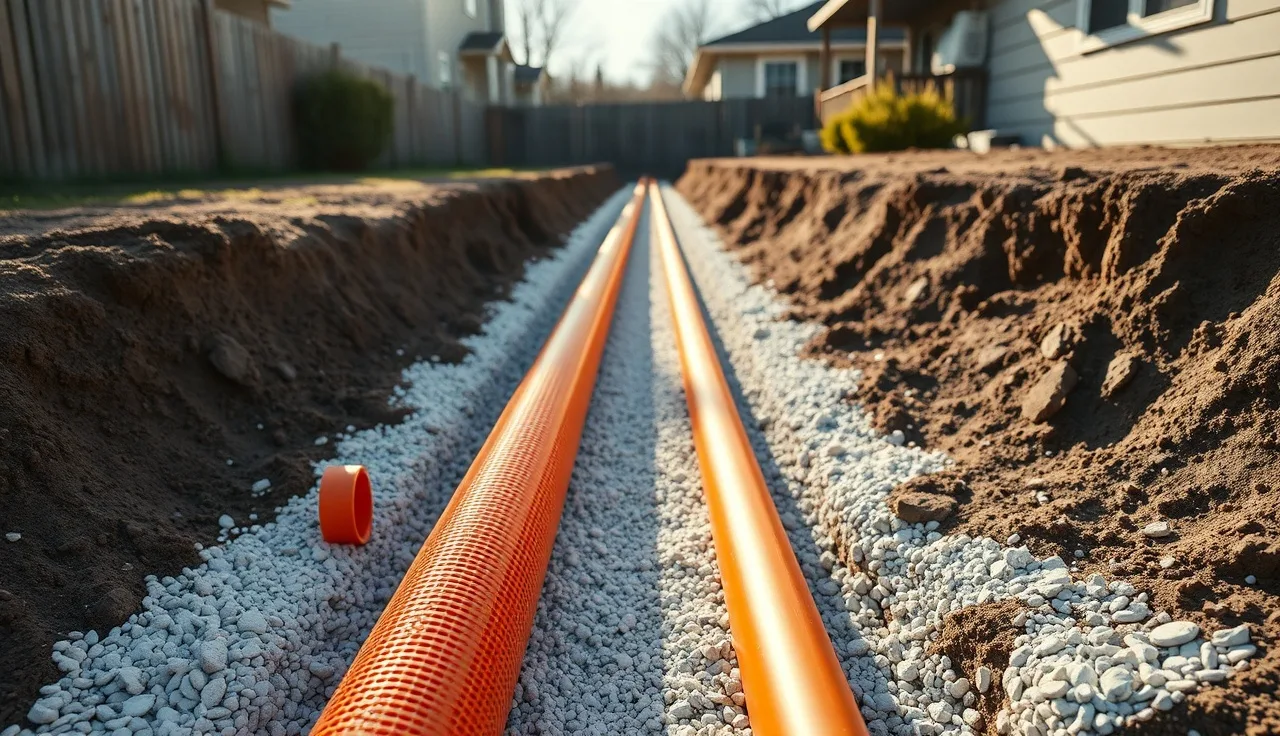
The pipe is simple. A 10-foot section of 4-inch SDR 35 PVC perforated pipe has two rows of 1/2-inch holes spaced 4 to 6 inches apart, running along the bottom half of the pipe. Those holes face down when installed, so effluent drips into the gravel beneath the pipe rather than pooling inside it. Corrugated HDPE versions (the brand most installers know is ADS) work the same way but flex around curves and weigh less to haul on a job site.
The pipe does not treat waste. Treatment happens in the soil after effluent leaves those holes. The pipe has one job: spread effluent evenly along each trench so no single spot gets saturated.
What materials are used for leach field pipe and how do they compare?
Two materials dominate: Schedule 40 or SDR 35 PVC, and corrugated single-wall or double-wall HDPE. Older clay and concrete pipe is still in the ground on pre-1970s systems, but nobody installs it now.
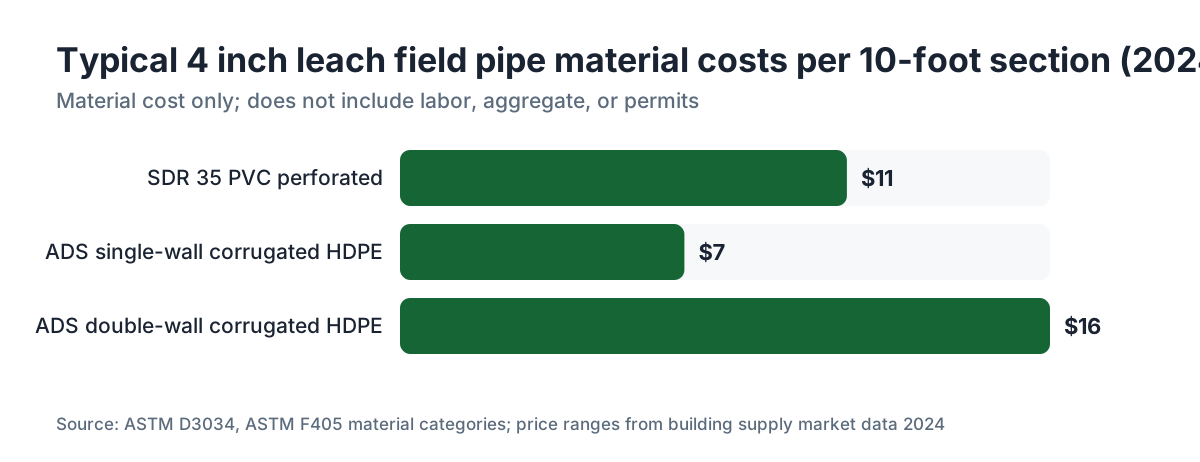
| Material | Typical 10-ft section cost (2024) | Lifespan estimate | Flexibility | Common standard |
|---|---|---|---|---|
| SDR 35 PVC perforated | $8 to $14 | 50+ years | Rigid | ASTM D3034 |
| ADS single-wall corrugated HDPE | $5 to $10 | 35 to 50 years | Flexible | ASTM F405 |
| ADS double-wall corrugated HDPE | $12 to $20 | 50+ years | Flexible | ASTM F405 / F2648 |
| Orangeburg (legacy only) | No longer sold | Fails in 20 to 30 years | N/A | N/A |
PVC's rigidity is a feature in stable soil. It holds its grade without sagging between support points. HDPE's flex helps when trenches run through tree-root zones or uneven terrain. Both meet ASTM standards and both are accepted in most jurisdictions, though a few state codes specify one over the other. Check your local rules before you buy.
SDR 35 is the wall-thickness designation that matters most for burial depth. SDR stands for Standard Dimension Ratio, and 35 means the pipe outside diameter divided by wall thickness equals 35. That wall handles normal soil loading in a standard trench without collapsing. Go deeper than 6 feet and some codes require Schedule 40, which is heavier-walled.
Orangeburg pipe is worth knowing about because millions of pre-1970 systems still have it underground. It's a fiber-and-tar product that soaks up moisture, deforms into an oval, and eventually collapses. If you have a system that old and it's failing, there's a decent chance Orangeburg is part of the problem.
What does a proper 4 inch leach field pipe installation look like?
The EPA's SepticSmart program describes a conventional system as a tank, a distribution device, and a drain field where perforated pipe in gravel lets effluent filter through the soil [1]. Whether that actually works comes down to four details: slope, burial depth, aggregate, and trench width.
Slope matters more than most homeowners realize. The pipe needs a consistent grade of 1/16 inch to 1/8 inch of drop per linear foot (roughly 0.5 to 1 percent). Too flat and effluent sits in the pipe instead of moving forward. Too steep and it rushes to the end of the run without distributing. A good installer sets this with a laser level and checks it before backfilling.
Burial depth usually runs 6 to 36 inches from the top of the pipe to finished grade. Most residential systems land at 18 to 24 inches in warm climates and 24 to 36 inches where freeze protection matters. The EPA recommends at least 6 inches of aggregate below the pipe and 2 inches above it before any barrier layer [8]. Many state codes require 12 inches below.
Trench width is typically 18 to 36 inches. The aggregate is usually 3/4-inch washed stone, clean with no fines, because fines migrate into the stone voids over time and cut permeability. Some systems use chamber technology instead of pipe-and-gravel, but that's a different product.
Each lateral ends with an inspection port: a capped vertical riser that reaches to or near grade so a technician can check for backup or dry conditions. Most codes require at least one port per lateral. If your system doesn't have them, a technician can often add them during a service call.
For the full system the pipe connects to, read our guide on leach fields.
How deep should 4 inch leach field pipe be buried?
Bury the pipe deep enough to protect it from surface damage and freeze, but shallow enough that effluent still reaches the aerobic treatment zone in the upper soil. Most residential systems land at 18 to 36 inches of cover, with a code minimum of 6 inches over the top of the pipe.
The upper limit is typically 36 inches in standard soil. Cold-climate states push deeper for freeze protection. Minnesota, for example, sets its own trench and depth requirements in Minnesota Rules Chapter 7080 rather than following the federal model [2].
Here's the practical consequence. If your leach field sits very shallow (6 to 12 inches), you'll see faster effluent surfacing in wet weather and more temperature swings in winter. Go too deep (36 inches plus) and treatment by aerobic soil organisms drops off, because you're below where soil biology is most active. The right depth splits the difference, which is why a perc test and soil profile done before design matter as much as the pipe spec.
Cover depth also matters for vehicle traffic. Never drive over a leach field trench. Even a riding mower over a shallow trench can crack PVC or crush corrugated HDPE. Most state codes ban structures and vehicles over the drain field for exactly this reason [11].
What slope is required for 4 inch leach field pipe?
Most state codes call for a slope between 1/16 inch and 1/8 inch per linear foot, with 1/8 inch (roughly 1 percent grade) the single most-cited number. Some codes write it as 2 to 4 inches of drop per 100 feet. The National Environmental Services Center at West Virginia University, whose technical guidance many state programs use, recommends 1/8 inch per foot as a conservative default [3].
Getting the slope wrong is one of the most common install mistakes. A lateral that sags even slightly creates a low point where effluent ponds. That spot loads the soil far harder than intended, biomat builds faster there, and that section fails first. A laser level isn't optional. It's the only way to verify grade before you pour stone.
On very long laterals, some designers steepen the slope slightly at the inlet and flatten it toward the outlet to offset the head pressure difference. Worth asking your designer about if you have laterals over 100 feet.
What are the signs that 4 inch leach field pipe has failed or is failing?
Leach field pipe fails in a few distinct ways. On modern PVC systems, the culprit is usually not the pipe but the biomat: a layer of anaerobic bacteria and organic solids that clogs the soil-aggregate interface and blocks infiltration even when the pipe is fine. Classic signs are slow drains throughout the house, sewage odors in the yard, wet or spongy ground over the trench lines, and in bad cases, sewage surfacing in pools.
Structural pipe failure shows up more on older systems. Orangeburg collapses. Old clay tile joints separate. Tree roots, pulled toward the moisture and nutrients in effluent, work into joints and eventually pack sections solid. On corrugated HDPE, UV degradation matters only where pipe sits exposed at the surface. Underground, it's a non-issue.
You diagnose structural failure with a camera inspection, the same tool used in sewer lines. A technician feeds a waterproof camera through the cleanout or inspection port and watches for deflection, root intrusion, and offset joints. If the pipe is intact and the bore is clear, the problem is soil clogging, not pipe damage. That points to a different fix: resting the field or replacing the drain field.
Backup into the tank instead of surfacing in the yard usually means the field is flooded and hydraulically overwhelmed. That happens after heavy rain on a borderline system, or after years of gradual biomat buildup. A septic tank pump out relieves pressure temporarily but won't fix underlying field failure.
Early warning is much cheaper than emergency replacement. Most septic tank inspections include a check of distribution box levels, a simple read on whether field saturation is building.
How do you connect 4 inch leach field pipe to the distribution box?
The distribution box (D-box) is where flow from the tank outlet splits into multiple lateral runs. Each lateral starts with a solid 4-inch section (no perforations) that exits the D-box and runs to the beginning of the perforated lateral. That solid section matters: you don't want effluent leaching into the ground right next to the D-box, because that soil saturates and the box floods.
The connection uses a standard 4-inch hub fitting. SDR 35 pipe joins with gasketed joints in most applications, not solvent weld, because you want some flex in the ground and you may need to pull sections for inspection later. Corrugated HDPE uses snap-together bell-and-spigot fittings.
Flow equalization at the D-box matters a lot. If one outlet sits slightly lower than the rest, almost all flow goes to that one lateral, which then fails while the others stay dry. Cornell Cooperative Extension guidance covers how unequal outlet elevation skews lateral loading [10]. A leveling tool and a set of outlet baffles or flow equalizers are standard practice for a careful installer. Some codes require the D-box outlets to be adjustable or the box to include a leveling mechanism.
A cracked or settled D-box is a repair job, not a full system replacement. For repair costs and scope, see our guide on septic system repair.
What is the correct pipe for a leach field: perforated or solid?
Both types belong in a leach field, in specific spots. Solid pipe carries effluent from the tank outlet to the D-box, and from the D-box to the start of each lateral's perforated run. Use solid pipe anywhere you don't want effluent to exit early. Perforated pipe makes up the distribution lateral, the part running the length of each trench.
A common DIY mistake is mixing these up. Run perforated pipe all the way from the tank and you lose effluent near the tank, in soil that wasn't designed for it. Run solid pipe in the lateral and effluent only exits at the very end, flooding that one endpoint.
The switch from solid to perforated usually happens at a marked point 5 to 10 feet past the D-box, or where the trench gravel begins. Your design drawing should spell this out.
How long do leach field pipe trenches need to be?
Trench length depends on your soil's percolation rate and your household's daily wastewater flow, not on some standard number. The figure comes from a percolation test (perc test) or soil morphology assessment done before design.
As a rough reference, most state design manuals use 1 to 2 square feet of trench bottom per gallon per day of design flow. A 3-bedroom home is typically assigned a design flow of 300 to 450 gallons per day depending on the state. With moderately permeable soil (perc rate of 30 to 45 minutes per inch), that might yield total trench lengths of 300 to 500 feet, split across 3 to 5 laterals.
Individual laterals are usually capped at 60 to 100 feet by code, because beyond that you can't hold uniform slope and distribution. Need more total footage? Add laterals rather than lengthening each one.
On a new system, pipe and materials are a small slice of the total. Labor, excavation, and stone dominate. See our breakdown of cost to install a septic system for realistic current figures.
Can you repair or replace sections of leach field pipe without replacing the whole field?
Yes, sometimes. If a camera inspection confirms a localized problem, like a root-infiltrated joint or a crushed section, a contractor can dig out that section, replace the pipe, and backfill. That costs a fraction of full replacement: roughly $500 to $2,500 for a single repair versus $5,000 to $20,000 or more for a whole new field.
The catch is that most leach field problems aren't localized pipe damage. They're soil failure. The infiltrative surface is clogged with biomat and won't absorb effluent no matter what the pipe looks like. Replacing the pipe there does nothing. You either rest the field (divert flow to a reserve area while the primary recovers, if your lot has room and your code allows it) or build new trenches in undisturbed ground.
A competent technician can usually tell the difference before breaking ground. The D-box test is simple: open the box and see whether effluent is backed up to the outlet elevation or higher. If it is, the field is saturated or clogged. If the box sits at normal level but one lateral acts up, localized pipe damage is more likely.
For major overhauls, pipe and hardware costs are well-documented, but you want accurate regional labor data too. SepticMind is used by service operators to track job costs and field conditions, which gives a clearer read on real repair pricing in your area than any national average.
Also worth reading: our full guide on septic tank repair covers what's fixable and what isn't.
What do state and EPA codes say about 4 inch leach field pipe specs?
The EPA sets no binding construction standards for onsite septic systems. That authority sits with the states. What the EPA offers through SepticSmart is guidance and educational material encouraging proper siting, design, and maintenance [1]. The enforceable specs come from state onsite wastewater codes, which in many states hand further authority to county health departments.
The EPA's Office of Water published design manuals, most notably the 1980 "Design Manual: Onsite Wastewater Treatment and Disposal Systems," that define conventional components including the 4-inch perforated pipe standard [4]. Many state codes adopted this framework and updated it over the years.
A few examples of how states handle the pipe spec: Minnesota requires Schedule 40 PVC or equivalent for soil treatment systems and sets minimum trench widths and aggregate depths in Minnesota Rules Chapter 7080 [2]. California's rules under Title 22 and county environmental health codes govern design flow and trench geometry. New York's State Residential Building Code and Part 75 of the Environmental Conservation Law set similar requirements.
The takeaway for a homeowner: your county health department or state environmental agency is the authority for what's required where you live. ASTM standards (D3034 for PVC [6], F405 for HDPE corrugated [7]) are the material specs those codes reference, so pipe sold at a supply store labeled to those standards is almost always code-compliant on the material side. Depth and slope still need a licensed designer or installer to verify against your local code.
The National Onsite Wastewater Recycling Association (NOWRA) keeps a state-by-state regulatory database that's a good starting point for finding your state's rules [5].
What does 4 inch leach field pipe cost, and what affects the price?
The pipe itself is cheap. A 10-foot section of 4-inch SDR 35 perforated PVC runs $8 to $14 at most supply stores as of 2024. Corrugated HDPE single-wall is a little less per foot. For a 300-foot lateral field, you're looking at $240 to $420 in pipe material. That's not where the money goes.
The real cost is excavation, stone, labor, inspection fees, permits, and soil testing. A complete conventional leach field for a 3-bedroom home typically runs $3,000 to $15,000 depending on soil, lot access, local labor rates, and whether the property already has a design on file. Rocky ground or a high water table can push it past $20,000. For a full breakdown, see our article on cost to put in a septic tank.
A partial repair or a few added inspection ports keeps material costs low. A 4-inch PVC inspection riser kit (pipe, end cap, cleanout cap) costs $15 to $35. Labor to expose the pipe end and set it properly is the bigger expense, usually $150 to $400 per port depending on burial depth.
Regular septic tank pumping is the single best way to protect your leach field pipe from early clogging. Unscreened solids that escape a full or failing tank load the pipe with material it was never designed to handle. EPA SepticSmart recommends pumping every 3 to 5 years as a baseline [1], and how often to pump your septic tank depends on household size and tank volume.
Frequently asked questions
Can I use 3 inch pipe instead of 4 inch for my leach field?
Almost certainly not for a residential system. Nearly all state onsite wastewater codes set 4 inch as the minimum diameter for leach field distribution pipe. Three-inch pipe has much less flow capacity and clogs with solids more easily. Undersized pipe would likely fail a county inspection and could void your permits. Check your specific state code, but 4 inch is essentially universal for homes.
Which is better for a leach field: PVC or corrugated HDPE pipe?
Both work well when installed correctly. SDR 35 PVC holds grade better in stable soil because it's rigid, which makes slope control easier. Corrugated HDPE is lighter and flexes around obstacles, which helps on rough terrain. For most residential installs on flat, stable lots, experienced installers lean toward PVC because slope reliability matters so much. In rocky or uneven ground, HDPE's flex is worth the trade-off.
How do I know if my leach field pipe is clogged versus completely failed?
A camera inspection through the inspection ports or cleanouts shows structural condition. If the pipe is intact but effluent is backed up in the distribution box, the soil is clogged, not the pipe. If the camera shows root intrusion, pipe deflection, or offset joints, that's structural failure. The distinction matters: soil clogging sometimes responds to field resting or aeration, while a broken pipe needs excavation and replacement.
What is the difference between perforated and solid leach field pipe?
Solid pipe carries effluent without releasing it, used from the tank to the distribution box and from the box to the start of each trench. Perforated pipe has holes along the bottom and runs the length of each trench, releasing effluent into the surrounding gravel and then the soil. Using them in the wrong spots is a common DIY mistake that causes early system failure.
How many holes are in 4 inch perforated leach field pipe?
Standard 4-inch perforated PVC meeting ASTM D3034 usually has two rows of 1/2-inch holes spaced every 4 to 6 inches along the bottom half of the pipe, so roughly 40 to 60 holes per 10-foot section. HDPE corrugated pipe has perforations in every corrugation valley. Both spread effluent evenly rather than shooting it out at high velocity.
Does leach field pipe need gravel around it?
Yes, in conventional systems. The standard install places a minimum of 6 to 12 inches of clean washed aggregate (typically 3/4-inch stone) below the pipe and 2 to 6 inches above it before a barrier layer of filter fabric or straw. The gravel creates void space that receives effluent from the pipe holes before it soaks into native soil. Chamber systems skip the gravel and use molded plastic arches, but those are a different product.
Can tree roots damage 4 inch leach field pipe?
Yes, and it's one of the most common causes of leach field pipe failure. Roots chase the moisture and nutrients in effluent and work into joint gaps, especially in older clay tile or gasketed PVC systems. Willow, poplar, and large maples are the worst offenders. Most codes require a minimum 10-foot setback from trees, but aggressive species travel much farther. If a camera confirms root intrusion, the affected sections need replacement.
How long does 4 inch PVC leach field pipe last?
SDR 35 PVC buried in stable soil with a properly working septic tank has an expected service life of 50 years or more. The pipe material rarely fails under normal conditions. Systems stop working because of soil clogging (biomat buildup) or tank solids escaping into the field, not the pipe degrading. Protect the pipe by pumping your tank on schedule and staying off the field with vehicles.
What slope or pitch does 4 inch leach field pipe need?
Most state codes and design manuals specify 1/8 inch of drop per linear foot, roughly 1 percent grade. Some allow as little as 1/16 inch per foot. The goal is forward flow without too much velocity. Too little slope pools effluent inside the pipe; too much pushes it to the end of the run and overloads that soil. A laser level is the reliable way to verify slope before backfilling.
Do I need an inspection port on my leach field laterals?
Most state codes require at least one inspection port (a capped riser reaching to or near grade) at the end of each lateral. They let a technician check whether effluent is backing up or whether the far end is even getting flow, which catches distribution problems early. If your system lacks them, they can be added by exposing the pipe end and installing a riser fitting, usually a half-day job.
What is the maximum length for a leach field lateral?
Most state codes cap individual laterals at 60 to 100 feet. Beyond that, holding consistent slope over the whole run gets difficult, and distribution suffers because pressure at the inlet is much higher than at the far end. If a design needs more total footage, the right move is adding more laterals of code-compliant length, not stretching existing ones past the limit.
Can I install leach field pipe myself, or does it require a licensed contractor?
In most states, installing or significantly altering an onsite septic system requires a licensed installer and a permit, even on your own property. A handful of states allow owner-installed systems on a primary residence with proper permits and inspections. Don't guess here: installing without a permit can bring fines, mandatory removal, and problems selling the property. Contact your county health department before any work.
What happens if leach field pipe freezes in winter?
Frozen leach field pipe is uncommon when pipe is buried to the minimum depth your state's cold-climate code requires, typically 24 to 36 inches in northern states. When it does happen, usually in systems with very shallow pipe or exposed risers, effluent can back up into the tank and then the house. Heat tape on exposed risers and adequate burial depth are the fixes. A system that freezes repeatedly likely has a design or depth problem.
Sources
- U.S. EPA, SepticSmart: Homeowner's Guide to Septic Systems: EPA SepticSmart recommends pumping every 3 to 5 years and describes conventional systems as using perforated pipe in gravel to allow effluent to filter through soil
- Minnesota Pollution Control Agency, Subsurface Sewage Treatment Systems (Minnesota Rules Chapter 7080): Minnesota Rules Chapter 7080 requires Schedule 40 PVC or equivalent and sets minimum trench widths, aggregate depths, and cold-climate burial requirements
- National Environmental Services Center, West Virginia University, Pipeline Newsletter: Onsite System Design: NESC guidance recommends 1/8 inch per foot as the standard slope for leach field laterals
- U.S. EPA, Design Manual: Onsite Wastewater Treatment and Disposal Systems (EPA 625/1-80-012): EPA's foundational design manual established 4-inch perforated pipe as the standard distribution pipe for conventional soil absorption systems
- National Onsite Wastewater Recycling Association (NOWRA), Regulatory Database: NOWRA maintains a state-by-state database of onsite wastewater regulations useful for finding jurisdiction-specific pipe and design requirements
- ASTM International, ASTM D3034: Standard Specification for Type PSM Poly(Vinyl Chloride) (PVC) Sewer Pipe and Fittings: ASTM D3034 defines wall thickness, dimensional tolerances, and perforation specifications for PVC sewer and drain pipe including SDR 35
- ASTM International, ASTM F405: Standard Specification for Corrugated Polyethylene (PE) Pipe and Fittings: ASTM F405 sets the material and dimensional standard for corrugated HDPE drainage pipe used in leach field applications
- U.S. EPA, Office of Water: Onsite Wastewater Treatment Systems Technology Fact Sheet, Septic Tank-Soil Absorption Systems: EPA fact sheet describes trench aggregate requirements including minimum aggregate depths below and above distribution pipe
- University of Minnesota Extension, Septic System Owner's Guide: University of Minnesota Extension guidance covers burial depth requirements for cold-climate leach field installations and freeze protection practices
- Cornell Cooperative Extension, Onsite Wastewater Management Program: Cornell guidance describes distribution box leveling requirements and the effect of unequal outlet elevation on lateral loading distribution
- U.S. EPA, SepticSmart: Protect Your Investment: EPA SepticSmart warns against driving or parking vehicles over drain field areas due to risk of pipe damage from compaction
Last updated 2026-07-09