500 gallon aerobic septic system: what you need to know
By the SepticMind Editorial Team

TL;DR
- A 500-gallon aerobic septic system pumps air through wastewater to grow bacteria that treat it before it hits the soil.
- Most states certify this as the smallest tank size, and it fits very small households (1-2 bedrooms) with low daily flow.
- Installed cost runs $10,000 to $20,000.
- It needs inspections a few times a year, an annual service contract, and chlorine refills every few months to stay legal.
What is a 500-gallon aerobic septic system?
An aerobic septic system treats wastewater by pumping air through it around the clock. That air feeds bacteria that break down solids and pathogens much faster than the bacteria in a conventional (anaerobic) tank. The payoff is cleaner effluent, which most states let you spray or drip across a smaller patch of ground than a conventional drain field needs.
The "500 gallon" number refers to the tank compartment volume. In an aerobic treatment unit (ATU), that volume holds the active aeration zone, usually next to a separate pre-treatment or settling compartment and a final pump or spray chamber. Some manufacturers pack all three zones into one tank body. Others split them into two or three tanks. Either way, 500 gallons of aeration capacity is the smallest size you'll find in most certified product lines.
Why so small? Aerobic treatment does more work per gallon than passive settling. A conventional septic tank has to hold two or three days of household flow to let solids settle. An ATU gets similar or better treatment in far less retention time because the bacteria run continuously with plenty of oxygen [1].
Still, 500 gallons is small, and it shows up in specific places: a one- or two-bedroom cabin, a small guest house, a seasonal home with low occupancy, or a commercial spot like a single-occupancy restroom. If you're eyeing one for a full-size family home, stop and think first.
Who is a 500-gallon aerobic system actually right for?
It fits small, low-flow households. The EPA ties system sizing to daily flow, and residential design commonly uses 75 gallons per bedroom per day, though many state codes plan for 100 to 150 gallons per bedroom to stay conservative [1]. Run the math: a two-bedroom home at 100 gallons per bedroom makes 200 gallons a day. A 500-gallon aeration compartment gives you about 2.5 days of hydraulic retention at that flow. That's fine for a well-designed ATU, but it leaves almost no buffer for a busy weekend.
A 500-gallon ATU works best when:
- Daily wastewater flow stays below 500 gallons (roughly 1-3 people on normal usage)
- The lot has little room for a drain field and needs the smaller footprint ATU effluent allows
- The site has shallow soil, a high water table, or marginal perc rates that rule out a big conventional system
- It's a seasonal or vacation property with predictable low-use stretches
Where it does not fit: a full-size family home with multiple bathrooms, laundry running most days, and guests on weekends. Hydraulic overloading is the fastest way to kill an aerobic system's biology and blow your compliance with the state operating permit [2].
Here's something people miss. Some states set 500 gallons as a hard floor and won't approve anything smaller for a permanent residence, no matter how few people live there. Texas, for example, requires aerobic systems to meet the NSF/ANSI 40 standard for residential use, and the smallest certified units cluster around 500 gallons of aeration volume [3]. Read your state code before you assume a smaller unit is even on the table.
How does a 500-gallon ATU actually work, step by step?
Wastewater enters a pre-treatment or trash tank first. Solids settle here, same as a conventional septic tank. This keeps floating grease and bulky solids out of the aeration chamber, where they'd clog the air diffusers.
From the pre-treatment zone, partly clarified liquid flows into the aeration chamber. This is the heart of the system. An electric air pump (the aerator or blower) forces air through diffusers at the bottom of the tank. Oxygen-loving bacteria grow in suspension and on surfaces inside the chamber. They consume biological oxygen demand (BOD) and knock down pathogens far more aggressively than anaerobic bacteria do. EPA guidance notes that a properly run ATU can cut BOD and suspended solids well below what a conventional tank achieves, which is exactly why states allow smaller dispersal areas for ATU effluent [1].
Treated effluent then moves into a clarifier or settling zone, where dead bacterial mass (humus or sludge) drops out. The clarified liquid heads to a pump chamber or spray tank. A timer-controlled pump doses that effluent to a drip irrigation field, a spray head system, or in some cases a small subsurface drain field.
Chlorine tablets (usually calcium hypochlorite) sit in a feeder on the outlet side and disinfect the effluent before it leaves, which most states require for any ATU that sprays above ground [2]. The spray heads or drip lines spread the treated, disinfected effluent across a set area, with setbacks from property lines, wells, and buildings.
The whole cycle depends on that air pump running nonstop. Cut power for more than a few hours and the aerobic bacteria start dying. That's not a scare story. A dead aerator is the most common cause of ATU failure in the field.
What does a 500-gallon aerobic septic system cost to install?
A complete install runs $10,000 to $20,000 for a residential property. That covers the tank, aerator, controls, and a basic spray or drip field, based on contractor pricing reported across state extension programs and industry data [4]. Straightforward installs in good soil can come in under $12,000. Sites with hard access, rocky ground, or required engineering can push past $25,000.
The tank and aerator itself is a smaller slice of the total than people expect. A 500-gallon ATU from a major manufacturer (Norweco, Jet, Infiltrator, and others) usually retails between $2,000 and $4,500 depending on configuration. Labor, permits, site work, and the dispersal system make up the rest.
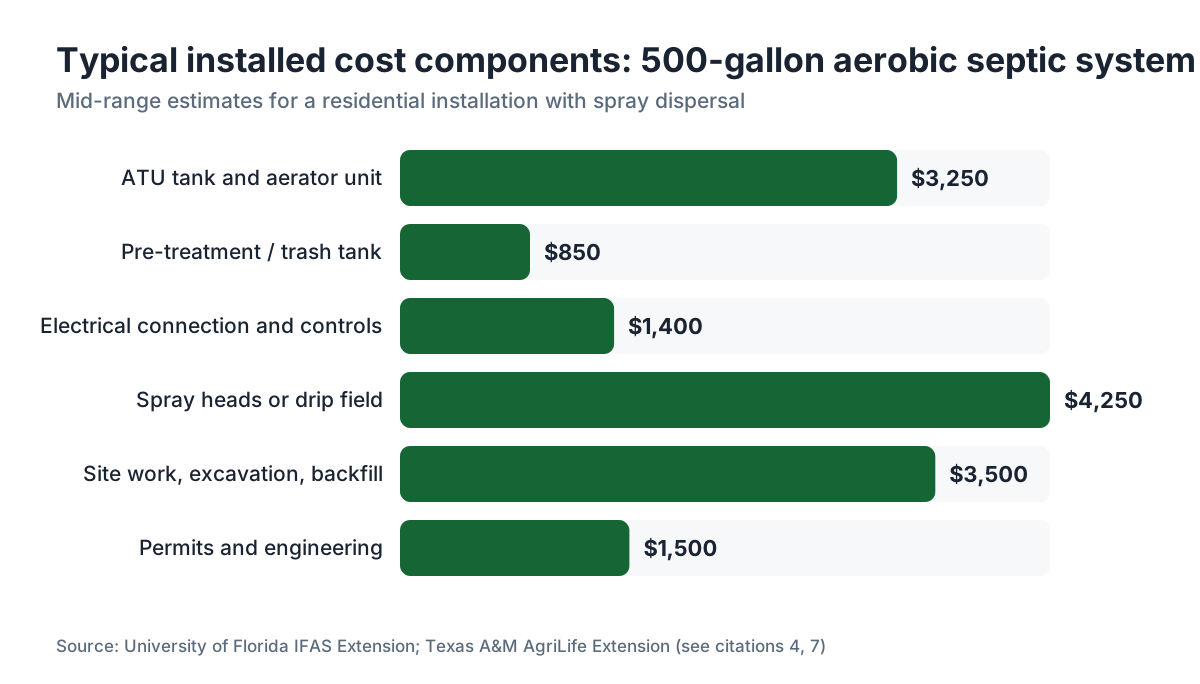
Here's a rough breakdown of where the money goes:
| Component | Typical cost range |
|---|---|
| ATU tank and aerator unit | $2,000 - $4,500 |
| Pre-treatment / trash tank | $500 - $1,200 |
| Electrical connection and controls | $800 - $2,000 |
| Spray heads or drip field | $2,500 - $6,000 |
| Site work, excavation, backfill | $2,000 - $5,000 |
| Permits and engineering | $500 - $2,500 |
| Total installed | $10,000 - $20,000+ |
For how that sits in the broader septic market, see our guide to cost to install septic system and cost to put in a septic tank for conventional comparisons.
One cost people routinely lowball: the ongoing maintenance contract. Most states require a licensed provider to inspect the system every 4 to 6 months. Those contracts run $150 to $400 per year in many markets, and they're not optional if you want to keep your operating permit valid [2].
What maintenance does a 500-gallon aerobic system require?
More than a conventional system. That's the honest answer, and it's the main tradeoff you're signing up for.
A conventional septic system needs pumping every 3 to 5 years and almost nothing else if it's loaded properly. An ATU needs steady attention because it's a machine with an electric motor, chlorine chemistry, and a living bacterial community that can crash when conditions shift.
Here's what routine maintenance really looks like:
Chlorine replenishment (every 1-3 months). The tablet feeder holds a limited supply of calcium hypochlorite. You or your service provider refills it on a schedule. Run out and untreated effluent reaches your spray heads, which is both a health hazard and a permit violation. Some homeowners track this themselves. Others leave it to the service contract.
Aerator inspection (quarterly or per contract). The air pump runs 24/7. Check that it's running, not vibrating hard, and that the diffusers aren't clogged. A failed aerator that goes unnoticed for a few days can wipe out your bacterial population and take weeks to rebuild.
Full system inspection (at least twice a year in most states). A licensed technician checks effluent quality, spray head distribution, chlorine residual, and tank solids. Many operating permits require this and require the technician to file a report with the county or state agency [2].
Sludge pumping. Even ATUs collect solids in the pre-treatment and clarifier zones. Most systems need septic tank pumping every 1 to 3 years depending on loading, which is more often than the 3-5 year cycle for a conventional tank. See our article on how often to pump septic tank for what changes that interval.
Spray head and drip line maintenance. Spray heads clog, catch a lawn mower, or drift out of adjustment. Drip emitters plug with biofilm. All of it needs periodic inspection and occasional replacement.
If you're a service operator running dozens of ATU accounts, tracking inspection schedules, chlorine levels, and permit reporting by hand gets painful fast. Software like SepticMind helps operators stay on top of inspection cycles and compliance records without missing a visit.
Total annual maintenance, service contract plus chlorine, typically runs $300 to $700 per year in many markets, plus pump-out costs every few years [7].
What are the rules and permits for a 500-gallon aerobic system?
This is where most homeowners get surprised. ATUs are not install-and-forget. They run under a permit, and that permit usually demands ongoing reporting.
The federal EPA does not directly regulate individual septic systems. Authority sits with states and local health departments [10]. The EPA's 2002 Voluntary Management Guidelines set the framework most states adopted: ATUs installed by certified contractors, inspected by licensed maintenance providers, and reported to the regulatory authority on a set schedule [6].
State requirements vary a lot. Texas is one of the stricter examples. Title 30 of the Texas Administrative Code, Chapter 285, requires aerobic systems to carry a two-year maintenance contract at installation, be inspected at least four times a year, and have effluent chlorinated to a minimum residual before surface application [3]. Texas also requires spray systems to keep setbacks of at least 10 feet from property lines and 50 feet from water wells.
NSF/ANSI Standard 40 is the performance certification most states reference for residential ATUs. A certified unit has to produce effluent with BOD5 at or below 25 mg/L and TSS at or below 30 mg/L on average [5]. NSF International keeps a searchable list of certified products, and the 500-gallon category is well covered by major manufacturers.
Before you buy anything, pull your county's on-site wastewater ordinance and your state's ATU rules. The permit application spells out approved products, setbacks, dispersal method, and reporting. Skip this step and buy a unit that isn't on your state's approved product list, and the county can flat-out refuse to permit it.
How long does a 500-gallon aerobic system last?
The tank itself, if it's concrete or good HDPE, lasts 20 to 40 years with proper care. That's on par with any well-made septic tank.
The mechanical parts are a different story. The air pump (aerator) usually lasts 5 to 10 years before it needs replacement, and a new one runs $300 to $800 depending on the brand [8]. Control panels and float switches have similar lifespans. Spray heads last 5 to 15 years depending on quality and whether they take a hit.
The dispersal system, spray or drip, tends to be the limiting part on many setups. Drip lines get damaged by roots, ground movement, or install errors and may need partial replacement after 10 to 15 years. Spray head fields hold up better but need periodic nozzle swaps.
The biological process doesn't wear out, but it can crash. Common causes of failure: power outages that kill the aerobic bacteria, disinfectants or antibiotics flushed into the tank, hydraulic overloading that washes biomass out of the aeration chamber, and neglected aerator maintenance. Most of these are recoverable if you catch them early. A system that's run anaerobic for months because of a dead aerator may need professional help and re-seeding of the bacterial population.
For repair guidance when something goes wrong, see septic system repair and septic tank repair.
What are the pros and cons of a 500-gallon aerobic system versus a conventional septic tank?
Neither system wins across the board. They solve different problems.
Where the 500-gallon ATU wins:
- Smaller dispersal footprint. ATU effluent quality typically allows a drain field around 50% smaller than a conventional system serving the same flow [9]. On a tight lot, that's the difference between getting a permit and not.
- Works on difficult soils. Clay-heavy or slow-percolating soil that fails a standard perc test can still take ATU effluent at reduced loading rates.
- Lower nitrogen output in some designs. Certain ATUs include anoxic zones that achieve partial denitrification, which matters near sensitive water bodies.
- Meets code where conventional systems are banned. Many counties in flood-prone or karst areas require ATUs or mandate them near water.
Where the conventional system wins:
- Lower installed cost. A conventional system on a suitable site often costs $5,000 to $10,000 less than an ATU [4].
- Far lower maintenance burden. No aerator, no chlorine, no operating permit reporting.
- Less failure risk from power outages or mechanical breakdown.
- Simpler for homeowners who don't want to think about their septic system.
If your lot can support a conventional system, the conventional system is almost always the better call on lifetime cost and hassle. The ATU earns its premium only when the site genuinely requires it.
One more thing. The 500-gallon size carries more risk than a larger ATU. Less buffer for peak flows, less margin if the aerator runs slow, faster swings in treatment quality when something goes sideways. A 750- or 1,000-gallon ATU on the same property gives you more resilience. If your lot and budget can handle the bigger size, the extra $1,000 to $2,000 is usually money well spent.
How do I know if my 500-gallon aerobic system is working properly?
Some things you can check yourself, and some you can't. Start with the easy signs.
Signs the system is working: The aerator makes a steady, consistent hum. Spray heads fire on their normal timer cycle and spray evenly with no pressure loss. No sewage odor around the tank lids, the spray area, or inside your home. Chlorine tablets get used up at a normal rate, which tells you water is flowing through the feeder.
Signs something is wrong: The aerator is silent or grinding. Spray heads aren't cycling or spray weakly. You smell rotten eggs or sewage near the tank or spray area. Toilets or drains back up or run slow. The chlorine feeder is untouched after several weeks despite normal use (could mean flow isn't reaching the feeder, or there's a blockage).
A working ATU produces effluent that's clear to slightly cloudy, not dark or foul. Lift the aeration chamber lid and see something that looks like raw sewage, and the aerobic biology has probably crashed.
For a formal check, a licensed inspector samples effluent and tests chlorine residual, BOD, and suspended solids against your permit's discharge limits. If you're due or haven't had one recently, see our guide to septic tank inspection for what to expect.
Some operators now put remote monitoring sensors on ATU systems that flag aerator failures or abnormal flow within hours instead of waiting for the next scheduled visit. That's the kind of early warning that keeps a minor problem from turning into a full replacement.
Can a 500-gallon aerobic system be expanded or upgraded?
Yes, within limits, and it depends heavily on your site permit.
If your household grows and you need more capacity, the simplest path is adding a second pre-treatment tank in series ahead of the existing ATU. That buys you more settling volume and more hydraulic buffer without replacing the aeration unit. Some installers also add a larger aeration chamber alongside the existing one, roughly doubling treatment capacity.
Your dispersal system has to handle the extra flow too. If you're already at the maximum loading rate your soil and permit allow, adding tank capacity does nothing unless you can also expand the spray or drip field. That means going back to the permitting authority for a modification.
Sometimes upgrading the whole system makes more sense than patching a 500-gallon unit that was already marginal. Get bids on both before you commit.
One thing that isn't easily changed: switching from an aerobic system to a conventional system on the same site. If the ATU was required because the site failed conventional perc standards, you're staying aerobic. If the ATU was a choice on a site that could have supported conventional, you'd need a permit modification and a new conventional install, which rarely pays off unless the existing ATU is at end of life.
For any real change to the system, pull a new permit. Unpermitted modifications can void your operating permit and create liability later if the system causes a problem.
What should I do before buying a property with a 500-gallon aerobic system?
Pull the operating permit and read it. It tells you the approved discharge limits, required inspection frequency, and any site-specific conditions. Then ask the seller for maintenance records and service contract history. A system with three years of documented inspections and no violations is a very different animal from one with a lapsed contract and no paperwork.
Hire a licensed septic inspector for a full evaluation before closing. They should run the aerator, check effluent quality, inspect spray heads or drip lines, and confirm the chlorine feeder works. A septic tank inspection on an ATU takes longer than a conventional tank inspection because there are more parts to check, and it's worth every dollar.
Ask directly: when was the aerator last replaced, and what's its condition? A ten-year-old aerator is near end of life. Build $500 to $800 into your negotiations if you're buying a system with aging mechanical parts.
Check whether the maintenance contract transfers or has to be set up fresh in your name. Some states require a valid contract in place at all times. If the seller's contract lapses at sale, you could have a compliance gap that draws regulatory attention.
Confirm the system is on your state's approved product list. Older systems installed before current certification rules may be grandfathered, but you want to know that going in. If it's not certified, find out what that means for replacement parts and future permitting.
SepticMind's inspection report templates and permit tracking tools help here if your inspector or the service company uses a digital workflow, making it easier to get clean documentation of the system's status before you close.
Frequently asked questions
How many bedrooms can a 500-gallon aerobic septic system handle?
Most state codes size ATUs at 75 to 150 gallons per bedroom per day. At 100 gallons per bedroom, a 500-gallon aeration chamber gives about 2.5 days of retention for a two-bedroom home. Most permitting authorities approve a 500-gallon ATU for 1 to 2 bedrooms. For 3 or more bedrooms, a larger unit is almost always required. Check your county code, since minimum sizing rules vary.
How often does a 500-gallon aerobic septic system need to be pumped?
More often than a conventional tank: typically every 1 to 3 years for the pre-treatment and clarifier zones, versus 3 to 5 years for a conventional tank. Less tank volume means solids build up faster as a share of total capacity. A licensed technician should check solids at each inspection and recommend pumping before solids reach 40-50% of tank depth. See our guide on how often to pump septic tank for more.
What type of chlorine tablets do I use in an aerobic septic system?
Calcium hypochlorite tablets (pool-style HTH or similar, usually 1-inch diameter) are the standard for ATU feeders. Do not use trichlor (cyanuric acid-based) tablets meant for swimming pools. They harm soil bacteria and may not be approved by your state. Check your manufacturer's manual for the approved tablet size and type, and refill the feeder every 4 to 12 weeks depending on flow.
What happens if the aerator stops working in a 500-gallon ATU?
The aerobic bacteria start dying within hours of losing oxygen. Within 24 to 48 hours, treatment quality drops sharply and the system shifts toward anaerobic. If the aerator is out more than a few days, your effluent may violate discharge standards and clog the dispersal system with partly treated solids. Replace a failed aerator right away, and expect 1 to 2 weeks of normal operation to rebuild the bacterial population.
Is a 500-gallon aerobic septic system legal in all states?
No. State rules vary a lot. Most states require ATUs to be certified to NSF/ANSI Standard 40 and appear on an approved product list. Some states set minimum tank sizes above 500 gallons for permanent residences. A few have extra local health department rules. Always check your state's on-site wastewater regulations and your county's ordinance before buying or installing any ATU.
Can I install a 500-gallon aerobic system myself?
In almost all states, no. ATU installation requires a licensed installer, and the system must be permitted and inspected before use. Running it without a valid permit and maintenance contract can bring fines and a required shutdown. Some homeowners handle minor tasks like refilling chlorine tablets, but tank installation, electrical connections, and any dispersal system work should go to licensed contractors.
How much does it cost to replace the aerator on a 500-gallon ATU?
Aerator replacement typically runs $300 to $800 for parts and labor, depending on the brand and how easy the unit is to reach. Major brands like Norweco, Jet, and Infiltrator have replacement aerators readily available. If your aerator is more than 8 to 10 years old, budget for replacement before it fails. Some maintenance contracts include aerator replacement at a discounted rate.
What is the difference between a 500-gallon aerobic system and a conventional septic tank?
A conventional septic tank relies on anaerobic bacteria and gravity settling, producing lower-quality effluent that needs a large drain field to finish treatment in the soil. An ATU forces air through the wastewater to grow aerobic bacteria, producing much cleaner effluent that needs a smaller dispersal area. ATUs cost more, need more maintenance, and require an operating permit, but they work on sites where conventional systems can't get a permit.
Do aerobic septic systems smell more than conventional systems?
A properly running ATU should smell less than a conventional system because aerobic treatment makes far less hydrogen sulfide. Strong sewage odor from your ATU usually means the aerator has failed and the system is running anaerobic, the chlorine feeder is empty, or a lid seal is broken. Odor is a reliable early warning. Investigate it instead of ignoring it.
Can I use an ATU in an area with a high water table?
Yes, and it's one of the main reasons people choose ATUs. Because effluent quality is much higher than a conventional tank's, regulators allow smaller drain fields and reduced setbacks from seasonal high water in many places. Some states allow drip dispersal with as little as 12 inches of separation from seasonal high groundwater, versus 24 to 48 inches for conventional systems. Confirm with your local health department for site-specific rules.
What certifications should I look for when buying a 500-gallon ATU?
Look for NSF/ANSI Standard 40 certification, which means the unit was independently tested to produce effluent with BOD5 at or below 25 mg/L and TSS at or below 30 mg/L. NSF International keeps a searchable database of certified products. Many states also keep their own approved product lists, so check both. A unit that's NSF 40 certified but not on your state's list may still not be approvable for your permit.
How do aerobic septic systems affect nearby wells and groundwater?
Properly running ATUs cut pathogen and BOD loading a lot compared to conventional systems, which is why regulators allow reduced setbacks to water bodies in some cases. But nitrogen can still pass through an ATU to groundwater unless the system has a denitrification step. State setback rules from wells still apply. Texas, for example, requires 50 feet from a water well for surface-application ATUs. Don't assume high effluent quality erases all groundwater risk.
What is the required setback distance for a 500-gallon aerobic septic system?
Setbacks vary by state, county, and dispersal method. As a general reference, Texas requires aerobic spray systems to sit at least 10 feet from property lines, 10 feet from the home, and 50 feet from water wells. Surface-application systems usually face stricter setbacks than subsurface drip. Always pull your state's on-site wastewater code and your county's health department rules for site-specific requirements before siting the system.
How do I find a licensed ATU maintenance provider in my area?
Start with your state's environmental or health agency website. Most keep a searchable list of licensed on-site wastewater contractors. Your county health department can usually give referrals too. When you interview providers, confirm they're licensed specifically for aerobic systems (some licenses cover conventional systems only), ask about their inspection reporting process, and get a written contract that spells out inspection frequency and what the service fee includes.
Sources
- U.S. EPA, Onsite Wastewater Treatment Systems Manual (EPA/625/R-00/008): ATUs can reduce BOD and suspended solids to lower levels than conventional septic tanks; EPA design guidance uses daily flow per bedroom for sizing
- U.S. EPA SepticSmart Program: Aerobic treatment units require operating permits, regular maintenance contracts, and inspection reporting in most states
- Texas Administrative Code, Title 30, Chapter 285 (On-Site Sewage Facilities), Texas Secretary of State: Texas requires aerobic systems to carry a maintenance contract, be inspected at least four times per year, chlorinate effluent before surface application, and meet 10-foot property line and 50-foot water well setbacks
- University of Florida IFAS Extension, Aerobic Treatment Units for Onsite Sewage Treatment: Installed cost of a residential ATU typically ranges from $10,000 to $20,000 or more depending on site conditions and dispersal method
- NSF International, NSF/ANSI 40 Residential Wastewater Treatment Systems: NSF/ANSI Standard 40 requires certified ATUs to produce effluent with BOD5 at or below 25 mg/L and TSS at or below 30 mg/L; NSF maintains a searchable list of certified products
- U.S. EPA, Decentralized Wastewater Treatment Systems: A Program Strategy (EPA 832-R-05-002): EPA's 2002 Voluntary Management Guidelines established the framework for ATU installation by certified contractors and regular inspection reporting
- Texas A&M AgriLife Extension, Aerobic Septic Systems: Annual maintenance cost for an ATU including service contract and chlorine typically runs $300 to $700 per year in many markets
- Oklahoma State University Extension, On-Site Sewage Treatment Options: ATU aerators typically last 5 to 10 years; replacement costs $300 to $800 depending on brand and accessibility
- National Environmental Services Center (NESC), West Virginia University, Small Flows Quarterly: Aerobic Treatment Units: ATU dispersal fields can be 50% smaller than conventional systems serving equivalent daily flow due to higher effluent quality
- U.S. EPA Office of Water, Voluntary National Guidelines for Management of Onsite and Clustered (Decentralized) Wastewater Treatment Systems: Authority over individual septic systems resides with states and local health departments, not the federal EPA
Last updated 2026-07-10