DIY perc test: how to run one and what the results mean
By the SepticMind Editorial Team

TL;DR
- A DIY perc test measures how fast water soaks into your soil, which tells you whether a conventional septic drain field will work on your land.
- You can run a rough version in an afternoon with a shovel and a watch.
- Most counties require a licensed soil scientist or engineer to certify the official results before a permit is issued, so treat a DIY test as a screening step before you spend money on professionals.
What is a perc test and why does it matter for septic?
A percolation test, almost always called a perc test, measures how quickly water drains through your soil. The number it produces, usually in minutes per inch (MPI), tells a designer how large your drain field needs to be and whether a conventional leach field will work at all. Soil that absorbs water too slowly can't handle the daily effluent load from a household. Soil that absorbs too fast sends partially treated sewage into groundwater before soil bacteria have time to clean it.
The EPA's SepticSmart program describes the soil absorption field as the component that "provides final treatment and disposal of the septic tank effluent," which is a good reminder that the perc test isn't just a regulatory hurdle. It's telling you something real about whether the ground can do its job [1].
Two situations make the test matter most. You're buying raw land and want to know it can support a septic system before you close. Or you're adding a structure and need to show the soil can handle more load. Perc results also move the cost to install a septic system a lot, because slow-draining soil usually forces a more expensive alternative system.
Can you legally do your own perc test?
Here's the honest answer. In almost every U.S. county, the official perc test that feeds a septic permit has to be performed or witnessed by a licensed soil scientist, professional engineer, or county sanitarian. A test you run yourself carries no legal standing for permitting [2].
Nobody stops you from digging holes and timing water on your own land, though. A DIY perc test is genuinely useful as a screening tool. Before you pay $500 to $1,500 for a professional soil evaluation, a rough DIY test can tell you whether your site is obviously unsuitable (soil that won't drain at all) or obviously fine (water gone in under a minute). It can also help you pick which corner of a big lot to bring the professional to, which saves money if you have options.
Some rural counties with thin staffing will accept homeowner results if a county inspector witnesses the test on site. Call your county health department or environmental services office before you do anything else. Ask the exact question: "Can a homeowner conduct the perc test if a county inspector witnesses it?" The answer varies by state and by county within a state. North Carolina requires a licensed soil scientist for most situations, while some Texas counties let a licensed professional engineer accept homeowner-dug holes [3][4].
What equipment do you need to run a DIY perc test?
The tools are simple. Nothing exotic here.
- A shovel or post-hole digger
- A ruler or measuring tape (a 12-inch ruler works fine)
- A bucket or garden hose with a known flow rate
- A stopwatch or phone timer
- A notebook
- Optional: a wooden dowel or rod to scratch the hole walls (explained below)
You'll need water too. Depending on soil, the pre-soak phase can take 5 to 10 gallons per hole. No water source on site? Haul it in jugs. Running a hose from a neighbor or nearby building is fine as long as you track how much you add.
Hole dimensions matter. The standard test uses a hole 4 to 12 inches in diameter and 12 to 24 inches deep, placed at the depth where the bottom of your future drain field will sit, typically 18 to 36 inches below grade depending on local code. A post-hole digger gives you a more consistent diameter than a shovel, which helps the math later.
How do you run a DIY perc test step by step?
The procedure below follows the general methodology in state and county sanitary codes [2][9]. It is not a substitute for your local official procedure, which may specify different depths, soak times, or measurement intervals.
Step 1: Dig the test hole.
Dig a hole roughly 6 inches across and 24 inches deep, or to the depth your local code specifies for the bottom of an absorption trench. Clean loose soil off the bottom. Scratch the side walls with a knife or dowel to break up any smeared soil that could seal the pores. Add 2 inches of coarse gravel or sand to the bottom to protect the surface during filling.
Step 2: Pre-soak the hole.
Fill the hole with at least 12 inches of water and let it drain all the way. Do this several times over a minimum of 4 hours, preferably overnight. This saturates the soil and swells clay particles so the test mimics the wet conditions the drain field actually works under. Skipping or shortening the pre-soak is the single most common mistake in informal perc tests, and it hands you optimistic numbers that don't reflect real performance.
Step 3: Run the timed test.
The morning after your pre-soak (or after the final soak cycle), fill the hole to 6 inches above the bottom. Start your timer. At 30-minute intervals, measure and record the drop in water level. Refill to the 6-inch mark after each reading if the water dropped more than a few inches. Continue for at least 4 readings. Use the last two or three readings, once they've stabilized, as your absorption rate.
Step 4: Calculate MPI.
Divide the time interval (in minutes) by the drop (in inches). Water dropped 2 inches in 30 minutes? Your perc rate is 30 / 2 = 15 minutes per inch.
Step 5: Dig multiple holes.
One hole is not enough. Run at least 3 to 6 holes spread across your proposed drain field. Soil varies, and a single outlier hole can mislead you badly.
Run holes in the morning when soil is cool and moisture is more even. Skip testing right after a heavy rain or during a long dry spell. Both skew results.
How do you interpret perc test results?
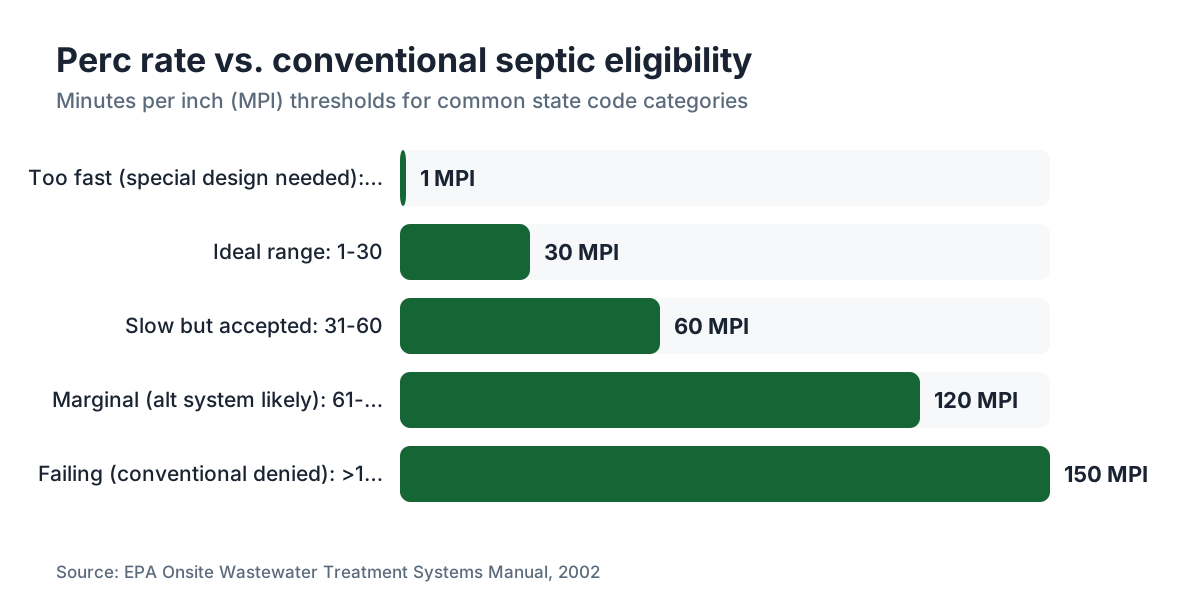
Match your MPI to the ranges most state sanitary codes use, though exact cutoffs vary by jurisdiction [2][9]. The table below shows the common bands.
| Perc rate (min/inch) | Typical classification | Conventional septic allowed? |
|---|---|---|
| Less than 1 | Too fast (gravelly/sandy) | Usually requires special design |
| 1 to 30 | Ideal | Yes, standard sizing |
| 31 to 60 | Slow but acceptable | Yes, larger field required |
| 61 to 120 | Marginal | Sometimes, with alternative systems |
| Over 120 | Failing / clay-dominated | Conventional system usually denied |
A perc rate under 1 MPI sounds great but actually flags soil so porous that effluent moves through before bacteria can treat it. Many codes treat this the same as a failure for conventional systems and require an engineered alternative.
A rate of 1 to 30 MPI is the sweet spot. A 30 MPI reading means the soil absorbs water at roughly 2 inches per hour, and sizing for a standard three-bedroom home typically lands at 900 to 1,500 square feet of field depending on code [5].
Rates over 60 MPI point toward clay-heavy soil. That doesn't always kill the project. Mound systems, drip irrigation, and other advanced treatment options exist for marginal soils. They cost more, sometimes a lot more. The cost to put in a septic tank breakdown shows how alternative systems change the total budget.
One thing nobody tells beginners. The perc test is only half the story. Most professional evaluations also include a soil morphology assessment, which reads soil color, texture, and layering to find the seasonal high water table and any restrictive horizons. A site can pass a perc test and still fail the overall evaluation because groundwater sits too close to the surface in wet months. A DIY perc test can't tell you this.
What factors can make DIY perc test results unreliable?
Several things throw off an informal perc test, and you should know them before you draw conclusions.
Seasonal moisture is the biggest variable. Soil that drains slowly in wet February can look much faster in dry August. Most states require professional testing under near-saturated conditions specifically to catch the worst case [2]. Test in a dry period and your numbers run optimistic.
Hole depth matters a lot. Dig to 12 inches when the real field sits at 30 inches, and you may be testing completely different soil. Clay layers, rock ledges, and hardpan show up at almost any depth.
Smearing the hole walls with a shovel compacts the pores and slows the apparent rate. That's why the professional standard calls for scratching the walls with a pointed tool after digging.
A short pre-soak gives artificially fast results. Plenty of homeowners skip it because it means coming back the next morning. Don't.
Soil disturbance from digging adds air pockets and loose material that drains differently than undisturbed soil. A narrow post-hole digger disturbs less than a wide shovel.
None of this makes a DIY test worthless. It means you treat the results as directional, not final. If your rough test shows 90 MPI across several holes, you have real information: bring in a professional, and start researching alternative systems before you commit to buying the land.
How much does a professional perc test cost compared to DIY?
A professional perc test typically runs $300 to $1,500 depending on location, the number of holes required, and whether a full soil evaluation is bundled in [6]. In high-demand markets or rough terrain, fees can reach $2,000 or more.
Your DIY materials cost almost nothing if you already own a shovel. Water, if you have to haul it, might run $10 to $20 for a few five-gallon jugs from a hardware store or laundromat. Call it $25 to $50 total.
The comparison isn't really about material cost. It's about what you get. A professional evaluation produces a legal document you can submit for a permit, a licensed signature, a soil profile description, and often a preliminary sizing recommendation. A DIY test produces information for your own decision.
Deciding whether to make an offer on a raw parcel? A rough DIY test is worth an afternoon before you spend $1,000 on a professional. Already under contract and heading toward permitting? Skip the DIY step and go straight to the licensed evaluator. Time matters, and a failed professional test tells you the same thing a DIY failure does, only with a paper trail that protects you in a real estate transaction.
For what the whole project costs once the test passes, the septic tank installation article covers full system breakdowns.
When does a site fail a perc test, and what are your options?
A site fails when the perc rate runs past the maximum the local code allows for conventional systems (often 60 or 120 MPI depending on the jurisdiction), or when the soil profile shows a restrictive layer or seasonal high water table too close to the surface [2][9].
Failing is not always the end. Here are the main paths forward.
Alternative system design. Mound systems, drip irrigation, aerobic treatment units, and constructed wetlands work on marginal sites. They need engineering and cost more to install and maintain, but they work. Your county health department keeps a list of approved system types.
Different location on the same parcel. With acreage, another spot may drain better. Professionals sometimes walk a property and suggest moving the test area 50 or 100 feet before calling the site unsuitable.
Challenging the results. Perc numbers are sensitive to timing and technique. If conditions during the test were unusual (a flood the week before, equipment problems, extreme drought), some counties allow a second test. Rare, but worth asking.
Buying down. In a real estate deal, a failed perc test is strong negotiating weight. The cost of an alternative system, often $15,000 to $40,000 more than a conventional one, is a real number you can put in front of a seller [6].
Walking away. If the site is marginal and alternative system costs push the total past what makes financial sense, walking away from the land is a legitimate outcome. A perc test, even a rough DIY one, is cheap compared to finding soil problems after you've closed.
How is a perc test different from a soil permeability test or a perk test?
"Perk test" and "perc test" are the same thing. People spell it both ways. The septic industry and regulatory agencies almost always use "percolation test" or "perc test." The alternate spelling is just a phonetic shortcut.
A soil permeability test is a broader term from civil engineering and agriculture. It includes lab methods (falling head, constant head) that measure hydraulic conductivity in cm/sec or similar units, not the field-condition minutes-per-inch result septic sizing uses. The USDA Natural Resources Conservation Service documents these permeability classes and the difference from field percolation testing [8]. The two answer similar underlying questions but report in different units and aren't interchangeable for septic design.
For septic permitting, "perc test" is the right term. If a contractor or county official says "soil evaluation," they usually mean the perc test plus a soil morphology assessment, which is the fuller workup needed for actual system design.
Do perc test results expire?
Yes. Most jurisdictions give perc results a validity window of 2 to 5 years, after which a new test is required before a permit will be issued [7]. The logic is that land use, drainage, and soil conditions change, and regulators want current data.
Buying land with an old perc test attached? Check the date and your county's expiration policy before you assume you can use that result. A 6-year-old passing test may be worthless for permitting today even if the soil hasn't moved an inch.
For real estate, even a non-expired result from a prior owner's evaluation may need re-certification or a professional's witness in your county. Some counties accept a transferred result. Others make the new applicant commission a fresh test. Ask the county health department directly, and get the answer in writing if you're relying on it in a purchase decision.
Septic service operators running permit applications across several counties use tools like SepticMind to track expiration dates and permit timelines across a project portfolio, which cuts the risk of finding an expired test when an application is due.
What should you do after a DIY perc test before calling a professional?
A few steps make the professional evaluation faster and sometimes cheaper.
Draw a simple site map with dimensions showing where your test holes were, what you found, and the GPS coordinates or lot references. A soil scientist can orient immediately on arrival instead of spending the first 30 minutes figuring out the site.
Note the soil texture and color at each depth. You don't need training to see whether soil is sandy, silty, or clay-heavy, or whether you spot orange or gray mottling, which signals periodic saturation. Write it down.
Document the date, the weather the day of the test and the three days before, and how you pre-soaked the holes. That context helps a professional read your results rather than wave them off.
Check with your county about where on the lot the drain field can legally go. Setbacks from property lines, wells, streams, and structures are fixed by code and may rule out parts of your lot no matter what the perc shows [2]. No point testing soil that's off-limits anyway.
Heading toward a full septic tank inspection or a new system permit? Having your DIY notes in hand gives the professional something to react to, which makes the conversation more productive than starting from zero.
How does the perc test relate to drain field sizing?
The perc rate feeds straight into drain field sizing. Most state codes use a table that ties MPI to a required square footage of absorption area per bedroom or per daily gallon of effluent. The slower the rate, the more area you need [5].
For a typical three-bedroom home producing roughly 300 gallons per day of effluent, here's how field size moves with perc rate under a common code formula.
| Perc rate (MPI) | Required absorption area (sq ft) | Approximate trench length (2 ft wide) |
|---|---|---|
| 5 | 750 | 375 ft |
| 15 | 900 | 450 ft |
| 30 | 1,050 | 525 ft |
| 60 | 1,500 | 750 ft |
| 90 | Likely alternative system required | N/A |
These numbers are illustrative, based on common code tables [5]. Your local code will have specific figures that may differ.
Why care for a DIY test? Because a rough test at 50 MPI puts you near the edge between a standard field and an oversized one. That's worth knowing before you finalize a lot purchase or plan a building footprint, because the drain field area has to come from somewhere on your lot, and it has to stay free of buildings, driveways, and heavy plantings for good. Understanding the leach field requirements for your soil type early keeps you from designing a house that leaves no room for the absorption system.
Operators handling soil evaluations and drain field designs across many client sites often use SepticMind to record test results and link them to system design records, keeping everything in one place for permit submissions and future septic tank inspections.
Frequently asked questions
Can I do my own perc test without a professional?
You can run a DIY perc test on your own land any time. The procedure is straightforward: dig holes at the drain field depth, pre-soak overnight, then time the water drop over several 30-minute intervals. The result gives you useful screening information. What it won't give you is a legal document for permitting. Every state requires a licensed professional to certify perc results before a septic permit is issued.
How long does a perc test take?
Plan for two days if you do it right. Day one is digging and pre-soaking, which takes 4 to 12 hours of soaking time (overnight works best). Day two is the timed test itself, which typically runs 2 to 4 hours including multiple measurement intervals. Rushing the pre-soak phase is the most common DIY mistake and produces falsely optimistic absorption rates.
What perc test rate is required for a septic system?
Most state codes require a perc rate between 1 and 60 minutes per inch for a conventional drain field, with 1 to 30 MPI considered ideal. Rates faster than 1 MPI are often treated as a failure due to insufficient treatment time. Rates slower than 60 to 120 MPI (the exact cutoff varies by state) usually require an engineered alternative system rather than a conventional leach field.
How deep should perc test holes be?
Most professional standards call for holes 12 to 24 inches deep, placed at the depth of the proposed absorption trench bottom. Local codes vary: some require 18 inches, others specify testing at 24 or 30 inches. The depth should reflect actual field installation depth, not an arbitrary number. Digging too shallow can give you results from topsoil that don't represent the soil that will actually receive effluent.
What happens if a perc test fails?
A failing perc test usually means conventional septic isn't allowed on that site in that location. Your options include testing a different area of the lot, designing an alternative system (mound, drip irrigation, aerobic treatment unit), challenging the result if conditions during testing were unusual, or using the failure as negotiating weight in a real estate transaction. A failed site is not always a dead end, but it always costs more to develop.
How much does it cost to have a professional perc test done?
Professional perc tests run $300 to $1,500 for most residential sites, depending on your state, the number of holes required, and whether a full soil evaluation is included. Complex terrain, multiple potential drain field areas, or difficult access can push costs higher. Some counties bundle the perc test into a single site evaluation fee; others charge separately. Call your county health department for the local baseline.
Do perc test results expire?
Yes. Most jurisdictions set expiration periods of 2 to 5 years. After expiration, a new test is required before a permit will be issued. If you're buying land with an existing perc test result, verify the date and your county's expiration policy before assuming you can use it. An expired result has no permit value even if the soil hasn't changed.
How many perc test holes do I need?
Professional standards typically require 3 to 6 test holes spread across the proposed drain field area. One hole is never sufficient because soil varies across even short distances. For a DIY screening test, running at least 3 holes gives you a more realistic picture. If results across holes vary widely, that variation itself is meaningful information about soil inconsistency on the site.
Can a perc test be done in winter or in dry conditions?
Technically yes, but the timing affects reliability. Most state codes require testing under near-saturated soil conditions, which naturally occur in late winter and spring. Testing in dry summer months can produce faster absorption rates that don't reflect how the soil will perform when the water table is highest. Frozen ground prevents testing entirely in cold climates. Most professional evaluators prefer late winter or early spring.
What is the difference between a perc test and a soil evaluation?
A perc test measures water absorption rate. A soil evaluation is broader and includes examining the soil profile (color, texture, layering) to identify the seasonal high water table, restrictive horizons, and potential groundwater contamination risk. Many counties require both for septic permitting. A site can pass a perc test but fail the overall evaluation because groundwater sits too close to the surface in wet months.
Is a perc test required before buying land?
It's not legally required in a purchase, but it's strongly advisable if you plan to build anything with a septic system. Land without a passing perc test may be unbuildable for residential use, or may require an expensive alternative septic system. Real estate agents often list land as "perc tested" as a selling point. Always verify the date and county validity of any existing test result before relying on it.
Can a perc test pass but a septic system still be denied?
Yes. A passing perc rate is one requirement among several. The overall soil evaluation may reveal a seasonal high water table too close to the surface, a restrictive clay layer, proximity to a well or water body within required setbacks, or insufficient lot area for the drain field. Any of these can result in permit denial even with an acceptable perc rate.
Sources
- EPA SepticSmart Program, Septic System Overview: EPA describes the soil absorption field as providing 'final treatment and disposal of the septic tank effluent'
- EPA, Onsite Wastewater Treatment Systems Manual (EPA/625/R-00/008): Standard perc test methodology including hole dimensions, pre-soak requirements, and measurement intervals for septic design
- North Carolina Department of Health and Human Services: State-level requirements for licensed soil scientists to conduct percolation testing for septic permits
- Texas Commission on Environmental Quality (On-Site Sewage Facilities program): State rules governing percolation test procedures and licensed professional engineer involvement in septic permitting
- University of Minnesota Extension, Onsite Sewage Treatment Program: Correlation between percolation rates and required drain field absorption area per bedroom for system sizing
- Penn State Extension, Septic System Resources: Professional perc test cost ranges and alternative system cost premiums for marginal soil sites
- Virginia Department of Health, Onsite Sewage and Well Programs: Perc test result validity periods and expiration requirements before permit issuance
- New York State Department of Health, Appendix 75-A Wastewater Treatment Standards: Percolation rate thresholds (maximum MPI) for conventional septic system approval and alternative system requirements
- National Environmental Services Center at West Virginia University: Field methodology for percolation tests including pre-soak duration and multiple hole requirements
Last updated 2026-07-10