DIY septic tank: what you can legally do yourself (and what you can't)
By the SepticMind Editorial Team
TL;DR
- Installing a septic tank yourself is illegal in most U.S.
- states without a licensed contractor and a local permit.
- A few rural counties allow owner-builder exceptions, but you still need a soil test, engineered design, and inspection.
- Routine tasks like pumping logistics, minor maintenance, and locating the tank are fair game.
- Installing the tank and drain field without permits risks fines, failed resale inspections, and contaminated groundwater.
Can you legally install a septic tank yourself?
Probably not. And definitely not before you call your county health department.
Septic installation is regulated at the state level, with counties layering on their own rules. The EPA's SepticSmart program is clear that onsite wastewater systems have to meet local permitting and inspection requirements before any work starts [1]. Most states require the installer to hold a licensed onsite wastewater contractor credential. A homeowner renting a backhoe for the weekend does not meet that bar.
A handful of states, mostly rural ones, carve out owner-builder exemptions. Texas lets a homeowner install a system on their own property under set conditions, but they still pull a permit from the local authorized agent and pass the same inspections a licensed contractor would [2]. Montana, Idaho, and parts of the rural Southeast have similar language. The exemption is not a free pass. It is permission to do the work yourself while meeting the same technical standards a pro meets.
Skip the process and the penalty ranges from a stop-work order to mandatory removal and reinstallation at your expense, plus fines that reach several thousand dollars in some states. The resale problem is worse than the fine. Real estate deals increasingly hinge on a passing septic tank inspection, and an unpermitted system fails on sight.
Before you spend a dollar, call the county and ask two questions straight: Do you require a licensed contractor for septic installation? Is there an owner-builder exemption? Get the answer in writing.
What septic work can a homeowner actually do without a license?
There's more legal DIY room than most people think, as long as you stay on the right side of the permit line.
Locating your tank: Digging up the access lid yourself is allowed almost everywhere. Use your as-built drawing from the county, or probe with a thin metal rod in a grid about 10 to 20 feet off the house wall. No permit, no license.
Maintenance and additives: Adding biological additives, keeping records, checking the effluent filter if your tank has one, and clearing minor clogs in your house drain lines are all yours to do. Whether additives help is a separate fight. The EPA says a properly maintained system doesn't need them [1], but nothing stops you from using them.
Riser installation: Many counties let a homeowner install concrete or plastic access risers so the lid sits at grade for easy future access. Check locally. It's often filed under maintenance, not installation.
Pumping logistics: You can't legally pump your own tank in most places. Pumped septage is a regulated waste that has to go to an approved facility, and EPA guidance treats septage handling as a licensed-hauler activity [3]. A licensed pumper brings a vacuum truck and hauls it off. You handle scheduling and access. That's the real DIY contribution here. Our guide on septic tank pumping walks through the whole process.
Minor repairs: Patching a cracked concrete lid, swapping a float switch on a pump, or fixing a broken baffle is often within reach for a skilled homeowner. Bigger jobs, like a broken pipe between the tank and drain field or a failed distribution box, usually need a permit. Our septic tank repair article covers which fixes cross the line.
Here's the general rule. If it involves excavation near the tank or drain field, or it changes how the system treats or distributes effluent, get a permit.
What does a DIY-friendly septic installation actually require?
Even in owner-builder states, you're doing far more than digging a hole and dropping in a tank. The process mirrors a professional install step for step.
Soil evaluation (perc test): A licensed soil scientist or sanitarian has to evaluate your soil's absorption rate before a permit gets issued anywhere in the country [4]. You cannot self-certify this. The test decides what size and type of drain field your property can support. Some states require a licensed professional engineer to stamp the results.
System design: Most counties want an engineered design drawing showing tank size, setbacks from wells, property lines, and structures, drain field dimensions, and pipe sizing. In an owner-builder county you may submit this yourself, but you need the soil test data first. Many counties publish their own design worksheets.
Permit application: Submit the design to your county health department with the application fee, usually $200 to $800 depending on the jurisdiction [5]. Some counties run weeks behind. Plan for it.
Installation: The physical work. Excavating, setting the tank (typically 750 to 1,500 gallons for a house), connecting inlet and outlet baffles, running pipe to the distribution box, laying the drain field trenches. A concrete septic tank weighs 5,000 to 9,000 pounds empty. You need equipment to place it safely.
Inspection: A county inspector visits before any backfill to verify the install matches the permitted design. Backfill early and you may be digging it back up.
Final approval: Pass inspection and the county issues a certificate of completion. Without it, your system is unpermitted even if every detail was correct.
The honest read: even in the friendly states, the soil testing, permit process, design requirements, and equipment needs make a true DIY install a real project. Most people who try it lose more time to paperwork than they expect.
How much does a DIY septic system cost vs. hiring a contractor?
Cost is the whole reason people ask this question. Here's the straight breakdown.
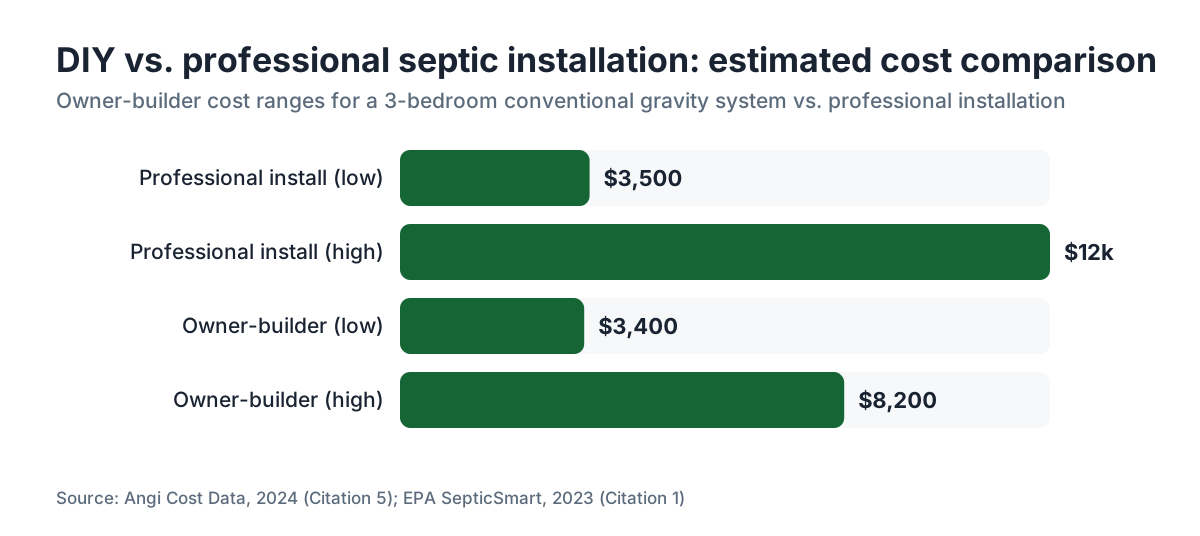
A professional install of a conventional gravity-fed system on a typical lot runs $3,500 to $12,000 depending on location, soil, and tank size [5]. Alternative systems (mound, aerobic treatment units, drip irrigation) can hit $15,000 to $30,000 or more. Our full cost to install septic system guide breaks it down.
In an owner-builder scenario, your numbers look roughly like this:
| Item | Typical owner-builder cost |
|------|---------------------------|
| Soil evaluation / perc test | $300 to $700 |
| County permit fee | $200 to $800 |
| Concrete septic tank (1,000 gal) | $700 to $1,200 |
| Tank delivery and placement (crane or equipment rental) | $400 to $900 |
| Pipe, fittings, distribution box | $200 to $500 |
| Drain field gravel and fabric | $600 to $1,500 |
| Excavator rental (if no equipment access) | $800 to $2,000 per day |
| Topsoil and seeding | $200 to $600 |
| Total estimated | $3,400 to $8,200 |
At a glance that reads like real savings. The hidden costs eat into it fast. Rent an excavator with no seat time on one and you'll burn far more days than a crew would. Mis-set the tank elevation or slope the drain field pipe wrong and you pay to fix it. If your county wants a licensed engineer to stamp the design, add $500 to $1,500.
The break-even math only works cleanly when you already own or have free access to excavation equipment and you've done earthwork like this before. For most homeowners the savings shrink once reality shows up.
For what pumping and upkeep cost after the system's in, see our cost to put in a septic tank guide.
What are the real risks of an unpermitted or improperly installed septic system?
Some people decide to skip the permit and hope nobody notices. Bad idea, and the fines are the least of it.
Groundwater contamination is the biggest non-regulatory risk. A septic system treats wastewater by letting soil bacteria break down pathogens as effluent moves through the drain field. Undersize the tank, build the drain field too shallow, or violate well setbacks, and untreated sewage reaches groundwater. The EPA calls improperly built or maintained septic systems a leading source of groundwater contamination in the U.S. [1]. If you drink from a private well, you're drinking that groundwater.
Neighbor wells get hit too. Setback rules exist because contamination doesn't respect property lines. A poorly placed system can foul a neighbor's water, and that opens you to liability.
Resale failure. Title companies and mortgage lenders increasingly require a passing septic inspection at sale. An unpermitted system fails that by definition, no matter how well it runs. You either retrofit a permit (often impossible after the fact) or tear it out and reinstall a permitted system, which costs more than doing it right the first time.
System failure costs. A badly installed drain field dies faster than a properly designed one. A leach field replacement alone runs $5,000 to $20,000 depending on size and soil. Cutting a corner to save $3,000 today and replacing the drain field in five years is a losing trade.
Health department enforcement. In many states, running an unpermitted system is a continuing violation that racks up daily fines. Some jurisdictions can condemn a property until the system is brought into compliance.
What type of septic system can a homeowner realistically build?
If you're in a permissive county and set on owner-builder, a conventional gravity-fed system is the realistic option. Fewer mechanical parts: a septic tank, a gravity-fed distribution pipe, a drain field. Fewer things to go wrong, and the installation steps are well documented in extension publications.
Alternative systems are another animal. Aerobic treatment units (ATUs) need air pumps, chlorination, and ongoing maintenance contracts in most states. Mound systems need precise engineered fill specs and compaction tests. Drip irrigation systems run pressurized distribution networks and electronic controls. None of that is beginner work.
Most extension services publish detailed installation guides for conventional systems. The University of Minnesota Extension, for one, hosts open guidance on residential septic design and construction written for northern climates [6]. These are legitimate technical resources, not a substitute for your local code, but they show you what the work actually involves before you commit.
Plastic tanks (high-density polyethylene) have gotten popular for homeowner installs because they're light enough to sometimes place without a crane. A 1,000-gallon HDPE tank weighs roughly 300 to 400 pounds empty, against 8,000 to 9,000 pounds for a comparable precast concrete tank. That gap matters a lot when you're working without heavy equipment. Check your county's approved tank list first. Not every jurisdiction accepts plastic.
How do you find out what your specific state and county allow?
There's no national database that gives you a clean answer for every jurisdiction. You have to do the footwork.
Start with your state environmental agency's website. Onsite wastewater rules usually live under the state department of environmental quality, department of health, or department of natural resources, depending on the state. Search your state plus "onsite wastewater regulations" or "septic system regulations." Most states publish their rules as administrative code, and owner-builder exemption language, if it exists, is in there.
Then call your county health department. State code sets the floor. Counties can be stricter. Ask directly: Is there an owner-builder or homeowner exemption for septic installation? What's the application process? Which parts of the install require a licensed professional?
The EPA's SepticSmart initiative links to state resources and tells homeowners to "contact your local health department or permitting agency" as the first step [1]. That's the right advice.
Two states show how far the rules swing. Florida requires a licensed contractor for all septic installation under Chapter 381 of the Florida Statutes [7]. Oregon lets a property owner install their own system with a permit through its onsite wastewater program, but requires a licensed installer for all alternative systems [8]. Same activity, opposite answer, depending on the state line.
Once a system is in, tracking its history matters at resale. Tools like SepticMind let homeowners log inspection dates, pump-out records, and permit info in one place.
What is the correct size septic tank for a DIY installation?
Tank sizing isn't a guess. It's set by your home's bedroom count and daily water use, with local code fixing the minimum.
The EPA and most state codes use bedroom count as the stand-in for expected wastewater flow [1]. A typical sizing table looks like this:
| Bedrooms | Minimum tank size (most states) | Daily flow estimate |
|----------|--------------------------------|---------------------|
| 1-2 | 750 gallons | 120-180 gpd |
| 3 | 1,000 gallons | 270-360 gpd |
| 4 | 1,200 gallons | 360-480 gpd |
| 5-6 | 1,500 gallons | 450-600 gpd |
Many counties now set a 1,000-gallon floor regardless of bedroom count, and some require 1,250 gallons for new installs. Going slightly larger than the minimum is almost always smart. A bigger tank gives solids more time to settle, which cuts the load on your drain field and stretches its life.
Tank size also drives how often you pump. A correctly sized tank for a typical three-bedroom home should be pumped every three to five years [9]. An undersized tank fills with solids faster, needs more frequent septic tank pump out service, and pushes more half-treated effluent to the drain field. For pumping schedules, see our guide on how often to pump septic tank.
What are the most common DIY septic installation mistakes?
These are the errors that show up over and over in county inspector reports and service calls.
Incorrect pipe slope. Drain pipes from the house to the tank and from the tank to the distribution box need a specific fall per foot, typically 1/8 to 1/4 inch per foot. Too little slope and solids settle and clog the pipe. Too much and the liquid outruns the solids, leaving them stranded. A slope error stays invisible until the system backs up.
Insufficient setbacks. Placing the tank or drain field too close to a well, a property line, a foundation, or a water body is a classic first-timer mistake. Required setbacks vary by state but commonly run 50 to 100 feet from a water supply well, 10 feet from a property line, and 5 to 10 feet from a building foundation [4].
Poor baffle installation. Baffles keep floating scum from leaving the tank and stop effluent from short-circuiting straight to the outlet. Skip them or set them wrong and the drain field clogs fast.
Compacting the drain field area. Driving equipment over the drain field trench area before installation compacts the soil and kills the permeability you're counting on. Mark the area off before any excavation and keep everything off it.
Backfilling before inspection. Burying the system before the county inspector signs off is the single most expensive mistake here. If the inspector can't verify the install, they can order a full excavation.
Using uncertified materials. Many counties keep an approved products list. Use a tank or pipe not on it and you can fail inspection even when the install is otherwise perfect.
For problems that surface after the system's running, our guide on septic system repair covers what different failure symptoms mean and when each one needs a pro.
How do you maintain a septic system after installation?
Whether you built it yourself or hired it out, the maintenance is identical.
Pump on schedule. For a standard household, every three to five years is the EPA's rule of thumb [1]. Septic tank cleaning and pumping pulls out the solids that would otherwise ride into the drain field and clog it. Skipping pumps is the top cause of early drain field failure.
Watch what goes down the drain. Grease, non-flushable wipes, prescription meds, and heavy bleach all wreck the bacterial ecosystem in the tank. The tank works because bacteria digest organic waste. Kill the bacteria and treatment stops.
Protect the drain field. Keep vehicles and heavy equipment off it. Plant only grass over it. Trees and shrubs send roots that invade pipes. Route surface water, roof runoff, and sump pump discharge away from the field so it doesn't get hydraulically overloaded.
Inspect every one to three years. An inspection checks the scum and sludge layers, the baffles, the effluent filter if present, and the distribution box. Some states require periodic inspections. Others leave it to you. Our septic tank inspection guide explains what inspectors check and what the red flags look like.
Keep records. Save your permit, your as-built drawing, inspection reports, and pump-out receipts. Many states require this documentation at resale, and it makes diagnosing problems later much easier. Operators managing multiple properties can use tools like SepticMind to track service histories and inspection schedules across a fleet.
For a full breakdown of what septic tank emptying involves and costs, see our dedicated guide.
Should you actually attempt a DIY septic tank installation?
Here's a straight opinion instead of a hedge.
For most homeowners in most states, a full DIY install is the wrong call, and the legal risk isn't even the main reason. The work needs accurate soil data, precise grading, the right equipment, and a real grasp of how the hydraulics have to function as a whole. Get one element wrong and you create a failure mode that hides for years before it shows up as a backed-up house or a soggy, sewage-smelling yard.
The people this fits are a narrow group. Rural property owner in a permissive state. Prior excavation experience. Access to equipment. A straightforward site with good soil. Time to run a multi-week permitting and construction process. Fit that profile and the savings are real.
Everyone else gets a better return by understanding the system well enough to maintain it, catch early warning signs, and avoid the choices that speed up failure. That knowledge costs nothing and heads off the expensive repair calls.
If cost is your driver, get multiple contractor quotes. The spread on septic installation is wide. The same job can quote $4,500 from one licensed installer and $9,000 from another in the same county. Shopping quotes is free and legal everywhere.
Frequently asked questions
Is it legal to install your own septic tank?
It depends on your state and county. Most U.S. states require a licensed onsite wastewater contractor for septic installation. A minority, including Texas and Oregon, allow owner-builder installation with a valid permit and the same inspections a licensed installer faces. Call your county health department before doing anything and ask specifically whether an owner-builder exemption exists. Get the answer in writing.
What permits do you need to install a septic tank?
At minimum, a county or local health department permit before any excavation. Most counties also require a soil evaluation report from a licensed soil scientist or sanitarian, and some require an engineered system design stamped by a licensed professional engineer. Permit fees typically run $200 to $800. No permit means an unpermitted system, which fails resale inspections and can trigger fines.
How much money can you save by doing a septic installation yourself?
In a permissive state, owner-builder material and equipment costs run roughly $3,400 to $8,200 for a conventional gravity system, against $3,500 to $12,000 for professional installation. Real savings depend on whether you own or can borrow excavation equipment, your labor efficiency, and whether your county requires a stamped engineer's design. For many homeowners the savings narrow to $1,000 to $3,000 once equipment rental is counted.
Can you install a plastic septic tank yourself instead of concrete?
Plastic (HDPE) tanks are much lighter than concrete, which makes them more practical for owner-builder work since a crane often isn't needed. A 1,000-gallon plastic tank weighs 300 to 400 pounds against 8,000 to 9,000 pounds for a comparable concrete tank. Not all counties accept plastic tanks, so check your local approved products list first. Plastic tanks also need careful backfilling to avoid deformation.
What size septic tank do you need for a 3-bedroom house?
Most state codes require a minimum 1,000-gallon tank for a 3-bedroom home, based on an estimated daily flow of 270 to 360 gallons. Many counties now set 1,000 gallons as the floor regardless of bedroom count, and some require 1,250 gallons for new installs. Going slightly above the minimum is generally worth it; a larger tank cuts solids loading on the drain field and extends its life.
How deep does a septic tank need to be buried?
Burial depth depends on local frost depth, inlet pipe elevation, and soil conditions. The inlet pipe from the house sets the top-of-tank elevation; the tank bottom falls below that based on tank height, typically 4 to 8 feet total from surface to tank bottom. In colder climates, the tank top should sit below the frost line. Your county permit will specify required depths for your site.
Do you need a perc test before installing a septic system?
Yes. A soil evaluation, which includes a percolation test or soil morphology assessment, is required before a permit is issued anywhere in the U.S. The test shows how fast your soil absorbs water, which sets the required drain field size and type. A licensed soil scientist or sanitarian has to perform it; you can't self-certify soil conditions. It typically costs $300 to $700.
What is the setback distance required between a septic tank and a well?
Setbacks vary by state, but most require at least 50 feet between a septic tank and a private water supply well, and 100 feet or more between the drain field and a well. Some states require 100 feet for both. Check your state's onsite wastewater regulations for exact figures. These numbers aren't negotiable, and violating them can contaminate your drinking water.
Can a homeowner pump their own septic tank?
In most jurisdictions, no. Pumped septage is a regulated waste that has to be hauled and disposed of at a licensed facility, and you can't legally transport it in a standard vehicle. You can handle everything around the pump-out: locating the tank, digging up the lid, having records ready, and clearing vehicle access for the truck. The pumping itself requires a licensed septic pumper.
How long does a DIY-installed septic system last?
A correctly designed, permitted, and installed conventional system should last 25 to 40 years with proper maintenance, the same lifespan as a professionally installed one. The drain field is usually the first part to fail. A badly installed system, with wrong pipe slopes, an undersized tank, or short setbacks, can fail in as few as 5 to 10 years, which erases any installation savings many times over.
What happens if you build a septic system without a permit?
Consequences range from fines (often $500 to several thousand dollars depending on the state), stop-work orders, and mandatory excavation and reinstallation, to automatic failure at resale inspection. Some states allow daily fines that stack until the violation is fixed. An unpermitted system usually can't be permitted after the fact; in most counties you have to remove it and start over with a proper permit.
Can you add a drain field yourself?
Drain field installation counts as new septic construction in most states and requires the same permit, soil evaluation, and inspection as a full system. Some owner-builder states let homeowners do this work with a permit. Replacing a failed drain field without a permit carries the same legal risks as unpermitted tank installation, plus the environmental risk of pushing inadequately treated effluent into the soil.
Are there any septic tasks that genuinely make sense as DIY?
Yes. Locating and uncovering your tank lid, installing access risers to bring the lid to grade, checking the effluent filter, keeping maintenance records, adding biological additives if you want, patching a broken concrete lid, and swapping a float switch on a dosing pump are all within a competent homeowner's reach. These tasks cost little and genuinely extend system life without crossing into licensed-contractor work.
How do you find out if your state allows owner-builder septic installation?
Search your state's administrative code for onsite wastewater or septic regulations, or call your county health department directly and ask whether an owner-builder or homeowner exemption exists. Oregon and Texas (through county authorized agents) are examples of states with explicit exemptions. Florida (Chapter 381) explicitly requires licensed contractors. The rules differ enough that there's no shortcut; you have to check your specific jurisdiction.
Sources
- U.S. EPA, SepticSmart Program: Properly maintained septic systems do not need additives; improperly installed or maintained systems are a leading source of groundwater contamination; homeowners should contact local health departments before installation.
- Texas Commission on Environmental Quality, On-Site Sewage Facilities program: Texas allows homeowner installation of their own septic system on their own property with a permit from the local authorized agent.
- U.S. EPA, Septic Systems (onsite wastewater management): Pumped septage is a regulated waste requiring transport by licensed haulers and disposal at approved facilities.
- U.S. EPA, How Your Septic System Works: Soil evaluation by a licensed professional is required before permit issuance; setback requirements from wells and property lines are mandatory for all systems.
- Angi, Septic System Installation Cost Data: Professional septic system installation costs $3,500 to $12,000 for a conventional gravity-fed residential system; county permit fees typically run $200 to $800.
- University of Minnesota Extension: University Extension publishes detailed guidance on residential septic system design and construction for homeowners in northern climates.
- Florida Statutes, Chapter 381, Public Health: Florida requires a licensed contractor for all onsite sewage treatment and disposal system installation under Chapter 381.
- Oregon Department of Environmental Quality, Onsite Wastewater program: Oregon allows property owners to install their own conventional septic system with a permit; licensed installers are required for all alternative systems.
- U.S. EPA, How to Care for Your Septic System: The EPA recommends pumping a standard residential septic tank every three to five years for proper maintenance.
- National Environmental Services Center, West Virginia University: Conventional gravity-fed septic systems with proper installation and maintenance typically last 25 to 40 years before drain field replacement is needed.
Last updated 2026-07-09