What's a perc test and do you actually need one?
By the SepticMind Editorial Team

TL;DR
- A perc test (percolation test) measures how fast water drains through soil to see whether land can support a septic drain field.
- It costs $150 to $750, takes a few hours on measurement day, and most counties require it before issuing a septic permit.
- Soil that drains too fast or too slow fails, which limits what kind of system you can install.
What is a perc test, exactly?
A perc test, short for percolation test, measures how fast soil absorbs water. The number it produces, called the perc rate, tells a health department or engineer whether your soil can treat and absorb wastewater before it reaches groundwater.
The idea is simple. Dig a hole, soak it with water, then measure how far the water drops over a set interval, usually 30 minutes. The result is minutes per inch: how long it takes the water level to fall one inch. A reading of 30 minutes per inch means the water dropped one inch in half an hour.
That number decides a lot. Most state codes set an acceptable window, usually somewhere between 1 and 60 minutes per inch for a conventional drain field, though the cutoffs shift by state and even by county [1]. Soil that drains faster than 1 minute per inch (very sandy or gravelly) lets wastewater slip through before bacteria neutralize the pathogens. Soil slower than 60 minutes per inch (heavy clay) won't accept wastewater fast enough, and the system backs up.
The perc test is one piece of a site evaluation. Most jurisdictions now pair it with a soil profile evaluation, where a licensed evaluator digs a pit and looks at the real layers of soil, checking for limiting layers like clay hardpan, rock, or seasonal high groundwater. The perc rate alone misses those conditions. But "perc test" is still the term most homeowners use for the whole evaluation, and the two usually happen on the same visit.
Why do you need a perc test before installing a septic system?
Every county or municipality that permits septic systems requires site suitability testing before it issues a permit, and the perc test or soil evaluation is that gate. No passing result on file means no legal conventional septic system. Contractors won't pull a permit, and inspectors won't sign off.
The reason isn't bureaucratic. A leach field does biological treatment in the soil itself. Aerobic bacteria in the top few feet of soil break down pathogens as wastewater percolates down toward groundwater. Drain too fast, and that treatment zone gets bypassed, so raw contamination reaches groundwater. Drain too slow, and sewage pools at the surface. That's a public health problem and an expensive mess.
The EPA's SepticSmart program states that "about 20 percent of the nation's households depend on individual onsite or small community sewage treatment systems," and points to failed systems as a leading source of groundwater contamination in rural areas [2]. The perc test is the step that keeps a doomed system from getting built in the first place.
Buying land to build on? The perc result can make or break the deal. Land that fails perc isn't worthless, but it needs an alternative system, and those cost a lot more. Finding out before you close escrow is worth the few hundred dollars the test costs.
How is a perc test performed, step by step?
The exact procedure varies by jurisdiction, but the broad steps match guidance from most state environmental and health departments.
Site preparation (1 to 2 days before the test): The evaluator or a licensed contractor digs test holes, usually 4 to 12 inches in diameter and 12 to 24 inches deep, in the proposed drain field area. Many codes require 2 to 6 holes spread across the site. The holes get pre-soaked, meaning filled with water and left to drain over 12 to 24 hours before the real measurement. That saturates the soil to mimic wet-season conditions and stops dry ground from giving falsely fast readings.
The measurement phase: On test day, each hole is filled to a set depth. After the water stabilizes, the evaluator reads the level at regular intervals, usually every 30 minutes, and records the drop. Most protocols want a consistent reading across at least three straight intervals before they'll call it valid.
Calculating the perc rate: The slowest steady reading from each hole is the one that counts. If your holes read 15, 20, and 45 minutes per inch, the 45 controls, because the field gets designed for the worst-performing spot.
The soil profile evaluation: In most modern site evaluations, a backhoe digs a pit 5 to 8 feet deep nearby. A certified soil scientist or sanitarian reads the layers for mottling (rust or gray streaks that mark seasonal water saturation), restrictive horizons, and depth to bedrock. This part can override a passing perc rate if a limiting condition sits too close to the surface.
Measurement day itself usually runs 2 to 4 hours, not counting the pre-soak the day before [3].
What does a perc test cost?
A perc test usually costs $150 to $750 across most of the country. Prices swing based on who does the work, what your county requires, and how much site prep is involved [4].
Here's what drives the range:
- County health department tests: Some jurisdictions still run perc tests themselves for a flat government fee, often $150 to $300. You hire a contractor to dig the holes, and the health department sends an inspector to measure.
- Private engineer or soil scientist: If your county wants a licensed professional's report, expect $400 to $750, sometimes more in states with detailed soil-morphology rules.
- Backhoe rental for the test pit: If a soil profile evaluation is required (increasingly common), add $100 to $300 for equipment.
- Remote or difficult terrain: Rural sites with poor road access or rocky ground push costs higher.
The full site evaluation report, which packages the perc test, soil profile, and engineered recommendations into one document for the permit office, runs $500 to $1,500 when a licensed engineer or certified soil evaluator does it [4].
Those numbers haven't moved much in recent years. Contractor availability in rural markets tightened after 2020, though, so some areas charge more just from demand. If the perc test is part of a full septic tank installation, the installer often folds it into the quote, which saves you a separate trip charge.
Here's the perspective that matters. For full cost to install septic system context, the perc test is usually less than 5% of total project cost, and it decides whether you can build at all.
What perc rate is acceptable for a conventional septic system?
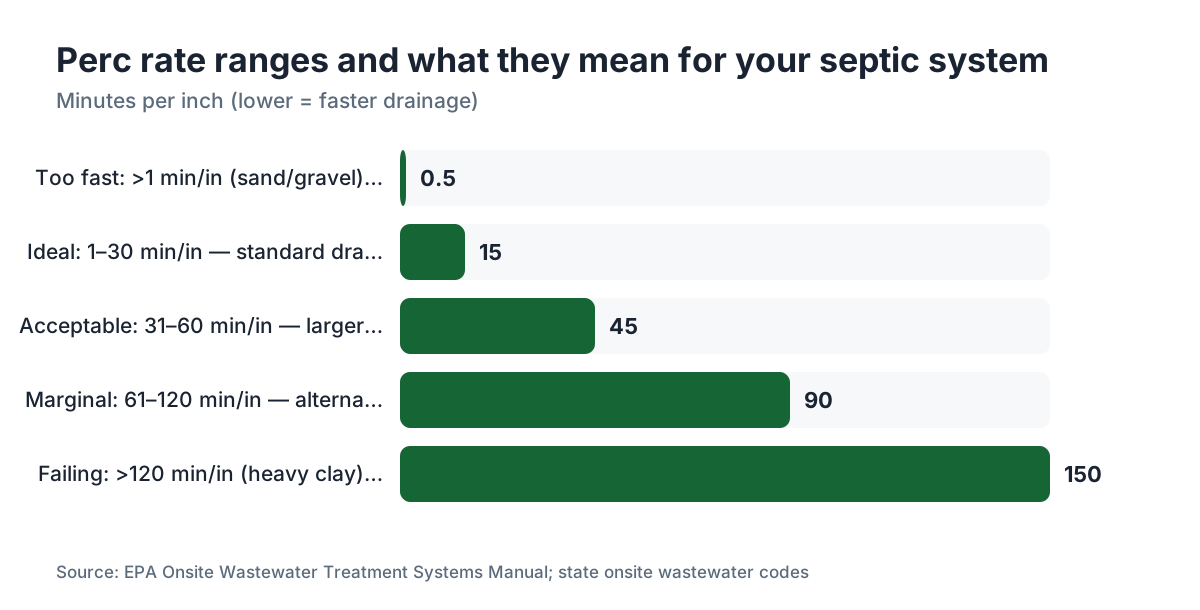
Most state codes set the acceptable perc rate for a conventional gravity-fed drain field between 1 and 60 minutes per inch [1][5]. The exact bounds differ by state, and some counties draw tighter lines.
Here's how to read the numbers:
| Perc Rate (min/inch) | Soil Condition | Conventional System? |
|---|---|---|
| Less than 1 | Very fast (gravel, coarse sand) | Usually not allowed |
| 1 to 30 | Ideal range | Yes |
| 31 to 60 | Acceptable but slower | Usually yes, larger field required |
| 61 to 120 | Marginal | Often requires alternative system |
| Greater than 120 | Very slow (clay) | Conventional system not permitted |
Faster-draining soil needs a bigger drain field so wastewater gets enough contact time for treatment. A reading of 5 minutes per inch needs more square footage than a reading of 30 minutes per inch, because water moves through fast and you need extra surface area to make up for it.
Some states, California and North Carolina among them, have mostly stepped away from the numerical perc rate as the main criterion and lean on soil morphology, the physical and visual character of the soil profile [5]. The perc test still gets run in many of those places, but a licensed soil scientist's read carries more weight than the raw number.
Site landing in the marginal zone (60 to 120 minutes per inch)? You're not out of options. It usually means an engineered alternative system, which the next section covers.
What happens if you fail a perc test?
Failing a perc test doesn't mean you can never build. It means a conventional gravity drain field won't work there, so you look at alternatives.
Soil that drains too slowly is the most common failure. The fix is usually a mound system, a pressure-dosed system, or a low-pressure pipe system. All of them add engineered soil or push effluent under pressure to beat the poor natural drainage. They cost a lot more than a conventional field, often $10,000 to $20,000 more depending on the site [4].
Soil that drains too fast is less common but just as much of a problem. Very sandy or gravelly soils in some coastal or glacial-outwash regions fail for this reason. The fix there often means a sand filter or other pre-treatment before effluent hits the native soil.
A high seasonal water table, found during the soil profile evaluation, is a different kind of failure. If the depth to seasonal high groundwater is less than 2 to 4 feet from the surface (state minimums vary), you may need a raised or mound system to get the required separation.
Bedrock near the surface is the hardest failure to beat. In parts of New England and the Appalachians, shallow ledge rock rules out most septic options unless there's enough suitable ground elsewhere on the parcel.
If you fail, hire a licensed engineer or certified soil evaluator who works in alternative systems. They can often find a workable answer the first test missed, including testing a different corner of the parcel. Not every failure is final.
Who performs a perc test and who's allowed to?
This question matters more than most people expect, and the answer is heavily state-specific.
In most states, a licensed professional has to conduct or supervise the perc test for the results to count with the permitting authority. The license type varies:
- Licensed Professional Engineer (PE) with an onsite wastewater specialty
- Registered Sanitarian or Environmental Health Specialist
- Certified Soil Scientist (required in states like North Carolina and Virginia that emphasize soil morphology)
- Licensed Septic System Designer or Installer (in some states, installers can test for their own projects)
Some jurisdictions still let the county health department run perc tests directly for an applicant. In that case, you pay a fee, the health department schedules the visit, and you (or your contractor) dig the test holes ahead of time.
As a homeowner, you almost never get to self-conduct a legally valid perc test for a permit, even if you understand every step. The result has to be certified by a licensed professional whose credentials the county accepts. Always check with your local health department before you hire anyone, because they'll tell you exactly whose reports they take.
For a real estate deal, some buyers hire their own soil evaluator, separate from the seller's test, for an unbiased second read. On a parcel where the septic picture is murky, that's money well spent.
How is a perc test different from a soil evaluation?
People swap the terms, but they aren't the same thing.
A perc test is the water-drop measurement, full stop: dig a hole, fill it, time the drain, calculate minutes per inch. It's a hydraulic reading.
A soil evaluation (also called a soil morphology evaluation or site evaluation) is broader. It includes the perc test but adds a visual read of a deep soil pit, looking at color, texture, structure, and the depth of each horizon. The evaluator hunts for things the perc number can't show: seasonal high water, impermeable layers, limiting layers too close to the surface.
The EPA and most modern state codes favor the soil morphology approach because it's more reliable than the perc test alone [2]. A soil can pass the perc test on paper and still fail the site evaluation if a clay hardpan sits 18 inches down, or if mottling shows the water table rises into the drain field zone during wet winters.
In plain talk, when somebody says "I need a perc test," they usually mean the full site evaluation. When a health department form asks for a "percolation test result," it usually wants the number from the water-drop measurement. Most modern permit packages need both.
How long does a perc test take and when should you schedule it?
Measurement day runs 2 to 4 hours for a standard residential site [3]. The full process takes longer once you count the pre-soak.
Most protocols require a 12 to 24-hour pre-soak before the measurement. The evaluator comes out to dig and fill the holes on day one, then returns on day two for the real test. Plan on a two-day process even though the billable professional time might fit in a half day.
Season matters in a lot of regions. Some states require perc tests when soils sit at or near field capacity, meaning after rain has saturated the ground. Test during a summer drought on bone-dry soil and you get artificially fast results that don't match how the site behaves after winter rains or spring snowmelt. The pre-soak partially makes up for this, but it doesn't fully copy saturated conditions. Some counties require tests between November and April, or only within a set soil-moisture range.
Buying property and want a perc test as a contingency? Build in lead time. Licensed evaluators in rural markets can be booked 2 to 4 weeks out. Fit that into your due-diligence period. Rushing the schedule to close faster is exactly how people end up owning land they can't build on.
Do perc tests expire?
Yes, in most jurisdictions. Perc test results and site evaluation reports carry an expiration date, and it swings a lot by state and county.
Common validity periods:
- 2 years: Many counties, including much of the Northeast and Southeast
- 3 to 5 years: Some western and Midwest states
- Indefinitely: A few rural jurisdictions still accept older tests, especially on land evaluated decades ago under older permitting rules
The reason for expiration is that site conditions change. A parcel that was pasture in 2018 might have had grading or fill work since. Clearing vegetation, nearby construction, or shifts in groundwater from new development can all rework the drainage.
Buying land with an existing perc test on file? Verify the test date and ask the county whether it's still valid. An expired test means paying for a new evaluation before you can pull a permit. That's an easy surprise to avoid.
Check whether the test met current code, too. Many states updated their soil evaluation rules in the 2000s and 2010s to require a full soil morphology evaluation alongside the perc test. An old result with just a perc number and no soil profile may not satisfy today's permit requirements even if it hasn't technically expired.
What does a perc test result mean for building plans and property value?
A passing perc test on a parcel is a real asset. It confirms the land can support a septic system, which is a prerequisite for any residential building permit in unsewered areas. Without it, the land has no legal path to a habitable structure.
For sales, a parcel with a current, passing perc test brings a real premium over one without, because the buyer skips the risk and cost of that unknown. In markets where rural land trades actively, sellers often run a perc test before they list.
A failed perc test, depending on how bad it is, cuts land value or pushes it toward uses that don't need septic, like agriculture, camping, or storage. It can also spark a price fight if a buyer finds it during due diligence.
For development, the perc rate directly sets the size of the drain field. Slower-draining soil needs more linear feet of perforated pipe and more square footage of field. That means higher installation costs. A site reading 45 minutes per inch needs a bigger field than one reading 15 minutes per inch for the same daily wastewater volume, which drives both the cost to put in a septic tank and how much of your yard the system eats.
If you run septic service operations and track customer properties with on-file evaluation data, tools like SepticMind let you attach site evaluation records to property profiles so they're right there when the customer calls years later.
For homeowners who already have a working system, the perc test is history. It happened before your system went in. What matters now is maintaining the system that was designed for your soil. The leach field sized from your perc result is your system's most expensive and most fragile part.
How do you find out if your property already has a perc test on file?
Start with your county or local health department. In most jurisdictions, perc tests and site evaluation reports live in the septic permit record, a public document tied to your parcel number.
Call or visit the environmental health or onsite wastewater division of your county. Give them your parcel number or address. Ask whether a septic permit is on file and whether it includes a site evaluation or perc test report.
If you have your property's title or closing documents from when you bought it, the septic permit is often listed in the disclosure package. Some title companies compile this; others don't.
Buying a house with an existing septic tank inspection? Ask the inspector whether they can pull the original permit file and whether the design matches current code. Older systems went in under looser rules and may not reflect the full soil evaluation process used today.
For raw land with no prior development, there's probably nothing on file. You'll need a fresh evaluation before you can permit anything.
One practical note: some older rural records sat on paper at the county office and never got digitized. Don't take a lack of online records as proof no test was ever done. A phone call straight to the office beats any property search portal.
Frequently asked questions
Can you build a house without a perc test?
Not legally in any jurisdiction that requires a septic system. If your property ties into public sewer, no perc test is needed. But in an unsewered rural area, every state requires a site suitability evaluation, which includes a perc test or soil evaluation, before it issues a building or septic permit. Skip it and you can't get a permit and can't legally occupy the structure.
How much does a perc test cost?
A perc test runs $150 to $750 for most residential parcels, depending on whether a county inspector (cheaper) or a licensed private engineer or soil scientist (pricier) does it. If a full soil profile evaluation and engineered report are required, costs reach $500 to $1,500. Rural or hard-to-access sites cost more from travel and equipment.
What is a passing perc test number?
Most state codes accept perc rates between 1 and 60 minutes per inch for a conventional drain field. The sweet spot is roughly 5 to 30 minutes per inch. Faster than 1 minute per inch means the soil drains too quick for good treatment. Slower than 60 minutes per inch usually means an alternative system. Check your state's onsite wastewater code for exact cutoffs.
Can you fail a perc test and still build?
Often yes. A failed conventional perc test means you can't install a standard gravity drain field, but it doesn't always mean no building. Options exist: mound systems, pressure-dosed systems, aerobic treatment units, or drip irrigation. These run more, typically $10,000 to $20,000 above a conventional system, but they work on marginal soils. A licensed engineer who does alternative systems can weigh your choices.
How deep are the holes dug for a perc test?
Perc test holes usually go 12 to 24 inches deep, about the depth of a proposed drain field. Some protocols call for holes 6 to 12 inches in diameter. The separate soil profile pit is much deeper, usually 5 to 8 feet, so the evaluator can read soil layers, seasonal high water markers, and any restricting horizons that would hurt system performance.
How long does a perc test take to complete?
Measurement day takes 2 to 4 hours. But most protocols require a 12 to 24-hour pre-soak the day before, so the full process spans two days. Add lead time to book a licensed evaluator, which runs 2 to 4 weeks in rural markets. Planning a land purchase contingency? Give yourself at least 3 to 4 weeks to get a valid result.
Is a perc test the same as a soil test?
Not exactly. A soil test in agriculture measures nutrients and pH. A perc test (percolation test) measures water absorption rate for septic suitability. What most permitting offices now require is a site evaluation, which pairs the perc rate measurement with a soil morphology evaluation, a visual read of soil layers in a deep pit that checks for seasonal water, hardpan, and depth to rock.
Do perc tests expire?
Yes. Most counties set a validity period of 2 to 5 years. After that, you need a new evaluation before a permit gets issued. Buying land with an old perc test on file? Verify the date with the county and confirm it still meets current code, which may now require a full soil morphology evaluation even if the original test was valid when it was done.
Who is allowed to perform a perc test?
It depends on your state. Most jurisdictions require a licensed professional engineer, registered sanitarian, certified soil scientist, or licensed septic system designer. Some counties still run tests themselves through the health department. Homeowners generally cannot conduct a legally valid perc test for a permit, even though the physical process is simple. Check with your county health department for the exact credentials they accept.
What time of year is best for a perc test?
Most jurisdictions prefer or require tests when soil is near saturation, usually late fall through early spring in temperate climates. Testing in a dry summer on bone-dry soil gives artificially fast absorption rates that don't reflect worst-case conditions. Some states require tests between November and April. The pre-soak helps, but seasonal timing still matters for accurate, code-compliant results.
Does a perc test hurt property value?
The test itself doesn't move value. The result does. A current passing perc test adds value to raw land because it confirms buildability. A failing result cuts value or limits the land to non-residential uses, unless an alternative system can be permitted. On improved property with an existing septic system, the perc test is historical and doesn't directly affect current market value.
What happens after you pass a perc test?
The licensed evaluator files a site evaluation report with the county health department or permitting office. That report, plus a septic system design from a licensed engineer or designer, forms the base of your septic permit application. Once the permit clears, a licensed installer can start work on the tank and drain field. The perc rate also sets the field size in the final design.
Sources
- EPA, Onsite Wastewater Treatment Systems Manual (EPA/625/R-00/008): Acceptable perc rates for conventional drain fields typically fall between 1 and 60 minutes per inch under most state codes
- EPA SepticSmart Program: About 20 percent of U.S. households depend on individual onsite or small community sewage treatment systems, and failed systems are a leading source of groundwater contamination
- University of Minnesota Extension, Septic System Owner's Guide: Perc test measurement day typically takes 2 to 4 hours for a standard residential site
- University of Georgia Extension, Septic Tank Considerations for Rural Property: Perc tests cost $150 to $750 for most residential parcels; full site evaluation reports can reach $500 to $1,500; alternative systems add $10,000 to $20,000 above conventional system costs
- North Carolina Department of Environmental Quality, Onsite Wastewater Section: North Carolina relies primarily on soil morphology evaluation rather than numerical perc rate as the controlling criterion for onsite system suitability
- Virginia Department of Health, Sewage Handling and Disposal Regulations: Virginia requires a certified soil scientist evaluation as part of site suitability determination for onsite sewage systems
- California State Water Resources Control Board, Onsite Wastewater Treatment Systems Policy: California's statewide OWTS Policy emphasizes soil morphology and limiting layers over perc rate for system siting decisions
- Penn State Extension, Soils and Septic Systems: Perc test holes are typically 12 to 24 inches deep; soil profile pits for morphology evaluation are dug 5 to 8 feet deep
- National Environmental Services Center (NESC), West Virginia University: Most counties set validity periods of 2 to 5 years on perc test results before requiring a new evaluation
- EPA, Septic System Frequently Asked Questions: Conventional drain field sizing is directly tied to the perc rate; slower-draining soils require greater square footage of field per bedroom
Last updated 2026-07-09