Who pays for a perc test: buyer, seller, or someone else?
By the SepticMind Editorial Team

TL;DR
- In a home sale, the buyer almost always pays for the perc test, because the buyer is the one who needs to know the land can support a septic system.
- On new construction, the developer or builder usually orders and pays.
- Costs run $150 to $1,500 depending on state and soil.
- A failed test can kill a deal or force a much pricier alternative system.
What is a perc test and why does it matter?
A percolation test, almost always called a perc test or perk test, measures how fast water moves through soil. The number it produces, usually stated in minutes per inch, tells a licensed engineer or county health official whether the soil can absorb the effluent a conventional septic system produces. No passing result, no permit for a standard drain field in most counties.
The test is simple in concept. A hole gets dug to the proposed drain field depth, saturated with water over a set presoak period (often 24 hours), then filled again and timed as the water drops a set distance, usually one inch. Most jurisdictions require three to five test holes across the proposed drain field area, more than one [1].
Failing matters a lot. If soil absorbs too slowly (often defined as more than 60 minutes per inch) or too fast (under 1 minute per inch in some codes), a conventional leach field will not work. The property either cannot be developed for residential use, or it needs an engineered alternative system that routinely costs two to four times more than a standard install. Before you spend a dollar on anything else tied to a rural lot or an older home without sewer access, you need to know where the soil stands.
Who pays for a perc test in a home sale: buyer or seller?
The buyer pays in the vast majority of real estate deals. That is the default in most states, and it mirrors who pays for the home inspection and the radon test. The buyer is confirming the property can do what they need it to do, so the buyer orders and pays.
Sellers do sometimes pay, and there are good reasons to. A seller with a passing perc test already on file can market the property as perc-approved, which removes a big contingency and pulls in buyers who are ready to build. Some rural land sellers pay for the test before listing specifically to command a higher price and a cleaner contract.
In a negotiated deal, the cost can land anywhere. Purchase agreements often name the seller as the party paying, as a concession, especially in a buyer's market or when the seller knows the lot is borderline. The contract controls. If yours says nothing about perc testing, assume the buyer pays.
One thing to be clear about. The party who pays for the test does not own it forever. Most state health departments keep perc test records on file by parcel number. A test the seller paid for five years ago may still be valid and on record, which can save the buyer from ordering a new one at all.
Who pays for a perc test on raw land or a new construction lot?
On raw land selling for the first time, the buyer typically pays, because testing is part of confirming the lot is buildable. That is standard due-diligence cost on any vacant lot where a septic system will be required.
On a new subdivision or planned development, the developer usually runs perc tests on every lot before selling, and those costs get folded into the land price. A buyer purchasing a lot in a planned community often inherits the developer's perc data. Confirm that data is still valid under current county standards before you rely on it.
A custom home builder working on a lot the buyer already owns will often coordinate and pay the testing company directly, then bill it back to the buyer as a line item in the construction contract. Read your contract carefully. It is common, not automatic.
For septic tank installation on new construction, the perc test is just the first cost in a longer chain. The full cost to install a septic system can run $3,000 to $15,000 or more depending on system type, soil, and local permit fees [2].
How much does a perc test cost?
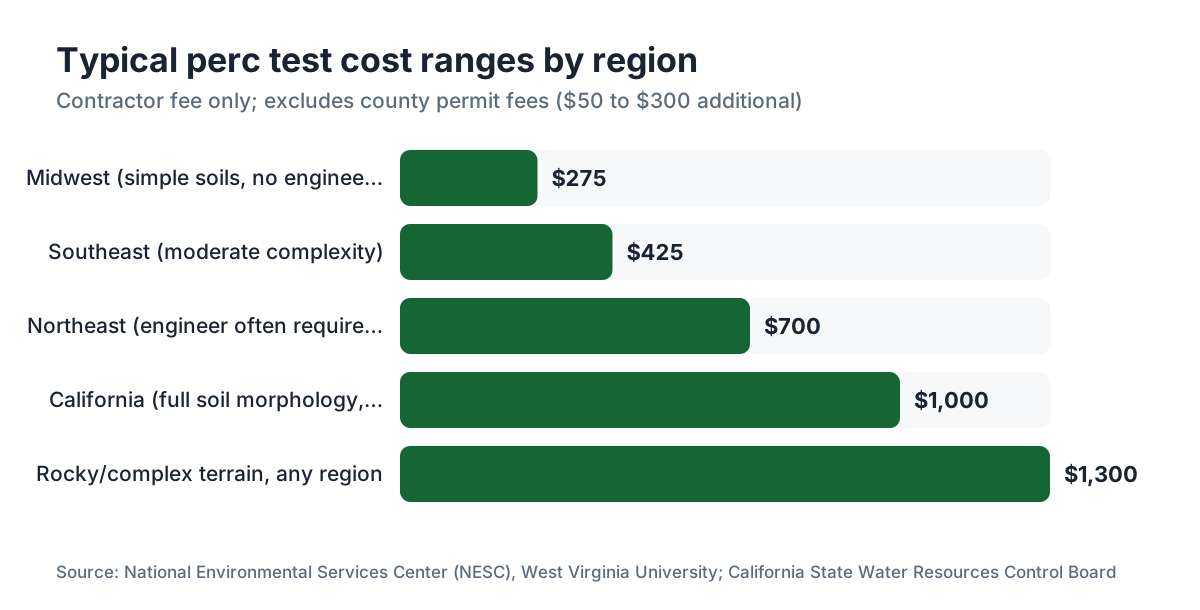
Perc test costs vary by state, county, and soil. The range is roughly $150 on the low end in rural areas with simple soils and $1,500 on the high end in states that require a licensed engineer to supervise and certify results. Most homeowners pay somewhere between $250 and $700 [3].
Here is a rough breakdown of what drives the cost:
| Cost factor | Impact on price |
|---|---|
| Number of test holes required | More holes, higher cost; some counties require 5+ |
| Presoak requirement | A 24-hour presoak adds a return-trip fee |
| Licensed engineer vs. certified contractor | Engineer-required states cost more |
| County permit fee (separate from test fee) | $50 to $300 in many jurisdictions |
| Site accessibility | Rocky soil or steep grades add excavation time |
| Soil profile (perc plus deep hole) | Deep boring adds $100 to $400 |
Many states require both a perc test and a soil profile or soil morphology evaluation. The soil evaluation looks at soil type, limiting layers, and seasonal high water table. If your jurisdiction requires both, budget for both. Some contractors quote them as a package. Others itemize them separately.
County permit fees for the test go to the health department and are usually non-refundable, even if the lot fails. These run $50 to $300 in most areas. Confirm with your local environmental or health department before assuming the quote you got covers all fees [1].
What happens if the perc test fails?
A failed perc test does not automatically kill a deal or a building project, but it changes the math a lot.
On a purchase contract with a perc contingency (more on that below), a failure gives the buyer the right to walk away and recover the earnest money. Most buyers in this spot either cancel or renegotiate the price down to cover the cost of an alternative system.
For a property that fails conventional perc standards, the options depend on which alternative systems your county approves. Common paths include:
- Mound systems, which raise the drain field above the natural soil surface and are common in high water table areas
- Aerobic treatment units (ATUs), which produce cleaner effluent that many soils can handle even when they fail standard perc
- Drip irrigation systems, which spread effluent slowly across a wider area
- Engineered fill systems, where approved fill soil is imported and tested
These alternatives cost more to install and more to maintain. A mound system or ATU can add $5,000 to $20,000 to your septic system installation costs compared to a conventional system [2]. They also tend to need more frequent septic tank pump-outs and professional maintenance contracts.
Some lots simply cannot support any septic system. Lots with extremely tight clay soils, very shallow bedrock, or wetlands and surface water nearby may be undevelopable for homes without public sewer access. That is why a perc contingency in a rural purchase contract is not optional.
Should the purchase contract include a perc contingency?
Yes. Full stop. If you are buying land or a home that relies on a septic system and no valid perc test exists on file, you need a perc contingency in your purchase agreement.
A perc contingency says, in plain terms, that the sale is conditioned on the property passing a perc test (or a soil evaluation, depending on your state's terminology) within a set timeframe. If it fails, the buyer can walk away and get the earnest money back. Without that language, a failed perc test can leave the buyer holding a property that cannot be developed.
Real estate attorneys in most states have standard contingency language for this. Ask for it by name. Do not accept vague wording like "subject to satisfactory inspection." Spell out who orders the test, who pays, what passing means under your county's standards, and what the timeline is.
If a seller refuses to include a perc contingency on undeveloped land, treat that as a serious red flag. A seller might be confident the lot passes (prior test data, adjacent lots with approvals), but the contingency still protects you from changes in county standards or gaps in documentation.
How long is a perc test valid?
It varies by state and sometimes by county. Many jurisdictions set perc test validity at two to five years. Some states have no formal expiration and treat a recorded test as permanently on file unless soil conditions change. Others require a new test any time a permit is pulled, no matter the prior results.
The EPA's SepticSmart program notes that local health departments hold authority over test validity and permits, and that requirements vary widely by state and local jurisdiction [4]. There is no federal standard here.
If you are relying on an older test from a seller's records, confirm with your county health department that it is still acceptable before you waive the perc contingency. County standards for minimum acceptable perc rates and testing methods have tightened in many places over the past decade. A test from 2010 may not satisfy a permit application filed today.
If the test has expired or the county will not accept it, someone has to pay for a new one. That is a negotiation point. Here is my take: if the seller is marketing the lot as perc-approved based on expired data, the seller should either pay for the updated test or adjust the price.
Who pays when a perc test is required for a septic inspection?
A perc test and a septic inspection are different things, and they are rarely required together. A septic tank inspection checks an existing system: tank condition, inlet and outlet baffles, the distribution box, and the drain field. A perc test checks whether soil can support a new or replacement system.
You might need both in one specific case. A home's existing drain field has failed, and the county wants proof the replacement area passes perc before it issues a permit for a septic system repair. Then the homeowner or the buyer (depending on who funds the repair) pays for the test.
In a standard home sale, the buyer pays for the septic inspection and, if a new system or field is needed, for any perc testing on the proposed replacement area. These costs stack up fast. Budget $300 to $600 for a septic inspection [5] and another $300 to $700 for a perc test if soil evaluation is also required.
SepticMind's operator tools help service companies track which jobs are tied to permit-required perc evaluations and schedule around them, which matters when presoak windows and county inspector availability have to line up.
Can a real estate agent or lender require a perc test?
An agent cannot require a perc test on their own authority, but they can and should strongly recommend one as due diligence on any property without sewer access. A lender can require one outright.
USDA Rural Development loans, the most common rural home financing program, require evidence of a functioning or approvable septic system, which in some cases means a current perc test or soil evaluation for properties without an existing approved system [6]. FHA and VA loans have similar demands for the septic system to be in good working condition, though they usually call for a septic inspection rather than a perc test on homes with existing systems [7].
If your lender is requiring a perc test as a loan condition, that cost falls on the borrower (the buyer) in almost every case. It is a loan condition, not a seller obligation. Some sellers will negotiate to cover it, but that is a concession you have to ask for.
Title companies and real estate attorneys sometimes flag perc test records (or the lack of them) during title research. If the county has a recorded failed test on the parcel, that can affect both financing and the deal. Pull county health department records on the parcel before closing, every time.
What should you ask before paying for a perc test?
Before you write a check, get clear answers to five questions.
First, is there already a test on file? Call the county health or environmental department with the parcel number and ask about prior perc test results, soil evaluations, or septic permits. Five minutes on the phone could save you hundreds of dollars.
Second, what exactly does your county require? Some counties still use a traditional perc test. Others moved to a full soil morphology evaluation by a licensed soil scientist or professional engineer, which takes longer and costs more. The method matters for the permit application, more than the raw result does.
Third, who is licensed to conduct the test? Most counties publish an approved list of testers. Hire an unlicensed contractor and the county may reject the results, and you pay twice.
Fourth, what does a passing result look like for your intended use? A four-bedroom house has different soil absorption requirements than a small single-family home. Confirm the testing parameters match your planned system size.
Fifth, what are all the fees? Separate the contractor fee from the county permit fee. Both are real. The county fee usually goes straight to the health department, not the contractor.
If you are tracking multiple properties through this process, tools like SepticMind help service operators manage the scheduling and documentation side of perc-related permits, especially when jobs involve both soil evaluation and follow-on septic tank repair or installation work.
State-by-state variations: who pays and what it costs
There is no federal rule dictating who pays for a perc test in a real estate transaction. State law, local custom, and contract terms govern all of it. A few examples show how wide the variation runs.
In Texas, the Texas Commission on Environmental Quality (TCEQ) regulates on-site sewage facilities, and the buyer typically pays for soil testing as due diligence on rural properties [8]. Texas has no statewide perc test standard; counties set their own.
In New York, the State Department of Health sets standards for individual sewage treatment systems, and local health departments run the permits [9]. The applicant, almost always the buyer or builder, pays both the contractor and the county permit fee.
In California, the State Water Resources Control Board publishes guidelines, but each county has its own fee schedule and method. Many California counties have dropped traditional perc tests for full soil morphology evaluations. Costs there often run $500 to $1,500 when an engineer is required [10].
In rural Midwest states like Iowa and Minnesota, traditional perc tests are still common and costs tend to sit lower, often $150 to $400 for a basic test [3].
The National Environmental Services Center (NESC) at West Virginia University, which publishes widely used guidance on small community water and wastewater systems, notes that testing requirements and who bears the cost depend entirely on state and local regulations and standard practice in the local real estate market [11].
Find out what your specific county requires, and what local custom says about who pays, before you sign anything.
Frequently asked questions
Does the seller ever pay for the perc test?
Yes, though it is less common. Sellers pay when they want to market land as perc-approved before listing, which speeds up the sale and can justify a higher price. A seller may also cover the cost as a concession during negotiations, especially in a slow market or when a buyer flags soil uncertainty as a deal risk. It always comes down to what the purchase contract says.
Is a perc test required to sell a house with a septic system?
Usually not. A perc test evaluates raw soil for a new system. An existing, functioning septic system typically needs a septic inspection for sale, not a new perc test. Exceptions come up when the existing drain field has failed and a replacement area needs evaluation, or when local ordinances require re-permitting at sale. Check with your county health department for what applies locally.
Can I do a perc test myself to save money?
Almost never. Most counties require perc tests to be conducted and certified by a licensed soil scientist, professional engineer, or county-approved tester. A DIY test has no standing for a permit application. You can run an informal percolation check to get a rough sense of your soil before spending money on permits, but it will not satisfy a county or a lender. Use a licensed professional whose results the county will accept.
What is the difference between a perc test and a soil evaluation?
A perc test measures how fast water moves through soil in timed test holes. A soil evaluation (also called soil morphology or soil profile analysis) looks at the physical characteristics of the soil, including texture, structure, color, and mottling that signals a seasonal high water table. Many states now require both, or have replaced perc testing with soil evaluation entirely as a more accurate way to site drain fields.
How long does a perc test take?
The on-site work usually takes two to four hours on test day, but the presoak period often needs a site visit 24 hours before the timed test. Total elapsed time from first visit to results is usually two days. If the county requires a scheduled inspector to be present, add time for their availability. Expect one to two weeks from scheduling to final documented results in most counties.
Can I negotiate perc test costs into the home sale price?
Yes. If a property needs a perc test and you are the buyer, you can ask the seller to pay for it, credit you the estimated cost at closing, or reduce the purchase price to cover it. Sellers are not obligated to agree, but it is a standard negotiating point on rural transactions. Get any agreement in writing in the purchase contract. A verbal promise from an agent binds no one.
What happens to my earnest money if the perc test fails?
If your purchase contract includes a properly worded perc contingency, a failed test gives you the right to cancel and recover your earnest money in full. Without a perc contingency, you may forfeit earnest money if you back out. This is exactly why the contingency language needs to be explicit: define what counts as a failure, the deadline for testing, and the cancellation procedure. Have a real estate attorney review it before you sign.
Do FHA or VA loans require a perc test?
FHA and VA loans generally require proof that the septic system is in good working condition at purchase, but for existing systems this usually means a septic inspection, not a new perc test. USDA Rural Development loans may require evidence of an approvable system for properties without an existing approved installation, which can mean a current soil evaluation or perc test. Confirm the specific requirement with your lender and appraiser.
How do I find out if a perc test was already done on a property?
Call or visit your county health department, environmental health office, or planning department with the property's parcel number or address. Most counties keep records of all permitted perc tests and septic approvals by parcel. This is public record in virtually every state. It takes five minutes and is free. Do this before ordering a new test; prior results may still be valid and accepted for a permit application.
What does a perc test failure mean for property value?
A failed perc test on a lot meant for development cuts its value significantly. The lot either cannot be developed for homes, or requires an expensive alternative system. Buyers routinely discount land prices by the full cost gap between a conventional system and the required alternative when a standard perc fails. On lots where no septic system is possible, the land may only sell for agricultural or recreational use, at a much lower price per acre.
Who pays for a perc test for a replacement septic system?
The homeowner pays when replacing a failed system on a property they already own. The county typically requires a soil evaluation or perc test on the proposed replacement area before issuing a new permit, even if the original system was approved decades ago. This is a homeowner cost, like any other repair permitting expense. If the home is under contract to sell and the failing system is the seller's disclosed problem, it may be negotiated as a seller cost.
Can a perc test result be appealed or retested?
Yes, in most jurisdictions. If you think the test was run improperly, or if site conditions during the test (drought, frost, saturation from recent rain) skewed the results, you can usually request a retest. Some counties let the applicant hire a second licensed tester and submit both sets of results. The county health department makes the final call. Retesting costs the same as the original test and is paid by the applicant.
Is a perc test the same as a septic inspection?
No. A perc test evaluates whether raw soil can absorb effluent, used when designing or permitting a new or replacement drain field. A septic inspection evaluates an existing, installed system: the tank, baffles, distribution box, and drain field performance. You might need both if a home has a failing system and a replacement area must be evaluated, but for a home with a working system, only an inspection is typically required.
Sources
- EPA SepticSmart: Homeowner's Guide to Septic Systems: Local health departments set perc test requirements, number of test holes, and presoak periods; requirements vary widely by jurisdiction
- EPA OnSite Wastewater Treatment Systems Manual: Alternative septic systems including mound and aerobic treatment units cost substantially more to install and maintain than conventional systems
- National Environmental Services Center (NESC), West Virginia University: Percolation Testing: Perc test costs range widely by region and soil complexity; Midwest costs often run $150-$400 for basic tests
- EPA SepticSmart Program: Protect Your Investment: Local health departments are the authority on test validity and permits; requirements vary widely by state and local jurisdiction
- EPA SepticSmart: Inspect and Pump Frequently: Septic inspections and routine maintenance costs referenced as part of homeowner septic cost guidance
- USDA Rural Development: Single Family Housing Guaranteed Loan Program: USDA Rural Development loans require evidence of a functioning or approvable septic system for properties without public sewer access
- HUD FHA Single Family Housing Policy Handbook (4000.1): FHA loans require the septic system to be in good working condition at time of purchase; for existing systems a septic inspection is typically required
- Texas Commission on Environmental Quality: On-Site Sewage Facilities: TCEQ regulates on-site sewage facilities in Texas; counties set their own soil testing requirements and the applicant (typically the buyer or builder) pays for testing
- New York State Department of Health: Individual Sewage Treatment Systems: New York State DOH sets standards for individual sewage treatment systems; local health departments administer permits and the applicant pays both contractor and county permit fees
- California State Water Resources Control Board: Onsite Wastewater Treatment Systems Policy: California counties set their own fee schedules and soil evaluation methodologies; many have moved to full soil morphology evaluations with costs often running $500-$1,500 when an engineer is required
- National Environmental Services Center (NESC), West Virginia University: Small Community Wastewater Issues Explained: Testing requirements and who bears the cost depend entirely on state and local regulations and standard practice in the local real estate market
Last updated 2026-07-09