Who performs a perc test and what the process actually involves
By the SepticMind Editorial Team
TL;DR
- In most states, a licensed soil scientist, professional engineer, or county environmental health official performs a perc test.
- The exact credential required varies by state and county.
- The test measures how fast water drains through soil to determine whether a site can support a septic drain field.
- Results must usually be filed with your local health or environmental department before a septic permit is issued.
What is a perc test and why does it matter for septic systems?
A percolation test, almost always called a perc test, measures how quickly water absorbs into the soil at a specific site. That number, expressed in minutes per inch, tells your local health department whether the ground can handle the effluent a septic drain field will discharge. Too fast and wastewater passes through before the soil can treat it. Too slow and it backs up, saturates the field, and eventually surfaces in your yard or basement.
The test result is not optional paperwork. The EPA's SepticSmart program ties proper system siting to soil conditions, and virtually every state links perc test results directly to the permit that authorizes construction [1]. No passing result, no permit. No permit, no legal septic installation.
The perc rate also decides which type of system you can install and how large the drain field needs to be. A site at 1 minute per inch needs a very different design than one at 45 minutes per inch, even when both technically pass. If you are budgeting for a new installation, the perc test is the first cost you hit, and it shapes every cost after it. See the full breakdown at cost to install septic system.
Who is legally qualified to perform a perc test?
There is no single national standard, and that trips up a lot of homeowners. The federal government sets no credential requirement for perc testers. Authority sits with each state's environmental or public health agency, and some states hand it down to the county level.
Still, the landscape sorts into a few common patterns:
Licensed soil scientists or soil evaluators. Many states, including North Carolina, Virginia, and Massachusetts, require a Licensed Soil Scientist (LSS) or Registered Soil Scientist. These professionals hold a state-issued credential based on education, experience, and an exam. They read soil morphology, horizon depth, and texture, which tells them far more than how fast water drains out of a hole.
Licensed professional engineers (PE). A PE with geotechnical or environmental experience can perform perc tests in most jurisdictions, either alone or alongside a soil scientist.
County or state environmental health officials. In many rural counties, especially across the Southeast and Midwest, the test is performed by or in the direct presence of a local health department sanitarian or environmental health specialist. You schedule through the county office, and they send a staff member to evaluate the site and witness the test. You may still need to hire someone to dig the test holes first.
Private licensed contractors. Some states let licensed septic system designers or installers, who hold a separate state license, perform or coordinate perc tests as part of a full site evaluation package.
The honest answer: call your county environmental health or public health department before you do anything else. They will tell you the exact credential required in your jurisdiction and may hand you a list of approved evaluators. That call takes five minutes and saves expensive mistakes.
Who performs a perc test in North Carolina specifically?
North Carolina is a useful case study because the state has a well-documented regulatory structure that many other states resemble.
In NC, perc tests are performed as part of a broader Soil Morphology Evaluation, not as a standalone procedure. The evaluation is conducted by a Licensed Soil Scientist (LSS) or an authorized agent of the local health department, usually an Environmental Health Specialist working under the NC Department of Health and Human Services. The relevant rules live in 15A NCAC 18E, North Carolina's onsite wastewater rules [2].
NC moved away from relying mainly on perc rates for system sizing years ago. Current rules emphasize soil morphological assessment: evaluators read the soil profile for texture, structure, consistency, and mottling (signs of seasonal water saturation) rather than just timing a bucket of water draining out of a hole. Perc rate data is still collected and used, but it is one input into the system design calculation, not the whole story.
Hire a private Licensed Soil Scientist in NC and they produce a soil evaluation report that you submit to the local health department. The county Environmental Health Specialist then reviews it, may run their own site visit, and issues (or denies) an Improvement Permit. You can find licensed evaluators through the North Carolina Onsite Wastewater Contractors and Inspectors Certification Board and the state's environmental health program [3].
For homeowners in other states searching for who performs a perc test in their area, the NC model is representative: find the state licensing board for soil scientists, or call your county health department directly.
How do you find a qualified perc tester in your area?
Start with your county health department or county environmental health office. Ask the direct question: what credential does the person performing my perc test need, and do you have a list of approved evaluators? Some counties run the test themselves (you pay a fee, they schedule it). Others hand you a list of approved private contractors.
If you need to hire privately, check:
- Your state's licensing board for soil scientists. The Soil Science Society of America maintains links to state licensing boards and can point you toward accredited professionals [4].
- Your state's licensing board for professional engineers, filtered for geotechnical or environmental specialty.
- Local septic system designers and installers. They frequently hold the required credential themselves or work with a soil scientist regularly. Because they need the perc data to design your system anyway, bundling the evaluation with the design is often cheaper than hiring separately.
Expect to pay between $150 and $500 for the perc test and soil evaluation on a standard residential lot, though states with more demanding protocols (full soil morphology reports, multiple test holes, longer site visits) can run $700 to $1,500 or more. The range is real. Nobody has published a clean national dataset on perc test pricing, so get two or three local quotes.
For context on what full installation costs look like once you have perc results, read the breakdown at cost to put in a septic tank before you commit to a lot purchase.
How is a perc test actually performed on the day?
The procedure varies somewhat by jurisdiction, but the core method is consistent enough that most states follow the same basic steps, derived from EPA guidance on onsite wastewater treatment [5].
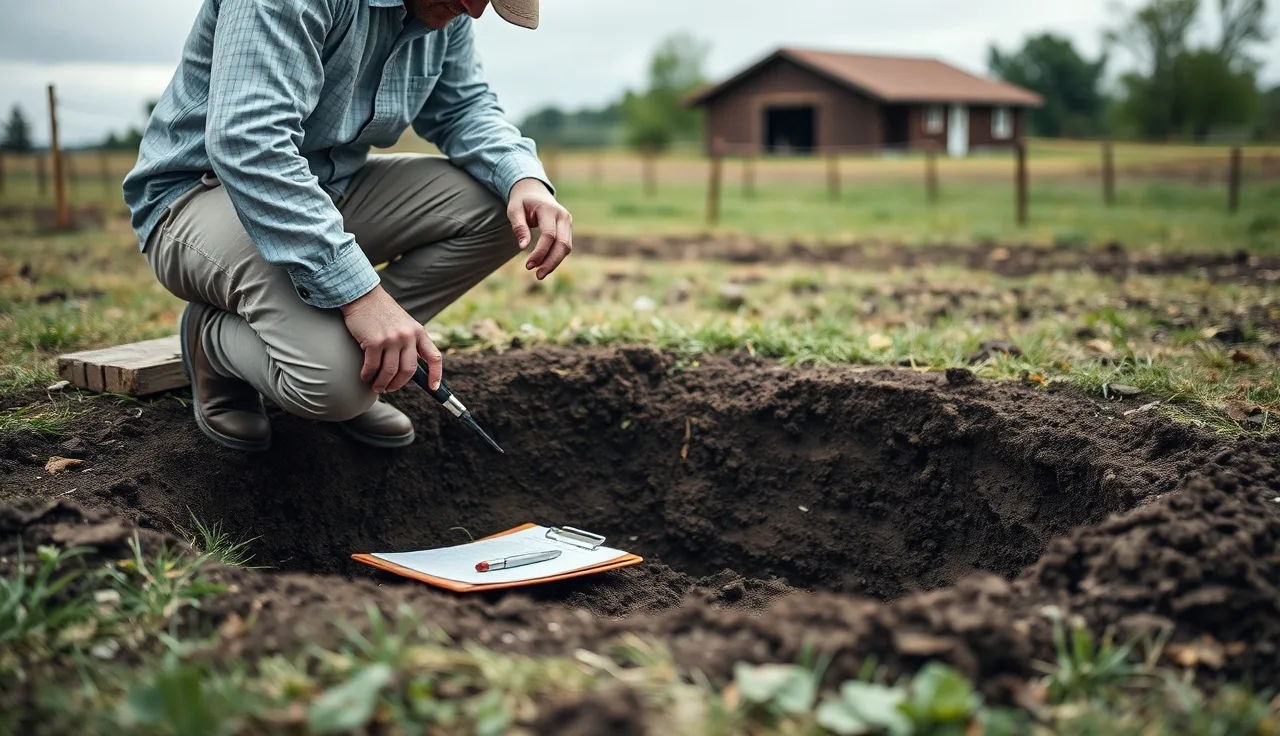
Site preparation. Before the evaluator arrives, test holes are dug, usually 4 to 12 inches in diameter and 12 to 36 inches deep, inside the proposed drain field area. Some jurisdictions require you (or your contractor) to dig these ahead of time. Others have the evaluator or a county crew do it. You typically need multiple holes: three to six is common for a standard residential lot.
Pre-soaking. The holes are filled with water and allowed to drain, usually repeatedly over 12 to 24 hours before the actual test. This saturates the soil to mimic what a drain field would experience after extended use. Skip or shorten the pre-soak and you get artificially fast results that fall apart under real conditions.
The timed test. Water is added to each hole to a standard depth, and the evaluator times how far the level drops over a set interval, typically 30 minutes. That measurement converts to a percolation rate in minutes per inch. A rate under 60 minutes per inch is generally acceptable for conventional drain fields in most states, and many states cap the maximum at 30 or 45 minutes per inch for standard systems. Sandy soils drain in 1 to 5 minutes per inch, which can be too fast. Heavy clay soils may exceed 60 minutes per inch, which usually means the site fails for a conventional system.
Soil profile evaluation. In states that require a full soil scientist evaluation, the evaluator also digs or examines soil profile pits to a depth of 4 to 6 feet. They note soil texture, structure, color, mottling, and depth to limiting layers like rock or seasonal water tables. This data, more than the perc rate, decides what system type and size is appropriate.
Results and documentation. The evaluator produces a written report with perc rates per hole, soil descriptions, and a recommendation for system type and sizing. Where the county conducts the test, results may go straight into the permit file. You need this documentation before a septic permit can be issued.
What perc test results mean for your drain field design
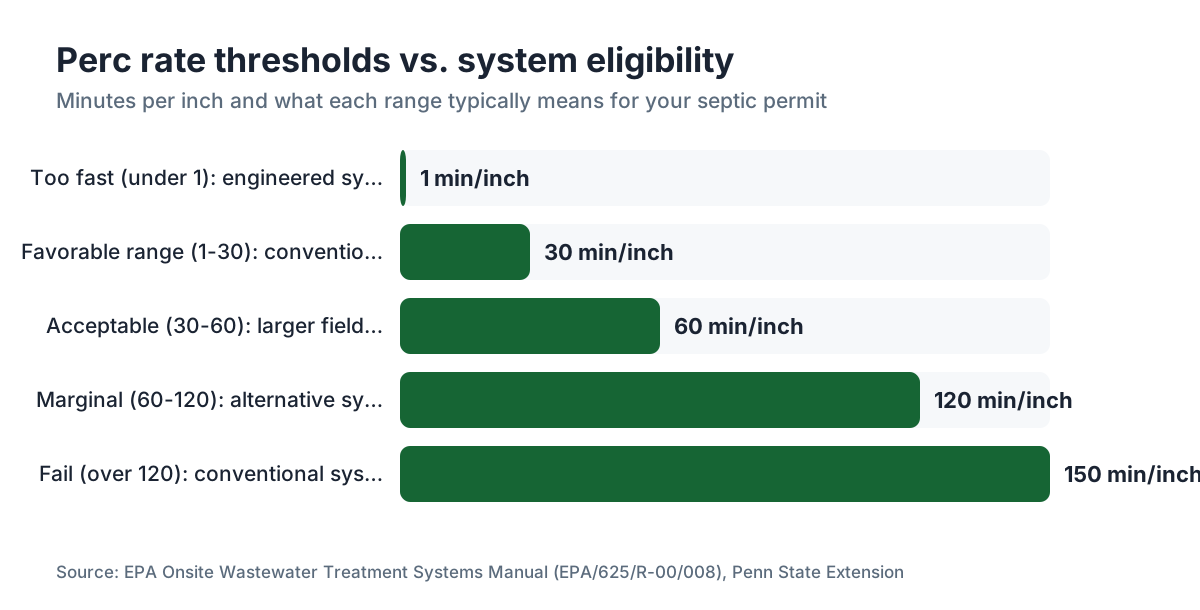
The perc rate maps directly to the required drain field area per bedroom (or per gallon of daily flow) that your local code specifies. Faster rates generally allow smaller fields. Slower rates require larger ones.
| Perc Rate (min/inch) | Typical Soil Type | Standard System Eligible | Notes |
|---|---|---|---|
| 1 or less | Coarse sand/gravel | Usually not (too fast) | Requires engineered system in most states |
| 1 to 30 | Sandy loam to loam | Yes | Most favorable range |
| 30 to 60 | Loam to clay loam | Yes, larger field required | Some states cap at 45 min/inch |
| 60 to 120 | Clay loam to clay | Conditional or alternative system | Mound, drip, or other advanced system |
| Over 120 | Heavy clay or rock | Fail for conventional system | May be able to appeal with engineered design |
These thresholds are guidelines. Your state or county code controls. North Carolina's 15A NCAC 18E, for example, uses soil morphology ratings rather than perc rate cutoffs alone, which means a site with a slow perc rate can still earn a permit if soil structure is favorable [2].
A failed conventional perc test is not the end of the road. Alternative systems including mound systems, drip irrigation, and constructed wetlands exist precisely for difficult soils. They cost more to install and maintain, but they make otherwise unbuildable lots usable. Your licensed soil scientist or engineer can tell you whether an alternative system is viable before you give up on a lot.
For more on what happens after the permit issues, the overview at septic tank installation covers the construction phase.
Can a homeowner perform their own perc test?
Physically, yes. Legally, almost certainly no, at least not for permit purposes.
You can dig holes in your yard, fill them with water, and time how fast it drains. That exercise is fine for a rough read on your soil before you invest in a lot or call in a professional. It tells you nothing definitive without the pre-soaking protocol, multiple holes in the right locations, and the soil profile evaluation that code requires.
For a permit, virtually every jurisdiction requires the test to be performed by or in the presence of a credentialed evaluator or county official. A homeowner's self-administered test has no legal standing. Skip this step and install a system without proper documentation, and you risk fines, forced removal of the system, and serious liability if the system fails and affects neighboring property or groundwater.
One exception worth knowing: some counties let a homeowner dig the test holes themselves (to specific dimensions) before the county official or licensed evaluator arrives. That can save money on excavation labor. Ask your county health department whether it's allowed and what the hole specifications are.
How much does a perc test cost and who pays for it?
The buyer or property owner pays. If you are purchasing land, you want the perc test done during your due diligence period, before closing, so you know whether the lot can legally support a septic system. A failed perc test on a lot with no sewer access is a serious defect.
Cost ranges, based on contractor pricing commonly reported in the industry (not a peer-reviewed dataset):
- County-administered test only (you dig the holes): $75 to $300 in county fees
- Private soil scientist or evaluator, standard lot: $300 to $800
- Full soil morphology evaluation with report (required in NC and similar states): $500 to $1,500
- Expedited or complex sites, engineered evaluation: $1,000 to $3,000+
If the site fails and you need an alternative system designed, add engineering fees of $1,500 to $5,000 on top of the increased system cost.
Some septic design-build contractors bundle the perc test and soil evaluation into their overall quote. That can work in your favor, but ask for itemized pricing so you know what you pay for each piece. The total cost to install a septic system once you have a passing perc test runs $3,000 to $15,000 or more depending on system type and site conditions, which you can read about in detail at cost to install septic system.
How long does a perc test take from scheduling to permit?
Plan for longer than you think. The timeline has several pieces that rarely move in parallel.
Scheduling a county official or private soil scientist in a busy season (spring and summer are peak) can take two to six weeks. The pre-soaking requirement adds 12 to 24 hours to the actual test day. County review of results and issuance of an Improvement Permit or equivalent can take another two to eight weeks depending on the jurisdiction's backlog.
In rural counties with small environmental health departments, four to twelve weeks from first call to permit is not unusual. In some fast-growth suburban counties the wait runs even longer, because the department is understaffed against demand.
Here's the practical move: buying land to build? Start the perc test process the day you go under contract. Make permit issuance a condition of closing if you can negotiate it. A lot that can't pass a perc test is worth substantially less than one that can.
For operators managing multiple site evaluations, scheduling and documentation tools like SepticMind help track test dates, permit deadlines, and evaluator assignments across a portfolio of jobs without anything slipping through a spreadsheet.
What happens if a site fails a perc test?
A failed perc test does not automatically mean the land is unbuildable for septic. It means a conventional gravity drain field won't work. You have several options:
Request a re-test. If you believe the test was conducted incorrectly (inadequate pre-soaking, wrong hole depth, wrong season), you can usually request a re-test. Soil conditions change seasonally, and a test done in a wet period may produce very different results than one done in late summer. Some jurisdictions allow this. Others don't.
Pursue an alternative system. Mound systems, drip irrigation systems, aerobic treatment units, and similar technologies are built for sites that fail conventional perc. They carry higher upfront cost ($10,000 to $30,000 or more) and require active maintenance contracts, but they can make a lot buildable. Your soil scientist or engineer should check whether any alternative is viable before you give up.
Appeal or variance. Some states let you petition for a variance if an engineered design can show the system will protect public health. This is expensive and uncertain, but it exists.
Walk away from the lot. If none of the above work, and there is no municipal sewer option, the land simply can't support a dwelling. That is painful information, but learning it before closing is far cheaper than after.
For systems already in the ground that are having problems, the repair pathway starts at septic system repair.
How does a perc test relate to a full septic inspection?
They are different things, and confusing them is surprisingly common.
A perc test happens before a septic system is built. It evaluates the soil to determine whether a system can be installed and what type. It is a pre-construction soil assessment.
A septic inspection happens after a system is built, usually when a home is being sold or when there is a suspected problem. An inspector examines the existing system: tank condition, effluent levels, baffles, distribution box, and drain field performance. They are not evaluating raw soil. They are assessing a working (or failing) system.
Some real estate deals involve both. The buyer wants to know whether the existing system works (inspection) and whether the lot could support a replacement if the current one failed (which might require perc data). The two processes have different practitioners, different fees, and different regulatory pathways.
For more on what a septic inspection covers and who should order one, the detailed walkthrough at septic tank inspection covers that ground. And if the inspection turns up problems, septic tank repair covers what comes next.
Operators running both inspection and soil evaluation services can track these as separate job types with their own documentation workflows. SepticMind's job management tools handle that distinction natively, which matters when a single property generates two separate permit-related documents.
Are perc test results permanent or do they expire?
They expire. Most states set a validity period on perc test results and the Improvement Permits (or equivalent) that flow from them. Common timeframes:
- North Carolina: Improvement Permits are valid for five years with extensions available under 15A NCAC 18E [2]
- Virginia: permits are generally valid for 18 months to five years depending on the permit type [6]
- Many states: two to five years is the typical range
If you had a perc test done on a lot and then didn't build within the permit window, you may need to redo the evaluation. Soil conditions can shift, particularly the depth to seasonal water tables, and regulatory standards sometimes tighten between test cycles.
Before buying land with an existing perc approval, verify the permit's expiration date with the issuing county agency. A five-year-old approval that has lapsed is worthless without a new evaluation.
Frequently asked questions
Do I need a licensed soil scientist to perform a perc test, or can anyone do it?
It depends entirely on your state and county. Many states require a Licensed Soil Scientist, a Professional Engineer, or a county Environmental Health Specialist to perform or witness the test before results have legal standing. Some states allow licensed septic designers. Call your county health department first. They will tell you the exact credential required and may provide a list of approved evaluators.
Who performs a perc test in North Carolina?
In NC, the evaluation is performed by a Licensed Soil Scientist or an authorized Environmental Health Specialist from the local health department. NC rules under 15A NCAC 18E require a full soil morphology evaluation, more than a timed perc test. Private soil scientists produce a report submitted to the county. The county reviews it and issues an Improvement Permit. The state environmental health program can point you to credentialed evaluators.
How much does a perc test cost?
Expect to pay $150 to $500 for a basic test in counties where the health department runs it, or $300 to $1,500 for a private soil scientist depending on your state's requirements. States requiring full soil morphology reports (like NC) sit toward the higher end. Expedited or complex sites can reach $3,000. Get at least two local quotes, since pricing varies widely by region and evaluator.
How long does a perc test take?
The physical test takes one to two days once the evaluator is on site: 12 to 24 hours of pre-soaking followed by the timed measurement. But scheduling an evaluator in peak season adds two to six weeks, and county permit review after results are submitted adds another two to eight weeks. Budget four to twelve weeks from first call to permit issuance in most rural jurisdictions.
Can I perform a perc test myself?
You can run an informal test on your own property, but it has no legal standing for permit purposes. Almost every jurisdiction requires the test to be performed by or in the presence of a credentialed evaluator or county official. Some counties allow homeowners to dig the test holes themselves before the official arrives, saving excavation costs. Ask your county health department for their specific hole preparation requirements.
What perc rate passes for a conventional septic system?
Most states accept perc rates between 1 and 60 minutes per inch for a conventional gravity drain field, with the sweet spot being 5 to 45 minutes per inch. Rates under 1 minute per inch drain too fast for adequate treatment. Rates over 60 minutes per inch usually require an alternative system such as a mound or drip system. Your state's onsite wastewater code sets the exact thresholds.
Does a perc test expire?
Yes. Perc test results and the Improvement Permits that flow from them have validity periods set by state code. North Carolina permits are valid for five years. Virginia permits run 18 months to five years. Most states fall in the two-to-five-year range. If you buy land with an existing approval, verify the expiration date with the county before closing. An expired permit requires a new evaluation.
What happens if my land fails a perc test?
A failed perc test rules out a conventional drain field but not necessarily all septic options. You can request a re-test if you believe conditions or procedures were problematic, pursue an alternative system (mound, drip, aerobic treatment unit), apply for a variance with an engineered design, or, if none of those are viable, accept that the lot cannot legally support a dwelling with private wastewater treatment.
Is a perc test the same as a septic inspection?
No. A perc test happens before construction to evaluate raw soil for a new system. A septic inspection evaluates an existing installed system, typically during a home sale or after a suspected failure. They involve different practitioners, different fees, different regulatory filings, and answer entirely different questions. Confusing the two is common, especially in real estate transactions.
Who digs the holes for a perc test?
Rules vary. In some counties, the homeowner or their contractor digs the test holes to county specifications before the evaluator arrives, which saves money. In others, the county evaluator or private soil scientist arranges excavation as part of their service. Ask your county health department whether you can prepare the holes yourself, and get the required dimensions and depth in writing before digging.
How many holes does a perc test require?
Most jurisdictions require three to six test holes across the proposed drain field area for a standard residential lot. The exact number depends on lot size, proposed system size, and state code. States that require full soil morphology evaluations may also require separate profile pits dug to 4 to 6 feet deep, independent of the percolation test holes.
Do I need a perc test to replace an existing septic system?
Often yes, especially if the replacement system is going in a new location on the lot or if the original permit documentation is missing. Some counties accept existing soil evaluation data if it is recent and on file. Others require a fresh evaluation. Check with your county environmental health office before assuming old data is enough, particularly if the original system is more than ten years old.
Is a perc test required for a septic system permit in all states?
Some form of soil evaluation is required in every state before a septic construction permit is issued, but the specific method varies. Some states rely primarily on perc test timing. Others, like North Carolina, emphasize soil morphology assessment over perc rate alone. A handful allow soil texture analysis in lieu of a timed test for certain soil types. Your state's onsite wastewater code or your county health department is the definitive source.
Sources
- EPA SepticSmart Program: Properly sited and designed septic systems begin with understanding soil conditions; EPA SepticSmart links system siting to soil evaluation requirements.
- North Carolina Department of Health and Human Services, 15A NCAC 18E Onsite Wastewater Rules: NC onsite wastewater rules under 15A NCAC 18E govern soil morphology evaluation, evaluator credentials, and Improvement Permit validity periods including the five-year term.
- North Carolina Department of Health and Human Services, Environmental Health Section: The NC environmental health program administers onsite wastewater evaluation credentials and directs homeowners to Licensed Soil Scientists and Environmental Health Specialists.
- Soil Science Society of America: Soil Science Society of America maintains links to state soil scientist licensing boards and accreditation resources for locating credentialed evaluators.
- EPA, Onsite Wastewater Treatment Systems Manual (EPA/625/R-00/008): EPA's Onsite Wastewater Treatment Systems Manual describes the standard percolation test procedure including pre-soaking protocol, hole dimensions, and the timed measurement method.
- Virginia Department of Health: Virginia onsite sewage regulations (12VAC5-610) govern who may perform soil evaluations and set permit validity periods of 18 months to five years depending on permit type.
- Massachusetts Department of Environmental Protection, Title 5 (310 CMR 15.000): Massachusetts Title 5 regulations require a Licensed Site Professional or Registered Sanitarian to conduct soil evaluations and perc tests for septic permitting.
- University of Minnesota Extension, Septic Systems: University of Minnesota Extension explains percolation rate thresholds and how perc test results translate to drain field sizing requirements.
- Penn State Extension: Penn State Extension describes the standard perc test procedure including hole preparation, pre-soaking, and the 30-minute timed measurement used to calculate minutes-per-inch rates.
- EPA, How Septic Systems Work: EPA overview of how septic systems work, linking proper soil evaluation to system performance and drain field sizing.
- National Environmental Services Center, West Virginia University: NESC technical resources describe how percolation rates correspond to soil texture categories and which rates are acceptable for conventional versus alternative systems.
Last updated 2026-07-09