Drain field system: how it works, fails, and gets fixed
By the SepticMind Editorial Team

TL;DR
- A drain field (also called a leach field) is the network of perforated pipes buried in gravel trenches that spreads septic tank effluent into soil for final treatment.
- Soil microbes strip out pathogens and nutrients.
- A well-sized, well-maintained field lasts 25 to 50 years.
- Hydraulic overload, missed pumping, and wrong soil conditions are the top reasons they die early.
What is a drain field system and what does it actually do?
A drain field is the final treatment stage in a conventional septic system. Solids settle in your septic tank. The liquid effluent then flows by gravity into a distribution box and spreads through perforated pipes laid in gravel-filled trenches. Effluent seeps out the pipe holes, moves through the gravel, and passes into the native soil beneath. That soil does the real work.
The U.S. EPA describes it plainly: effluent "slowly percolates into the soil, naturally removing harmful coliform bacteria, viruses, and nutrients." [1] Aerobic and anaerobic bacteria in the top few feet of soil digest organic matter and pathogens. By the time the water reaches groundwater, it should be biologically safe.
The field does two jobs at once. It disperses water so your yard doesn't flood with wastewater, and it finishes the treatment the tank started. The tank removes maybe 40 to 50 percent of the biological oxygen demand in raw sewage. The soil handles the rest. Skip either step and you've got a public health problem in your backyard.
Most people never think about the drain field until it fails. That's the wrong approach. It's usually the most expensive single component to replace, and its lifespan tracks directly with how you treat the rest of the system.
How does a drain field work, step by step?
The process starts at the outlet baffle of the septic tank. Clarified effluent, still carrying dissolved nutrients and some pathogens, leaves the tank and heads for the field. Here's the sequence.
From tank to distribution: A pipe carries effluent to a distribution box (D-box) or a manifold header. The D-box has one job: split flow evenly across all trenches. If it's out of level or clogged, some trenches drown while others sit dry.
Through the lateral pipes: Perforated 4-inch pipes, usually schedule 40 PVC, run the length of each trench. Trenches are typically 18 to 36 inches deep, 1 to 3 feet wide, and 50 to 100 feet long. They're packed with clean 3/4-inch crushed stone. The gravel supports the pipe, keeps soil out, and creates void space for effluent to spread before it touches soil.
Into the soil: Effluent seeps from the gravel into undisturbed native soil through a layer called the biomat. The biomat is a thin, dark biological film at the gravel-soil interface. It slows infiltration, which actually extends contact time between effluent and soil microbes. A thin biomat is healthy. A thick, sealed-off biomat is failure.
Final treatment: Aerobic bacteria in the unsaturated soil above groundwater digest organics and pathogens. EPA guidance requires a minimum vertical separation between the bottom of the field and the seasonal high water table so water gets treated before it reaches groundwater. [1] Most state codes set that separation at 2 to 4 feet.
Absorption and evapotranspiration: Plant roots take up some treated water, and some evaporates from the soil surface. In dry climates, that share of the hydraulic load is real, not a rounding error.
What are the different types of drain field systems?
Conventional gravity systems are the most common. Soil conditions, lot size, and local code push a lot of installs toward alternative designs. Here's how the main types stack up. [2]
| System Type | How it works | Best fit | Relative cost |
|---|---|---|---|
| Conventional gravity trench | Gravity-fed perforated pipe in gravel trenches | Deep, permeable soil; adequate lot size | Baseline (1x) |
| Chamber system | Plastic arched chambers replace gravel; larger contact area | Marginal soils; space-limited sites | 1.0-1.2x |
| Drip irrigation (pressure-dosed) | Effluent pumped in timed doses to shallow soil via drip tubing | Shallow soil; nitrogen-sensitive areas | 2-3x |
| Mound system | Field built above grade in imported sand fill | High water table; shallow bedrock | 1.5-2.5x |
| Aerobic treatment unit (ATU) with surface drip | Aeration tank cleans effluent before the field | Tight soil; near water bodies | 2.5-4x |
| Seepage pit (cesspool-style) | Single excavated pit; banned in most states | Legacy systems only | N/A (mostly illegal) |
Chamber systems, made by companies like Infiltrator, have largely replaced gravel in new construction across many states. They're faster to install, and the open-bottom chambers give more soil contact per linear foot of trench. [3]
A mound system is a conventional field lifted onto a bed of coarse sand. They're everywhere in Wisconsin, Minnesota, and other northern states where shallow bedrock or high water tables are the norm. The Wisconsin Department of Natural Resources publishes mound design standards that many other states model their codes on. [4]
Drip irrigation systems deliver treated effluent in small timed doses through subsurface tubing at shallow depth, 6 to 12 inches. They need a pretreatment tank, pump, timer, and filter, so they cost more upfront and more to run. The payoff: they can treat wastewater in soils that would flunk a conventional perc test.
How big does a drain field need to be?
Two things drive sizing: daily flow volume and soil absorption rate. Get either one wrong and the system fails early or costs far more than it needs to.
Daily flow volume: The common design standard is 150 gallons per day (GPD) per bedroom. A 3-bedroom house is designed for 450 GPD. Some states use fixture counts or measured flow, but bedroom count is the dominant method. [5]
Soil absorption rate (percolation test): A perc test clocks how fast water drains through your soil, in minutes per inch (mpi). Sandy soils might perk at 1 to 3 mpi. Loamy soils run 30 to 60 mpi. Clay soils above 60 mpi often flunk conventional system requirements outright. [5]
Required trench bottom area works out to: area (sq ft) = design flow (GPD) / application rate (GPD/sq ft). The application rate comes from a state table that converts perc results to a safe loading rate.
A real example: a 3-bedroom house (450 GPD) in soil that perks at 30 mpi might need about 375 to 450 square feet of trench bottom area. With 3-foot-wide trenches, that's 125 to 150 linear feet, usually split into two or three parallel laterals.
Undersized fields are the engineering mistake behind a big share of early failures. Buying a home on septic? Ask for the original permit and design documents. Confirm the bedroom count the system was built for matches how you plan to live in the house.
What causes drain field failure?
Most drain field failures trace back to three mechanisms. They often overlap.
Hydraulic overload: You're pushing more water through the system than it was built to take. The usual suspects: water softener backwash dumping into the septic system, a toilet that runs all night, a household bigger than the bedroom-count design, or sump pumps and roof drains piped into the septic line. Each of these can double or triple the load for stretches of time, drowning the soil before it can recover.
Biomat accumulation: A heavy biomat builds when too much organic matter reaches the field. That happens when the tank overflows sludge (from missed pump-outs), when a garbage disposal sends a steady stream of food waste, or when the system is just old. Biomat itself isn't failure. It's the system working. But a biomat that thickens until it's impermeable backs effluent up.
Compaction and physical damage: Driving or parking over the field crushes the gravel bed and the pipes. Tree roots, especially from willows, maples, and other water-seekers, invade and plug laterals. Heavy equipment during a landscaping project can wreck a field that was working fine that morning.
EPA's SepticSmart campaign lists "diverting rainwater drainage from roofs, driveways, and other surfaces away from the drain field" as a key prevention step, because saturated soil can't accept more effluent no matter how well you've maintained everything else. [1]
Soil type matters over time too. Fine-textured soils, especially high-clay soils, start with limited permeability. As the biomat develops over decades, infiltration drops further. Soil that perc-tested at 45 mpi when new may effectively run at 90 mpi after 20 years. That's not failure in the usual sense. It's aging.
Wet spots over the field, sewage odor in the yard, multiple fixtures draining slow at once, or sewage backing into the house: those are the four classic signs of distress. Any one of them earns a call to a licensed septic professional, not a plumber.
Can a failing drain field be repaired, or does it always need replacement?
This is the question every homeowner hopes has a cheap answer. Sometimes it does.
The cheap fixes that sometimes work:
If hydraulic overload is the problem, killing the source (a leaking toilet, a bad water softener, an illegal sump pump connection) can give the field weeks or months to rest and partly recover. Soil is biologically active. A rested field can re-open its permeability as the biomat thins.
If the D-box is cracked or out of level, replacing it runs a few hundred dollars and can fix an uneven loading problem that was burning out one or two laterals while the rest sat idle.
Live-bacteria additive products (the microbial kind, not enzyme additives) show some evidence of thinning an established biomat in marginal cases. The research is thin and mixed. Nobody has good controlled-trial data at scale, but some extension programs say they're worth a shot before you abandon the field.
The mid-tier options:
Hydro-jetting the laterals clears physical clogs and some biomat. Figure $200 to $600 per lateral. It won't fix saturated soil, but it buys time.
Air injection systems (Terralift and similar rigs) fracture compacted soil around the laterals to restore permeability. Results swing wide, from a couple of years to more than a decade. Costs run $1,000 to $3,000 depending on the approach.
Full replacement:
When the soil is saturated and biologically spent, or when pipes are crushed or root-choked throughout, replacement is the only real answer. Most jurisdictions require a fresh perc test and permit. A conventional replacement runs $3,000 to $15,000 depending on soil, site access, system size, and local labor. [6] Mound and alternative systems in tough soils can hit $15,000 to $30,000 or more.
Some lots have a designated repair area set aside for exactly this moment. If yours doesn't and you're on a small lot, replacement gets genuinely complicated. Dig out your original permit documents.
For the full picture of a system overhaul, the septic system repair article covers the whole spectrum of options, and leach field goes deeper on field-specific failure and replacement.
How much does a drain field system cost to install or replace?
Drain field costs swing wider than almost any other home system, because site conditions run the price. Rocky soil, high water tables, and bad access can double or triple the cost of an otherwise identical install.
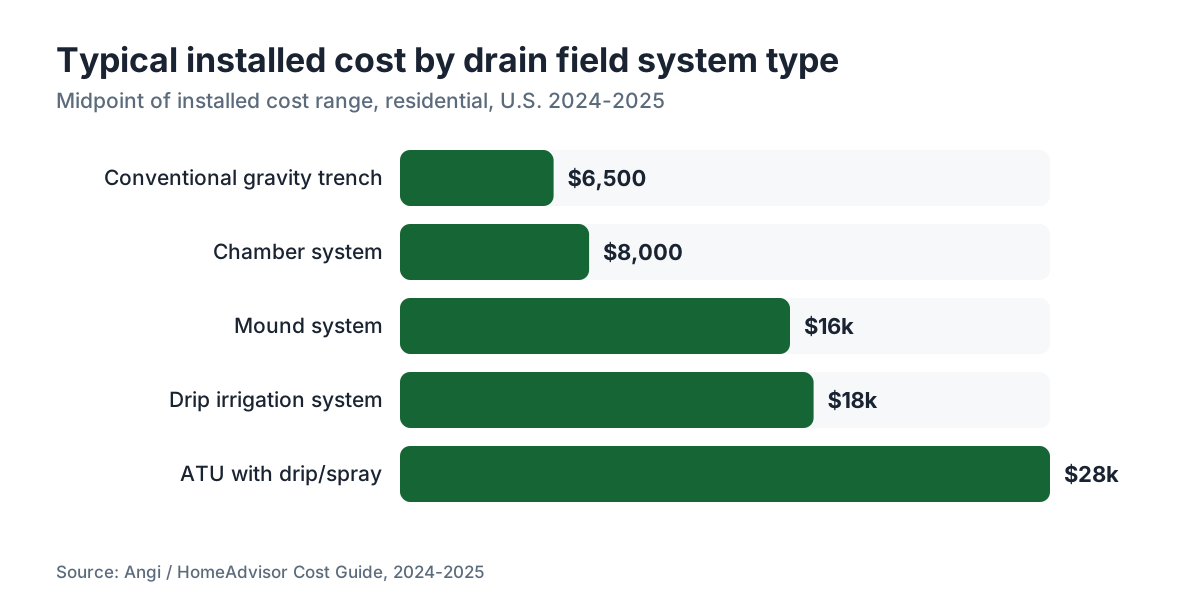
Here are realistic installed cost ranges for residential drain fields in the U.S. as of 2024-2025. [6]
| System type | Typical installed cost range | What drives the high end |
|---|---|---|
| Conventional gravity trench | $3,000 - $10,000 | Long trenches, poor soil, hard excavation |
| Chamber system | $4,000 - $12,000 | Same as conventional; chambers add slight material cost |
| Mound system | $8,000 - $25,000 | Imported fill, pump, larger footprint |
| Drip irrigation system | $10,000 - $25,000 | Pretreatment unit, pump, controls |
| ATU with drip or spray | $15,000 - $40,000 | ATU equipment, controls, service contracts |
Permit fees add $200 to $1,500 in most places. Some states require an engineer or licensed designer to stamp the plans, which tacks on $500 to $2,000.
Budgeting for a new build? The full system (tank plus field) is often $10,000 to $20,000 for a conventional setup on a cooperating site. The cost to install septic system article breaks the whole budget down.
One thing to know: field installation labor is local. Rural areas with active well-and-septic crews can be a lot cheaper than suburban markets where excavation contractors stay booked. Get at least three bids, and make sure each one covers the same scope: permit, soil testing, backfill, and final inspection.
What are the rules and regulations that govern drain field installation?
Drain fields are regulated at the state level, not federally, and most states hand administration down to county or local health departments. EPA sets guidance and some national drinking water standards that shape where and how fields can go, but it doesn't issue installation permits. [1]
State programs vary a lot. Every state has an "onsite wastewater" or "subsurface sewage disposal" code that spells out:
- Setback distances from wells, property lines, buildings, surface water, and roads (commonly 50 to 100 feet from a drinking water well, 10 to 20 feet from property lines)
- Minimum soil depth and separation to the seasonal high water table (commonly 2 to 4 feet)
- Maximum soil percolation rates allowed for conventional systems
- Required inspection points during and after install
- Who can perform soil evaluations (licensed soil evaluators or engineers in most states)
Federal guidance comes from EPA's septic documents and the Onsite Wastewater Treatment Systems Manual. The 2002 edition is still a primary reference for designers and regulators. [2]
The Clean Water Act (33 U.S.C. § 1251 et seq.) is the federal framework that gives states the authority and the motivation to regulate onsite systems. A failing field that discharges to surface water or groundwater is a water quality violation. [7]
Buying a home with a septic system? Ask the seller for the permit, the as-built drawing, and the most recent inspection report. Some states require a passing inspection at transfer. Others require no disclosure at all. Know which one you're in before you sign.
How do you maintain a drain field to make it last?
The best drain field maintenance strategy costs almost nothing. It's mostly about what you don't do.
Pump the tank on schedule. This is the biggest lever you have. EPA recommends pumping every 3 to 5 years for a typical household. [1] A tank that overflows solids into the field will kill it. The how often to pump septic tank and septic tank pumping articles handle the timing question in detail.
Protect the surface. Never drive over it. Don't let heavy equipment, or even a riding mower run over the same path again and again, pack the soil down. Keep it planted with shallow-rooted grass. No trees or shrubs within 30 feet.
Control the water going in. Fix leaking toilets and faucets fast. A running toilet can add 200 gallons a day, close to half the design load of a 3-bedroom house on its own. Route surface runoff and roof downspouts away from the field. Don't tie a sump pump into the septic system.
Watch what goes down the drain. Fats, oils, and grease clog the tank and eventually reach the field. Harsh chemicals, big doses of antibiotics, and non-degradable wipes have no business in a septic system. Coffee grounds and garbage disposal food waste build sludge faster than toilet paper and human waste alone.
Inspect on a schedule. A licensed inspector can catch a failing D-box, a cracked distribution pipe, or rising sludge before any of it reaches the field. Most states recommend inspection every 1 to 3 years. [8]
Operators managing dozens of residential accounts have to track pump-out intervals, inspection history, and service notes across every one of them. That's where software like SepticMind earns its keep, because keeping clients on schedule is exactly how preventable failures get caught before they turn expensive.
How do you know if your drain field is failing?
Some signs are impossible to miss. Others are quiet enough that homeowners ignore them for months before calling anyone.
Obvious signs:
- Wet, spongy, or swampy ground right over the trenches, especially after a dry stretch
- Sewage odor in the yard, over the field or near the tank
- Multiple house drains slow at the same time (one slow drain is usually a pipe; all of them slow at once is usually the system)
- Sewage backing into basement floor drains or ground-floor toilets
Subtle signs:
- Grass over the field is unusually green and growing fast. Nitrogen-rich effluent near the surface fertilizes it heavily.
- Water rises in the toilet bowl when you run the washing machine
- Gurgling from fixtures when nothing is actively draining
Seeing any of these? Stop adding water to the system. Cut laundry to minimum loads, take short showers, skip the overnight dishwasher run. Then call a licensed septic contractor. Not a plumber, not a drain cleaning service. The fix might be simple, a blocked inlet baffle or a clogged D-box, or it might need a full system evaluation. Either way you need someone who can read the whole system, more than the pipe in front of them.
A septic tank inspection is usually the starting point. The inspector opens the tank, measures the sludge and scum layers, checks the baffles, and probes the field for saturation.
What is the lifespan of a drain field, and when should you plan for replacement?
A well-designed, well-maintained conventional drain field should last 25 to 50 years. [9] That's the published guidance from state extension programs and EPA. The honest truth is that the range is wide because it leans hard on soil type, usage, and maintenance history.
Fields that get pumped on time, serve a household sized to the design capacity, and sit in permeable, well-drained soil can cruise to 40 or 50 years. Fields in tight clay, under oversized households, or with a history of skipped pump-outs are often struggling by year 15 to 20.
A practical planning framework:
- Under 20 years old: Assume significant useful life remains if there are no failure signs. Focus on maintenance.
- 20 to 30 years old: Get a professional evaluation every 2 to 3 years. Check whether the original soil conditions still hold up. Confirm the tank is being pumped on schedule.
- Over 30 years old: Budget for replacement. It may not be imminent, but a system this age deserves an inspection that includes probing the field for saturation, more than checking the tank.
Condition matters more than age, but age tracks condition for a reason. Biomat accumulation, pipe degradation, and soil compaction all climb with time.
Buying a home with an older system? The septic tank inspection article covers what a pre-purchase inspection should include. Any system past 20 years old should get a full field assessment, more than a tank inspection, before you close.
How does a drain field relate to the rest of the septic system?
The drain field doesn't work in isolation. It sits downstream of everything, which means problems upstream become field problems if they go unfixed.
The tank's job is to separate solids from liquid and hold them until they're pumped. When the tank isn't pumped on schedule, the sludge layer rises until solids start flowing out with the effluent. Those solids clog the gravel and biomat far faster than liquid ever would. That's the direct mechanical link between pumping frequency and field lifespan.
The inlet and outlet baffles inside the tank control what enters and leaves. A failed outlet baffle is one of the most common reasons fields end up receiving solid material. Baffles cost $50 to $150 in parts and a few hours of labor to replace. [10] They turn up routinely during a septic tank pump out or inspection.
The distribution box is the handoff between the tank side and the field side. D-box problems are common and cheap to fix, but only if somebody finds them. That's why opening and inspecting the D-box belongs in any routine service visit, more than the tank.
For homeowners the takeaway is short: everything you do upstream protects the field. Keeping the tank pumped, the baffles intact, and the D-box level is cheap insurance against a $10,000 to $25,000 field replacement.
Operators running large portfolios of residential accounts can use SepticMind's scheduling and service history tools to flag accounts overdue for pumping or inspection, which is where most drain field damage begins.
Frequently asked questions
How long does a drain field last?
A properly designed and maintained drain field typically lasts 25 to 50 years. Systems in well-draining soils with consistent pumping schedules regularly hit the high end. Systems in clay-heavy soils, serving oversized households, or with missed pump-outs often show stress by year 15 to 20. Soil type and maintenance history matter more than age alone.
What is the difference between a drain field and a leach field?
They're the same thing, just different regional names. Drain field is more common in the Southeast and Pacific Northwest. Leach field is widely used in the Northeast and Midwest. Some technical documents use 'absorption field' or 'soil absorption system.' All of these refer to the network of perforated pipes buried in gravel trenches that disperses and treats septic effluent in soil.
Can I build a deck or shed over my drain field?
No. Structures over a field block evapotranspiration, cut off inspection access, and often need footings that physically damage the pipes and gravel. Most state codes flatly prohibit permanent structures over drain fields. Even temporary vehicle parking compacts soil enough to cut permeability. Keep the surface planted with shallow-rooted grass and leave it clear.
What should I never put down the drain if I have a septic system?
Never flush or drain cooking grease or oil, wipes (including 'flushable' ones), coffee grounds, pharmaceuticals, paint, solvents, excessive bleach, or large amounts of antibacterial cleaner into a septic system. These clog the tank and field, kill the beneficial bacteria the system runs on, or both. Keep garbage disposal use minimal; ground food solids build sludge fast.
How much does drain field replacement cost?
Replacing a conventional gravity field typically runs $3,000 to $10,000 installed, including permit, excavation, pipe, gravel or chambers, and backfill. Mound systems cost $8,000 to $25,000. Drip irrigation runs $10,000 to $25,000. Aerobic treatment systems with subsurface dispersal can reach $40,000. Site access, soil conditions, and local labor markets drive most of the variance.
Why is my drain field wet even when it hasn't rained?
Wet ground over the field without recent rain usually means effluent is surfacing, which points to hydraulic overload or soil failure. Common causes: a tank that hasn't been pumped in years and is now sending solids to the field, a leaking toilet adding hundreds of gallons a day, a blocked or uneven distribution box dumping all the flow into one trench, or a biomat so thick the soil can't take any more liquid.
Do septic additives help a failing drain field?
The evidence is mixed and mostly thin. Live-bacteria additives may help thin a biomat in marginal cases, especially during a rest period with reduced load. Enzyme-only products haven't shown consistent benefit in controlled conditions. Chemical additives can actually damage system components. No additive substitutes for proper tank pumping. If the field is genuinely failing, an additive is unlikely to reverse it.
How far does a drain field need to be from a well?
Most state codes require at least 50 to 100 feet of horizontal separation between a field and a drinking water well. The exact minimum depends on your state and local code. Shallow dug wells often need more separation than deep drilled wells. Setback rules also cover surface water, property lines, and building foundations. Check your state's onsite wastewater code for the exact figures.
Can a drain field be repaired without full replacement?
Sometimes. If failure comes from hydraulic overload, cutting the excess water source and resting the field can restore some capacity. A damaged or unlevel distribution box replaces for a few hundred dollars. Hydro-jetting laterals clears physical clogs and buys time. Air injection can fracture compacted soil around the pipes. When the soil is biologically spent or physically damaged throughout, full replacement is usually the only lasting fix.
Does homeowners insurance cover drain field failure?
Standard homeowners policies almost universally exclude drain field failure because it counts as a maintenance issue, not a sudden accidental event. Some insurers sell septic system riders or service line endorsements that may cover specific damage. Read the policy carefully. Coverage for backup and overflow, meaning damage inside the home from a backing-up system, is separate from coverage for the field itself.
What is a perc test and do I need one for a drain field?
A percolation test measures how fast water drains through your soil, in minutes per inch. It's required for nearly all new field permits and most replacement permits in the U.S. The test sets system sizing and decides whether a conventional system is even feasible. Results above roughly 60 minutes per inch often force an alternative design. Most states require a licensed soil evaluator or engineer to run and certify the test.
How do I find my drain field if I don't know where it is?
Start with your county health department's records. Most permits include a site plan or as-built drawing showing the tank and field. If no records exist, a septic professional can locate the system by finding the tank first, with a probe or locating device, then tracing the outlet pipe to the distribution box and laterals. Some inspection cameras run through the laterals to map them.
What trees or plants are safe to grow near a drain field?
Shallow-rooted turf grass is the safest choice over the field itself. Avoid trees and large shrubs within 30 feet, especially water-seekers: willows, maples, poplars, elms, and birches. Their roots infiltrate perforated pipes and crush them over time, or block the gravel bed. Ornamental grasses and perennials with shallow fibrous roots can generally go around the perimeter without much risk.
Sources
- U.S. EPA, SepticSmart: Protect Your Investment: Effluent percolates into soil, naturally removing harmful coliform bacteria, viruses, and nutrients; EPA recommends pumping every 3 to 5 years and diverting surface water from drain fields.
- U.S. EPA, Onsite Wastewater Treatment Systems Manual (EPA/625/R-00/008, 2002): Federal design reference for conventional and alternative drain field system types, sizing, and state regulatory frameworks.
- Infiltrator Water Technologies, Chamber System Design: Chamber systems provide greater soil contact area per linear foot of trench compared to gravel systems and are widely permitted in new construction.
- Wisconsin Department of Natural Resources, Mound System Design Standards: Wisconsin DNR publishes mound system design standards widely referenced by other state programs for high water table and shallow soil conditions.
- North Carolina State University Extension, Soil Evaluation and Septic System Sizing: Daily design flow of 150 gallons per bedroom per day and percolation test requirements for sizing drain field trench bottom area.
- HomeAdvisor / Angi, Septic System and Drain Field Cost Guide: Installed cost ranges for conventional ($3,000-$10,000), mound ($8,000-$25,000), and alternative drain field systems ($10,000-$40,000) as of 2024-2025.
- U.S. Congress, Clean Water Act, 33 U.S.C. § 1251 et seq.: Federal statutory authority under which states regulate onsite wastewater systems; discharges from failing drain fields to surface or groundwater constitute a water quality violation.
- Virginia Department of Health, Onsite Sewage Program: State guidance recommending periodic inspection every 1 to 3 years for onsite sewage systems to identify component failures before drain field damage occurs.
- Penn State Extension, Septic System Maintenance and Lifespan: Well-maintained conventional drain fields typically last 25 to 50 years; soil type and maintenance history are the primary determinants of lifespan.
- University of Minnesota Extension, Septic System Basics: Septic tank outlet baffles cost $50 to $150 in parts; a failed outlet baffle is a common cause of solids reaching the drain field.
Last updated 2026-07-09