Iowa septic inspection: rules, costs, and what to expect
By the SepticMind Editorial Team
TL;DR
- Iowa requires most counties to inspect onsite wastewater systems at the point of sale, and many counties mandate pumping before the inspection.
- A standard inspection runs $150, $400, takes one to three hours, and checks tank condition, effluent levels, and drain field function.
- Systems built before 1974 or within 200 feet of a water source face the strictest scrutiny.
What are Iowa's rules for septic system inspections?
Iowa regulates onsite wastewater systems under Iowa Code Chapter 455B and the administrative rules in Iowa Administrative Code Chapter 567-69 [1]. The state gives counties and cities authority to adopt and enforce their own onsite wastewater ordinances, which means requirements vary more than most homeowners expect. Some counties require a licensed inspector to evaluate the system before any property transfer closes. Others trigger an inspection only when the system is modified or when a complaint is filed.
The Iowa Department of Natural Resources (DNR) sets minimum standards that all local programs must meet, but counties can and regularly do impose stricter rules on top of those minimums [2]. If you're buying or selling a home in Polk, Linn, or Johnson County, you'll face inspection requirements that differ in meaningful ways from rural counties running on a county sanitarian's office with lighter staff.
One provision catches sellers off guard. Iowa's private well and septic inspection law (passed under Iowa Code 455B.172) strongly encourages disclosure and inspection at point of sale, and many lenders and title companies treat a passing inspection report as a hard requirement even when the county doesn't formally mandate one [3]. FHA and USDA rural loans almost always require a septic inspection before closing on Iowa property.
When is a septic inspection legally required in Iowa?
The clearest trigger is real estate transfer. A large share of Iowa counties have adopted point-of-transfer inspection ordinances, meaning the seller must have the septic system inspected and provide documentation to the buyer before closing. Check with your county sanitarian or environmental health office to confirm whether your county is one of them.
Beyond real estate sales, Iowa requires inspection or re-permitting whenever a system is repaired, expanded, or modified [1]. If a homeowner adds a bedroom, converts a seasonal cabin to a year-round residence, or installs a new pressure-dosed system, the county will inspect before approving the work.
New construction always requires inspection and approval. The county sanitarian reviews soil evaluations, site plans, and system design before issuing a construction permit, and a final inspection confirms the system was built to spec before the permit closes.
Lenders add a fourth trigger. USDA Rural Development loans, FHA-insured mortgages, and VA loans typically require a septic inspection as part of the property appraisal process regardless of county ordinance [4]. If the loan program requires it, the inspection happens even in counties that haven't adopted a transfer ordinance.
Some counties also run random compliance inspections on older systems or systems near sensitive water bodies like lakes, rivers, or public water supply watersheds.
How much does a septic inspection cost in Iowa?
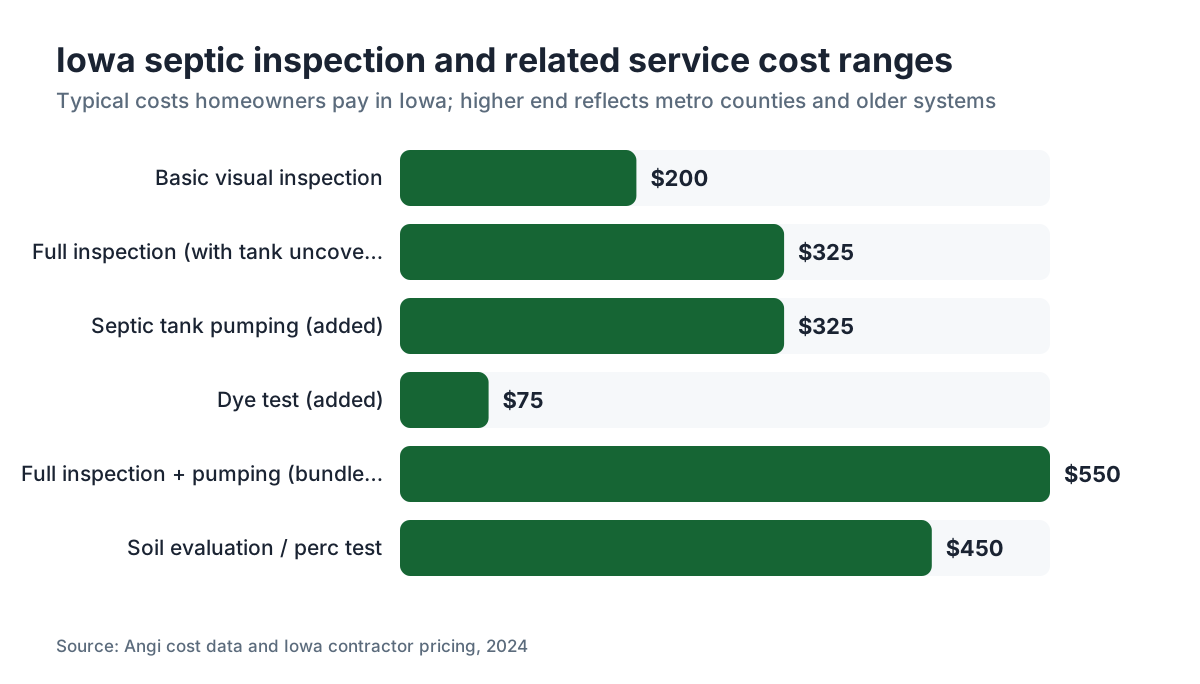
A basic visual inspection by a licensed inspector in Iowa typically runs $150, $250. A full inspection that includes locating and uncovering the tank, checking baffles, probing the drain field, and producing a written report lands closer to $250, $400 [5]. If the county requires pumping before the inspection (which several counties do), add $200, $450 for that service depending on tank size and location.
The table below breaks out the common cost components:
| Service | Typical Iowa cost range |
|---|---|
| Basic visual inspection | $150, $250 |
| Full inspection with tank uncovering | $250, $400 |
| Septic tank pumping (required by some counties) | $200, $450 |
| Dye test (some counties require) | $50, $100 added to inspection fee |
| Soil probe / perc test (new systems or major repairs) | $300, $600 |
| Full inspection + pumping, bundled | $350, $750 |
Prices run higher in metro areas like Des Moines, Cedar Rapids, and Iowa City, and can be lower in rural counties where the county sanitarian performs the inspection as part of permitting with little or no fee. Always ask whether the county charges a separate inspection fee (common: $50, $150) on top of the contractor's fee.
If you're shopping for a home and want to avoid surprises, budget $500 total. That covers a mid-range full inspection plus the pumping that many Iowa counties require as a precondition.
What does an Iowa septic inspector actually check?
A thorough Iowa septic inspection follows a consistent sequence. The inspector starts by locating the tank (using the original permit drawings from the county file if available), uncovering the access lids, and measuring the scum and sludge layers inside the tank. Iowa's general guidance follows EPA SepticSmart recommendations: if the combined scum and sludge layers occupy more than one-third of the tank's liquid depth, the system needs pumping [6].
Next comes the condition of the inlet and outlet baffles. A missing or deteriorated outlet baffle lets solids escape into the drain field and is one of the most common findings inspectors flag. Concrete tanks built before the early 1990s often have concrete baffles that have partially dissolved. PVC tee replacements cost $50, $150 per baffle and prevent expensive drain field damage.
The inspector checks the distribution box (D-box) if one is present, looking for settled or cracked concrete, uneven distribution of effluent to the laterals, and evidence of backflow. They'll probe the drain field for soft spots, surfacing effluent, or lush green stripes of grass that suggest the field is saturated or failing. Some inspectors run a dye test, flushing fluorescent dye through the system and looking for it at the surface or in nearby ditches.
For leach field assessment, the inspector notes soil conditions, any prior repairs, and proximity to water sources. Iowa's administrative rules specify minimum separation distances: 200 feet from a public water supply, 50 feet from a private well, and 10 feet from a property line, among others [1].
The inspection ends with a written report classifying the system as passing, requiring repair, or failing. Some counties use a three-tier classification. Others use pass/fail. Ask for the county's specific form before hiring an inspector so you know what documentation will satisfy the county office.
Who is qualified to perform a septic inspection in Iowa?
Iowa licenses septic system contractors and inspectors through the Iowa DNR. Anyone performing inspection, installation, or repair of onsite wastewater systems for compensation must hold a current Iowa DNR contractor license [2]. The license categories include Installer, Maintainer, and Service Provider, and the relevant one for inspections is Service Provider (also called an Operation and Maintenance provider in some county programs).
County sanitarians from county environmental health offices can also perform inspections, and in some rural counties the sanitarian is effectively the only game in town. In metro counties, you'll have a choice of licensed private contractors.
For real estate transactions, confirm with the county whether they accept inspections from any licensed DNR contractor or require use of a county-approved list. Polk County, for example, maintains its own list of approved inspectors for point-of-sale evaluations.
Your home inspector is not a qualified substitute. General home inspectors in Iowa are licensed under a separate program (Iowa Code Chapter 543E) and are not licensed for onsite wastewater inspection unless they also hold an Iowa DNR septic contractor license [7]. A home inspector can note visible warning signs, but the county will not accept their report as a septic compliance inspection.
What happens if a septic system fails the inspection in Iowa?
A failing system creates a real problem at closing, but it's not automatically a deal-breaker. Iowa has no statewide law that voids a sale on septic failure, so the outcome depends on negotiation between buyer and seller and on what the county ordinance requires.
Common outcomes after a failed inspection:
- The seller repairs or replaces the system before closing. This is the cleanest resolution. For a repair, expect $1,500, $5,000 depending on what failed. Full system replacement in Iowa runs $8,000, $20,000 or more depending on soil, site, and system type [see /cost-to-install-septic-system].
- The parties negotiate a price reduction. The buyer accepts the system as-is and applies the repair credit to post-closing work. Lenders on government-backed loans (FHA, USDA, VA) generally won't allow this. They require the defect to be corrected before closing.
- The transaction falls through. If neither party can agree on who pays for the fix, the deal dies.
Many counties will issue a temporary use permit that allows a property to transfer while repairs are scheduled, but this typically requires the new owner to sign a compliance agreement committing to repair within a set timeframe (often 90 to 180 days).
For septic system repair options in Iowa, the county sanitarian can advise on what's permitted given your soil type and lot size. Alternative systems (mound systems, drip irrigation, constructed wetlands) are sometimes the only option on tight or wet lots.
How do Iowa's county-by-county rules differ?
This is where Iowa gets complicated. The Iowa DNR sets the floor, but each of Iowa's 99 counties operates under its own ordinance. The practical differences include:
Point-of-sale inspection requirement. Many urban and suburban counties require it. Some rural counties do not. Contact your specific county environmental health or sanitarian office to confirm.
Pumping before inspection. Polk County requires the tank to be pumped before the inspection so the inspector can see the interior clearly. Most inspectors recommend this practice regardless of county mandate because you simply can't assess baffle condition or concrete integrity through liquid. Septic tank pump out before inspection adds cost but prevents false passes.
Age-based condemnation rules. Some Iowa counties automatically classify systems built before a certain year as non-conforming and require upgrade or replacement at point of sale, regardless of functional condition. The specific year varies by county.
Proximity to water rules. Properties near Iowa's lakes, rivers, and drinking water wells face stricter requirements. The DNR's nutrient reduction strategy and Iowa's water quality initiatives have pushed several lake-area counties to adopt enhanced onsite wastewater rules.
Fees. County permit and inspection fees range from zero (in counties where the sanitarian performs the inspection as part of normal duties) to $200 or more.
The Iowa DNR maintains a list of county environmental health offices on its website, and that's your best first call before listing or making an offer on any Iowa property with a septic system [2].
How do you prepare for an Iowa septic inspection?
Good preparation reduces surprises and can mean the difference between a passing report and a repair order.
Start by pulling your county's permit records. The original permit shows the system's installation date, tank size, drain field layout, and any prior repairs. Most counties keep these records going back decades and can provide copies. Knowing your system's age matters because systems installed before 1974 (before Iowa adopted modern septic rules) often predate current separation distance and design requirements.
Have the tank pumped before the inspector arrives if your county doesn't mandate it. A clean tank lets the inspector see the baffle condition, look for cracks, and confirm the tank has held its structural integrity. Septic tank cleaning done within the past year also signals to a buyer that the seller has maintained the system. The EPA SepticSmart program notes that pumping every three to five years is standard for a household of four, but a pre-inspection pump-out makes sense even if you're not at that interval yet [6].
Locate and mark your clean-out access ports and the drain field corners. Inspectors charge by time. Saving them 30 minutes of probing around the yard saves you money.
Fix obvious issues before the inspection if you can. A risers-and-lids upgrade ($200, $600) brings access to grade and makes future inspections faster. Replacing deteriorated baffles ($50, $150 per baffle) is cheap and prevents a failed inspection on what is otherwise a healthy system.
Keep water use low for 24 to 48 hours before the inspection. Running the washing machine, dishwasher, and multiple showers the morning of inspection day floods the system and can make a healthy drain field look stressed.
Operators managing multiple property inspections can streamline documentation and scheduling with tools like SepticMind, built for onsite wastewater service businesses handling volume inspection workflows in states like Iowa.
How often should you inspect a septic system in Iowa even when not selling?
Iowa's administrative code doesn't set a mandatory routine inspection interval for systems that aren't being transferred or modified [1]. Even so, the EPA and most Iowa county environmental health programs recommend having your system inspected every three to five years for conventional gravity systems and annually for systems with mechanical components (pumps, aerators, alarms) [6].
For pumping frequency, the classic guidance holds: pump every three to five years for a typical family home with a 1,000-gallon tank. If you have a garbage disposal, a large household, or an older system, move closer to every two to three years. See our guide on how often to pump a septic tank for a breakdown by household size.
Routine inspection outside of a sale makes financial sense. Replacing a damaged baffle costs under $200. Replacing a failed drain field costs $5,000, $15,000. Inspectors often catch early-stage problems (root intrusion, high sludge levels, minor baffle deterioration) that cost almost nothing to fix if caught early and a small fortune if ignored.
Iowa properties on or near lakes, in floodplains, or above fractured bedrock should consider annual inspections because the environmental and public health stakes are higher and because county officials in those areas are more likely to run compliance checks.
What do Iowa septic inspection reports look like, and how long are they valid?
Iowa doesn't have a single uniform inspection report form statewide. Each county can require its own format, and some counties have specific checklists while others accept a written narrative from the licensed inspector. Before hiring an inspector, ask the county environmental health office what form they accept and whether the inspector needs to submit the report directly to the county or provide it only to the property owner.
Most counties that require point-of-sale inspections also set a validity window. Common validity periods run from 90 days to 12 months from the inspection date. If a sale falls through and a new buyer comes along, you may need a fresh inspection if the original report has expired.
A passing report generally states that the system appears to be functioning as designed at the time of inspection, that the tank is in acceptable condition, and that there are no signs of drain field failure. Inspectors typically note they can't guarantee future performance, and that language is standard and appropriate. The Iowa DNR's guidance on system performance standards is the benchmark for what counts as a passing system [2].
Keep a copy of every inspection report in your home files. When you sell, disclosing prior inspection history (including any repairs made) shows good faith and often smooths the buyer's due diligence process.
What are the most common reasons Iowa septic systems fail inspection?
After talking to inspectors and county sanitarians across the state, a clear pattern of failure reasons emerges.
Deteriorated or missing baffles are the single most common finding. The outlet baffle matters most. Without it, partially treated effluent and solids move directly into the drain field. On older concrete tanks, the baffle may have dissolved entirely.
High sludge and scum levels are the second most common issue. These say the system hasn't been pumped in years. Septic tank emptying before inspection prevents this from becoming a failed report, since a pump-out followed by a re-inspection often resolves the issue quickly.
Drain field failure is the most expensive finding. Signs include surfacing effluent, extremely slow drainage in the house, or soggy ground over the field. Causes range from biomat buildup (common in older fields) to physical damage from vehicles or tree roots. On a property with a failing drain field, the inspection fails and the county typically requires a full design and replacement.
Improper setbacks from wells, water bodies, or property lines are a compliance issue on older systems that went in before current separation distance rules. The system may work fine but be sited in a way that no longer meets code, which triggers a replacement requirement in some counties.
Cracked or deteriorated tank walls or lids are a structural failure. A tank with visible cracks can allow groundwater intrusion (diluting effluent and overloading the field) or raw sewage exfiltration into the soil before treatment.
Unpermitted modifications, such as added bedrooms or a converted garage with a bathroom that pushed hydraulic load beyond the system's design capacity, also trigger failures.
How does Iowa's septic inspection process compare to neighboring states?
Iowa's approach sits in the middle of the regional spectrum. Minnesota has a statewide mandatory point-of-sale inspection law with uniform reporting requirements. Iowa leaves that decision to counties. Illinois similarly leaves septic oversight largely to county health departments. Wisconsin has a statewide sanitary permit system with stronger uniformity than Iowa but also county-level administration.
The practical consequence for Iowa homeowners is that you can't rely on assumptions from past experience in another state. The inspection requirements for a property in Story County near Ames differ from those in a rural county in southwest Iowa, sometimes dramatically.
One area where Iowa has moved aggressively relative to some neighbors is nutrient reduction and water quality. Iowa's Nutrient Reduction Strategy, released in 2013 and updated since, has pushed county programs to be more vigilant about failing systems near waterbodies because failing septic systems contribute nitrogen and phosphorus to Iowa's already-stressed water quality [8]. That translates to stricter enforcement in lake-adjacent counties like Dickinson, Emmet, and Palo Alto.
If you're comparing costs for a new system after a failed inspection, see our overview of cost to put in a septic tank and cost to install septic system for Iowa-relevant numbers.
Where can Iowa homeowners and operators find the official rules and county contacts?
The Iowa DNR's Environmental Services Division manages onsite wastewater program administration. Their website lists county contacts, the administrative code chapters governing septic systems, and licensing information for contractors [2].
Iowa Administrative Code Chapter 567-69 is the primary rule document. It covers design standards, setback requirements, permit requirements, and system types allowed in Iowa. Reading the actual rule text isn't easy, but the county sanitarian can translate what any specific provision means for your property.
For EPA-level guidance, the EPA's SepticSmart program (epa.gov/septic) provides homeowner education materials that match Iowa's program goals, particularly around proper maintenance, what not to flush, and when to call a professional [6].
Iowa State University Extension publishes practical guidance on private water and wastewater systems in Iowa, including publications on septic system maintenance and troubleshooting that are accurate for Iowa's soil and regulatory context [9].
Service operators handling Iowa inspection and maintenance work across multiple counties can benefit from purpose-built scheduling and reporting tools. SepticMind is designed for exactly that workflow and helps operators track inspection due dates, county-specific requirements, and service history across a customer base.
For repairs after a failed inspection, start with our guides on septic tank repair and septic system repair to understand what options are available before the county visit.
Frequently asked questions
Does Iowa require a septic inspection before selling a house?
Many Iowa counties require a point-of-sale septic inspection, but there is no single statewide law mandating it for every transaction. Whether you need one depends on your specific county's ordinance. Even without a county mandate, FHA, USDA, and VA lenders almost always require a septic inspection as part of the loan approval process. Check with your county environmental health or sanitarian office to confirm what applies to your property.
How much does a septic inspection cost in Iowa?
A basic Iowa septic inspection runs $150, $250. A full inspection that includes uncovering the tank, checking baffles, and producing a written report costs $250, $400. If the county requires pumping before the inspection, add $200, $450 for that service. Budgeting $500 total covers a full inspection plus pumping in most Iowa counties. Metro areas like Des Moines and Cedar Rapids tend to be at the higher end of those ranges.
Who can legally perform a septic inspection in Iowa?
Iowa requires anyone performing onsite wastewater system inspection or maintenance for compensation to hold a current Iowa DNR contractor license. County sanitarians can also perform inspections under their public health authority. A general home inspector is not a qualified substitute unless they also hold an Iowa DNR septic contractor license. Confirm with your county whether they require inspectors from a county-approved list or accept any licensed DNR contractor.
How long is an Iowa septic inspection report valid for a real estate sale?
Validity periods vary by county. Most Iowa counties that require point-of-sale inspections set a validity window of 90 days to 12 months from the inspection date. If your sale falls through and a new buyer comes along after the report expires, you'll likely need a new inspection. Always confirm the validity period with the county environmental health office before scheduling the inspection.
What happens if a septic system fails inspection in Iowa?
A failed inspection doesn't automatically kill the sale. Seller and buyer can negotiate who pays for repairs, which typically run $1,500, $5,000 for minor work or $8,000, $20,000 for full replacement. Government-backed lenders (FHA, USDA, VA) generally require the defect to be corrected before closing, so a price-reduction workaround won't work with those loans. Some counties issue temporary use permits allowing transfer with a signed repair commitment.
Does Iowa require pumping before a septic inspection?
Some Iowa counties, including Polk County, require the septic tank to be pumped before the inspection so the inspector can clearly see baffles and tank condition. Other counties leave this to the inspector's discretion. Even where pumping isn't required, most experienced Iowa inspectors recommend it. A clean tank allows accurate assessment of baffle condition, tank structure, and inlet/outlet integrity that's impossible to see through liquid.
How often should I have my Iowa septic system inspected?
Iowa administrative code doesn't set a mandatory routine inspection interval for non-transactional situations, but EPA and Iowa county health programs recommend inspection every three to five years for conventional gravity systems. Systems with mechanical components (pumps, aerators, alarms) need annual inspection. Properties near lakes, rivers, or drinking water wells should consider annual inspections given higher environmental risk and greater county scrutiny in those areas.
What is Iowa's setback requirement for septic systems from wells?
Iowa Administrative Code Chapter 567-69 requires a minimum 50-foot separation between a septic system drain field and a private well, and 200 feet from a public water supply. Other setbacks include 10 feet from property lines and specific distances from drainage tile, streams, and structures. Older systems installed before these rules were adopted may be non-conforming, which can trigger upgrade requirements at point of sale in some counties.
Can a septic system be condemned in Iowa because of its age alone?
Some Iowa counties have adopted age-based rules that classify systems installed before a certain year as automatically non-conforming at point of sale, regardless of how well they function. This varies by county. The Iowa DNR minimum standards don't require condemnation by age alone, but local ordinances can. If you own or are buying a home with a very old system, check with the county sanitarian about whether an age-based rule applies.
What is the most common reason Iowa septic systems fail inspection?
Deteriorated or missing outlet baffles are the single most common finding in Iowa septic inspections. The outlet baffle prevents solids from flowing into the drain field; on older concrete tanks, baffles often dissolve over time. Replacing a baffle costs $50, $150 and is one of the most cost-effective septic repairs available. High sludge levels (solved by pumping) and drain field saturation are the next most common failure reasons.
Do Iowa county sanitarians accept a home inspector's septic report?
No. Iowa county environmental health offices do not accept general home inspector reports as septic compliance inspections. Home inspectors are licensed under Iowa Code Chapter 543E, a separate program that does not qualify them to perform onsite wastewater system inspections. You need a licensed Iowa DNR septic contractor or the county sanitarian to perform an inspection that will satisfy county transfer requirements or a lender's conditions.
How do I find Iowa county septic permit records for a property I'm buying?
Contact the county environmental health office or county sanitarian for the county where the property is located. Most Iowa counties keep permit records going back several decades and can provide copies of the original installation permit, any repair permits, and prior inspection reports. The Iowa DNR website lists contact information for all 99 county environmental health offices. These records tell you tank size, system type, installation date, and drain field location.
What septic system types does Iowa allow, and does that affect inspection?
Iowa allows conventional gravity systems, mound systems, pressure-dosed systems, drip irrigation systems, and aerobic treatment units, among others. The system type affects inspection requirements: mechanical systems (those with pumps or aerators) require more frequent inspection and often an annual maintenance contract with a licensed provider. The original permit on file with the county identifies your system type, which the inspector uses to apply the correct evaluation criteria.
Is a percolation test required for a septic inspection in Iowa?
A percolation (perc) test is not required for a routine compliance or point-of-sale inspection of an existing system. Perc tests and soil morphology evaluations are required for new system design or when an existing system needs to be replaced and a new drain field location must be selected. If an inspection reveals a failing drain field, the county will require a soil evaluation before approving a replacement design, which can add $300, $600 to your project costs.
Sources
- Iowa Legislature, Iowa Code Chapter 455B and Iowa Administrative Code Chapter 567-69: Iowa regulates onsite wastewater systems under Iowa Code Chapter 455B and IAC Chapter 567-69, setting minimum standards including setback distances and permit requirements.
- Iowa Department of Natural Resources, Onsite Wastewater Program: Iowa DNR licenses onsite wastewater contractors and maintains county environmental health contact information; counties may adopt stricter rules than state minimums.
- Iowa Legislature, Iowa Code Section 455B.172: Iowa Code 455B.172 addresses private well and septic system disclosure and inspection in connection with property transfer.
- U.S. Department of Agriculture Rural Development, Single Family Housing Guaranteed Loan Program: USDA Rural Development guaranteed loans require septic system inspections as part of property eligibility determination before closing.
- HomeAdvisor / Angi, Septic Inspection Cost Guide: National and Iowa-area septic inspection cost data; full inspections with pumping typically total $350, $750 in the Midwest.
- U.S. Environmental Protection Agency, SepticSmart Program: EPA SepticSmart recommends inspection every three to five years and pumping when combined scum and sludge layers exceed one-third of tank liquid depth.
- Iowa Legislature, Iowa Code Chapter 543E (Home Inspectors): Iowa Code Chapter 543E licenses home inspectors under a separate program from DNR onsite wastewater contractor licensing.
- Iowa Department of Agriculture and Land Stewardship, Iowa Nutrient Reduction Strategy: Iowa's Nutrient Reduction Strategy has increased county scrutiny of failing septic systems near water bodies because of their contribution of nitrogen and phosphorus to Iowa waterways.
- Iowa State University Extension and Outreach, Private Water and Wastewater Systems: Iowa State University Extension publishes guidance on septic system maintenance and troubleshooting applicable to Iowa soil and regulatory conditions.
- U.S. Department of Housing and Urban Development, FHA Single Family Housing Policy Handbook: FHA-insured mortgages require that onsite septic systems meet local health authority standards and are typically inspected as part of the appraisal process.
Last updated 2026-07-09