Drain field specifications: what every homeowner needs to know
By the SepticMind Editorial Team
TL;DR
- Drain field specifications define how effluent from your septic tank spreads into soil for final treatment.
- Common numbers: trenches 18 to 36 inches deep, 1 to 3 feet wide, spaced 6 to 10 feet apart, with perforated pipe laid at 1/16 to 1/8 inch of slope per foot.
- Soil has to perc between 1 and 60 minutes per inch.
- Every state sets its own minimums, but EPA SepticSmart guidance applies nationally.
What is a drain field and what does it actually do?
A drain field, also called a leach field or soil absorption system, is the part of your septic system where partly treated wastewater leaves the tank and soaks into the ground. The soil does the real work. Bacteria and other microorganisms living in the top few feet of native soil eat pathogens and nutrients before the water reaches groundwater. The tank just removes solids. The field finishes the job.
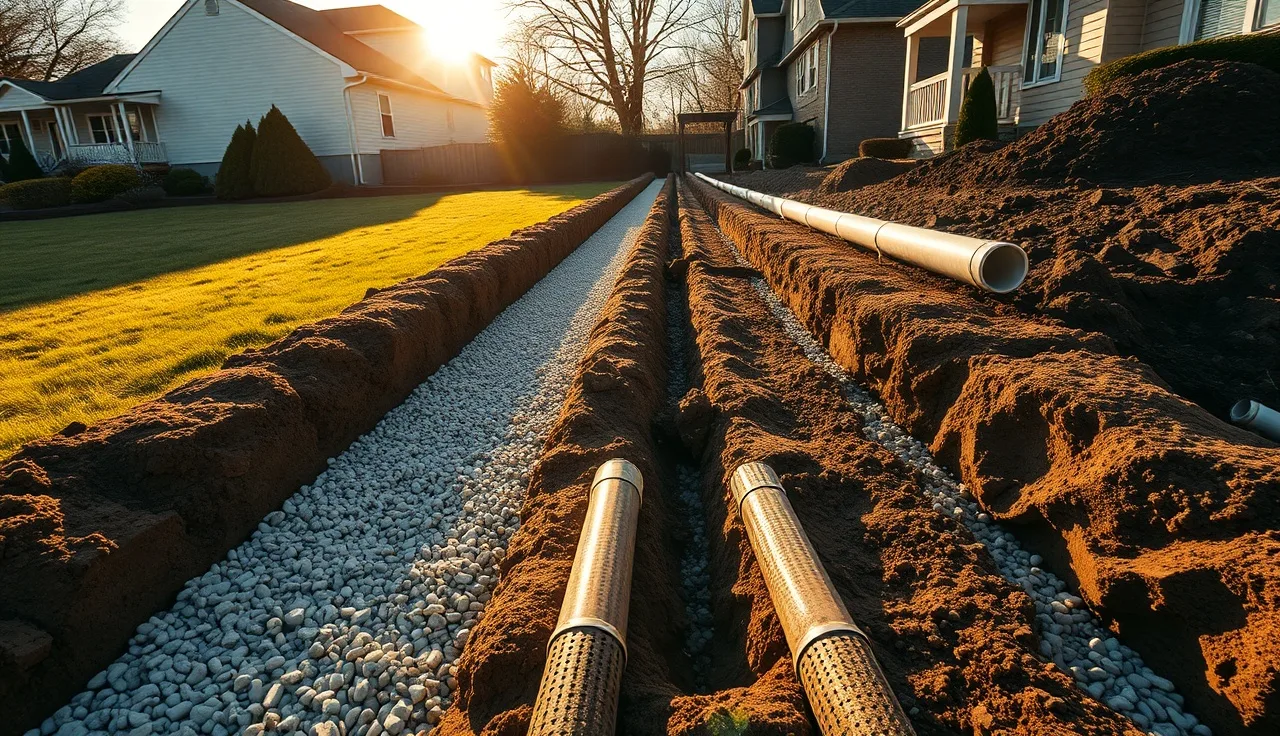
Effluent flows from the septic tank through a distribution box or manifold and into a network of perforated pipes buried in gravel-filled trenches. Holes in the pipe let liquid drip down into the gravel, spread sideways, and then soak into the surrounding soil. A field that's sized and built right treats household wastewater for 20 to 30 years with no mechanical help [1].
When a drain field fails, it's almost always because the soil gets overloaded, clogged with solids (usually from a neglected tank), or drowned by high groundwater. Learn the specs that prevent those failures and you've done most of the work of protecting your system. Our guide to the leach field covers how the tank and field work together.
What soil tests determine drain field size?
Two tests set the size of your field: the percolation test (perc test) and the soil morphology evaluation. Together they tell a designer how fast your soil absorbs water and how much of it can safely handle waste. Everything else flows from those results.
The perc test measures how many minutes it takes water in a bored hole to drop one inch. A rate of 1 to 60 minutes per inch (mpi) is the accepted range for a conventional gravity system [2]. Rates under 3 mpi mean the soil is too sandy or gravelly to filter pathogens before the water hits groundwater. Rates above 60 mpi mean the soil is too tight, usually clay-heavy, to take the volume a household makes. Either extreme forces an alternative design.
The soil morphology evaluation matters more. A licensed soil scientist or evaluator digs test pits, sometimes 5 to 8 feet deep, and reads the soil profile by eye. They look for mottling (gray or orange streaks that signal seasonal saturation), restrictive layers like hardpan or fractured rock, and the depth to seasonal high groundwater. Most state codes require this evaluation on top of a perc test, not instead of it [3].
Those two tests drive every other spec: how many linear feet of trench you need, how deep the trenches can go, and whether a conventional system is even legal on your lot.
| Perc rate (min/inch) | Soil type | Conventional system allowed? |
|---|---|---|
| < 1 | Gravel, coarse sand | No (too fast, alternative required) |
| 1 to 5 | Sandy loam | Yes, but larger field area needed |
| 6 to 30 | Loam, silt loam | Yes, standard design |
| 31 to 60 | Clay loam, silt | Yes, but design loading rates lower |
| > 60 | Heavy clay | No (too slow, alternative required) |
What are standard drain field trench dimensions?
Trench dimensions change with state code, but they cluster in a tight range. Most conventional gravity systems use trenches 18 to 36 inches wide and 18 to 36 inches deep, measured from the native soil surface to the bottom of the gravel bed [2]. The perforated distribution pipe sits near the top of the gravel, usually with 6 to 12 inches of gravel below it and 2 to 6 inches above.
Depth matters a lot. You want the pipe in biologically active soil, which means staying in the top few feet of the profile. You also need clearance between the trench bottom and the seasonal high groundwater table. Most states require 2 to 4 feet of separation between the gravel bottom and the highest recorded groundwater level [3]. That separation zone is where treatment happens.
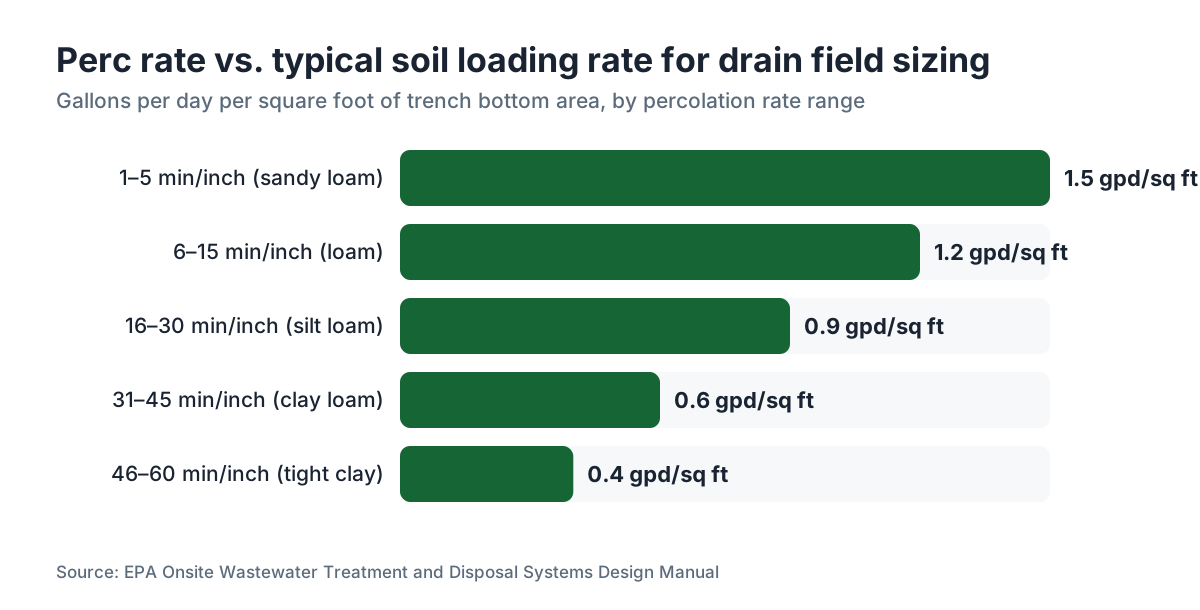
Trench length comes from the perc rate and the daily design flow. A typical 3-bedroom house uses 450 gallons per day (gpd) as its design flow under some codes and 300 gpd under others, so check your local table. Say your perc rate is 30 mpi and the loading table specifies 1.2 gallons per square foot of trench bottom per day. For a 2-foot-wide trench, that lands near 188 linear feet, though your state's table gives the exact figure [4].
Trench spacing, measured center to center, runs 6 to 10 feet. The gap between trenches keeps the soil structure intact so effluent from neighboring trenches doesn't merge and overload one zone.
Gravel spec matters too. Most codes call for washed, crushed stone or river gravel, 3/4 to 1.5 inches across. Angular aggregate with the fines washed out moves effluent better and resists clogging longer than rounded or dirty gravel. A permeable geotextile fabric covers the gravel bed before backfill to stop soil from washing down and plugging the pores.
What pipe sizes and slopes are required?
Distribution pipe in drain field trenches is almost always 4-inch perforated PVC or ABS in homes. Schedule 40 and SDR 35 both pass under most state codes, though SDR 35 (a lighter-wall pipe) dominates new work because it costs less.
Slope, or grade, is one of the most argued specs on any job site. The pipe runs nearly level so flow spreads along the whole trench instead of dumping at the inlet end. The typical grade is 1/16 to 1/8 inch per foot of horizontal run, roughly 0.5 to 1 percent [2]. Some codes allow up to 1/4 inch per foot. Push past that and flow piles up at the downhill end while the far end never gets enough effluent to stay biologically active.
The supply line from the tank to the distribution box is solid (non-perforated) pipe, usually 4-inch as well, run at a steeper 1/4 inch per foot so solids don't settle out on the way.
Distribution boxes (D-boxes) split flow from the tank into multiple trench laterals. Every outlet port has to sit at the exact same elevation so flow divides evenly. A D-box that's settled even half an inch to one side pushes most of the flow to a single lateral, burning it out early while the rest stay dry. Leveling and resetting a D-box is one of the cheapest fixes in septic work, and one of the most often missed at inspection [5].
What setback distances do drain fields have to meet?
Setbacks protect drinking water, surface water, and neighboring property from contamination. Every state publishes its own table, but the EPA SepticSmart program summarizes the common national minimums [1].
| Feature | Typical minimum setback |
|---|---|
| Drinking water well (private) | 50 to 100 ft |
| Public water supply well | 100 to 200 ft |
| Property line | 5 to 10 ft |
| Foundation / basement wall | 10 to 20 ft |
| Swimming pool | 10 to 15 ft |
| Streams, rivers, lakes | 25 to 100 ft |
| Wetlands | 50 to 100 ft |
| Slopes > 15 to 20% grade | Special design required |
The ranges are wide because states differ hard. Virginia requires 100 feet from a private well in most cases. Florida's minimum is 75 feet under Chapter 64E-6 of the Florida Administrative Code [6]. North Carolina requires 50 feet from a watercourse under 15A NCAC 18A.1950 [7]. Check your state and county codes before you assume any number applies to you.
Setbacks also govern what you can build or plant over and around the field after it goes in. Driveways, patios, pools, sheds, and deep-rooted trees are the most common violations. Any structure above the field compacts the soil, blocks oxygen exchange, and can collapse the trench. Tree roots, especially willow, poplar, and silver maple, worm into pipe perforations and cause blockages that cost real money to clear. Most codes ban impervious surface over a drain field and tell you to keep trees at least 30 feet away [1].
How much drain field area does a typical household need?
Sizing starts with design flow. Most state health codes size residential systems at 75 to 150 gallons per bedroom per day, with 100 gallons per bedroom per day (gpd) the most common single number [4]. A 3-bedroom house has a design flow of 300 gpd. Some states add a bedroom equivalent for a home office, a large jacuzzi, or an irrigation connection, so ask your designer what applies locally.
Once you have the flow, divide by the hydraulic loading rate for your perc rate. Loading rates in state tables usually run from 0.2 gpd per square foot (slow perc soil) to 1.5 gpd per square foot (medium loam). Take a 3-bedroom house at 300 gpd, a 30 mpi perc rate, and a loading rate of 0.8 gpd/sq ft. That works out to 375 square feet of trench-bottom absorption area.
If your trenches are 2 feet wide, that's 187.5 linear feet of trench. Round up to 190 feet. Call it two laterals at 95 feet each, or three at roughly 63 feet.
Most states also require a reserve area. The reserve, usually 100 percent of the original field area, stays undisturbed and buildable so a replacement field can go in if the original fails. Lose your reserve area by building a garage over it and you can make a property legally non-conforming and knock down its value [5].
For a full breakdown of septic installation costs, including field sizing, see our guide to cost to install a septic system.
How do alternative drain field designs change the specifications?
When a conventional gravity trench won't work, because of slow perc, high groundwater, shallow bedrock, or a small lot, regulators permit or require an alternative design. Each one carries its own spec sheet.
Mound systems raise the absorption field above native grade on a built mound of imported sandy fill. EPA guidance and most state codes require fill with a perc rate between 1 and 30 mpi, a minimum of 2 to 4 feet of fill, and a basal area sized to the design flow [8]. Mounds need a pump and pressure-dosed distribution to spread effluent evenly across the raised bed. They run roughly $10,000 to $20,000 more than a gravity system for a typical home, and prices swing a lot by region.
Drip dispersal systems use small-diameter tubing buried 6 to 12 inches deep with emitters spaced every 2 to 3 feet. They open up fields on slopes, small lots, and sites with shallow soil. The spec requires effluent filtered to 100 microns or finer before it enters the drip lines, plus an annual pressure test [9].
Pressure-dosed lateral systems use the same trench geometry as gravity systems but time-dose effluent with a pump so the soil rests between doses. The pipe is solid with small orifices, typically 1/8 to 3/16 inch, drilled to spec for equal pressure along the lateral. Orifice spacing and lateral length are engineered to hold 1 to 2 feet of head pressure at the end of each run.
Chamber systems swap gravel and perforated pipe for plastic arch-shaped chambers that create a void space for effluent. EPA and most state codes accept them as equal to gravel systems, often with a 20 to 25 percent cut in required trench length because more soil surface is exposed inside the chamber [10].
What inspections and permits are required before and after installation?
Every new drain field in the U.S. needs a permit from the local health department or environmental agency. The process runs in three steps: site evaluation (soil testing and site plan review), plan approval, and installation inspection. Skip any of them and you have an illegal system that a buyer's inspector will flag.
During installation, the inspector (usually a county sanitarian or licensed engineer) visits at least once, often twice. First after the trenches are dug and before gravel goes in, to check depth and native soil. Second after the pipe is laid and before backfill. Take your own photos at each stage even if the county doesn't ask. They prove compliance if a dispute comes up later.
After installation, the permit file gets recorded with the property deed in most jurisdictions. That record matters at septic tank inspection time and during any real estate deal.
Operating permits, required annually or every two years in some states for alternative systems with mechanical parts (pumps, timers, alarms), are separate from the installation permit. Miss a renewal and you can trigger fines or a forced upgrade. If you run multiple properties or manage clients with alternative systems, tracking those renewal dates is exactly the operational job software like SepticMind handles.
For an existing system, a repair permit comes first before you modify or expand a field in almost every state. You can't add a lateral or reroute distribution without a revised site plan and fresh approval [3].
What maintenance practices keep a drain field within spec?
A field that's built right and cared for should last 25 to 30 years. Two failures cause most of the early deaths: solids from an overfull tank get pushed into the field and clog the gravel, or the surface above the field gets compacted or waterlogged. Both are preventable.
Pumping your septic tank every 3 to 5 years is the single most protective thing you can do for the field. The EPA SepticSmart program says, "Have your septic system inspected at least every three years by a professional" [1]. Once solids build past roughly 30 to 40 percent of tank volume, they start leaving with the effluent. See our breakdown of how often to pump your septic tank and the septic tank pump out process.
Water conservation matters more than most homeowners think. Push an extra 100 gallons a day through a system sized for 300 gpd, a 33 percent overload, and you can saturate the biomat zone and kill the field early. Install high-efficiency toilets, spread laundry across the week, and fix leaking faucets fast.
Don't plant anything with aggressive roots near the field. Grass is fine. A vegetable garden that needs watering adds hydraulic load. Keep shrubs and trees at least 30 feet away [1].
Skip the additives. Never pour yeast or septic treatment products into a working system. EPA found no evidence that biological or chemical additives improve field performance, and some may harm the biomat or downstream water quality [11]. Save the money.
Wet spots above the field, sewage odor at ground level, slow drains in the house: those are early failure signs, and they don't fix themselves. Getting a septic system repair diagnosis early almost always costs less than replacing the whole field.
How does drain field specification affect property value and real estate sales?
A failing or undersized drain field is one of the most expensive surprises in a home sale, and in most states you have to disclose it. When a septic property changes hands, lenders usually require a passing Title 5 inspection (in Massachusetts) or the equivalent state inspection showing the field operates within code [5].
If the field flunks, the seller either fixes it before closing or cuts the price to cover repair. Drain field work runs from about $3,000 for a simple gravity lateral repair to $30,000 or more for a mound or full replacement on a hard site [12]. Set that against the cost of routine septic tank cleaning and septic tank pumping and the pumping bill looks tiny.
Buyers should pull the original permit file from the county health department, beyond whatever the seller discloses. The file shows the original design flow, the bedroom count the field was sized for, and whether the reserve area still exists. A house marketed as four bedrooms with a field permitted for three is a problem in waiting.
Home additions that add bedrooms or bathrooms can legally require a field upgrade even before the current field shows stress. A new bedroom raises design flow by 75 to 150 gpd, which may blow past the permitted capacity of the existing field. Check with your county health department before you pull a building permit for any addition [3].
What are the most common reasons drain fields fail to meet specifications?
Field failures fall into a handful of predictable buckets, and most trace back to either design shortcuts or maintenance neglect. Know the pattern and you can usually spot the cause fast.
Solid overloading from a neglected tank is the top cause. When a tank isn't pumped on schedule, the scum and sludge layers grow until effluent carries raw solids into the trench. Those solids seal the soil pores and build a biomat so thick the field can't take flow. Once it's set, a heavy biomat is very hard to reverse.
Hydraulic overloading is second. Run a garbage disposal hard, do eight loads of laundry in a day, or add extra people to the house and you can temporarily double the system's flow. Soil hit with double its design load stays saturated between doses and never fully recovers.
Bad original installation is more common than people expect. Trenches dug too deep (past the biologically active zone), gravel with fines that clog fast, D-boxes that were never leveled, pipe laid at too steep a grade: any of these kills a field early. If your field is under 10 years old and failing, a design or install defect is worth investigating hard.
Groundwater rise is a natural cause no maintenance can beat if the site was evaluated in a dry year. A field a few inches above the water table in a drought can flood in a wet one. That's exactly why state codes require seasonal high water table data instead of just the reading on test day.
Compaction from parking or driving over the field crushes the trench structure and blocks oxygen exchange. Oxygen in the soil above the biomat keeps aerobic decomposition going. No oxygen, no treatment.
For repair options once failure is confirmed, start with a septic tank repair assessment to rule out tank-side causes before you assume the field itself needs replacement.
Frequently asked questions
How deep should drain field trenches be?
Most state codes require conventional drain field trenches 18 to 36 inches deep, measured from the native soil surface to the bottom of the gravel bed. The perforated pipe sits near the top of the gravel, usually 6 to 12 inches above the gravel bottom. The real limit is that the trench bottom must sit at least 2 to 4 feet above the seasonal high groundwater table, which often caps the depth more than any sizing rule.
What is the minimum setback from a well to a drain field?
The most common minimum setback from a private drinking water well to a drain field is 50 to 100 feet, depending on the state. Florida requires 75 feet under Chapter 64E-6 of the Florida Administrative Code. Some states require 100 feet or more, especially for shallow or unlined wells. Public water supply wells usually require 100 to 200 feet. Verify with your county health department, since local rules can beat state minimums.
How many linear feet of drain field trench do I need for a 3-bedroom house?
For a typical 3-bedroom house with a design flow of 300 gallons per day and a perc rate in the 6 to 30 minutes per inch range, you'll generally need 150 to 300 linear feet of 2-foot-wide trench. The exact number comes from your state's loading rate table for your specific perc rate. Faster perc (sandier soil) needs more trench because the loading rate per square foot drops to protect groundwater.
Can I put a driveway or patio over my drain field?
No. Nearly all state codes ban impervious surfaces over a drain field. Paving or compacting the soil above the field blocks oxygen exchange, which the biomat needs for aerobic treatment, and can crush the trenches under vehicle weight. Even parking a car on the field repeatedly causes compaction that degrades performance. If you don't know where your field is, request the original permit drawing from your county health department.
What perc rate is too fast or too slow for a conventional drain field?
A perc rate slower than 60 minutes per inch is generally too slow for a conventional gravity system; the soil can't take household flow volumes. A rate faster than 1 minute per inch is too fast because pathogens and nutrients get no time for treatment before reaching groundwater. The ideal range is roughly 3 to 45 minutes per inch for most state loading tables. Sites outside that range need an alternative design like a mound or drip system.
Do I need a reserve drain field area, and what can I do with it?
Most states require a reserve area equal to 100 percent of the original field's absorption area, kept undisturbed and free of any structure. The reserve waits in case the original field fails and needs replacement. You can grow grass over it, but not plant trees or build anything. Losing the reserve to construction can make a property non-conforming under health code and complicate or block a future sale.
What is a distribution box and how does it affect drain field performance?
A distribution box (D-box) is a concrete or plastic chamber that splits effluent from the septic tank into multiple trench laterals. Every outlet port has to sit at the same elevation so flow divides evenly. A D-box that has settled even half an inch sends most flow to one lateral, overloading it while the others sit dry. D-box leveling is one of the cheapest and most overlooked septic repairs. Check it every time the tank is pumped.
How long does a drain field last?
A properly sized, correctly installed drain field in suitable soil lasts 25 to 30 years with normal household use and routine tank pumping every 3 to 5 years. Fields die early when the tank isn't pumped (solids clog the gravel), when the house is hydraulically overloaded (more people or water than the design flow), or when the surface is compacted by vehicles or structures. Sites with borderline soil tend to see 15 to 20 year lifespans even with good maintenance.
What pipe material and size is used in drain field trenches?
Standard residential drain field laterals use 4-inch perforated PVC pipe, either Schedule 40 or SDR 35 wall thickness. SDR 35 is more common in new work because it's lighter and cheaper while still meeting structural requirements for burial depth. The supply line from the tank to the distribution box is solid (non-perforated) 4-inch PVC, run at a steeper 1/4 inch per foot to keep solids from settling in the line.
When is a mound system required instead of a conventional drain field?
A mound system is required when the seasonal high groundwater table sits too close to the surface for a conventional trench to hold the required 2 to 4 feet of separation, when soil perc rates are borderline slow (45 to 60 mpi), or when shallow bedrock blocks adequate trench depth. Mounds are common in states with high seasonal water tables like Minnesota, Wisconsin, and parts of the Southeast. They run roughly $10,000 to $20,000 more than a gravity system for a home.
Can a drain field be repaired, or does it have to be replaced?
It depends on the failure. If the tank is pumped and the soil rests and recovers, partial biomat failures sometimes resolve. If only one lateral is clogged, you can sometimes clean or replace it while leaving the rest of the field intact. Total replacement is usually needed when solids have reached every lateral, when compaction has permanently wrecked the soil structure, or when groundwater conditions have changed. A repair permit comes first before any field modification in most states.
Does the number of bedrooms determine how the drain field is sized?
Yes. Most state codes use bedroom count as the proxy for occupancy and daily water use because it's a stable, verifiable number. The standard design flow is 75 to 150 gallons per bedroom per day, with 100 gallons per bedroom per day the most common. A 3-bedroom house uses 300 gpd as its design flow. Adding a bedroom, even without changing the number of people living there, may legally require upgrading your field to meet the new design flow.
What's the difference between a drain field and a leach field?
They're the same thing. Drain field, leach field, soil absorption system, and disposal field all name the buried trench network that takes clarified effluent from the septic tank and spreads it into the soil. Some engineers prefer soil absorption system because it stresses the treatment function over the drainage one. All four terms show up in state codes and refer to identical infrastructure.
What do I do if I see wet spots or odors over my drain field?
Surface wet spots and sewage odors above the field signal hydraulic failure, usually meaning the soil can no longer take the flow the system produces. First, have the tank pumped and inspected to rule out a full tank. Then cut water use hard for several weeks to let the field rest. If the problem sticks after those two steps, call a licensed septic engineer for a field evaluation before assuming total replacement. Catching it early saves money.
Sources
- EPA SepticSmart: Protect Your Investment: Have your septic system inspected at least every three years by a professional; keep trees 30 feet from the field; no impervious surfaces over drain fields.
- EPA Design Manual: Onsite Wastewater Treatment and Disposal Systems (EPA 625/1-80-012): Typical trench dimensions 18 to 36 inches wide and deep; perforated pipe grade 1/16 to 1/8 inch per foot; perc rate range 1 to 60 mpi for conventional systems.
- CDC: Private Wells and Septic Systems: State codes require soil morphology evaluation and minimum 2 to 4 feet separation between trench bottom and seasonal high groundwater; repair permits required before field modifications.
- University of Minnesota Extension: Septic System Owner's Guide: Design flow standard of 75 to 150 gallons per bedroom per day; 100 gpd most common; total field length derived from perc rate loading rate tables.
- Massachusetts Title 5 (310 CMR 15.000): State Environmental Code for Septic Systems: Reserve area equal to 100% of original field required; Title 5 inspection required at property sale; D-box leveling affects lateral flow distribution.
- Florida Administrative Code Chapter 64E-6: Standards for Onsite Sewage Treatment and Disposal Systems: Florida minimum setback from private well to drain field is 75 feet under Chapter 64E-6.
- North Carolina Administrative Code 15A NCAC 18A.1950: Sewage Treatment and Disposal: North Carolina requires minimum 50-foot setback from a watercourse under 15A NCAC 18A.1950.
- EPA: Mound Systems for Onsite Wastewater Treatment: Mound fill material must perc 1 to 30 mpi; minimum 2 to 4 feet of fill required; requires pressure dosing for even distribution.
- EPA: Chamber System Equivalency Guidance: Chamber systems accepted as equivalent to gravel/pipe systems with 20 to 25% reduction in required trench length due to increased soil contact area.
- EPA: Septic System Additives: EPA found no evidence that biological or chemical additives improve drain field performance; some additives may cause downstream water quality harm.
- Angi: Septic System Cost Guide: Drain field replacement costs range from $3,000 for simple gravity lateral repair to $30,000 or more for mound systems or full replacement on difficult sites.
Last updated 2026-07-09