Drain field installers: how to find, vet, and hire the right one
By the SepticMind Editorial Team
TL;DR
- Drain field installers are licensed contractors who design and build the soil-treatment portion of a septic system.
- Costs typically run $3,000, $15,000 for a conventional system, with alternative systems pushing past $20,000.
- Finding a good one means checking state licensing, pulling soil test records, and getting at least three itemized bids before signing.
What does a drain field installer actually do?
A drain field installer, sometimes called an onsite wastewater contractor or septic system contractor, handles everything from the outlet pipe of your septic tank outward into the soil. That includes trenching, placing distribution pipes or chambers, grading, and final inspection coordination.
The tank and the drain field are separate scopes. Some installers do both. Many specialize in one or the other. When you call around, ask specifically whether the quote covers tank installation or only the leach field. Mixing up those scopes is one of the most common reasons homeowners end up with surprise invoices mid-project.
Most states require a separate license or certification for onsite wastewater work beyond a general contractor's license. In Florida, septic contractors must hold a Septic Tank Contractor license from the Department of Health [1]. Texas requires a Licensed Installer credential from the TCEQ [2]. The specific category varies by state, but the principle holds everywhere: drain field work is a regulated trade, not a landscaping job.
A competent installer also reads the soil evaluation, works with the local health department on permits, and adjusts the design if the soil profile changes during excavation. That last piece matters more than most homeowners realize. Soil conditions 18 inches down are not always what the surface suggests, and a good installer makes field calls without billing you for an engineer every time.
What licenses and certifications should a drain field installer have?
This is the single most important vetting step, and it takes about five minutes on your state agency's website. Every legitimate installer carries a state-issued license you can verify by number before you sign anything.
Every state that has an onsite wastewater program (which is all of them) requires installers to carry a state license or registration. The issuing agency is usually the state department of health or department of environmental quality. Check the license number the contractor gives you against the state's public lookup tool before you do anything else.
Beyond the state license, look for:
- General liability insurance, at least $1 million per occurrence. Ask for a certificate of insurance naming your address, not a verbal assurance.
- Workers' compensation coverage if the crew has employees. If a worker is hurt on your property and the contractor has no workers' comp, your homeowner's insurance may be on the hook.
- Local health department approval to pull permits in your county. Some counties require contractors to be on an approved list in addition to holding the state license.
- National Association of Wastewater Technicians (NAWT) certification or similar voluntary credentials. These aren't required but signal that the person has invested in ongoing training [3].
Never let an installer start work without a pulled permit. The permit triggers inspections at key stages, which protects you legally and physically. An unpermitted drain field can be ordered removed at your expense, and it will not satisfy a buyer's inspector when you sell the house.
How much does drain field installation cost?
Conventional gravity drain fields typically cost $3,000 to $8,000 for the field alone, with full tank-and-field installs running $6,000 to $15,000 in most regions [4]. Costs swing hard because soil conditions, system type, local labor rates, and permit fees all move the number.
For a conventional gravity-fed trench system on reasonable soil, most homeowners in 2024 paid somewhere between $3,000 and $8,000 for the field, not counting the tank. See the full breakdown in our guide to the cost to install a septic system.
Alternative systems, which the county requires when soil doesn't pass a standard perc test, cost more:
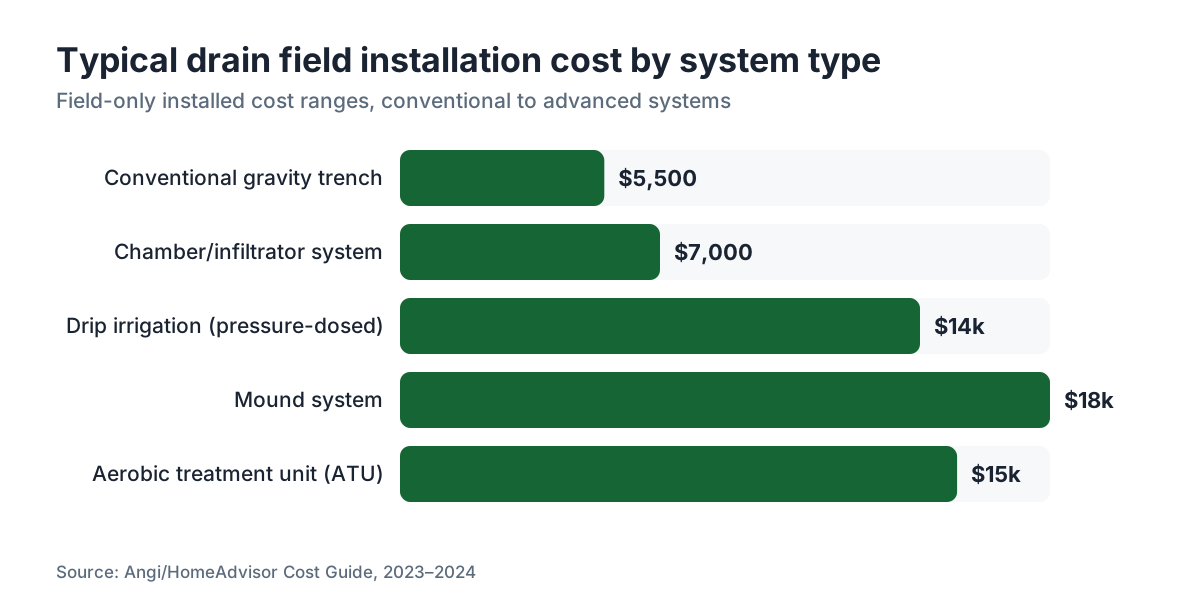
| System type | Typical installed cost (field only) | When it's required |
|---|---|---|
| Conventional gravity trench | $3,000, $8,000 | Good soil, adequate setbacks |
| Chamber/infiltrator system | $4,000, $10,000 | Slightly variable soil |
| Drip irrigation (pressure-dosed) | $8,000, $20,000+ | Tight or shallow soil |
| Mound system | $10,000, $25,000 | High water table or impermeable layers |
| Aerobic treatment unit (ATU) | $10,000, $20,000 | Failing perc, near surface water |
Source: Homeowner cost survey data, HomeAdvisor/Angi 2023 to 2024 [4]
Permit fees add $200 to $1,500 depending on the county. Soil testing and site evaluation (usually done by a licensed soil scientist or sanitarian) runs another $500 to $1,500 and is a separate line item before any contractor is even hired.
Here's the figure that surprises people. Repairing or replacing a failing field often costs more than a new install on a clean lot, because you have to work around existing structures, haul off failed media, and sometimes remediate the soil. If you're dealing with a failing system, read through our septic system repair guide first so you understand what you're actually replacing.
How do you find qualified drain field installers in your area?
Start with your state health department or environmental agency. Most keep a public database of licensed septic contractors searchable by county. This beats Google as a starting point because every name on the state list has already cleared the licensing hurdle.
After that:
Local health department. The sanitarians who inspect completed systems see every installer's work quality. Call the environmental health office for your county and ask if they can suggest contractors who consistently pass first inspection. They can't officially endorse anyone, but many will tell you who gets the job done clean.
Neighboring homeowners. If you're in a rural area where most lots are on septic, ask neighbors who they used and whether the system is still running well. A five-year track record beats any online review.
NAWT and state trade associations. The National Association of Wastewater Technicians has a member directory at nawt.org [3]. State onsite wastewater associations can also point you toward credentialed installers.
Google and Angi/HomeAdvisor, with skepticism. These platforms are useful for phone numbers but not for vetting. Reviews can be gamed. Verify licensing independently regardless of how many stars a company has.
Get at least three bids. Not to play contractors against each other on price, but because three bids reveal the real range and expose any outlier that's planning to cut corners or pad the invoice.
What questions should you ask a drain field installer before hiring?
Here's what to actually ask, and what to listen for.
Are you licensed for onsite wastewater work in this state, and can I have your license number? If they hesitate or give a general contractor number, that's a problem.
Who pulls the permit? The right answer is that the installer pulls it. If they tell you to handle the permit, that's a red flag.
Have you worked with this county's health department before? Local familiarity matters. An installer who knows the county sanitarian and the local soil conditions will catch problems faster.
What happens if the excavation reveals different soil conditions than the perc test showed? You want to hear that they'll stop, reassess, and get revised approval before proceeding. Not that they'll "figure it out."
What's the timeline, and what delays are my risk versus yours? Weather, inspector scheduling, and material delivery are common causes of delay. Know who absorbs the cost if the project stalls.
Can I see references from projects completed in the past two years? Call those references. Ask whether the final invoice matched the quote, how the site looked after work was done, and whether anything needed to come back and be fixed.
What warranty do you offer on the installation? Most installers offer one to two years on workmanship. The system components themselves carry manufacturer warranties. Get both in writing.
The EPA's SepticSmart program advises homeowners to "always verify that the contractor holds a valid license and has liability insurance" before any onsite wastewater work begins [5].
What red flags should make you walk away from a drain field installer?
Six warning signs should end the conversation. The clearest one: an installer who offers to skip the permit to save you money is planning to cost you far more at resale.
Wants cash only or full payment upfront. Legitimate contractors take deposits, typically 10 to 30 percent, and bill on milestones. Full upfront payment leaves you with no recourse.
Can't show proof of insurance. Ask for a certificate, not a verbal promise. If they claim their policy lapsed and they're "working on renewing it," walk.
Offers to skip the permit. An unpermitted field has no inspection record, which is a serious liability at resale. Some states impose fines that follow the property, not the owner who made the decision.
Quotes a price before seeing the soil evaluation results. Nobody can price a drain field accurately without knowing the soil loading rate. A contractor who skips this step either doesn't know what they're doing or plans to change the number later.
Presses you to sign the same day. Good installers have full schedules and don't need to hustle you.
Suggests you don't need an engineer or soil scientist because they "know the area." Site evaluation must be done by a licensed professional in most states, separate from the installer. These are two different roles by design.
Has no local track record. Online businesses that subcontract locally and manage the project remotely have a bad history in this trade. Drain field installation is too site-specific for a hands-off management model.
What's the difference between a drain field installer and a septic system designer?
These are two separate functions, and in most states, two separate licenses. The designer decides what gets built. The installer builds it.
A septic system designer, often a licensed soil scientist, professional engineer, or registered sanitarian, evaluates the site, runs the perc or soil morphology tests, and produces a permitted design that specifies system type, sizing, setbacks, and placement. They submit the design to the health department for approval.
The installer builds what the designer specifies. In some states, a single person can hold both credentials. In others, they must be separate parties.
As a homeowner, you typically hire the designer first. The designer produces a permitted plan. You take that plan to bid with installers. Skipping the designer and going straight to an installer who says they'll "handle the design" is fine only if that installer holds the specific design credential in your state. Verify it.
For a broader look at what goes into a full system install, see our guide to septic tank installation.
How does the drain field installation process work, start to finish?
Six steps run from first soil test to final approval, and the sequence matters because delays compound if you get it wrong. Total timeline: six to sixteen weeks in most areas, driven mostly by permit turnaround.
Step 1: Site evaluation. A licensed evaluator tests the soil, records percolation rates or soil morphology, and determines what system type is feasible. This happens before any contractor is hired. Expect one to three site visits.
Step 2: System design. The designer produces a stamped plan based on the evaluation. This plan specifies everything the installer needs.
Step 3: Permit application. Either the designer or installer submits the design to the county health department. Permit review takes two to six weeks in most jurisdictions, longer in busy counties or when the design requires a variance.
Step 4: Installation. The contractor excavates, installs distribution pipe or chambers, places gravel or aggregate (or chamber units that replace gravel), backfills, and grades. A conventional field on a straightforward lot takes one to three days of active work.
Step 5: Inspection. Most states require at least one mid-construction inspection before backfilling, so the inspector can see pipe placement, depth, and grade. Some require a second inspection at final grade. The installer coordinates this. You shouldn't have to.
Step 6: As-built drawing. After final approval, the installer (or designer) produces a drawing showing exactly where the field is, at what depth, and with what components. Keep this document permanently. You'll need it for future septic tank inspections, repairs, and resale.
How do state regulations shape what a drain field installer can and can't do?
Onsite wastewater regulation in the U.S. is almost entirely a state and local function. The EPA sets broad guidance but does not set minimum technical standards for drain field construction [5]. The rules your installer must follow depend entirely on where you live.
Key regulatory areas that vary by state:
- Minimum setbacks. How far the field must sit from wells, property lines, buildings, and surface water. Texas requires a minimum of 10 feet from property lines and 75 feet from public water supply wells for most systems [2]. Florida's rules differ. Your county may impose stricter setbacks on top of state minimums.
- Approved system types. Some states prohibit certain chamber brands or require specific aggregate gradations. California imposes additional restrictions on advanced treatment in some regions [6].
- Soil loading rates. How many gallons per day per square foot the field can accept. These figures come from perc test results and drive field sizing.
- Maintenance requirements. Some states mandate inspection and maintenance contracts for alternative systems, which affects long-term operating costs after installation.
The takeaway: an installer licensed in one state may not legally work in an adjacent state, and a design that meets code in one county might need a variance in the next. Confirm local requirements through your county health department before trusting anything a contractor says about what's allowed.
What should a drain field installation contract include?
A written contract protects both parties and signals professionalism. If an installer offers only a verbal agreement or a single-page invoice, ask for more. Eight items belong in every drain field contract.
A good contract covers:
- Scope of work in detail. Not "install drain field" but specific dimensions, system type, pipe specifications, aggregate type, and grading plan.
- Permit responsibility. Who applies, who pays the fee, and who is responsible if the permit is delayed.
- Payment schedule. Deposit amount, milestone payments tied to specific completed phases, and final payment due date.
- Change order process. What happens if soil conditions or permit requirements change the scope. You want written change orders before any out-of-scope work begins.
- Warranty terms. What's covered, for how long, and what voids the warranty.
- Site restoration. Whether the installer is responsible for grading, seeding, or hauling off excess soil. This is a common source of disputes.
- Cleanup and timeline. Expected start date, projected completion date, and what happens if the project runs long.
- Insurance certificates. Attached, not promised.
If the installer uses a standard form, read it. Some standard contractor forms include arbitration clauses that limit your legal options if something goes wrong.
How long does a drain field last, and what affects it?
A properly installed conventional drain field on suitable soil lasts 20 to 30 years, sometimes longer [7]. That's the realistic working life with normal maintenance. Systems built on marginal soil, run by oversized households, or starved of tank pumping fail faster, often in 10 to 15 years.
The biggest factors in drain field lifespan:
Tank maintenance. This is the one homeowners control most directly. A neglected tank lets solids carry over into the field, clogging the soil interface. The EPA SepticSmart program recommends pumping every three to five years as a baseline [5]. See our guide on how often to pump a septic tank for the specific math by household size.
Hydraulic load. Running more water through the system than it was sized for is the second most common failure cause. Leaky fixtures, water softeners draining to the system, and sump pumps connected to the septic line all shorten field life.
Soil compaction. Driving vehicles over the field collapses the soil pores. Once compacted, that soil can't recover [9]. Mark your field clearly, especially before work crews or delivery vehicles show up.
Biomat development. Every drain field develops a biomat, a layer of biological material at the soil interface that slows infiltration. A healthy biomat actually filters effluent. An overgrown one eventually seals the field. Good tank maintenance keeps the biomat manageable.
When a field does fail, the leach field article covers the signs, the options, and what a replacement actually involves.
For operators managing multiple client systems and tracking maintenance cycles, service intervals, and field installation records across a customer base, SepticMind's operations software was built for exactly this workflow.
Should you get a drain field inspection before buying a home on septic?
Yes. Full stop. A standard home inspection does not include a septic system evaluation, so a house on septic needs its own dedicated inspection before you buy.
A home inspector will flush toilets and note whether drains are slow, but they won't dig to check field condition, test effluent quality, or assess how much life the field has left.
A dedicated septic inspection by a licensed inspector costs $300 to $600 in most markets and includes tank pumping to observe the tank interior, inspection of the distribution box, and some assessment of field condition (often through probe testing or observation of wet spots) [8]. It won't give you a year-by-year lifespan estimate, but it will reveal active failures and obvious problems.
For a property with an older system (15 years and up), also ask for a dye test or camera inspection of the outlet line to the field. These cost more but reveal clogs and line damage that probe testing misses.
If the seller can produce the original as-built drawing, the permit file, and tank pumping records, that's a good sign. If they can't locate any of those documents, factor in the cost of a full system investigation before making your offer. Our septic tank inspection guide covers what inspectors look for in detail.
How do drain field costs change for repairs versus new installation?
Repair is almost always cheaper than full replacement, but the window for repair is narrower than most homeowners assume. Once the soil itself seals, no repair saves it.
Partial repairs, like replacing a broken distribution box, a single collapsed pipe segment, or a clogged inlet end of the field, run $500 to $3,000. These work when the failure is mechanical and the soil biomat hasn't fully sealed.
Full field replacement is required when the soil is saturated and biologically sealed, which is what the phrase "failed drain field" really means. At that point, you need a new field in a new location on the lot (if space exists) or a different system type. Costs return to the ranges in the table above.
One thing to be clear about: pumping and cleaning the tank won't save a failed field. Sellers sometimes pump the tank immediately before a home inspection to mask field backup. If you're buying a home and the seller just pumped a tank with no recorded service history, be skeptical.
For ongoing maintenance that extends field life, see our guides on septic tank pumping and septic tank cleaning.
SepticMind's platform helps service operators flag clients who are overdue for pumping before a field problem develops, which is cheaper for everyone than an emergency call after backup.
Frequently asked questions
Do I need a separate permit for a drain field, or does the septic tank permit cover it?
In most states, a single onsite wastewater system permit covers the whole installation, tank and field together. Some counties require separate permit applications for each major system component. Always check with your local health department before assuming the tank permit covers field work. The installer should know the local requirement and handle the application.
Can I install a drain field myself to save money?
Almost certainly not legally. Most states require a licensed onsite wastewater contractor for any drain field installation, and permits are issued only to licensed contractors. DIY installation without a permit creates major liability at resale and can result in fines or mandatory removal at your expense. The health and environmental risks of an improperly installed field are also significant.
How many bids should I get for drain field installation?
Get at least three. One bid gives you a price with no context. Two bids tell you if you have an outlier but not which direction. Three bids reveal the real market range for your specific project and soil type. Don't automatically hire the cheapest. Ask the low bidder exactly what's excluded from their price, because that's usually where the gap hides.
What's the difference between a drain field and a leach field?
They're the same thing. Drain field, leach field, absorption field, and soil treatment area are all names for the soil-based component that receives clarified effluent from the septic tank and lets it percolate into the ground. Regional terminology differs, but the function is identical. Some states use "soil treatment area" in their official regulations to be more precise.
How long does drain field installation take once work begins?
Active construction on a conventional system takes one to three days on a straightforward lot. Complex terrain, large systems, or alternative system types can take a week or more. What takes longer is everything before construction: soil evaluation, design, and permit approval often adds six to twelve weeks to the total timeline. Plan for two to four months from first call to final inspection.
What soil conditions make a drain field more expensive?
High water tables, clay-heavy soils, shallow bedrock, and very fine or very coarse sandy soils all complicate or disqualify conventional systems. When standard percolation tests fail or soil morphology shows restrictive layers, you need an alternative system like a mound, drip irrigation, or aerobic treatment unit. Each of these costs significantly more than a conventional trench system.
Can a drain field be installed in winter?
It depends on how frozen the ground is and local regulations. In mild-winter climates, winter installation is common and can even be an advantage since contractors are less busy. In cold-climate states, frozen ground prevents proper excavation and pipe bedding, and some states prohibit installation when ground temperatures fall below a certain threshold. Ask your contractor and check your county health department's rules.
What happens if a drain field installer fails the inspection?
The inspector issues a correction notice specifying what needs to be fixed. The contractor corrects the deficiency and requests a re-inspection. In most cases, this doesn't affect your timeline much if the installer catches it early. Costs for corrections are on the contractor if the issue stems from workmanship. If it's a design change required by the inspector, that may trigger a change order conversation.
Does homeowner's insurance cover drain field replacement?
Standard homeowner's policies typically exclude septic system failures, including drain field replacement. Some insurers offer septic or service line riders that cover part of the replacement cost, usually with coverage limits of $5,000 to $10,000. Read your policy carefully. A few states have programs that help low-income homeowners finance septic repairs. Check with your state environmental agency for available assistance programs.
How do I find out where my existing drain field is?
The best source is your property's as-built drawing, which should be on file with your county health department even if you don't have a personal copy. Call the county environmental health office and request the septic permit records for your address. If no records exist (common with older systems), a licensed inspector can often locate the field using probes, dye testing, or ground-penetrating radar.
Will installing a new drain field increase my property value?
A functioning, code-compliant septic system is a basic expectation for a rural property, not a premium feature. A new field on a property with a previously failing system removes a major buyer objection and erases a discount from your market value, but it won't add value above what a working system already supports. The financial case for replacement is about avoiding a failed sale, not boosting price.
How close can a drain field be to a well or property line?
Setback requirements vary by state and local code. A common minimum is 50 to 100 feet from a private drinking water well, but some states require 75 to 150 feet depending on soil type and system design. Property line setbacks are often 5 to 10 feet at minimum. Your local health department has the exact numbers for your jurisdiction, and your soil evaluator or designer confirms setbacks during design.
Can I add bedrooms to my house without upgrading the drain field?
Possibly not. Septic systems are sized based on projected daily water use, which correlates to the number of bedrooms. Adding a bedroom often triggers a requirement to verify that the existing system can handle the added load, and in many counties, a permit for the addition requires a septic adequacy review. If the system is undersized for the new bedroom count, a field expansion or upgrade may be required before the addition permit is issued.
Sources
- Florida Department of Health, Septic Tank Contractor Licensing: Florida requires septic contractors to hold a Septic Tank Contractor license from the Department of Health.
- Texas Commission on Environmental Quality (TCEQ), On-Site Sewage Facilities: Texas requires a Licensed Installer credential from the TCEQ and sets minimum setback requirements including 10 feet from property lines for most systems.
- National Association of Wastewater Technicians (NAWT): NAWT offers voluntary certification programs for onsite wastewater professionals and maintains a member directory.
- Angi (HomeAdvisor), Septic System Installation Cost Guide, 2023 to 2024: Conventional gravity drain fields typically cost $3,000, $8,000 installed; mound systems can reach $10,000, $25,000; full system installation (tank and field) commonly runs $6,000, $15,000.
- U.S. EPA SepticSmart Program: EPA SepticSmart advises homeowners to 'always verify that the contractor holds a valid license and has liability insurance' and recommends pumping every three to five years as a baseline maintenance interval.
- California State Water Resources Control Board, Onsite Wastewater Treatment Systems Policy: California imposes additional restrictions on certain system types in sensitive groundwater areas and near surface water.
- Penn State Extension, Septic System Maintenance: A properly installed and maintained conventional drain field can last 20 to 30 years or more.
- National Association of Realtors, Septic System Inspection Guidance: Dedicated septic inspections including tank pumping typically cost $300, $600 in most markets.
- University of Minnesota Extension, Septic System Owner's Guide: Soil compaction from vehicle traffic over a drain field can permanently collapse soil pores and contribute to premature field failure.
- North Carolina State Extension, Septic System Setback Requirements: Common setback minimums from private wells range from 50 to 100 feet depending on state and system type; some states require up to 150 feet.
Last updated 2026-07-09