Drain field installation: costs, steps, and what can go wrong
By the SepticMind Editorial Team
TL;DR
- A new drain field (also called a leach field) costs $3,000 to $8,000 for a conventional gravity system, and $10,000 to $25,000 for mound or ATU systems on difficult soils.
- Installation takes 1 to 5 days once permits clear.
- Soil percolation rate, lot size, setback rules, and health department approval drive almost every decision and dollar.
What is a drain field and what does it actually do?
A drain field is the underground network of perforated pipes, gravel, and soil that takes clarified wastewater (effluent) from your septic tank and spreads it into the ground, where soil bacteria finish treating it before it reaches groundwater. Lose the drain field and your septic system has nowhere to put its liquid waste.
The sequence is simple. Solids settle in the tank. Liquid effluent flows by gravity (or a pump) to a distribution box, then out into a series of trenches or chambers buried 18 to 36 inches down. Each trench holds a perforated pipe surrounded by 6 to 12 inches of washed gravel, or a gravel-free plastic chamber, and the effluent soaks down through the aggregate into native soil. [1]
The soil does the real work. Aerobic and anaerobic bacteria in the top 12 to 24 inches of soil eat pathogens and nutrients before the treated water ever nears the water table. That biological layer is exactly why drain fields fail when soil gets waterlogged, compacted, or clogged with biomat. A drain field is not a pipe job. It's a living biological system buried in your yard.
Several names mean the same thing. Leach field, leach lines, absorption field, drain field. EPA guidance and Florida rules mostly say "drain field"; contractors say "leach field" just as often. Same component.
What are the main types of drain field systems, and which one do you need?
Your soil's percolation rate and water table depth decide the system type, almost by themselves. No honest contractor quotes you a system before the soil test is done. Here they are, roughly in order of cost and complexity.
Conventional gravity trench system. Perforated pipe in gravel-filled trenches. Effluent flows by gravity, no pump. This works only when native soil perc sits between about 1 and 60 minutes per inch (the EPA benchmark range for acceptable conventional systems) and the seasonal high water table is at least 18 to 24 inches below the trench bottom. [1] Cheapest and most common.
Chamber system (Infiltrator or equivalent). Plastic arch chambers stand in for gravel. Same gravity idea, but chambers hold more storage volume per foot and install faster. The Infiltrator Quick4 is the one you'll see most. A comparable field needs roughly 40% fewer linear feet than gravel in many state design tables. [2] Cost lands near or slightly above conventional gravel.
Pressure-dosed system. A pump pushes effluent from a dosing chamber to the field in timed doses, so the soil gets rest periods between them. Treatment and soil recovery both improve. Many Florida counties require it when the natural grade is too flat for gravity distribution. Adding a pump, float controls, and an alarm adds roughly $1,500 to $3,000.
Mound system. When the seasonal high water table or bedrock sits too close to the surface, the field goes above grade in an engineered sand mound. Florida uses these heavily where water tables are high, including large parts of Central Florida around Orlando and Apopka. Mounds run $10,000 to $20,000 installed because you're trucking in fill, grading, and usually pumping. [3]
Aerobic treatment unit (ATU) with drip or surface application. An ATU treats wastewater to a higher standard before dispersal, so the field can be smaller or sit on poorer soil. Some Florida counties require it for new construction. Maintenance costs more (quarterly service contracts are standard in Florida, roughly $150 to $200 per year). [4]
| System type | Typical installed cost | Soil requirement | Pump needed? |
|---|---|---|---|
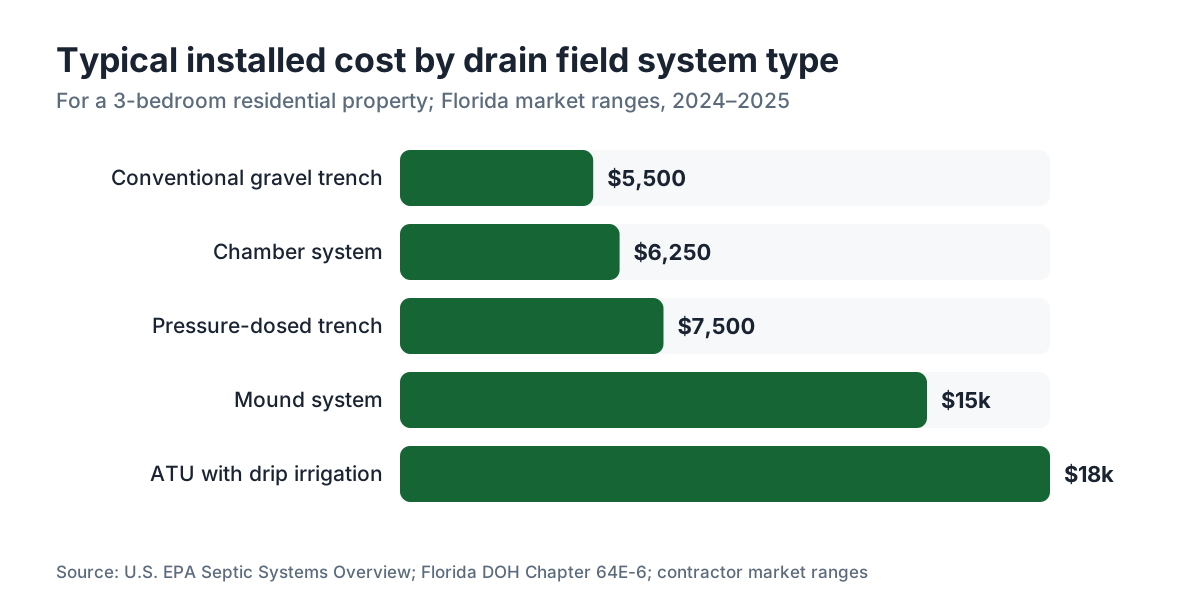
| Conventional gravel trench | $3,000 to $8,000 | Perc 1 to 60 min/inch, water table 24"+ below trench | No |
| Chamber system | $3,500 to $9,000 | Same as conventional | No |
| Pressure-dosed trench | $5,000 to $10,000 | Moderate perc, limited grade | Yes |
| Mound system | $10,000 to $20,000 | Shallow water table or poor perc | Yes |
| ATU with drip irrigation | $12,000 to $25,000 | Poor perc, restricted setbacks | Yes |
How much does drain field installation cost?
A conventional gravity drain field for a 3-bedroom home usually runs $3,000 to $8,000 installed across most U.S. markets, with Florida sitting in the lower-middle of that range on straightforward lots. Mound and ATU systems push the total to $10,000 to $25,000. Replacing a failed field on an existing system costs less than a full new install because the tank is already there, but you still pay for permits and a fresh soil evaluation.
Here's where the money actually goes on a conventional job.
Soil evaluation and perc test: $150 to $500. A licensed soil evaluator or engineer runs a percolation test (timed water absorption in a test hole) and reads the soil profile. In Florida this has to be done by a licensed site evaluator under Chapter 64E-6 of the Florida Administrative Code. [4]
Permit fees: $75 to $500 or more, depending on county. Orange County or Seminole County (Orlando area) permits typically run $150 to $400 for a standard residential system.
Excavation and grading: $500 to $2,500. Sandy Central Florida soils around Apopka and Orlando trench faster than clay-heavy dirt, which holds costs below national averages.
Materials (pipe, gravel or chambers, distribution box, inspection ports): $800 to $2,500 for a conventional system.
Labor: $1,500 to $4,000, driven by linear footage, depth, and obstacles (trees, utilities, existing structures).
Inspection and final approval: usually folded into permit fees, though some counties bill a separate inspection charge.
The biggest cost driver nobody warns you about: if your lot has poor soil or a high water table, you find that out after the perc test, and your budget has to swallow the upgrade to a mound or ATU. Get the soil test done before you collect contractor bids, not after. [1]
For the full system picture, see our guide to cost to install septic system.
What are the steps in drain field installation from start to finish?
Here's the real sequence, in order. Some steps overlap and timelines swing with county backlog, but this is how most residential jobs actually go.
Step 1: Site evaluation (1 to 3 days). A licensed soil evaluator reads the site: soil profile, seasonal high water table, slope, and setback distances from wells, property lines, buildings, and water bodies. This drives the design. In Florida the evaluator must be licensed under Chapter 489 or certified under the Department of Health program. [4]
Step 2: Percolation test (half a day). Test holes get dug, pre-saturated, then timed as they drain. Florida uses its own protocol rather than the ASTM standard (the 30-minute perc method in Chapter 64E-6). The result, in minutes per inch (MPI), sets how many square feet of field your soil can absorb. A 3 MPI soil needs less area than a 45 MPI soil, and both still qualify for conventional systems.
Step 3: System design and permit application (1 to 4 weeks). A contractor or engineer draws the site plan and submits it to the county health department. This is where timelines slip. Some counties turn permits around in a week; others take a month. Call the county office before you promise anyone a start date.
Step 4: Site layout and utility marking (half a day). Before any digging, you must notify 811 (Call Before You Dig) at least 2 business days ahead. That's federal law across the U.S. [5] The contractor then marks the trench lines.
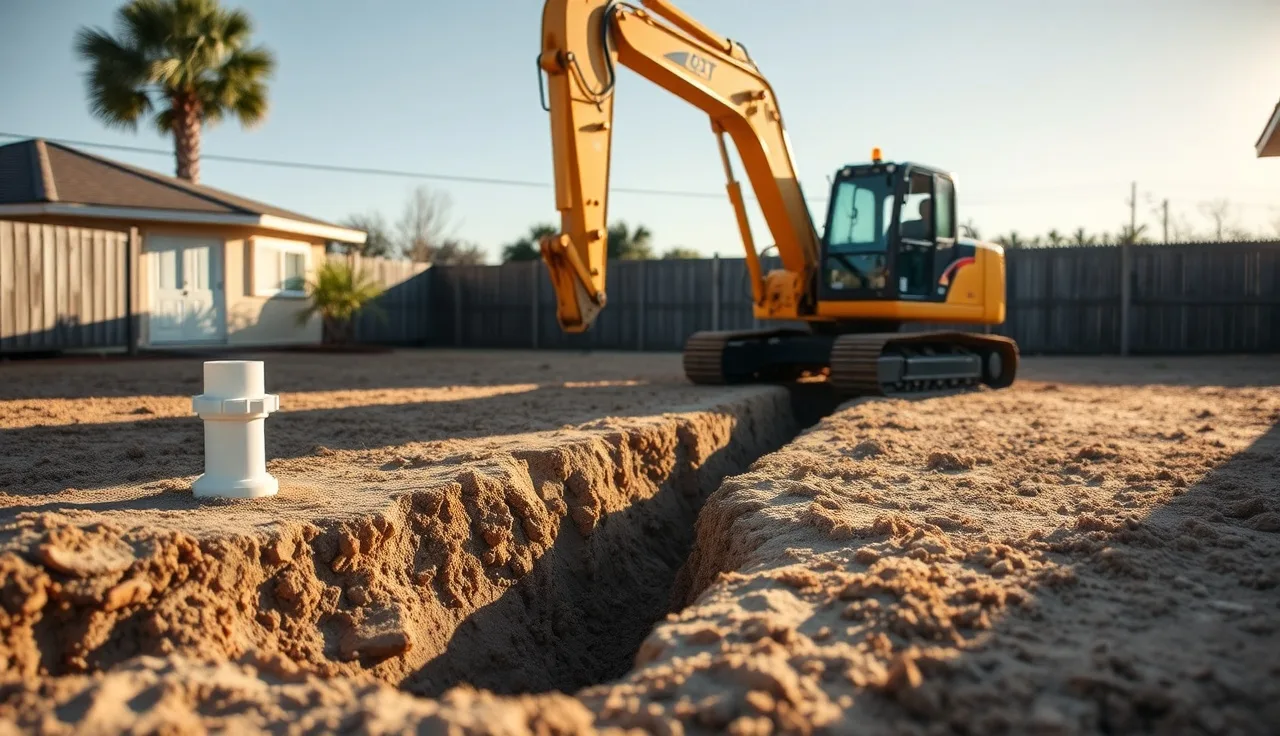
Step 5: Excavation (1 day). A track excavator or trencher cuts the trenches. A standard 3-bedroom conventional system in Florida might need 300 to 600 linear feet of trench at 2 to 3 feet wide and 2 to 3 feet deep, depending on the design.
Step 6: Install aggregate, pipe, and chambers (1 to 2 days). Gravel goes in to the design depth, perforated pipe gets laid with end caps, and the distribution box is set dead level. Each trench gets inspection ports (required in most states for long-term monitoring). A chamber system skips the gravel and snaps plastic arches together on a gravel bed.
Step 7: Inspection (half a day, scheduled). The county inspector comes out before any backfill. You cannot legally cover the system until it passes. This is no rubber stamp. Inspectors check trench depth, pipe slope, gravel depth, setbacks, and D-box leveling.
Step 8: Backfill and grading (half a day). Native soil is mounded slightly over the trenches to allow for settling. No compaction equipment crosses the field. That's how you kill it before it ever runs.
Step 9: Final approval and recordation. The health department issues its approval. In Florida the permit and as-built drawing become public record and follow the property. That matters the day you sell the house.
What setback distances and permit rules apply to drain field installation?
Setbacks are the minimum horizontal distances between your drain field and anything it could contaminate or damage. Every state writes its own. Florida's live in Chapter 64E-6 of the Florida Administrative Code, enforced by the Florida Department of Health. [4]
Florida's standard setback minimums for drain fields:
| Feature | Minimum setback |
|---|---|
| Potable water well | 75 feet (conventional), 50 feet (filled system) |
| Surface water (lakes, streams) | 75 feet |
| Property line | 5 feet |
| Building foundation | 10 feet |
| Swimming pool | 15 feet |
| Stormwater conveyance | 10 feet |
| Drainage ditches | 10 feet |
These are floors, not targets. Counties can and do add larger setbacks. Orange County and Seminole County, which cover most of the Orlando metro, follow state minimums with some local overlays. [6]
For drain field installation in Apopka, the site sits in either Orange County or Lake County jurisdiction. Both follow Chapter 64E-6, and both require a permit before any earthwork. Apopka's sandy soils usually perc well, which keeps most sites in the conventional category, but the seasonal high water table can bite in the low-lying areas west of US-441.
Across the broader Orlando area the same rules apply. The Orange County Health Department's Environmental Health program reviews all permit applications.
One thing worth knowing: when a field fails and you replace it, you typically have to build the new field in a completely undisturbed part of your lot. You can't rehab a dead conventional field in place and call it new. Most health departments make the replacement meet current code, which can mean a bigger or alternative system than the original.
How do soil percolation tests work, and what results disqualify a site?
A percolation test measures how fast water moves through your soil. The slower the rate, the more square footage of field you need, or the more advanced the system has to be.
The Florida protocol (Chapter 64E-6) requires pre-soaking the test holes for a set period, then measuring the water level drop over 30-minute intervals. Averaging the measured rates gives you the percolation rate in minutes per inch (MPI). [4]
Florida's tiers work roughly like this. Soils percing at 1 to 45 MPI support a conventional or chamber system. Soils at 46 to 120 MPI need a more advanced system or a larger footprint. Soils slower than 120 MPI are generally unsuitable for conventional on-site treatment and trigger a mandatory review for alternative systems. [4]
The evaluator also hunts for a "limiting condition": the shallowest rock, seasonal water table, or other restrictive layer. Florida requires at least 24 inches of vertical separation between the bottom of the field and the seasonal high water table for conventional systems. [4] In much of Central Florida, especially near the Wekiva Basin or alongside the lake chains around Orlando and Apopka, seasonal water tables climb within 12 to 18 inches of the surface during the summer rainy season. That's what pushes those lots to mound systems.
Nobody has clean data on what share of Florida lots fail a standard perc test. Contractors working Orange and Lake counties report that 20 to 30 percent of new evaluation sites there need an alternative system because of water table problems. That's practitioner experience, not a survey. Weight it accordingly.
How big does a drain field need to be for a 3-bedroom or 4-bedroom home?
Sizing rests on two numbers: estimated daily sewage flow (based on bedroom count, a proxy for how many people live there) and the soil absorption rate from the perc test.
EPA design guidance uses bedroom count because it predicts wastewater generation reliably. A 3-bedroom home is typically designed for 450 gallons per day (GPD); a 4-bedroom home for 600 GPD. [1] Many state codes, Florida's included, use the same bedroom-based flow estimates.
Once you have daily flow and perc rate, you calculate the required absorption area. The formula from most state design tables:
Required square footage = Daily flow (GPD) / Application rate (GPD/sq ft)
The application rate comes off the perc test. A soil percing at 5 MPI might get an application rate around 0.8 GPD/sq ft; a 45 MPI soil might be only 0.2 GPD/sq ft. [1]
A concrete example. A 3-bedroom home (450 GPD) on soil percing at 15 MPI, with a Florida-code application rate near 0.6 GPD/sq ft, needs 750 square feet of absorption area. At a standard 3-foot-wide trench, that's roughly 250 linear feet. Real Florida installs in sandy Central Florida soils often come in under 300 linear feet for 3-bedroom homes, which is why drain field work around Orlando and Apopka tends to cost less than the same job in clay-heavy Southeastern states.
Most states also require a reserve area (a "repair area" or "replacement area") equal in size to the primary field, kept undisturbed in case the primary fails. If your lot can't fit both, you may not be allowed to install an on-site system at all.
What can go wrong during drain field installation, and how do you avoid it?
Most installation failures trace back to a handful of mistakes made during the install itself, not during years of use.
Digging in wet conditions. Excavating waterlogged soil smears the trench walls, sealing the boundary between gravel and native soil (installers call it "smearing" or "sidewall sealing"). A sealed wall can't absorb effluent no matter what the perc rate says. Good contractors won't dig when soil moisture is too high. [7]
Incorrect trench slope. Perforated pipe needs a specific slope to spread effluent evenly down the trench, typically 1/8 to 1/4 inch per foot. Too steep and effluent pools at the end; too flat and the far end never gets used. Plenty of "failed" fields are really fields where half the trench did all the work because of a slope error.
Driving equipment over finished trenches. Compaction above the trench wrecks the soil structure that percolation depends on. Backfill should be hand-tamped lightly or left to settle on its own. Never let a tractor roll over a freshly backfilled field.
Undersized or unlevel distribution box. Set the D-box even slightly off-level and all the effluent runs to one outlet. That trench overloads while the others sit dry. A level check on the D-box at inspection is non-negotiable.
Skipping the perc test or reusing an old one. Some contractors, especially on replacement jobs, try to lean on a soil evaluation from years back. Soil conditions change. Seasonal water tables shift as development and land use change around a lot. Florida code requires a fresh evaluation if conditions may have changed. [4]
Covering before inspection. This one is both illegal and expensive. Backfill before the county inspector signs off, and if the inspector later finds a problem, you dig it all back up. No exceptions.
Operators juggling several field projects at once need a way to track permit status, inspection dates, and soil test results so none of these slip through the cracks. SepticMind's field operations platform is built for exactly that kind of project-level tracking across a service area.
Poor contractor selection. Always confirm your contractor is licensed under Florida's Chapter 489 contractor licensing (for septic system installation) and holds an active registration with the county health department. The license number belongs on every bid. [8]
How long does a drain field last, and what shortens its life?
A well-installed conventional field in suitable soil should last 20 to 30 years, and plenty run longer. The EPA cites 25 to 30 years as a typical lifespan under proper maintenance. [1] Fields that die at 5 to 10 years almost always died for a reason: overloading, bad installation, or a neglected tank.
The most common cause of early failure is a neglected septic tank. When solids build up and eventually spill into the field, they clog the gravel and pipe with biomat faster than anything else. That's why pumping your tank every 3 to 5 years (depending on household size) is the single best thing you can do to protect the field. Our guide on how often to pump septic tank has the specifics.
The other life-shorteners:
Hydraulic overloading. Running more water through the system than it was sized for. A running toilet can waste 100 or more gallons a day. Heavy back-to-back laundry loads and water softener backwash pile on too. [1]
Root intrusion. Roots chase moisture. A mature live oak or willow planted 15 feet from a field will eventually invade the gravel. Roots don't just plug pipes; they fracture the gravel bed and disrupt the biomat layer.
Parking and compaction. One heavy vehicle over a field can compact the soil enough to permanently cut absorption. Fence it off and keep visitors from parking on it.
Garbage disposals. Disposals add a lot of solids to the tank. They aren't banned, but they call for more frequent pumping and can shorten field life if you don't manage the tank around them. The EPA's SepticSmart program tells homeowners to "avoid or minimize use of a garbage disposal" specifically to protect the drain field. [9]
Florida fields tend to age faster where summer rainfall is heavy and seasonal water tables are high, because the soil stays saturated longer and the aerobic treatment layer thins out. Well-designed Central Florida systems plan for this through proper sizing and real seasonal water table data.
What are the signs of a failing drain field, and can it be repaired?
You'll usually see a drain field failing before it fully quits. The signs are reliable.
Sewage odors in the yard, strongest over or downhill of the trench lines. Standing water, or a suspiciously green, lush patch of grass over the field while the rest of the lawn is dry. Slow drains inside the house (all of them, not one). Sewage backing up into the lowest fixtures, like a floor drain or shower. [1]
A camera-scope septic inspection can tell you whether the trouble is in the pipes or in the field itself. See our septic tank inspection guide for what that process looks like.
Once a conventional field has biomat failure (the usual culprit), real repair options are thin. Rest and aeration can rescue a borderline case: divert flow to a repair area and let the primary rest for 6 to 12 months, and it sometimes recovers some capacity. EPA guidance notes that "rest periods allow the biomat to break down," but this only works for partial failures in otherwise suitable soil. [1]
Products sold as "drain field restorers" or biological additives that supposedly eat biomat have a weak track record in controlled studies. The EPA's position is that the evidence for septic additives measurably helping drain field performance isn't convincing. [10]
For a genuinely dead field, replacement is the real fix. Depending on your lot, that means a new field in the reserve area (if one exists and is undisturbed) or a redesigned system. Our septic system repair guide walks through the decision.
If the tank is the problem instead of the field (cracked, baffles gone, inlet or outlet blocked), that's a different path. See septic tank repair.
How do you maintain a drain field after installation?
Maintaining a drain field is mostly about what you don't do.
Pump your septic tank on schedule. A household of 4 on a 1,000-gallon tank runs roughly every 3 years. A 1,500-gallon tank with 2 people can often go 5 to 7 years. The EPA SepticSmart program recommends inspection "every 3 years by a professional" and pumping "every 3 to 5 years" for conventional systems. [9] A scheduled septic tank pump out is the cheapest way to extend field life.
Keep the field area clear. Grass is fine. Trees and shrubs are not. Mow it, but skip the fertilizer (extra nutrients pull roots toward the field). No parking, no raised garden beds, no hardscaping over the trench lines.
Watch your water use. Spread laundry across the week instead of ten loads on Saturday. Fix leaking toilets and faucets right away. Don't route roof drainage or sump pump discharge anywhere near the field.
Keep the biology alive. Don't dump antibacterial cleaners in bulk, solvents, paints, medications, or excessive bleach down the drain. The tank and field run on live bacteria.
For ATU systems (common in Florida for new construction), follow the mandatory service contract. Florida Chapter 64E-6 requires quarterly service on ATU systems, and the service provider files reports with the health department. [4] Skipping service is both a code violation and a fast way to ruin a $15,000 system.
Homeowners who want to track maintenance schedules and get pump-out reminders can use SepticMind's homeowner tools, which handle the calendar so you don't have to.
How do drain field installation costs and rules differ in Florida versus other states?
Florida earns its own section. The geology, climate, and rules all differ meaningfully from most of the country.
Water table. Florida has the highest concentration of high-water-table lots of any major state. Across much of Central Florida the seasonal high water table sits within 12 to 36 inches of grade during summer. That forces many installs into mound or elevated systems most other states rarely need.
Sandy soils. The upside. Sandy soils in the Clermont Ridge, Apopka, and north Orange County areas perc quickly. Contractors routinely see 5 to 15 MPI rates, ideal for conventional systems and allowing smaller absorption areas. That makes drain field installation in Apopka and the broader Orlando area relatively cheap per linear foot compared to clay-heavy states.
Regulatory framework. Florida's onsite sewage rules (Chapter 64E-6, enforced by county health departments under the Florida Department of Health) rank among the more detailed in the country. [4] The state also runs a mandatory upgrade program for systems near outstanding Florida waters, which has pushed thousands of property owners to ATU upgrades over the past decade. [6]
Costs. Anecdotally, conventional drain field installation in the Orlando metro runs $3,500 to $7,000 for a typical 3-bedroom home as of 2024 to 2025. Mound systems in the same market run $10,000 to $18,000. These are contractor-quoted ranges, and Florida construction labor costs have climbed hard since 2021, so old quotes aren't reliable.
Comparison to other regions. The same conventional system in New England or the Pacific Northwest, where clay and bedrock are common, might run $8,000 to $15,000 because of tougher digging and more restrictive soils. Florida's sandy geology is a genuine advantage for conventional installs.
For a full system comparison, see our guide on cost to put in a septic tank, which covers tank and field together.
Frequently asked questions
How long does drain field installation take?
The physical work, from excavation to backfill, usually takes 1 to 3 days for a conventional gravity system. A mound system takes 3 to 5 days because of the earthwork. The bigger time sink is permitting. Most Florida county health departments take 1 to 4 weeks to review and approve an application, and that wait happens before any digging starts.
Can I install a drain field myself?
In Florida, no. Chapter 64E-6 requires onsite sewage treatment and disposal systems to be installed by a licensed contractor registered with the county health department. Self-installation isn't allowed for residential septic properties. Most other states have similar rules. An unpermitted install creates major liability at resale and risks groundwater contamination fines.
How do I find out where my existing drain field is located?
Start with your county health department. Florida requires as-built drawings to be filed as public records when a permit closes out. The department can search by property address and hand you the permit record and site plan. You can also hire a septic company to probe the yard and trace the pipe run from the distribution box.
Does a new drain field require a new septic tank?
Not necessarily. If your existing tank is structurally sound, properly sized, and has working baffles, it can stay in service when the field is replaced. A contractor should inspect it before deciding. If the tank is undersized for current code, cracked, or has failed baffles, the health department may require an upgrade as part of the permit. See our septic tank repair guide for what that involves.
What is the difference between a drain field and a leach field?
Nothing. Both terms name the same component: the network of perforated pipes and surrounding aggregate that disperses treated effluent into soil. "Drain field" appears in EPA guidance and Florida rules; "leach field" is just as common among contractors and in older codes. Some engineers say "absorption field." They all mean the same underground system.
How close can a drain field be to a well?
In Florida, the minimum setback from a potable water well to a conventional drain field is 75 feet, measured horizontally. For filled or elevated systems like mounds, it drops to 50 feet under certain conditions. Some counties require more. If a well sits closer than the required distance, you may not be able to install an on-site septic system at all, or you may need to relocate the well.
What happens if a drain field fails the county inspection?
The inspector writes up the specific deficiency, and work stops until the contractor fixes it and reschedules. Common failures include incorrect trench depth, an unlevel D-box, thin gravel depth, or setback violations. You can't legally connect the system to the house or cover any components until the county signs off. That's why experienced contractors call the inspector at the right phase, not after backfill.
How many bedrooms can a drain field support?
The field is sized to the system's permitted bedroom count (or equivalent sewage flow) at the time of installation. Adding bedrooms without upgrading the septic system is a permit violation in most states and can overload the field. Planning a new bedroom or an accessory dwelling unit? Contact the county health department before construction to find out whether the existing system can handle the added flow.
Can a drain field be installed in clay soil?
It depends on the clay type and perc rate. Soil percing slower than 120 minutes per inch is generally too slow for a conventional field. Many clays land in the 60 to 120 MPI range, which may qualify for an alternative system with a larger footprint or pressure dosing. Tight clay often needs a mound system or, in extreme cases, connection to public sewer where it's available.
Does drain field installation affect my property value or homeowners insurance?
A permitted, working drain field adds value, or at least doesn't subtract it. A failing or unpermitted field is a major liability at resale, and most real estate transactions require a septic inspection. Some insurers exclude coverage for sewage backup if the system lacks proper permits. Keeping a current permit record on file with the county is the simplest protection you have.
What is a drain field reserve area and why does it matter?
A reserve area is an undisturbed part of your lot set aside for a future replacement field if the primary one fails. Most state codes, Florida's included, require you to identify and protect it at permitting. Build a shed, pool, or driveway over the reserve and you destroy your ability to replace the system in place, which can make the property unsellable as a septic lot.
How do I get a drain field installation permit in Orlando or Apopka, Florida?
Applications go to the Orange County Health Department's Environmental Health division (for most of Orlando and Apopka in Orange County) or the Lake County Health Department (for parts of Apopka in Lake County). Your licensed septic contractor usually handles the filing. You'll need a site plan, soil evaluation, perc test results, and the permit fee. Review typically takes 1 to 4 weeks.
Sources
- U.S. EPA, Septic Systems Overview and Homeowner's Guide: Conventional drain field design principles, sizing by bedroom count (450 GPD for 3BR), 25-30 year lifespan, and hydraulic overloading as a failure cause.
- Infiltrator Water Technologies, Quick4 Chamber Product Documentation: Chamber systems require roughly 40% fewer linear feet than gravel systems in comparable trench designs.
- U.S. EPA, Septic Systems Overview (mound and alternative system types): Mound systems are used where seasonal high water table or bedrock is close to the surface, and cost more due to imported fill and pumping.
- Florida Department of Health, Chapter 64E-6 Florida Administrative Code, Onsite Sewage Treatment and Disposal Systems: Florida perc test methodology, limiting conditions (24-inch vertical separation), setback requirements, ATU quarterly service requirement, and licensed installer requirements.
- Common Ground Alliance, Call 811 Before You Dig: Federal law requires notifying 811 at least 2 business days before excavation.
- Orange County Florida, Environmental Health and Onsite Sewage: Orange County follows Chapter 64E-6 setback minimums with local overlays; permit review and registration of septic contractors required.
- U.S. EPA, Septic Systems Overview (installation practices): Excavating in wet or waterlogged soil smears trench walls and reduces the soil's ability to absorb effluent.
- Florida Department of Business and Professional Regulation, Contractor Licensing Chapter 489: Septic system installation in Florida requires a contractor licensed under Chapter 489 and registered with the county health department.
- U.S. EPA, SepticSmart Homeowner Guidance: SepticSmart advises inspection every 3 years, pumping every 3 to 5 years, and minimizing garbage disposal use to protect the drain field.
- U.S. EPA, Septic System Additives: EPA finds no convincing evidence that biological or chemical septic additives measurably improve drain field performance.
Last updated 2026-07-09