Drain field installation: costs, steps, and what can go wrong
By the SepticMind Editorial Team
TL;DR
- A conventional drain field costs $3,000 to $15,000 installed, takes one to three days of digging, and needs a permit plus a percolation test in effectively every U.S.
- jurisdiction.
- Soil type, lot size, setback rules, and whether you're stuck with a mound or alternative system drive most of the cost and timeline swing.
What is a drain field and what does it actually do?
A drain field is the last treatment stage of a septic system. Wastewater leaves the tank as clarified effluent, flows into a network of perforated pipes buried in gravel-filled trenches, and seeps slowly into the native soil around it. The soil does the real work. Bacteria and chemical reactions in the ground strip out pathogens and nutrients before the water reaches groundwater. [1]
The EPA describes the drain field as the place where "wastewater is treated by the soil as it percolates through." [1] Simple sentence, big implication: soil condition is everything. Sand and loamy soils accept effluent fast enough to avoid flooding and slow enough to treat it. Heavy clay barely takes it at all. Bedrock a few feet down kills a conventional trench system before you start.
Most homes run a gravity-fed conventional trench design. Effluent flows downhill from the tank, disperses through perforated pipe, and works its way through a 6 to 24 inch gravel layer into the soil below. That design has been standard since the mid-20th century, and when it's sized and sited right, nothing beats it for reliability. [2]
People swap the words "drain field," "leach field," and "absorption field" like they mean different things. They don't. If you see leach field in an old permit, that's the same component you're reading about here.
What tests and permits does a drain field installation require?
You can't legally install a drain field without a permit in any U.S. state. Every state has onsite wastewater regulations, and most hand enforcement to the county or local health department. The permit process usually runs four to eight weeks from application to approval. Rural counties in the busy season can stretch that to three months. [3]
Two tests drive approval: the percolation test (perc test) and the soil profile evaluation.
The perc test measures how fast water soaks into the soil. A technician digs test holes to the planned trench depth, saturates them with water over 12 to 24 hours, then times the drop rate in minutes per inch (mpi). Most health departments accept 1 to 60 mpi for conventional systems. Faster than 1 mpi and the soil is too coarse to treat effluent. Slower than 60 mpi, common in clay, and a conventional field won't work. You're looking at a mound system or an aerobic treatment unit instead. [11]
The soil profile evaluation is different work. A licensed soil scientist or engineer digs a pit, often 4 to 6 feet deep, to hunt for limiting layers: seasonal high groundwater, fragipan, restrictive bedrock. Most codes want a minimum 2 to 4 feet of unsaturated soil below the trench bottom to protect groundwater. [3]
After the tests pass, the installer submits a site plan showing field location, setbacks, dimensions, and soil data. The health department reviews it and issues a permit with conditions attached. A final inspection after installation (and sometimes a mid-installation one) has to happen before the system gets covered and turned on.
Skipping the permit isn't just illegal. It usually makes the system uninsurable and can freeze a home sale for years. Sellers turn up unpermitted fields all the time during septic tank inspection contingencies.
How do setbacks and lot size affect where you can put a drain field?
Setback rules say how far the field has to sit from anything it could contaminate or that could crush it. The numbers vary by state and county, but the EPA's guidance and most state codes land in the same neighborhood. [1]
| Feature | Typical minimum setback |
|---|---|
| Private drinking water well | 50 to 100 ft (many states require 100 ft) |
| Public water supply well | 100 to 200 ft |
| Property line | 5 to 25 ft |
| Foundation/basement | 10 to 25 ft |
| Swimming pool | 15 to 25 ft |
| Surface water (stream, pond) | 25 to 100 ft |
| Drainage ditches | 10 to 25 ft |
| Water service lines | 10 ft |
Those are floors, not targets. Your local code may be stricter. A lot that looks plenty big can fail on setbacks alone, especially a small rural parcel where a well, the property lines, a stream, and the house all fight for the same ground. Pull your county's onsite wastewater code before you buy land planning to install a new system.
Lot size also caps the field dimensions. A conventional system for a 3-bedroom home might need 3,000 to 5,000 square feet of drain field area (trench plus buffer), plus a full repair area held in reserve for a future replacement field. Many counties make you set aside a repair area equal to the primary field. If your lot can't fit both, the permit won't issue. [3]
That reserved repair area matters more than people think. When a field fails, you need somewhere to put its replacement. Homeowners who put a shed or a row of trees over their designated repair area sometimes end up staring at a $30,000 mound system because the cheap options are gone.
How to install a drain field: the actual steps
Here's how a licensed installer runs a conventional gravity-trench installation start to finish. This is the process, not a DIY manual. Most states require a licensed contractor or certified installer for this work, and some require a licensed engineer to stamp the design. [3]
Step 1: Site prep and layout. The installer stakes out trench locations from the approved site plan and calls 811 (or the state dig-safe line) to mark buried utilities at least 72 hours before digging. [4]
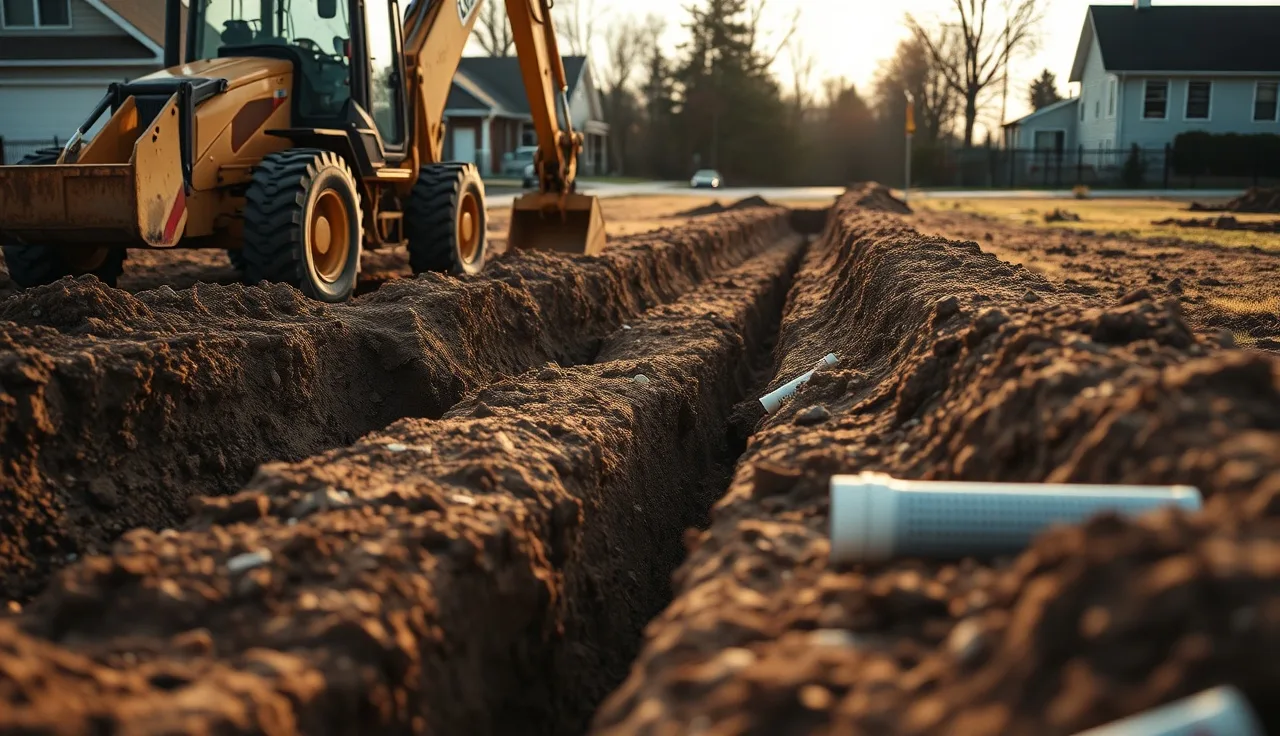
Step 2: Excavation. A backhoe or mini-excavator digs the trenches to the permitted depth, usually 18 to 36 inches, at widths of 18 to 36 inches. Trenches hold a slight downward grade, typically 1/8 to 1/4 inch per foot, so effluent spreads evenly. Excavated soil goes off to the side. Pile it on the field area and you compact the soil you're counting on to treat the water.
Step 3: Gravel base. A 6-inch base of washed aggregate, usually 3/4-inch crushed stone, goes into each trench. This layer holds the pipe and creates void space for effluent to distribute and sit during high-flow periods.
Step 4: Pipe. Perforated PVC pipe, usually 4-inch diameter, lays on the gravel with the holes facing down. Sections join with standard couplings, and end caps close the downhill ends. The distribution box (D-box) connects to the supply line from the tank and splits flow evenly to each trench.
Step 5: More gravel, then fabric. Aggregate covers the pipe to 2 inches above the top. A geotextile filter fabric goes over the gravel to keep soil fines from washing down into the stone and clogging it over the years.
Step 6: Backfill and grade. Native soil fills the trench back to grade. Installers usually crown the soil 6 to 12 inches to allow for settling over the first year. The final grade slopes away from the field to push surface runoff elsewhere.
Step 7: Inspection and connection. The installer calls for the final health department inspection before covering the D-box or connecting the tank outlet. Once it passes, the outlet pipe hooks up, the system goes live, and the homeowner gets as-built paperwork. Keep that paperwork forever.
A pressure-dosed or pump-fed system adds a pump chamber, float controls, and a dosing timer to the sequence. A mound system adds imported fill and a much bigger excavation footprint. Pipe, gravel, fabric: those fundamentals don't change.
How long does a drain field installation take?
The digging itself takes one to three days on a normal residential lot with decent soil and weather. A small system (two bedrooms, light sandy soil) can be excavated, piped, inspected, and backfilled in one long day. A larger system or a hard-to-reach lot runs two to three days.
Everything around the digging is what eats the calendar. Permitting runs four to eight weeks on average, sometimes longer. Scheduling the licensed installer adds one to four weeks depending on the season. The spring rush from April through June in northern states can push contractor availability six weeks out.
Total time from decision to working system: figure two to four months in a clean case. Need a variance, an engineering review, or a mound design? Add one to three months.
Weather runs the show. Most installers won't dig frozen or saturated ground. Wet clay that gets tracked and packed during installation can drag down field performance for years. A contractor who waits a day or two for the ground to dry out is doing you a favor, not stalling.
What does a drain field installation cost?
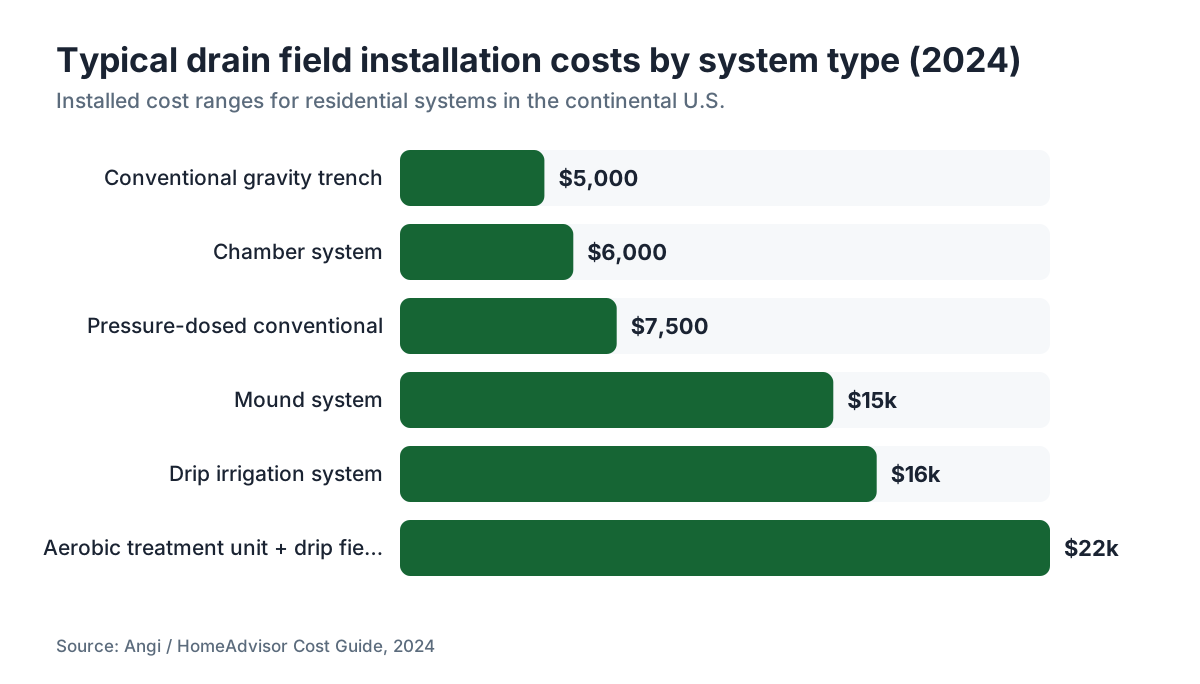
A conventional gravity trench field runs $3,000 to $7,000 installed. A mound system runs $10,000 to $20,000. A single number is useless here, so here's the honest breakdown by system type and what moves it. [5]
| System type | Typical installed cost (2024) |
|---|---|
| Conventional gravity trench | $3,000 to $7,000 |
| Chamber system (Infiltrator-style) | $4,000 to $8,000 |
| Pressure-dosed conventional field | $5,000 to $10,000 |
| Mound system | $10,000 to $20,000 |
| Aerobic treatment unit + drip field | $15,000 to $30,000 |
| Constructed wetland or drip irrigation | $8,000 to $25,000 |
The biggest cost drivers: linear feet of trench (set by bedroom count and soil perc rate), depth and difficulty of the dig, soil import (mound systems truck in 50 to 200 cubic yards of sand fill), the distance from tank to field, and local labor rates. High-cost states run 30 to 50% above these ranges. California, Massachusetts, and the Northeast are the usual offenders. [5]
Permit fees add $200 to $1,500 depending on the jurisdiction. Perc testing and soil evaluation add $300 to $1,000 if the installer didn't bundle them into the quote. Engineering design fees, required on complex sites and alternative systems, run $500 to $3,000.
One cost people forget: the septic tank itself. Installing a drain field as part of a brand-new system means you need the tank too. See cost to install septic system for the combined numbers. Replacing only the field, with a good tank in the ground, means the figures above apply.
If you want the tank component priced out on its own, cost to put in a septic tank breaks that down.
What size drain field do you need for your house?
Field size comes from two inputs: estimated daily wastewater flow and the soil's absorption capacity from the perc test.
The EPA and most state codes use bedroom count as a stand-in for daily flow. The standard assumption is 120 gallons per bedroom per day, though some states use 150 for newer designs. A 3-bedroom home makes roughly 360 gallons a day. [12]
From there, the designer divides daily flow by the soil's long-term acceptance rate (LTAR), a value pulled from the perc results. Soil with a 30-mpi perc rate might carry an LTAR of 0.4 gallons per day per square foot. Divide 360 by 0.4 and you need 900 square feet of trench bottom. Convert that to linear feet by trench width and you have your field dimensions.
Faster soils (say 5 mpi) allow higher LTARs and smaller fields. Slower soils (45 mpi) force much larger fields or an alternative system. That's how two identical houses 500 feet apart end up with wildly different field sizes and costs.
Sizing also has to cover peak flow. A household that runs big laundry days, takes long showers, or hosts guests can blow past design flow for a stretch. A field sized to daily average alone has no cushion. Good designs build in 10 to 25% oversizing to soak up real-world swings without drowning the biomat.
For a replacement field, most counties make the new field meet current code even if the original was grandfathered smaller. So a replacement can come out noticeably bigger than what you dug up.
Can you install a drain field yourself, or do you need a licensed contractor?
In most states, you need a licensed septic installer or onsite wastewater contractor to pull the permit and do the work. Some states allow homeowners to install on their own property under a homeowner permit, but even those states usually require a licensed pro to run the soil tests, sign the design, and handle the inspections. [3]
My honest take: don't do this yourself unless you're already in the trades and you know your local code cold. The downside is brutal. A badly installed field fails in two to five years instead of twenty to thirty. You contaminate your soil, maybe your groundwater, and you torch any shot at an insurance claim. Then it becomes a disclosure headache at resale.
What homeowners can legitimately handle: clearing vegetation from the site, grading the surface after installation, maintaining the system afterward, and doing the paperwork legwork (pulling soil test quotes, tracking permit status, scheduling inspections).
If money is the sticking point, get three quotes. Prices swing 30 to 50% between contractors in a lot of markets. The cheapest bid isn't automatically wrong, but ask straight out whether it covers the permit fee, inspection fees, the D-box, and filter fabric. Those add-ons are what separate a lowball number from a complete one.
Septic service operators juggling multiple installs face a different problem: tracking permit timelines, soil test results, and inspection dates across a stack of sites gets messy fast. Tools like SepticMind are built for that workflow, tying field data to permit status and customer records in one place.
What are the alternatives when conventional drain field installation isn't possible?
Not every lot supports a conventional gravity trench. When the perc test fails, the water table sits too high, or the usable area is too tight, alternative designs step in.
Mound systems are the common alternative. A mound pumps effluent up into a raised bed of imported sand fill, skipping past the bad native soil underneath. They handle slow perc rates, high seasonal water tables, and shallow bedrock. They cost $10,000 to $20,000, run larger and more visible than a conventional field, but they're well-understood and most installers can build one. [2]
Drip irrigation systems push effluent through subsurface drip emitters spread across a bigger area. They fit sloped sites and odd lot shapes where trenches won't work. They need a pump and filtration, which adds mechanical parts and maintenance cost.
Aerobic treatment units (ATUs) treat wastewater harder before it hits the dispersal area, so cleaner effluent can discharge at higher rates into marginal soil. Many states require quarterly maintenance contracts for ATUs, adding $200 to $500 a year in running cost.
Constructed wetlands and recirculating sand filters are rarer residential options for lots with tight constraints, or where surface discharge (with a state permit) is allowed.
What you can build depends heavily on what your state and county permit. Not every county approves every system type. Bring your soil test results and a site sketch to a licensed designer before you assume any alternative works on your lot.
How long does a drain field last, and what makes it fail early?
A well-designed, well-installed conventional field lasts 20 to 30 years under normal use. Some go longer. EPA guidance puts the expected life at 20 to 30 years when the system is maintained right, and University of Minnesota Extension lands in the same range. [1][10]
Early failure almost always comes down to one of four causes.
First, hydraulic overload: pushing more water into the field than the soil can take. Running appliances all at once, leaking toilets, or housing more people than the design allowed for saturates the biomat faster than it recovers. The fix is behavior change, and sometimes a pump timer that doses effluent in timed batches.
Second, biomat growth with no recovery. Every field grows a biomat, a biological layer at the soil interface that slows infiltration. Managed right, it reaches equilibrium. Overloaded, it keeps thickening until it seals the field off. Resting the field (diverting flow to a repair area for a stretch) can sometimes revive a clogged field without a full replacement.
Third, physical damage. Parking cars, trucks, or equipment over the field packs the soil and crushes pipe. Roots from trees planted too close worm in and block the lines. Both failures cost real money and both are completely preventable.
Fourth, chemical damage. Pouring solvents, paint, or antibacterial cleaners down the drain kills the bacteria that treat the wastewater and throws off the biomat balance. The bacteria in a healthy field are what make the whole thing work.
Regular septic tank pumping every three to five years is the single best move a homeowner can make to protect the field. Solids that overflow a neglected tank ride out to the field and clog it for good. See how often to pump septic tank for the data behind that interval.
What are the signs that a new drain field installation was done wrong?
Bad installation shows up within months in the worst cases, or within two to five years in the subtler ones. Knowing the tells helps you catch it before it gets expensive.
Sewage backing up into the lowest drains in the house within the first year is a serious red flag. It can mean the D-box sits level instead of slightly sloped, so one trench takes all the flow while the others sit dry. It can also mean a pipe connection failed or a trench got dug too flat.
Wet, soggy patches over the field after rain might just be surface drainage. But if they show up between rains or smell like sewage, effluent is surfacing, which means the field is saturated and the soil isn't accepting flow. On a new install, that usually points to undersizing or a bad soil evaluation.
Slow drains across the house (more than one fixture) hint that the outlet pipe is partly blocked or the field isn't taking flow. Have a pro camera the outlet line and check the D-box before you write off the field itself.
Uneven grass growth over the field can flag uneven distribution. Bright green stripes over one trench while the rest look ordinary means that trench is soaking up all the effluent while the others get bypassed.
If you bought a house with a recently installed system and any of these show up, ask for the as-built permit documents. If the installer can't produce them or the ground doesn't match the paper, you may have grounds for a complaint with the state licensing board or a claim against the contractor's bond.
A thorough septic tank inspection at purchase checks the field for failure signs and reviews the permit history. Don't skip it.
How do you maintain a new drain field after installation?
Good maintenance starts the day the field goes live. The first year counts most, because the biomat is establishing itself and the system is calibrating to how much water the household actually uses.
Keep every vehicle and piece of heavy equipment off the field, permanently. Mark the field boundaries clearly before the first winter so a snowplow operator doesn't drive across it. Don't plant trees or big shrubs within 30 feet of the field. Shallow-rooted grass is fine and actually helps by pulling up moisture and holding the soil against erosion.
Pump the tank on schedule. A typical 3-bedroom household with a 1,000-gallon tank means every three to five years. septic tank pump out walks through what happens during a pump-out and what the pumper should check. Skip this and you've got the most common reason fields die young.
Conserve water during heavy-use stretches. Spread laundry across the week instead of five loads on Saturday. Fix a leaking toilet the day you notice it. A toilet that runs nonstop dumps roughly 200 gallons a day into your field, about enough to shove a correctly sized field into overload.
Skip the additives. The EPA has no scientific evidence that biological or chemical additives improve septic performance, and some damage the biomat or push solids into the field. [1] The field doesn't need help. It needs you to stop overwhelming it.
Operators running service routes get a different angle here: SepticMind's scheduling and inspection recordkeeping tools track which systems are due for pumping and flag patterns across a customer base that can signal field stress before it turns into a failure call.
A septic tank cleaning visit is also a good moment to ask the pumper to eyeball the D-box and the field surface if they can reach it.
What regulations govern drain field installation in the United States?
Drain field installation is regulated at the state and local level, not federally, but federal guidance shapes most state codes. The EPA's Onsite Wastewater Treatment Systems Manual and the EPA SepticSmart initiative set the baseline science that state rules build on. [1][2]
The Clean Water Act gives the EPA authority over discharges to waters of the United States, which is why systems that could reach groundwater or surface water need state permits beyond the local health department sign-off. In practice, residential drain fields sit under state onsite wastewater codes enforced by county health departments, with the EPA acting more as a technical resource than a direct regulator. [6]
Every state has an onsite wastewater treatment and disposal code. A few examples: North Carolina's 15A NCAC 18A .1900 rules, Massachusetts Title 5 (310 CMR 15.000), and California's county environmental health codes under the Porter-Cologne Water Quality Control Act. These set minimum setbacks, perc test requirements, soil evaluation standards, inspection protocols, and installer licensing. [7][9]
Installing near a wellhead protection area or a sensitive watershed can trigger extra permit requirements under the Safe Drinking Water Act. [8]
The practical point: there's no single national standard. A design that clears permitting in sandy-soil Florida might not come close in clay-heavy Tennessee. Start with your county health department's specific onsite wastewater code, not a national guide.
Frequently asked questions
How much does it cost to install a drain field?
A conventional gravity trench drain field costs $3,000 to $7,000 installed for a typical residential lot. Mound systems, needed when soil perc rates run too slow, cost $10,000 to $20,000. Aerobic treatment unit systems with drip fields can reach $30,000. Permit fees, soil testing, and engineering design add $500 to $2,500 on top, depending on your county.
How long does it take to install a drain field?
The physical excavation and installation takes one to three days. Permitting and scheduling the contractor typically add six to twelve weeks before shovels hit dirt. From deciding to install to having a working system, budget two to four months for a conventional system, or three to six months if an alternative design or variance is needed.
Can I install a drain field myself?
In most states, no. Installing a drain field requires a licensed onsite wastewater contractor to pull the permit and do the work. A few states allow homeowner permits on your own property, but even those require a licensed professional to sign off on the soil evaluation and final inspection. A badly installed field can fail in two to five years instead of twenty to thirty.
How do I know if my soil will pass a perc test for a drain field?
A licensed soil evaluator or sanitarian runs the percolation test and soil profile evaluation. Soils with perc rates between 1 and 60 minutes per inch usually qualify for conventional systems. Sandy or loamy soils pass easily. Heavy clay, shallow bedrock, or a high seasonal water table often force an alternative design like a mound system. You won't know for certain until formal testing is done.
What is the difference between a drain field and a leach field?
They're the same thing. Drain field, leach field, absorption field, and soil absorption system all name the network of perforated pipes buried in gravel-filled trenches where treated wastewater from the septic tank disperses into the soil. Leach field is older terminology that turns up in a lot of pre-2000 permits and homeowner documents.
How many bedrooms does a drain field support?
Field size is calculated from bedroom count, not bedrooms alone. Most state codes assume 120 gallons of wastewater per bedroom per day as the baseline flow. A larger field serves more bedrooms, but soil perc rate sets how much trench area each bedroom needs. A 3-bedroom home in sandy soil might need 600 square feet of trench; the same home in slower soil might need 1,500.
What setbacks do drain fields need from wells and property lines?
Most state codes require 50 to 100 feet from a private drinking water well, 5 to 25 feet from property lines, 10 to 25 feet from a foundation, and 25 to 100 feet from surface water. These are minimums. Your county may require more. The exact requirements come from your county's onsite wastewater code, not a national standard.
How long does a drain field last?
A properly installed conventional drain field lasts 20 to 30 years under normal household use, per EPA and university extension guidance. Early failure usually traces to hydraulic overload (too much water), solids overflow from a neglected tank, physical damage from vehicles driven over the field, or roots from nearby trees. Tank pumping every three to five years is the best protection.
What happens if a drain field installation fails inspection?
The health department issues a correction notice listing what has to be fixed before re-inspection. Common failures include trench depth or grade that doesn't match the approved design, missing filter fabric, pipe perforations facing the wrong way, or a D-box that isn't level. The contractor corrects the deficiency and requests a re-inspection. Covering the field before inspection is a code violation in effectively every jurisdiction.
Do I need to reserve a repair area when installing a drain field?
Yes, in most counties. The permit requires a designated repair area, usually equal in size to the primary field, held for a future replacement system. Building structures, paving, or planting trees over the repair area isn't allowed. Homeowners who ignore that restriction can face extremely expensive options when the primary field eventually fails.
What is a distribution box in a drain field system?
A distribution box (D-box) is a small concrete or plastic box that takes effluent from the septic tank outlet and splits it evenly among the drain field trenches. A level D-box matters: if one side sits even slightly high, all the flow runs to the lower trenches and the others get nothing. D-box inspection is part of any thorough septic inspection.
Can a failed drain field be repaired instead of fully replaced?
Sometimes. Biomat rehabilitation through resting (diverting flow to a repair area for months), hydro-jetting the perforated pipes, or introducing aerobic bacteria can extend field life in mild cases. If the soil is permanently sealed with anaerobic biomat or the pipes are crushed, repair won't work and replacement is required. A licensed pro can tell you whether repair is realistic or a waste of money.
Does a new home construction drain field install differ from replacing an old one?
The physical installation is similar, but new construction usually has more room to site the field. Replacement installs are boxed in by what's already on the lot: existing field location, repair area availability, mature trees, and any hardscape built since the original permit. Replacement permits sometimes allow the same footprint if the original met current code; otherwise the new field has to meet current standards.
What is a mound system and when is one required?
A mound system is an above-grade drain field built on imported sand fill when native soil can't handle conventional trenches. It's required when perc rates run too slow (over 60 mpi in most codes), the water table sits too shallow, or bedrock is within a few feet of the surface. Mound systems cost $10,000 to $20,000 installed and need a pump to push effluent into the raised bed.
Sources
- U.S. EPA, SepticSmart: How Septic Systems Work: Drain field described as where wastewater is treated by the soil as it percolates through; EPA recommends no additives; 20-30 year lifespan with proper maintenance.
- U.S. EPA, Onsite Wastewater Treatment Systems Manual (EPA/625/R-00/008): Conventional trench design described as standard; mound systems cited as alternative for slow perc soils and high water tables; perc rate acceptance ranges.
- National Environmental Services Center (NESC), West Virginia University, Onsite Wastewater Permitting: Permit required in all U.S. states; soil evaluation and perc test required before permit approval; licensed installer requirement; repair area reservation requirement.
- Common Ground Alliance, Call 811 Before You Dig: Federal law and state regulations require contacting 811 at least 72 hours before excavation to mark buried utilities.
- Angi / HomeAdvisor, Septic System Installation Cost Guide (2024): Conventional drain field installed cost $3,000-$7,000; mound system $10,000-$20,000; aerobic treatment unit systems up to $30,000 (2024 national averages).
- U.S. EPA, Laws and Regulations (Clean Water Act): Clean Water Act provides EPA authority over discharges to waters of the U.S.; residential drain fields primarily regulated under state codes.
- Massachusetts Department of Environmental Protection, Title 5 Regulations (310 CMR 15.000): Massachusetts Title 5 sets minimum setbacks, perc test standards, and inspection requirements for onsite septic systems.
- U.S. EPA, Safe Drinking Water Act: Safe Drinking Water Act may impose additional permit requirements for systems installed near wellhead protection areas.
- North Carolina Department of Health and Human Services, Wastewater Section (15A NCAC 18A .1900): North Carolina onsite wastewater rules set minimum soil evaluation depth, setback distances, and installer licensing requirements.
- University of Minnesota Extension, Septic Systems: Conventional drain fields last 20-30 years with proper maintenance; tank pumping every 3-5 years recommended to protect field life; vehicle traffic cited as cause of early failure.
- Penn State Extension, Onsite Sewage Disposal and Percolation Testing: Perc rate between 1 and 60 mpi generally acceptable for conventional systems; soil profile evaluation required to identify limiting layers.
- Oregon State University Extension Service, Septic Systems and Their Maintenance: Daily wastewater flow estimated at 120 gallons per bedroom per day for system sizing; long-term acceptance rate derived from perc test for trench area calculation.
Last updated 2026-07-09