Drain field parts explained: every component and what it does
By the SepticMind Editorial Team
TL;DR
- A drain field has six main parts: the outlet pipe from the septic tank, a distribution box or manifold, lateral perforated pipes, gravel or aggregate fill, a geotextile fabric layer, and the native soil below.
- Each part does a specific job in spreading and treating effluent.
- Knowing these components helps you catch failure early and talk straight with contractors and inspectors.
What are the main parts of a drain field?
A drain field, also called a leach field or soil absorption system, is not one pipe buried in dirt. It's an assembly of separate parts, each doing a different job. Get one of them wrong at install, and the whole thing can fail years before it should.
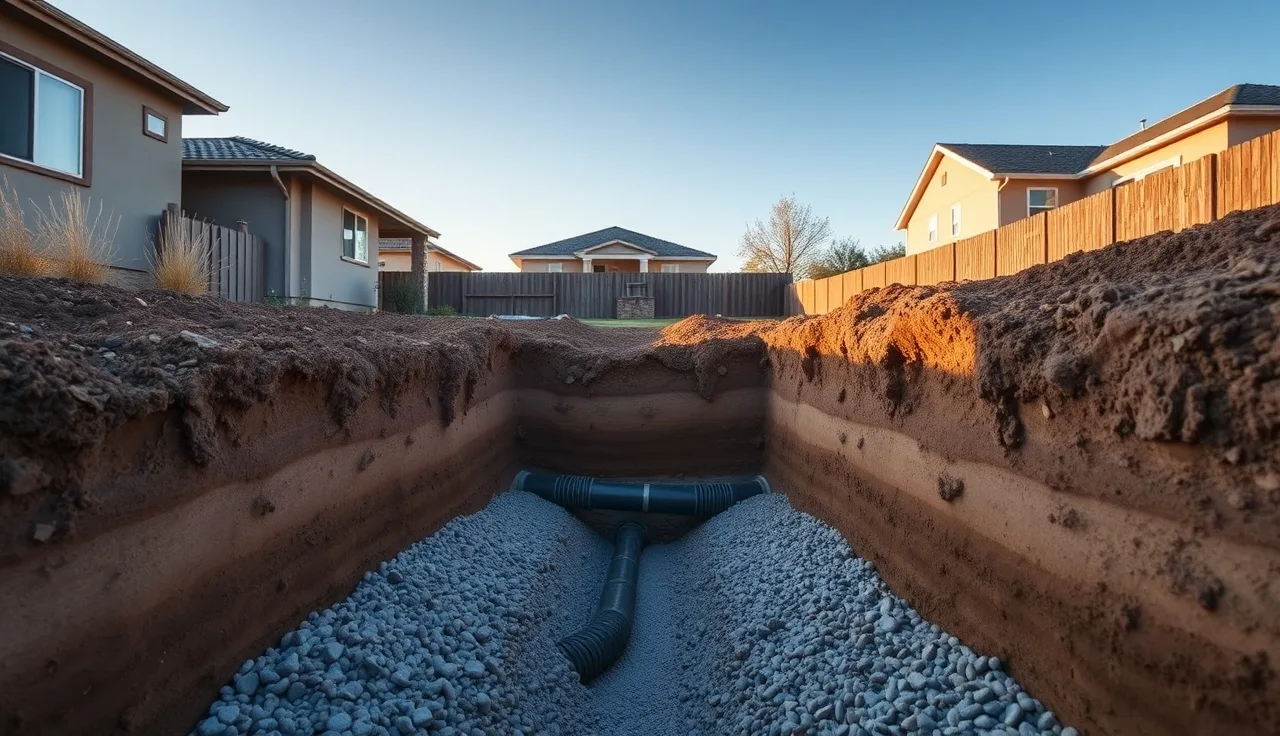
The six core parts: (1) the effluent outlet pipe running from the septic tank to the field; (2) a distribution device, either a distribution box (d-box) or a header manifold; (3) lateral perforated pipes laid flat in trenches; (4) a surrounding aggregate layer, almost always washed gravel or crushed stone; (5) a geotextile filter fabric between the gravel and the native soil; and (6) the native soil itself, which does the actual biological treatment. Some modern systems swap several of these for proprietary chamber or drip-irrigation gear, but the function of each stage stays the same.
The EPA's SepticSmart program describes a conventional soil absorption system as one where "septic tank effluent is distributed into the soil through a series of perforated pipes or chambers" [1]. That's the quick version. The details matter a lot more.
What does the inlet pipe and outlet pipe do?
The outlet pipe leaving your septic tank moves effluent by gravity to the field. In modern installs it's 4-inch Schedule 40 PVC, though you'll still find clay tile and cast iron in systems built before the 1970s. It drops on a grade of roughly 1/8 inch to 1/4 inch per foot, enough to keep effluent moving without scouring the pipe or letting solids drop out [2].
That slope matters more than most homeowners realize. Too flat and solids pile up in the pipe and clog it. Too steep and the effluent outruns the solids, which clogs it from the other direction. Contractors check slope with a laser level or a digital torpedo level. You can check it yourself with a $20 smartphone level app if you ever dig down to a cleanout.
Most codes want a cleanout access point near the septic tank outlet and at any change of direction. If yours is buried with no risers, that's an easy upgrade your pumper can handle during a routine septic tank pump out. Figure $50 to $150 in parts plus a little labor.
How does a distribution box (d-box) work and why does it fail?
The distribution box sits between the septic tank outlet and the lateral trenches. Its job is simple: take effluent from the tank and split it evenly into each lateral line. A level d-box holds effluent at the same height in every outlet, so all the laterals get roughly the same flow.
D-boxes are usually precast concrete, though plastic versions from makers like Tuf-Tite have gotten common since the 1990s. A standard residential unit runs 12x12 to 18x18 inches with 2 to 6 outlets, depending on field size. Each outlet has a short baffle or just relies on level to equalize flow.
Failure almost always traces to one of three things: settling (which tilts the box and dumps all the flow into one lateral), cracking from root intrusion or frost heave, or outlet holes plugged with biomat. When a d-box fails, you'll usually see one strip of yard with lush grass and standing water while the rest looks dry and normal. A contractor can dig up and relevel or replace a concrete d-box for $200 to $500 in most markets. A plastic replacement is often cheaper, $75 to $200 for the box itself [3].
If your system uses a header manifold instead of a d-box, that's a solid pipe running perpendicular to the laterals with tee fittings at each connection. Manifolds are generally more reliable for equal distribution, especially on sloped lots, because a long header equalizes pressure better than a small box with a handful of outlets.
What are lateral pipes and why are they perforated?
The lateral pipes are what most people picture when they think drain field: long runs of 4-inch pipe in parallel trenches, drilled with 1/2-inch holes every few inches along the bottom half. The holes face down in a conventional gravel-and-pipe system, not up. Effluent drips out the holes, drains through the gravel, and enters the soil below.
Holes-down is counterintuitive to a lot of homeowners. The reason is hydraulic loading. You want a slow, controlled drip into the aggregate, not effluent pooling inside the pipe and surging out. Holes-up designs got tried historically and flooded the aggregate unevenly.
Pipe material has changed over the decades. Orangeburg pipe (a pressed wood-fiber product) was used from the 1940s through the 1970s and is notorious for collapsing from the inside, because it basically dissolves over time [4]. Concrete pipe followed. By the 1980s, perforated PVC and HDPE became standard and still are. HDPE is flexible and handles frost movement better. PVC is stiffer and easier to cut to exact length.
Lateral length depends on local code and perc test results. Most state onsite wastewater rules set a maximum length, often 100 feet per lateral, to keep pressure distribution even. North Carolina's rules, for example, cap conventionally loaded laterals at 100 feet [5]. Your local environmental health office has the specific limit for your county.
Spacing between laterals runs 6 to 10 feet center to center. Too close and the soil between trenches stays saturated and loses treatment capacity. Standard trench width is 24 to 36 inches.
What role does gravel and aggregate fill play?
The gravel layer is more than filler. It does two jobs: it gives effluent a place to spread sideways before it hits native soil, and it creates an aerobic zone where bacteria start treating waste before it reaches the treatment zone below the trench.
Code typically wants washed, crushed stone, 3/4-inch to 2.5-inch nominal size, with very little fines (less than 3% passing a No. 200 sieve). Rounded river gravel is allowed but less common, because its smooth surface gives less microbial attachment area than angular crushed stone. The aggregate layer runs 6 to 12 inches below the pipe and 2 inches above it.
Gravel depth below the pipe is where a lot of DIY and budget installs cut corners. EPA design guidance for onsite systems calls for a minimum of 6 inches of aggregate beneath the invert of the distribution pipe [1]. Going thinner cuts treatment capacity and can cause premature biomat on the trench bottom.
One alternative worth knowing: gravelless systems use lightweight polystyrene aggregate (such as Infiltrator EZflow) or foam-wrapped pipe bundles instead of crushed stone. They're lighter, faster to install, and have solid long-term performance data, though materials cost more [10]. Some states require a variance to use them. Check your state environmental health code.
What is geotextile fabric and is it always required?
Geotextile filter fabric is a permeable nonwoven textile, usually polypropylene, laid over the gravel before backfill goes in. It lets water pass while keeping fine soil particles from migrating down into the gravel and plugging it. Without fabric, native backfill soil works its way into the aggregate over time and cuts permeability [11].
Most modern codes require geotextile over the aggregate in all conventional installs. It's sold by the roll in widths from 3 to 6 feet, and it's cheap, roughly 5 to 15 cents per square foot. Skipping it to save $50 to $100 on a $5,000 to $15,000 drain field is a bad trade.
One thing to be clear on: geotextile is not a root barrier. Aggressive tree and shrub roots will punch through it over time. That's why most codes want large trees kept at least 50 feet from the drain field boundary, and why willows, poplars, and silver maples are trouble even at greater distances [9].
For how the drain field ties into the rest of the system, see our guide on leach field care and failure.
How does native soil treat the effluent?
The soil below the gravel is the real treatment engine. As effluent percolates down through native soil, three things happen: physical filtration strains out particles, adsorption binds pathogens and some nutrients to soil particles, and microbes in the aerobic and anaerobic zones break down organic matter and pathogens.
This is why a perc test (percolation test) matters so much before you install. Soil that drains too fast (sandy or gravelly) doesn't give enough contact time for treatment. Soil that drains too slow (clay-heavy or saturated) won't take effluent and backs up. Most state codes express acceptable perc rates in minutes per inch, typically 1 to 60 mpi, with a sweet spot around 30 to 45 mpi for good treatment [5].
The treatment zone runs roughly 2 to 4 feet below the trench bottom in most soils. That's why the minimum depth to seasonal high groundwater, bedrock, or a restrictive layer is regulated so hard, usually 2 to 4 feet below the bottom of the aggregate depending on your state [8]. Blowing that setback is the top cause of permit denial during a septic tank inspection.
Biomat forms naturally at the trench bottom over time, a dark biological layer that actually helps regulate and slow how effluent applies. A thin, healthy biomat is normal. A thick, sealed biomat is the main reason drain fields fail after 20 to 30 years of heavy use.
What about advanced and alternative drain field components?
Not every drain field uses the classic gravel-and-pipe layout. Several alternative components have gone mainstream, especially on lots with poor soil or high groundwater.
Chamber systems replace perforated pipe and gravel with plastic arch-shaped chambers. Effluent flows into the chamber's open bottom and contacts soil directly. Infiltrator Water Technologies, the dominant maker, has published field data showing chamber systems can cut required absorption area by up to 50% versus gravel systems under some state codes [6]. They're widely approved and probably the most common alternative in new residential installs today.
Low-pressure pipe (LPP) systems use small-diameter (1.25 to 1.5 inch) pressure-dosed pipes with orifices spaced every 3 to 6 feet. A pump doses effluent in timed bursts, giving the soil a rest between loadings. LPP works well on sloped sites and is required in some states for lots that wouldn't otherwise pass a conventional perc test.
Drip irrigation takes the pressure-dosed idea further, using subsurface drip emitters set only 6 to 12 inches deep in topsoil. It needs filtered effluent (usually from an aerobic treatment unit upstream) and regular emitter maintenance. It's expensive up front but fits on very small lots.
If your system uses a pump, that pump chamber and float assembly count as drain field parts. If the pump quits, dosing stops and your tank backs up. Pumps typically last 7 to 15 years and cost $300 to $700 to replace, not counting the service call [3]. Track that pump's age the same way you track your tank's pump-out schedule. If you run a service territory and want to keep those recurring tasks straight, the septic operations software at SepticMind is built for exactly that.
What do drain field parts typically cost?
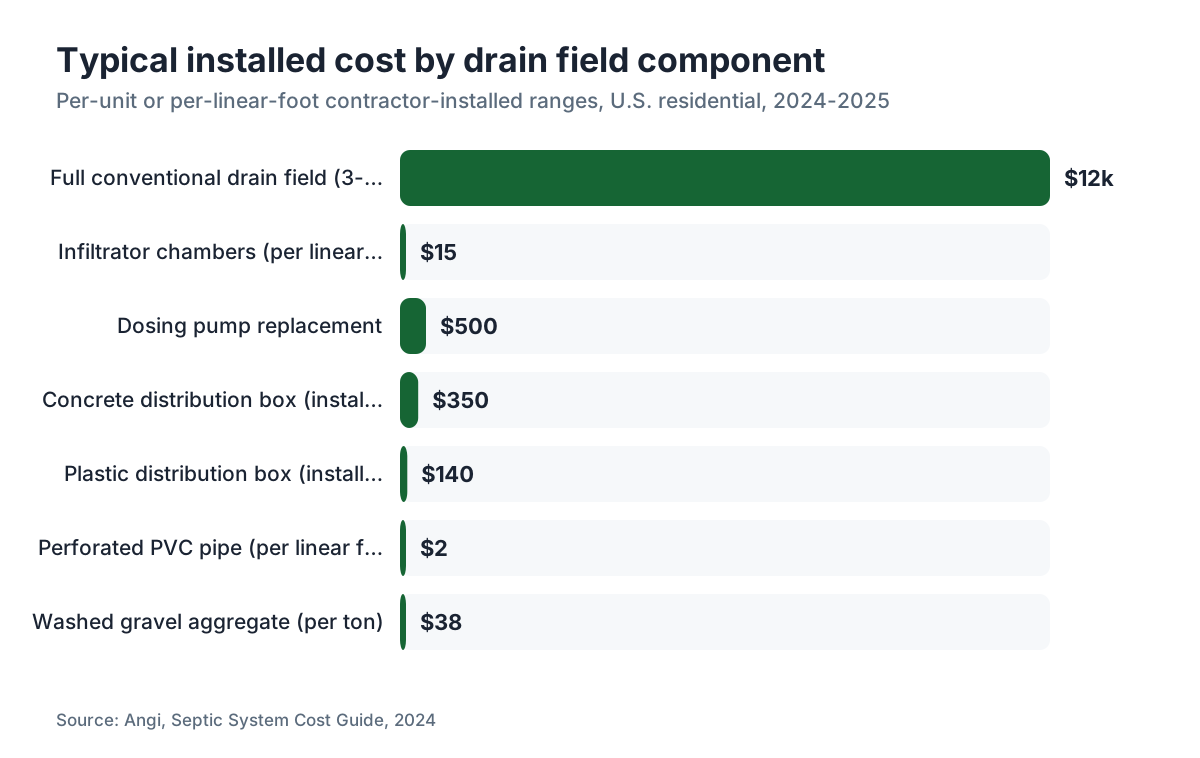
Part costs vary by region and system type, but these ranges reflect contractor-installed prices across the U.S. for 2024 to 2025 [3].
| Component | Typical installed cost | Notes |
|---|---|---|
| 4-inch perforated PVC pipe | $1.00-2.50/linear ft | Material only; labor varies by trench |
| Distribution box (concrete) | $200-500 | Includes leveling and backfill |
| Distribution box (plastic) | $75-200 | Material; installation similar |
| Washed gravel aggregate | $25-50/ton | Typically 4-8 tons per 100 linear ft |
| Geotextile fabric | $0.05-0.15/sq ft | Almost never a significant cost |
| Infiltrator chambers | $8-18/unit | Installed; unit covers ~3 linear ft |
| Dosing pump + float | $300-700 | Replacement only; new install higher |
| Full new drain field (conventional, 3-bed home) | $5,000-20,000 | Wide range based on soil, site, region |
For context, the full cost to install septic system including tank, field, and labor runs $10,000 to $30,000 and up depending on location and soil. The drain field is usually the biggest single line in that total.
Replacing one failed d-box or a single cracked lateral is far cheaper than replacing the whole field, which is why early diagnosis saves real money. Catching a d-box problem before it saturates the field can be a $500 fix instead of a $15,000 field replacement. See more on septic system repair options.
How can you tell if a drain field component is failing?
The classic signs are wet soggy areas over the field, sewage smell in the yard or house, slow drains indoors, and in bad cases, sewage surfacing. Those are late-stage symptoms. The earlier indicators are worth knowing.
A single wet strip in an otherwise dry field usually means one lateral is taking all the flow, which points to a tilted or blocked d-box. Wet spots at the upper end of the field can mean the inlet pipe cracked or settled. A uniformly soggy field more often means biomat failure across all the laterals or a hydraulic overload.
You can also watch your tank level. During a routine septic tank pumping, a good pumper notes how fast the tank refills and whether the outlet baffle looks like it's backing up. If effluent isn't leaving the tank at normal rates, the field is the first suspect.
Video camera inspection of the inlet and lateral pipes has gotten affordable, typically $150 to $400 for a contractor to run a camera through the system. It can catch root intrusion, pipe collapse, and aggregate migration inside the pipe before you see a problem in the yard. Worth doing if your system is 20-plus years old and you've never had one.
For older systems, checking for Orangeburg pipe is especially important. Orangeburg doesn't fail all at once. It soft-spots and collapses in sections. A camera inspection is the only way to know how much is still functional [4].
How long do drain field parts last?
Lifespan comes down to three things: install quality, how the system gets loaded, and what the soil and water table do over time.
Modern PVC and HDPE perforated pipe can realistically last 30 to 50 years, maybe longer, if the system isn't overloaded and roots stay away. Concrete d-boxes can last 40-plus years if they aren't cracked by settling or frost. Plastic d-boxes are newer, so they don't have a 40-year track record, but PVC and polyethylene don't corrode, so long life is expected.
The aggregate layer technically doesn't wear out, but biomat at the trench bottom slowly shrinks the effective infiltration area. Most authorities figure a conventional gravel-and-pipe drain field has a functional life of 20 to 30 years under normal loading before biomat buildup or biological exhaustion starts to limit performance [7]. Well-maintained systems on good soil regularly go 40-plus.
Chamber systems are harder to age because the oldest large-scale installs only date to the mid-1980s. Infiltrator reports 30-plus years of field data from early installations, with no chamber structural failures in properly installed systems [6].
What kills drain fields early: solids escaping a failing tank (guard against it with regular septic tank cleaning), hydraulic overloading from leaky fixtures or a garbage disposal, and soil compaction from driving or parking over the field. Compaction cuts soil porosity and can crack buried pipes. No vehicles, no heavy equipment, no deep-rooted plants over the drain field.
What does the installation process look like for a new drain field?
Installation starts before any equipment shows up. A soil evaluation, including a perc test and soil profile analysis, decides whether the site can support a conventional system and how big the field needs to be. In most states a licensed soil scientist or sanitarian does this, and the report goes in with the permit application.
Once permits are pulled, here's the usual sequence:
- Excavation of trenches to specified depth (usually 18 to 36 inches), sloped to grade.
- Gravel placement, minimum 6 inches below pipe invert.
- Pipe laying, holes down, checked for slope with a level.
- D-box or manifold installed at correct elevation, leveled in all directions.
- More gravel over the pipe to 2 inches above the top of the pipe.
- Geotextile fabric rolled over the gravel.
- Native soil backfill, usually mounded 6 to 12 inches above grade to allow for settling.
- Final inspection by the local health department, before or after backfill depending on local practice.
Field work on a 3-bedroom home typically takes 1 to 3 days. Permit timelines swing wildly. Some counties turn them around in a week, others take 60 to 90 days. Build that into any schedule if you're building new or replacing a failed system. For the full new-system process, see our guide on septic tank installation.
SepticMind's scheduling and job-tracking tools help contractors stay on top of permit timelines and install checklists across multiple jobs, which earns its keep during a busy install season.
Frequently asked questions
Can I replace just one lateral pipe without replacing the whole drain field?
Yes, in most cases. If a camera inspection or excavation shows one lateral is collapsed or root-invaded but the others still work, a contractor can replace that run on its own. Cost is typically $500 to $2,000 depending on trench length and depth. The real question is whether the rest of the field is still biologically viable. If heavy biomat covers all the trenches, spot repair doesn't fix the underlying problem.
What is a distribution box and where is it located?
A distribution box (d-box) is a small concrete or plastic junction box between the septic tank outlet and the drain field laterals. It splits incoming effluent evenly into each lateral trench. It's usually buried 12 to 24 inches deep, somewhere between the tank and the field. A contractor can find it by probing or by tracing the outlet pipe with a camera or metal fish tape.
Why do perforated pipes have the holes facing down, not up?
Holes face down so effluent drips slowly into the gravel below the pipe instead of filling the pipe and flooding the trench unevenly. Gravity draws effluent out the bottom holes in a controlled drip, which spreads the hydraulic load across the trench bottom. Holes-up designs let effluent pool inside the pipe and then surge, which causes uneven loading and premature biomat.
What is biomat and is it always a problem?
Biomat is a biological layer that forms on the soil at the bottom of drain field trenches as bacteria colonize organic matter in the effluent. A thin biomat actually helps regulate infiltration and adds treatment. It turns into a problem when it thickens enough to block infiltration, usually from hydraulic overloading or solids escaping a full tank. Moderating water use and pumping the tank on schedule are the best prevention.
How deep should a drain field be installed?
Most state codes want the bottom of the aggregate at least 2 to 4 feet above the seasonal high groundwater table, bedrock, or any restrictive soil layer. Trench depth to the top of gravel typically runs 18 to 36 inches below grade. The exact depth comes from your local onsite wastewater rule and the soil profile in your permit application. Shallower is generally better as long as minimum setbacks hold.
What is an Infiltrator chamber and is it better than gravel and pipe?
An Infiltrator chamber is a ribbed plastic arch that replaces perforated pipe and gravel in the trench. Effluent flows from the septic tank into the open-bottom chamber and contacts soil directly. Chambers can cut required field area by up to 50% under some state codes, handle higher hydraulic loads, and install faster. They're widely approved and have 30-plus years of field data. For most new installs with decent soil, chambers are at least as good as conventional systems, often better.
How do I know if my drain field has an Orangeburg pipe that could fail?
Orangeburg pipe was used in drain fields and sewer laterals from the 1940s through the early 1970s. If your home dates to that era and the system was never replaced, assume Orangeburg is possible. A pipe camera inspection is the only definitive way to check. Soft spots, oval deformation, or partial collapse on camera confirm it. Don't wait for full collapse. Repair is cheaper before the field floods with solids.
What size gravel is required for a drain field?
Most state codes and EPA guidance want washed, crushed stone in the 3/4-inch to 2.5-inch nominal size range, with less than 3% fines passing a No. 200 sieve. Angular crushed stone beats rounded gravel because its irregular surface gives more area for microbes to attach. Using finer gravel or unwashed material is a common shortcut that speeds up biomat formation and cuts system life.
Do I need geotextile fabric over the drain field gravel?
Yes, in nearly all modern code-compliant installs. Geotextile fabric keeps fine soil particles from migrating into the aggregate during backfill and rain. Without it, fines slowly clog the gravel and cut permeability. The fabric is cheap, roughly 5 to 15 cents per square foot, so skipping it is false economy. Check your state's onsite wastewater code for the exact requirement. Most mandate it outright.
Can tree roots destroy drain field pipes?
Yes. Tree and shrub roots follow moisture and will find perforated pipe within a few years if planted nearby. Willows, poplars, silver maples, and cottonwoods are the worst and can invade from 50-plus feet away. Most codes recommend a minimum 50-foot setback between large trees and the field boundary. Roots that enter perforated pipe can fully block laterals or crack the pipe at joints. Mechanical root cutting and chemical barriers buy time, not a permanent fix.
How often should a drain field be inspected?
A visual look at the field surface every spring and after heavy rain costs nothing and catches early surfacing or wet spots. A full professional inspection, including checking d-box level and running a camera through at least the inlet, makes sense every 3 to 5 years for systems over 15 years old. Many states require an inspection at property sale. Regular tank pumping, typically every 3 to 5 years, protects the field by preventing solids carryover.
What is a low-pressure pipe (LPP) drain field system?
A low-pressure pipe system uses a pump to dose effluent through small-diameter pressurized laterals with precisely spaced orifices. The pump fires in timed bursts, pushing a controlled volume through the field and giving the soil a rest between doses. LPP allows installation on sloped lots and marginal soils where gravity systems can't spread effluent evenly. It needs electricity and a pump that requires periodic maintenance and eventual replacement.
What happens if the distribution box is not level?
An unlevel d-box sends most or all the flow to the lowest outlet, overloading one or two laterals while the rest get almost nothing. The overloaded laterals fail early from biomat buildup while the underused ones never develop their full treatment potential. Eventually the saturated lateral causes surfacing or backup. Releveling a settled d-box early, before the field is damaged, is a $200 to $500 fix. Waiting until the field fails means a $5,000 to $20,000 replacement.
Sources
- U.S. EPA, SepticSmart: How Your Septic System Works: A conventional soil absorption system distributes septic tank effluent into the soil through perforated pipes or chambers; EPA design guidance calls for a minimum of 6 inches of aggregate beneath the invert of the distribution pipe.
- U.S. EPA, Onsite Wastewater Treatment Systems Manual (EPA/625/R-00/008): Outlet pipes from septic tanks should be sloped at 1/8 to 1/4 inch per foot to move effluent by gravity without scouring.
- Angi, Septic System Cost Guide, 2024: Distribution box replacement costs $200-500 for concrete units; dosing pump replacement typically runs $300-700; full conventional drain field installation for a 3-bedroom home ranges $5,000-20,000.
- University of Minnesota Extension, Septic System Owner's Guide: Orangeburg pipe, a pressed wood-fiber product used from the 1940s through the 1970s, is known to collapse from inside as the material deteriorates over time.
- North Carolina Department of Environmental Quality, Onsite Wastewater Rules (15A NCAC 18A .1900): North Carolina's onsite wastewater rules cap conventionally loaded lateral length at 100 feet and specify acceptable percolation rates of 1-60 minutes per inch for soil absorption systems.
- Infiltrator Water Technologies, Chamber System Performance Data: Infiltrator chamber systems can reduce required absorption area by up to 50% compared to conventional gravel-and-pipe systems under applicable state codes; 30+ year field performance data from early installations shows no structural chamber failures in properly installed systems.
- U.S. EPA, Septic System Fact Sheet (EPA 832-F-02-002): Conventional gravel-and-pipe drain fields typically have a functional life of 20-30 years under normal loading before biomat accumulation or soil biological exhaustion begins to limit performance.
- Virginia Department of Health, Sewage Handling and Disposal Regulations: State onsite wastewater regulations require minimum separation distances from seasonal high groundwater, bedrock, and restrictive soil layers to the bottom of the aggregate layer in drain field trenches.
- Penn State Extension, Septic System Maintenance: The Soil Absorption Field: Tree and shrub roots can invade perforated drain field pipes from 50 or more feet away; willows, poplars, and silver maples are cited as particularly problematic species near septic absorption areas.
- National Onsite Wastewater Recycling Association (NOWRA), Model Regulatory Framework: Gravelless aggregate systems including polystyrene media meet performance standards equivalent to crushed stone in states that have adopted the model framework, with some requiring a variance for site-specific approval.
- University of Rhode Island, Onsite Wastewater Training Center: Geotextile filter fabric prevents fine soil particles from migrating into drain field aggregate; most modern state codes require it over all aggregate layers before backfill.
Last updated 2026-07-09