Drain field lines: how they work, fail, and get fixed
By the SepticMind Editorial Team
TL;DR
- Drain field lines are perforated pipes buried 18 to 36 inches deep that spread treated septic effluent across a gravel-filled trench so soil bacteria can finish treatment.
- They last 20 to 30 years with proper care, fail from biomat buildup, root intrusion, or hydraulic overload, and replacement runs $3,000 to $20,000 depending on system size and local soil.
What are drain field lines and what do they actually do?
Drain field lines, also called leach lines or distribution lines, are the last stage of a conventional septic system. Effluent leaves the tank as a liquid that's had its solids settled out but still carries pathogens, nutrients, and biochemical oxygen demand. The lines take that liquid and spread it across a wide patch of soil so the real treatment can happen underground.
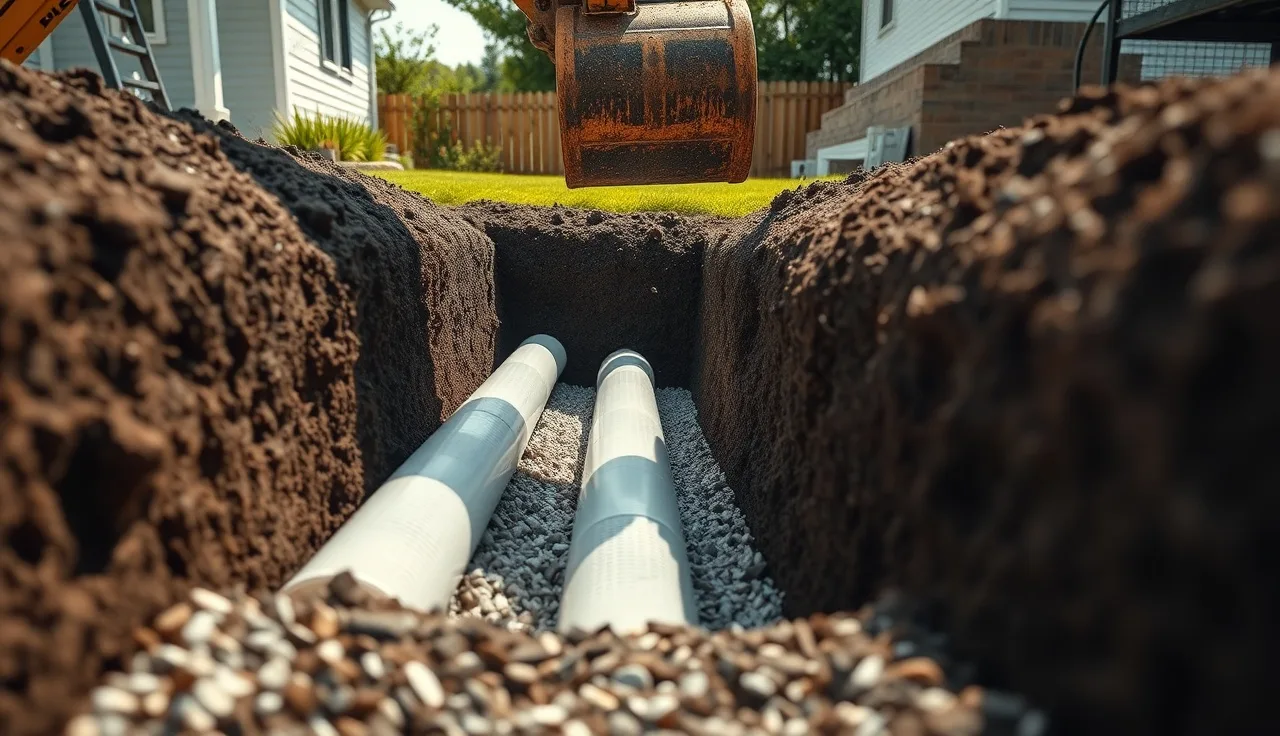
Each line is a perforated pipe, usually 4-inch PVC or corrugated poly tubing, laid in a gravel-filled trench. Holes or slots face down. Effluent dribbles out, moves through the gravel bed, and soaks into the native soil below. Soil bacteria, especially the aerobic organisms near the surface, digest the remaining organic matter and pathogens before the water reaches groundwater. [1]
The EPA's SepticSmart program describes the drain field as the component where "wastewater percolates into the soil, naturally removing harmful coliform bacteria, viruses, and nutrients." [1] Accurate, as far as it goes. What it undersells is the engineering dependency. The soil has to have the right texture. The lines have to distribute load evenly. And the rate of liquid entering the field can never consistently exceed the soil's acceptance rate, or the whole thing clogs.
A standard house might have three to five parallel trenches, each 50 to 100 feet long, adding up to 150 to 500 linear feet of pipe depending on percolation rate and household size. Bigger households or slower soils need more footage. A licensed designer calculates that number from a perc test or a soil morphology evaluation. [2]
What are drain field lines made of and how are they laid?
Modern lines are either rigid Schedule 40 PVC with drilled holes or slotted corrugated HDPE pipe, which is lighter and faster to install. Until the 1980s, most drain field lines were clay or concrete pipe with open joints instead of perforations. Those worked, but they were heavy, they leaked roots at the joints, and they spread effluent unevenly.
The trench matters as much as the pipe. A standard trench is 18 to 36 inches wide and 18 to 36 inches deep, filled with 3/4-inch washed stone from the bottom up to a few inches above the pipe crown. A layer of geotextile fabric sits on top of the stone, separating it from the native backfill so soil fines don't wash down and plug the void space. Some newer systems skip gravel entirely and use chamber systems, arched plastic units that sit right on native soil and make their own void. More on those below. [3]
Lines run from a distribution box, or in pressure-dosed systems, from a manifold with orifice-shielded laterals. Gravity systems use the natural grade of the lot to carry effluent from the tank to the D-box and out through the lines. Each lateral gets a shallow slope, around 1/8 to 1/4 inch per foot, so effluent doesn't sprint past the first few feet of trench and drown one spot while the rest stays dry.
Pressure-dosed systems put a pump in a separate dosing chamber and send effluent out in timed cycles. That spreads the load more evenly and lets the soil rest and drain between doses. The EPA lists pressure dosing as one of the design changes that can stretch drain field life in marginal soils. [1]
How long do drain field lines last?
Most well-designed, well-maintained drain field lines last 20 to 30 years. Some run past 40. Others quit before 10. The spread comes down to a handful of factors: hydraulic loading, solids carryover from the tank, soil type, root pressure, and whether the system was sized right for the house to begin with.
The number one killer of drain field lines is biomat, a dense black organic layer that forms at the soil interface when anaerobic bacteria burn through oxygen faster than air can replace it. A little biomat is normal and part of how treatment works. It turns into a problem when it thickens enough to block infiltration. Biomat piles up fast when solids escape the tank (which means the tank is overdue for pumping, see septic tank pumping) or when daily water use runs past the system's design flow. [4]
Root intrusion is the other common mechanical failure. Trees and big shrubs chase water. Roots from willows, silver maples, and certain poplars travel 30 to 50 feet. Once a root finds a perforation, it grows into a dense mat that chokes flow and eventually cracks the pipe. Most state codes require trees be kept 30-plus feet from drain field lines, and many list specific banned species. [2]
Compaction kills systems too. Drive a car or park equipment over a drain field and you crush the gravel void that effluent needs to move through. Once compacted, those trenches almost never come back without excavation.
What are the signs that drain field lines are failing?
Wet, spongy ground over the drain field with a sewage smell is the clearest sign. That's surfacing effluent, and it means the soil can no longer take flow at the rate the house is producing it. In bad cases you'll see a greener strip of grass over each trench (extra nutrients feeding the grass) or liquid pooling in a low spot in the yard.
Inside the house, sluggish drains and gurgling toilets are the early warnings. They usually mean the system is saturated and backpressure is building. If several fixtures back up at once, that's a stronger signal than one slow drain, which might just be a pipe clog. Full sewage backup into the lowest drains is a late-stage failure that needs a plumber and a pumper the same day.
A septic tank inspection can catch drain field stress before it turns into a mess in the yard. A trained inspector checks the liquid level in the tank (a level riding high means the field isn't accepting flow), looks for sludge carryover, and sometimes runs a dye test or scopes the outlet baffle. Some use soil probing to check saturation in the trench zone.
Don't wait for surfacing effluent to act. Minnesota's onsite sewage program notes that most drain field failures come on gradually and that early steps like resting the field, pumping more often, and cutting water use can add years to a struggling system. [5] That squares with what installers report, though solid state-level data on how often intervention actually works is thin.
Can you clean or restore drain field lines without replacing them?
Yes, sometimes. Options run from simple rest and water-conservation habits to mechanical jetting, biological treatments, and aeration. Results vary a lot, and an honest restoration contractor will tell you none of these methods work once the soil itself is permanently clogged.
The most evidence-backed fix for biomat-driven failure is aeration, injecting air into the soil around the lines to flip the microbial community from anaerobic to aerobic. Aerobic bacteria eat biomat faster than anaerobic bacteria can build it. Systems like the Terralift (compressed air driven in through a probe) and various perforated-pipe aeration setups have been studied. University of Minnesota Extension research on failing systems reported partial or full recovery in a majority of aerated fields when the field was also rested, but warned that systems with cracked pipe or fully saturated impermeable subsoil did not come back. [6]
Hydro-jetting is the other common service call. A high-pressure nozzle runs down each lateral to break up biomat, root fibers, and solids, then those get vacuumed out. Jetting can restore flow in lines that are partly blocked and where the soil hasn't failed yet. It's not permanent. Fix nothing about the cause and the lines re-clog. Plan on cleaning drain field lines every 3 to 7 years in a system trending toward biomat trouble, not as a first move on a healthy one.
Biological additives, the enzyme and bacteria products on the store shelf, have been tested over and over and the results are unimpressive at best. EPA's SepticSmart guidance states that "biological additives are not necessary for a properly functioning system" and can push solids into the drain field. [1] That's a polite way of saying most of them waste your money.
How much does it cost to repair or replace drain field lines?
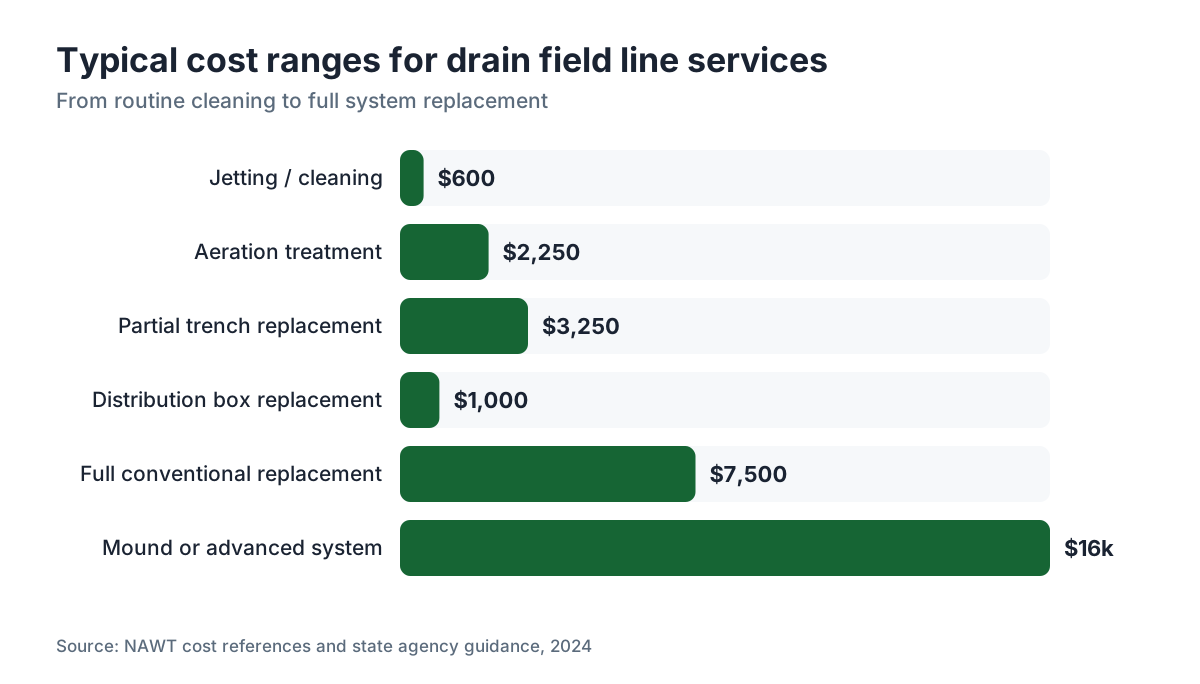
Cost swings hard with system type, soil, permit rules, and region. The table below gives real ranges pulled from contractor surveys and state agency cost guidance.
| Service | Typical Cost Range | Notes |
|---|---|---|
| Jetting / cleaning drain field lines | $300, $900 | Per visit; a pump-out may add $200, $500 |
| Aeration treatment | $1,000, $3,500 | Equipment and labor; may need multiple sessions |
| Partial trench replacement (1 to 2 lines) | $1,500, $5,000 | Depends on footage and access |
| Full drain field replacement (conventional) | $3,000, $12,000 | Typical residential lot; new perc test usually required |
| Alternative/advanced system replacement | $8,000, $25,000+ | Mound, drip, aerobic units; site-dependent |
| Distribution box replacement only | $500, $1,500 | If lines are intact but the D-box failed |
Those numbers pull from state agency cost guidance and the National Association of Wastewater Technicians. [7] Permit fees, soil engineer costs, and system design add another $500 to $2,500 in many states.
If you're already staring at a failed field, price a full cost to install septic system at the same time you gather repair bids. On an older property, replacement often pencils out better than a string of repair attempts.
Operators track one thing carefully: whether jetting and restoration work got documented for the property record. SepticMind's service platform lets operators log drain field work, attach before-and-after camera footage, and flag systems for follow-up, which gives homeowners a maintenance history that matters at resale.
State regulators increasingly demand documentation of repairs. California's Water Resources Control Board requires that any repair to an onsite wastewater system be permitted and inspected before backfilling. [8]
What types of drain field systems exist beyond conventional trenches?
Conventional gravity trenches are the most common system in the U.S., but they're far from the only one. Site problems drive most of the alternatives: high groundwater, shallow bedrock, slow clay soil, or a small lot all push installers toward engineered options.
Chamber systems swap the gravel bed for arched plastic chambers (Infiltrator is the dominant brand) that sit right on the soil. They need less digging, install faster, and give a bit more infiltration surface per linear foot. Approved in most states and common in new construction since the 2000s. [3]
Mound systems build a raised drain field on top of native soil using imported fill, usually a sandy loam, to get the required separation from groundwater or bedrock. They're hard to miss, a berm 18 to 36 inches above grade, cost more to install ($10,000 to $20,000 on average), and need a pump. But they work reliably on sites that can't support any in-ground field.
Drip irrigation systems use pressure dosing and small-diameter tubing to dose effluent at very low rates, often in a shallow zone 6 to 12 inches down. They cost more and need more maintenance (filters, pump checks), but they allow fields on tiny lots or marginal soil. Several western states promote drip as a water reuse option.
Aerobic treatment units (ATUs) treat effluent to a higher standard before it ever reaches the drain field, which cuts the biomat load a lot. They're common in Texas and the Southeast and required by some counties when a lot is too small for conventional sizing. Our leach field article goes deeper on sizing by system type.
How do you protect drain field lines and make them last?
The most effective protection is boring: pump your tank on schedule (every 3 to 5 years for most households, sooner for garbage disposal users or big families), and don't drown the system in water. Those two habits stop most premature drain field failures.
For how often to pump, see how often to pump septic tank. Short version: 3-year intervals work for an average household, but the only precise answer comes from measuring sludge and scum at inspection.
Beyond pumping, the practical rules are short.
Keep vehicles, heavy equipment, and stored material off the drain field. The gravel bed has to stay porous. One pass from a loaded pickup can compact a trench enough to cut infiltration 30 to 50%. There's no fixing compacted gravel without digging it up.
Send roof drainage, sump pump discharge, and surface runoff away from the field. Extra water from outside sources saturates the soil and blocks the field from taking household effluent. This rule gets ignored constantly and does reliable damage.
Don't plant trees or large shrubs within 30 feet of any line. Shallow-rooted ground covers and grass are fine, and actually helpful, since plant uptake pulls out some moisture. Deep-rooted species are not.
Fix household leaks fast. A running toilet can add 100 to 200 gallons a day to a system designed for 150 gallons per bedroom per day. EPA's design guidance uses 150 gpd per bedroom as the standard design flow. [1] A single leaking flapper valve can push a system over capacity by itself.
Flush nothing but human waste and toilet paper. Wipes (even the "flushable" ones), feminine products, and medications don't break down in the tank. They pile up as solids or ride out to the drain field.
What does a drain field line inspection involve?
A real drain field inspection goes past walking the yard hunting for wet spots. A thorough one checks the distribution box for solids, cracked walls, or uneven flow, checks the tank's liquid level against the outlet baffle, probes or sounds the trench zone for saturation, and sometimes runs a camera down one or more laterals.
Camera inspection (CCTV scoping) of laterals is still uncommon for routine maintenance but standard when a system is failing or getting evaluated for a sale. A small push camera, usually 50 to 100 feet of cable on a 1.5-inch or smaller head, runs down the line from the D-box and shows root intrusion, broken segments, sediment, or collapsed pipe. That footage is objective proof of condition.
For a septic tank inspection at point of sale, most states require the inspector to report on drain field condition as part of the full evaluation. What "drain field condition" means varies. Some states want a load test (run water, watch for surfacing), others want only a visual check of the risers and D-box.
Selling? Get a pre-listing inspection so nothing ambushes you. A failing field found by the buyer's inspector turns into a negotiation, a repair, or a price cut. Have your repair quotes and past maintenance records ready to hand over.
When does a failed drain field mean the whole septic system needs replacement?
Not every drain field failure drags the tank down with it. The tank is a concrete or fiberglass vessel. If it's structurally sound and the baffles are intact, it usually stays in service while the field gets rebuilt. The septic tank repair page covers which tank repairs are worth doing and what they run.
Some failures do take the whole system. If the soil on the property can no longer support a conventional field (groundwater rose, lot coverage changed, or the original perc results no longer hold), you may need a permit for an entirely different system type. That means a new design, a new perc test or soil evaluation, and often a different spot on the lot if the original field location is spent.
State codes differ on how much of the old system you can reuse. Most require a new distribution box with new lines. Some require updated pressure dosing when the lot is below a minimum size. A licensed designer who knows your state's rules is the only reliable guide here.
For full replacement costs and financing, the cost to put in a septic tank article breaks out the line items. Drain field installation is often 40 to 60% of total system cost on a new conventional build.
One honest note: don't sign a drain field replacement contract without at least two bids and proof the contractor holds a current license in your state. Unlicensed drain field work is common in rural areas and it creates liability problems at resale, because unpermitted systems tend to flunk county health inspections.
What do state and federal regulations say about drain field lines?
The federal picture is thinner than most homeowners expect. The EPA sets voluntary guidance through programs like SepticSmart and funds state and local programs, but there's no single federal standard for drain field design or setbacks. Regulation happens almost entirely at the state level, with enforcement often handed to county health departments. [1]
EPA's SepticSmart program recommends homeowners have their septic system inspected roughly every three years by a licensed professional and pumped every three to five years. [1] That's guidance, not law in most places. Plenty of states have written inspection requirements into code, especially for point-of-sale transfers.
State codes set the specifics: minimum trench depths, setbacks from wells and property lines, required separation above seasonal high groundwater, approved pipe materials, and designer licensing. The National Onsite Wastewater Recycling Association (NOWRA) keeps a state-by-state regulatory reference that's the best starting point for local rules. [9]
A few examples. Florida requires 24 inches of separation between the bottom of a drain field trench and the estimated seasonal high water table in most zones. [10] North Carolina's rules require drain field lines to sit at least 50 feet from any water supply well and 10 feet from property lines. [2] California requires a permit for any repair, more than new installation. [8]
If you run a service operation tracking compliance across a client base, keeping permit numbers, inspection dates, and state code citations for each property is good practice and increasingly required for liability protection. Managing that by hand across dozens of properties is exactly where software built for the trade starts paying for itself.
Frequently asked questions
How deep are drain field lines buried?
Standard depth is 18 to 36 inches from grade to the top of the pipe, with the exact number set by local code, frost depth, and the required separation above seasonal high groundwater. In northern states with deep frost, lines may sit shallower relative to finish grade but still meet the groundwater separation. Your local health department permit spells out the required depth for your site.
How many drain field lines does a typical house need?
A 3-bedroom home on average-percolation soil (roughly 20 to 60 minutes per inch) usually needs 300 to 500 linear feet of trench, split across three to five parallel lines each 60 to 100 feet long. Soil type drives the count more than house size. Fast sandy soil needs less footage; slow clay needs a lot more. A licensed designer calculates exact footage from a perc test or soil morphology evaluation.
Can drain field lines be cleaned without excavation?
Yes, in many cases. Hydro-jetting sends high-pressure water through each lateral to break up biomat and root debris, then vacuums out the material. Aeration injects air into the surrounding soil to shift bacteria from anaerobic to aerobic, which eats biomat. These no-dig methods work best on lines that are partially blocked. They won't restore lines where the surrounding soil has permanently lost its infiltration capacity.
What is the difference between a drain field and a leach field?
Nothing meaningful. The terms get used interchangeably across the industry and in regulatory documents. 'Drain field' and 'leach field' both mean the network of perforated pipes and surrounding gravel or aggregate that disperses septic effluent into the soil. Some state codes prefer 'absorption field' or 'soil treatment area.' The pipes themselves are sometimes called laterals or drain field lines.
How do I find my drain field lines?
Start with the county health department. Permitted systems should have an as-built drawing on file showing the tank, distribution box, and drain field lines. If records don't exist, a septic locator probe or a pipe camera run from the D-box can map the lines. During dry spells, look for evenly spaced parallel strips of lush or depressed grass; drain field lines often show up clearly from the air.
Can I build over drain field lines?
No. Structures, driveways, patios, and parking surfaces over drain field lines are banned by nearly every state code and will void permits. Impermeable surfaces block the oxygen exchange and soil evaporation the field depends on. Heavy structures compact the trench zone. Even a wood deck adds enough shade and moisture disruption to speed up biomat. Setbacks from drain field lines also apply to pools, sheds, and additions.
What causes drain field lines to get clogged?
The main cause is biomat, a dense layer of anaerobic bacteria and organic material that forms at the trench-soil interface over time. A little biomat is normal, but it builds fast when solids escape the tank (from skipped pumping) or when hydraulic loading beats design capacity. Root intrusion, soil compaction, and high groundwater are the other big causes. Flushing non-biodegradable material speeds up solids carryover into the field.
How long does drain field installation take?
A conventional residential drain field usually takes one to three days to install once permits clear and materials are on site. Permit timelines vary widely. Some counties turn them around in a week, others take four to eight weeks. Alternative systems (mounds, drip) take longer, often three to five days. Poor site access, rock, and surprise groundwater all stretch the schedule.
Does homeowners insurance cover drain field line failure?
Standard homeowners policies exclude septic system failures. A few insurers offer optional endorsements covering drain field repair or replacement, usually capped at $5,000 to $10,000. Home warranty plans sometimes include septic coverage, but most exclude pre-existing conditions and require proof the system was properly maintained. Read the fine print before you count on either one.
How do I know if my drain field lines need replacing versus just cleaning?
If jetting or aeration restores function and the system holds for two-plus years, the lines were cleanable. If problems return within months, the surrounding soil has likely lost its infiltration capacity for good and replacement is the cheaper path over time. A dye test, a soil probe for saturation, or a camera run of the laterals before you commit gives you real information instead of a guess. Get that assessment before paying for major cleaning.
What trees are safe to plant near a drain field?
Shallow-rooted plants are safest: ornamental grasses, wildflowers, and low ground covers like creeping phlox or clover. Skip vegetable gardens over the field because of pathogen concerns. Keep all trees at least 30 feet away and specifically avoid willows, silver maple, birch, poplar, and elm, which throw aggressive surface roots. Fruit trees and ornamental cherries should stay outside the 30-foot zone too. Most state extension programs publish plant lists for septic setback zones.
Can I add drain field lines to expand my existing system?
Sometimes, but it needs a new permit and soil evaluation in most states. If the existing field is partly used up, or you're adding a bedroom and need more capacity, a licensed designer can check whether adjacent unused area of the lot qualifies for extra trenches. You can't just extend existing lines without a design review. Reserve-area requirements in many state codes mean new systems must set aside a second field footprint for exactly this.
Sources
- EPA SepticSmart Program: EPA guidance on how drain fields treat effluent, design flow of 150 gpd per bedroom, 3-year inspection and 3-5 year pumping recommendations, and position on biological additives
- North Carolina Department of Environmental Quality, Division of Water Infrastructure / onsite wastewater rules: North Carolina setback requirements: 50 feet from water supply wells, 10 feet from property lines; tree and root intrusion guidance
- EPA, Types of Septic Systems: Chamber systems as approved alternative to gravel-filled trenches; design and approval status in most states
- Penn State Extension, Septic System Owner's Guide: Biomat formation mechanism, role of solids carryover from underpumped tanks, and hydraulic overload as primary causes of drain field failure
- Minnesota Pollution Control Agency, Subsurface Sewage Treatment Systems program: Guidance that most drain field failures are gradual and that early intervention (rest cycles, more frequent pumping, reduced water use) can extend the life of a struggling drain field
- University of Minnesota Extension, Onsite Sewage Treatment Program: Aeration treatments showed partial or full recovery in a majority of tested drain fields when combined with field resting; ineffective for physical pipe damage or fully saturated impermeable subsoils
- National Association of Wastewater Technicians (NAWT), cost and service standards references: Cost ranges for drain field cleaning, partial trench replacement, and full system replacement used in cost table
- California State Water Resources Control Board, Onsite Wastewater Treatment Systems Policy: California requires permits and inspection before backfilling for any repair to an onsite wastewater treatment system
- National Onsite Wastewater Recycling Association (NOWRA): State-by-state regulatory reference for onsite wastewater rules and designer licensing requirements
- Florida Department of Health, Onsite Sewage Program (Chapter 64E-6, FAC): Florida requires a 24-inch separation between the bottom of a drain field trench and the estimated seasonal high water table in most zones
Last updated 2026-07-09