Drain field replacement cost: what homeowners actually pay
By the SepticMind Editorial Team
TL;DR
- Replacing a septic drain field costs $3,000 to $20,000.
- Most homeowners land between $5,000 and $12,500.
- The spread comes from soil type, lot size, system design, and local permitting.
- A standard gravity trench on an easy lot runs $5,000 to $8,000.
- Alternative systems on hard sites push past $15,000, sometimes over $20,000.
What does drain field replacement cost on average?
Most homeowners pay $5,000 to $12,500 to replace a conventional septic drain field. The low end sits near $3,000 for a small system on easy soil. The high end passes $20,000 for large properties or sites that need alternative treatment. That range is not lazy hedging. It reflects real differences in soil percolation, permit fees, excavation difficulty, and the system you end up installing.
The EPA's SepticSmart program puts a new conventional septic system (tank plus leach field) at $3,000 to $7,000, but that number skews toward simple rural installs [1]. In Massachusetts, New York, California, and the Pacific Northwest, the drain field alone often runs $8,000 to $15,000 once you add permitting, engineering, and soil testing.
Here is the trick when you compare quotes. If one bid is far below the others, ask whether it includes the perc test, permit fees, and inspection. Those three line items together often add $500 to $2,000 that a low bid quietly leaves out.
What factors drive the cost of a new septic drain field?
No two drain field replacements cost the same. Here is what actually moves the number.
Soil percolation rate. Soil that drains too fast (sandy) or too slow (clay-heavy) needs an engineered fix. A failed perc test in a clay yard might force a mound system or drip irrigation instead of simple trenches, and that can double the price. Your installer can't skip this step. Most state onsite wastewater codes require a licensed soil evaluator to run the perc test before anyone issues a permit [2].
System size (number of bedrooms). Drain field sizing ties to daily wastewater flow, which codes estimate from bedroom count. A 3-bedroom home usually needs 750 to 1,500 square feet of field. A 5-bedroom home may need close to double that. More area means more pipe, more aggregate, more digging.
Type of replacement system. A gravity trench is the cheapest. Pressure distribution adds a pump and control panel, roughly $1,000 to $2,500 more. A mound needs imported fill soil and adds $3,000 to $8,000. An aerobic treatment unit (ATU) or drip system, required in many states for bad soil or tight setbacks, can push the total to $15,000 to $25,000.
Lot constraints and excavation. Rocky soil, high groundwater, steep grades, or a field buried under a deck all add equipment and labor time. Digging out old aggregate and hauling it away adds another $500 to $1,500 in most markets.
Local permit fees and engineering. Permits run under $200 in some rural counties and over $1,000 where health departments are active. Some states require a licensed engineer or registered sanitarian to stamp the plans, which adds $500 to $1,500.
Labor and regional wage rates. Excavation crews in the Southeast charge $35 to $65 an hour. In New England and on the West Coast, $75 to $120 is normal. That gap compounds fast across a 2 to 4 day job.
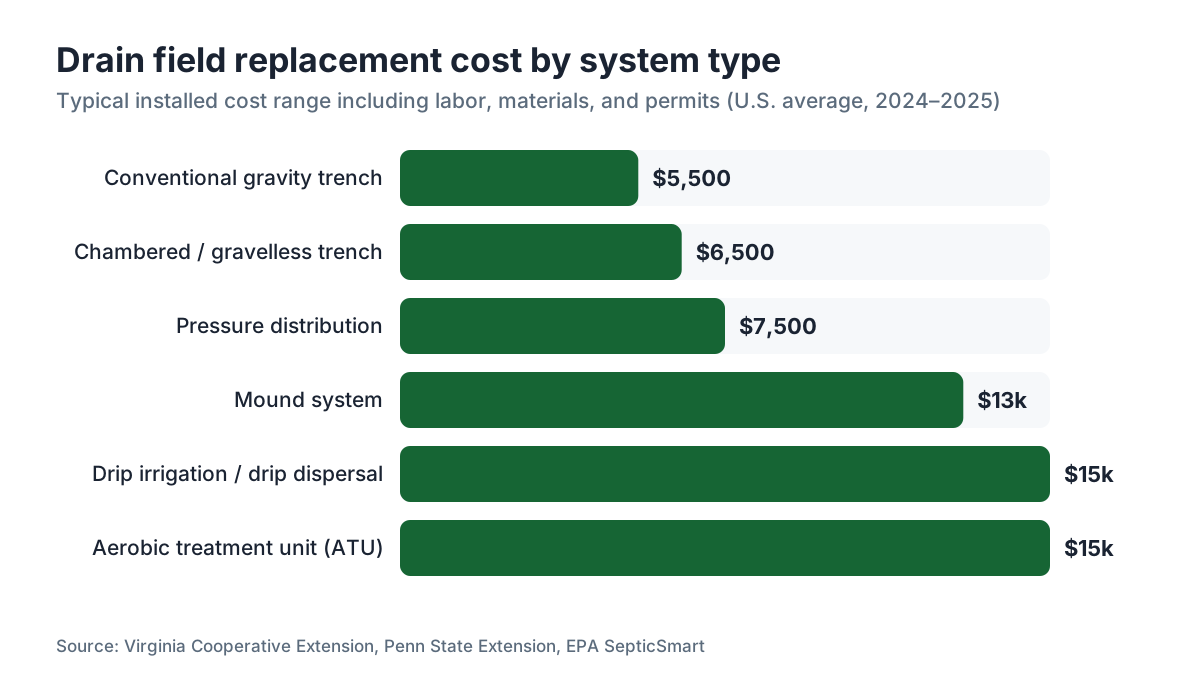
Drain field replacement cost by system type
The table shows typical installed cost ranges by system type. These are total project costs including labor, materials, permits, and inspection. They do not include tank replacement (if the tank itself needs work, see septic tank repair).
| System Type | Typical Installed Cost | Best For |
|---|---|---|
| Conventional gravity trench | $3,000, $8,000 | Good soil, flat lot, adequate space |
| Pressure distribution | $5,000, $10,000 | Uneven lots, marginal soil perc |
| Mound system | $8,000, $18,000 | High water table, slow-perc soil |
| Drip irrigation / drip dispersal | $10,000, $20,000 | Small lots, sensitive areas, poor soil |
| Aerobic treatment unit (ATU) | $10,000, $20,000+ | Challenging sites, setback failures |
| Chambered / gravelless trench | $4,000, $9,000 | Standard lots, alternative to gravel |
Gravity trenches stay the most common replacement because they cost the least when soil and space allow it. The EPA estimates about 20% of U.S. households run on septic systems, and most of those use some form of trench-and-gravel absorption field [1].
Chambered systems (Infiltrator is the brand you'll hear most) skip the gravel and use plastic arches. They cost a bit more in materials but often less in delivery and labor. Plenty of installers prefer them now. They aren't better or worse for treatment. They're just lighter to haul and quicker to set.
Can you repair a drain field instead of replacing it?
Sometimes. A failed field isn't always dead for good, and repair is worth investigating before you commit to full replacement.
Hydro-jetting the lateral lines ($300 to $800) clears roots and biomat in early-stage failures. Septic additives and bacteria treatments are mostly wasted money. The EPA and most state regulators are skeptical of biological additives as a repair strategy, and no peer-reviewed evidence shows they reliably bring a failed field back [3].
Aerification (also called soil fracturing or terralift) forces compressed air into the soil around the lines to break up biomat and compaction. It runs $1,000 to $3,000. It helps some biomat-clogged systems and is worth trying before you excavate, as long as the field isn't in total failure.
Resting the field means redirecting flow to a second field (if you have one) for 6 to 12 months so the biomat can decompose. Many older properties were built with two alternating fields for exactly this.
Full replacement is the right call when the soil has irreversible biomat saturation, the field has physically collapsed, perc results fail across the whole area, or local code forces an upgrade (common after a sale).
For the broader picture on repairing the system as a whole, the septic system repair guide covers tank, pump, and distribution box fixes separately from field work.
How much does a drain field inspection and perc test cost?
Before any replacement you pay for diagnostics. A basic drain field inspection by a licensed inspector runs $100 to $300. It usually covers a visual check, a look at the distribution box, and probing the surface for wet spots or odors. A full perc test runs $300 to $700. Budget $500 to $2,000 total before you sign a contract.
A dye test (flushing fluorescent dye through the system to check for surface breakout) adds $50 to $150 and shows up often in real estate deals.
The perc test itself is required by most state codes before a new field gets permitted. The $300 to $700 range depends on how many test holes you need and local labor rates. Some states require a licensed soil scientist or professional engineer to run or supervise it, which raises the bill [2].
If your county wants a site evaluation report from a licensed soil evaluator or sanitarian, add $500 to $1,500. That is separate from the permit fee.
Don't skip these. A perc test run in the wrong season, on frozen or saturated ground, can give a misleading result and cost you far more later.
What does drain field replacement cost by state?
State variation is real and large. These are honest estimates pulled from state extension programs and industry reporting.
| State/Region | Typical Range | Notes |
|---|---|---|
| Southeast (GA, AL, SC, TN) | $3,000, $8,000 | Lower labor and permit costs |
| Midwest (OH, IN, MO, KS) | $4,000, $10,000 | Moderate; clay soils push to higher end |
| Texas | $4,000, $12,000 | TCEQ rules vary by county; some ATU requirements |
| New England (MA, CT, NH) | $8,000, $20,000 | Strict Title 5 rules in MA; high engineering costs |
| Pacific Northwest (WA, OR) | $8,000, $18,000 | Wet climates drive mound/ATU requirements |
| California | $8,000, $25,000+ | County-specific; Bay Area labor rates high |
| Florida | $5,000, $15,000 | High water table common; mound systems frequent |
Massachusetts is the outlier worth understanding. Title 5 (310 CMR 15.000) requires a licensed inspection before any property sale, and replacement systems have to meet setback distances that are hard to hit on older lots. That pushes many homeowners straight to engineered alternatives [4]. Title 5 took effect in 1995 and has flagged thousands of failing systems statewide since.
Texas regulates onsite systems through the TCEQ (Texas Commission on Environmental Quality), and county rules vary a lot. Some rural counties require ATUs as the default even on new installs, which raises the baseline cost [5]. Florida's high water table means mound and other alternative systems come up often, and every drain field replacement needs a permit statewide [12].
Does homeowners insurance cover drain field replacement?
No. Standard homeowners policies do not cover drain field replacement, and that is one of the harshest surprises when a field fails.
Most policies exclude underground systems, gradual damage, and maintenance failures. Biomat clogging and soil saturation are slow processes, so insurers file them under maintenance rather than a sudden covered event.
Some insurers sell a septic rider or endorsement for an extra $40 to $100 a year. These vary a lot. Some cover repair of specific parts (pump, tank, inlet baffle) but explicitly exclude the absorption field. Read the exclusions before you pay anyone.
Home warranties are just as limited. Most plans exclude drain fields by name, or cap coverage at $1,000 to $1,500, which barely dents a replacement.
Your real protection is prevention. Regular septic tank pumping every 3 to 5 years keeps solids out of the field and is the best documented way to stretch field life. The EPA SepticSmart program calls "having your septic system inspected and pumped regularly" the top maintenance priority for system longevity [1].
Are there grants or financing options for septic drain field replacement?
Yes, and homeowners skip them all the time.
USDA Rural Development offers loans and grants for septic repair and replacement through its Section 504 Home Repair program and the Water and Environmental Programs. Low-income rural homeowners may qualify for grants up to $10,000 or loans up to $40,000 [6]. Income limits apply and vary by county.
The EPA's Clean Water State Revolving Fund (CWSRF) sends money to states, which can steer it into onsite septic repair programs. Vermont, North Carolina, Maine, and Minnesota all run active low-interest loan programs for failed septic systems [7]. Call your state environmental or health agency and ask what's funded right now.
Some county health departments offer hardship assistance or loan programs tied to public health rules. These are patchwork and you have to ask directly, but they exist more often than people think.
Most septic contractors don't offer in-house financing. Personal loans and home equity lines are the common paths. Rates as of mid-2025 swing widely, so shop before you borrow. A $10,000 project financed at 8% over 5 years adds about $2,165 in interest.
If you're replacing more than the field, cost to install septic system covers full system pricing.
How long does drain field replacement take?
The digging is fast. A typical gravity trench replacement takes 1 to 3 days of active excavation and installation once the equipment is on site. The full timeline from decision to finished system is far longer. Plan on 6 to 16 weeks in most jurisdictions.
Here is a realistic sequence:
- Perc test and soil evaluation: 1 to 4 weeks (depends on scheduling and soil conditions)
- Permit application and approval: 2 to 8 weeks (varies enormously by county)
- Contractor scheduling: 1 to 6 weeks depending on season and demand
- Installation: 1 to 3 days
- Final inspection: 1 to 5 business days after installation
If your system is actively failing (sewage surfacing, backups into the house), call your county health department right away. Most jurisdictions have an emergency permit process that compresses the timeline when there's a public health risk.
Don't run the system at normal volume while you wait. Cut water use hard. Every gallon you send to a failing field makes recovery harder and can create surface discharge that violates state code.
What's the difference between drain field repair and full drain field replacement?
Repair is any fix short of excavating and rebuilding the absorption area. That covers jetting lines, replacing a distribution box ($300 to $600), swapping a broken lateral segment ($200 to $800), or treating for roots. Repair makes sense when the failure is localized, the soil still absorbs effluent, and the fix targets one specific mechanical or biological problem.
Replacement means excavating the old field (or abandoning it in place per local code), laying new perforated pipe or chambers, adding aggregate or media, and backfilling. It's warranted when the soil is saturated and can't absorb, the biomat has spread through the whole absorption zone, or a perc re-test shows the area can't carry the required design load.
Some installers offer "partial replacement," adding new trenches next to the old ones in unused soil. This only works with enough setback distance and suitable soil nearby. It costs roughly 60 to 80% of a full replacement when conditions allow.
Operators tracking repair versus replacement across many service accounts use tools like SepticMind to flag system status and set inspection reminders, which helps sort emergency response from routine monitoring.
For the tank side, septic tank repair covers what you can fix without a full replacement.
How do you know when a drain field is failing?
By the time most homeowners notice, the signs are obvious. That's the problem. The earlier warnings are quiet.
Early signs: slow drains across the house (more than one fixture), gurgling in drains after a flush, and oddly green, lush grass right over the field, especially in dry weather.
Late signs: sewage odor in the yard or house, wet or spongy ground over the field, sewage surfacing on the lawn (a public health violation in every state), and sewage backing up into the lowest fixtures indoors.
Here's a useful diagnostic. If a washing machine load triggers a backup but the toilet flushes fine, the field is likely hydraulically overloaded (too much water at once). Spread laundry across the day and see whether the problem is flow rate or true field saturation.
Regular pumping is the best early-warning system you have. A pumper who inspects the baffles and checks effluent quality can catch trouble before it reaches the field. Start with how often to pump your septic tank to set that schedule.
The EPA's SepticSmart program tells homeowners to watch for "wet areas or standing water around the septic system" as a primary failure sign [1].
How can you make a new drain field last as long as possible?
A well-maintained drain field should last 25 to 30 years, according to North Carolina State Extension [8]. Fields that die in 10 years almost always had a preventable cause.
Pump the tank on schedule. The number one cause of early field failure is solids carryover from an overfull tank. A tank pumped every 3 to 5 years keeps the effluent leaving at decent quality. See how often to pump septic tank for sizing-based guidance.
Spread your water use. Don't run six loads of laundry on a Saturday. Hydraulic overload is a genuine failure mode. A field rated for 1,000 gallons a day can't take 400 gallons in two hours without shoving half-treated effluent into the soil faster than it can absorb.
Keep vehicles and heavy equipment off the field. Compaction crushes the air pockets that let aerobic bacteria treat effluent. One pass from a riding mower is fine. One pass from a delivery truck can do permanent damage.
Plant grass, not trees. Tree roots hunt for water and will find your lines. Keep trees 20 to 30 feet from the field boundary, and pull any large existing trees closer than that.
Don't flush wipes, grease, or harsh chemicals. They block the tank inlet, kill the bacterial colony, or pass through and clog the lines. The "flushable wipes" category has drawn heavy litigation precisely because the things don't break down.
Add a septic tank riser if you don't have one. Easy access means inspections and pumping actually happen on schedule instead of getting put off because finding the lid is a half-day dig.
Frequently asked questions
How much does a new septic drain field cost for a 3-bedroom house?
A 3-bedroom home usually generates 300 to 450 gallons of wastewater a day and needs a field sized to match, typically 750 to 1,200 square feet of absorption area. Expect $4,000 to $10,000 for a conventional gravity system in most U.S. markets. Difficult soil or a high water table pushes that to $10,000 to $18,000 for a mound or drip system.
Can I replace a drain field without replacing the septic tank?
Yes, if the tank is structurally sound and correctly sized. An inspector checks for cracks, baffle condition, and capacity. If the tank is fine, you replace only the field and distribution components. If it's undersized for the house or cracked, replacing both at once saves a second round of excavation and permitting. Get the tank inspected before you commit either way.
How long does a septic drain field last before it needs replacement?
A properly maintained field lasts 25 to 30 years. Fields that never get pumped, that take grease or chemicals, or that suffer compaction and root intrusion often fail in 10 to 15 years. The single biggest longevity factor is pumping frequency. Letting solids overflow into the field is the fastest way to destroy it.
Does replacing a drain field require a permit?
Yes, in nearly every jurisdiction in the United States. Onsite wastewater systems are regulated at the state and county level, and most require a soil evaluation, a design plan, a permit, and a final inspection before the system gets covered. Installing without a permit risks fines, forced removal, and title problems when you sell.
What is the cheapest type of drain field replacement?
A conventional gravity trench with gravel or chambered plastic arches is consistently the cheapest, at $3,000 to $8,000 installed. It only works where soil percolation and lot geometry allow it. You can't force the cheap option if your soil fails the perc test. The alternative system isn't pricier because the contractor picked it. It's pricier because code requires it.
How do I get multiple quotes for drain field replacement?
Contact at least three licensed septic contractors in your county. Verify each holds a current license with your state health or environmental agency (most states publish lookup tools online). Insist that every quote itemizes the perc test, permit fees, soil evaluation, installation, and inspection separately. That way you compare the same scope across bids instead of trusting the lowest number from whoever left out the fees.
Will a failing drain field affect my property value or ability to sell?
Yes, a lot. Many states require a septic inspection at or before sale, and a failed field has to be disclosed. In Massachusetts, a Title 5 failure generally requires repair or replacement within two years of the inspection or before closing. Buyers usually negotiate the full replacement cost off the price, sometimes more. Handle it before listing when you can.
Can I install a drain field myself to save money?
Technically possible in a few states with light regulation, but almost always a bad idea and illegal without permits. Most states require a licensed installer, a licensed engineer or soil evaluator, and multiple inspections. A DIY field that fails inspection has to be dug up and redone. The licensing rules exist because a failed field is a public health problem, more than a property one.
How does soil type affect drain field replacement cost?
Soil type is the biggest variable after system size. Sandy or loamy soil drains well and usually allows a cheap gravity trench. Clay or silt perc too slowly and require a mound or ATU at $8,000 to $20,000. Bedrock near the surface limits trench depth and may force a mound. A soil evaluation before you get quotes tells you which system type you're actually facing.
What's the difference between a leach field and a drain field?
They're the same thing. Leach field, drain field, absorption field, and leachfield all name the network of perforated pipes or chambers buried in the soil that takes septic tank effluent and lets it percolate into the ground. Some regions favor one term over another, but there's no technical difference. You may also see 'seepage bed' for a wider, shallower version.
Is drain field replacement tax deductible?
Generally no, not as a current-year deduction on a primary residence. It's a capital improvement, which can raise your cost basis and lower capital gains when you sell. On a rental property, the cost may be depreciable. Talk to a tax professional about your situation. A few states offer credits for septic upgrades near sensitive water bodies.
What happens if I ignore a failing drain field?
It gets worse until sewage surfaces in your yard or backs up into your home. Surface discharge of sewage violates state environmental law in every state and can bring fines, mandatory repair orders, and in bad cases a ban on using the system. Beyond the legal risk, it's a real health hazard. Acting early, when you first see slow drains or wet spots, is always far cheaper than emergency replacement.
How do USDA or government programs help with drain field replacement costs?
The USDA Section 504 Home Repair program offers grants up to $10,000 for very low-income rural homeowners for essential repairs including septic, plus loans up to $40,000 at low interest. The EPA's Clean Water State Revolving Fund sends money to states that run their own septic loan programs. Vermont, Maine, North Carolina, and Minnesota have active programs. Call your county extension office or health department to find what's available locally.
Sources
- U.S. EPA, SepticSmart Program: EPA estimates 20% of U.S. households use septic systems; SepticSmart advises regular pumping and inspection as the top maintenance priority; typical new septic system cost range cited
- U.S. EPA, Onsite Wastewater Treatment Systems Manual (EPA/625/R-00/008): State onsite wastewater codes require licensed soil evaluators to conduct percolation tests before permitting; soil type determines appropriate system design
- U.S. EPA, Septic System Additives: EPA takes a skeptical view of biological additives as a repair strategy for failed drain fields; no documented reliable restoration of failed absorption areas
- Massachusetts DEP, Title 5 Regulations (310 CMR 15.000): Massachusetts Title 5 requires licensed inspection before property sale and mandates repair/replacement of failed systems within two years or before sale
- Texas Commission on Environmental Quality (TCEQ), On-Site Sewage Facilities: TCEQ regulates onsite sewage facilities in Texas; county-level rules vary and some require aerobic treatment units as the default system type
- USDA Rural Development, Section 504 Home Repair Program: USDA Section 504 offers grants up to $10,000 and loans up to $40,000 for low-income rural homeowners for essential repairs including septic systems
- U.S. EPA, Clean Water State Revolving Fund: EPA's CWSRF flows funding to states which can direct it to onsite septic repair and replacement loan programs for homeowners
- North Carolina State Extension, Septic Systems and Their Maintenance: Properly maintained drain fields last 25-30 years; solids carryover from infrequent pumping is the leading cause of premature field failure
- Virginia Cooperative Extension, Septic System Owner's Manual: Conventional gravity trench systems are the least expensive drain field type; pressure distribution and mound systems required for challenging soil conditions
- Florida Department of Health, Onsite Sewage Program: Florida's high water table frequently requires mound or other alternative systems; permit required for all drain field replacements statewide
Last updated 2026-07-09