Drain field services: what they are, what they cost, and when you need them
By the SepticMind Editorial Team
TL;DR
- Drain field services cover inspection, cleaning, aeration, resting, and full replacement of the leach field that filters wastewater into the soil.
- A basic inspection runs around $200.
- A full replacement runs $5,000 to $20,000 or more.
- Most failing fields signal trouble for months before they need replacement, so early diagnosis almost always saves money.
What is a drain field and what does it actually do?
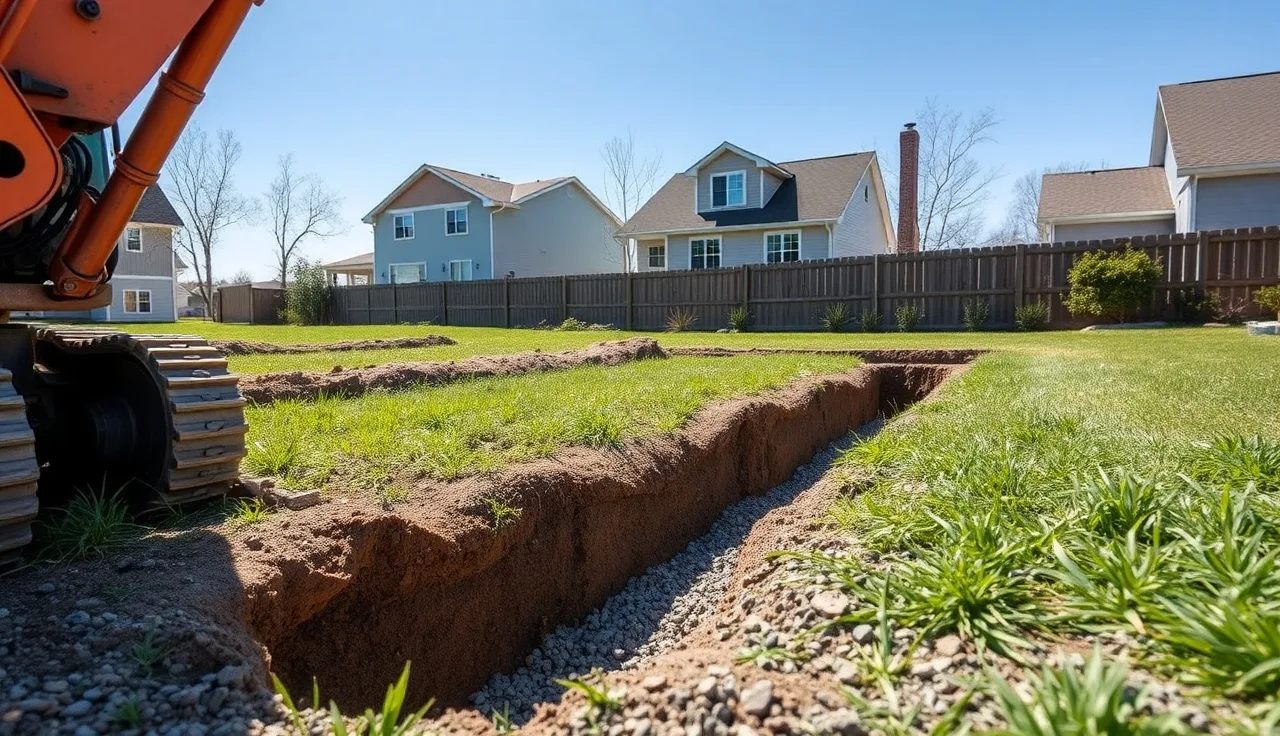
A drain field, also called a leach field or soil absorption system, is a network of perforated pipes buried in gravel-filled trenches that spreads septic effluent into the surrounding soil. The soil does the real work. It filters pathogens, strips nutrients, and returns clean water to the water table. Take away a working drain field and your septic system has nowhere to send treated wastewater, so sewage backs up fast.
The EPA's SepticSmart program describes a conventional drain field as "a series of trenches or a bed lined with gravel or crushed stone" below the distribution box, where effluent drains slowly through the rock layer and into native soil [5]. That soil layer, usually 2 to 4 feet of native earth above the seasonally high water table, is what protects groundwater and drinking wells.
Most conventional systems are gravity-fed. The tank sits uphill from the field, and effluent flows downhill by grade. Pressure-dosed systems use a pump to spread effluent more evenly. Mound systems lift the drain field above native grade when the soil is too shallow or too wet. Each design calls for a slightly different service approach, but the goal never changes: get treated effluent into aerobic soil where it can be safely absorbed.
The drain field is the same component as your leach field, and it's the part most homeowners ignore until it dies. That's backwards. It's also the single most expensive component to replace.
What drain field services exist, and which one do you actually need?
There are six main categories of drain field service. They are not interchangeable, and the wrong one wastes money.
Inspection. A technician locates the field, checks the distribution box, probes the trenches for saturation, and may camera-scope the outlet line. This is always the right first step. If a contractor quotes $3,000 in treatment before doing an inspection, walk away.
Pumping the septic tank. Not technically a drain field service, but a full tank is the most common cause of field failure. Solids overflow into the trenches and clog the biomat, the thin bacterial layer that filters effluent. If you haven't pumped in 3 to 5 years, do that before anything else. See our guide on septic tank pumping.
Aeration or resting. Sometimes the field just needs to dry out. If you have an alternate field (many older systems were permitted with two fields that switch back and forth), you divert flow to the resting field and give the saturated one 6 to 12 months to recover. No chemicals, no heavy equipment. When this works, it's essentially free.
Jetting or hydro-jetting. High-pressure water is forced through the distribution pipes to break up biomat and flush debris back toward the tank. It's controversial. Some extension programs say it can restore partial function, and critics say it just re-suspends the clog. Virginia Cooperative Extension notes that jetting is "often proposed but rarely proven" for biomat remediation [2]. I'd only do it after a camera inspection shows the pipe itself is clogged, not the surrounding soil.
Soil fracturing or aeration injection (Terralift, bio-remediation). A probe is driven into the trench and air is injected to fracture compacted soil and restore permeability. Some contractors also inject biological cultures or enzymes. The evidence is genuinely mixed. A few university studies found short-term permeability gains, but long-term data is thin. Costs typically run $1,500 to $4,000 for a full field.
Replacement or new installation. When the soil is biologically sealed (true biomat failure) or structurally wrecked, the only real fix is a new field. That means a new perc test, a permit, excavation, and installation. It's expensive and disruptive, and it's permanent. Our guide on septic system repair walks the process end to end.
What does drain field service cost?
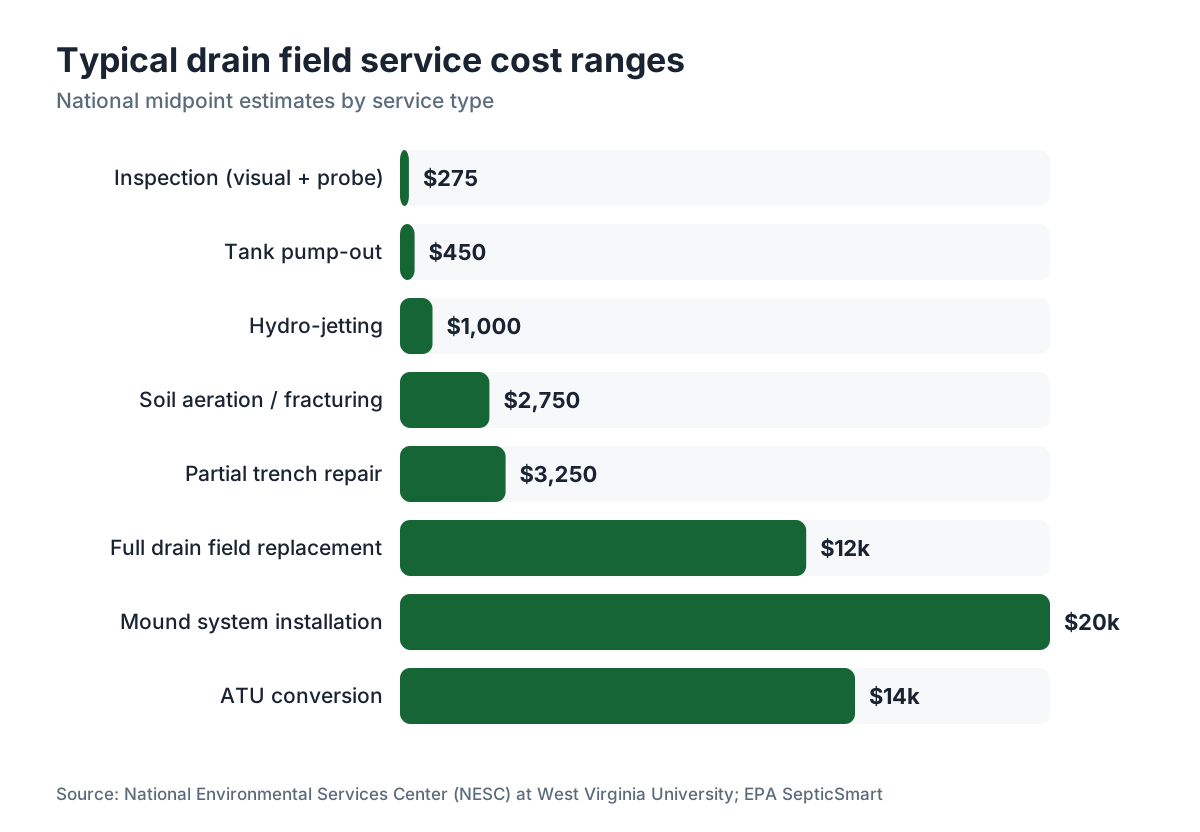
Cost swings hard by service type, region, and site conditions. The table below gives honest national ranges based on contractor pricing and extension cost estimates. Rural areas with long equipment hauls push numbers up. Dense suburban markets tend to be more competitive.
| Service | Typical cost range | Notes |
|---|---|---|
| Inspection (visual + probe) | $150 to $400 | Should include distribution box check |
| Tank pump-out (if needed first) | $300 to $600 | See septic tank pump out |
| Hydro-jetting | $500 to $1,500 | Effectiveness varies; camera first |
| Soil aeration / fracturing | $1,500 to $4,000 | Short-term; no guarantee |
| Partial trench repair | $1,500 to $5,000 | If only one arm of the field is failed |
| Full drain field replacement | $5,000 to $20,000+ | Site and permit dependent |
| Mound system installation | $10,000 to $30,000+ | Poor soils or high water table |
| Aerobic treatment unit (ATU) conversion | $8,000 to $20,000 | Alternative when soil is limiting |
The biggest cost driver for replacement is soil testing and permitting, not the pipe and gravel. A new perc test runs $500 to $1,500 by itself, and permits in states like California or New York add another $500 to $2,000. Some jurisdictions require an engineer's stamp on the design, which adds $1,000 to $3,000 more [9].
A flat "rejuvenation" price quoted over the phone, sight unseen, is a red flag. Real contractors want to inspect first. EPA SepticSmart guidance warns homeowners that "products claiming to fix or clean septic systems" rarely perform as advertised and are no substitute for proper maintenance [1].
For full installation numbers, our guide on cost to install septic system breaks down what drives the final figure.
What are the warning signs that your drain field is failing?
Drain fields rarely fail overnight. They give you months of warning, and catching it early is the difference between a $500 fix and a $15,000 replacement.
The clearest sign is wet, spongy, or perpetually soggy ground right above the trench lines, especially during a dry stretch. If you can trace your trenches by the strip of lush green grass growing over them, the field is surfacing effluent. That's a public health problem, more than an eyesore.
Slow drains across the whole house come next. A single slow drain usually means a clog in one pipe. Slow drains everywhere, with the tank already pumped, almost always points to the field.
Sewage odor in the yard, especially near the field or the distribution box, means effluent isn't being absorbed fast enough. If the smell is inside the house, check the tank first, but a failed field can push gases backward through the system.
Backups at the lowest drain in the house (usually a floor drain or a first-floor toilet) during heavy rain are a classic sign of a hydraulically overloaded field. The soil is saturated, the field can't take more, and effluent has nowhere to go but up.
High nitrate levels in a nearby well, confirmed by a water test, can mean the field isn't treating effluent well. The EPA recommends annual water testing for homes within 200 feet of a septic system [1]. This sign shows up slowly, but it's the most serious one on the list.
How long does a drain field last, and what shortens its life?
A well-built, properly maintained conventional drain field should last 25 to 30 years, per University of Minnesota Extension guidance [6]. Some go 40 or more. Others die at 10. The spread is almost entirely about how the system was operated, not any flaw in the design.
The number one killer is overloading with solids. When the tank isn't pumped, partly digested solids overflow into the distribution pipes and feed an anaerobic biomat that seals the soil. The pores clog with a slimy bacterial layer and the field stops draining. Once that biomat sets deep in the soil, it's very hard to reverse.
Too much water is the second killer. The field is sized for a design flow, roughly 75 to 100 gallons per person per day for a conventional home, though state standards vary. The EPA recommends designing at 75 gallons per bedroom per day [3]. Three loads of laundry in one afternoon, a house full of guests, or a new garbage disposal all shove flow past that rate and drown the field before it can drain.
Compaction from parking, driving, or construction over the field crushes the pipe and collapses the gravel. Tree and shrub roots grow into the pipes and do the same mechanical damage. Keep heavy equipment and deep-rooted plants off the field, permanently.
Chemicals matter too. Bleach, drain cleaners, and antibacterial products kill the bacteria in both the tank and the field biomat. Household chemicals in moderation aren't a real problem. Dumping cleaning products or old medications down the drain on a regular basis genuinely harms the biology.
How often you should pump the septic tank ties straight to field life. Regular pumping stops the overflow that starts the biomat sealing in the first place.
Can a drain field be repaired, or does it always need full replacement?
This is the question homeowners most want a clean yes-or-no on, and the honest answer is that it depends on why it's failing.
If the failure is hydraulic (soil saturated from too much water, compaction from above, or a seasonal high water table), rest and reduced water use can bring it back. The EPA notes that resting a drain field by temporarily diverting flow to an alternate system is a legitimate remediation strategy [1]. This costs nothing beyond the plumbing to divert flow, and it works as long as the soil itself isn't permanently sealed.
If the failure is biological (true biomat sealing after years of solids overflow), the outlook is worse. Some aeration treatments restore partial permeability, but most extension services doubt the recovery lasts. Virginia Cooperative Extension guidance says no chemical or biological additive has been proven to reliably restore a failed drain field, and some may actually harm soil structure [2].
Partial replacement is sometimes an option. If one or two trench arms have failed and the rest of the field works, you may be able to abandon the dead arms and install new lateral lines nearby where the soil still passes percolation. That takes a permit and a site evaluation, but it can cut cost sharply against a full new system.
Full replacement is unavoidable when the native soil across the whole field is permanently impermeable, when site conditions have changed (rising water table, erosion), or when the system was undersized for how the household actually lives.
For septic tank repair problems that are separate from the field, the process and cost profile look different.
What happens during a professional drain field inspection?
A real drain field inspection takes 1 to 3 hours and goes well past looking at the ground. Here's what a thorough one covers.
First, the technician locates the tank, distribution box, and field using as-built drawings from the county health department or a pipe locator. Plenty of homeowners have no idea where their field runs, and probing blind damages the system.
Next, the tank is opened and the liquid level checked. A level higher than the outlet baffle means the field isn't taking flow. The scum and sludge layers get measured to see if pumping is due. If you haven't had a septic tank cleaning in years, this step alone tells a story.
The distribution box comes next. It should sit level and split flow evenly to every trench arm. A tilted D-box dumps all flow into one arm, overloading it while the others sit dry. Re-leveling is a cheap fix, $200 to $500, and it can save a whole field.
Then the technician probes the soil above each trench arm with a steel rod. Saturated soil gives almost no resistance. Healthy, draining soil feels firm at 12 to 18 inches deep. Some inspectors pull a core sample to read soil texture and moisture directly.
A camera scope of the outlet pipe and distribution lines can catch root intrusion, pipe collapse, or biological buildup, and it adds $200 to $400 to the bill. It's worth doing before any expensive remediation.
Real estate inspections go further. A NAWT-certified inspector (National Association of Wastewater Technicians) runs a load test, sending water through for a set period and watching for surfacing or backup. Some states require this level at property sale. Our guide on septic tank inspection covers what real estate transactions demand specifically.
What permits and regulations govern drain field work?
Almost every state requires a permit to install or replace a drain field, and most require one for major repairs too. The permit exists because failed or badly designed fields contaminate groundwater, and that hits everyone on well water nearby.
Permits come from the county or local health department in most states, not the state agency, so requirements vary a lot even within one state. You can usually find the local onsite wastewater code on your county health department's website. The EPA keeps a state-by-state regulatory contact list through SepticSmart [1].
A new drain field permit almost always requires a percolation test, or a soil morphology evaluation, which most states now prefer over the old perc test, to confirm the soil can accept effluent at the required rate. Many jurisdictions require a licensed designer or engineer to draw the system. The installer has to be licensed under the state's onsite wastewater program. Pennsylvania's DEP, for example, requires a soil evaluation and a licensed installer for onsite sewage work [10].
Here's the number to know. Most states set a minimum vertical separation of 24 to 36 inches between the bottom of the drain field trenches and the seasonally high water table or bedrock. If your site can't hit that, you need an engineered alternative like a mound or drip system. The range across states runs from 18 inches in some older codes to 48 inches in newer codes for sensitive watersheds [12]. Check your own state code.
Skipping the permit is a serious mistake. It voids homeowner's insurance coverage for the work, it can force you to tear out and redo the system at your own cost if it's discovered, and it creates liability when you sell. Never skip the permit.
How do you find a qualified drain field service contractor?
Competence in this trade varies a lot, and the wrong contractor can make a failing field worse. Here's how to find someone legitimate.
Start with state licensing. Every state that licenses onsite wastewater contractors (most do) keeps a public lookup database. Search your state environmental agency or health department site for "onsite wastewater contractor license lookup." Five minutes here separates licensed contractors from unlicensed ones.
NAWT certification (National Association of Wastewater Technicians) is a voluntary national credential that requires passing written exams and field skills tests. Most states don't require it, but it signals the contractor takes the trade seriously. Find certified inspectors at nawt.org [4].
Get at least three quotes, and make each contractor visit the site before quoting. A phone quote for drain field work is fiction. Each quote should spell out what service they're doing, what equipment, and what happens if it doesn't work.
Ask this one directly: "What's my refund or recourse if this treatment doesn't solve the problem?" Honest contractors will tell you when a field is too far gone for remediation. Anyone who guarantees recovery without a site inspection is selling you something.
For operators managing multiple service accounts and customer records, SepticMind's operations software tracks inspection history, service intervals, and permit status across a customer base, which cuts down on missed follow-ups for at-risk systems.
Check the local health department referral list too. Some county departments keep lists of permitted contractors who have worked in compliance in their jurisdiction, and that's a real quality signal.
What's the difference between a drain field and an alternative system?
When native soil can't support a conventional drain field, alternative systems step in. The four most common are mound systems, drip irrigation, aerobic treatment units (ATUs), and constructed wetlands.
A mound system builds an engineered soil bed above grade using imported sand and gravel. You use it when the water table sits too high or there isn't enough depth to bedrock. Mounds cost a lot more to install, $10,000 to $30,000 and up, and they need more upkeep, including pump inspection and timer adjustment. They work on sites where a conventional field simply can't.
Drip irrigation doses tiny amounts of effluent through emitters buried a few inches down, using frequent small doses instead of the big periodic doses of a conventional field. It's far more land-efficient and handles tough soils, but it needs an ATU pretreatment stage and has more mechanical parts to service.
Aerobic treatment units pretreat effluent to a much higher quality before it hits the soil, using forced aeration to feed aerobic bacteria. Because the effluent comes out cleaner, the soil absorption area can be smaller. ATUs are common in states with strict groundwater rules or tight lots. Most states require quarterly maintenance contracts, and upkeep runs $100 to $300 per year [11].
The right system depends on soil type, lot size, setbacks, depth to groundwater, and local code. If you're replacing a failed conventional field and your lot is tight or the soil is marginal, get an engineering assessment before assuming a like-for-like swap is even possible. Full installation ranges for alternatives are in our cost to put in a septic tank guide.
How do you maintain a drain field to make it last?
Most drain field maintenance is household behavior, not a service you hire out.
Pump the tank on schedule. For a typical 3-bedroom home with a 1,000-gallon tank, that's every 3 to 5 years. The EPA's rule of thumb: pump when the sludge and scum layers together fill more than a third of the tank's liquid volume [1]. Don't wait for symptoms. A septic tank emptying is cheap next to a field repair.
Spread your water use across the week. Running the dishwasher, washing machine, and shower in the same two-hour window sends a hydraulic slug the field wasn't built to take. North Carolina State Extension guidance points to spacing out concentrated water use as a real way to avoid overloading [7]. Doing laundry across several days genuinely helps, especially if your household is at or above design flow.
Keep records. Know where the field is, when the tank was last pumped, and what the permit says about the design. No records? Your county health department usually has the permit on file.
Don't plant trees or shrubs near the field. Grass is the correct cover. It transpires water, holds the soil, and has shallow roots that leave the pipes alone. Keep the surface over the field clear of any structure, paving, or heavy equipment.
Never pour grease down the drain. Grease slips through the tank as a liquid and hardens in the cooler field pipes. It's one of the most reliable ways to speed up trench failure.
Schedule a professional inspection every 3 to 5 years even when nothing seems wrong. Catching a tilted distribution box or an early biomat costs a few hundred dollars. Ignoring it until the field fails costs tens of thousands.
A properly maintained conventional drain field, per EPA SepticSmart guidance, "can last for decades" with routine tank pumping as the main maintenance action [1].
What should you ask a contractor before hiring them for drain field work?
These are the exact questions I'd want answered before signing anything.
"Are you licensed for onsite wastewater work in this state, and can I see your license number?" If they can't answer in 30 seconds, stop there.
"What does this inspection include, specifically?" The answer should name the tank, the distribution box, probing the field, and a written report. "Looking around" is not an inspection.
"Have you pulled permits in this county before?" Local experience matters. County health departments have quirks. A contractor who's never worked your county may not know the local rules on setbacks, inspection steps, or approved materials.
"What will you do if this service doesn't fix the problem?" You need to know upfront whether you're buying a definitive repair or a trial treatment with no guarantee.
"Do I need my tank pumped before this work?" For any field remediation, the answer should almost always be yes. A contractor who wants to do field work with a full tank isn't thinking clearly about the process.
"Can you give me a written report after the inspection?" Written documentation is what you need for insurance, property sales, and your own records. A verbal report is worth nothing.
For service operators juggling scheduling and customer communication across these job types, tools like SepticMind keep inspection reports, service history, and follow-up scheduling in one place instead of scattered across paper folders and email threads.
Frequently asked questions
How much does drain field repair cost on average?
Minor repairs like re-leveling a distribution box run $200 to $500. Partial trench repair or aeration treatment typically costs $1,500 to $4,000. Full replacement runs $5,000 to $20,000 or more depending on system type, lot conditions, soil testing, and permit fees. A site inspection before any repair is the only way to get a realistic estimate.
Can a drain field be restored without replacing it?
Sometimes. If the field is failing from hydraulic overload or seasonal saturation, cutting water use and resting the field for several months can bring it back. If the failure is true biomat sealing from solids overflow, recovery is much harder. Hydro-jetting and soil fracturing have mixed evidence. No chemical additive has been proven to reliably restore a biologically failed field.
How long does a drain field replacement take?
The physical install usually takes 1 to 3 days once equipment is on site. But the full timeline from permit application to final inspection typically runs 4 to 12 weeks depending on your county's backlog, how fast a perc test can be scheduled, and how complex the design is. Plan for 6 to 8 weeks as a realistic middle estimate. Start the permit process the day failure is confirmed.
What are the signs of drain field failure I can see without digging?
Soggy or spongy ground above the trench lines that won't dry out, unusually lush green grass over the field, sewage odor in the yard near the field, slow drains throughout the house, and backup at the lowest drain during heavy rain or high water use. Any one of these warrants a professional inspection. Several at once means act now.
Does homeowners insurance cover drain field failure?
Standard policies almost never cover failure from wear, negligence, or lack of maintenance, which is most failures. Some policies offer a rider for sudden and accidental collapse of underground systems. Read your policy and ask your insurer specifically about septic coverage before you need it. Permitted work is required for any claim to have a chance.
How often should a drain field be inspected?
Every 3 to 5 years as part of a routine septic inspection is the standard recommendation from most state extension programs. If your household is larger than the system was designed for, or the system is over 20 years old, inspect every 2 to 3 years. Real estate transactions almost always require a fresh inspection regardless of when the last one happened.
Can you use additives or enzymes to clean a drain field?
EPA SepticSmart states that products claiming to clean or restore septic systems are generally unproven and are no substitute for proper maintenance and pumping. Some enzyme products may support normal tank function at the margins, but no additive has shown a reliable ability to clear a failing drain field. Save the money and spend it on a proper inspection.
What's the difference between a drain field and a leach field?
Nothing. They're the same thing. "Drain field," "leach field," and "soil absorption system" all name the network of perforated pipes in gravel trenches that takes septic effluent and spreads it into the soil for final treatment. Terminology varies by region: the Southeast tends to say drain field, New England often says leach field. The function and service needs are identical.
Does a failed drain field affect well water?
Yes, it can. A field that surfaces effluent or saturates the soil above the water table can push nitrates, bacteria, and pathogens into nearby groundwater. The EPA recommends annual water testing for homes within 200 feet of a septic system. If a neighbor's well or your own shows elevated nitrates or coliform bacteria, a failing drain field is one of the first things to check.
Do I need a permit to repair or replace a drain field?
In almost every jurisdiction, yes. Full replacement always requires a permit. Many states also require permits for major repairs, including adding new trench lines or relocating part of the field. Permits require a soil evaluation and an approved design. Working without one creates liability at sale, can void insurance, and may force you to tear out and redo the work.
How do I find out where my drain field is located?
Start with your county or local health department. Most jurisdictions keep the as-built permit documents on file, which show the field layout and rough dimensions. If no records exist, a septic contractor can locate the system with a pipe locator or by tracing from the cleanout. Know the field location before any landscaping or excavation near the home.
Can I drive or park on my drain field?
No. Heavy vehicles compact the soil over the trenches and can crush the perforated pipes. Even repeated passes with a lawn tractor over the same path cause measurable compaction over time. Keep all vehicles, heavy equipment, and permanent structures off the field. This is one of the most common causes of premature failure, and it's entirely preventable.
What happens during drain field replacement?
After permits clear, an excavator removes the old pipe, gravel, and often some of the biologically saturated soil. New trenches are dug in the permitted area, gravel is laid, perforated pipe is set at the correct grade, and the trench is covered with fabric and backfill. A new distribution box usually goes in. The county inspector visits before backfill to confirm the install matches the permitted design.
How do I choose between repairing and replacing my drain field?
Get a full inspection first. If the failure is hydraulic and the soil structure is intact, repair or resting is worth trying. If the soil has true biomat sealing from years of solids overflow, or the system is old and undersized, replacement usually costs less over 10 years than repeated failed remediation attempts. A good contractor gives you an honest read; one who pushes expensive treatments before inspecting is not.
Sources
- U.S. Environmental Protection Agency, SepticSmart Program: EPA SepticSmart program guidance on drain field maintenance, rest as a remediation strategy, additive effectiveness, water testing, and tank pumping thresholds
- Virginia Cooperative Extension, Septic System Operation and Maintenance: Virginia Cooperative Extension statement that hydro-jetting is often proposed but rarely proven for biomat remediation, and that no chemical or biological additive reliably restores a failed drain field
- U.S. Environmental Protection Agency, Onsite Wastewater Treatment Systems Manual (2002): EPA design flow guideline of 75 gallons per bedroom per day for conventional residential septic system sizing
- National Association of Wastewater Technicians (NAWT): NAWT provides voluntary national certification for onsite wastewater inspectors requiring written and field skills testing
- U.S. Environmental Protection Agency, How Your Septic System Works: EPA description of a conventional drain field as a series of trenches or a bed lined with gravel or crushed stone below the distribution box
- University of Minnesota Extension, Septic System Owner's Guide: Guidance on drain field lifespan of 25 to 30 years with proper maintenance, and that solids overflow is the primary cause of premature failure
- North Carolina State University Extension, Septic Systems and Their Maintenance: Guidance on spreading household water use as a maintenance strategy and the risk of hydraulic overloading from concentrated use periods
- National Environmental Services Center (NESC) at West Virginia University: Cost range data and permit process requirements for drain field inspection, repair, and replacement, including mound system and ATU cost ranges
- Pennsylvania Department of Environmental Protection, Onsite Sewage Facilities: State permit requirements for drain field installation, repair, and replacement including soil evaluation and licensed installer requirements
- University of Florida IFAS Extension, Septic Tank Systems: Guidance on aerobic treatment units, drip irrigation alternatives, and maintenance contract requirements for alternative systems
- Texas Commission on Environmental Quality, Onsite Sewage Facilities Rules: State-level example of minimum vertical separation requirements between drain field bottom and seasonal high water table or bedrock
Last updated 2026-07-09