Drain field rock: what it is, why it matters, and how to pick it
By the SepticMind Editorial Team
TL;DR
- Drain field rock (usually 1.5-inch clean washed gravel) surrounds the perforated pipes in a leach field and does two jobs.
- It holds the pipe up so it doesn't sink and crush, and it lets effluent spread out and percolate into the soil before it reaches the biomat.
- Get the size, cleanliness, or depth wrong and the field fails in years instead of decades.
What is drain field rock and what does it actually do?
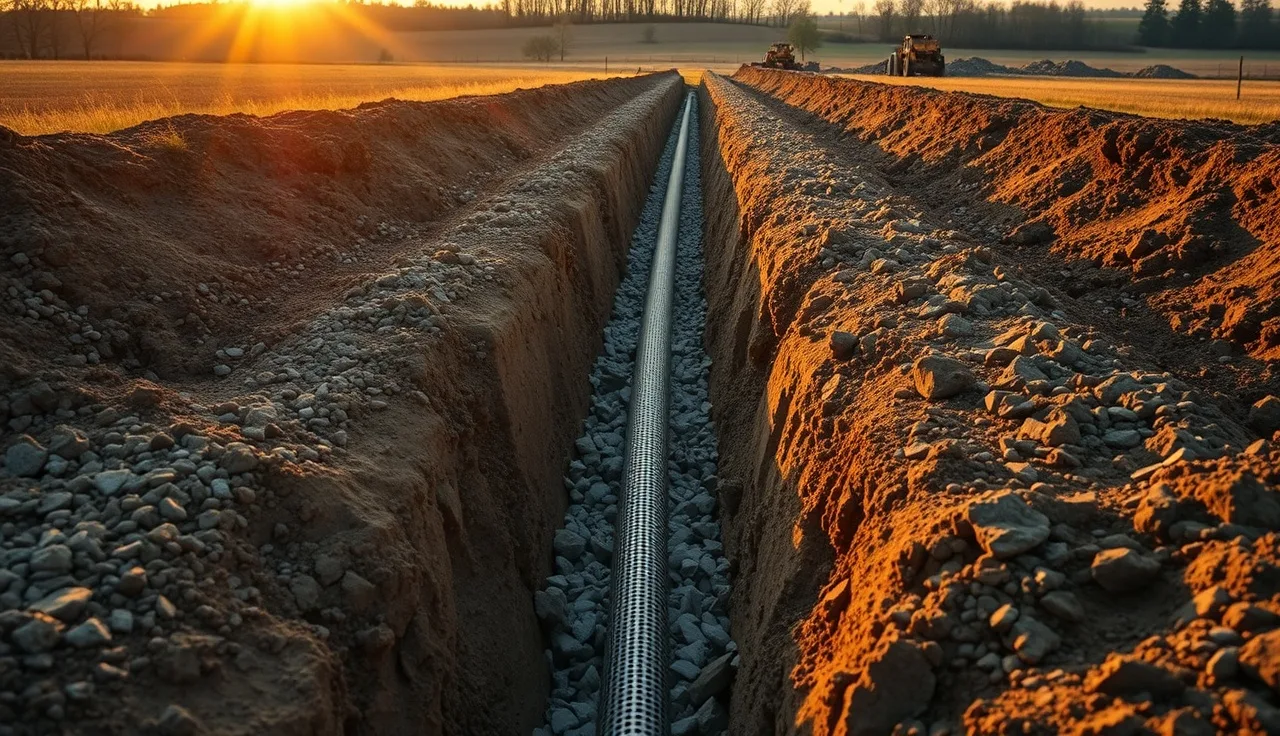
Drain field rock is the layer of washed, angular gravel that fills the trench around the perforated distribution pipe in a conventional leach field. It's not decorative. It's not filler. The system physically can't work without it, and it does three things.
First, it distributes effluent. Liquid leaving the pipe doesn't drop straight down. It spreads sideways through the void space between gravel pieces, which gives it time and surface area to percolate before it reaches native soil. Tight, fine material saturates immediately and pushes effluent to the surface. Coarse rock makes the air gaps that stop that from happening.
Second, it protects the pipe from the soil. Perforated pipe sitting in direct contact with soil either crushes under the trench backfill or clogs with fine particles inside a season or two. The gravel holds the pipe at grade and keeps fine soil from working its way in.
Third, it supports the bacteria that treat the effluent. The underside of the rock layer is where the biomat forms, a thin biological layer that cleans effluent before it enters native soil. The EPA's SepticSmart program describes a healthy biomat as part of normal operation, not a failure sign [1]. Without enough rock depth below the pipe, there isn't enough surface area for that layer to work.
You'll hear drain field rock called drain rock, septic gravel, leach rock, or just crushed stone. Same material. The name changes by region.
What size rock does a drain field need?
The industry standard, and the size written into most state onsite wastewater codes, is 3/4-inch to 2.5-inch clean washed crushed stone or river gravel [2]. Most installers default to 1.5-inch nominal size. It sits right in the middle of that window and it's usually the easiest to get from a quarry.
Size matters more than people think. Go too small (pea gravel at 3/8 inch) and the void space collapses under compaction, which slows drainage. Go too large (3 inch and up) and the pieces bridge over the pipe perforations, leaving dead zones where effluent pools instead of spreads.
The old ASTM C33 gradations for Coarse Aggregate No. 3 (1.5 to 3 inches) and No. 4 (3/4 to 1.5 inches) show up in state specs as acceptable ranges [3]. If your installer buys from a quarry, ask for a gradation certificate and check that it falls between those limits.
Angularity counts too. Angular crushed stone locks together better than smooth river gravel, so it stays put under the pipe and doesn't shift as effluent moves through. Many state codes (North Carolina's 15A NCAC 18E is a good example) require stone that's clean, hard, and durable, with only a small percentage of fines passing the No. 200 sieve [4]. Clean is the word that separates good rock from rock that will fail you. Any fines, dust, or clay coating washes off into the biomat and plugs it.
Here's a field test that takes two minutes. Grab a handful of gravel, drop it in a white bucket with a little water, and shake. If the water turns gray or brown, the stone has too many fines. Reject the load.
How deep does the rock need to be in a leach trench?
Depth comes from state code, not manufacturer specs, so there's regional variation. The most common standard, reflected in the old EPA Design Manual for Onsite Wastewater Treatment that most states derive from, calls for:
- At least 12 inches of gravel below the bottom of the distribution pipe
- At least 2 inches of gravel above the top of the pipe before the barrier (geotextile fabric or straw) and backfill go in [5]
Some states allow 6 inches below the pipe as a minimum, but 12 is the number inspectors enforce most often. Most of the biological treatment happens in those 12 inches below the pipe, so cutting it short isn't just a code problem. It's a performance problem.
Total trench depth usually runs 24 to 36 inches from the surface down to the bottom of the gravel bed. The pipe sits near the top of the gravel, pitched at a grade of 1/8 to 1/4 inch per foot for even distribution.
Reading a perc test result or a septic design plan, the effective depth number is the thickness of gravel below the pipe bottom. That's the number that sets how much treatment surface area you actually get. A design showing 6 inches of effective depth is code-minimum in some states but noticeably worse than 12 inches. Ask the designer why before you sign off.
What types of stone can be used, and which should you avoid?
Not every rock belongs in a drain field. The material has to clear four bars.
- Hard enough to resist crushing under trench backfill and soil pressure. Soft limestone or sandstone breaks down over time and generates fines that plug the system.
- Chemically inert. Some shale or slag leaches compounds that mess with soil chemistry.
- Washed clean of fines and clay coatings.
- Sized consistently within the approved gradation window.
What commonly passes: washed crushed limestone, washed crushed granite, washed river gravel (where code allows), washed recycled concrete aggregate (in some jurisdictions).
What commonly fails: unwashed crusher run (too many fines), pea gravel (too small, low void ratio), decomposed granite (breaks down), bank-run gravel (uncontrolled gradation, often full of clay), slag (chemical concerns in some soils), chat (fine byproduct of lead and zinc mining, contamination risk).
Recycled concrete deserves its own note. A handful of states allow it if it meets gradation and wash standards [6]. The catch is pH. Fresh crushed concrete can be highly alkaline and may hit the biological community in the biomat. If your installer proposes it, ask for the state code section that permits it and get a wash certification showing pH is within range.
Geocomposite chamber systems (EZflow, Infiltrator, and similar) replace the rock layer with a synthetic aggregate core inside a fabric sleeve. They're code-approved in most states and perform about the same as rock in standard soil [7]. They cost more per foot of trench but save a lot on gravel hauling, which is a real advantage on remote or access-limited lots.
How much drain field rock does a typical system need?
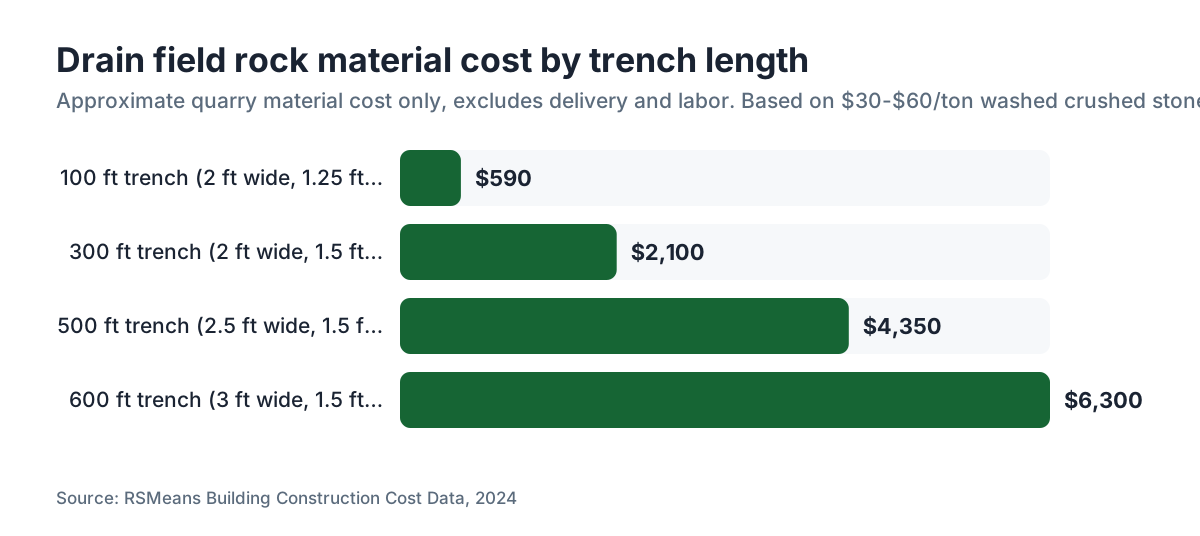
It depends on trench length, trench width, and gravel depth. A standard residential leach field runs 300 to 600 linear feet of trench, each trench 2 to 3 feet wide, with 12 to 18 inches of gravel below the pipe plus cover above.
Here's a rough calc for one 100-foot trench, 2 feet wide, with 18 inches of gravel:
100 ft x 2 ft x 1.5 ft = 300 cubic feet, or about 11 cubic yards per 100-foot trench.
A full system with 400 feet of trench needs roughly 44 cubic yards of stone. At typical quarry prices of $30 to $60 per ton (it varies hard by region and stone type), and about 1.4 tons per cubic yard for clean crushed stone, you're looking at $1,800 to $3,700 for the material alone [8]. Delivery and placement stack on top.
That's why rock is a real line item in any new septic install. Reviewing a bid for a septic tank installation? Make sure the stone spec and quantity are spelled out. A bid that lumps everything under materials without listing gradation or cubic yards should prompt questions.
| Trench length (ft) | Trench width (ft) | Gravel depth (ft) | Cubic yards of rock | Approx. material cost |
|---|---|---|---|---|
| 100 | 2 | 1.25 | 9.3 | $400 to $780 |
| 300 | 2 | 1.5 | 33 | $1,400 to $2,800 |
| 500 | 2.5 | 1.5 | 69 | $2,900 to $5,800 |
| 600 | 3 | 1.5 | 100 | $4,200 to $8,400 |
Does the rock eventually fail or need to be replaced?
Yes, and this is the honest answer most homeowners don't get upfront. Drain field rock does not last forever, and the main enemy is biomat buildup.
Over time, the layer right below the distribution pipe gets colonized by anaerobic bacteria that form the biomat. Normal and desirable, up to a point. But if the septic tank isn't pumped on schedule, extra solids pass into the field and speed up biomat growth until it seals the gravel-to-soil interface completely. At that point effluent has nowhere to go and it backs up.
The gravel itself can compact or migrate. Vehicles driven over the field crush the aggregate and kill void space. Tree roots invade the trench and shove rock aside. In iron-rich soil, iron ochre (a rust-colored gelatinous precipitate) forms in the gravel and plugs the drainage paths.
The signs a gravel layer has failed: wet spots or sewage odors over the field, slow drains throughout the house, or effluent surfacing after rain [9]. By the time you see them, the gravel is usually compromised enough that the field needs either resting and rehab or full replacement.
Rehab options include hydro-jetting the distribution lines, applying biological additives (mixed evidence on whether they do anything), or pulling the distribution pipe and raking the gravel to break up the biomat crust. None of these is a guaranteed fix. Sometimes you can replace the gravel and pipe in the original trenches. Other times the soil is too saturated and you need a new field location. See septic system repair for what those options cost.
The best protection against early gravel failure is pumping the tank on schedule. EPA recommends every 3 to 5 years for most households [1]. Not sure where you stand? Check how often to pump your septic tank based on your tank size and household size.
What goes on top of the rock layer: geotextile fabric, straw, or nothing?
Once the pipe is laid and the rock is in place, something has to separate the gravel from the soil backfill above it. Skip the barrier and fine soil particles wash down into the void space during rain and plug the rock within a few years.
Three options show up in practice.
- Geotextile filter fabric (nonwoven). The current standard in most states. A strip of nonwoven polypropylene or polyester fabric goes over the gravel surface before backfill. It passes water while blocking soil particles. It's durable, it's cheap (roughly $0.10 to $0.20 per square foot), and it doesn't rot. Most codes specify a minimum water flow rate (permittivity) and a maximum apparent opening size (AOS) so it passes effluent but stops fine soil.
- Untreated building paper or straw. Older installs used a 1 to 2 inch layer of straw or building paper as a temporary separator, counting on it to decompose and leave a stable interface. Common practice before geotextile fabric was easy to get. It works fine in a lot of installations but it's no longer the specified standard in most places.
- Nothing. Rare in modern installs and a red flag if you see it on a plan. Some very coarse soils with low fine-particle content can tolerate it, but it's not best practice.
Getting a field replaced or rehabbed? Insisting on proper geotextile fabric over the rock is one of the few spots where a small upgrade in material pays off big in long-term performance. Ask your installer which product they're using and whether it meets your state's spec.
Are alternatives to rock (chambers, EZflow) better or just different?
For most homes on well-draining soil, geocomposite systems perform about the same as rock over a 20-to-30-year horizon. The choice comes down to site logistics and cost, not treatment quality.
Chamber systems (open-bottom arches like Infiltrator or ADS Biodiffuser) replace both the pipe and the gravel. Effluent drips off the chamber walls straight into the soil. They give a larger effective infiltration area per linear foot than a pipe-in-gravel trench, which sometimes lets you use a shorter total trench length and cut the cost to install a septic system on a tight lot.
EZflow and similar pre-engineered products wrap synthetic aggregate (expanded polystyrene beads or recycled plastic) in a geotextile sock with the pipe already inside. They install like a giant sausage link. They weigh less than rock (a big deal on sites with bad vehicle access) and the grading is factory-controlled, so you don't have to worry about a quarry sending off-spec material.
The University of Minnesota Extension has published research comparing rock and chambered systems in cold climates and found no statistically significant difference in long-term hydraulic performance under normal loading [10]. The caveat is normal loading. If the septic tank is neglected and solids carry over, a chamberless rock system gives more surface area for biological treatment before it fails completely. That's a marginal difference and not a reason to pick rock over chambers if chambers otherwise make sense for the site.
Where rock genuinely wins: sloped terrain, where the weight of the rock helps keep the trench stable, and very cold climates, where the thermal mass of stone moderates soil freezing around the pipe. Where chambers win: remote lots where trucking gravel gets expensive, and expansive soils where the rigid pipe-in-gravel arrangement can shift.
What do state and EPA codes actually say about drain field rock?
Federal guidance comes mostly from EPA's Design Manual for Onsite Wastewater Treatment and Disposal Systems (1980, still the baseline most state codes derive from) and the SepticSmart materials [1][5]. EPA itself doesn't set prescriptive aggregate size in most cases, because onsite wastewater regulation sits with the states. What EPA specifies at the program level is performance: the system has to protect groundwater and public health.
At the state level the requirements get explicit. A few examples:
- North Carolina's 15A NCAC 18E requires 1/2 to 2.5 inch washed stone, minimum 6 inches below the pipe, with a geotextile or 2-inch straw cover [4].
- Florida's Chapter 64E-6, Florida Administrative Code, specifies 3/4 to 2.5 inch clean washed shell or stone, minimum 6 inches below the distribution pipe [11].
- California's county codes vary, but most adopt the California Plumbing Code guidelines, which specify 3/4 to 2.5 inch washed gravel.
The takeaway for homeowners: look up your state's onsite wastewater code before you accept any bid. Most states publish these on their department of environmental quality or department of health website. If a bid doesn't mention stone size or depth, ask. If an installer tells you stone spec doesn't matter, that's wrong.
EPA's SepticSmart guidance puts it plainly: "Properly designed, installed, and maintained onsite wastewater treatment systems protect your investment and the environment" [1]. That phrase, properly designed and installed, is doing a lot of work. Aggregate spec is part of design. Depth is part of installation. Both matter.
Operators running multiple installation projects should track material specs across jobs. That's exactly the documentation that prevents liability later. Tools like SepticMind's operations software let crews attach material certs and inspection photos to individual job records, which matters when a state inspector asks for proof of spec compliance six months after install.
How do you inspect drain field rock without digging everything up?
You mostly can't do a thorough rock inspection without at least partial excavation, which is why drain field inspections are functional and visual rather than material-specific. A licensed inspector assessing a system for a real estate sale checks for wet spots, odors, surface breakout, and drain rate, but won't typically verify that the gravel below is 1.5-inch versus pea gravel [12].
What you can do without digging:
- Pull the distribution box lid (or the clean-out cap at the head of the trench) and check whether water is standing above the pipe inlet. Standing water means the rock bed is saturated, which can point to biomat occlusion or a high water table event.
- Camera the distribution lines. A drain snake camera pushed through the clean-out shows whether the pipe perforations are open or whether roots or debris have gotten into the trench.
- Dye testing. A licensed inspector introduces a non-toxic tracer dye at the tank outlet and watches for it to surface over the field. Dye appearing at the surface within hours means infiltration through the rock and soil has failed.
- Soil probe sampling. A tile probe or soil sampling tube pushed into the field area lets you feel for resistance changes and pull a small core. Hit gravel at the expected depth and find it loose and well-structured, and the bed is probably intact. If the probe slides through with no resistance, the void space may be gone.
For a septic tank inspection at the time of a home purchase, ask specifically whether the inspector evaluates field performance or only tank condition. Many home inspectors only open the tank. A full system inspection from a licensed sanitarian or septic engineer is a different, more expensive scope.
Suspect the rock bed has failed and weighing repair versus replacement? Pay for a partial excavation at the head of the field. It costs a few hundred dollars and gives you a real answer instead of a guess. See septic system repair and leach field for what rehabilitation realistically costs.
What does drain field rock cost, and where do common mistakes happen in the bid?
Clean washed crushed stone runs $30 to $60 per ton at the quarry gate, depending on region and stone type. Delivery adds $50 to $200 depending on haul distance. Figure 1.2 to 1.5 tons per cubic yard.
For a 400-linear-foot field with standard 2-foot-wide trenches and 18 inches of gravel, budget $2,500 to $5,000 for material and delivery alone. Placement (machine time to fill trenches and hand-rake to grade) adds labor that's usually bundled into the overall installation quote.
Here's where bids go wrong.
Crusher run substitution. Crusher run (also called road base) is far cheaper than washed crushed stone, sometimes 40 to 50 percent cheaper. Some installers spec washed stone and deliver crusher run. The fines in crusher run migrate into the biomat and cut field life hard. Ask for a delivery ticket and a quarry gradation cert.
Short depth. An installer who puts 6 inches of gravel below the pipe instead of 12 saves material cost but cuts effective treatment depth. You won't know until the field fails early.
Oversized rock to reduce quantity. A 3-inch stone fills the same volume with fewer pieces, so if an installer is cutting corners on cubic yards, oversized stone can make a thin layer look adequate to an untrained eye.
No geotextile. Skipping the fabric saves maybe $100 on a full system. The payoff in field longevity is large against that savings.
The cost to put in a septic tank and cost to install a septic system articles cover the full picture of what you should pay and how to read a bid. The rock spec sits inside that larger cost, but it's worth pulling out and verifying on its own.
For septic service operators running installs, SepticMind's job documentation lets you attach material delivery tickets directly to installation records, which protects you if a homeowner later claims the field went in below spec.
How does the rock layer interact with the biomat and long-term field performance?
The relationship between drain field rock and the biomat is the core of how a leach field treats wastewater. Understanding it explains why maintenance decisions matter, and why some systems last 40 years while others fail at 10.
Effluent leaving the distribution pipe is not clean water. It carries suspended solids, pathogens, nutrients, and biological oxygen demand. The rock layer creates a transition zone where that effluent slows down, spreads out, and starts biological treatment before it reaches native soil. The bottom surface of the gravel bed, where it meets native soil, is where the biomat forms.
The biomat is a dense, mostly anaerobic microbial community. Its job is to eat organic matter and partially treat the effluent. A thin, healthy biomat slows the passage of effluent just enough to promote treatment without blocking flow. EPA's SepticSmart materials note that "a healthy septic system has a working biomat that helps treat the effluent before it enters the soil" [1].
Problems start when the biomat thickens past the rock's ability to pass effluent. That happens in three ways: solids carryover from an overfull or damaged septic tank, hydraulic overload (more water per day than the field was designed for), or gravel installed without enough depth below the pipe (which limits the biomat's surface area, so it concentrates in a thin zone and occludes faster).
Once the biomat seals the gravel-to-soil interface, no amount of biological additive or bacterial inoculant reopens it quickly. Resting the field (taking it offline for 6 to 12 months while an alternate field or dosing system carries the load) sometimes allows partial biomat decomposition in aerobic conditions. But the gravel itself has to be able to drain for resting to work, and if the soil below the gravel is also saturated, resting won't help.
The practical lesson: gravel depth is not negotiable. Twelve inches below the pipe is the spec for a reason. And pumping the tank on schedule (roughly every 3 to 5 years for a 1,000-gallon tank serving a 3-bedroom house) is the single maintenance act most likely to keep that gravel layer working for 20 to 30 years. Don't wait for wet spots. Check how often to pump your septic tank to see what schedule fits your household.
Frequently asked questions
Can I use pea gravel in a drain field instead of standard crushed stone?
In most states, no. Pea gravel (3/8 inch and smaller) is too fine. It compacts under trench backfill and reduces the void space the field needs to distribute and percolate effluent. Standard codes call for 3/4-inch to 2.5-inch washed stone. A few state codes allow 1/2-inch as a minimum, but pea gravel below that is nearly universally prohibited in onsite wastewater regulations.
How do I know if a drain field has enough gravel depth without excavating?
You mostly can't confirm it without digging. A soil probe gives a rough indication of where the gravel layer starts and ends, and a camera inspection of the distribution pipes shows whether perforations are open. For a home purchase, a full functional evaluation by a licensed sanitarian beats visual inspection alone. If you need certainty, a test pit at the head of the field is the most direct answer.
Does adding septic tank additives help if the drain field rock is clogged?
The evidence is weak. EPA has reviewed bacterial and enzyme additives and found no consistent data showing they restore a clogged leach field. Some products may modestly reduce solids in the tank, which indirectly slows biomat buildup, but once the gravel-to-soil interface is sealed, no additive reliably reopens it. Resting the field, fixing the tank, and sometimes physical rehabilitation are the interventions that work.
What happens if you drive over a drain field with a vehicle?
Compaction is the main damage. Heavy vehicles crush the void space in the gravel layer, reduce hydraulic conductivity, and can crack the distribution pipe. Even repeated parking of passenger vehicles causes gradual compaction. Most state codes prohibit parking or construction over drain fields. If you've driven over yours, have an installer probe the field for pipe damage or settlement before assuming the worst.
How long does drain field rock last before the system needs to be replaced?
With proper tank maintenance (pumping every 3 to 5 years) and no hydraulic overload or vehicle damage, a properly installed gravel leach field lasts 25 to 40 years. Fields that get excessive solids carryover, are undersized, or went in with inferior gravel often fail in 10 to 15 years. There's no fixed expiration date. Condition depends heavily on maintenance history.
Is recycled crushed concrete acceptable as drain field rock?
It depends entirely on your state code. Some states allow it if it meets gradation standards and passes wash requirements to reduce alkalinity. Others prohibit it outright. Fresh crushed concrete can have a high pH that stresses the biological community in the biomat. If an installer proposes it, ask for the specific code section permitting it and a wash certificate showing pH is within the acceptable range for your jurisdiction.
How much does it cost to replace the gravel in a drain field?
Replacing the gravel in an existing field, including excavation, new stone, new pipe, and geotextile fabric, typically runs $3,000 to $10,000 for a standard residential system, depending on field size, site access, and regional labor rates. If the native soil below the field is also saturated or failed, you may need to relocate the field entirely, which pushes cost higher and often requires a new perc test and permit.
Do chamber systems eliminate the need for drain field rock entirely?
Yes. Open-bottom chamber systems (Infiltrator, ADS Biodiffuser, and similar) replace both the perforated pipe and the gravel with a hollow arch that sits directly on native soil. Effluent drips from the chamber walls into the soil. Most state codes now accept them as equivalent to rock-trench systems, and they can reduce installation cost where hauling gravel is expensive. They're not superior in all conditions but they're a legitimate alternative.
What does the geotextile fabric on top of the gravel actually do?
It keeps soil particles from washing down into the gravel void space during rain and over time. Without a separator, fine soil migrates into the rock layer and cuts hydraulic conductivity within a few years. Nonwoven geotextile fabric passes water but blocks fine particles. It's cheap (roughly $0.10 to $0.20 per square foot) against the protection it gives, and it's now the standard specified in most state onsite wastewater codes.
Can tree roots damage the drain field rock layer?
Yes. Tree and shrub roots chase the moisture and nutrients in the gravel bed. Over time they displace rock, crack or crush distribution pipe, and cut channels that bypass the treatment zone. Willow, poplar, and elm are the most aggressive offenders. State codes typically require a setback of 10 to 50 feet between drain fields and trees. If roots are already present, hydro-jetting clears the pipe, but the root system stays and re-invades.
What's the difference between drain field rock and the stone used in septic tank leach lines?
They're the same thing. Drain field rock, leach rock, septic gravel, and trench stone all refer to the washed, graded aggregate placed in leach trenches around the distribution pipe. The terminology shifts by region and installer preference, but it describes one material with one job: creating the void space that lets effluent distribute and percolate.
How do I verify that the stone delivered to my install site is the right spec?
Ask for the quarry's gradation report, a standard document showing what percentage of the material passes each sieve size. It should show no more than a few percent passing the No. 4 sieve and essentially zero passing the No. 200 sieve (fines). Do a field wash test: shake a handful in water and look for turbidity. Ask for a delivery ticket showing the product name and quarry source, and cross-check that name against the spec in your state code.
Sources
- U.S. EPA, SepticSmart program: EPA recommends pumping every 3 to 5 years and describes biomat as part of normal system operation
- U.S. EPA, Onsite Wastewater Treatment Systems Manual (EPA/625/R-00/008): Standard industry aggregate size for drain field trenches is 3/4-inch to 2.5-inch clean washed crushed stone or gravel
- ASTM International, ASTM C33 Standard Specification for Concrete Aggregates: ASTM C33 gradation numbers 3 and 4 define acceptable coarse aggregate size ranges commonly cited in state septic codes
- U.S. EPA, Design Manual for Onsite Wastewater Treatment and Disposal Systems (EPA-600/2-78-173): EPA design manual calls for minimum 12 inches of gravel below distribution pipe and 2 inches above before backfill
- U.S. EPA, Sustainable Management of Construction and Demolition Materials: Recycled concrete aggregate is permitted in some jurisdictions for drainage applications when it meets gradation and wash standards
- Infiltrator Water Technologies, product and regulatory documentation: Geosynthetic chamber and EZflow products are code-approved alternatives to rock-trench systems in most U.S. states
- RSMeans Building Construction Cost Data, 2024 edition: Clean washed crushed stone prices range $30 to $60 per ton at quarry gate depending on region and stone type
- U.S. EPA, SepticSmart: Signs of a Failing Septic System: Signs of drain field failure include wet spots, sewage odors over the field, and slow drains inside the home
- University of Minnesota Extension, Onsite Sewage Treatment Program: Research comparing rock and chambered systems in cold climates found no statistically significant difference in long-term hydraulic performance under normal loading
- Florida Department of Health, Chapter 64E-6 Florida Administrative Code, Onsite Sewage Treatment and Disposal Systems: Florida requires 3/4 to 2.5-inch clean washed shell or stone with minimum 6 inches of aggregate below distribution pipe
- National Environmental Services Center, West Virginia University: Drain field inspections during real estate transactions are typically functional and visual; they do not verify aggregate gradation without excavation
Last updated 2026-07-09