Do it yourself septic system: what you can and can't legally do
By the SepticMind Editorial Team
TL;DR
- Most states bar homeowners from installing a full septic system without a licensed contractor, but about half allow owner-builders to do the work on their own property with a permit.
- Legal DIY covers maintenance, inspections, and minor repairs.
- Full installation needs soil testing, engineering, permits, and often licensed labor.
- Expect $3,000 to $15,000 in materials alone even if you dig the trenches yourself.
Can a homeowner legally install their own septic system?
It depends on your state, sometimes your county, and whether you're building new or repairing what's already in the ground.
About half of U.S. states have owner-builder exemptions. Those let a homeowner install a septic system on their own primary residence without a licensed contractor, as long as they pull the right permits and pass every required inspection. The other half require a licensed installer for any new system, no exceptions. Some states split it down the middle: you can do the digging yourself, but a licensed professional has to design the system, watch the installation, and sign off on it [1].
This matters more than most people realize. Installing without permits in a state that requires them can bring fines, a mandatory removal order, and real liability if the system fails and contaminates a neighbor's well or a nearby stream. The EPA has said for years that failing septic systems are one of the most common sources of groundwater contamination in the country [2].
Before you buy a single fitting, call your local health department or environmental permitting office. Ask two questions. Does my county allow owner-installed septic systems? And what does the permit process require? That call is free, and it saves you from mistakes that run into the thousands.
If your state allows owner installation, the permit process usually runs like this: a site evaluation, a soil percolation test (or a soil morphology evaluation by a licensed soil scientist), a system design approved by the health department, inspections at each stage of construction, and a final approval before you flush anything into it. None of that is optional.
What states allow owner-builder septic installation?
There's no clean federal list, and state rules shift, so treat any list you find online as a starting point to verify, not gospel. States with historically permissive owner-builder rules include Texas, Tennessee, Missouri, Arkansas, and a number of rural Midwest and Mountain West states. States that lean strict on licensed-contractor requirements include California, Florida, Massachusetts, and New York [3].
Texas lets a homeowner install their own system on property they own if it serves a single-family residence and the homeowner gets all required permits from the county or the Texas Commission on Environmental Quality (TCEQ) [3]. Tennessee has similar provisions running through its county health departments.
Even in permissive states, counties pile on their own rules. A Texas county with a groundwater protection ordinance may demand a licensed installer no matter what state law allows. Check at the county level after you check at the state level.
The patchwork is the trap for anyone researching this online. You'll find a forum post from 2014 saying "I built my own system in [State], no problem," and that state may have tightened its rules three times since. Call the authority having jurisdiction directly. For most systems, that's your county sanitarian or environmental health department.
What soil testing and site evaluation do you actually need?
You cannot skip this. The soil decides what kind of system you can build, where it goes, and how big it has to be. Soil that drains too fast (gravel or coarse sand) won't treat effluent before it hits groundwater. Soil that drains too slow (clay) backs up and fails. There's a narrow band of soil where a conventional gravity drain field works well [8].
Two main methods do the evaluation: the perc test and soil morphology evaluation.
A perc test measures how fast water moves through soil in a test hole. Results come in minutes per inch (MPI). Most conventional drain fields need soil that absorbs water somewhere between 1 and 60 MPI, though the acceptable range changes by state code [8]. A result slower than 60 MPI in many jurisdictions pushes you into an alternative system, which costs a lot more.
Soil morphology evaluation is more accurate and more states now require it. A licensed soil scientist reads the soil profile for texture, structure, and seasonal high water table based on soil color and mottling, without running water through it. This catches seasonal flooding that a perc test done in a dry August would miss completely.
In most states, even on an owner-builder job, the soil evaluation has to be done by or reviewed by a licensed professional. In Texas, a licensed site evaluator conducts the assessment [3]. Plan to pay $300 to $800 for a perc test, or $500 to $1,500 for a full soil morphology evaluation, depending on your region.
What does a DIY septic system actually cost?
This is where people underestimate, badly. The physical labor is real work, but it's a slice of the total. Materials, permits, engineering, and inspections stack up fast.
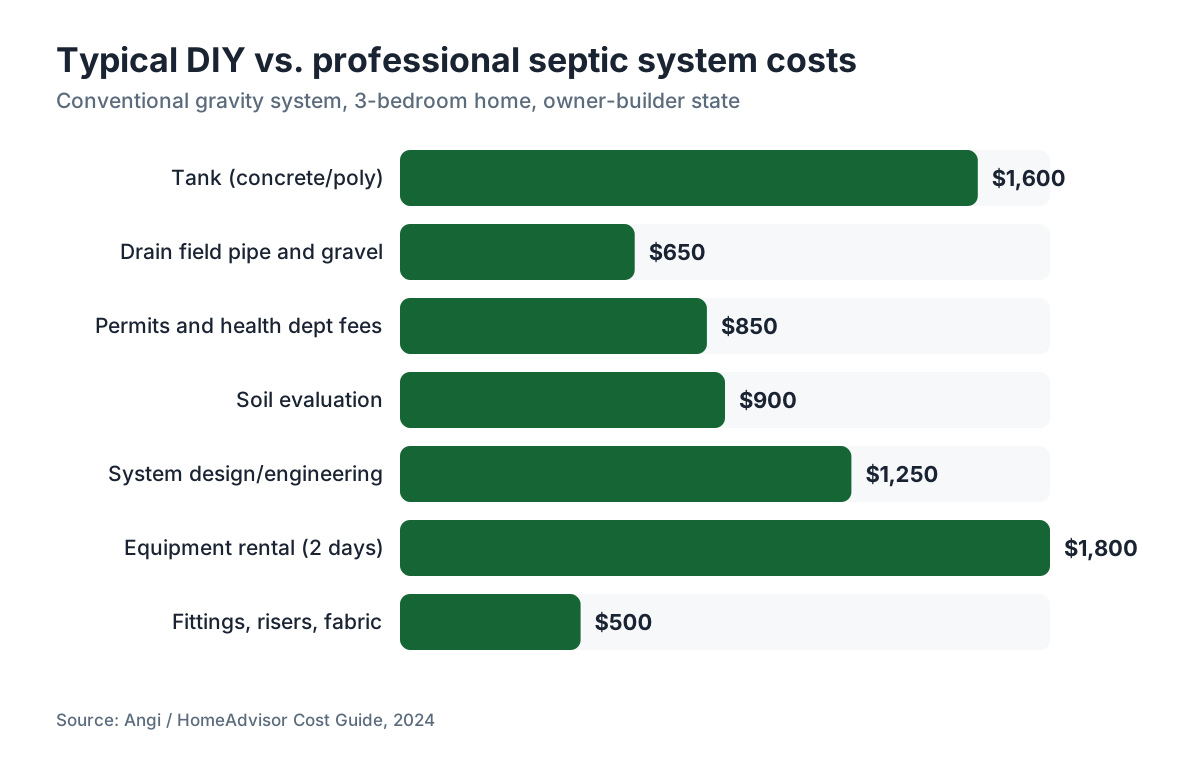
For a conventional gravity-fed system serving a 3-bedroom home, a realistic material-only budget looks like this:
| Component | Estimated Cost |
|---|---|
| Concrete or poly septic tank (1,000-1,500 gal) | $700 - $2,500 |
| Distribution box or manifold | $50 - $200 |
| Drain field pipe and aggregate (per 100 linear feet) | $300 - $600 |
| Geotextile fabric | $100 - $300 |
| Inlet/outlet fittings and risers | $100 - $400 |
| Permits and health department fees | $200 - $1,500 |
| Soil evaluation (required) | $300 - $1,500 |
| System design (if required) | $500 - $2,000 |
| Equipment rental (excavator, trench digger) | $400 - $1,500/day |
Add it up and you're at $2,750 to $10,500 before you touch a shovel. A typical professional installation for a conventional system runs $5,000 to $15,000 total [5]. So the DIY savings are real, but smaller than people expect, and they come with risk you're taking on personally.
Alternative systems cost far more. A mound system adds $5,000 to $15,000 in materials alone because of the engineered sand fill it needs [5]. Aerobic units and drip systems climb higher.
Our full breakdown of cost to install septic system and cost to put in a septic tank covers how these numbers move by region and system type.
How do you design a conventional septic system?
A conventional septic system has four parts: the pipe from the house, the septic tank, a distribution system, and the drain field (also called a leach field or absorption field). Simple on paper. Unforgiving in the dirt.
Tank size comes from the number of bedrooms in the home, not the number of people living there, because codes use bedrooms as a proxy for peak flow. Most states require at least 1,000 gallons for a 1-3 bedroom home and 1,250 gallons for a 4-bedroom home, but check your local code [1]. The tank has to be watertight, carry inlet and outlet baffles, and stay accessible for pumping.
Drain field size comes from your perc rate and daily flow estimate. The common formula: daily design flow (gallons per day) divided by the application rate (gallons per square foot per day, pulled from your perc result) gives the required drain field area in square feet. For a 3-bedroom home at a perc rate of 30 MPI, a typical calculation lands around 600 to 900 square feet of field [8].
Setbacks are non-negotiable. Every state sets minimum distances from the drain field to wells, property lines, buildings, surface water, and slope breaks. A typical minimum is 50 to 100 feet from a potable well to the drain field, and 10 feet from a property line, but these swing widely [10]. If your lot can't hold the required setbacks, you may not be able to install a conventional system at all.
For a closer look at how the drain field works and what kills it, see our leach field guide.
What equipment do you need to install a septic system yourself?
More than most people own. That's the honest starting point.
You need an excavator or backhoe to dig the tank hole (typically 6-8 feet deep) and the drain field trenches. A mini-excavator rents for $400 to $700 per day, a full-size backhoe for $800 to $1,500 per day depending on region. A concrete tank weighs 5,000 to 8,000 pounds, so you either need lifting equipment on site or you order a lighter poly tank.
Trenching for the drain field has to hold uniform grade. The pipes slope at 1/8 to 1/4 inch per foot, and over a 100-foot run, being off by half an inch pools effluent in the low spots. A laser level ($30 to $60 per day rental) is the right tool here, not a torpedo level and good intentions.
Round out the list with a transit or laser level for pipe grades, a plate compactor for backfill, pipe cutters, and basic plumbing tools for the connections. Some areas require a pressure test on the tank before burial, which means renting a pump.
Renting gear you've never run? Budget time to learn it. Digging near a house foundation with a backhoe for the first time is genuinely dangerous. Rental yards often give a short orientation. Ask for it, and take it.
What can go wrong with a DIY septic installation?
Plenty. The consequences run from expensive to hazardous.
Improper grading is the most common error in amateur drain field work. If the distribution pipes aren't level, or the trenches lose consistent grade, effluent pools in the low spots instead of spreading across the field. One section takes the whole load, the rest sits dry, and the overloaded stretch fails early. The field was never really running at design capacity.
Too little depth above the seasonal high water table is the next frequent mistake. The bottom of the drain field trench needs a minimum clearance above that water table, usually 2 to 4 feet depending on state code. Measure the water table in August, build 18 inches above it, and March will teach you why that number exists.
Bad tank placement creates access problems you'll pay for every few years. A tank buried under a driveway, patio, or dense tree roots is expensive to pump and worse to repair. Every tank needs at minimum a 24-inch-diameter riser to grade for access [2].
Skipping required inspections can mean you tear out what you built. Health departments inspect open trenches before backfill in most jurisdictions. Backfill before inspection and an inspector can order you to dig it all back up. This bites homeowners who feel schedule pressure and rush to finish.
For what happens when a system does fail, see our guides on septic system repair and septic tank repair.
What septic work can homeowners legally do without a permit or contractor?
Maintenance is the homeowner's territory, and it's the work that actually keeps a system alive.
Pumping the tank is not on the list. That requires a licensed pumper with a vacuum truck in every state. But you can pump out on schedule every 3 to 5 years (the EPA recommends 3 to 5 years as a general guideline, with actual frequency tied to tank size and household size) [2], find your tank, keep records, and make sure the licensed pumper does the job right. See how often to pump septic tank for a detailed schedule.
Inspection basics are fair game. You can check tank lids, look for wet spots over the drain field, watch for slow drains, and note odors. Open a riser, shine a flashlight, and read the scum and sludge layers. A full septic tank inspection by a licensed inspector is a different animal and usually required for a home sale.
Minor plumbing repairs inside the house (swapping an inlet pipe fitting, installing an effluent filter on the outlet baffle) sit within homeowner scope in most states and need no permit. Effluent filters are cheap ($30 to $150) and cut solids reaching the drain field sharply. Cleaning them once a year is dead-simple maintenance you can absolutely do.
Adding risers to bring tank access up to grade is often homeowner-allowable. So is adding inspection ports to a drain field, which are just PVC standpipes that let you watch field conditions.
For septic tank cleaning timing and what to expect, see that dedicated guide.
SepticMind's maintenance tracking tools log pump-out dates, inspection notes, and system records in one place, which earns its keep if you're running an older system or have tenants.
Are alternative septic systems harder to DIY than conventional systems?
Yes. By a wide margin.
Conventional gravity systems are mechanically plain: a tank, some pipe, gravel-filled trenches. That's the friendliest scenario for an owner-builder. Alternative systems exist because the site has conditions (too-tight soil, high water table, small lot, sensitive water nearby) that a conventional system can't handle, and those same conditions make the install harder.
Mound systems require importing and grading engineered sand fill in specific layers, with precise slopes and dimensions. The fill spec matters. Use the wrong sand or gravel and the system doesn't work, even when it looks right on top.
Aerobic treatment units (ATUs) carry mechanical guts: aerators, pumps, timers, and in some states spray heads or drip emitters for dispersal. Many states require an annual maintenance contract with a licensed service provider. The EPA notes that ATUs "require more maintenance than conventional septic systems" [2]. An owner-builder ATU install is possible in some jurisdictions, but running one means ongoing licensed maintenance regardless of who buried it.
Drip irrigation dispersal systems need pressure-dosed pump chambers, filtration, and precision-engineered tubing. These sit firmly in engineer-and-contractor territory for most homeowners.
If your site evaluation comes back saying you need an alternative system, the honest advice is to hire it out. The complexity and the inspection requirements make a successful DIY unlikely, and the cost of failure is steep.
How do you get a septic permit and what does the process look like?
The permit process is where most DIY septic projects either come together or fall apart. Here's what a typical run looks like, though the details shift by jurisdiction.
Step 1: Contact your county health department or local permitting authority. Ask for their onsite wastewater treatment system (OWTS) or individual sewage disposal system (ISDS) permit application. Many counties have this online now.
Step 2: Hire a licensed soil scientist or site evaluator to run a site evaluation and soil test. That produces a written report with your soil data, which rides along with the permit application.
Step 3: Submit the permit application with a site plan showing the proposed system location, all setbacks, property boundaries, and the house. In many counties, a licensed designer or engineer has to stamp the design drawings.
Step 4: Pay fees. Permit fees run from $200 in rural counties to over $1,500 in some California counties [1].
Step 5: Receive permit approval with any conditions attached, which may include a list of required inspection stages.
Step 6: Install the system. Keep the permit on site during construction. Call for the required inspections (usually tank installation, open trench before backfill, and final).
Step 7: Receive final approval and certificate of completion. File it with your property records.
The timeline from application to approval usually runs 2 to 8 weeks depending on county workload and whether your application needs revisions [1].
For what a professional installation includes, the septic tank installation guide covers the contractor side of this in detail.
Is it worth doing a septic system yourself, or should you hire a pro?
Honest answer: for most people the math doesn't work out as well as they hope, and the risk is real money.
If you're an experienced construction laborer or a contractor yourself, in a state with a clear owner-builder exemption, on a site with favorable conditions for a simple conventional system, then doing the physical work yourself (with professional soil evaluation and design) might save you $3,000 to $6,000. That's meaningful.
If you're a homeowner with little heavy-equipment experience, a complicated site, or a state that requires licensed installers, the savings evaporate. You'll spend on equipment rental, make at least one expensive mistake, and grind through a permit process that a contractor handles in weeks.
The middle path works for a lot of owner-builders. Hire a licensed designer for the soil evaluation and system design (this protects you legally and gets you a system that passes inspection), pull the permit yourself, rent the equipment, and do the excavation and installation labor. You save on labor, often 30 to 50 percent of a contractor's bill, without gambling on design errors you'd never catch on your own.
Nobody has clean aggregate data on DIY septic failure rates specifically. The overall septic failure rate is estimated at 10 to 20 percent of the roughly 21 million U.S. onsite systems at any given time [9], and installation errors rank among the leading causes of premature failure. That's the bet you're placing.
If you're managing an existing system rather than installing new, the SepticMind platform tracks maintenance schedules, pump-out history, and inspection records in one place, whether you're doing the work yourself or coordinating with service providers.
What does federal and state law actually say about DIY septic systems?
At the federal level, the EPA does not directly regulate septic system installation. The Clean Water Act hands states and localities the authority to regulate onsite wastewater systems [6]. The EPA's role is guidance, technical assistance, and oversight of state programs, not direct permitting. Its SepticSmart program lays out best practices but carries no regulatory authority over installation.
Authority flows down to local health departments in most states. The applicable rules live in the state's administrative code under titles like "individual sewage disposal systems," "onsite wastewater treatment systems," or "private sewage disposal." Those rules spell out who can install, which designs are approved, what setbacks apply, and which inspections are required.
A couple of real examples. The Texas Health and Safety Code, Chapter 366, gives counties the authority to regulate on-site sewage facilities, and TCEQ rules under 30 TAC Chapter 285 govern the construction requirements [11]. Tennessee's rules sit at Chapter 0400-48-01 under the Department of Environment and Conservation.
The practical consequence: a septic system installed without required permits is typically not recognized by the health department, can't be approved for a home sale, may trigger fines, and can be ordered decommissioned and replaced at your expense. In some states, selling a home with an unpermitted septic system is a real estate disclosure violation.
EPA guidance states that "more than one in five U.S. households" depends on onsite wastewater treatment, and that proper installation and maintenance are the main safeguards against groundwater contamination [2].
Frequently asked questions
Can I install my own septic system without a license?
It depends on your state. About half of U.S. states have owner-builder exemptions that let homeowners install a system on their own primary residence with a permit. The other half require a licensed contractor. Even in owner-builder states, soil evaluation and system design usually have to involve licensed professionals. Call your county health department first to get the correct answer for your location.
How much does a DIY septic system cost in materials alone?
For a conventional gravity system serving a 3-bedroom home, expect $2,750 to $10,500 across materials, permits, soil evaluation, system design, and equipment rental combined. The tank runs $700 to $2,500, drain field pipe and gravel add $400 to $900, and permits plus professional fees add $1,000 to $5,000. Full professional installation for a comparable system typically costs $5,000 to $15,000.
Do you need a permit to install a septic system yourself?
Yes, in every U.S. jurisdiction. Even states with owner-builder exemptions require a permit, soil evaluation, design approval, and inspections at each installation stage. Installing without a permit risks fines, a mandatory removal order, and complications when you sell your home. There is no legal path to a permitted septic system that skips the permit process itself.
What is a perc test and do I need one for a DIY septic system?
A percolation (perc) test measures how fast water moves through your soil, in minutes per inch. It's required in most jurisdictions before any septic permit is issued. Results set the drain field size and decide whether a conventional system is even viable on your site. Most states require the test to be conducted or overseen by a licensed soil evaluator. Cost runs $300 to $800.
Can a homeowner pump their own septic tank?
No. Pumping a septic tank requires a licensed pumper operating a vacuum truck. Homeowners cannot legally pump their own tanks in any U.S. state, because of the hazardous nature of septic waste and the disposal requirements. What you can do is schedule pumping every 3 to 5 years, keep records, and maintain the access risers so the pumper's job goes smoothly.
What septic maintenance can homeowners legally do themselves?
Homeowners can inspect tank lids, check for wet spots over the drain field, clean effluent filters (a simple annual task that extends drain field life), add risers to bring tank access to grade, and monitor drain performance. Inside the house, minor plumbing repairs to the line leading to the tank are generally homeowner scope. Anything involving the tank interior, pumping, or the drain field structure typically needs a licensed professional.
How long does a DIY septic system last if installed correctly?
A properly installed and maintained conventional septic system lasts 25 to 40 years. The drain field is the limiting part. Premature failure usually traces to design errors (undersized field, wrong soil evaluation), installation mistakes (poor grading, too little depth above the water table), or neglected maintenance (tank never pumped, solids reaching the drain field). Systems pumped on schedule and not abused with harsh chemicals routinely hit 30-plus years.
What size septic tank do I need for a 3-bedroom house?
Most state codes require a minimum 1,000-gallon tank for a 3-bedroom home and 1,250 gallons for a 4-bedroom home. These minimums are based on estimated peak daily flow, not actual occupancy. Some states and counties require larger tanks regardless of bedroom count. Check your local onsite wastewater code for the specific requirement; the state health department website is usually the correct source.
Can you install a mound septic system yourself?
Technically possible in owner-builder states, but hard in practice. Mound systems require imported engineered sand fill in specified gradations, precise grading of the mound geometry, and a pump chamber with a float switch and timer. The design is typically engineer-stamped. Errors in fill spec or grade produce a system that passes visual inspection but fails within a few years. For most homeowners, mound systems are hire-it-out territory.
What setback distances does a septic system need from a well?
The minimum setback from a conventional drain field to a potable well is typically 50 to 100 feet, depending on state code. Some states require 100 feet from the tank and 150 from the drain field. The septic tank itself usually needs at least 50 feet from any well. These are minimums; more distance is always better. Your state's onsite wastewater rules set the specific distances, and your permit site plan must document compliance.
What happens if a DIY septic system fails inspection?
The inspector issues a deficiency notice describing what's wrong. Common failures include incorrect pipe grade, insufficient trench depth, setback violations, or improper tank placement. You correct the problem and call for re-inspection. If you already backfilled before the required open-trench inspection, you may have to excavate again. Repeated failures can lead to permit revocation, forcing you to restart the design and permitting process.
Is DIY septic installation worth it financially?
For someone with construction experience in an owner-builder state and a simple site, yes, potentially $3,000 to $6,000 in labor savings. For most homeowners without heavy-equipment experience or facing a complex site, the savings shrink after equipment rental and professional fees, and the risk of a costly mistake is real. The middle path: hire out design and inspection, do the excavation and installation labor yourself.
Which states allow homeowners to install their own septic systems?
States with historically permissive owner-builder exemptions include Texas, Tennessee, Missouri, Arkansas, and several rural Midwest and Mountain West states. States that generally require licensed contractors for new systems include California, Florida, Massachusetts, and New York. Rules change, and county-level restrictions can override state permissiveness. Verify directly with your county health department or state environmental agency before assuming any exemption applies to you.
What is the biggest mistake homeowners make on DIY septic installations?
Shortcutting the soil evaluation. A perc test done in the wrong season or read wrong leads to an undersized drain field or a system dropped into soil that can't handle the load. That mistake stays invisible on inspection day, then shows up as a flooded drain field within five years. Professional soil evaluation is the single expense you should not cut from a DIY septic project.
Sources
- EPA, Onsite Wastewater Treatment Systems Manual: State and local codes govern who may install septic systems, required setbacks, tank sizing by bedroom count, and permit inspection stages
- EPA SepticSmart Program: More than one in five U.S. households relies on onsite wastewater treatment; EPA recommends pumping every 3-5 years; failing septic systems are a leading source of groundwater contamination; aerobic treatment units require more maintenance than conventional septic systems
- Texas Commission on Environmental Quality, 30 TAC Chapter 285, On-Site Sewage Facilities: Texas allows owner-installation of on-site sewage facilities on owner-occupied single-family residences with required permits and a licensed site evaluator for soil assessment
- Angi, Septic System Installation Cost Guide: Conventional septic system professional installation typically costs $5,000 to $15,000; mound systems add $5,000 to $15,000 in materials for engineered fill
- U.S. EPA, Summary of the Clean Water Act: The Clean Water Act delegates authority to regulate onsite wastewater systems to states and localities; the federal government does not directly permit septic installations
- National Environmental Services Center at West Virginia University: Perc test methodology and acceptable rates for conventional drain field design; soil morphology evaluation is more accurate than perc testing for seasonal water table assessment
- EPA, Decentralized Wastewater Treatment Systems Program: Approximately 21 million U.S. homes use onsite wastewater systems; failure rates estimated at 10-20% of systems at any given time; installation error is a leading cause of premature failure
- University of Florida IFAS Extension, EDIS: Minimum setback from drain field to potable well is typically 50 to 100 feet depending on state code; tank sizing minimums by bedroom count
- Texas Health and Safety Code, Chapter 366: Texas counties have statutory authority to regulate on-site sewage facilities under Chapter 366; TCEQ rules under 30 TAC Chapter 285 govern construction requirements
Last updated 2026-07-10